S-LCG: Structured Linear Congruential Generator-Based Deterministic Algorithm for Search and Optimization
Pith reviewed 2026-05-08 16:49 UTC · model grok-4.3
The pith
S-LCG is a deterministic optimization algorithm that uses a structured linear congruential generator in a two-level architecture to reach near-global optima on most benchmark problems with only one tunable parameter.
A machine-rendered reading of the paper's core claim, the machinery that carries it, and where it could break.
Core claim
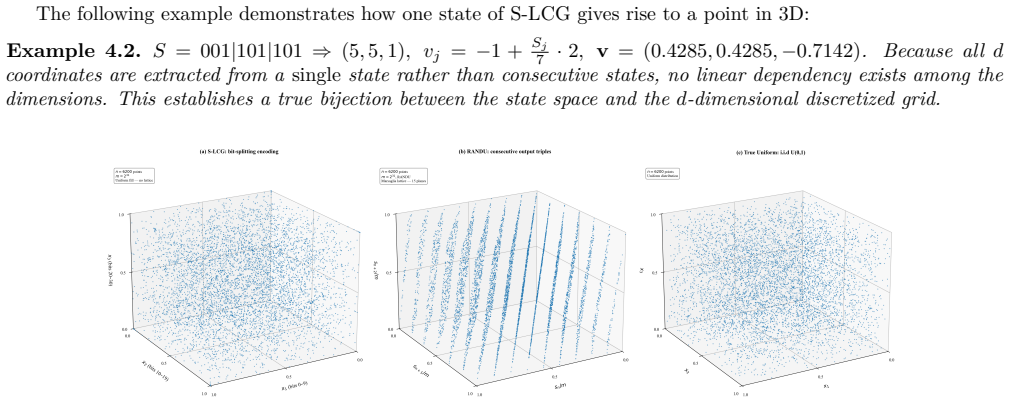
The Structured Linear Congruential Generator follows a two-level architecture in which an external adaptive loop balances exploration and exploitation of the generator space while the internal loop evaluates solutions; its defining traits are a memoryless scheme that produces non-overlapping sequences from distinct seeds, a bit-splitting representation that converts generator states into multi-dimensional points to avoid lattice artifacts, adaptive exploration-exploitation that implicitly optimizes the objective, and constant information-gathering speed that prevents premature convergence, yielding a strictly reproducible framework controlled by a single sensitive parameter.
What carries the argument
The S-LCG two-level architecture that combines an adaptive outer loop for exploration-exploitation balance with bit splitting of generator states to produce non-redundant multi-dimensional search points.
If this is right
- S-LCG reaches within 1 percent of the global optimum in 83.3 percent of 138 cases across 26 functions and dimensions 2 to 30.
- The method statistically outperforms eight binary optimization algorithms including genetic algorithms.
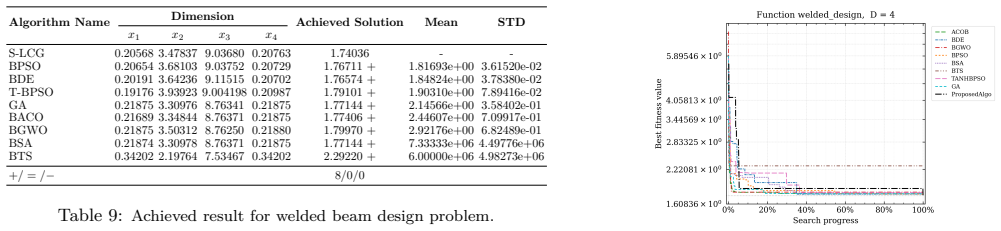
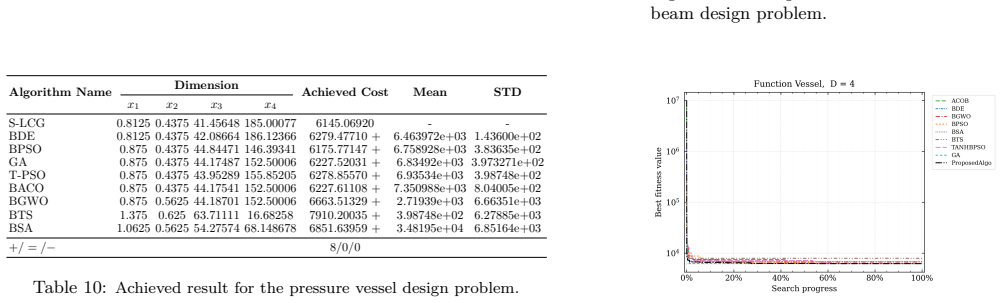
- S-LCG successfully solves three constrained engineering design problems.
- All runs are strictly reproducible because the generator is deterministic and only one parameter requires tuning.
Where Pith is reading between the lines
- The memoryless non-overlapping property could allow S-LCG to be distributed across independent processors without duplicate evaluations.
- Because the algorithm gathers information at constant speed, it may remain effective on problems where other methods slow down as dimension grows beyond 30.
- The single-parameter design could simplify embedding S-LCG inside larger hybrid solvers that combine deterministic and stochastic steps.
- If the bit-splitting step generalizes, similar mappings might improve other pseudo-random generators used for optimization.
Load-bearing premise
The bit-splitting representation and adaptive exploration-exploitation loop actually produce implicit optimization of the objective function and avoid premature convergence without post-hoc adjustments or hidden parameters beyond the single stated one.
What would settle it
Running S-LCG on a fresh collection of 30-dimensional benchmark functions with the single parameter held fixed and recording whether the fraction of cases reaching within 1 percent of the global optimum falls below 70 percent or whether any evaluation sequences from distinct seeds overlap.
Figures




read the original abstract
This study presents a novel deterministic optimization algorithm based on a special variant of the Linear Congruential Generator (LCG). While conventional algorithms generally operate within the search space, the introduced technique follows a two-level architecture. In particular, an external loop that adaptively balances between exploration and exploitation, while the internal loop evaluates solutions. It is motivated by the intrinsic structure of the generator, the reason behind naming it the Structured Linear Congruential Generator (S- LCG). which enjoys a number of unique characteristics as follows: 1) a memoryless scheme, which ensures non-overlapping sequences based on distinct seeds, thus ensuring no evaluation redundancy; 2) bit splitting representation, which converts LCG states into multi-dimensional points to overcome the Marsaglia lattice effect; 3) adaptive exploration-exploitation of the generator space, which leads to implicit optimization of the surrogate smooth objective function; and 4) constant information gathering speed to avoid the problem of premature convergence. Extensive testing on 26 benchmark functions across dimensions d = 2 to 30 demonstrates that S-LCG comes within 1% of the global optimum in 83.3% of 138 cases (100% at d = 2, 81.2% at d = 30) while the nearest competitor GA achieved 75.4%. Statistical validation shows that S-LCG outperforms eight cutting-edge binary algorithms. Furthermore, its practical value is confirmed by validation on three constrained engineering design problems. In the end, S-LCG offers an optimization framework that is strictly reproducible and requires only one sensitive parameter to be tuned.
Editorial analysis
A structured set of objections, weighed in public.
Referee Report
Summary. The manuscript introduces the Structured Linear Congruential Generator (S-LCG), a deterministic optimization algorithm employing a two-level architecture: an external adaptive loop that balances exploration and exploitation of the generator space, and an internal loop that evaluates candidate solutions. It highlights four claimed properties: memoryless non-overlapping sequences from distinct seeds, bit-splitting representation to eliminate the Marsaglia lattice effect, adaptive exploration-exploitation that implicitly optimizes a surrogate smooth objective function, and constant information-gathering speed to prevent premature convergence. The authors report that S-LCG reaches within 1% of the global optimum on 83.3% of 138 benchmark instances (26 functions, dimensions 2–30), outperforming a genetic algorithm (75.4%) and eight other binary methods, with additional validation on three constrained engineering design problems. The method is presented as strictly reproducible and requiring only a single sensitive parameter.
Significance. If the adaptive mechanism can be shown to operate with exactly one tunable parameter and to deliver the stated performance without hidden constants or post-hoc adjustments, the work would constitute a meaningful contribution by supplying a fully deterministic, reproducible alternative to stochastic global optimizers. The breadth of the benchmark suite (138 cases across dimensions) and the engineering validation provide a solid empirical foundation for assessing practical utility.
major comments (2)
- [Abstract] Abstract: the central claim that the external adaptive loop produces 'implicit optimization of the surrogate smooth objective function' while using only one sensitive parameter is not supported by any explicit rule, equation, or pseudocode. Without the precise definition of how the exploration-exploitation balance is updated (including any thresholds, scaling factors, or iteration limits), it is impossible to verify that the adaptation does not embed additional constants or create circular dependence on the objective values it is supposed to optimize.
- [Abstract] Abstract (two-level architecture description): the bit-splitting representation is asserted to remove the Marsaglia lattice effect and enable the reported performance, yet no mathematical mapping from LCG states to multi-dimensional points or proof of non-overlapping coverage is supplied. This mechanism is load-bearing for both the determinism claim and the comparison against GA; its absence prevents assessment of whether the 83.3% success rate is reproducible or relies on implementation-specific choices.
minor comments (2)
- [Abstract] Abstract: the phrasing 'S- LCG' contains an extraneous space; standardize to 'S-LCG'.
- [Abstract] Abstract: the sentence 'It is motivated by the intrinsic structure of the generator, the reason behind naming it the Structured Linear Congruential Generator (S-LCG). which enjoys' is grammatically incomplete and should be restructured for readability.
Simulated Author's Rebuttal
We thank the referee for the thorough review and constructive criticism of our manuscript. We address each major comment point by point below, providing clarifications and committing to revisions where the comments identify gaps in explicit detail or supporting mathematics.
read point-by-point responses
-
Referee: [Abstract] Abstract: the central claim that the external adaptive loop produces 'implicit optimization of the surrogate smooth objective function' while using only one sensitive parameter is not supported by any explicit rule, equation, or pseudocode. Without the precise definition of how the exploration-exploitation balance is updated (including any thresholds, scaling factors, or iteration limits), it is impossible to verify that the adaptation does not embed additional constants or create circular dependence on the objective values it is supposed to optimize.
Authors: We agree that the abstract lacks the explicit update rule and pseudocode for the adaptive loop. The full manuscript (Section 3) defines the single sensitive parameter as the adaptation rate that governs the shift between exploration and exploitation phases based solely on the generator state sequence, without direct dependence on objective function values. However, to fully support the claim of implicit surrogate optimization and strict one-parameter reproducibility, we will insert the governing equations and pseudocode into the abstract and expand Section 3 with a dedicated derivation showing the absence of hidden constants or circularity. This revision will make the mechanism verifiable from the abstract onward. revision: yes
-
Referee: [Abstract] Abstract (two-level architecture description): the bit-splitting representation is asserted to remove the Marsaglia lattice effect and enable the reported performance, yet no mathematical mapping from LCG states to multi-dimensional points or proof of non-overlapping coverage is supplied. This mechanism is load-bearing for both the determinism claim and the comparison against GA; its absence prevents assessment of whether the 83.3% success rate is reproducible or relies on implementation-specific choices.
Authors: The manuscript (Section 4) introduces bit-splitting as the conversion of LCG integer states into coordinate tuples via fixed-width bit extraction, which is intended to produce uniform coverage without lattice artifacts. We acknowledge that a formal mathematical mapping and a proof of non-overlapping sequences from distinct seeds are not provided. To address this, we will add the explicit state-to-point mapping function, together with a short proof sketch demonstrating that distinct seeds generate disjoint subsequences and that the bit-extraction step eliminates the Marsaglia lattice structure in the projected space. These additions will be placed in a new subsection and referenced from the abstract, thereby strengthening the determinism and reproducibility claims. revision: yes
Circularity Check
No circularity in derivation; algorithm properties presented as design features with external validation
full rationale
The paper introduces an algorithm via a two-level architecture and lists four characteristics (memoryless scheme, bit splitting, adaptive loop, constant speed) as intrinsic to the S-LCG generator. Performance claims rest on empirical testing against 26 benchmarks and three engineering problems, not on any closed-form derivation or prediction that reduces to fitted inputs. The adaptive exploration-exploitation is stated as a listed property leading to implicit optimization, but no equations or self-referential definitions are provided that would make the optimization tautological by construction. No self-citations, uniqueness theorems, or ansatzes are invoked in the given text to justify core claims. The single-parameter claim is presented as a design choice, with results shown to be reproducible on standard test suites.
Axiom & Free-Parameter Ledger
free parameters (1)
- one sensitive parameter
axioms (1)
- standard math Linear congruential generators produce deterministic pseudo-random sequences from a seed via linear recurrence.
invented entities (1)
-
S-LCG with bit splitting representation
no independent evidence
Reference graph
Works this paper leans on
-
[1]
K. Sörensen and F. Glover. Metaheuristics. InEncyclopedia of Operations Research and Management Science. Springer, 2013
work page 2013
-
[2]
H. R. Lourenço, O. C. Martin, and T. Stützle. Iterated local search. InHandbook of Metaheuristics, pages 321–353. Kluwer Academic Publishers, Norwell, MA, 2003
work page 2003
- [3]
-
[4]
Thomas Bartz-Beielstein, Marco Chiarandini, Luís Paquete, and Mike Preuss, editors.Experimental Methods for the Analysis of Optimization Algorithms. Springer, 2010
work page 2010
-
[5]
D. E. Knuth.The Art of Computer Programming, Volume 2: Seminumerical Algorithms. Addison–Wesley, Reading, MA, 3rd edition, 1997
work page 1997
-
[6]
Sean Luke.Essentials of Metaheuristics. Lulu, 2nd edition, 2013. Available for free at http://cs.gmu.edu/˜ sean/book/metaheuristics/
work page 2013
-
[7]
I. M. Sobol’. On the distribution of points in a cube and the approximate evaluation of integrals.USSR Computational Mathematics and Mathematical Physics, 7(4):86–112, 1967
work page 1967
-
[8]
J. H. Halton. On the efficiency of certain quasi-random sequences of points in evaluating multi-dimensional integrals. Numerische Mathematik, 2(1):84–90, 1960
work page 1960
-
[9]
D. H. Lehmer. Mathematical methods in large-scale computing units.Proceedings of the Second Symposium on Large-Scale Digital Calculating Machinery, pages 141–146, 1951
work page 1951
-
[10]
A collection of selected pseudorandom number generators with linear structures
Karl Entacher. A collection of selected pseudorandom number generators with linear structures. Technical report, Austrian Center for Parallel Computation, 2001. Extended version (Originally published 1997)
work page 2001
-
[11]
X. Yao, Y. Liu, and G. Lin. Evolutionary programming made faster.IEEE Transactions on Evolutionary Computation, 3(2):82–102, 1999
work page 1999
-
[12]
Xin-She Yang. Test problems in optimization. InEngineering Optimization: An Introduction with Metaheuristic Applications, pages 261–266. John Wiley & Sons, 2010
work page 2010
-
[13]
S. Kirkpatrick, C. D. Gelatt, and M. P. Vecchi. Optimization by simulated annealing.Science, 220(4598):671–680, 1983
work page 1983
-
[14]
V. Černý. Thermodynamical approach to the traveling salesman problem: an efficient simulation algorithm.Journal of Optimization Theory and Applications, 45(1):41–51, 1985
work page 1985
-
[15]
F. Glover. Future paths for integer programming and links to artificial intelligence.Computers & Operations Research, 13(5):533–549, 1986
work page 1986
-
[16]
N. Mladenović and P. Hansen. Variable neighborhood search.Computers & Operations Research, 24(11):1097–1100, 1997
work page 1997
-
[17]
J. H. Holland.Adaptation in Natural and Artificial Systems. University of Michigan Press, 1975. 2nd ed., MIT Press, 1992
work page 1975
-
[18]
D. E. Goldberg.Genetic Algorithms in Search, Optimization, and Machine Learning. Addison–Wesley, 1989
work page 1989
-
[19]
Mitchell.An Introduction to Genetic Algorithms
M. Mitchell.An Introduction to Genetic Algorithms. MIT Press, 1996
work page 1996
-
[20]
R. Storn and K. Price. Differential evolution—a simple and efficient heuristic for global optimization over continuous spaces.Journal of Global Optimization, 11:341–359, 1997
work page 1997
-
[21]
K. V. Price, R. M. Storn, and J. A. Lampinen.Differential Evolution: A Practical Approach to Global Optimization. Springer, 2005
work page 2005
-
[22]
L. J. Fogel, A. J. Owens, and M. J. Walsh.Artificial Intelligence through Simulated Evolution. John Wiley & Sons, 1966
work page 1966
-
[23]
D. B. Fogel.Evolutionary Computation: Toward a New Philosophy of Machine Intelligence. IEEE Press, 1995
work page 1995
-
[24]
J. Kennedy and R. C. Eberhart. Particle swarm optimization. InProc. IEEE International Conference on Neural Networks, pages 1942–1948, 1995. 20
work page 1942
-
[25]
R. Poli, J. Kennedy, and T. Blackwell. Particle swarm optimization: an overview.Swarm Intelligence, 1(1):33–57, 2007
work page 2007
- [26]
-
[27]
M. Dorigo and L. M. Gambardella. Ant colony system: A cooperative learning approach to the traveling salesman problem.IEEE Trans. Evolutionary Computation, 1(1):53–66, 1997
work page 1997
- [28]
-
[29]
R. A. Formato. Central force optimization: A new metaheuristic with applications in applied electromagnetics.Progress in Electromagnetics Research, 77:425–491, 2007
work page 2007
-
[30]
R. A. Formato. Central force optimization: a new deterministic gradient-like optimization metaheuristic.OPSEARCH, 46(1):25–51, 2009
work page 2009
-
[31]
E. Rashedi, H. Nezamabadi-Pour, and S. Saryazdi. Gsa: A gravitational search algorithm.Information Sciences, 179(13):2232–2248, 2009
work page 2009
-
[32]
A. Y. S. Lam and V. O. K. Li. Chemical-reaction-inspired metaheuristic for optimization.IEEE Transactions on Evolutionary Computation, 14(3):381–399, 2010
work page 2010
-
[33]
A. Y. S. Lam and V. O. K. Li. Chemical reaction optimization: a tutorial.Memetic Computing, 4(1):3–17, 2012
work page 2012
-
[34]
S. Mirjalili, S. M. Mirjalili, and A. Lewis. Grey Wolf Optimizer.Advances in Engineering Software, 69:46–61, 2014
work page 2014
-
[35]
S. Mirjalili and A. Lewis. The Whale Optimization Algorithm.Advances in Engineering Software, 95:51–67, 2016
work page 2016
- [36]
-
[37]
G. Dhiman and V. Kumar. Spotted Hyena Optimizer: A novel bio-inspired based metaheuristic technique for engineering applications.Advances in Engineering Software, 114:48–70, 2017
work page 2017
- [38]
-
[39]
A. A. Heidari, S. Mirjalili, H. Faris, I. Aljarah, M. Mafarja, and H. Chen. Harris Hawks Optimization: Algorithm and applications.Future Generation Computer Systems, 97:849–872, 2019
work page 2019
-
[40]
S. Mirjalili, A. H. Gandomi, S. Z. Mirjalili, S. Saremi, H. Faris, and S. M. Mirjalili. Salp Swarm Algorithm: A bio-inspired optimizer for engineering design problems.Advances in Engineering Software, 114:163–191, 2017
work page 2017
-
[41]
B. Abdollahzadeh, F. S. Gharehchopogh, N. Khodadadi, and S. Mirjalili. Mountain Gazelle Optimizer: A new nature- inspired metaheuristic algorithm for global optimization problems.Advances in Engineering Software, 174:103282, 2022
work page 2022
-
[42]
Wen chuan Wang, Wei can Tian, Dong mei Xu, and Hong fei Zang. Arctic puffin optimization: A bio-inspired metaheuristic algorithm for solving engineering design optimization.Advances in Engineering Software, 195:103694, 2024
work page 2024
-
[43]
D. H. Wolpert and W. G. Macready. No free lunch theorems for optimization.IEEE Transactions on Evolutionary Computation, 1(1):67–82, 1997
work page 1997
-
[44]
M. Maucher, U. Schöning, and H. A. Kestler. Search heuristics and the influence of non-perfect randomness: examining genetic algorithms and simulated annealing.Computational Statistics, 26(2):303–319, 2011
work page 2011
-
[45]
S. K. Park and K. W. Miller. Random number generators: good ones are hard to find.Communications of the ACM, 31(10):1192–1201, 1988
work page 1988
- [46]
- [47]
-
[48]
Niederreiter.Random Number Generation and Quasi-Monte Carlo Methods
H. Niederreiter.Random Number Generation and Quasi-Monte Carlo Methods. SIAM, 1992
work page 1992
-
[49]
H. Maaranen, K. Miettinen, and M. M. Mäkelä. Quasi-random initial population for genetic algorithms.Computers & Mathematics with Applications, 47:1885–1895, 2004. 21
work page 2004
-
[50]
Müller, and Petros Koumoutsakos
Nikolaus Hansen, Sibylle D. Müller, and Petros Koumoutsakos. Reducing the time complexity of the derandomized evolution strategy with covariance matrix adaptation (cma-es).Evolutionary Computation, 11(1):1–18, 2003
work page 2003
-
[51]
T. E. Hull and A. R. Dobell. Random number generators.SIAM Review, 4(3):230–254, 1962
work page 1962
-
[52]
Certain topics in telegraph transmission theory.Proceedings of the IEEE, 90(2):280–305, 2002
Harry Nyquist. Certain topics in telegraph transmission theory.Proceedings of the IEEE, 90(2):280–305, 2002. Reprint of the classic 1928 paper
work page 2002
-
[53]
Claude E. Shannon. Communication in the presence of noise.Proceedings of the IEEE, 86(2):447–457, 1998. Reprint of the classic 1949 paper
work page 1998
-
[54]
Gandomi, Xuefeng Chu, and Huiling Chen
Iman Ahmadianfar, Ali Asghar Heidari, Amir H. Gandomi, Xuefeng Chu, and Huiling Chen. RUN beyond the metaphor: An efficient optimization algorithm based on runge kutta method.Expert Systems with Applications, 181:115079, 2021. 22
work page 2021
discussion (0)
Sign in with ORCID, Apple, or X to comment. Anyone can read and Pith papers without signing in.