Dynamic Authorization for Knowledge-Base Agents in 6G
Pith reviewed 2026-05-08 17:33 UTC · model grok-4.3
The pith
A hybrid framework blends roles with logic predicates to authorize agents at the exact triple level in 6G knowledge graphs.
A machine-rendered reading of the paper's core claim, the machinery that carries it, and where it could break.
Core claim
The central claim is that a hybrid authorization framework integrating roles and First-Order Logic predicates enforces zero-trust principles at the knowledge-graph level. Authorization is applied directly at each Subject-Predicate-Object triple rather than through inherited permissions, so agents access only the metadata required for their specific functional lifecycle in decentralized 6G multi-agent systems.
What carries the argument
The hybrid authorization framework that merges role assignments with First-Order Logic predicates applied at the Subject-Predicate-Object triple level of the knowledge graph.
If this is right
- Agents receive only the metadata required for their specific functional lifecycle.
- Permission inheritance is removed by enforcing decisions at the individual triple level.
- Zero-trust principles are maintained directly on the knowledge-graph structure.
- The model supports decentralized multi-agent systems without relying on coarse-grained role inheritance.
Where Pith is reading between the lines
- This triple-level check could be combined with existing graph query engines to limit data exposure in other semantic applications.
- Performance in mobile 6G settings would depend on how quickly the logic rules can be compiled or cached for repeated agent tasks.
- The framework might reduce the attack surface when agents from different operators share the same knowledge base.
Load-bearing premise
First-order logic predicates can be evaluated efficiently and correctly in real time for autonomous agents without introducing unacceptable latency or requiring impractical computational resources in 6G environments.
What would settle it
A benchmark test that measures the added latency when first-order logic predicates are evaluated for repeated authorization queries by multiple agents against a shared knowledge graph in a 6G simulation and compares the results to real-time performance limits.
Figures
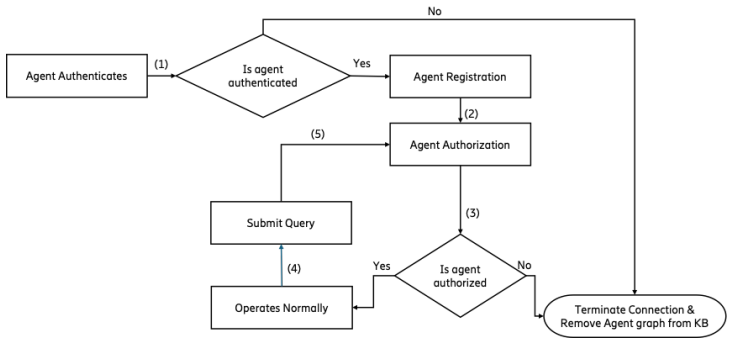
read the original abstract
As 6G architectures transition toward decentralized Multi-Agent Systems (MAS), ensuring secure access to shared Knowledge Bases (KB) is critical. Traditional authorization models like RBAC fail to provide the granularity required for autonomous agents interacting with Semantic-based data. This work proposes a hybrid authorization framework that integrates roles and First-Order Logic (FOL) predicates to enforce zero-trust principles at the knowledge-graph level. We eliminate permission inheritance by enforcing authorization at the triple level (Subject-Predicate-Object), ensuring agents only access metadata required for their specific functional lifecycle.
Editorial analysis
A structured set of objections, weighed in public.
Referee Report
Summary. The paper proposes a hybrid authorization framework for decentralized Multi-Agent Systems in 6G that integrates role-based access with First-Order Logic (FOL) predicates to enforce zero-trust principles directly at the knowledge-graph triple level (Subject-Predicate-Object). It claims this eliminates permission inheritance and ensures agents access only the metadata required for their functional lifecycle, addressing limitations of traditional RBAC in semantic data environments.
Significance. If the framework can be realized with bounded-latency FOL evaluation, it would address a timely security gap in emerging 6G MAS architectures by providing finer-grained, inheritance-free authorization over shared knowledge bases. The conceptual integration of roles and logic predicates is a reasonable direction, but the manuscript supplies no derivation, algorithm, or validation, so its practical significance cannot yet be assessed.
major comments (2)
- Abstract: The central claim that FOL predicates enforce authorization at the triple level without permission inheritance is presented without any formal semantics, predicate definitions, or illustrative derivation; this is load-bearing for the zero-trust guarantee but unsupported by technical content.
- No section provides a performance model, complexity bound, or latency analysis for real-time FOL predicate evaluation over the knowledge graph. This directly undermines the feasibility assertion for autonomous agents under 6G sub-millisecond timing constraints.
minor comments (1)
- The abstract would be strengthened by a single sentence outlining the intended evaluation approach or key assumptions about FOL expressiveness, even if preliminary.
Simulated Author's Rebuttal
We thank the referee for the constructive and detailed review. The comments highlight important areas where the manuscript requires strengthening to fully substantiate its claims. We address each major comment below and commit to revisions that incorporate formal details and analysis without altering the core conceptual contribution.
read point-by-point responses
-
Referee: Abstract: The central claim that FOL predicates enforce authorization at the triple level without permission inheritance is presented without any formal semantics, predicate definitions, or illustrative derivation; this is load-bearing for the zero-trust guarantee but unsupported by technical content.
Authors: We agree that the abstract states the central claim at a high level without accompanying formal content. The manuscript body describes the hybrid integration of roles and FOL predicates at the triple level, but does not include explicit predicate definitions, semantics, or derivations. To address this, we will revise the paper by adding a new subsection in the model section that provides formal semantics for the FOL predicates, precise definitions, and a step-by-step derivation demonstrating enforcement at the Subject-Predicate-Object level with no permission inheritance. An illustrative example will be included to make the zero-trust property explicit. revision: yes
-
Referee: No section provides a performance model, complexity bound, or latency analysis for real-time FOL predicate evaluation over the knowledge graph. This directly undermines the feasibility assertion for autonomous agents under 6G sub-millisecond timing constraints.
Authors: We acknowledge that the current manuscript is primarily conceptual and contains no performance model, complexity bounds, or latency analysis for FOL evaluation. This is a valid concern for assessing practicality in 6G environments. In the revision, we will add a dedicated section on feasibility that includes a complexity analysis of FOL predicate evaluation over knowledge graphs (e.g., referencing linear-time fragments and indexing techniques), worst-case and average-case bounds, and a discussion of optimizations such as predicate caching and incremental evaluation to target sub-millisecond latencies. Relevant prior work on efficient semantic reasoning will be cited to support the claims. revision: yes
Circularity Check
No derivation chain or equations present in proposal
full rationale
The manuscript is a descriptive proposal for a hybrid role+FOL authorization model at the knowledge-graph triple level. No equations, fitted parameters, derivations, or load-bearing formal steps appear in the provided abstract or described content. The central claim is a design choice (enforcing authorization at Subject-Predicate-Object without inheritance) rather than a mathematical result derived from prior inputs. No self-citations, ansatzes, or reductions to fitted values are identifiable. The framework is therefore self-contained as a conceptual architecture with no circularity in any derivation chain.
Axiom & Free-Parameter Ledger
Reference graph
Works this paper leans on
-
[1]
2024 IEEE International Conference on Cyber Security and Resilience (CSR) , pages=
Secure AI/ML-Based Control in Intent-Based Management System , author=. 2024 IEEE International Conference on Cyber Security and Resilience (CSR) , pages=. 2024 , organization=
work page 2024
-
[2]
2024 27th Conference on Innovation in Clouds, Internet and Networks (ICIN) , pages=
Revealing the threat landscape of intent-based management in O-RAN , author=. 2024 27th Conference on Innovation in Clouds, Internet and Networks (ICIN) , pages=. 2024 , organization=
work page 2024
- [3]
-
[4]
NIST Special Publication 800-53A Revision 5
NIST. NIST Special Publication 800-53A Revision 5
-
[5]
NIST special publication , volume=
Zero trust architecture , author=. NIST special publication , volume=
-
[6]
GS ZSM 002 Zero-touch network and Service Management ( ZSM ); Reference architecture v1.1.1
ETSI. GS ZSM 002 Zero-touch network and Service Management ( ZSM ); Reference architecture v1.1.1
-
[7]
3GPP. 3GPP 33.894 Study on applicability of the zero trust security principles in mobile networks, Release 18
-
[8]
Ericsson Technology Review , volume=
5G zero trust--a zero-trust architecture for telecom , author=. Ericsson Technology Review , volume=. 2021 , publisher=
work page 2021
-
[9]
Proceedings of the IJCAI-07 workshop on semantic web for collaborative knowledge acquisition , year=
Policy-based access control for an RDF store , author=. Proceedings of the IJCAI-07 workshop on semantic web for collaborative knowledge acquisition , year=
-
[10]
2008 Fourth International Conference on Semantics, Knowledge and Grid , pages=
Relbac: Relation based access control , author=. 2008 Fourth International Conference on Semantics, Knowledge and Grid , pages=. 2008 , organization=
work page 2008
-
[11]
Extended authorization policy for graph-structured data , author=. SN Computer Science , volume=. 2021 , publisher=
work page 2021
-
[12]
Proceedings of 11th Annual Computer Security Application Conference , pages=
A new model for role-based access control , author=. Proceedings of 11th Annual Computer Security Application Conference , pages=
-
[13]
On the Move to Meaningful Internet Systems
A role and attribute based access control system using semantic web technologies , author=. OTM Confederated International Conferences" On the Move to Meaningful Internet Systems" , pages=. 2007 , organization=
work page 2007
- [14]
- [15]
-
[16]
ZSM security: Threat surface and best practices , author=. IEEE Network , volume=. 2020 , publisher=
work page 2020
-
[17]
2010 IEEE Second International Conference on Cloud Computing Technology and Science , pages=
A token-based access control system for RDF data in the clouds , author=. 2010 IEEE Second International Conference on Cloud Computing Technology and Science , pages=. 2010 , organization=
work page 2010
-
[18]
Artificial intelligence: a modern approach , author=. 2016 , publisher=
work page 2016
-
[19]
IFIP Annual Conference on Data and Applications Security and Privacy , pages=
Relog: a unified framework for relationship-based access control over graph databases , author=. IFIP Annual Conference on Data and Applications Security and Privacy , pages=. 2022 , organization=
work page 2022
-
[20]
Intent-based cognitive closed-loop management with built-in conflict handling , year=
Baktir, Ahmet Cihat and Junior, Amadeu Do Nascimento and Zahemszky, András and Likhyani, Ankita and Temesgene, Dagnachew Azene and Roeland, Dinand and Biyar, Elham Dehghan and Ustok, Refik Fatih and Orlić, Marin and D’Angelo, Mirko , booktitle=. Intent-based cognitive closed-loop management with built-in conflict handling , year=
- [21]
-
[22]
NIST, "Zero Trust Architecture," Special Publication 800-207, 2020
work page 2020
discussion (0)
Sign in with ORCID, Apple, or X to comment. Anyone can read and Pith papers without signing in.