Parameter estimation for kappa distributions using the EM algorithm in the superstatistical framework
Pith reviewed 2026-05-25 06:28 UTC · model grok-4.3
The pith
Treating fluctuating inverse temperature as a latent variable restores exponential family structure for kappa distributions and enables closed-form EM updates.
A machine-rendered reading of the paper's core claim, the machinery that carries it, and where it could break.
Core claim
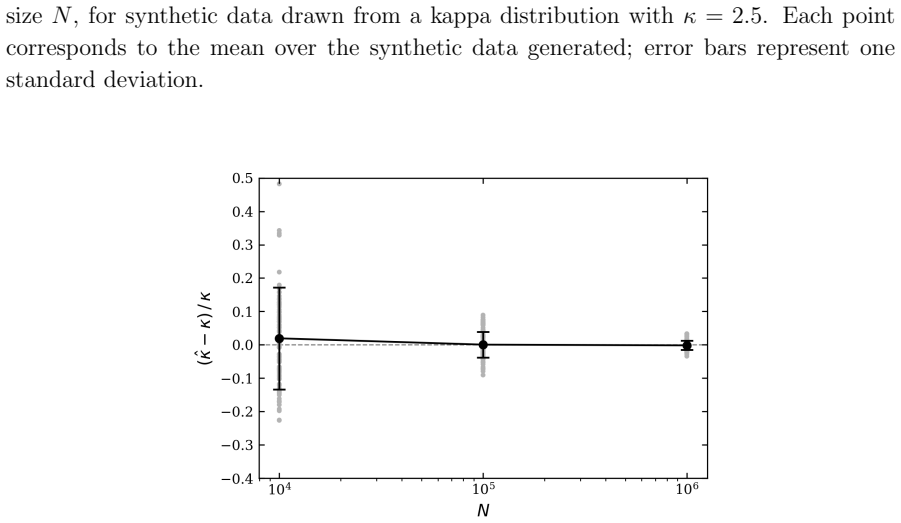
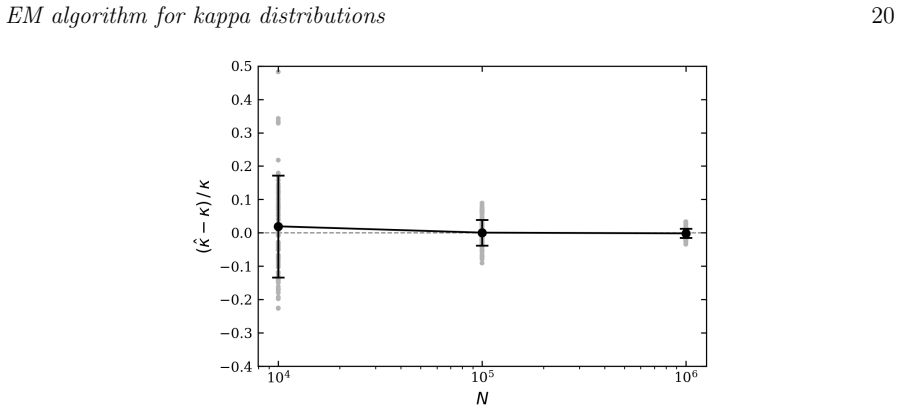
Working within the Beck-Cohen superstatistics framework, where a gamma-distributed inverse temperature β generates the kappa distribution upon marginalization, we treat β as a latent variable. This hierarchical description restores the exponential family structure that the marginal kappa distribution lacks, and yields an analytically tractable implementation of the expectation-maximization (EM) algorithm whose E-step and M-step admit closed-form expressions in terms of sufficient statistics. Applied to synthetic data drawn from the model, the algorithm converges monotonically to a stationary point of the marginal kappa log-likelihood and recovers the generating parameters consistently across
What carries the argument
The latent inverse temperature β from a gamma distribution in the Beck-Cohen superstatistical hierarchy, which provides the sufficient statistics for closed-form EM updates.
If this is right
- The EM algorithm converges monotonically to a stationary point of the marginal kappa log-likelihood.
- It recovers the generating parameters consistently across different values of κ.
- It supplies a tractable and transparent route to inference for superstatistical systems that have local temperature fluctuations.
Where Pith is reading between the lines
- The latent-variable approach could be tested on actual space plasma observations to see if the inferred temperature fluctuations match a gamma distribution.
- Similar hierarchical constructions might allow EM estimation for other non-exponential-family distributions that arise as marginals of parameter fluctuations.
- The method opens the possibility of extending superstatistics to more complex latent fluctuation models while retaining analytic updates.
Load-bearing premise
The data are generated precisely according to the Beck-Cohen model with gamma-distributed inverse temperature, making the marginal exactly kappa and supplying the required sufficient statistics through the latent hierarchy.
What would settle it
Apply the EM procedure to synthetic data sampled directly from a kappa distribution without the underlying gamma fluctuation mechanism and observe whether the parameter estimates match the true values or the log-likelihood increases at each step.
Figures



read the original abstract
Kappa distributions are widely used in space plasma physics to model velocity distribution functions with heavy tails. Parameter estimation in these distributions is, however, complicated by the fact that the kappa distribution does not belong to the exponential family, so it admits no sufficient statistics and direct maximum likelihood requires numerical optimization without analytically closed-form update equations. Working within the Beck-Cohen superstatistics framework, where a gamma-distributed inverse temperature \(\beta\) generates the kappa distribution upon marginalization, we treat \(\beta\) as a latent variable. This hierarchical description restores the exponential family structure that the marginal kappa distribution lacks, and yields an analytically tractable implementation of the expectation-maximization (EM) algorithm whose E-step and M-step admit closed-form expressions in terms of sufficient statistics. Applied to synthetic data drawn from the model, the algorithm converges monotonically to a stationary point of the marginal kappa log-likelihood and recovers the generating parameters consistently across the explored range of \(\kappa\). EM thus offers a tractable and transparent route to inference in superstatistical systems with local temperature fluctuations.
Editorial analysis
A structured set of objections, weighed in public.
Referee Report
Summary. The manuscript claims that kappa distributions, which lack exponential-family structure and thus sufficient statistics, can be fit via EM by embedding them in the Beck-Cohen superstatistics hierarchy: each observation has an independent latent inverse temperature β_i ~ Gamma whose conditional is exponential-family (Maxwellian), yielding conjugate Gamma posteriors, closed-form posterior expectations, and analytic M-step updates that recover the marginal kappa MLE. Synthetic-data experiments are reported to show monotonic convergence to a stationary point of the marginal log-likelihood and consistent recovery of the generating κ across a range of values.
Significance. If the closed-form EM steps are correctly derived and the synthetic recovery is reproducible, the work supplies a computationally transparent route to inference for superstatistical models that is directly applicable to velocity-distribution fitting in space plasma physics; it also illustrates a general technique for restoring exponential-family structure via latent-variable hierarchies.
major comments (2)
- [Abstract] Abstract and main text: the central claim that the E-step and M-step 'admit closed-form expressions in terms of sufficient statistics' is asserted without displaying the explicit update equations, the updated Gamma parameters, or the expressions for E[β_i | x_i] and E[log β_i | x_i]. Because these expressions are load-bearing for the tractability claim, their absence leaves the soundness of the method only partially supported.
- [Synthetic data experiments] Synthetic-data section: the manuscript states 'consistent recovery across the explored range of κ' and 'monotonic convergence' but supplies neither the number of Monte Carlo replicates, the range of sample sizes, the initialization procedure, nor any quantitative error metrics (bias, variance, or convergence rate) that would allow verification of the consistency claim.
minor comments (2)
- Notation for the gamma shape and rate parameters should be introduced once and used consistently when writing the posterior updates.
- The manuscript should state the precise form of the conditional density p(x|β) (Maxwellian or equivalent) and confirm that the marginal is exactly the kappa distribution under the chosen gamma prior.
Simulated Author's Rebuttal
We thank the referee for the detailed and constructive report. The comments highlight opportunities to strengthen the presentation of the method and the experimental results. We address each major comment below and will incorporate the suggested additions in the revised manuscript.
read point-by-point responses
-
Referee: [Abstract] Abstract and main text: the central claim that the E-step and M-step 'admit closed-form expressions in terms of sufficient statistics' is asserted without displaying the explicit update equations, the updated Gamma parameters, or the expressions for E[β_i | x_i] and E[log β_i | x_i]. Because these expressions are load-bearing for the tractability claim, their absence leaves the soundness of the method only partially supported.
Authors: We agree that the explicit update equations are necessary to fully support the tractability claim. The current manuscript asserts the existence of closed-form expressions but does not display them. In the revised version we will add a new subsection (or appendix) that derives and presents the E-step expressions for E[β_i | x_i] and E[log β_i | x_i] under the Gamma posterior, the updated Gamma shape and rate parameters, and the resulting analytic M-step updates for the kappa-distribution parameters. This will make the exponential-family restoration and the EM implementation fully transparent. revision: yes
-
Referee: [Synthetic data experiments] Synthetic-data section: the manuscript states 'consistent recovery across the explored range of κ' and 'monotonic convergence' but supplies neither the number of Monte Carlo replicates, the range of sample sizes, the initialization procedure, nor any quantitative error metrics (bias, variance, or convergence rate) that would allow verification of the consistency claim.
Authors: The referee is correct that the synthetic-experiments section lacks the quantitative details required for independent verification. In the revision we will expand this section to report the number of Monte Carlo replicates, the specific sample sizes examined, the initialization strategy (e.g., method-of-moments or random starts), and summary statistics including bias, variance, and convergence-rate measures across the tested range of κ values. These additions will allow readers to assess the consistency claim directly. revision: yes
Circularity Check
No significant circularity; standard EM on conjugate latent model
full rationale
The derivation treats the Beck-Cohen superstatistics construction (gamma-distributed β latent, marginal kappa) as given and applies the textbook EM algorithm for a gamma mixture of exponentials. The E-step uses the conjugate gamma posterior to obtain closed-form expectations of the sufficient statistics; the M-step matches those expectations. This is exactly the standard route for such hierarchical models and does not reduce any fitted quantity to itself, invoke self-citations as load-bearing uniqueness theorems, or smuggle ansatzes. The only self-citation risk is the Beck-Cohen framework itself, which is external and not authored by the present team; the paper's contribution is the explicit EM implementation, which remains independent of its own outputs.
Axiom & Free-Parameter Ledger
axioms (1)
- domain assumption Beck-Cohen superstatistics: gamma-distributed inverse temperature β marginalizes to a kappa distribution
Reference graph
Works this paper leans on
-
[1]
Binsack.Plasma Studies with the IMP-2 Satellite
J. Binsack.Plasma Studies with the IMP-2 Satellite. PhD thesis, Massachusetts Institute of Technology, USA, 1966
work page 1966
-
[2]
S. Olbert. Summary of experimental results from M.I.T. detector on IMP-1. InPhysics of the Magnetosphere, pages 641–659. Springer, Dordrecht, 1968
work page 1968
-
[3]
V. M. Vasyliunas. A survey of low-energy electrons in the evening sector of the magnetosphere with OGO 1 and OGO 3.J. Geophys. Research, 73(9):2839–2884, 1968
work page 1968
-
[4]
G. Nicolaou and G. Livadiotis. Overview of recent applications of kappa distributions in space and laboratory plasmas. Presented at the 44th COSPAR Scientific Assembly, 2022
work page 2022
-
[5]
C. Tsallis. Possible generalization of Boltzmann-Gibbs statistics.Journal of Statistical Physics, 52(1-2):479–487, 1988
work page 1988
- [6]
-
[7]
C. Beck. Superstatistics: theory and applications.Continuum Mech. Thermodyn., 16:293–304, 2004
work page 2004
-
[8]
A. P. Dempster, N. M. Laird, and D. B. Rubin. Maximum likelihood from incomplete data via the EM algorithm.Journal of the Royal Statistical Society, Series B, 39(1):1–38, 1977
work page 1977
-
[9]
E. S´ anchez, M. Gonz´ alez-Navarrete, and C. Caama˜ no Carrillo. Bivariate superstatistics: an application to statistical plasma physics.European Physical Journal B, 94:1–7, 2021
work page 2021
-
[10]
K. Ourabah, L. A. Gougam, and M. Tribeche. Nonthermal and suprathermal distributions as a consequence of superstatistics.Phys. Rev. E, 91(1):012133, 2015
work page 2015
- [11]
-
[12]
K. Ourabah. Demystifying the success of empirical distributions in space plasmas.Physical Review Research, 2:023121, 2020
work page 2020
-
[13]
E. Gravanis, E. Akylas, C. Michailides, and G. Livadiotis. Superstatistics and isotropic turbulence. Physica A, 567:125694, 2021
work page 2021
-
[14]
P. D. Dixit. A maximum entropy thermodynamics of small systems.Journal of Chemical Physics, 138:184111, 2013
work page 2013
-
[15]
P. D. Dixit. Detecting temperature fluctuations at equilibrium.Physical Chemistry Chemical Physics, 17:13000–13005, 2015
work page 2015
-
[16]
L. Herron and P. D. Dixit. Thermal behavior of small magnets.Journal of Statistical Mechanics: Theory and Experiment, 2021:033207, 2021
work page 2021
-
[17]
P. Jizba and H. Kleinert. Superstatistics approach to path integral for a relativistic particle. Physical Review D, 82:085016, 2010
work page 2010
- [18]
-
[19]
K. Ourabah, E. M. Barboza Jr., E. M. C. Abreu, and J. A. Neto. Superstatistics: consequences on gravitation and cosmology.Physical Review D, 100:103516, 2019
work page 2019
-
[20]
L. L. Chen and C. Beck. A superstatistical model of metastasis and cancer survival.Physica A, 387:3162–3172, 2008
work page 2008
- [21]
-
[22]
M. I. Bogachev, O. A. Markelov, A. R. Kayumov, and A. Bunde. Superstatistical model of bacterial DNA architecture.Scientific Reports, 7:43034, 2017
work page 2017
-
[23]
B. Sch¨ afer, C. Beck, K. Aihara, D. Witthaut, and M. Timme. Non-Gaussian power grid frequency fluctuations characterized by L´ evy-stable laws and superstatistics.Nature Energy, 3:119–126, 2018
work page 2018
-
[24]
M. O. Costa, R. Silva, and D. H. A. L. Anselmo. Superstatistical and DNA sequence coding of the human genome.Physical Review E, 106:064407, 2022. EM algorithm for kappa distributions24
work page 2022
- [25]
-
[26]
G. Livadiotis and D. J. McComas. Understanding kappa distributions: A toolbox for space science and astrophysics.Space Science Reviews, 175:183–214, 2013
work page 2013
-
[27]
S. Davis and G. Guti´ errez. Temperature is not an observable in superstatistics.Phys. A, 505:864– 870, 2018
work page 2018
- [28]
-
[29]
C. M. Bishop.Pattern Recognition and Machine Learning. Springer, New York, 2006
work page 2006
-
[30]
E. L. Lehmann and G. Casella.Theory of Point Estimation. Springer, New York, 2 edition, 1998
work page 1998
-
[31]
Robert and George Casella.Monte Carlo Statistical Methods
Christian P. Robert and George Casella.Monte Carlo Statistical Methods. Springer, New York, 2 edition, 2004
work page 2004
discussion (0)
Sign in with ORCID, Apple, or X to comment. Anyone can read and Pith papers without signing in.