Recognition: unknown
Superconductivity mediated by nematic fluctuations -- the dispersion of collective modes
Pith reviewed 2026-05-08 15:42 UTC · model grok-4.3
The pith
Pair susceptibility in nematic-fluctuation-mediated superconductors has a qualitatively distinct analytic structure from BCS, yielding unconventional dispersion for phase and amplitude collective modes.
A machine-rendered reading of the paper's core claim, the machinery that carries it, and where it could break.
Core claim
We find that the analytic structure of the pair susceptibility in both channels is qualitatively distinct from that in a BCS superconductor. This gives rise to a highly unconventional dispersion of phase and amplitude collective modes.
What carries the argument
The pair susceptibility χ(q, Ω) evaluated at finite momentum q and frequency Ω, together with its pole structure and imaginary part in the transverse phase channel and longitudinal amplitude channel.
If this is right
- The phase mode no longer follows the linear dispersion expected for a Goldstone boson at small momentum.
- The amplitude mode acquires a dispersion and damping profile set by the arc-vanishing gap rather than by the full gap magnitude.
- The spectral function Im χ(q, Ω) develops features in both channels that have no counterpart in BCS theory.
- These distinctions persist for s+- pairing symmetry provided the gap still vanishes on four arcs.
Where Pith is reading between the lines
- If the predicted dispersion is observed, it would help differentiate nematic-fluctuation pairing from phonon or spin-fluctuation mechanisms in the same material.
- The result implies that gap anisotropy induced by fluctuations can alter collective excitations more strongly than static gap anisotropy alone.
- Experiments sensitive to both momentum and frequency, such as momentum-resolved Raman or neutron scattering, become direct tests of the underlying fluctuation spectrum.
Load-bearing premise
The derivation assumes a specific model of long-range nematic fluctuations that produces a highly anisotropic gap vanishing on four arcs at finite temperature below Tc, even for s+- pairing symmetry.
What would settle it
Spectroscopic measurement of the dispersion of phase and amplitude modes in a candidate material; if the modes follow the standard linear phase mode and gapped amplitude mode of BCS theory, the predicted qualitative distinction collapses.
Figures


read the original abstract
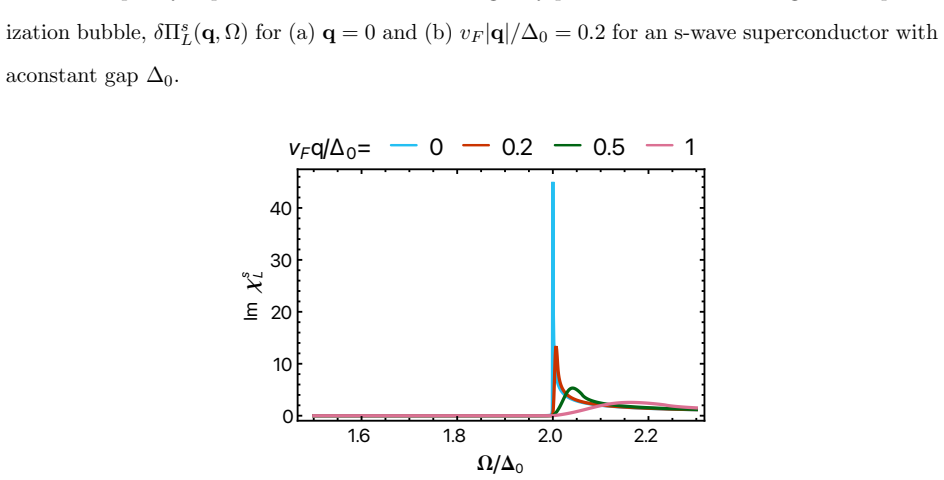
We analyze the spectrum of collective modes in a superconductor in which pairing is mediated by long-range nematic fluctuations. Previous experimental and theoretical studies have found that the superconducting gap in such a system is highly anisotropic and, at any finite $T<T_c$, vanishes on four arcs of the Fermi surface, even when the pairing symmetry is $s$ wave ($s^{+-}$ between hole and electron pockets). We derive the expression for the pair susceptibility $\chi(\mathbf{q},\Omega)$ at finite momentum $\mathbf{q}$ and frequency $\Omega$ deep in the superconducting phase. We analyze the spectral function, $\operatorname{Im}\chi(\mathbf{q},\Omega)$, and its pole structure in the transverse (phase) and longitudinal (amplitude) channels, and compare the results with those of a conventional $s$-wave superconductor. We find that the analytic structure of the pair susceptibility in both channels is qualitatively distinct from that in a BCS superconductor. This gives rise to a highly unconventional dispersion of phase and amplitude collective modes.
Editorial analysis
A structured set of objections, weighed in public.
Referee Report
Summary. The manuscript analyzes collective modes in a superconductor paired via long-range nematic fluctuations. It starts from the established result that the gap is highly anisotropic and vanishes on four arcs of the Fermi surface at any finite T < Tc (even for s+- symmetry between pockets). The authors derive the pair susceptibility χ(q, Ω) deep in the superconducting state, compute its spectral function Im χ(q, Ω), and extract the pole structure in the transverse (phase) and longitudinal (amplitude) channels. They conclude that this analytic structure is qualitatively different from BCS, producing unconventional dispersions for both phase and amplitude modes.
Significance. If the central derivation holds, the work supplies a concrete, parameter-free prediction for the dispersion of phase and amplitude modes that is tied directly to the arc-node gap structure induced by nematic fluctuations. This offers a potential experimental discriminator between nematic-mediated pairing and conventional BCS superconductivity, particularly in iron-based materials. The microscopic starting point and absence of fitted parameters are strengths.
major comments (2)
- The central claim that the analytic structure of χ(q, Ω) is qualitatively distinct from BCS rests on the specific gap that vanishes on four arcs at finite T < Tc. This gap form is imported from prior studies rather than re-derived; the manuscript should state the explicit functional form used for the gap (including its temperature dependence) and demonstrate that the reported pole structure survives modest variations in the arc length or fluctuation range.
- The derivation of χ(q, Ω) at finite q and Ω follows standard linear-response methods for a fixed gap, but the handling of analytic continuation, the long-range nematic fluctuations, and the contribution from the arc nodes must be shown explicitly. Without these steps, it is unclear whether the claimed qualitative difference in the transverse and longitudinal channels is robust or an artifact of the approximation scheme.
minor comments (2)
- The comparison to the BCS case would be strengthened by writing the corresponding BCS expressions for the phase and amplitude poles alongside the nematic-fluctuation results.
- Notation for the transverse and longitudinal channels should be defined once at the beginning of the susceptibility section and used consistently.
Simulated Author's Rebuttal
We thank the referee for the careful reading of our manuscript and the constructive comments. We have revised the manuscript to address both major points, as detailed below.
read point-by-point responses
-
Referee: The central claim that the analytic structure of χ(q, Ω) is qualitatively distinct from BCS rests on the specific gap that vanishes on four arcs at finite T < Tc. This gap form is imported from prior studies rather than re-derived; the manuscript should state the explicit functional form used for the gap (including its temperature dependence) and demonstrate that the reported pole structure survives modest variations in the arc length or fluctuation range.
Authors: We agree that the explicit gap form and its robustness should be stated clearly. In the revised manuscript we now give the functional form Δ(k,T) used throughout (taken from the nematic-fluctuation pairing calculation of our earlier work), including its explicit temperature dependence that produces arc nodes whose length grows with T. We have added a new subsection with numerical checks showing that the reported pole structure and unconventional dispersions remain qualitatively unchanged for arc-length variations of ±15 % and for moderate changes in the nematic fluctuation range, provided the gap retains extended arc nodes rather than point nodes. These results are presented in the main text and supplementary material. revision: yes
-
Referee: The derivation of χ(q, Ω) at finite q and Ω follows standard linear-response methods for a fixed gap, but the handling of analytic continuation, the long-range nematic fluctuations, and the contribution from the arc nodes must be shown explicitly. Without these steps, it is unclear whether the claimed qualitative difference in the transverse and longitudinal channels is robust or an artifact of the approximation scheme.
Authors: We thank the referee for this request for greater transparency. The revised manuscript now contains an expanded derivation section that explicitly walks through (i) the Matsubara-frequency linear-response expression for the pair susceptibility, (ii) the analytic continuation to real frequencies (via direct contour integration along the real axis, avoiding the branch cuts introduced by the arc nodes), (iii) the incorporation of the long-range nematic interaction through the momentum-dependent vertex, and (iv) the treatment of the arc-node regions in the momentum integrals via the appropriate coherence factors and integration domains. These steps confirm that the distinct analytic structures in the transverse and longitudinal channels arise directly from the nodal arcs and are not artifacts of the approximation. revision: yes
Circularity Check
No significant circularity; derivation self-contained from model
full rationale
The paper starts from a microscopic model of long-range nematic fluctuations, adopts the resulting highly anisotropic gap (vanishing on four arcs) as an established input from prior studies, and then computes the pair susceptibility χ(q,Ω) via standard linear-response methods for a fixed gap. The subsequent extraction of pole structure in transverse and longitudinal channels, spectral function, and comparison to BCS follows directly from those equations without any reduction to a fitted parameter, self-definition, or load-bearing self-citation chain. The claimed qualitative distinction in analytic structure is a calculational consequence of the input gap anisotropy rather than an independent prediction that loops back to the paper's own outputs.
Axiom & Free-Parameter Ledger
axioms (2)
- standard math Standard analytic continuation from Matsubara frequencies to real frequencies is valid for the pair susceptibility.
- domain assumption The superconducting gap remains highly anisotropic with four nodal arcs at any finite T < Tc for s+- pairing.
Reference graph
Works this paper leans on
-
[1]
Transverse Susceptibility 26
-
[2]
Correction to the transverse susceptibility from the cold regions 29 C
Longitudinal Susceptibility 27 B. Correction to the transverse susceptibility from the cold regions 29 C. Width and height of the peaks of transverse susceptibility,χ T 31 D. Kramers Kronig Relation 32 References 32 I. Introduction The interplay between superconductivity and electronic nematicity has emerged as one of the central themes in the study of a ...
-
[3]
Γq(k)− Z k F(k+ q 2)F(−k+ q
-
[4]
Below we compute the susceptibility atT= 0, in which caseT P ωm = R dωm/(2π)
¯Γq(k),(9) where the integration stands for R k =N 0 TP ωm R dξk R dθk/2π. Below we compute the susceptibility atT= 0, in which caseT P ωm = R dωm/(2π). The equations for the two-particle vertices Γ q(k) and ¯Γq(k) are shown graphically in Fig. 2 b,c. In analytical form Γq(k) = 1− Z k G(k+ q 2)G(−k+ q 2)Γq(p)V(k,p) + Z k F(k+ q 2)F(−k+ q 2)¯Γq(p)V(k,p), (...
-
[5]
As a result, Imχ L(q,Ω) exhibits logarithmic divergence at two distinct frequencies Ω peak,1(q) and Ω peak,2(q), whose values we already presented in Eq
The curvature remainsβ= 2∆ 0α for both cases. As a result, Imχ L(q,Ω) exhibits logarithmic divergence at two distinct frequencies Ω peak,1(q) and Ω peak,2(q), whose values we already presented in Eq. 28. The jump in Reχ L(q,Ω) is same at Ω peak,1(q) and Ω peak,2(q) and equalsN 0/ √ 2πg2√α- a half of its value atq= 0. Whenθ q =nπ/2, n= 0−3 (a direction tow...
-
[6]
Γs q − Z k Fs(k+ q 2)F s(−k+ q
-
[7]
The equations for Γ s q, ¯Γs q are same as depicted in Fig
¯Γs q,(A3) where the Green’s functions are Gs(k) = i ωm +ξ k (i ωm)2 −E 2 s,k , F s(k) = ∆0 (i ωm)2 −E 2 s,k ,(A4) andE s,k = p ξ2 k + ∆2 0 is the quasi-particle excitation energy, and the two-particle vertices Γs q, ¯Γs q are independent of internal momentumk, and the integration sign stands for R k = TP ωk R d2k/(2π)2. The equations for Γ s q, ¯Γs q are...
-
[8]
+F s(k+ q 2)Fs(−k+ q 2),(A9) Πs L(q) = Z k Gs(k+ q 2)Gs(−k+ q 2)−F s(k+ q 2)Fs(−k+ q 2) .(A10) We plug Eqs. (12)-(A8) into the expression for the pair susceptibilityχ s(q), perform the analytic continuationiΩ m →Ω +i δ, and get χs(q,Ω) = 1 2 Πs T (q) 1−V 0 Πs T (q) + Πs L(q) 1−V 0 Πs T (q) ,(A11) 25 where Πs T,L(q) = Πs T,L(q,Ω) =Π s T,L(q, iΩ m →Ω +i δ)....
-
[9]
(A12), δΠs T (q) =− 1 4 Z 2π 0 dθk 2π Z ∞ −∞ dξk Es,k+q/2 +E s,k−q/2 Es,k+q/2 Es,k−q/2 Ω2 − ξk+q/2 −ξ k−q/2 2 (Ω +iδ) 2 − Es,k+q/2 +E s,k−q/2 2
T ransverse Susceptibility We call the transverse part of the pair-pair susceptibility, χs T (q) =− 1 2V 0 1 V0 δΠs T (q) + 1 ,(A16) 26 whereδΠ s T (q) = Πs T (q)−Π s T (0), and has the following expression using Eq. (A12), δΠs T (q) =− 1 4 Z 2π 0 dθk 2π Z ∞ −∞ dξk Es,k+q/2 +E s,k−q/2 Es,k+q/2 Es,k−q/2 Ω2 − ξk+q/2 −ξ k−q/2 2 (Ω +iδ) 2 − Es,k+q/2 +E s,k−q/...
-
[10]
(A13), δΠs L(q) =− 1 4 Z 2π 0 dθk 2π Z ∞ −∞ dξk Es,k+q/2 +E s,k−q/2 Es,k+q/2 Es,k−q/2 (Ω)2 −4∆ 2 0 − ξk+q/2 −ξ k−q/2 2 (Ω +iδ) 2 − Es,k+q/2 +E s,k−q/2 2
Longitudinal Susceptibility We call the longitudinal part of the pair-pair susceptibility, χs L(q) =− 1 2V 0 1 V0 δΠs L(q) + 1 ,(A21) where Πs L(q) = Πs T (0) +δΠ s L(q) and has the following expression using Eq. (A13), δΠs L(q) =− 1 4 Z 2π 0 dθk 2π Z ∞ −∞ dξk Es,k+q/2 +E s,k−q/2 Es,k+q/2 Es,k−q/2 (Ω)2 −4∆ 2 0 − ξk+q/2 −ξ k−q/2 2 (Ω +iδ) 2 − Es,k+q/2 +E s...
-
[11]
As a result, the peak of Imχ T (|q|, θq,Ω) appears when θq ±cos −1 Ω vF |q| =n π 2 , n= 0−3 (C2) This corresponds to two unique solution: Ω 1 =v F |q|cosθ q and Ω 2 =v F |q|sinθ q. The height of these peaks are equal to hs = ImχT (|q|, θq,Ω s) = 2N 0 ∆2 0 g2v2 F |q|2 sin 2θq , i= 1,2 (C3) We define the width of these peaks as width at half maxima such tha...
-
[12]
Fradkin, S
E. Fradkin, S. A. Kivelson, M. J. Lawler, J. P. Eisenstein, and A. P. Mackenzie, Nematic fermi fluids in condensed matter physics, Annu. Rev. Condens. Matter Phys.1, 153 (2010). 32
2010
-
[13]
Chu, H.-H
J.-H. Chu, H.-H. Kuo, J. G. Analytis, and I. R. Fisher, Divergent nematic susceptibility in an iron arsenide superconductor, Science337, 710 (2012)
2012
-
[14]
A. B¨ ohmer, P. Burger, F. Hardy, T. Wolf, P. Schweiss, R. Fromknecht, M. Reinecker, W. Schranz, and C. Meingast, Nematic susceptibility of hole-and electron-doped bafe2as2 iron- based superconductors from shear modulus measurements, arXiv preprint arXiv:1305.3515 (2013)
-
[15]
Gallais, R
Y. Gallais, R. Fernandes, I. Paul, L. Chauvi` ere, Y.-X. Yang, M.-A. M´ easson, M. Cazayous, A. Sacuto, D. Colson, and A. Forget, Observation of incipient charge nematicity in ba (fe 1- x co x) 2 as 2, Physical review letters111, 267001 (2013)
2013
-
[16]
M. Yi, Y. Zhang, Z.-X. Shen, and D. Lu, Role of the orbital degree of freedom in iron-based superconductors, npj Quantum Materials2, 57 (2017)
2017
-
[17]
J.-H. Chu, J. G. Analytis, K. De Greve, P. L. McMahon, Z. Islam, Y. Yamamoto, and I. R. Fisher, In-plane resistivity anisotropy in an underdoped iron arsenide superconductor, Science 329, 824 (2010)
2010
-
[18]
Mirri, A
C. Mirri, A. Dusza, S. Bastelberger, M. Chinotti, L. Degiorgi, J.-H. Chu, H.-H. Kuo, and I. Fisher, Origin of the resistive anisotropy in the electronic nematic phase of bafe 2 as 2 revealed by optical spectroscopy, Physical review letters115, 107001 (2015)
2015
-
[19]
Chuang, M
T.-M. Chuang, M. P. Allan, J. Lee, Y. Xie, N. Ni, S. Bud’ko, G. Boebinger, P. Canfield, and J. Davis, Nematic electronic structure in the “parent” state of the iron-based superconductor ca (fe1–x co x) 2as2, Science327, 181 (2010)
2010
-
[20]
Y. Ando, K. Segawa, S. Komiya, and A. Lavrov, Electrical resistivity anisotropy from self- organized one dimensionality in high-temperature superconductors, Physical review letters 88, 137005 (2002)
2002
-
[21]
Hinkov, D
V. Hinkov, D. Haug, B. Fauqu´ e, P. Bourges, Y. Sidis, A. Ivanov, C. Bernhard, C. Lin, and B. Keimer, Electronic liquid crystal state in the high-temperature superconductor yba2cu3o6. 45, Science319, 597 (2008)
2008
-
[22]
Y. Sato, S. Kasahara, H. Murayama, Y. Kasahara, E.-G. Moon, T. Nishizaki, T. Loew, J. Porras, B. Keimer, T. Shibauchi,et al., Thermodynamic evidence for a nematic phase transition at the onset of the pseudogap in yba2cu3o y, Nature Physics13, 1074 (2017)
2017
-
[23]
Lawler, K
M. Lawler, K. Fujita, J. Lee, A. Schmidt, Y. Kohsaka, C. K. Kim, H. Eisaki, S. Uchida, J. Davis, J. Sethna,et al., Intra-unit-cell electronic nematicity of the high-t c copper-oxide 33 pseudogap states, Nature466, 347 (2010)
2010
-
[24]
R. Daou, J. Chang, D. LeBoeuf, O. Cyr-Choiniere, F. Lalibert´ e, N. Doiron-Leyraud, B. Ramshaw, R. Liang, D. Bonn, W. Hardy,et al., Broken rotational symmetry in the pseu- dogap phase of a high-t c superconductor, Nature463, 519 (2010)
2010
-
[25]
J. Wu, A. Bollinger, X. He, and I. Boˇ zovi´ c, Spontaneous breaking of rotational symmetry in copper oxide superconductors, Nature547, 432 (2017)
2017
-
[26]
Y. Cao, D. Rodan-Legrain, J. M. Park, N. F. Yuan, K. Watanabe, T. Taniguchi, R. M. Fernandes, L. Fu, and P. Jarillo-Herrero, Nematicity and competing orders in superconducting magic-angle graphene, science372, 264 (2021)
2021
-
[27]
Hanaguri, K
T. Hanaguri, K. Iwaya, Y. Kohsaka, T. Machida, T. Watashige, S. Kasahara, T. Shibauchi, and Y. Matsuda, Two distinct superconducting pairing states divided by the nematic end point in FeSe 1−xSx, Science advances4, eaar6419 (2018)
2018
-
[28]
Shibauchi, T
T. Shibauchi, T. Hanaguri, and Y. Matsuda, Exotic superconducting states in FeSe-based materials, Journal of the Physical Society of Japan89, 102002 (2020)
2020
-
[29]
Y. Sato, S. Kasahara, T. Taniguchi, X. Xing, Y. Kasahara, Y. Tokiwa, Y. Yamakawa, H. Kon- tani, T. Shibauchi, and Y. Matsuda, Abrupt change of the superconducting gap structure at the nematic critical point in FeSe 1−xSx, Proceedings of the National Academy of Sciences 115, 1227 (2018)
2018
-
[30]
Ishida, Y
K. Ishida, Y. Onishi, M. Tsujii, K. Mukasa, M. Qiu, M. Saito, Y. Sugimura, K. Matsuura, Y. Mizukami, K. Hashimoto,et al., Pure nematic quantum critical point accompanied by a superconducting dome, Proceedings of the National Academy of Sciences119, e2110501119 (2022)
2022
-
[31]
Mukasa, K
K. Mukasa, K. Ishida, S. Imajo, M. Qiu, M. Saito, K. Matsuura, Y. Sugimura, S. Liu, Y. Ue- zono, T. Otsuka,et al., Enhanced superconducting pairing strength near a pure nematic quantum critical point, Physical Review X13, 011032 (2023)
2023
-
[32]
H. Xu, X. Niu, D. Xu, J. Jiang, Q. Yao, Q. Chen, Q. Song, M. Abdel-Hafiez, D. Chareev, A. Vasiliev,et al., Highly anisotropic and twofold symmetric superconducting gap in nemati- cally ordered FeSe 0.93S0.07, Physical Review Letters117, 157003 (2016)
2016
-
[33]
D. Liu, C. Li, J. Huang, B. Lei, L. Wang, X. Wu, B. Shen, Q. Gao, Y. Zhang, X. Liu, et al., Orbital origin of extremely anisotropic superconducting gap in nematic phase of FeSe superconductor, Physical Review X8, 031033 (2018). 34
2018
-
[34]
P. O. Sprau, A. Kostin, A. Kreisel, A. E. B¨ ohmer, V. Taufour, P. C. Canfield, S. Mukherjee, P. J. Hirschfeld, B. M. Andersen, and J. S. Davis, Discovery of orbital-selective cooper pairing in FeSe, Science357, 75 (2017)
2017
-
[35]
Nagashima, T
T. Nagashima, T. Hashimoto, S. Najafzadeh, S.-i. Ouchi, T. Suzuki, A. Fukushima, S. Kasa- hara, K. Matsuura, M. Qiu, Y. Mizukami,et al., Discovery of nematic Bogoliubov Fermi surface in an iron-chalcogenide superconductor, preprint (2022)
2022
-
[36]
Walker, K
M. Walker, K. Scott, T. Boyle, J. Byland, S. B¨ otzel, Z. Zhao, R. Day, S. Zhdanovich, S. Gorovikov, T. Pedersen,et al., Electronic stripe patterns near the fermi level of tetrag- onal Fe (Se, S), npj Quantum Materials8, 60 (2023)
2023
-
[37]
P. K. Nag, K. Scott, V. S. de Carvalho, J. K. Byland, X. Yang, M. Walker, A. G. Greenberg, P. Klavins, E. Miranda, A. Gozar, V. Taufour, R. M. Fernandes, and E. H. da Silva Neto, Highly anisotropic superconducting gap near the nematic quantum critical point of FeSe1−xSx, Nature Physics21, 89 (2025)
2025
-
[38]
Y. Mizukami, M. Haze, O. Tanaka, K. Matsuura, D. Sano, J. B¨ oker, I. Eremin, S. Kasa- hara, Y. Matsuda, and T. Shibauchi, Thermodynamics of transition to BCS-BEC crossover superconductivity in FeSe 1−xSx, arXiv preprint arXiv:2105.00739 (2021)
-
[39]
Mizukami, M
Y. Mizukami, M. Haze, O. Tanaka, K. Matsuura, D. Sano, J. B¨ oker, I. Eremin, S. Kasahara, Y. Matsuda, and T. Shibauchi, Unusual crossover from Bardeen-Cooper-Schrieffer to Bose- Einstein-condensate superconductivity in iron chalcogenides, Communications Physics6, 183 (2023)
2023
-
[40]
Matsuura, M
K. Matsuura, M. Roppongi, M. Qiu, Q. Sheng, Y. Cai, K. Yamakawa, Z. Guguchia, R. P. Day, K. M. Kojima, A. Damascelli,et al., Two superconducting states with broken time-reversal symmetry in FeSe1−xSx, Proceedings of the National Academy of Sciences120, e2208276120 (2023)
2023
-
[41]
K. R. Islam and A. Chubukov, Unconventional superconductivity near a nematic instability in a multi-orbital system, npj Quantum Materials9, 28 (2024)
2024
-
[42]
K. R. Islam and A. Chubukov, Unconventional superconductivity mediated by nematic fluc- tuations in a multiorbital system: Application to doped fese, Physical Review B111, 094503 (2025)
2025
-
[43]
Lederer, Y
S. Lederer, Y. Schattner, E. Berg, and S. A. Kivelson, Enhancement of superconductivity near a nematic quantum critical point, Physical Review Letters114, 097001 (2015). 35
2015
-
[44]
Lederer, Y
S. Lederer, Y. Schattner, E. Berg, and S. A. Kivelson, Superconductivity and non-fermi liquid behavior near a nematic quantum critical point, Proceedings of the National Academy of Sciences114, 4905 (2017)
2017
-
[45]
Yamase and R
H. Yamase and R. Zeyher, Superconductivity from orbital nematic fluctuations, Phys. Rev. B 88, 180502 (2013)
2013
-
[46]
Agatsuma and H
T. Agatsuma and H. Yamase, Structure of the pairing gap from orbital nematic fluctuations, Phys. Rev. B94, 214505 (2016)
2016
-
[47]
Klein and A
A. Klein and A. Chubukov, Superconductivity near a nematic quantum critical point: Inter- play between hot and lukewarm regions, Physical Review B98, 220501 (2018)
2018
-
[48]
K. R. Islam and A. Chubukov, Unconventional superconductivity mediated by nematic fluctu- ations in a multiorbital system: Application to doped fese, Phys. Rev. B111, 094503 (2025)
2025
-
[49]
Bardasis and J
A. Bardasis and J. Schrieffer, Excitons and plasmons in superconductors, Physical Review 121, 1050 (1961)
1961
-
[50]
P. W. Anderson, New method in the theory of superconductivity, Phys. Rev.110, 985 (1958)
1958
-
[51]
N. N. Bogoliubov, A new method in the theory of superconductivity., Sov. Phys. JETP34 (1958)
1958
-
[52]
P. W. Anderson, Plasmons, gauge invariance, and mass, Phys. Rev.130, 439 (1963)
1963
-
[53]
S. N. Artemenko and A. F. Volkov, Collective excitations with a sound spectrum in supercon- ductors, Sov. Phys. JETP42, 896 (1975)
1975
-
[54]
Schmid and G
A. Schmid and G. Sch¨ on, Collective oscillations in a dirty superconductor, Phys. Rev. Lett. 34, 941 (1975)
1975
-
[55]
Schmid, The approach to equilibrium in a pure superconductor the relaxation of the cooper pair density, Physik der kondensierten Materie8, 129 (1968)
A. Schmid, The approach to equilibrium in a pure superconductor the relaxation of the cooper pair density, Physik der kondensierten Materie8, 129 (1968)
1968
-
[56]
A. F. Volkov and S. M. Kogan, Collisionless relaxation of the energy gap in superconductors, Zh. Eksp. Teor. Fiz65, 2038 (1974), English translation: Sov. Phys. JETP,38, 1018 (1974)
2038
-
[57]
I. O. Kulik, O. Entin-Wohlman, and R. Orbach, Pair susceptibility and mode propagation in superconductors: A microscopic approach, Journal of Low Temperature Physics43, 591 (1981)
1981
-
[58]
Barlas and C
Y. Barlas and C. Varma, Amplitude or higgs modes in d-wave superconductors, Physical Review B—Condensed Matter and Materials Physics87, 054503 (2013). 36
2013
-
[59]
Vollhardt and P
D. Vollhardt and P. W¨ olfle,The Superfluid Phases of Helium 3(Taylor & Francis, Lon- don/New York, 1990)
1990
-
[60]
Benfatto, S
L. Benfatto, S. Caprara, C. Castellani, A. Paramekanti, and M. Randeria, Phase fluctuations, dissipation, and superfluid stiffness in d-wave superconductors, Physical Review B63, 174513 (2001)
2001
-
[61]
P. W. Anderson, Random-phase approximation in the theory of superconductivity, Physical Review112, 1900 (1958)
1900
-
[62]
Combescot, M
R. Combescot, M. Y. Kagan, and S. Stringari, Collective mode of homogeneous superfluid fermi gases in the bec-bcs crossover, Physical Review A—Atomic, Molecular, and Optical Physics74, 042717 (2006)
2006
-
[63]
Katsumi, N
K. Katsumi, N. Tsuji, Y. I. Hamada, R. Matsunaga, J. Schneeloch, R. D. Zhong, G. D. Gu, H. Aoki, Y. Gallais, and R. Shimano, Higgs mode in the d-wave superconductor bi 2 sr 2 cacu 2 o 8+ x driven by an intense terahertz pulse, Physical review letters120, 117001 (2018)
2018
-
[64]
Littlewood and C
P. Littlewood and C. Varma, Amplitude collective modes in superconductors and their cou- pling to charge-density waves, Physical Review B26, 4883 (1982)
1982
-
[65]
Maiti and A
S. Maiti and A. V. Chubukov, s+ is state with broken time-reversal symmetry in fe-based superconductors, Physical Review B—Condensed Matter and Materials Physics87, 144511 (2013)
2013
-
[66]
Maiti and P
S. Maiti and P. Hirschfeld, Collective modes in superconductors with competing s-and d-wave interactions, Physical Review B92, 094506 (2015)
2015
-
[67]
Paramekanti, M
A. Paramekanti, M. Randeria, T. Ramakrishnan, and S. Mandal, Effective actions and phase fluctuations in d-wave superconductors, Physical Review B62, 6786 (2000)
2000
-
[68]
Phan and A
D. Phan and A. V. Chubukov, Following the higgs mode across the bcs-bec crossover in two dimensions, Physical Review B107, 134519 (2023)
2023
-
[69]
Podolsky, A
D. Podolsky, A. Auerbach, and D. P. Arovas, Visibility of the amplitude (higgs) mode in condensed matter, Physical Review B—Condensed Matter and Materials Physics84, 174522 (2011)
2011
-
[70]
J. Alth¨ user and G. S. Uhrig, Collective modes in superconductors including coulomb repulsion, arXiv preprint arXiv:2503.05494 (2025)
-
[71]
Schwarz, B
L. Schwarz, B. Fauseweh, N. Tsuji, N. Cheng, N. Bittner, H. Krull, M. Berciu, G. Uhrig, A. Schnyder, S. Kaiser,et al., Classification and characterization of nonequilibrium higgs 37 modes in unconventional superconductors, Nature communications11, 287 (2020)
2020
-
[72]
S. G. Sharapov, H. Beck, and V. M. Loktev, Finite-temperature time-dependent effective theory for the phase field in two-dimensional d-wave neutral superconductors, Physical Review B64, 134519 (2001)
2001
-
[73]
S. G. Sharapov and H. Beck, Effective action approach and carlson-goldman mode in d-wave superconductors, Physical Review B65, 134516 (2002)
2002
-
[74]
Shimano and N
R. Shimano and N. Tsuji, Higgs mode in superconductors, Annual Review of Condensed Matter Physics11, 103 (2020)
2020
-
[75]
Udina, T
M. Udina, T. Cea, and L. Benfatto, Theory of coherent-oscillations generation in terahertz pump-probe spectroscopy: From phonons to electronic collective modes, Physical Review B 100, 165131 (2019)
2019
-
[76]
Yang and M
F. Yang and M. Wu, Theory of higgs modes in d-wave superconductors, Physical Review B 102, 014511 (2020)
2020
- [77]
-
[78]
V. P. Galaiko, Kinetic equation for relaxation processes in superconductors, Sov. Phys. JETP 34, 203 (1972)
1972
-
[79]
Y. M. Galperin, V. I. Kozub, and B. Z. Spivak, Dissipationless bcs dynamics with large branch imbalance, Sov. Phys. JETP54, 1126 (1981)
1981
-
[80]
V. S. Shumeiko,Dynamics of electronic system with off-diagonal order parameter and non- linear resonant phenomena in superconductors(Doctoral Thesis, Institute for Low Tempera- ture Physics and Engineering, Kharkov, Ukraine, 1990)
1990
discussion (0)
Sign in with ORCID, Apple, or X to comment. Anyone can read and Pith papers without signing in.