Recognition: unknown
Classical shadows over symmetric spaces
Pith reviewed 2026-05-08 16:04 UTC · model grok-4.3
The pith
Classical shadow protocols extend to uniform sampling from compact symmetric spaces, yielding a unifying theory and slight sample-complexity gains for some observables.
A machine-rendered reading of the paper's core claim, the machinery that carries it, and where it could break.
Core claim
By replacing the usual group sampling with uniform sampling from compact symmetric spaces, the authors obtain a family of classical shadow protocols that admit a single theoretical treatment; for observables sampled from suitable distributions, some of these protocols achieve modestly lower sample complexities than the standard group-based schemes.
What carries the argument
The classical shadow map induced by uniform random sampling over a compact symmetric space, which serves as the randomized measurement ensemble and permits the derivation of shadow-norm bounds via the geometry of the space.
If this is right
- A single mathematical description now covers classical shadows generated by any compact symmetric space.
- For observables drawn from appropriate distributions, some new protocols require modestly fewer samples than existing group-based schemes.
- Variance bounds for the estimators follow directly from the representation theory and geometry of the symmetric space.
- Any experimental realization of uniform sampling over such a space immediately yields a valid shadow protocol.
Where Pith is reading between the lines
- Hardware implementations would need circuits or control sequences that produce the required symmetric-space distribution rather than Haar-random unitaries.
- The modest efficiency gains may become practically relevant only when the observable distribution aligns closely with the symmetry of the chosen space.
- The framework could be tested by comparing predicted versus measured estimator variances on small quantum devices using known symmetric-space ensembles.
Load-bearing premise
Uniform random sampling from the chosen compact symmetric space must be experimentally realizable, and the target observables must belong to the distributions for which the sample-complexity bound improves.
What would settle it
An explicit calculation of the shadow norm for a concrete symmetric space (such as a sphere or Grassmannian) that deviates from the predicted unifying formula, or an experiment showing no reduction in required shots for the claimed observable distributions.
Figures
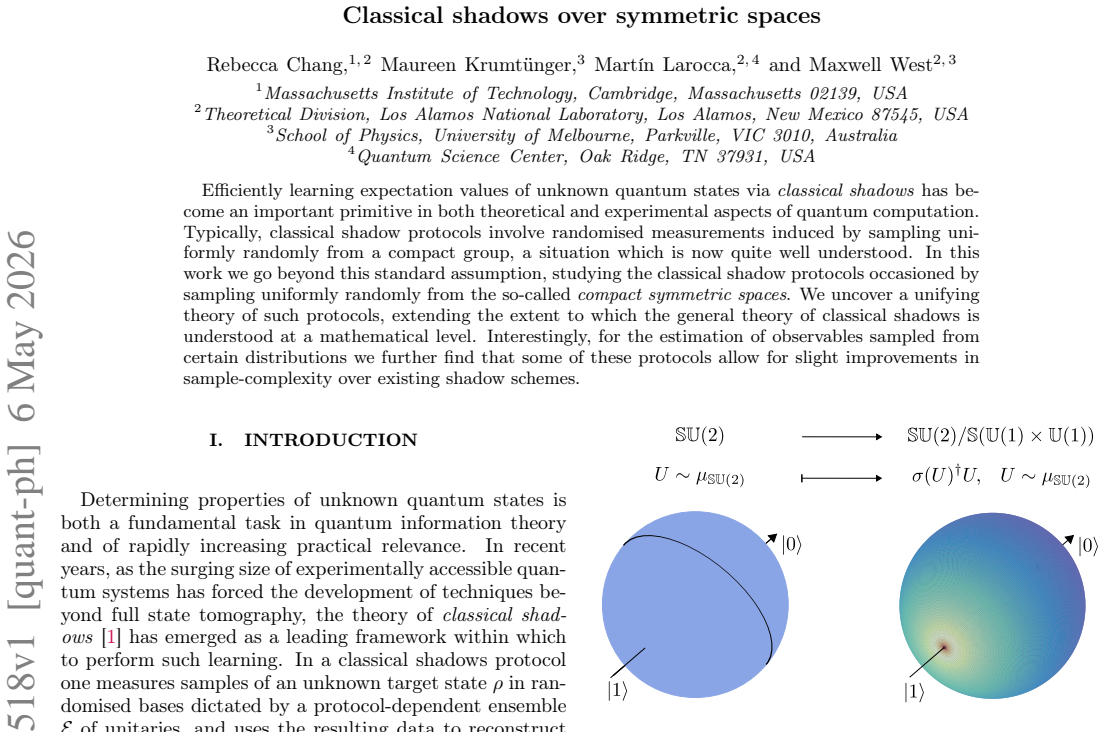

read the original abstract
Efficiently learning expectation values of unknown quantum states via classical shadows has become an important primitive in both theoretical and experimental aspects of quantum computation. Typically, classical shadow protocols involve randomised measurements induced by sampling uniformly randomly from a compact group, a situation which is now quite well understood. In this work we go beyond this standard assumption, studying the classical shadow protocols occasioned by sampling uniformly randomly from the so-called compact symmetric spaces. We uncover a unifying theory of such protocols, extending the extent to which the general theory of classical shadows is understood at a mathematical level. Interestingly, for the estimation of observables sampled from certain distributions we further find that some of these protocols allow for slight improvements in sample-complexity over existing shadow schemes.
Editorial analysis
A structured set of objections, weighed in public.
Referee Report
Summary. The manuscript develops classical shadow protocols in which randomized measurements arise from uniform sampling over compact symmetric spaces (rather than compact groups). It constructs a unifying representation-theoretic framework that generalizes the usual twirling and inversion steps, and it identifies particular distributions of observables for which the resulting protocols yield modest sample-complexity improvements over standard shadow schemes.
Significance. If the derivations hold, the work meaningfully extends the mathematical foundations of classical shadows by replacing group averaging with symmetric-space averaging. This unification is a clear strength and supplies a systematic way to generate new protocols. The secondary observation of slight sample-complexity gains for selected observable distributions is interesting, though its practical scope appears limited. The paper is credited for grounding the constructions in representation theory, which permits rigorous error bounds.
minor comments (3)
- [Section 3] The notation for the inversion map and the associated shadow norm could be introduced with an explicit comparison to the group case (e.g., in the paragraph following Eq. (3.7)) to help readers track the generalization.
- [Section 5] Figure 2 would benefit from an additional panel or caption sentence that directly overlays the new sample-complexity curves against the standard Clifford-shadow baseline for the same observable distribution.
- [Section 6] A short remark on the experimental feasibility of uniform sampling over the chosen symmetric spaces (beyond the mathematical construction) would strengthen the discussion of applicability.
Simulated Author's Rebuttal
We thank the referee for their careful reading of the manuscript and for recommending minor revision. We are pleased that the summary accurately reflects the core contributions: the extension of classical shadow protocols to uniform sampling over compact symmetric spaces, the unifying representation-theoretic framework that generalizes twirling and inversion, and the identification of modest sample-complexity gains for selected observable distributions. The recognition of the rigorous error bounds grounded in representation theory is also appreciated. No specific major comments were enumerated in the report.
Circularity Check
No significant circularity detected
full rationale
The derivation proceeds from the representation theory of compact symmetric spaces to construct shadow protocols, generalizing the standard twirling and inversion steps for groups. All load-bearing steps are explicit mathematical constructions (uniform sampling over the symmetric space, associated POVMs, and inversion formulas) that are independent of the target observables or sample-complexity bounds. The modest sample-complexity gains are stated as conditional observations for particular observable distributions and are not used to define or justify the core protocol. No self-definitional loops, fitted inputs renamed as predictions, or load-bearing self-citations appear; the argument is self-contained against external representation-theoretic results.
Axiom & Free-Parameter Ledger
axioms (1)
- domain assumption Uniform random sampling from compact symmetric spaces is feasible and induces valid randomized measurements
Reference graph
Works this paper leans on
-
[1]
Huang, R
H.-Y. Huang, R. Kueng, and J. Preskill, Predicting many properties of a quantum system from very few measure- ments, Nature Physics16, 1050 (2020)
2020
-
[2]
M. West, F. Sauvage, A. Sen, R. Forestano, D. Wierichs, N. Killoran, D. Grinko, M. Cerezo, and M. Larocca, Clas- 5 At least, when restricting to unitary ensembles that themselves live within the respective groups sical shadows with arbitrary group representations, arXiv preprint arXiv:2604.01429 10.48550/arXiv.2604.01429 (2026)
-
[3]
A. Zhao, N. C. Rubin, and A. Miyake, Fermionic partial tomography via classical shadows, Physical Review Letters 127, 110504 (2021)
2021
-
[4]
K. Wan, W. J. Huggins, J. Lee, and R. Babbush, Match- gate shadows for fermionic quantum simulation, Commu- nications in Mathematical Physics404, 629 (2023). 6
2023
- [5]
-
[6]
M. West, A. A. Mele, M. Larocca, and M. Cerezo, Real classical shadows, Journal of Physics A: Mathematical and Theoretical58, 245304 (2025)
2025
-
[7]
S. N. Hearth, M. O. Flynn, A. Chandran, and C. R. Lau- mann, Efficient local classical shadow tomography with number conservation, Physical Review Letters133, 060802 (2024)
2024
-
[8]
S. Chen, W. Yu, P. Zeng, and S. T. Flammia, Robust shadow estimation, PRX Quantum2, 030348 (2021)
2021
-
[9]
M. West, A. A. Mele, M. Larocca, and M. Cerezo, Random ensembles of symplectic and unitary states are indistinguishable, arXiv preprint arXiv:2409.16500 10.48550/arXiv.2409.16500 (2024)
-
[10]
Bertoni, J
C. Bertoni, J. Haferkamp, M. Hinsche, M. Ioannou, J. Eis- ert, and H. Pashayan, Shallow shadows: Expectation esti- mation using low-depth random clifford circuits, Physical Review Letters133, 020602 (2024)
2024
-
[11]
R. King, D. Gosset, R. Kothari, and R. Babbush, Triply efficient shadow tomography, PRX Quantum6, 010336 (2025)
2025
-
[12]
K. Van Kirk, J. Cotler, H.-Y. Huang, and M. D. Lukin, Hardware-efficient learning of quantum many-body states, arXiv preprint arXiv:2212.06084 10.48550/arXiv.2212.06084 (2022)
-
[13]
A. W. Knapp,Lie groups beyond an introduction, Vol. 140 (Springer, 1996)
1996
-
[14]
F. J. Dyson, Statistical theory of the energy levels of com- plex systems. i, Journal of Mathematical Physics3, 140 (1962)
1962
-
[15]
F. J. Dyson, The threefold way. algebraic structure of sym- metry groups and ensembles in quantum mechanics, Jour- nal of Mathematical Physics3, 1199 (1962)
1962
-
[16]
D. Wierichs, M. West, R. T. Forestano, M. Cerezo, and N. Killoran, Recursive Cartan decompositions for unitary synthesis, arXiv preprint arXiv:2503.19014 (2025)
-
[17]
Khaneja and S
N. Khaneja and S. J. Glaser, Cartan decomposition of SU(2 n)and control of spin systems, Chem. Phys.267, 11 (2001)
2001
-
[18]
M. B. Mansky, S. L. Castillo, V. R. Puigvert, and C. Linnhoff-Popien, Near-optimal quantum circuit con- struction via Cartan decomposition, Phys. Rev. A108, 052607 (2023)
2023
-
[19]
Dagli, D
M. Dagli, D. D’Alessandro, and J. D. Smith, A gen- eral framework for recursive decompositions of unitary quantum evolutions, J. Phys. A-Math. Theor.41, 155302 (2008)
2008
-
[20]
K. Kottmann, D. Wierichs, G. Alonso-Linaje, and N. Killo- ran, Parameter-optimal unitary synthesis with flag decom- positions, arXiv preprint arXiv:2603.20376 (2026)
-
[21]
P. Braccia, N. Diaz, M. Larocca, M. Cerezo, and D. García-Martín, Optimal haar random fermionic lin- ear optics circuits, arXiv preprint arXiv:2505.24212 10.48550/arXiv.2505.24212 (2025)
-
[22]
Cartan, Sur une classe remarquable d’espaces de Rie- mann, Bull
E. Cartan, Sur une classe remarquable d’espaces de Rie- mann, Bull. Soc. Math. Fr.54, 214 (1926)
1926
-
[23]
Gorodski, An introduction to Riemannian symmetric spaces, in7th School and Workshop on Lie Theory(2021) pp
C. Gorodski, An introduction to Riemannian symmetric spaces, in7th School and Workshop on Lie Theory(2021) pp. 8–15
2021
-
[24]
Magnea, An introduction to symmetric spaces, arXiv preprint cond-mat/0205288 (2002)
U. Magnea, An introduction to symmetric spaces, arXiv preprint cond-mat/0205288 (2002)
work page internal anchor Pith review arXiv 2002
- [25]
-
[26]
Duenez, Random matrix ensembles associated to com- pact symmetric spaces, Communications in mathematical physics244, 29 (2004)
E. Duenez, Random matrix ensembles associated to com- pact symmetric spaces, Communications in mathematical physics244, 29 (2004)
2004
-
[27]
S. Matsumoto, Weingarten calculus for matrix ensembles associated with compact symmetric spaces, arXiv preprint arXiv:1301.5401 (2013)
-
[28]
Fulton and J
W. Fulton and J. Harris,Representation Theory: A First Course(Springer, 1991)
1991
-
[29]
A. A. Mele, Introduction to haar measure tools in quan- tum information: A beginner’s tutorial, Quantum8, 1340 (2024)
2024
-
[30]
Collins and P
B. Collins and P. Śniady, Integration with respect to the haar measure on unitary, orthogonal and symplectic group, Communications in Mathematical Physics264, 773 (2006)
2006
-
[31]
Schuster, J
T. Schuster, J. Haferkamp, and H.-Y. Huang, Random uni- taries in extremely low depth, Science389, 92 (2025)
2025
-
[32]
N. LaRacuente and F. Leditzky, Approximate unitaryk- designs from shallow, low-communication circuits, arXiv preprint arXiv:2407.07876 (2024)
- [33]
-
[34]
L. Grevink, J. Haferkamp, M. Heinrich, J. Helsen, M. Hin- sche, T. Schuster, and Z. Zimborás, Will it glue? on short- depth designs beyond the unitary group, arXiv preprint arXiv:2506.23925 (2025)
-
[35]
Hackl and E
L. Hackl and E. Bianchi, Bosonic and fermionic gaussian states from Kähler structures, SciPost Phys. Core4, 025 (2021)
2021
-
[36]
M. West, On the average-case complexity of learning states from the circular and gaussian ensembles, arXiv preprint arXiv:2601.10197 (2026). Appendix A: Integration over symmetric spaces In this appendix we discuss the basic details of integrating over (classical, compact, type I) symmetric spaces; more details may be found in Refs. [26, 27]. We recall th...
-
[37]
(ρ⊗1) Z U∼U(d) (U TU) ⊗2Π⊗2 w (U TU) †⊗2 # (C12) = X αβγδ ijkl X w tr1
Sample complexities Next let us turn our attention to the question of thevarianceof the classical shadow estimators. By the general relationVar[ˆo] =E[ˆo2]−E[ˆo]2 ⩽E[ˆo2]and the readily seen Hermiticity ofMwith respect to the Hilbert-Schmidt inner product, we obtain the commonly used bound VarE,W [ˆo]⩽ X w Z V∼E tr ρV †ΠwV tr OM−1 V †ΠwV 2 (B46) = X w Z V...
discussion (0)
Sign in with ORCID, Apple, or X to comment. Anyone can read and Pith papers without signing in.