Eigenstate-Selective Entangled Two-Photon Absorption in Monolayer WSe₂
Pith reviewed 2026-05-08 11:43 UTC · model grok-4.3
The pith
The phase of a polarization-entangled photon pair selects which biexciton eigenstates are populated in monolayer WSe₂.
A machine-rendered reading of the paper's core claim, the machinery that carries it, and where it could break.
Core claim
In a frequency-nondegenerate ladder scheme, the biphoton phase φ sets the relative amplitude between the two independent valley pathways. Within the valley-symmetric limit this phase factorizes from the material response, partitioning the biexciton eigenstate distribution according to φ: the symmetric Bell state (φ = 0) selectively drives bright eigenstates while the antisymmetric state (φ = π) drives the exchange-dark eigenstate. No classical polarization source reproduces this φ-dependent distribution.
What carries the argument
Factorization of the biphoton Bell-state phase from the material response in the valley-symmetric limit, which partitions excitation among biexciton eigenstates according to φ.
If this is right
- The symmetric Bell state selectively populates bright biexciton eigenstates.
- The antisymmetric Bell state selectively populates the exchange-dark eigenstate.
- Classical polarization sources cannot replicate the phase-dependent eigenstate distribution.
- Phase-scan visibility exceeds 0.97 at 4 K for broadband SPDC sources with high purity even after valley dephasing and intervalley scattering.
Where Pith is reading between the lines
- The same phase-control mechanism may apply to other valleytronic 2D materials where ladder pathways remain valley-decoupled.
- This selection rule could be used to prepare specific biexciton states for quantum-optics experiments without additional filtering.
- Extending the scheme to entangled photon sources with tunable bandwidth would test how the visibility scales with dephasing time.
Load-bearing premise
The two valley pathways share no intermediate state and the phase factorizes from the material response inside the valley-symmetric limit.
What would settle it
A measurement showing that classical light with the same polarization statistics produces identical bright-to-dark eigenstate ratios as the entangled source, or that the phase-scan visibility falls below 0.97 under the stated dephasing conditions.
Figures


read the original abstract
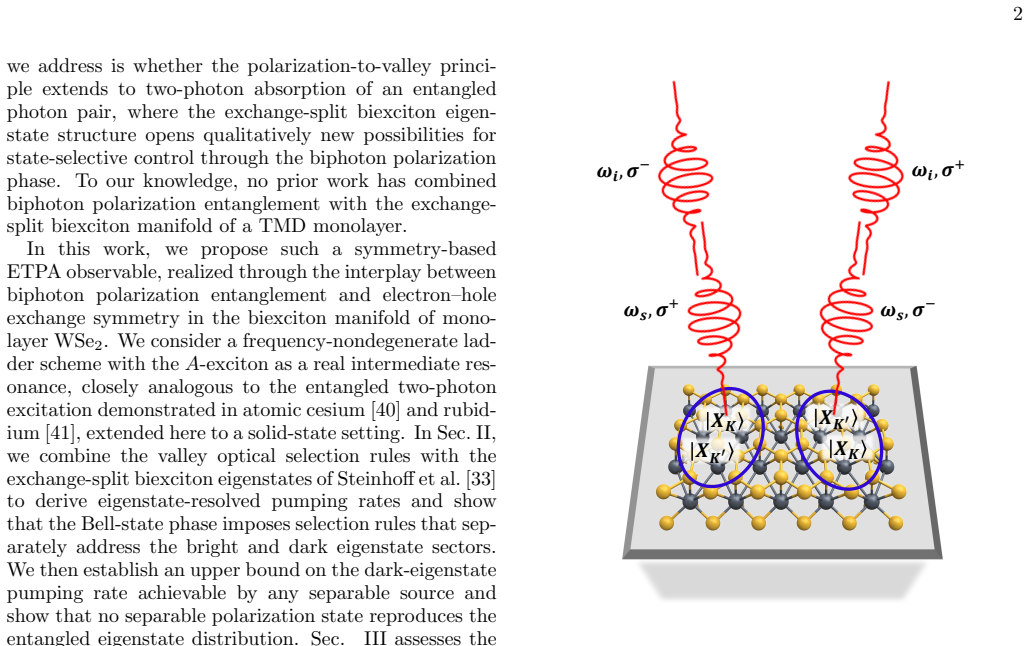
We show that the Bell-state phase of a polarization-entangled photon pair controls the biexciton eigenstate distribution produced by entangled two-photon absorption (ETPA) in monolayer WSe$_2$. In a frequency-nondegenerate ladder scheme, two independent valley pathways ($K$ and $K'$) share no intermediate state, so the biphoton phase sets the relative amplitude between them. Within the valley-symmetric limit this phase factorizes from the material response, and the resulting selection rule partitions the excitation among biexciton eigenstates according to the Bell-state phase $\varphi$. The symmetric Bell state ($\varphi = 0$) selectively drives bright eigenstates, while the antisymmetric state ($\varphi = \pi$) drives the exchange-dark eigenstate. No classical polarization source reproduces this $\varphi$-dependent eigenstate distribution. Including valley dephasing and intervalley scattering at 4~K, the phase-scan visibility exceeds $0.97$ for broadband SPDC ($T_e \sim 100$~fs) with high source purity.
Editorial analysis
A structured set of objections, weighed in public.
Referee Report
Summary. The manuscript claims that the Bell-state phase φ of a polarization-entangled photon pair controls the biexciton eigenstate distribution in monolayer WSe₂ via entangled two-photon absorption (ETPA) in a frequency-nondegenerate ladder. Because the K and K′ valley pathways share no intermediate state, the phase factorizes from the material response within the valley-symmetric limit, so that φ=0 selectively populates bright eigenstates while φ=π populates the exchange-dark eigenstate. No classical polarization source reproduces the φ-dependent distribution, and the phase-scan visibility remains >0.97 even after including valley dephasing and intervalley scattering at 4 K for broadband SPDC sources with high purity.
Significance. If the independence of the valley pathways holds, the result would demonstrate a clean, phase-controlled quantum-optical selection rule for accessing both bright and exchange-dark biexciton states in a 2D material. The explicit contrast with classical sources and the reported robustness against realistic dephasing constitute concrete, falsifiable predictions that strengthen the work. The absence of free parameters in the selection rule (within the stated limit) is a notable strength.
major comments (1)
- [theoretical model / valley-pathway analysis] The load-bearing assumption that the K and K′ pathways share no intermediate state in the frequency-nondegenerate ladder (stated in the abstract and developed in the theoretical model) must be justified more rigorously. Any residual virtual-state overlap or weak intervalley mixing would generate cross terms that prevent clean factorization of φ and could allow classical sources to mimic the reported eigenstate distribution. The manuscript should either derive the absence of shared intermediates from the band structure or quantify the visibility degradation for small mixing amplitudes.
minor comments (2)
- [results / visibility analysis] The visibility calculation at 4 K (including dephasing rates and source purity) should be presented with explicit equations and parameter values so that the >0.97 figure can be reproduced.
- [throughout] Notation for the biexciton eigenstates (bright vs. exchange-dark) and the biphoton phase φ should be defined once at first use and used consistently; a short table summarizing the selection rule for φ=0 and φ=π would improve clarity.
Simulated Author's Rebuttal
We thank the referee for their constructive assessment and for highlighting the need for a more rigorous treatment of the valley-pathway independence. We address the major comment below and will incorporate the requested justification into the revised manuscript.
read point-by-point responses
-
Referee: The load-bearing assumption that the K and K′ pathways share no intermediate state in the frequency-nondegenerate ladder (stated in the abstract and developed in the theoretical model) must be justified more rigorously. Any residual virtual-state overlap or weak intervalley mixing would generate cross terms that prevent clean factorization of φ and could allow classical sources to mimic the reported eigenstate distribution. The manuscript should either derive the absence of shared intermediates from the band structure or quantify the visibility degradation for small mixing amplitudes.
Authors: We agree that the independence of the K and K′ pathways requires explicit derivation from the band structure rather than assertion. In the revised manuscript we will add a dedicated subsection (and supporting appendix) that starts from the valley-dependent single-particle Hamiltonian of monolayer WSe₂ in the effective-mass approximation. The frequency-nondegenerate ladder is defined such that one photon is resonant with the K-valley A-exciton transition while the second photon addresses the K′-valley transition; because the conduction- and valence-band extrema are separated by ~2.5 Å⁻¹ in momentum space and intervalley matrix elements vanish at linear order in the absence of defects or strong spin-orbit mixing, the virtual intermediate exciton states for the two pathways are orthogonal. We will explicitly show that the two-photon amplitude factorizes as A_K(ω₁) A_{K′}(ω₂) e^{iφ} + A_{K′}(ω₁) A_K(ω₂) e^{-iφ} with no cross terms when intervalley mixing amplitude ε = 0. To address the second part of the comment, we will also include a perturbative calculation of visibility degradation for small ε, demonstrating that the phase-scan visibility remains >0.90 for ε ≲ 0.05 (well within the regime expected for high-quality samples at 4 K). These additions will be placed immediately after the current theoretical-model paragraph and will be cross-referenced in the abstract. revision: yes
Circularity Check
No significant circularity; derivation follows from stated valley geometry
full rationale
The paper derives the Bell-state phase control over biexciton eigenstate distribution directly from the physical setup of a frequency-nondegenerate ladder with two independent valley pathways (K and K') that share no intermediate state, within the valley-symmetric limit. This leads to phase factorization from the material response and the resulting selection rule (symmetric Bell state drives bright eigenstates, antisymmetric drives exchange-dark). No equations, fitted parameters, or self-citations are shown reducing the central claim to its own inputs by construction; the independence assumption is presented as a property of the WSe2 band structure and scheme rather than a self-referential fit or imported uniqueness theorem. The result is self-contained as a logical consequence of the geometry, consistent with external benchmarks for such systems.
Axiom & Free-Parameter Ledger
axioms (2)
- domain assumption Valley-symmetric limit in which the biphoton phase factorizes from the material response
- domain assumption Two independent valley pathways share no intermediate state
Reference graph
Works this paper leans on
-
[1]
Biexciton eigenstates from the exchange Hamiltonian [33]
Eigenstate decomposition of the cross-circular sector The symmetric and antisymmetric superpositions of |B2⟩and|B 3⟩have distinct eigenstate decompositions (Table I): 1√ 2(|B2⟩+|B 3⟩) =− 1√ 3 |Φ1⟩+ 1√ 2 |Φ2⟩+ 1√ 6 |Φ6⟩, (17a) 1√ 2(|B2⟩ − |B3⟩) =|Φ 3⟩.(17b) 5 TABLE I. Biexciton eigenstates from the exchange Hamiltonian [33]. Single (↑/↓) and double (⇑/⇓) a...
-
[2]
Since the eigen- state decomposition [Eqs
Exact phase factorization Time-reversal symmetry of the TMD band structure at zero magnetic field guarantees identical dipole ma- trix elements and dephasing rates in the two valleys (d(K) 0 =d (K′) 0 ,γ K =γ K′), so that the two-photon ker- nels satisfyT 2(ω) =T 3(ω)≡T(ω). Since the eigen- state decomposition [Eqs. (17a) and (17b)] shows that M2 +M 3 con...
-
[3]
Dominant-contraction approximation A further simplification arises from the non-degenerate excitation scheme. Because the signal and idler central frequencies are separated by the binding energyE (Φα) B ≫ℏγ X ≈1.5 meV [46, 47], only one time-ordering has a resonant intermediate state. The suppression ratio is |T(ω i)|2 |T(ω s)|2 = ℏ2γ2 X (E(Φα) B )2 +ℏ 2γ...
-
[4]
give Wα(φ) =κ α|gα|2 pσ+σ− +p σ−σ+ + 2Re(ρσ+σ−,σ−σ+) =κ α|gα|2(1 + cosφ), α∈ {1,2,6}. (34) Every bright eigenstate individually carries the same (1+ cosφ) modulation; only the overall scaleκ α|gα|2 differs. For the dark eigenstate (the antisymmetric superposition |B2⟩ − |B 3⟩), the cross term⟨Φ 3|B2⟩ ⟨B3|Φ3⟩=−1/2 reverses the coherence contribution, repla...
-
[5]
Any such state has positive partial transpose (PPT) [48, 49]
General classical bound A separable (classical) polarization state can be de- composed as an incoherent mixture of product states, ρsep =P k qk ρ(k) s ⊗ρ (k) i (qk ≥0, P k qk = 1). Any such state has positive partial transpose (PPT) [48, 49]. Ap- plied to the 2×2 principal submatrix ofρ Ti indexed by {|σ+σ+⟩,|σ −σ−⟩}, PPT requires that its determinant be ...
-
[6]
Eigenstate-distribution consequences The co-circular analog of Eq. (27) follows from re- stricting the polarization sum to the same-helicity pairs (σ+, σ+)→ |B 1⟩and (σ −, σ−)→ |B 6⟩: W (co) α =κ (co) α X (µν),(µ′ν′) ⟨Φα|Bµν⟩ ⟨Bµ′ν′|Φα⟩ρ µν,µ′ν′, (40) where (µν),(µ ′ν′)∈ {(σ +σ+),(σ −σ−)}with co-circular populationsp σ+σ+,p σ−σ− and coherenceρ σ+σ+,σ−σ−. ...
work page 2025
-
[7]
Using the linear-in-flux scaling of ETPA in the isolated-pair regime [3, 16], the pumping rate is Wα =κ α X µ1µ2,µ′ 1µ′ 2 ⟨Φα|Bµ1µ2 ⟩ ⟨Bµ′ 1µ′ 2 |Φα⟩ρ µ1µ2,µ′ 1µ′ 2 ,(C4) with κα ≡κ 0 γ2 B (ωΦαg −ω p)2 +γ 2 B , κ 0 ≡R pairs 2π2 |N |2|T |2 T 2e γ2 B . The factorization now separates the eigenstate geome- try and light correlations exactly as before, but it...
-
[8]
Tripartite state, decoherence factor, and mean dwell time After the signal photon is absorbed from|ψ(φ)⟩ Bell [Eq. (30)], but before the idler arrives, the joint state of (material + idler photon + environment) is 16 |ψtot(t)⟩= 1√ 2 |XK⟩ |σ−⟩i |EK(t)⟩ +e iφ |XK′⟩ |σ+⟩i |EK′(t)⟩ , (D1) where|E K(t)⟩and|E K′(t)⟩are the environmental states conditioned on th...
-
[9]
An exciton created in valleyKat dwell timeτ= 0 survives inKwith probabilitye −γivτ
Combined visibility from intervalley scattering Unlike valley dephasing, which degrades the off- diagonal coherence without changing the pathway popu- lation, intervalley scattering physically transfers the in- termediate exciton from one valley to the other at rate γiv. An exciton created in valleyKat dwell timeτ= 0 survives inKwith probabilitye −γivτ. A...
-
[10]
K. E. Dorfman, F. Schlawin, and S. Mukamel, Nonlin- ear optical signals and spectroscopy with quantum light, Rev. Mod. Phys.88, 045008 (2016)
work page 2016
-
[11]
F. Schlawin, K. E. Dorfman, and S. Mukamel, Entangled two-photon absorption spectroscopy, Acc. Chem. Res. 51, 2207 (2018)
work page 2018
-
[12]
M. G. Raymer, T. Landes, and A. H. Marcus, Entangled two-photon absorption by atoms and molecules: A quan- tum optics tutorial, J. Chem. Phys.155, 081501 (2021)
work page 2021
- [13]
- [14]
-
[15]
O. Varnavski, B. Pinsky, and T. Goodson, Entangled photon excited fluorescence in organic materials: An ul- trafast coincidence detector, J. Phys. Chem. Lett.8, 388 (2017)
work page 2017
-
[16]
J. P. Villabona-Monsalve, O. Calder´ on-Losada, M. N. nez Portela, and A. Valencia, Entangled two photon absorp- tion cross section on the 808 nm region for the com- mon dyes zinc tetraphenylporphyrin and rhodamine b, J. Phys. Chem. A121, 7869 (2017)
work page 2017
- [17]
-
[18]
K. M. Parzuchowski, A. Mikhaylov, M. D. Mazurek, R. N. Wilson, D. J. Lum, T. Gerrits, C. H. Camp, M. J. Stevens, and R. Jimenez, Setting bounds on entangled two-photon absorption cross sections in common fluo- rophores, Phys. Rev. Appl.15, 044012 (2021)
work page 2021
-
[19]
M. He, B. P. Hickam, N. Harper, S. Szoke, and S. K. Cushing, Experimental upper bounds for resonance- enhanced entangled two-photon absorption cross section of indocyanine green, J. Chem. Phys.160, 094305 (2024)
work page 2024
-
[20]
A. Mikhaylov, R. N. Wilson, K. M. Parzuchowski, M. D. Mazurek, J. C. H. Camp, M. J. Stevens, and R. Jimenez, Hot-band absorption can mimic entangled two-photon absorption, J. Phys. Chem. Lett.13, 1489 (2022)
work page 2022
-
[21]
B. P. Hickam, M. He, N. Harper, S. Szoke, and S. K. Cushing, Single-photon scattering can account for the discrepancies among entangled two-photon measurement techniques, J. Phys. Chem. Lett.13, 4934 (2022)
work page 2022
-
[22]
F. Triana-Arango, R. Ram´ ırez-Alarc´ on, and G. Ramos- Ortiz, Entangled two-photon absorption in transmission- based experiments: Deleterious effects from linear optical losses, J. Phys. Chem. A128, 2210 (2024)
work page 2024
-
[23]
H.-B. Fei, B. M. Jost, S. Popescu, B. E. A. Saleh, and M. C. Teich, Entanglement-induced two-photon trans- parency, Phys. Rev. Lett.78, 1679 (1997)
work page 1997
-
[24]
A. Muthukrishnan, G. S. Agarwal, and M. O. Scully, In- ducing disallowed two-atom transitions with temporally entangled photons, Phys. Rev. Lett.93, 093002 (2004)
work page 2004
-
[25]
F. Schlawin, K. E. Dorfman, B. P. Fingerhut, and S. Mukamel, Manipulation of two-photon-induced fluo- rescence spectra of chromophore aggregates with entan- gled photons: A simulation study, Phys. Rev. A86, 023851 (2012)
work page 2012
-
[26]
Oka, Entangled two-photon absorption spectroscopy for optically forbidden transition detection, J
H. Oka, Entangled two-photon absorption spectroscopy for optically forbidden transition detection, J. Chem. Phys.152, 044106 (2020)
work page 2020
-
[27]
D. Xiao, G.-B. Liu, W. Feng, X. Xu, and W. Yao, Cou- 18 pled spin and valley physics in monolayers of MoS 2 and other group-VI dichalcogenides, Phys. Rev. Lett.108, 196802 (2012)
work page 2012
-
[28]
K. F. Mak, K. He, J. Shan, and T. F. Heinz, Control of valley polarization in monolayer MoS2 by optical helicity, Nat. Nanotechnol.7, 494 (2012)
work page 2012
-
[29]
H. Zeng, J. Dai, W. Yao, D. Xiao, and X. Cui, Valley po- larization in MoS 2 monolayers by optical pumping, Nat. Nanotechnol.7, 490 (2012)
work page 2012
-
[30]
T. Cao, G. Wang, W. Han, L. Ye, C. Zhu, J. Shi, Q. Niu, P. Tan, E. Wang, B. Liu, and J. Feng, Valley-selective circular dichroism of monolayer molybdenum disulphide, Nat. Commun.3, 887 (2012)
work page 2012
-
[31]
K. F. Mak, C. Lee, J. Hone, J. Shan, and T. F. Heinz, Atomically thin MoS2: A new direct-gap semiconductor, Phys. Rev. Lett.105, 136805 (2010)
work page 2010
-
[32]
A. Chernikov, T. C. Berkelbach, H. M. Hill, A. Rigosi, Y. Li, B. Aslan, D. R. Reichman, M. S. Hybertsen, and T. F. Heinz, Exciton binding energy and nonhydrogenic Rydberg series in monolayer WS2, Phys. Rev. Lett.113, 076802 (2014)
work page 2014
-
[33]
G. Wang, A. Chernikov, M. M. Glazov, T. F. Heinz, X. Marie, T. Amand, and B. Urbaszek, Colloquium: Excitons in atomically thin transition metal dichalco- genides, Rev. Mod. Phys.90, 021001 (2018)
work page 2018
-
[34]
X. Xu, W. Yao, D. Xiao, and T. F. Heinz, Spin and pseudospins in layered transition metal dichalcogenides, Nat. Phys.10, 343 (2014)
work page 2014
-
[35]
J. R. Schaibley, H. Yu, G. Clark, P. Rivera, J. S. Ross, K. L. Seyler, W. Yao, and X. Xu, Valleytronics in 2D materials, Nat. Rev. Mater.1, 16055 (2016)
work page 2016
-
[36]
H. Yu, X. Cui, X. Xu, and W. Yao, Valley excitons in two-dimensional semiconductors, Natl. Sci. Rev.2, 57 (2015)
work page 2015
- [37]
- [38]
-
[39]
K. Hao, J. F. Specht, P. Nagler, L. Xu, K. Tran, A. Singh, C. K. Dass, C. Sch¨ uller, T. Korn, M. Richter, A. Knorr, X. Li, and G. Moody, Neutral and charged inter-valley biexcitons in monolayer MoSe 2, Nat. Commun.8, 15552 (2017)
work page 2017
-
[40]
Barboneet al., Charge-tuneable biexciton complexes in monolayer WSe2, Nat
M. Barboneet al., Charge-tuneable biexciton complexes in monolayer WSe2, Nat. Commun.9, 3721 (2018)
work page 2018
-
[41]
S.-Y. Chen, T. Goldstein, T. Taniguchi, K. Watanabe, and J. Yan, Coulomb-bound four- and five-particle inter- valley states in an atomically-thin semiconductor, Nat. Commun.9, 3717 (2018)
work page 2018
-
[42]
A. Steinhoff, M. Florian, A. Singh, K. Tran, M. Ko- larczik, S. Helmrich, A. W. Achtstein, U. Woggon, N. Owschimikow, F. Jahnke, and X. Li, Biexciton fine structure in monolayer transition metal dichalcogenides, Nat. Phys.14, 1199 (2018)
work page 2018
-
[43]
Zhanget al., Magnetic brightening and control of dark excitons in monolayer WSe2, Nat
X.-X. Zhanget al., Magnetic brightening and control of dark excitons in monolayer WSe2, Nat. Nanotechnol.12, 883 (2017)
work page 2017
-
[44]
M. R. Molas, C. Faugeras, A. O. Slobodeniuk, K. No- gajewski, M. Bartos, D. M. Basko, and M. Potemski, Brightening of dark excitons in monolayers of semicon- ducting transition metal dichalcogenides, 2D Mater.4, 021003 (2017)
work page 2017
-
[45]
G. Wanget al., In-plane propagation of light in transition metal dichalcogenide monolayers: Optical selection rules, Phys. Rev. Lett.119, 047401 (2017)
work page 2017
-
[46]
D. Erkensten, S. Brem, and E. Malic, Exciton-exciton interaction in transition metal dichalcogenide monolayers and van der Waals heterostructures, Phys. Rev. B103, 045426 (2021)
work page 2021
-
[47]
V. Shahnazaryan, I. Iorsh, I. A. Shelykh, and O. Kyri- ienko, Exciton-exciton interaction in transition-metal dichalcogenide monolayers, Phys. Rev. B96, 115409 (2017)
work page 2017
- [48]
-
[49]
N. P. Georgiades, E. S. Polzik, K. Edamatsu, H. J. Kim- ble, and A. S. Parkins, Nonclassical excitation for atoms in a squeezed vacuum, Phys. Rev. Lett.75, 3426 (1995)
work page 1995
- [50]
-
[51]
Y. H. Shih,An Introduction to Quantum Optics: Photon and Biphoton Physics, 2nd ed. (CRC Press, 2021)
work page 2021
-
[52]
T. Kim, M. Fiorentino, and F. N. C. Wong, Phase-stable source of polarization-entangled photons using a polar- ization Sagnac interferometer, Phys. Rev. A73, 012316 (2006)
work page 2006
-
[53]
A. Fedrizzi, T. Herbst, A. Poppe, T. Jennewein, and A. Zeilinger, A wavelength-tunable fiber-coupled source of narrowband entangled photons, Opt. Express15, 15377 (2007)
work page 2007
-
[54]
N. Tischler, M. Krenn, R. Fickler, X. Vidal, A. Zeilinger, and G. Molina-Terriza, Quantum optical rotary disper- sion, Sci. Adv.2, e1601306 (2016)
work page 2016
-
[55]
F. Cadiz, E. Courtade, C. Robert, G. Wang, Y. Shen, H. Cai, T. Taniguchi, K. Watanabe, H. Carr` ere, D. La- garde, M. Manca, T. Amand, P. Renucci, S. Tongay, X. Marie, and B. Urbaszek, Excitonic linewidth ap- proaching the homogeneous limit in MoS 2-based van der Waals heterostructures, Phys. Rev. X7, 021026 (2017)
work page 2017
-
[56]
O. A. Ajayi, J. V. Ardelean, G. D. Shepard, J. Wang, A. Antony, T. Taniguchi, K. Watanabe, T. F. Heinz, S. Strauf, X.-Y. Zhu, and J. C. Hone, Approaching the intrinsic photoluminescence linewidth in transition metal dichalcogenide monolayers, 2D Mater.4, 031011 (2017)
work page 2017
-
[57]
Peres, Separability criterion for density matrices, Phys
A. Peres, Separability criterion for density matrices, Phys. Rev. Lett.77, 1413 (1996)
work page 1996
-
[58]
M. Horodecki, P. Horodecki, and R. Horodecki, Separa- bility of mixed states: necessary and sufficient conditions, Phys. Lett. A223, 1 (1996)
work page 1996
-
[59]
D. J. Bamford, L. E. Jusinski, and W. K. Bischel, Abso- lute two-photon absorption and three-photon ionization cross sections for atomic oxygen, Phys. Rev. A34, 185 (1986)
work page 1986
-
[60]
C. Eichhorn, S. Kuhn, F. Scholze, and G. Schmid, Sin- gle and two-photon absorption laser-induced fluorescence spectroscopy in rare gases for gridded ion thruster plume diagnostics, EPJ Tech. Instrum.9, 2 (2022)
work page 2022
- [61]
-
[62]
C. R. Zhu, K. Zhang, M. Glazov, B. Urbaszek, T. Amand, Z. W. Ji, B. L. Liu, and X. Marie, Exciton valley dynam- 19 ics probed by Kerr rotation in WSe 2 monolayers, Phys. Rev. B90, 161302 (2014)
work page 2014
-
[63]
M. M. Glazov, T. Amand, X. Marie, D. Lagarde, L. Bouet, and B. Urbaszek, Exciton fine structure and spin decoherence in monolayers of transition metal dichalcogenides, Phys. Rev. B89, 201302 (2014)
work page 2014
-
[64]
M. Z. Maialle, E. A. de Andrada e Silva, and L. J. Sham, Exciton spin dynamics in quantum wells, Phys. Rev. B 47, 15776 (1993)
work page 1993
-
[65]
G. Moody, C. K. Dass, K. Hao, C.-H. Chen, L.-J. Li, A. Singh, K. Tran, G. Clark, X. Xu, G. Bergh¨ auser, E. Mali´ c, A. Knorr, and X. Li, Intrinsic homogeneous linewidth and broadening mechanisms of excitons in monolayer transition metal dichalcogenides, Nat. Com- mun.6, 8315 (2015)
work page 2015
-
[66]
A. M. Jones, H. Yu, N. J. Ghimire, S. Wu, G. Aivazian, J. S. Ross, B. Zhao, J. Yan, D. G. Mandrus, D. Xiao, W. Yao, and X. Xu, Optical generation of excitonic valley coherence in monolayer WSe 2, Nat. Nanotechnol.8, 634 (2013)
work page 2013
-
[67]
K. Hao, G. Moody, F. Wu, C. K. Dass, L. Xu, C.-H. Chen, L. Sun, M.-Y. Li, L.-J. Li, A. H. MacDonald, and X. Li, Direct measurement of exciton valley coherence in monolayer WSe2, Nat. Phys.12, 677 (2016)
work page 2016
-
[68]
Y.-M. He, O. Iff, N. Lundt, V. Baez, M. Davanco, K. Srinivasan, S. H¨ ofling, and C. Schneider, Cascaded emission of single photons from the biexciton in mono- layered WSe2, Nat. Commun.7, 13409 (2016)
work page 2016
-
[69]
W. K. Wootters, Entanglement of formation of an ar- bitrary state of two qubits, Phys. Rev. Lett.80, 2245 (1998)
work page 1998
-
[70]
F. Verstraete, J. Dehaene, and B. D. Moor, Local filter- ing operations on two qubits, Phys. Rev. A64, 010101 (2001)
work page 2001
discussion (0)
Sign in with ORCID, Apple, or X to comment. Anyone can read and Pith papers without signing in.