Recognition: unknown
IY Lyr: A Thick-Disk first-overtone RR Lyrae Star with a Possible Neutron Star Companion
Pith reviewed 2026-05-08 05:23 UTC · model grok-4.3
The pith
An old thick-disk RR Lyrae star has a 1.37 solar mass companion most likely a neutron star.
A machine-rendered reading of the paper's core claim, the machinery that carries it, and where it could break.
Core claim
IY Lyr is established as a first-overtone RR Lyrae star in a binary system. The orbital period is 3.94 years with eccentricity 0.46, mass function 0.65 solar masses from O-C analysis. The companion is confirmed by radial velocity residuals and Gaia proper motions. Combined constraints give an orbital inclination of 94.8 degrees and companion mass of 1.37 solar masses. With thick-disk membership indicated by abundances [Fe/H] ≈ -1.0 and [α/Fe] ≈ +0.27, and kinematics Lz ≈ 1250 kpc km/s, Zmax ≈ 1.31 kpc, the age is old enough to exclude a main-sequence companion, so the companion is most likely a typical neutron star, although a massive white dwarf cannot be ruled out.
What carries the argument
O-C analysis of the pulsation period variations to detect the light-travel time effect from the binary orbit, combined with radial velocity data and Gaia astrometry to determine the full orbital solution and companion mass.
Load-bearing premise
Thick-disk membership based on chemical abundances and kinematics implies an age old enough to rule out a main-sequence companion of 1.37 solar masses.
What would settle it
Detection of a luminous main-sequence companion through high-resolution imaging or detailed spectroscopy would show that the companion is not a compact object.
Figures

read the original abstract
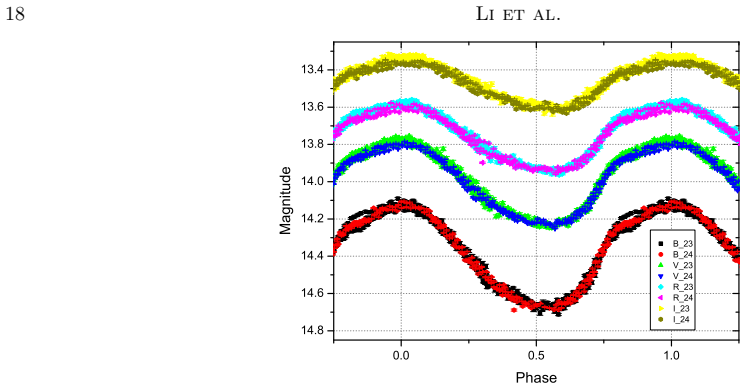
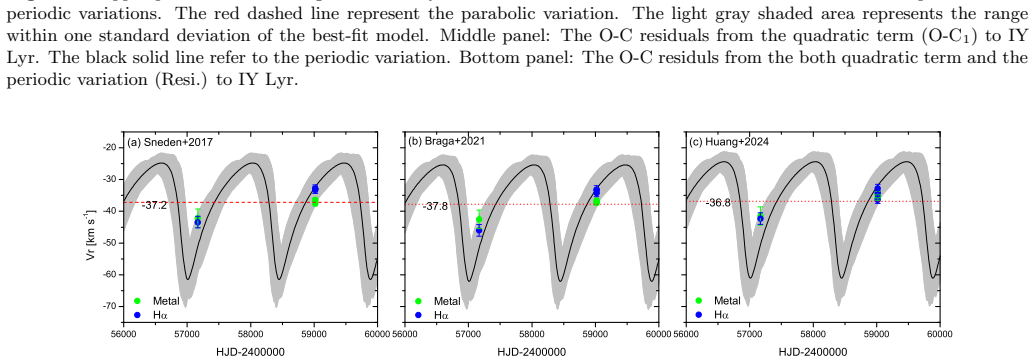
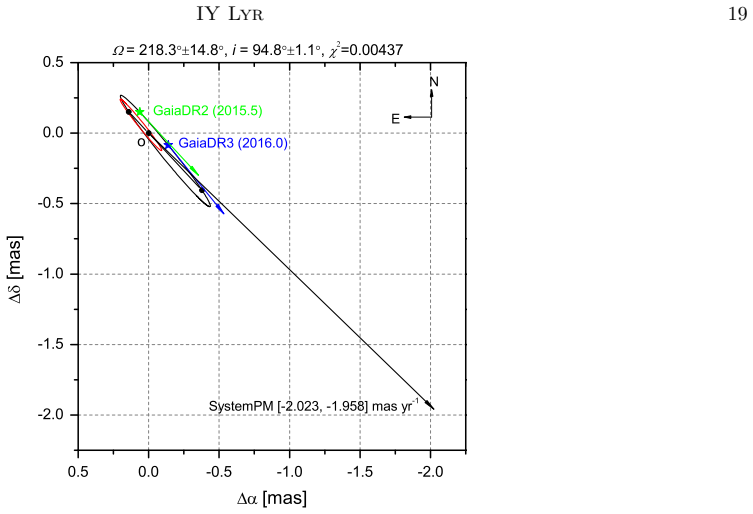
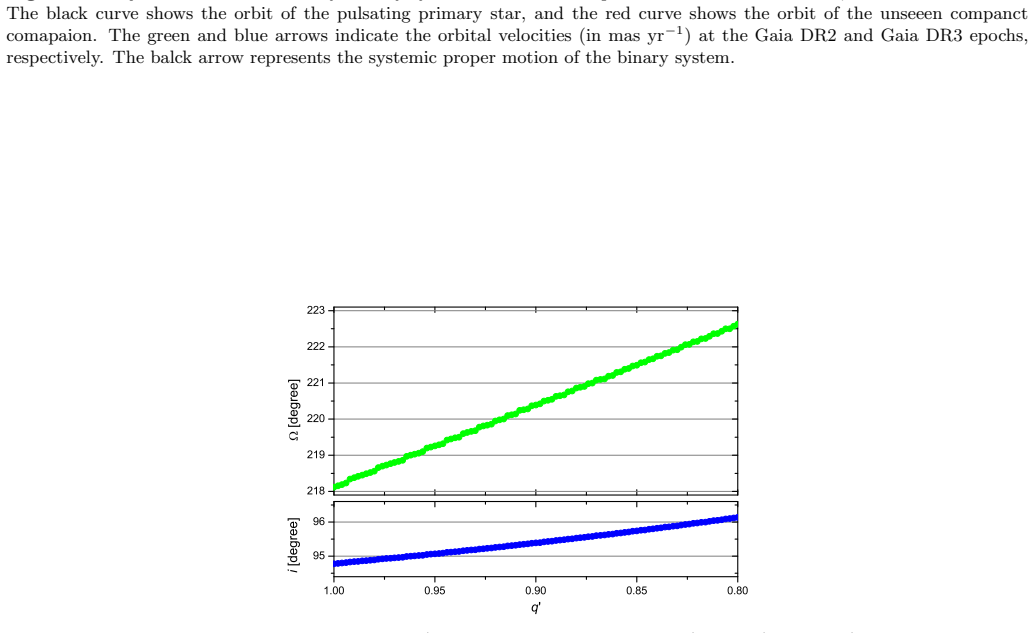
IY Lyr, historically misclassified as an eclipsing binary, is now established as a first-overtone RR Lyrae star (RRc star). Using multi-band photometry (ASAS-SN, ZTF, TESS, and our BVRI data), LAMOST spectroscopy, and Gaia astrometry, we investigate its pulsation, binarity, and Galactic population. From O-C analysis, we detect a long-term period decrease and a light-travel time effect with an orbital period of 3.94 years, eccentricity of 0.46, and a mass function of 0.65 M$_{\odot}$. The companion is independently confirmed by radial velocity residuals and Gaia proper motions. Combined constraints yield an orbital inclination of 94.8$^{\circ}$ and a companion mass of 1.37 M$_{\odot}$. Chemical abundances ([Fe/H] $\simeq$ -1.0, [$\alpha$/Fe] $\simeq$ +0.27, Xiang et al. 2019) and dynamics ($L_{\rm z}$ $\simeq$ 1250 kpc km s$^{-1}$, $Z_{\rm max}$ $\simeq$ 1.31 kpc) identify IY Lyr as an old, high-$\alpha$, thick-disk star. The companion mass lies at the peak of the neutron star mass distribution, and the system's age excludes a main-sequence star; we conclude the companion is most likely a typical neutron star, although a massive white dwarf near the Chandrasekhar limit cannot be ruled out. IY Lyr is among the few RRc binaries with a compact companion verified by multiple methods, and it has important implications for thick-disk binary evolution and neutron star formation.
Editorial analysis
A structured set of objections, weighed in public.
Referee Report
Summary. The manuscript establishes IY Lyr as a first-overtone RR Lyrae (RRc) star rather than an eclipsing binary. Multi-survey photometry (ASAS-SN, ZTF, TESS, BVRI), LAMOST spectroscopy, and Gaia astrometry are used to detect a long-term period decrease plus a light-travel-time effect in the O-C diagram, yielding an orbital period of 3.94 yr, eccentricity 0.46, and mass function 0.65 M⊙. Independent confirmation comes from radial-velocity residuals and Gaia proper-motion anomalies. Combined constraints give an inclination of 94.8° and companion mass 1.37 M⊙. Thick-disk membership is inferred from [Fe/H] ≃ −1.0, [α/Fe] ≃ +0.27, Lz ≃ 1250 kpc km s⁻¹ and Zmax ≃ 1.31 kpc; the system age is invoked to exclude a main-sequence companion, leading to the conclusion that the companion is most likely a neutron star (or possibly a massive white dwarf).
Significance. If the binary detection and compact-object interpretation hold, the result is significant: it adds one of the few RRc systems with a compact companion verified by three independent techniques (photometric timing, spectroscopy, and astrometry). The thick-disk context supplies a rare laboratory for binary evolution and neutron-star formation in an old, high-α population. The paper supplies reproducible multi-band light curves and Gaia data products that could support follow-up.
major comments (2)
- [Abstract and concluding section] Abstract and final paragraph: the statement that 'the system's age excludes a main-sequence star' rests on population-level thick-disk indicators ([Fe/H] ≃ −1.0, [α/Fe] ≃ +0.27, Lz ≃ 1250 kpc km s⁻¹, Zmax ≃ 1.31 kpc) implying age ≳ 8 Gyr. No individual age (isochrone fit to the RR Lyrae, asteroseismic constraints, or otherwise) is reported. Because a 1.37 M⊙ main-sequence star has a lifetime of ~3–5 Gyr, a younger main-sequence companion remains viable and the compact-object conclusion is not required by the data.
- [O-C analysis] O-C analysis section: the exact data-exclusion criteria, the functional form used for the long-term period decrease, and the weighting of the multi-survey photometry in the orbital fit are not fully specified. These choices directly affect the derived orbital elements (P_orb = 3.94 yr, e = 0.46, f(m) = 0.65 M⊙) and the subsequent mass-function-to-mass conversion.
minor comments (2)
- [Notation] The mass-function symbol f(m) and the inclination constraint should be defined once in the text and used consistently in equations and tables.
- [Figures] Figure captions for the O-C diagram and RV time series should state the number of points retained after any exclusion cuts.
Simulated Author's Rebuttal
We thank the referee for the detailed and constructive review. We address each major comment below and have revised the manuscript to improve clarity and precision where the concerns are valid.
read point-by-point responses
-
Referee: [Abstract and concluding section] Abstract and final paragraph: the statement that 'the system's age excludes a main-sequence star' rests on population-level thick-disk indicators ([Fe/H] ≃ −1.0, [α/Fe] ≃ +0.27, Lz ≃ 1250 kpc km s⁻¹, Zmax ≃ 1.31 kpc) implying age ≳ 8 Gyr. No individual age (isochrone fit to the RR Lyrae, asteroseismic constraints, or otherwise) is reported. Because a 1.37 M⊙ main-sequence star has a lifetime of ~3–5 Gyr, a younger main-sequence companion remains viable and the compact-object conclusion is not required by the data.
Authors: We agree that the original phrasing was overly definitive. The manuscript relies on population-level indicators for thick-disk membership, which statistically imply an age ≳ 8 Gyr, but we do not provide an individual age for IY Lyr itself. In the revised version we have softened the language in the abstract and conclusion to 'the thick-disk membership and chemical abundances make a main-sequence companion unlikely' and added a short paragraph discussing the low probability of a young interloper given the Galactic kinematics and abundances. We note, however, that even without an age constraint the 1.37 M⊙ companion mass combined with the absence of photometric or spectroscopic signatures of a luminous star continues to favor a compact object. revision: partial
-
Referee: [O-C analysis] O-C analysis section: the exact data-exclusion criteria, the functional form used for the long-term period decrease, and the weighting of the multi-survey photometry in the orbital fit are not fully specified. These choices directly affect the derived orbital elements (P_orb = 3.94 yr, e = 0.46, f(m) = 0.65 M⊙) and the subsequent mass-function-to-mass conversion.
Authors: We accept this criticism and have expanded the O-C analysis section in the revised manuscript. We now explicitly state the data-exclusion criteria (removal of points with photometric uncertainty > 0.05 mag and 3σ outliers from the preliminary fit), the functional form (quadratic term for secular period change plus the standard light-travel-time expression), and the weighting (inverse-variance weighting using the reported photometric errors from each survey, with an additional scaling factor for TESS data). These details are provided in a new subsection and in the figure caption for the O-C diagram to ensure full reproducibility. revision: yes
Circularity Check
No significant circularity; derivation is self-contained
full rationale
The orbital elements (period 3.94 yr, eccentricity 0.46, mass function 0.65 M⊙) are obtained by direct least-squares fitting of the O-C diagram to photometric timing data, with independent confirmation from radial-velocity residuals and Gaia proper motions. The inclination (94.8°) and companion mass (1.37 M⊙) follow algebraically from the mass function plus the combined geometric constraints without any redefinition or renormalization that loops back to the input data. Thick-disk membership is assigned from measured [Fe/H], [α/Fe], Lz and Zmax values drawn from external catalogs (Xiang et al. 2019 and Gaia), which are population statistics independent of the binary solution; the subsequent age argument is an external inference, not a fitted parameter renamed as a prediction. No self-citations are load-bearing, no ansatz is smuggled, and no uniqueness theorem is invoked. The chain therefore remains externally falsifiable at each step.
Axiom & Free-Parameter Ledger
free parameters (3)
- orbital period =
3.94 years
- eccentricity =
0.46
- mass function =
0.65 M_sun
axioms (3)
- domain assumption First-overtone RR Lyrae stars obey standard pulsation models allowing reliable classification from light-curve shape and period
- standard math The observed periodic O-C variation is produced by the light-travel-time effect in a Keplerian orbit
- domain assumption Thick-disk kinematics and alpha-enhanced abundances imply an age sufficient to exclude a main-sequence companion of 1.37 solar masses
Reference graph
Works this paper leans on
-
[1]
P., Tollerud, E
Astropy Collaboration, Robitaille, T. P., Tollerud, E. J., et al.\ 2013, , 558, A33
2013
-
[2]
Bertin, E., & Arnouts, S.\ 1996, , 117, 393
1996
-
[3]
Corrales, L.\ 2015, , 805, 23
2015
-
[4]
J., Porter, R
Ferland, G. J., Porter, R. L., van Hoof, P. A. M., et al.\ 2013, , 49, 137
2013
-
[5]
J., & Biemesderfer, C
Hanisch, R. J., & Biemesderfer, C. D.\ 1989, , 21, 780
1989
-
[6]
1994, LaTeX: A Document Preparation System, 2nd Edition (Boston, Addison-Wesley Professional)
Lamport, L. 1994, LaTeX: A Document Preparation System, 2nd Edition (Boston, Addison-Wesley Professional)
1994
-
[7]
J., Ness, J.-U., Osborne, J
Schwarz, G. J., Ness, J.-U., Osborne, J. P., et al.\ 2011, , 197, 31
2011
-
[8]
Vogt, F. P. A., Dopita, M. A., Kewley, L. J., et al.\ 2014, , 793, 127
2014
-
[9]
The elusive chase for the first RR Lyr star in a binary system: the case of KIC 2831097. , keywords =. doi:10.1051/0004-6361/202556279 , archivePrefix =. 2509.20473 , primaryClass =
-
[10]
Reconsidering the Bailey diagrams of ab-type RR Lyrae stars, metallicity-mediated evolution as the direct cause of the Oosterhoff phenomenon. , keywords =. doi:10.1093/mnras/staf1358 , archivePrefix =. 2404.00911 , primaryClass =
-
[11]
Connections between the cycle-to-cycle light curve and O - C variations of non-Blazhko RR Lyrae stars. , keywords =. doi:10.1051/0004-6361/202452817 , archivePrefix =. 2503.19579 , primaryClass =
-
[12]
Search for binary-channel metal-rich RR Lyrae candidates. , keywords =. doi:10.1051/0004-6361/202553790 , archivePrefix =. 2503.01018 , primaryClass =
-
[13]
Separating the causes of OC variations in an RR Lyrae star with the Blazhko effect: The case of V1109 Cas. , keywords =. doi:10.1051/0004-6361/202450674 , adsurl =
-
[14]
Probing the Galactic Halo with RR Lyrae Stars. VI. The Radial Velocity Curve Templates of RRc Stars. Research in Astronomy and Astrophysics , keywords =. doi:10.1088/1674-4527/ad50b5 , adsurl =
-
[15]
RR Lyrae from binary evolution: abundant, young, and metal-rich. , keywords =. doi:10.1093/mnras/stad3996 , archivePrefix =. 2208.04332 , primaryClass =
-
[16]
Two Different Weak Modulations in ab-type RR Lyrae Variable V838 Cyg, and Potential Influence of Metal Abundance on Blazhko Modulation. , keywords =. doi:10.3847/1538-3881/ace2bc , archivePrefix =. 2301.04081 , primaryClass =
-
[17]
Gaia Data Release 3. Specific processing and validation of all-sky RR Lyrae and Cepheid stars: The RR Lyrae sample. , keywords =. doi:10.1051/0004-6361/202243964 , archivePrefix =. 2206.06278 , primaryClass =
-
[18]
Time series analysis of bright TESS RRc stars: additional modes, phase variations, and more. , keywords =. doi:10.1093/mnras/stad556 , archivePrefix =. 2302.09384 , primaryClass =
-
[19]
The ASAS-SN catalogue of variable stars X: discovery of 116 000 new variable stars using G-band photometry. , keywords =. doi:10.1093/mnras/stac3801 , archivePrefix =. 2205.02239 , primaryClass =
-
[20]
Metallicity of Galactic RR Lyrae from Optical and Infrared Light Curves. II. Period-Fourier-Metallicity Relations for First Overtone RR Lyrae. , keywords =. doi:10.3847/1538-4357/ac67ee , archivePrefix =. 2204.07627 , primaryClass =
-
[21]
Reanalysis of c-type RR Lyrae variable BE Dor, period modulations and possible mechanism. , keywords =. doi:10.1093/mnras/stab3808 , archivePrefix =. 2110.11615 , primaryClass =
-
[22]
Proper-motion anomaly and resolved common proper-motion pairs
Stellar and substellar companions from Gaia EDR3. Proper-motion anomaly and resolved common proper-motion pairs. , keywords =. doi:10.1051/0004-6361/202142146 , archivePrefix =. 2109.10912 , primaryClass =
-
[23]
Four 'Peculiar' RRd stars observed by K2. , keywords =. doi:10.1093/mnras/stab1929 , archivePrefix =. 2107.01483 , primaryClass =
-
[24]
Posters from the TESS Science Conference II (TSC2) , year = 2021, month = jul, eid =
On the extreme period change of the RR Lyrae variable BE Dor. Posters from the TESS Science Conference II (TSC2) , year = 2021, month = jul, eid =. doi:10.5281/zenodo.5123547 , adsurl =
-
[25]
The ASAS-SN catalogue of variable stars IX: The spectroscopic properties of Galactic variable stars. , keywords =. doi:10.1093/mnras/stab114 , archivePrefix =. 2006.10057 , primaryClass =
-
[26]
Research in Astronomy and Astrophysics , keywords =
Contact binaries at different evolutionary stages. Research in Astronomy and Astrophysics , keywords =. doi:10.1088/1674-4527/20/10/163 , adsurl =
-
[27]
The Zwicky Transient Facility Catalog of Periodic Variable Stars. , keywords =. doi:10.3847/1538-4365/ab9cae , archivePrefix =. 2005.08662 , primaryClass =
-
[28]
Variables in the Southern hemisphere
The ASAS-SN catalogue of variable stars - V. Variables in the Southern hemisphere. , keywords =. doi:10.1093/mnras/stz2711 , archivePrefix =. 1907.10609 , primaryClass =
-
[29]
The ASAS-SN catalogue of variable stars – II. Uniform classification of 412 000 known variables
The ASAS-SN catalogue of variable stars - II. Uniform classification of 412 000 known variables. , keywords =. doi:10.1093/mnras/stz844 , archivePrefix =. 1809.07329 , primaryClass =
-
[30]
The ASAS-SN catalogue of variable stars III: variables in the southern TESS continuous viewing zone. , keywords =. doi:10.1093/mnras/stz444 , archivePrefix =. 1901.00009 , primaryClass =
-
[31]
Multiplicity of Galactic Cepheids and RR Lyrae stars from Gaia DR2. II. Resolved common proper motion pairs. , keywords =. doi:10.1051/0004-6361/201834211 , archivePrefix =. 1908.00545 , primaryClass =
-
[32]
Binarity from proper motion anomaly
Stellar and substellar companions of nearby stars from Gaia DR2. Binarity from proper motion anomaly. , keywords =. doi:10.1051/0004-6361/201834371 , archivePrefix =. 1811.08902 , primaryClass =
-
[33]
Multiplicity of Galactic Cepheids and RR Lyrae stars from Gaia DR2. I. Binarity from proper motion anomaly. , keywords =. doi:10.1051/0004-6361/201834210 , archivePrefix =. 1903.03632 , primaryClass =
-
[34]
Specific characterisation and validation of all-sky Cepheids and RR Lyrae stars
Gaia Data Release 2. Specific characterisation and validation of all-sky Cepheids and RR Lyrae stars. , keywords =. doi:10.1051/0004-6361/201833374 , archivePrefix =. 1805.02079 , primaryClass =
-
[35]
The Zwicky Transient Facility: Data Processing, Products, and Archive
The Zwicky Transient Facility: Data Processing, Products, and Archive. , keywords =. doi:10.1088/1538-3873/aae8ac , archivePrefix =. 1902.01872 , primaryClass =
work page internal anchor Pith review doi:10.1088/1538-3873/aae8ac 1902
-
[36]
A First Catalog of Variable Stars Measured by the Asteroid Terrestrial-impact Last Alert System (ATLAS). , keywords =. doi:10.3847/1538-3881/aae47f , archivePrefix =. 1804.02132 , primaryClass =
-
[37]
The ASAS-SN catalogue of variable stars I: The Serendipitous Survey. , keywords =. doi:10.1093/mnras/sty838 , archivePrefix =. 1803.01001 , primaryClass =
-
[38]
The RRc Stars: Chemical Abundances and Envelope Kinematics. , keywords =. doi:10.3847/1538-4357/aa8b10 , archivePrefix =. 1709.00494 , primaryClass =
-
[39]
Machine-learned Identification of RR Lyrae Stars from Sparse, Multi-band Data: The PS1 Sample. , keywords =. doi:10.3847/1538-3881/aa661b , archivePrefix =. 1611.08596 , primaryClass =
-
[40]
KIC 2831097 - a 2-yr-orbital-period RR Lyrae binary candidate. , keywords =. doi:10.1093/mnrasl/slw194 , archivePrefix =. 1609.06474 , primaryClass =
-
[41]
The Identification of RR Lyrae and Scutti Stars from Variable Galaxy Evolution Explorer Ultraviolet Sources. , keywords =. doi:10.1088/0004-6256/148/6/121 , archivePrefix =. 1408.0808 , primaryClass =
-
[42]
The Man behind the Curtain: X-Rays Drive the UV through NIR Variability in the 2013 Active Galactic Nucleus Outburst in NGC 2617. , keywords =. doi:10.1088/0004-637X/788/1/48 , archivePrefix =. 1310.2241 , primaryClass =
-
[43]
Identification of 685 KOIs as False Positives via Ephemeris Matching Based on Q1-Q12 Data
Contamination in the Kepler Field. Identification of 685 KOIs as False Positives via Ephemeris Matching Based on Q1-Q12 Data. , keywords =. doi:10.1088/0004-6256/147/5/119 , archivePrefix =. 1401.1240 , primaryClass =
-
[44]
Astronomische Nachrichten , keywords =
Eclipsing variables: Catalogue and classification. Astronomische Nachrichten , keywords =. doi:10.1002/asna.201311942 , adsurl =
-
[45]
Model survey for the new class of variable stars
Pulsation models for the 0.26 M _ star mimicking RR Lyrae pulsator. Model survey for the new class of variable stars. , keywords =. doi:10.1093/mnras/sts258 , archivePrefix =. 1210.6030 , primaryClass =
-
[46]
Template RR Lyrae H , H , and H Velocity Curves. , keywords =. doi:10.1088/0004-6256/144/4/114 , archivePrefix =. 1208.1997 , primaryClass =
-
[47]
RR-Lyrae-type pulsations from a 0.26-solar-mass star in a binary system. , keywords =. doi:10.1038/nature10966 , archivePrefix =. 1204.1872 , primaryClass =
-
[48]
Times of minima
B.R.N.O. Times of minima. Open European Journal on Variable Stars , year = 2008, month = nov, volume =
2008
-
[49]
A catalogue of eclipsing variables. , keywords =. doi:10.1051/0004-6361:20053137 , adsurl =
-
[50]
The Light-Time Effect in Astrophysics: Causes and cures of the O-C diagram , year = 2005, editor =
The O-C Diagram: Basic Procedures. The Light-Time Effect in Astrophysics: Causes and cures of the O-C diagram , year = 2005, editor =
2005
-
[51]
A first-overtone RR Lyrae star with cyclic period changes. , keywords =. doi:10.1111/j.1365-2966.2004.08242.x , archivePrefix =. astro-ph/0407420 , primaryClass =
-
[52]
Die veraenderlichen Sterne der nordlichen Milchstrasse. Teil VI. Veroeffentlichungen der Sternwarte Sonneberg , year = 1951, month = jan, volume =
1951
-
[53]
RR Lyrae Stars, Metal-Poor Stars, and the Galaxy , year = 2011, editor =
Peculiarities of Blazhko Stars: New Insights. RR Lyrae Stars, Metal-Poor Stars, and the Galaxy , year = 2011, editor =. doi:10.48550/arXiv.1108.4987 , archivePrefix =. 1108.4987 , primaryClass =
-
[54]
RAS Techniques and Instruments , year = 2025, month = aug, volume =
Transformations between the Gaia G _ BP , G, and G _ RP and the Johnson-Cousins photometric system. RAS Techniques and Instruments , year = 2025, month = aug, volume =. doi:10.1093/rasti/rzaf037 , adsurl =
-
[55]
VizieR Online Data Catalog: LAMOST DR4 catalogs (Luo+, 2018)
2018
-
[56]
VizieR Online Data Catalog: LAMOST DR5 catalogs (Luo+, 2019)
2019
-
[57]
VizieR Online Data Catalog: LAMOST DR7 catalogs (Luo+, 2019)
2019
-
[58]
2019, ApJS, 245, 34, doi: 10.3847/1538-4365/ab5364
Abundance Estimates for 16 Elements in 6 Million Stars from LAMOST DR5 Low-Resolution Spectra. , keywords =. doi:10.3847/1538-4365/ab5364 , archivePrefix =. 1908.09727 , primaryClass =
-
[59]
Stellar Parameters and Chemical Abundances Estimated from LAMOST-II DR8 MRS Based on Cycle-StarNet. , keywords =. doi:10.3847/1538-4365/acce36 , archivePrefix =. 2305.05854 , primaryClass =
-
[60]
Stellar Atmospheric Parameters of 11,000 RR Lyrae Stars from LAMOST Spectra. , keywords =. doi:10.3847/1538-4365/ad43d5 , archivePrefix =. 2404.15411 , primaryClass =
-
[61]
The Spectroscopic Binaries from the LAMOST Medium-resolution Survey. I. Searching for Double-lined Spectroscopic Binaries with a Convolutional Neural Network. , keywords =. doi:10.3847/1538-4365/ac42d1 , archivePrefix =. 2112.03818 , primaryClass =
-
[62]
Lithium Abundances from the LAMOST Medium-resolution Survey Data Release 9. , keywords =. doi:10.3847/1538-4365/ad2f28 , archivePrefix =. 2403.01815 , primaryClass =
-
[63]
Deriving the Stellar Labels of LAMOST Spectra with the Stellar LAbel Machine (SLAM). , keywords =. doi:10.3847/1538-4365/ab55ef , archivePrefix =. 1908.08677 , primaryClass =
-
[64]
VizieR Online Data Catalog: LAMOST DR11 catalogs (Luo+, 2026)
2026
-
[65]
AX UMa, an ab-type RR Lyrae Star with a Rapidly Decreasing Pulsation Period, and Its Binarity. , keywords =. doi:10.3847/1538-3881/abe4df , adsurl =
-
[66]
Period Analysis of Seven Field ab-type RR Lyrae Stars Based on O - C Diagrams: Cyclic Variations and Long-term Period Changes. , keywords =. doi:10.3847/1538-4357/aad32f , adsurl =
-
[67]
Period analysis of two non-Blazhko RRab stars, FN Lyr and V894 Cyg, based on Kepler photometry: evidence of low-mass companions on wider orbits. , keywords =. doi:10.1093/mnras/stu1344 , adsurl =
-
[68]
On the Use of Field RR Lyrae as Galactic Probes. V. Optical and Radial Velocity Curve Templates. , keywords =. doi:10.3847/1538-4357/ac1074 , archivePrefix =. 2107.00923 , primaryClass =
-
[69]
Studies of RR Lyrae Variables in Binary Systems. I. Evidence of a Trimodal Companion Mass Distribution. , keywords =. doi:10.3847/1538-4357/abff4b , archivePrefix =. 2105.03750 , primaryClass =
-
[70]
Candidates for RR Lyrae in binary systems from the OGLE Galactic bulge survey. , keywords =. doi:10.1093/mnrasl/slz069 , archivePrefix =. 1905.11878 , primaryClass =
-
[71]
Cyclic variations in O-C diagrams of field RR Lyrae stars as a result of LiTE. , keywords =. doi:10.1093/mnras/stw851 , archivePrefix =. 1504.05246 , primaryClass =
-
[72]
New RR Lyrae variables in binary systems. , keywords =. doi:10.1093/mnrasl/slv024 , archivePrefix =. 1502.01318 , primaryClass =
-
[73]
Local RR Lyrae stars: native and alien. , keywords =. doi:10.1093/mnras/stz3580 , archivePrefix =. 1912.07686 , primaryClass =
-
[74]
V., Melchior, A.-L., & Zolotukhin, I
Local kinematics and the local standard of rest. , keywords =. doi:10.1111/j.1365-2966.2010.16253.x , archivePrefix =. 0912.3693 , primaryClass =
-
[75]
2015, ApJS, 216, 29, doi: 10.1088/0067-0049/216/2/29
galpy: A python Library for Galactic Dynamics. , keywords =. doi:10.1088/0067-0049/216/2/29 , archivePrefix =. 1412.3451 , primaryClass =
-
[76]
The mass distribution and gravitational potential of the Milky Way. , keywords =. doi:10.1093/mnras/stw2759 , archivePrefix =. 1608.00971 , primaryClass =
-
[77]
A detailed elemental abundance study of 714 F and G dwarf stars in the solar neighbourhood
Exploring the Milky Way stellar disk. A detailed elemental abundance study of 714 F and G dwarf stars in the solar neighbourhood. , keywords =. doi:10.1051/0004-6361/201322631 , archivePrefix =. 1309.2631 , primaryClass =
-
[78]
2022, Nature, 603, 599, doi: 10.1038/s41586-022-04496-5
A time-resolved picture of our Milky Way's early formation history. , keywords =. doi:10.1038/s41586-022-04496-5 , archivePrefix =. 2203.12110 , primaryClass =
-
[79]
The biggest splash. , keywords =. doi:10.1093/mnras/staa876 , archivePrefix =. 1909.04679 , primaryClass =
-
[80]
A Large Stellar Evolution Database for Population Synthesis Studies. II. Stellar Models and Isochrones for an -enhanced Metal Distribution. , keywords =. doi:10.1086/501344 , archivePrefix =. astro-ph/0603721 , primaryClass =
discussion (0)
Sign in with ORCID, Apple, or X to comment. Anyone can read and Pith papers without signing in.