Recognition: 2 theorem links
· Lean TheoremPlanar morphometry via functional shape data analysis and quasi-conformal mappings
Pith reviewed 2026-05-14 22:16 UTC · model grok-4.3
The pith
A method combining elastic boundary registration with quasi-conformal interior extension captures coupled morphological variations in planar biological shapes more effectively than boundary-only or interior-only approaches.
A machine-rendered reading of the paper's core claim, the machinery that carries it, and where it could break.
Core claim
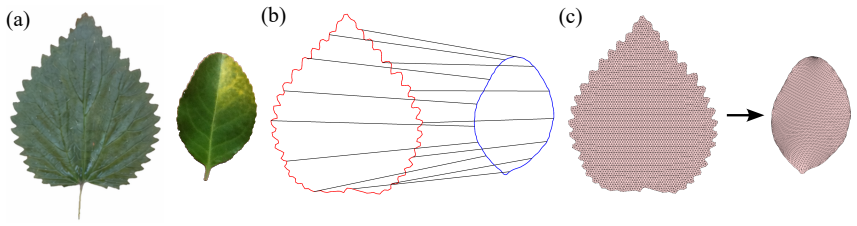
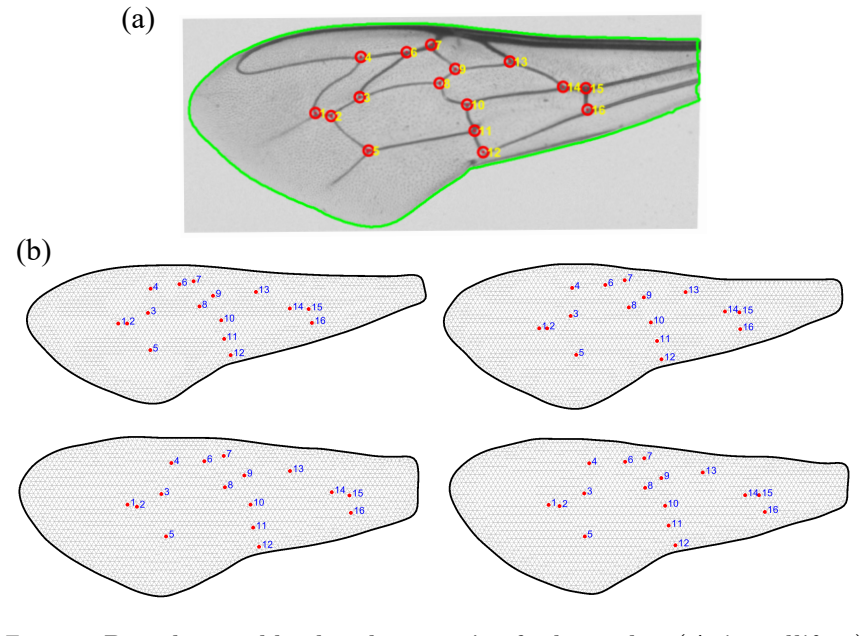
FDA-QC registers planar curves by their square-root velocity functions under elastic matching, extends the resulting boundary correspondence to the interior via a quasi-conformal map, and thereby yields a unified representation that quantifies shape variation while allowing controlled morphing; experiments on leaf and insect-wing datasets show this joint boundary-interior description outperforms purely boundary-based or interior-based alternatives.
What carries the argument
FDA-QC pipeline: elastic registration of square-root velocity functions on the boundary followed by quasi-conformal extension to the interior domain.
Load-bearing premise
That extending boundary correspondences via quasi-conformal mappings accurately preserves and reveals biologically meaningful interior variations without introducing artifacts or requiring extensive landmark constraints.
What would settle it
Apply the method to a set of planar shapes whose true interior deformation is known from independent imaging or simulation; if the recovered interior variation deviates systematically from the known deformation while boundary error remains small, the central claim fails.
Figures




read the original abstract
The study of shapes is one of the most fundamental problems in life sciences. Although numerous methods have been developed for the morphometry of planar biological shapes over the past several decades, most of them focus solely on either the outer silhouettes or the interior features of the shapes without capturing the coupling between them. Moreover, many existing shape mapping techniques are limited to establishing correspondence between planar structures without further allowing for the quantitative analysis or modelling of shape changes. In this work, we introduce FDA-QC, a novel planar morphometry method that combines functional shape data analysis (FDA) techniques and quasi-conformal (QC) mappings, taking both the boundary and interior of the planar shapes into consideration. Specifically, closed planar curves are represented by their square-root velocity functions and registered by elastic matching in the function space. The induced boundary correspondence is then extended to the entire planar domains by a quasi-conformal map, optionally with landmark constraints. Moreover, the proposed FDA-QC method can naturally lead to a unified framework for shape morphing and shape variation quantification. We apply the FDA-QC method to various leaf and insect wing datasets, and the experimental results show that the proposed combined approach captures morphological variation more effectively than purely boundary-based or interior-based descriptions. Altogether, our work paves a new way for understanding the growth and form of planar biological shapes.
Editorial analysis
A structured set of objections, weighed in public.
Referee Report
Summary. The manuscript introduces FDA-QC, a planar morphometry framework that represents closed curves via square-root velocity functions (SRVF), registers them by elastic matching in function space, and extends the resulting boundary correspondence to the full planar domain using quasi-conformal mappings (optionally with sparse landmarks). It claims this hybrid method captures both boundary and interior morphological variation more effectively than purely boundary-based or interior-based approaches, enables unified shape morphing and variation quantification, and demonstrates superiority on leaf and insect wing datasets.
Significance. If the experimental superiority claim is substantiated with quantitative metrics, the method would supply a diffeomorphic, landmark-optional pipeline that couples boundary registration with interior extension, offering a practical advance for biological morphometry studies that require consistent interior correspondences without direct interior feature extraction.
major comments (2)
- [Experimental results] Experimental results section: the claim that FDA-QC 'captures morphological variation more effectively' than boundary-only or interior-only methods is stated without any quantitative metrics (e.g., Procrustes distances, variance explained, registration error, or comparison to baselines such as pure SRVF or landmark-based TPS), error bars, or statistical tests; the superiority therefore rests on qualitative visual inspection alone.
- [Method (QC extension)] Quasi-conformal extension subsection: the construction registers only the boundary via SRVF + elastic matching and extends via QC (minimal dilatation or zero Beltrami) without using any interior intensity, texture, or venation data; the assertion that the method 'takes both the boundary and interior into consideration' therefore depends on the unverified premise that the chosen QC map aligns with biologically meaningful interior features rather than merely producing a smooth diffeomorphism.
minor comments (1)
- [Abstract] Abstract and dataset description: the number of samples, species, and exact leaf/wing datasets are not specified, making reproducibility and scope assessment difficult.
Simulated Author's Rebuttal
We thank the referee for the thoughtful and constructive comments, which help us improve the clarity and rigor of the manuscript. We address each major comment below and indicate the revisions we will make.
read point-by-point responses
-
Referee: Experimental results section: the claim that FDA-QC 'captures morphological variation more effectively' than boundary-only or interior-only methods is stated without any quantitative metrics (e.g., Procrustes distances, variance explained, registration error, or comparison to baselines such as pure SRVF or landmark-based TPS), error bars, or statistical tests; the superiority therefore rests on qualitative visual inspection alone.
Authors: We agree that quantitative support is needed to strengthen the superiority claims. In the revised manuscript we will add direct comparisons using Procrustes distances between registered shapes, the percentage of variance explained by the first few principal components of the FDA-QC representations, and registration error metrics against baselines (pure SRVF boundary registration and landmark-based TPS). We will also report standard errors and perform paired statistical tests (e.g., Wilcoxon signed-rank) to assess significance. These additions will replace reliance on visual inspection alone. revision: yes
-
Referee: Quasi-conformal extension subsection: the construction registers only the boundary via SRVF + elastic matching and extends via QC (minimal dilatation or zero Beltrami) without using any interior intensity, texture, or venation data; the assertion that the method 'takes both the boundary and interior into consideration' therefore depends on the unverified premise that the chosen QC map aligns with biologically meaningful interior features rather than merely producing a smooth diffeomorphism.
Authors: The FDA-QC pipeline considers the interior by using the boundary correspondence to induce a diffeomorphic extension over the entire planar domain via quasi-conformal mapping. This guarantees a consistent, orientation-preserving mapping of interior points that can be used for subsequent morphing and variation analysis, even when interior features are not directly observed. The minimal-dilatation QC map is chosen precisely because it provides a canonical, smooth interpolation that respects the boundary registration. We will revise the relevant subsection to clarify this hybrid construction, explicitly state the modeling assumption that the boundary-driven extension is biologically plausible for the leaf and wing datasets, and add a short discussion of limitations when interior landmarks or textures are available. revision: partial
Circularity Check
No significant circularity detected
full rationale
The paper defines FDA-QC as boundary registration via SRVF elastic matching followed by QC extension to the domain (optionally with landmarks). The central claim that the hybrid captures morphological variation more effectively rests on experimental results from leaf and wing datasets rather than any equation or definition that reduces the output to the inputs by construction. No self-definitional steps, fitted parameters renamed as predictions, or load-bearing self-citations appear in the provided text. The derivation remains self-contained against external benchmarks and established FDA/QC techniques.
Axiom & Free-Parameter Ledger
axioms (1)
- domain assumption Quasi-conformal mappings can extend a boundary correspondence to the interior domain while preserving orientation and allowing optional landmark constraints.
Lean theorems connected to this paper
-
IndisputableMonolith/Cost/FunctionalEquation.leanwashburn_uniqueness_aczel unclear?
unclearRelation between the paper passage and the cited Recognition theorem.
closed planar curves are represented by their square-root velocity functions and registered by elastic matching... extended to the entire planar domains by a quasi-conformal map
-
IndisputableMonolith/Foundation/AlexanderDuality.leanalexander_duality_circle_linking unclear?
unclearRelation between the paper passage and the cited Recognition theorem.
shape dissimilarity... dQC = mean(|μ|)... maximal dilatation K(f)
What do these tags mean?
- matches
- The paper's claim is directly supported by a theorem in the formal canon.
- supports
- The theorem supports part of the paper's argument, but the paper may add assumptions or extra steps.
- extends
- The paper goes beyond the formal theorem; the theorem is a base layer rather than the whole result.
- uses
- The paper appears to rely on the theorem as machinery.
- contradicts
- The paper's claim conflicts with a theorem or certificate in the canon.
- unclear
- Pith found a possible connection, but the passage is too broad, indirect, or ambiguous to say the theorem truly supports the claim.
Reference graph
Works this paper leans on
-
[1]
D. W. Thompson,On growth and form. Cambridge University Press, 1917
work page 1917
-
[2]
Shape manifolds, procrustean metrics, and complex projective spaces,
D. G. Kendall, “Shape manifolds, procrustean metrics, and complex projective spaces,”Bulletin of the London Mathematical Society, vol. 16, no. 2, pp. 81–121, 1984
work page 1984
-
[3]
Size and shape spaces for landmark data in two dimensions,
F. L. Bookstein, “Size and shape spaces for landmark data in two dimensions,” Statistical Science, vol. 1, no. 2, pp. 181–222, 1986
work page 1986
-
[4]
M. Zelditch, D. Swiderski, and H. D. Sheets,Geometric morphometrics for biologists: a primer. Academic Press, 2012
work page 2012
-
[5]
F. L. Bookstein,The measurement of biological shape and shape change, vol. 24. Springer Science & Business Media, 2013
work page 2013
-
[6]
D. X. Gu and E. Saucan,Classical and discrete differential geometry: theory, applications and algorithms. CRC Press, 2023
work page 2023
-
[7]
K. Alim, S. Armon, B. I. Shraiman, and A. Boudaoud, “Leaf growth is conformal,” Physical Biology, vol. 13, no. 5, p. 05LT01, 2016. 27
work page 2016
-
[8]
Conformal growth of Arabidopsis leaves,
G. Mitchison, “Conformal growth of Arabidopsis leaves,”Journal of Theoretical Biology, vol. 408, pp. 155–166, 2016
work page 2016
-
[9]
Minimizing the elastic energy of growing leaves by conformal mapping,
A. Dai and M. B. Amar, “Minimizing the elastic energy of growing leaves by conformal mapping,”Physical Review Letters, vol. 129, no. 21, p. 218101, 2022
work page 2022
-
[10]
Global constraints within the developmental program of the Drosophila wing,
V. Alba, J. E. Carthew, R. W. Carthew, and M. Mani, “Global constraints within the developmental program of the Drosophila wing,”Elife, vol. 10, p. e66750, 2021
work page 2021
-
[11]
Planar morphometry, shear and optimal quasi- conformal mappings,
G. W. Jones and L. Mahadevan, “Planar morphometry, shear and optimal quasi- conformal mappings,”Proceedings of the Royal Society A, vol. 469, no. 2153, p. 20120653, 2013
work page 2013
-
[12]
Planar morphometrics using Teichm¨ uller maps,
G. P. T. Choi and L. Mahadevan, “Planar morphometrics using Teichm¨ uller maps,”Proceedings of the Royal Society A, vol. 474, no. 2217, p. 20170905, 2018
work page 2018
-
[13]
Data-driven quasi-conformal morphodynamic flows,
S. Mosleh, G. P. T. Choi, and L. Mahadevan, “Data-driven quasi-conformal morphodynamic flows,”Proceedings of the Royal Society A, vol. 481, no. 2314, p. 20240527, 2025
work page 2025
-
[14]
Landmark matching via large deformation diffeomor- phisms,
S. C. Joshi and M. I. Miller, “Landmark matching via large deformation diffeomor- phisms,”IEEE Transactions on Image Processing, vol. 9, no. 8, pp. 1357–1370, 2000
work page 2000
-
[15]
Computing large deformation metric mappings via geodesic flows of diffeomorphisms,
M. F. Beg, M. I. Miller, A. Trouv´ e, and L. Younes, “Computing large deformation metric mappings via geodesic flows of diffeomorphisms,”International Journal of Computer Vision, vol. 61, no. 2, pp. 139–157, 2005
work page 2005
-
[16]
Computable elastic distances between shapes,
L. Younes, “Computable elastic distances between shapes,”SIAM Journal on Applied Mathematics, vol. 58, no. 2, pp. 565–586, 1998
work page 1998
-
[17]
On shape of plane elastic curves,
W. Mio, A. Srivastava, and S. Joshi, “On shape of plane elastic curves,”Inter- national Journal of Computer Vision, vol. 73, no. 3, pp. 307–324, 2007
work page 2007
-
[18]
2D-shape analysis using conformal mapping,
E. Sharon and D. Mumford, “2D-shape analysis using conformal mapping,” International Journal of Computer Vision, vol. 70, no. 1, pp. 55–75, 2006
work page 2006
-
[19]
Shape analysis of elastic curves in Euclidean spaces,
A. Srivastava, E. Klassen, S. H. Joshi, and I. H. Jermyn, “Shape analysis of elastic curves in Euclidean spaces,”IEEE Transactions on Pattern Analysis and Machine Intelligence, vol. 33, no. 7, pp. 1415–1428, 2010. 28
work page 2010
-
[20]
A. Srivastava and E. P. Klassen,Functional and shape data analysis, vol. 1. Springer, 2016
work page 2016
-
[21]
Elastic shape analysis of planar objects using tensor field representations,
R. Zhang and A. Srivastava, “Elastic shape analysis of planar objects using tensor field representations,”Journal of Mathematical Imaging and Vision, vol. 63, no. 9, pp. 1204–1221, 2021
work page 2021
-
[22]
Leaf - UCI Machine Learning Repository
P. Silva and A. Maral, “Leaf - UCI Machine Learning Repository.” https: //archive.ics.uci.edu/dataset/288/leaf (accessed on October 18, 2025), 2014
work page 2025
-
[23]
Lehto,Quasiconformal mappings in the plane, vol
O. Lehto,Quasiconformal mappings in the plane, vol. 126. Springer-Verlag Berlin Heidelberg, 1973
work page 1973
-
[24]
L. V. Ahlfors,Lectures on quasiconformal mappings, vol. 38. American Mathe- matical Society, Providence, RI, 2006
work page 2006
-
[25]
Landmark-and intensity-based registration with large deformations via quasi-conformal maps,
K. C. Lam and L. M. Lui, “Landmark-and intensity-based registration with large deformations via quasi-conformal maps,”SIAM Journal on Imaging Sciences, vol. 7, no. 4, pp. 2364–2392, 2014
work page 2014
-
[26]
Tooth morphometry using quasi-conformal theory,
G. P. T. Choi, H. L. Chan, R. Yong, S. Ranjitkar, A. Brook, G. Townsend, K. Chen, and L. M. Lui, “Tooth morphometry using quasi-conformal theory,” Pattern Recognition, vol. 99, p. 107064, 2020
work page 2020
-
[27]
Teichm¨ uller mapping (T-map) and its applications to landmark matching registration,
L. M. Lui, K. C. Lam, S.-T. Yau, and X. Gu, “Teichm¨ uller mapping (T-map) and its applications to landmark matching registration,”SIAM Journal on Imaging Sciences, vol. 7, no. 1, pp. 391–426, 2014
work page 2014
-
[28]
Convergence of an iterative algorithm for Te- ichm¨ uller maps via harmonic energy optimization,
L. M. Lui, X. Gu, and S.-T. Yau, “Convergence of an iterative algorithm for Te- ichm¨ uller maps via harmonic energy optimization,”Mathematics of Computation, vol. 84, no. 296, pp. 2823–2842, 2015
work page 2015
-
[29]
F. P. Gardiner and N. Lakic,Quasiconformal Teichm¨ uller theory. No. 76, American Mathematical Society, 2000
work page 2000
-
[30]
Discovering communities through friendship,
G. Morrison and L. Mahadevan, “Discovering communities through friendship,” PLoS One, vol. 7, no. 7, p. e38704, 2012
work page 2012
-
[31]
Asymmetric network connectivity using weighted harmonic averages,
G. Morrison and L. Mahadevan, “Asymmetric network connectivity using weighted harmonic averages,”Europhysics Letters, vol. 93, no. 4, p. 40002, 2011. 29
work page 2011
-
[32]
A simple mesh generator in MATLAB,
P.-O. Persson and G. Strang, “A simple mesh generator in MATLAB,”SIAM Review, vol. 46, no. 2, pp. 329–345, 2004
work page 2004
-
[33]
R. Sari´ c, E.ˇCustovi´ c, A. Akagi´ c, M. Trt´ ılek, M. G. Lewsey, and J. Whelan, “Computer vision-based recognition and distinction of Arabidopsis thaliana eco- types using supervised deep learning models,”The Plant Phenome Journal, vol. 8, no. 1, p. e70041, 2025
work page 2025
-
[34]
A framework for few-shot language model evaluation
A. Oleksa, E. C˘ auia, A. Siceanu, Z. Puˇ skadija, M. Kovaˇ ci´ c, M. A. Pinto, and A. Tofilski, “Collection of wing images for conservation of honey bees (Apis mellifera) biodiversity in Europe, Zenodo.” https://doi.org/10.5281/zenodo. 7244070(accessed on October 18, 2025), 2022
-
[35]
Honey bee (Apis mellifera) wing images: a tool for identification and conservation,
A. Oleksa, E. C˘ auia, A. Siceanu, Z. Puˇ skadija, M. Kovaˇ ci´ c, M. A. Pinto, P. J. Rodrigues, F. Hatjina, L. Charistos, M. Bouga, J. Preˇ sern,˙I. Kandemir, S. Raˇ si´ c, S. Kusza, and A. Tofilski, “Honey bee (Apis mellifera) wing images: a tool for identification and conservation,”GigaScience, vol. 12, p. giad019, 2023
work page 2023
-
[36]
Molecular characterisation of indigenous Apis mellifera carnica in Slovenia,
S. Suˇ snik, P. Kozmus, J. Poklukar, and V. Meglic, “Molecular characterisation of indigenous Apis mellifera carnica in Slovenia,”Apidologie, vol. 35, no. 6, pp. 623–636, 2004
work page 2004
-
[37]
Population genetic structure of coastal Croatian honeybees (Apis mellifera carnica),
I. Mu˜ noz, R. Dall’Olio, M. Lodesani, and P. De la R´ ua, “Population genetic structure of coastal Croatian honeybees (Apis mellifera carnica),”Apidologie, vol. 40, no. 6, pp. 617–626, 2009
work page 2009
-
[38]
Morphological diversity of Carniolan honey bee (Apis mellifera carnica) in Croatia and Slovenia,
Z. Puˇ skadija, M. Kovaˇ ci´ c, N. Raguˇ z, B. Luki´ c, J. Preˇ sern, and A. Tofilski, “Morphological diversity of Carniolan honey bee (Apis mellifera carnica) in Croatia and Slovenia,”Journal of Apicultural Research, vol. 60, no. 2, pp. 326– 336, 2021
work page 2021
-
[39]
A review of methods for discrimination of honey bee populations as applied to European beekeeping,
M. Bouga, C. Alaux, M. Bienkowska, R. B¨ uchler, N. L. Carreck, E. Cauia, R. Chlebo, B. Dahle, R. Dall’Olio, P. De la R´ ua, A. Gregorc, E. Ivanova, A. Kence, M. Kence, N. Kezi´ c, H. Kiprijanovska, P. Kozmus, P. Kryger, Y. Le Conte, M. Lodesani, A. M. Murilhas, A. Siceanu, G. Soland-Reckeweg, A. Uzunov, and J. Wilde, “A review of methods for discriminati...
work page 2011
-
[40]
R. Brodschneider, J. Brus, and J. Danihl´ ık, “Comparison of apiculture and winter mortality of honey bee colonies (Apis mellifera) in Austria and Czechia,” Agriculture, Ecosystems & Environment, vol. 274, pp. 24–32, 2019. 30
work page 2019
-
[41]
Ruttner,Biogeography and Taxonomy of Honeybees
F. Ruttner,Biogeography and Taxonomy of Honeybees. Springer, 1988
work page 1988
-
[42]
H. Kaur, N. Nedi´ c, and A. Tofilski, “Influence of honey bee (Apis mellifera) breeding on wing venation in Serbia and neighbouring countries,”PeerJ, vol. 12, p. e17247, 2024
work page 2024
-
[43]
S. Bakhchou, A. Aglagane, A. Tofilski, F. Mokrini, O. Er-Rguibi, E. H. El Mouden, J. Machlowska, S. Fellahi, and E. H. Mohssine, “Morphological diversity of Moroc- can honey bees (Apis mellifera L. 1758): Insights from a geometric morphometric study of wing venation in honey bees from different climatic regions,”Diversity, vol. 17, no. 8, p. 527, 2025. 31
work page 2025
discussion (0)
Sign in with ORCID, Apple, or X to comment. Anyone can read and Pith papers without signing in.