Recognition: unknown
T^a_{cbar{s}0}(2900), T_{cs0}^*(2870)⁰, and other singly-heavy tetraquark states
Pith reviewed 2026-05-08 08:34 UTC · model grok-4.3
The pith
The LHCb states T^a_{c s0}(2900) and T_cs0^*(2870) are the second highest I(J^P)=1(0^+) cn s nbar and higher I(J^P)=0(0^+) cs n nbar tetraquarks in a mass splitting model.
A machine-rendered reading of the paper's core claim, the machinery that carries it, and where it could break.
Core claim
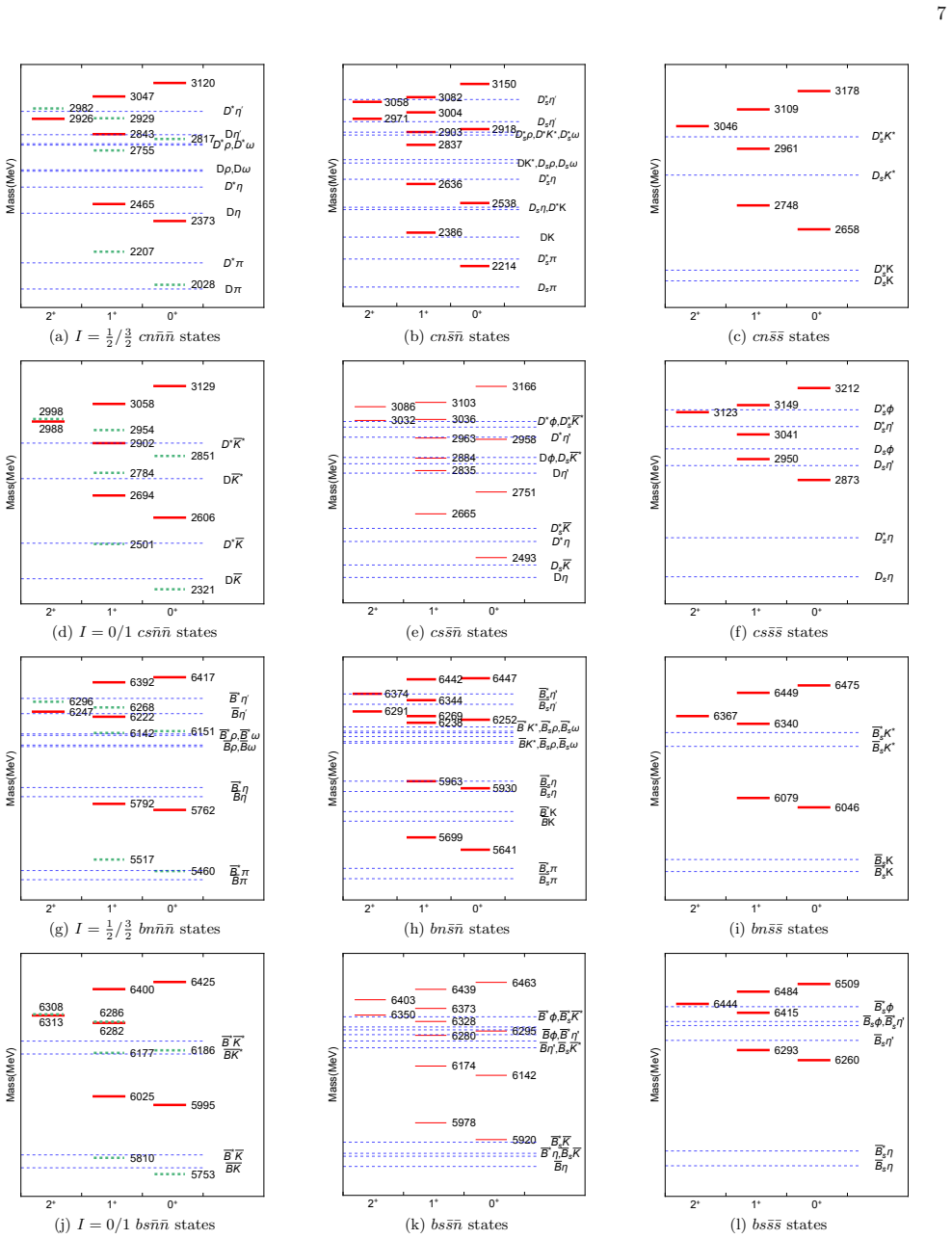
We systematically study the mass spectra of S-wave singly-heavy tetraquark states Qq qbar qbar (Q=c,b; q=u,d,s) in a mass splitting model. We adopt the assumption that the X(4140) is the lowest J^{PC}=1^{++} cs cbar sbar tetraquark and use this state as a reference to determine the mass splittings. According to the obtained results, we find that the recently observed states T^a_{c s0}(2900)^{++/0} and T_cs0^*(2870)^0 by the LHCb Collaboration can be consistently interpreted as the second highest I(J^P)=1(0^+) cn sbar nbar (n=u,d) and the higher I(J^P)=0(0^+) cs nbar nbar tetraquark states, respectively.
What carries the argument
A mass splitting model anchored by the assumed lowest 1++ cs cbar sbar tetraquark X(4140) that fixes relative masses for all other singly-heavy tetraquarks.
If this is right
- The lowest I(J^P)=0(0^+) and 0(1^+) cn sbar nbar and cs nbar nbar states are predicted to be narrow.
- The corresponding bottom-sector states are also expected to be narrow tetraquark candidates.
- Rearrangement decay widths are estimated for the assigned and predicted states in a simple scheme.
- The mass and decay information guides experimental searches for additional singly-heavy tetraquarks.
Where Pith is reading between the lines
- If the assignments hold, the same mass-splitting pattern should appear among bottom tetraquarks and can be tested at higher-energy colliders.
- The model implies that compact tetraquark structures are favored over loosely bound molecular pictures for these particular states.
- Extending the calculation to include orbital excitations would produce a more complete spectrum testable by future data.
Load-bearing premise
The assumption that the X(4140) is the lowest J^{PC}=1^{++} cs cbar sbar tetraquark used to fix the reference mass splittings.
What would settle it
A measurement of the quantum numbers or precise mass of T^a_{c s0}(2900) that places it outside the predicted position for the second I=1 0+ cn sbar nbar state.
Figures
read the original abstract
We systematically study the mass spectra of $S$-wave singly-heavy tetraquark states $Qq\bar{q}\bar{q}$ ($Q=c,b$; $q=u,d,s$) in a mass splitting model. We adopt the assumption that the $X(4140)$ is the lowest $J^{PC}=1^{++}$ $cs\bar{c}\bar{s}$ tetraquark and use this state as a reference to determine the mass splittings. According to the obtained results, we also estimate the rearrangement decay widths of the tetraquarks within a simple scheme. We find that the recently observed states $T^a_{c\bar{s}0}(2900)^{++/0}$ and $T_{cs0}^*(2870)^0$ by the LHCb Collaboration can be consistently interpreted as the second highest $I(J^P)=1(0^+)$ $cn\bar{s}\bar{n}$ ($n=u,d$) and the higher $I(J^P)=0(0^+)$ $cs\bar{n}\bar{n}$ tetraquark states, respectively. We predict several narrow tetraquark candidates: the lowest $cn\bar{s}\bar{n}$ and $cs\bar{n}\bar{n}$ with $I(J^P)=0(0^+)$ and $0(1^+)$, and their bottom counterparts. The obtained information from mass spectrum and rearrangement decay properties will help search for the new singly-heavy tetraquark states.
Editorial analysis
A structured set of objections, weighed in public.
Referee Report
Summary. The manuscript systematically studies the mass spectra of S-wave singly-heavy tetraquark states Qq qbar qbar (Q=c,b; q=u,d,s) in a mass splitting model. It adopts the assumption that X(4140) is the lowest J^{PC}=1^{++} cs cbar s bar tetraquark to fix the mass splittings, interprets the LHCb states T^a_{c bar s0}(2900)^{++/0} as the second highest I(J^P)=1(0^+) cn bar s bar n tetraquark and T_{cs0}^*(2870)^0 as the higher I(J^P)=0(0^+) cs bar n bar n state, estimates rearrangement decay widths in a simple scheme, and predicts several narrow tetraquark candidates including bottom counterparts.
Significance. If the X(4140) assumption holds, the work supplies a consistent phenomenological assignment for the recent LHCb tetraquark candidates together with concrete predictions for additional narrow states and their decay properties, which could guide experimental searches. The systematic coverage of mass spectra across flavor combinations and the inclusion of width estimates are strengths that add value to the tetraquark phenomenology literature.
major comments (2)
- [Abstract and §2] Abstract and model description: The mass predictions for the cn bar s bar n and cs bar n bar n configurations (including the specific assignments to the 2900 MeV and 2870 MeV resonances) are obtained by adding flavor-dependent splittings whose zero point and offsets are fixed exclusively by treating the X(4140) mass as the ground-state cs cbar s bar 1^{++} tetraquark; no alternative calibration, sensitivity study, or independent cross-check is provided, so the numerical agreement is a direct consequence of this single input choice.
- [Abstract] Abstract: The rearrangement decay widths are estimated only within a simple scheme with no quantitative error analysis, uncertainty propagation, or comparison to alternative decay models, which weakens the support for the claimed consistency of the state interpretations.
minor comments (1)
- [Abstract] The notation T^a_{c bar s0}(2900)^{++/0} and similar state labels could be defined more explicitly on first use to aid readers outside the immediate LHCb tetraquark community.
Simulated Author's Rebuttal
We thank the referee for the careful reading of our manuscript and the constructive comments. We address the major comments point by point below, providing the strongest honest defense of our approach while clarifying limitations and indicating revisions where appropriate.
read point-by-point responses
-
Referee: [Abstract and §2] Abstract and model description: The mass predictions for the cn bar s bar n and cs bar n bar n configurations (including the specific assignments to the 2900 MeV and 2870 MeV resonances) are obtained by adding flavor-dependent splittings whose zero point and offsets are fixed exclusively by treating the X(4140) mass as the ground-state cs cbar s bar 1^{++} tetraquark; no alternative calibration, sensitivity study, or independent cross-check is provided, so the numerical agreement is a direct consequence of this single input choice.
Authors: We agree that the numerical results follow directly from anchoring the mass splittings to the X(4140) as the lowest 1^{++} cs cbar s bar state, as explicitly stated in the abstract and Section 2. This is the defining feature of the mass-splitting model, which is a phenomenological framework designed to test consistency of assignments rather than to deliver parameter-independent predictions. The agreement with the LHCb states T^a_{c bar s0}(2900) and T_{cs0}^*(2870)^0 therefore illustrates that these resonances fit naturally within the same pattern once the reference mass is fixed. We have added a short paragraph in Section 2 that explicitly discusses the dependence on this assumption, notes that alternative interpretations of X(4140) would shift the entire spectrum, and states that the current calibration is chosen because it is the most commonly adopted one in the literature. A full sensitivity scan over multiple reference states would require recomputing all flavor combinations and is left for future work, but the transparency of the single-input procedure is now emphasized. revision: partial
-
Referee: [Abstract] Abstract: The rearrangement decay widths are estimated only within a simple scheme with no quantitative error analysis, uncertainty propagation, or comparison to alternative decay models, which weakens the support for the claimed consistency of the state interpretations.
Authors: The widths are obtained from a minimal quark-rearrangement model that yields only order-of-magnitude estimates of the dominant two-body channels; this is standard for exploratory tetraquark studies and is sufficient to identify which states are expected to be narrow. We accept that the absence of propagated uncertainties or comparisons with other approaches (e.g., QCD sum rules or effective Lagrangians) limits the quantitative strength of the decay discussion. In the revised version we have updated the abstract to describe the widths as “rough estimates” and inserted a brief paragraph in the decay section that lists the main sources of uncertainty (phase-space approximations, wave-function overlap assumptions) and notes that more refined calculations lie beyond the present scope. The qualitative conclusion that the predicted narrow states remain narrow under reasonable variations is retained, but the language is now more cautious. revision: partial
Circularity Check
No significant circularity; model uses external reference state to set scale
full rationale
The paper explicitly adopts the assumption that the observed X(4140) is the lowest 1++ cs cbar sbar tetraquark and uses its mass to fix the zero point and flavor-dependent splittings in a phenomenological mass formula. It then computes masses for cn sbar nbar and cs nbar nbar configurations and compares them to the new LHCb resonances T^a_c sbar s0(2900) and T_cs0^*(2870). This is a standard calibration-plus-prediction procedure with an independent external input; the new states are not used to determine the splittings, and the paper makes no claim that the splittings are derived from first principles or that the assignment is forced by internal consistency alone. No self-referential definitions, fitted inputs renamed as predictions of the same quantities, or load-bearing self-citations appear in the derivation chain.
Axiom & Free-Parameter Ledger
free parameters (1)
- mass splittings
axioms (1)
- ad hoc to paper X(4140) is the lowest J^{PC}=1^{++} cs bar c bar s tetraquark
Reference graph
Works this paper leans on
-
[1]
First Observation of a Doubly Charged Tetraquark and Its Neutral Partner,
R. Aaijet al.[LHCb], “First Observation of a Doubly Charged Tetraquark and Its Neutral Partner,” Phys. Rev. Lett. 131, no.4, 041902 (2023) [arXiv:2212.02716 [hep-ex]]
-
[2]
Amplitude analysis ofB 0 →D 0D+ s π− andB + →D −D+ s π+ decays,
R. Aaijet al.[LHCb], “Amplitude analysis ofB 0 →D 0D+ s π− andB + →D −D+ s π+ decays,” Phys. Rev. D108, no.1, 012017 (2023) [arXiv:2212.02717 [hep-ex]]
-
[3]
A model-independent study of resonant structure inB + →D +D−K+ decays,
R. Aaijet al.[LHCb], “A model-independent study of resonant structure inB + →D +D−K+ decays,” Phys. Rev. Lett. 125, 242001 (2020) [arXiv:2009.00025 [hep-ex]]
-
[4]
Amplitude analysis of theB + →D +D−K+ decay,
R. Aaijet al.[LHCb], “Amplitude analysis of theB + →D +D−K+ decay,” Phys. Rev. D102, 112003 (2020) [arXiv:2009.00026 [hep-ex]]
-
[5]
Exotic hadron naming convention,
T. Gershon [LHCb], “Exotic hadron naming convention,” [arXiv:2206.15233 [hep-ex]]
-
[6]
Observation of New Charmonium or Charmoniumlike States inB + →D ∗±D∓K+ Decays,
R. Aaijet al.[LHCb], “Observation of New Charmonium or Charmoniumlike States inB + →D ∗±D∓K+ Decays,” Phys. Rev. Lett.133, no.13, 131902 (2024) [arXiv:2406.03156 [hep-ex]]
-
[7]
Observation of the Open-Charm Tetraquark CandidateT ∗ cs0(2870)0 in theB − →D −D0K0 S Decay,
R. Aaijet al.[LHCb], “Observation of the Open-Charm Tetraquark CandidateT ∗ cs0(2870)0 in theB − →D −D0K0 S Decay,” Phys. Rev. Lett.134, no.10, 101901 (2025) [arXiv:2411.19781 [hep-ex]]
-
[8]
V. M. Abazovet al.[D0], “Evidence for aB 0 s π± state,” Phys. Rev. Lett.117, no.2, 022003 (2016) [arXiv:1602.07588 [hep-ex]]
-
[9]
Search for Structure in theB 0 s π± Invariant Mass Spectrum,
R. Aaijet al.[LHCb], “Search for Structure in theB 0 s π± Invariant Mass Spectrum,” Phys. Rev. Lett.117, no.15, 152003 (2016) [arXiv:1608.00435 [hep-ex]]
-
[10]
Search for the X(5568) state decaying into B 0 s π± in proton-proton collisions at √s= 8 TeV,
A. M. Sirunyanet al.[CMS], “Search for the X(5568) state decaying into B 0 s π± in proton-proton collisions at √s= 8 TeV,” Phys. Rev. Lett.120, no.20, 202005 (2018) [arXiv:1712.06144 [hep-ex]]
-
[11]
A search for the exotic mesonX(5568) with the Collider Detector at Fermilab,
T. Aaltonenet al.[CDF], “A search for the exotic mesonX(5568) with the Collider Detector at Fermilab,” Phys. Rev. Lett.120, no.20, 202006 (2018) [arXiv:1712.09620 [hep-ex]]
-
[12]
Search for a Structure in theB 0 s π± Invariant Mass Spectrum with the ATLAS Experiment,
M. Aaboudet al.[ATLAS], “Search for a Structure in theB 0 s π± Invariant Mass Spectrum with the ATLAS Experiment,” Phys. Rev. Lett.120, no.20, 202007 (2018) [arXiv:1802.01840 [hep-ex]]
-
[13]
X(5568) and and its partner states,
Y. R. Liu, X. Liu and S. L. Zhu, “X(5568) and and its partner states,” Phys. Rev. D93, no.7, 074023 (2016) [arXiv:1603.01131 [hep-ph]]
-
[14]
Mass and decay constant of the newly observed exoticX(5568) state,
S. S. Agaev, K. Azizi and H. Sundu, “Mass and decay constant of the newly observed exoticX(5568) state,” Phys. Rev. D93, no.7, 074024 (2016) [arXiv:1602.08642 [hep-ph]]
-
[15]
CanX(5568) be a tetraquark state?,
W. Wang and R. Zhu, “CanX(5568) be a tetraquark state?,” Chin. Phys. C40, no.9, 093101 (2016) [arXiv:1602.08806 [hep-ph]]
-
[16]
Z. G. Wang, “Analysis of theX(5568) as scalar tetraquark state in the diquark-antidiquark model with QCD sum rules,” Commun. Theor. Phys.66, no.3, 335-339 (2016) [arXiv:1602.08711 [hep-ph]]
-
[17]
QCD sum rule study of a charged bottom-strange scalar meson,
C. M. Zanetti, M. Nielsen and K. P. Khemchandani, “QCD sum rule study of a charged bottom-strange scalar meson,” Phys. Rev. D93, no.9, 096011 (2016) [arXiv:1602.09041 [hep-ph]]
-
[18]
Decoding theX(5568) as a fully open-flavorsu ¯b ¯dtetraquark state,
W. Chen, H. X. Chen, X. Liu, T. G. Steele and S. L. Zhu, “Decoding theX(5568) as a fully open-flavorsu ¯b ¯dtetraquark state,” Phys. Rev. Lett.117, no.2, 022002 (2016) [arXiv:1602.08916 [hep-ph]]
-
[19]
Width of the exoticX b(5568) state through its strong decay toB 0 s π+,
S. S. Agaev, K. Azizi and H. Sundu, “Width of the exoticX b(5568) state through its strong decay toB 0 s π+,” Phys. Rev. D93, no.11, 114007 (2016) [arXiv:1603.00290 [hep-ph]]
-
[20]
A QCD sum rule calculation of the X ±(5568)→B 0 s π± decay width,
J. M. Dias, K. P. Khemchandani, A. Mart´ ınez Torres, M. Nielsen and C. M. Zanetti, “A QCD sum rule calculation of the X ±(5568)→B 0 s π± decay width,” Phys. Lett. B758, 235-238 (2016) [arXiv:1603.02249 [hep-ph]]
-
[21]
Analysis of the strong decayX(5568)→B 0 s π+ with QCD sum rules,
Z. G. Wang, “Analysis of the strong decayX(5568)→B 0 s π+ with QCD sum rules,” Eur. Phys. J. C76, no.5, 279 (2016) [arXiv:1603.02498 [hep-ph]]
-
[22]
Tetraquark States with Open Flavors,
L. Tang and C. F. Qiao, “Tetraquark States with Open Flavors,” Eur. Phys. J. C76, no.10, 558 (2016) [arXiv:1603.04761 [hep-ph]]
-
[23]
Masses of open charm and bottom tetraquark states in a relativized quark model,
Q. F. L¨ u and Y. B. Dong, “Masses of open charm and bottom tetraquark states in a relativized quark model,” Phys. Rev. D94, no.9, 094041 (2016) [arXiv:1603.06417 [hep-ph]]
-
[24]
Open-flavor charm and bottomsq¯q ¯Qandqq¯q ¯Qtetraquark states,
W. Chen, H. X. Chen, X. Liu, T. G. Steele and S. L. Zhu, “Open-flavor charm and bottomsq¯q ¯Qandqq¯q ¯Qtetraquark states,” Phys. Rev. D95, no.11, 114005 (2017) [arXiv:1705.10088 [hep-ph]]
-
[25]
0 + tetraquark states from improved QCD sum rules: delving intoX(5568),
J. R. Zhang, J. L. Zou and J. Y. Wu, “0 + tetraquark states from improved QCD sum rules: delving intoX(5568),” Chin. Phys. C42, no.4, 043101 (2018) [arXiv:1705.03741 [hep-ph]]
-
[26]
Mass spectra and decays of open-heavy tetraquark states,
T. Guo, J. Li, J. Zhao and L. He, “Mass spectra and decays of open-heavy tetraquark states,” Phys. Rev. D105, no.5, 054018 (2022) [arXiv:2108.06222 [hep-ph]]
-
[27]
Open-charm tetraquark candidate: Note onX 0(2900),
J. R. Zhang, “Open-charm tetraquark candidate: Note onX 0(2900),” Phys. Rev. D103, no.5, 054019 (2021) [arXiv:2008.07295 [hep-ph]]. 20
-
[28]
Analysis of theX 0(2900) as the scalar tetraquark state via the QCD sum rules,
Z. G. Wang, “Analysis of theX 0(2900) as the scalar tetraquark state via the QCD sum rules,” Int. J. Mod. Phys. A35, no.30, 2050187 (2020) [arXiv:2008.07833 [hep-ph]]
-
[29]
Magnetic moment of theX 1(2900) state in the diquark–antidiquark picture,
U. ¨Ozdem and K. Azizi, “Magnetic moment of theX 1(2900) state in the diquark–antidiquark picture,” Eur. Phys. J. A 58, no.9, 171 (2022) [arXiv:2202.11466 [hep-ph]]
-
[30]
Open charm and bottom tetraquarks in an extended relativized quark model,
Q. F. L¨ u, D. Y. Chen and Y. B. Dong, “Open charm and bottom tetraquarks in an extended relativized quark model,” Phys. Rev. D102, no.7, 074021 (2020) [arXiv:2008.07340 [hep-ph]]
-
[31]
Mass spectrum and strong decays of tetraquark ¯c¯sqqstates,
G. J. Wang, L. Meng, L. Y. Xiao, M. Oka and S. L. Zhu, “Mass spectrum and strong decays of tetraquark ¯c¯sqqstates,” Eur. Phys. J. C81, no.2, 188 (2021) [arXiv:2010.09395 [hep-ph]]
-
[32]
sQ¯ q¯ q(q=u,d;Q=c,b) tetraquarks in the chiral quark model,
G. Yang, J. Ping and J. Segovia, “sQ¯ q¯ q(q=u,d;Q=c,b) tetraquarks in the chiral quark model,” Phys. Rev. D103, no.7, 074011 (2021) [arXiv:2101.04933 [hep-ph]]
-
[33]
X(2900) in a chiral quark model,
Y. Tan and J. Ping, “X(2900) in a chiral quark model,” Chin. Phys. C45, no.9, 093104 (2021) [arXiv:2010.04045 [hep-ph]]
-
[34]
DK and BK-like spectra from Laplace sum rule at NLO,
S. Narison, A. Rabemananajara and D. Rabetiarivony, “DK and BK-like spectra from Laplace sum rule at NLO,” Nucl. Part. Phys. Proc.318-323, 90-95 (2022) [arXiv:2111.06481 [hep-ph]]
-
[35]
Tetraquarks with open charm flavor,
Y. Xue, X. Jin, H. Huang and J. Ping, “Tetraquarks with open charm flavor,” Phys. Rev. D103, no.5, 054010 (2021) [arXiv:2008.09516 [hep-ph]]
-
[36]
Discovery ofT a c¯s(2900)0,++ implies new charmed-strange pentaquark system,
H. T. An, Z. W. Liu, F. S. Yu and X. Liu, “Discovery ofT a c¯s(2900)0,++ implies new charmed-strange pentaquark system,” Phys. Rev. D106, no.11, L111501 (2022) [arXiv:2207.02813 [hep-ph]]
-
[37]
Modeling the resonanceT a cs(2900)++ as a hadronic molecule D*+K*+,
S. S. Agaev, K. Azizi and H. Sundu, “Modeling the resonanceT a cs(2900)++ as a hadronic molecule D*+K*+,” Phys. Rev. D107, no.9, 094019 (2023) [arXiv:2212.12001 [hep-ph]]
-
[38]
Analysis of theT c¯s(2900)and related tetraquark states with the QCD sum rules,
X. S. Yang, Q. Xin and Z. G. Wang, “Analysis of theT c¯s(2900)and related tetraquark states with the QCD sum rules,” Int. J. Mod. Phys. A38, no.11, 2350056 (2023) [arXiv:2302.01718 [hep-ph]]
-
[39]
P. G. Ortega, D. R. Entem, F. Fernandez and J. Segovia, “Novel Tcs and Tcs¯candidates in a constituent-quark-model- based meson-meson coupled-channels calculation,” Phys. Rev. D108, no.9, 094035 (2023) [arXiv:2305.14430 [hep-ph]]
-
[40]
T. de Oliveira, D. Harnett, R. Kleiv, A. Palameta and T. G. Steele, “Light-QuarkSU(3) Flavour Splitting of Heavy-Light Constituent Diquark Masses and Doubly-Strange Diquarks from QCD Sum-Rules,” Phys. Rev. D108, no.5, 054036 (2023) [arXiv:2307.15815 [hep-ph]]
-
[41]
Strong decays ofT a c¯s0(2900)++/0 as a fully open-flavor tetraquark state,
D. K. Lian, W. Chen, H. X. Chen, L. Y. Dai and T. G. Steele, “Strong decays ofT a c¯s0(2900)++/0 as a fully open-flavor tetraquark state,” Eur. Phys. J. C84, no.1, 1 (2024) [arXiv:2302.01167 [hep-ph]]
-
[42]
Charmed-strange tetraquarks and their decays in the potential quark model,
F. X. Liu, R. H. Ni, X. H. Zhong and Q. Zhao, “Charmed-strange tetraquarks and their decays in the potential quark model,” Phys. Rev. D107, no.9, 096020 (2023) [arXiv:2211.01711 [hep-ph]]
-
[43]
P-wave coupled-channel scattering ofB sπ, B ∗ s π, B K, B ∗Kand the puzzlingX(5568),
X. W. Kang and J. A. Oller, “P-wave coupled-channel scattering ofB sπ, B ∗ s π, B K, B ∗Kand the puzzlingX(5568),” Phys. Rev. D94, no.5, 054010 (2016) [arXiv:1606.06665 [hep-ph]]
-
[44]
Is the newly reportedX(5568) aB ¯Kmolecular state?,
R. Chen and X. Liu, “Is the newly reportedX(5568) aB ¯Kmolecular state?,” Phys. Rev. D94, no.3, 034006 (2016) [arXiv:1607.05566 [hep-ph]]
-
[45]
B sπ–B ¯Kinteractions in finite volume andX(5568),
J. X. Lu, X. L. Ren and L. S. Geng, “B sπ–B ¯Kinteractions in finite volume andX(5568),” Eur. Phys. J. C77, no.2, 94 (2017) [arXiv:1607.06327 [hep-ph]]
-
[46]
Study of X(5568) in a unitary coupled-channel approximation ofB ¯KandB sπ,
B. X. Sun, F. Y. Dong and J. L. Pang, “Study of X(5568) in a unitary coupled-channel approximation ofB ¯KandB sπ,” Chin. Phys. C41, no.7, 074104 (2017) [arXiv:1609.04068 [nucl-th]]
-
[47]
The possibleBπmolecular state and its radiative decay,
H. W. Ke, L. Gao and X. Q. Li, “The possibleBπmolecular state and its radiative decay,” Eur. Phys. J. C77, no.5, 285 (2017) [arXiv:1612.08390 [hep-ph]]
-
[48]
Molecular picture for theX 0(2866) as aD ∗ ¯K ∗ J P = 0+ state and related 1 +,2 + states,
R. Molina and E. Oset, “Molecular picture for theX 0(2866) as aD ∗ ¯K ∗ J P = 0+ state and related 1 +,2 + states,” Phys. Lett. B811, 135870 (2020) [erratum: Phys. Lett. B837, 137645 (2023)] [arXiv:2008.11171 [hep-ph]]
-
[49]
X 0(2900) and its heavy quark spin partners in molecular picture,
M. W. Hu, X. Y. Lao, P. Ling and Q. Wang, “X 0(2900) and its heavy quark spin partners in molecular picture,” Chin. Phys. C45, no.2, 021003 (2021) [arXiv:2008.06894 [hep-ph]]
-
[50]
H. Chen, H. R. Qi and H. Q. Zheng, “X1(2900) as a ¯D1Kmolecule,” Eur. Phys. J. C81, no.9, 812 (2021) [arXiv:2108.02387 [hep-ph]]
-
[51]
Prediction of possibleDK 1 bound states,
X. K. Dong and B. S. Zou, “Prediction of possibleDK 1 bound states,” Eur. Phys. J. A57, no.4, 139 (2021) [arXiv:2009.11619 [hep-ph]]
-
[52]
Looking for the exoticX 0(2866) and itsJ P = 1+ partner in the ¯B0 →D (∗)+K −K(∗)0 reactions,
L. R. Dai, R. Molina and E. Oset, “Looking for the exoticX 0(2866) and itsJ P = 1+ partner in the ¯B0 →D (∗)+K −K(∗)0 reactions,” Phys. Rev. D105, no.9, 096022 (2022) [arXiv:2202.11973 [hep-ph]]
-
[53]
Molecular picture forX 0(2900) andX 1(2900),
J. He and D. Y. Chen, “Molecular picture forX 0(2900) andX 1(2900),” Chin. Phys. C45, no.6, 063102 (2021) [arXiv:2008.07782 [hep-ph]]
-
[54]
X 0(2866) as aD ∗ ¯K ∗ molecular state,
M. Z. Liu, J. J. Xie and L. S. Geng, “X 0(2866) as aD ∗ ¯K ∗ molecular state,” Phys. Rev. D102, no.9, 091502 (2020) [arXiv:2008.07389 [hep-ph]]
-
[55]
Strong decays of ¯D∗K ∗ molecules and the newly observedX 0,1 states,
Y. Huang, J. X. Lu, J. J. Xie and L. S. Geng, “Strong decays of ¯D∗K ∗ molecules and the newly observedX 0,1 states,” Eur. Phys. J. C80, no.10, 973 (2020) [arXiv:2008.07959 [hep-ph]]
-
[56]
How to understand the X(2900)?,
B. Wang and S. L. Zhu, “How to understand the X(2900)?,” Eur. Phys. J. C82, no.5, 419 (2022) [arXiv:2107.09275 [hep-ph]]
-
[57]
C. J. Xiao, D. Y. Chen, Y. B. Dong and G. W. Meng, “Study of the decays ofS−wave ¯D∗K ∗ hadronic molecules: The scalarX 0(2900) and its spin partnersX J(J=1,2) ,” Phys. Rev. D103, no.3, 034004 (2021) [arXiv:2009.14538 [hep-ph]]
-
[58]
On the structures of new scalar resonancesT a cs0(2900)++ andT a cs0(2900)0,
S. S. Agaev, K. Azizi and H. Sundu, “On the structures of new scalar resonancesT a cs0(2900)++ andT a cs0(2900)0,” J. Phys. G50, no.5, 055002 (2023) [arXiv:2207.02648 [hep-ph]]. 21
-
[59]
H. W. Ke, Y. F. Shi, X. H. Liu and X. Q. Li, “Possible molecular states of ¯D∗K ∗ (D∗K ∗) and new exotic statesX 0(2900), X1(2900),T 0 cs0(2900)0 andT a cs0(2900)++,” Phys. Rev. D106, no.11, 114032 (2022) [arXiv:2210.06215 [hep-ph]]
-
[60]
Searching for the open flavor tetraquarkT c¯s0(2900)++ in the processB + → K+D+D−,
M. Y. Duan, E. Wang and D. Y. Chen, “Searching for the open flavor tetraquarkT c¯s0(2900)++ in the processB + → K+D+D−,” Eur. Phys. J. C84, no.7, 681 (2024) [arXiv:2305.09436 [hep-ph]]
-
[61]
Roles of ¯D∗K ∗ andD ∗ ¯Dmolecular states in decayB + →D ∗+D−K+,
Z. M. Ding, Q. Huang and J. He, “Roles of ¯D∗K ∗ andD ∗ ¯Dmolecular states in decayB + →D ∗+D−K+,” Eur. Phys. J. C85, no.10, 1133 (2025) doi:10.1140/epjc/s10052-025-14882-8 [arXiv:2508.12686 [hep-ph]]
-
[62]
Coupled-channelD ∗K ∗ −D ∗ s ρinteractions and the origin ofT c¯s0(2900),
M. Y. Duan, M. L. Du, Z. H. Guo, E. Wang and D. Y. Chen, “Coupled-channelD ∗K ∗ −D ∗ s ρinteractions and the origin ofT c¯s0(2900),” Phys. Rev. D108, no.7, 074006 (2023) [arXiv:2307.04092 [hep-ph]]
-
[63]
Five-flavor molecular pentaquarks in the Ξ (′,∗) b ¯D(∗) and Ξ(′,∗) c B(∗) systems,
F. L. Wang and X. Liu, “Five-flavor molecular pentaquarks in the Ξ (′,∗) b ¯D(∗) and Ξ(′,∗) c B(∗) systems,” [arXiv:2603.23287 [hep-ph]]
work page internal anchor Pith review arXiv
-
[64]
Searching for the 2 + partner of theT cs0(2870) in theB − →D −D0K0 S reaction,
J. Song, Z. Y. Yang and E. Oset, “Searching for the 2 + partner of theT cs0(2870) in theB − →D −D0K0 S reaction,” Phys. Rev. D111, no.9, 094004 (2025) [arXiv:2502.10342 [hep-ph]]
-
[65]
T 0 ¯c¯s1production in theB + decays processes,
Z. Yu, Q. Wu, Z. L. Yue and D. Y. Chen, “T 0 ¯c¯s1production in theB + decays processes,” [arXiv:2511.18072 [hep-ph]]
-
[66]
J. D. E. Yeo, C. E. Thomas and D. J. Wilson, “ExoticT ∗ csJ andT ∗ c¯sJstates and coupled-channel scattering at theSU(3) flavour symmetric point from lattice QCD,” [arXiv:2604.19553 [hep-lat]]
work page internal anchor Pith review Pith/arXiv arXiv
-
[67]
Triangle singularity as the origin ofX 0(2900) andX 1(2900) observed inB + →D +D−K+,
X. H. Liu, M. J. Yan, H. W. Ke, G. Li and J. J. Xie, “Triangle singularity as the origin ofX 0(2900) andX 1(2900) observed inB + →D +D−K+,” Eur. Phys. J. C80, no.12, 1178 (2020) [arXiv:2008.07190 [hep-ph]]
-
[68]
Possibility ofT c¯s(2900) as the resonance-like structure induced by threshold effects,
Y. H. Ge, X. H. Liu and H. W. Ke, “Possibility ofT c¯s(2900) as the resonance-like structure induced by threshold effects,” Eur. Phys. J. C82, no.10, 955 (2022) [arXiv:2207.09900 [hep-ph]]
-
[69]
Kinematical cusp and resonance interpretations of theX(2900),
T. J. Burns and E. S. Swanson, “Kinematical cusp and resonance interpretations of theX(2900),” Phys. Lett. B813, 136057 (2021) [arXiv:2008.12838 [hep-ph]]
-
[70]
Spectrum and rearrangement decays of tetraquark states with four different flavors,
J. B. Cheng, S. Y. Li, Y. R. Liu, Y. N. Liu, Z. G. Si and T. Yao, “Spectrum and rearrangement decays of tetraquark states with four different flavors,” Phys. Rev. D101, no.11, 114017 (2020) [arXiv:2001.05287 [hep-ph]]
-
[71]
X(4140),X(4270),X(4500) andX(4700) and theircs¯c¯stetraquark partners,
J. Wu, Y. R. Liu, K. Chen, X. Liu and S. L. Zhu, “X(4140),X(4270),X(4500) andX(4700) and theircs¯c¯stetraquark partners,” Phys. Rev. D94, no.9, 094031 (2016) [arXiv:1608.07900 [hep-ph]]
-
[72]
Pentaquark states with theQQQq¯qconfiguration in a simple model,
S. Y. Li, Y. R. Liu, Y. N. Liu, Z. G. Si and J. Wu, “Pentaquark states with theQQQq¯qconfiguration in a simple model,” Eur. Phys. J. C79, no.1, 87 (2019) [arXiv:1809.08072 [hep-ph]]
-
[73]
Systematic studies of charmonium-, bottomonium-, andB c-like tetraquark states,
J. Wu, X. Liu, Y. R. Liu and S. L. Zhu, “Systematic studies of charmonium-, bottomonium-, andB c-like tetraquark states,” Phys. Rev. D99, no.1, 014037 (2019) [arXiv:1810.06886 [hep-ph]]
- [74]
-
[75]
Hidden-charm pentaquarks and their hidden-bottom andB c-like partner states,
J. Wu, Y. R. Liu, K. Chen, X. Liu and S. L. Zhu, “Hidden-charm pentaquarks and their hidden-bottom andB c-like partner states,” Phys. Rev. D95, no.3, 034002 (2017) [arXiv:1701.03873 [hep-ph]]
-
[76]
Heavy-flavored tetraquark states with theQQ ¯Q ¯Qconfiguration,
J. Wu, Y. R. Liu, K. Chen, X. Liu and S. L. Zhu, “Heavy-flavored tetraquark states with theQQ ¯Q ¯Qconfiguration,” Phys. Rev. D97, no.9, 094015 (2018) [arXiv:1605.01134 [hep-ph]]
-
[77]
X(3960), X 0(4140), and other compact states*,
S. Y. Li, Y. R. Liu, Z. L. Man, Z. G. Si and J. Wu, “X(3960), X 0(4140), and other compact states*,” Chin. Phys. C48, no.6, 063109 (2024) [arXiv:2308.06768 [hep-ph]]
-
[78]
Hidden-charm pentaquark states in a mass splitting model,
S. Y. Li, Y. R. Liu, Z. L. Man, Z. G. Si and J. Wu, “Hidden-charm pentaquark states in a mass splitting model,” Phys. Rev. D108, no.5, 056015 (2023) [arXiv:2307.00539 [hep-ph]]
-
[79]
Triply Heavy Tetraquark States in a Mass-Splitting Model,
S. Y. Li, Y. R. Liu, Z. L. Man, C. R. Shu, Z. G. Si and J. Wu, “Triply Heavy Tetraquark States in a Mass-Splitting Model,” Symmetry17, no.2, 170 (2025) [arXiv:2501.16105 [hep-ph]]
-
[80]
Doubly heavy tetraquark states in a mass splitting model,
S. Y. Li, Y. R. Liu, Z. L. Man, Z. G. Si and J. Wu, “Doubly heavy tetraquark states in a mass splitting model,” Phys. Rev. D110, no.9, 094044 (2024) [arXiv:2401.00115 [hep-ph]]
discussion (0)
Sign in with ORCID, Apple, or X to comment. Anyone can read and Pith papers without signing in.