Recognition: unknown
Na-IRSTD: Enhancing Infrared Small Target Detection via Native-Resolution Feature Selection and Fusion
Pith reviewed 2026-05-08 14:50 UTC · model grok-4.3
The pith
A framework using full native resolution and selective token processing detects small dim targets in infrared images more accurately than downsampling methods.
A machine-rendered reading of the paper's core claim, the machinery that carries it, and where it could break.
Core claim
The Na-IRSTD framework extracts and fuses features at the original image resolution to preserve subtle target cues that downsampling loses, while an accompanying token reduction and selection strategy identifies target patches with high accuracy and confidence, thereby enhancing low-level details and keeping computation manageable, which enables state-of-the-art results on four standard benchmarks.
What carries the argument
Native-resolution feature extraction and fusion paired with a token reduction and selection strategy that prioritizes target patches.
If this is right
- Small targets keep their subtle low-level cues because features stay at native resolution instead of being downsampled.
- Computational load stays practical because only selected patches receive full native-resolution treatment rather than dense processing of every token.
- Detection accuracy rises on benchmarks that feature complex background clutter.
- The same selection mechanism proves robust when tested across multiple public infrared datasets.
Where Pith is reading between the lines
- Similar native-resolution selection could help small-lesion detection in medical imaging or faint-object search in astronomy where detail loss from downsampling is also costly.
- The work suggests that hybrid full-detail plus selective architectures may become preferable to uniform downsampling whenever the signal-to-noise ratio is low and selection can be made reliable.
- Integrating the token selection with hardware-aware constraints could open deployment paths for on-device infrared monitoring systems.
Load-bearing premise
The token reduction and selection strategy reliably identifies target patches at high confidence without missing dim targets or adding bias when backgrounds are cluttered.
What would settle it
Running the model on a new infrared dataset containing many extremely faint targets in heavy clutter and finding that it misses more targets than a comparable downsampling baseline would show the native-resolution claim does not hold.
Figures
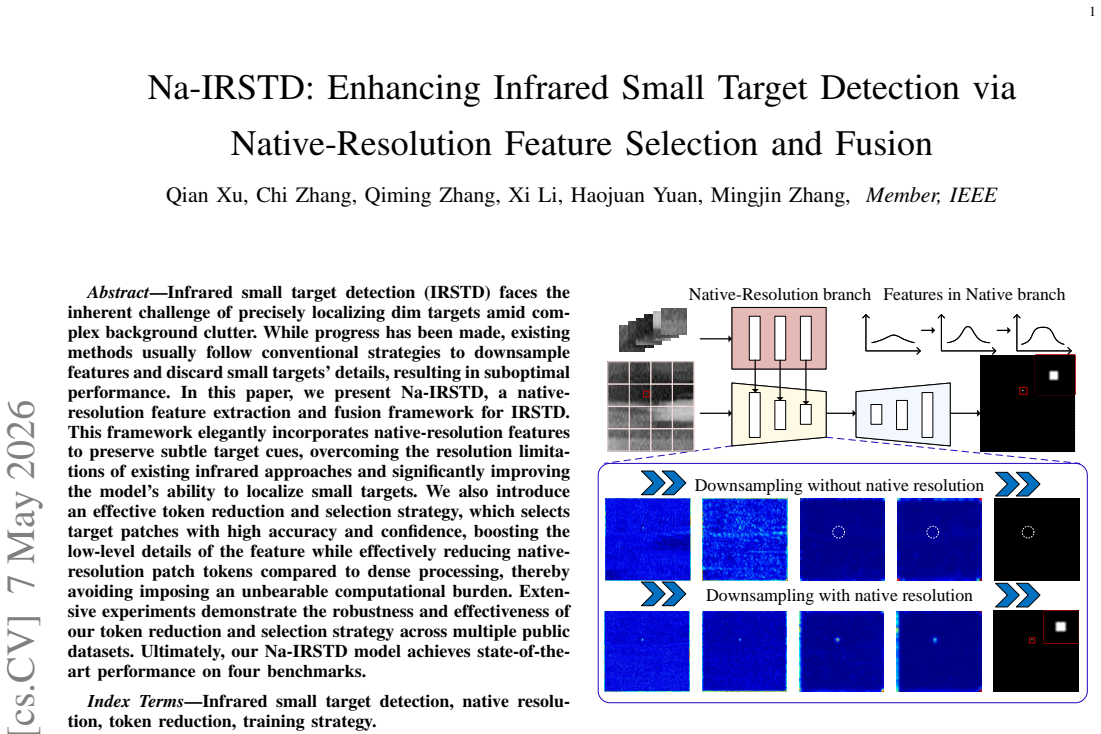


read the original abstract
Infrared small target detection (IRSTD) faces the inherent challenge of precisely localizing dim targets amid complex background clutter. While progress has been made, existing methods usually follow conventional strategies to downsample features and discard small targets' details, resulting in suboptimal performance. In this paper, we present Na-IRSTD, a native-resolution feature extraction and fusion framework for IRSTD. This framework elegantly incorporates native-resolution features to preserve subtle target cues, overcoming the resolution limitations of existing infrared approaches and significantly improving the model's ability to localize small targets. We also introduce an effective token reduction and selection strategy, which selects target patches with high accuracy and confidence, boosting the low-level details of the feature while effectively reducing native-resolution patch tokens compared to dense processing, thereby avoiding imposing an unbearable computational burden. Extensive experiments demonstrate the robustness and effectiveness of our token reduction and selection strategy across multiple public datasets. Ultimately, our Na-IRSTD model achieves state-of-the-art performance on four benchmarks.
Editorial analysis
A structured set of objections, weighed in public.
Referee Report
Summary. The paper proposes Na-IRSTD, a native-resolution feature extraction and fusion framework for infrared small target detection (IRSTD). It preserves low-level target details by avoiding conventional downsampling and introduces a token reduction and selection strategy that purportedly identifies target patches with high accuracy and confidence while controlling computational cost. The authors report extensive experiments demonstrating the strategy's robustness and claim state-of-the-art performance on four public benchmarks.
Significance. If the token selection mechanism reliably retains dim (<3-pixel) targets in clutter without systematic false negatives or bias, the approach could meaningfully improve localization accuracy over downsampling-based baselines by retaining native-resolution cues. The multi-dataset SOTA claim, if substantiated with proper ablations, would represent a practical advance in IRSTD; however, the absence of direct validation for selection precision on low-SNR targets leaves the performance gains' attribution uncertain.
major comments (1)
- [Method description and experiments] The central performance claim rests on the token reduction and selection strategy (abstract: 'selects target patches with high accuracy and confidence'). No quantitative evaluation of selection precision/recall against ground-truth target locations is provided, nor are there ablations replacing the selector with random or uniform sampling to isolate its contribution. If selection error exceeds a few percent on dim targets, the native-resolution advantage collapses and the reported SOTA gains cannot be attributed to the proposed mechanism.
minor comments (1)
- [Abstract] The abstract states 'extensive experiments' and 'SOTA performance' but supplies no numerical metrics, dataset names, or baseline comparisons; including at least the key mIoU or Pd/Fa numbers would strengthen the summary.
Simulated Author's Rebuttal
We thank the referee for the constructive feedback and the opportunity to improve the manuscript. We address the major comment on the evaluation of the token reduction and selection strategy below and will incorporate the suggested analyses in the revised version.
read point-by-point responses
-
Referee: The central performance claim rests on the token reduction and selection strategy (abstract: 'selects target patches with high accuracy and confidence'). No quantitative evaluation of selection precision/recall against ground-truth target locations is provided, nor are there ablations replacing the selector with random or uniform sampling to isolate its contribution. If selection error exceeds a few percent on dim targets, the native-resolution advantage collapses and the reported SOTA gains cannot be attributed to the proposed mechanism.
Authors: We agree that direct quantitative validation of the selector is necessary to fully attribute the reported gains. While the manuscript demonstrates overall robustness through multi-dataset experiments and qualitative results, explicit precision/recall metrics against ground-truth target locations (especially for dim, low-SNR targets) and controlled ablations against random/uniform sampling were not included. In the revision we will add a dedicated analysis section reporting selection precision and recall on the four benchmarks, with emphasis on targets smaller than 3 pixels, plus ablations that replace the proposed selector with random and uniform baselines while keeping all other components fixed. These additions will clarify the mechanism's contribution and address the attribution concern. revision: yes
Circularity Check
No circularity; empirical architecture with no derivations
full rationale
The paper presents Na-IRSTD as an empirical neural network framework for infrared small target detection. It introduces a native-resolution feature extraction and fusion approach plus a token reduction/selection strategy, validated through experiments on public datasets and SOTA claims on four benchmarks. No equations, first-principles derivations, or predictions appear that could reduce to inputs by construction. No self-definitional steps, fitted parameters renamed as predictions, or load-bearing self-citations are present in the provided text. The method is self-contained as an architectural proposal tested externally.
Axiom & Free-Parameter Ledger
Reference graph
Works this paper leans on
-
[1]
Infrared small target segmentation networks: A survey,
R. Kou, C. Wang, Z. Peng, Z. Zhao, Y . Chen, J. Han, F. Huang, Y . Yu, and Q. Fu, “Infrared small target segmentation networks: A survey,” Pattern recognition, vol. 143, p. 109788, 2023
2023
-
[2]
Review on recent develop- ment in infrared small target detection algorithms,
S. S. Rawat, S. K. Verma, and Y . Kumar, “Review on recent develop- ment in infrared small target detection algorithms,”Procedia Computer Science, vol. 167, pp. 2496–2505, 2020
2020
-
[3]
A multiscale fuzzy metric for detecting small infrared targets against chaotic cloudy/sea-sky backgrounds,
H. Deng, X. Sun, and X. Zhou, “A multiscale fuzzy metric for detecting small infrared targets against chaotic cloudy/sea-sky backgrounds,”IEEE Transactions on Cybernetics, vol. 49, no. 5, pp. 1694–1707, 2019
2019
-
[4]
Shifting neighbors within temporal contexts for slow-moving infrared small target detec- tion,
Y . Zhu, Y . Ma, F. Fan, J. Huang, and G. Wang, “Shifting neighbors within temporal contexts for slow-moving infrared small target detec- tion,”IEEE Signal Processing Letters, 2025
2025
-
[5]
The temporal-spatial information fusion network for multi-frame infrared small target detection,
T. Ma, H. Wang, J. Liang, Y . Wang, J. Peng, Z. Kai, and X. Liu, “The temporal-spatial information fusion network for multi-frame infrared small target detection,”IEEE Transactions on Instrumentation and Measurement, 2025
2025
-
[6]
Visible- thermal tiny object detection: A benchmark dataset and baselines,
X. Ying, C. Xiao, W. An, R. Li, X. He, B. Li, X. Cao, Z. Li, Y . Wang, M. Hu, Q. Xu, Z. Lin, M. Li, S. Zhou, L. Liu, and W. Sheng, “Visible- thermal tiny object detection: A benchmark dataset and baselines,”IEEE Transactions on Pattern Analysis and Machine Intelligence, vol. 47, no. 7, pp. 6088–6096, 2025
2025
-
[7]
Infrared small target detection based on the weighted strengthened local contrast measure,
J. Han, S. Moradi, I. Faramarzi, H. Zhang, Q. Zhao, X. Zhang, and N. Li, “Infrared small target detection based on the weighted strengthened local contrast measure,”IEEE Geoscience and Remote Sensing Letters, vol. 18, no. 9, pp. 1670–1674, 2020
2020
-
[8]
Infrared small target detection based on partial sum of the tensor nuclear norm,
L. Zhang and Z. Peng, “Infrared small target detection based on partial sum of the tensor nuclear norm,”Remote Sensing, vol. 11, no. 4, p. 382, 2019
2019
-
[9]
Detection of small aerial object using random projection feature with region clustering,
J. Wang, G. Zhang, K. Zhang, Y . Zhao, Q. Wang, and X. Li, “Detection of small aerial object using random projection feature with region clustering,”IEEE Transactions on Cybernetics, vol. 52, no. 5, pp. 3957– 3970, 2022
2022
-
[10]
U-net: Convolutional networks for biomedical image segmentation,
O. Ronneberger, P. Fischer, and T. Brox, “U-net: Convolutional networks for biomedical image segmentation,” inInternational Conference on Medical image computing and computer-assisted intervention. Springer, 2015, pp. 234–241
2015
-
[11]
Isnet: Shape matters for infrared small target detection,
M. Zhang, R. Zhang, Y . Yang, H. Bai, J. Zhang, and J. Guo, “Isnet: Shape matters for infrared small target detection,” inProceedings of the IEEE/CVF conference on computer vision and pattern recognition, 2022, pp. 877–886
2022
-
[12]
Dstransnet: Dynamic feature selection network with feature enhancement and multi-attention for infrared small target detection,
R. Huang, J. Huang, Y . Ma, F. Fan, and Y . Zhu, “Dstransnet: Dynamic feature selection network with feature enhancement and multi-attention for infrared small target detection,”IEEE Transactions on Geoscience and Remote Sensing, pp. 1–1, 2025
2025
-
[13]
Msma-net: An infrared small target detection network by multiscale super-resolution enhancement and multilevel attention fusion,
T. Ma, H. Wang, J. Liang, J. Peng, Q. Ma, and Z. Kai, “Msma-net: An infrared small target detection network by multiscale super-resolution enhancement and multilevel attention fusion,”IEEE Transactions on Geoscience and Remote Sensing, vol. 62, pp. 1–20, 2023
2023
-
[14]
Irsam: Advancing segment anything model for infrared small target detection,
M. Zhang, Y . Wang, J. Guo, Y . Li, X. Gao, and J. Zhang, “Irsam: Advancing segment anything model for infrared small target detection,” inEuropean Conference on Computer Vision. Springer, 2024, pp. 233– 249
2024
-
[15]
Attention and prediction-guided motion detection for low-contrast small moving targets,
H. Wang, J. Zhao, H. Wang, C. Hu, J. Peng, and S. Yue, “Attention and prediction-guided motion detection for low-contrast small moving targets,”IEEE Transactions on Cybernetics, vol. 53, no. 10, pp. 6340– 6352, 2023
2023
-
[16]
Toward accurate infrared small target detection via edge-aware gated transformer,
Y . Zhu, Y . Ma, F. Fan, J. Huang, K. Wu, and G. Wang, “Toward accurate infrared small target detection via edge-aware gated transformer,”IEEE Journal of Selected Topics in Applied Earth Observations and Remote Sensing, vol. 17, pp. 8779–8793, 2024
2024
-
[17]
Dcganet: Fusing selective variable convolution and dynamic content- guided attention for infrared small target detection,
Y . Chen, Y . Zhu, S. Min, Z. Qiu, A. Hu, T. Wang, and T. Zhang, “Dcganet: Fusing selective variable convolution and dynamic content- guided attention for infrared small target detection,”Knowledge-Based Systems, p. 115546, 2026
2026
-
[18]
Mcdnet: An infrared small target detection network using multi- criteria decision and adaptive labeling strategy,
T. Ma, Q. Ma, Z. Yang, J. Liang, J. Fu, Y . Dou, Y . Ku, U. Ahmad, and L. Qu, “Mcdnet: An infrared small target detection network using multi- criteria decision and adaptive labeling strategy,”IEEE Transactions on Geoscience and Remote Sensing, vol. 62, pp. 1–14, 2024
2024
-
[19]
Unleashing the power of generic segmentation model: A simple baseline for infrared small target detection,
M. Zhang, C. Zhang, Q. Zhang, Y . Li, X. Gao, and J. Zhang, “Unleashing the power of generic segmentation model: A simple baseline for infrared small target detection,” inProceedings of the 32nd ACM International Conference on Multimedia, 2024, pp. 10 392–10 401
2024
-
[20]
Toward robust infrared small target detection via frequency and spatial feature fusion,
Y . Zhu, Y . Ma, F. Fan, J. Huang, Y . Yao, X. Zhou, and R. Huang, “Toward robust infrared small target detection via frequency and spatial feature fusion,”IEEE Transactions on Geoscience and Remote Sensing, 2025
2025
-
[21]
Relational part-aware learning for complex composite object detection in high-resolution remote sensing images,
S. Yuan, L. Zhang, R. Dong, J. Xiong, J. Zheng, H. Fu, and P. Gong, “Relational part-aware learning for complex composite object detection in high-resolution remote sensing images,”IEEE Transactions on Cy- bernetics, vol. 54, no. 10, pp. 6118–6131, 2024
2024
-
[22]
Infrared patch-image model for small target detection in a single image,
C. Gao, D. Meng, Y . Yang, Y . Wang, X. Zhou, and A. G. Hauptmann, “Infrared patch-image model for small target detection in a single image,”IEEE transactions on image processing, vol. 22, no. 12, pp. 4996–5009, 2013
2013
-
[23]
Infrared small target detection via non-convex rank approximation minimization joint l 2, 1 norm,
L. Zhang, L. Peng, T. Zhang, S. Cao, and Z. Peng, “Infrared small target detection via non-convex rank approximation minimization joint l 2, 1 norm,”Remote Sensing, vol. 10, no. 11, p. 1821, 2018. 12
2018
-
[24]
Reweighted infrared patch-tensor model with both nonlocal and local priors for single-frame small target detection,
Y . Dai and Y . Wu, “Reweighted infrared patch-tensor model with both nonlocal and local priors for single-frame small target detection,”IEEE journal of selected topics in applied earth observations and remote sensing, vol. 10, no. 8, pp. 3752–3767, 2017
2017
-
[25]
Infrared dim and small target detection via multiple subspace learning and spatial-temporal patch-tensor model,
Y . Sun, J. Yang, and W. An, “Infrared dim and small target detection via multiple subspace learning and spatial-temporal patch-tensor model,” IEEE Transactions on Geoscience and Remote Sensing, vol. 59, no. 5, pp. 3737–3752, 2020
2020
-
[26]
Asymmetric contextual modulation for infrared small target detection,
Y . Dai, Y . Wu, F. Zhou, and K. Barnard, “Asymmetric contextual modulation for infrared small target detection,” inProceedings of the IEEE/CVF winter conference on applications of computer vision, 2021, pp. 950–959
2021
-
[27]
Dense nested attention network for infrared small target detection,
B. Li, C. Xiao, L. Wang, Y . Wang, Z. Lin, M. Li, W. An, and Y . Guo, “Dense nested attention network for infrared small target detection,” IEEE Transactions on Image Processing, vol. 32, pp. 1745–1758, 2022
2022
-
[28]
Rkformer: Runge-kutta transformer with random-connection attention for infrared small target detection,
M. Zhang, H. Bai, J. Zhang, R. Zhang, C. Wang, J. Guo, and X. Gao, “Rkformer: Runge-kutta transformer with random-connection attention for infrared small target detection,” inProceedings of the 30th ACM International Conference on Multimedia, 2022, pp. 1730–1738
2022
-
[29]
Single-frame infrared small target detection via gaussian curvature inspired network,
M. Zhang, K. Yue, B. Li, J. Guo, Y . Li, and X. Gao, “Single-frame infrared small target detection via gaussian curvature inspired network,” IEEE Transactions on Geoscience and Remote Sensing, 2024
2024
-
[30]
Faa-net: A frequency-aware attention network for single-frame infrared small target detection,
S. Zhuang, Y . Hou, M. Qi, and D. Wang, “Faa-net: A frequency-aware attention network for single-frame infrared small target detection,”IEEE Transactions on Instrumentation and Measurement, 2025
2025
-
[31]
Mim-istd: Mamba-in-mamba for efficient infrared small target detection,
T. Chen, Z. Ye, Z. Tan, T. Gong, Y . Wu, Q. Chu, B. Liu, N. Yu, and J. Ye, “Mim-istd: Mamba-in-mamba for efficient infrared small target detection,”IEEE Transactions on Geoscience and Remote Sensing, 2024
2024
-
[32]
Irmamba: Pixel difference mamba with layer restoration for infrared small target detection,
M. Zhang, X. Li, F. Gao, and J. Guo, “Irmamba: Pixel difference mamba with layer restoration for infrared small target detection,” inProceedings of the AAAI Conference on Artificial Intelligence, vol. 39, no. 9, 2025, pp. 10 003–10 011
2025
-
[33]
Moe-ir: Infrared dim small target detection method with mixture of experts feature extraction,
Z. Weng, X. Fu, X. Zhang, and S. Sun, “Moe-ir: Infrared dim small target detection method with mixture of experts feature extraction,” Electronics Letters, vol. 61, no. 1, p. e70359, 2025
2025
-
[34]
Saist: Segment any infrared small target model guided by contrastive language- image pretraining,
M. Zhang, X. Li, F. Gao, J. Guo, X. Gao, and J. Zhang, “Saist: Segment any infrared small target model guided by contrastive language- image pretraining,” inProceedings of the Computer Vision and Pattern Recognition Conference, 2025, pp. 9549–9558
2025
-
[35]
Dual-transformer feature enhancement for infrared small-dim target detection,
G. Hu, L. Fan, H. Xu, C. Lin, X. Ding, and Y . Huang, “Dual-transformer feature enhancement for infrared small-dim target detection,”IEEE Journal of Selected Topics in Applied Earth Observations and Remote Sensing, vol. 19, pp. 342–356, 2026
2026
-
[36]
Diffusion-based continuous feature representation for infrared small-dim target detection,
L. Fan, Y . Wang, G. Hu, F. Li, Y . Dong, H. Zheng, C. Lin, Y . Huang, and X. Ding, “Diffusion-based continuous feature representation for infrared small-dim target detection,”IEEE Transactions on Geoscience and Remote Sensing, vol. 62, pp. 1–17, 2024
2024
-
[37]
Deep high-resolution represen- tation learning for human pose estimation,
K. Sun, B. Xiao, D. Liu, and J. Wang, “Deep high-resolution represen- tation learning for human pose estimation,” inCVPR, 2019
2019
-
[38]
Hc-mamba: Vision mamba with hybrid convolutional techniques for medical image segmentation,
J. Xu, “Hc-mamba: Vision mamba with hybrid convolutional techniques for medical image segmentation,”arXiv preprint arXiv:2405.05007, 2024
-
[39]
Content-adaptive downsam- pling in convolutional neural networks,
R. Hesse, S. Schaub-Meyer, and S. Roth, “Content-adaptive downsam- pling in convolutional neural networks,” inProceedings of the IEEE/CVF Conference on Computer Vision and Pattern Recognition, 2023, pp. 4544–4553
2023
-
[40]
Progressive neighborhood aggregation for semantic segmentation refinement,
T. Liu, Y . Wei, and Y . Zhang, “Progressive neighborhood aggregation for semantic segmentation refinement,” inProceedings of the AAAI Conference on Artificial Intelligence, vol. 37, no. 2, 2023, pp. 1737– 1745
2023
-
[41]
Frequency-adaptive dilated con- volution for semantic segmentation,
L. Chen, L. Gu, D. Zheng, and Y . Fu, “Frequency-adaptive dilated con- volution for semantic segmentation,” inProceedings of the IEEE/CVF Conference on Computer Vision and Pattern Recognition, 2024, pp. 3414–3425
2024
-
[42]
Token merging: Your ViT but faster,
D. Bolya, C.-Y . Fu, X. Dai, P. Zhang, C. Feichtenhofer, and J. Hoffman, “Token merging: Your ViT but faster,” inInternational Conference on Learning Representations, 2023. [Online]. Available: https://openreview.net/forum?id=JroZRaRw7Eu
2023
-
[43]
DynamicViT: Efficient vision transformers with dynamic token sparsification,
Y . Rao, W. Zhao, B. Liu, J. Lu, J. Zhou, and C.-J. Hsieh, “DynamicViT: Efficient vision transformers with dynamic token sparsification,” in Advances in Neural Information Processing Systems, vol. 34, 2021, pp. 13 937–13 949
2021
-
[44]
A-ViT: Adaptive tokens for efficient vision transformer,
H. Yin, A. Vahdat, J. M. Alvarez, A. Mallya, J. Kautz, and P. Molchanov, “A-ViT: Adaptive tokens for efficient vision transformer,” inProceedings of the IEEE/CVF Conference on Computer Vision and Pattern Recogni- tion, 2022, pp. 10 809–10 818
2022
-
[45]
Speed-up of vision transformer models by attention-aware token filtering,
T. Naruko and H. Akutsu, “Speed-up of vision transformer models by attention-aware token filtering,”arXiv preprint arXiv:2506.01519, 2025
-
[46]
AdaViT: Adaptive vision transformers for efficient image recognition,
L. Meng, H. Li, B.-C. Chen, S. Lan, Z. Wu, Y .-G. Jiang, and S.-N. Lim, “AdaViT: Adaptive vision transformers for efficient image recognition,” inProceedings of the IEEE/CVF Conference on Computer Vision and Pattern Recognition, 2022, pp. 12 309–12 318
2022
-
[47]
Evo-ViT: Slow-fast token evolution for dynamic vision transformer,
Y . Xu, Z. Zhang, M. Zhang, K. Sheng, K. Li, W. Dong, L. Zhang, C. Xu, and X. Sun, “Evo-ViT: Slow-fast token evolution for dynamic vision transformer,”Proceedings of the AAAI Conference on Artificial Intelligence, vol. 36, no. 3, pp. 2964–2972, 2022
2022
-
[48]
Dynamic token pruning in plain vision transformers for semantic segmentation,
Q. Tang, B. Zhang, J. Liu, F. Liu, and Y . Liu, “Dynamic token pruning in plain vision transformers for semantic segmentation,” inProceedings of the IEEE/CVF International Conference on Computer Vision, 2023, pp. 777–786
2023
-
[49]
Dynamic token-pass transformers for semantic segmentation,
Y . Liu, Q. Zhou, J. Wang, Z. Wang, F. Wang, J. Wang, and W. Zhang, “Dynamic token-pass transformers for semantic segmentation,” inPro- ceedings of the IEEE/CVF Winter Conference on Applications of Com- puter Vision, 2024, pp. 1827–1836
2024
-
[50]
Segment anything,
A. Kirillov, E. Mintun, N. Ravi, H. Mao, C. Rolland, L. Gustafson, T. Xiao, S. Whitehead, A. C. Berg, W.-Y . Lo, P. Dollar, and R. Girshick, “Segment anything,” inProceedings of the IEEE/CVF International Conference on Computer Vision (ICCV), October 2023, pp. 4015–4026
2023
-
[51]
Uiu-net: U-net in u-net for infrared small object detection,
X. Wu, D. Hong, and J. Chanussot, “Uiu-net: U-net in u-net for infrared small object detection,”IEEE Trans. Image. Process., vol. 32, pp. 364– 376, 2023
2023
-
[52]
Attention-guided pyramid context networks for detecting infrared small target under complex background,
T. Zhang, L. Li, S. Cao, T. Pu, and Z. Peng, “Attention-guided pyramid context networks for detecting infrared small target under complex background,”IEEE Transactions on Aerospace and Electronic Systems, vol. 59, no. 4, pp. 4250–4261, 2023
2023
-
[53]
Rpcanet: Deep unfolding rpca based infrared small target detection,
F. Wu, T. Zhang, L. Li, Y . Huang, and Z. Peng, “Rpcanet: Deep unfolding rpca based infrared small target detection,” inProceedings of the IEEE/CVF Winter Conference on Applications of Computer Vision, 2024, pp. 4809–4818
2024
discussion (0)
Sign in with ORCID, Apple, or X to comment. Anyone can read and Pith papers without signing in.