Pathways to AGI
Pith reviewed 2026-05-08 10:43 UTC · model grok-4.3
The pith
AGI is conceptually and definitionally problematic, so its pursuit must account for the social and economic conditions shaping current AI tools.
A machine-rendered reading of the paper's core claim, the machinery that carries it, and where it could break.
Core claim
From the critical software studies view, the current situation with AI is not inevitable, and AGI itself is problematic conceptually and definitionally. This leads to examining the closeness of linkage between commercial AI development and prevailing circumstances, identifying pathways, leverage nodes, and alternative possibilities that can inform recommendations for more balanced socio-technical approaches to AGI-adjacent capabilities.
What carries the argument
The analysis of pathways and leverage nodes, where leverage nodes are decision points with small changes that produce large downstream effects and dead ends represent alternative possibilities that did not become dominant.
If this is right
- Pathways to current generative AI tools can be traced through their capabilities, product forms, and adoption patterns.
- Decision points act as leverage nodes with large effects, while dead ends show missed alternatives.
- Trajectories differ between proprietary frontier models, open-weight models, and domain-specific or sovereign models.
- Alternative projects from key nodes have varying states of success, stall, failure, or absorption.
- Socio-technical programs can be proposed to move toward AGI-adjacent capability with requirements for transparency, moderation, wellbeing, and sustainable business models.
Where Pith is reading between the lines
- Understanding these historical branches could inform policy decisions on AI governance to favor certain models over others.
- The emphasis on avoiding inevitability assumptions might extend to questioning whether AGI is the right goal altogether.
- Linking AI development to broader social structures suggests that changes in economic systems could alter future AI trajectories.
Load-bearing premise
That assumptions about the inevitability of the current AI situation can and should be avoided in order to critically examine its development.
What would settle it
Historical evidence showing that all current AI capabilities arose without significant influence from specific decision points or that no viable alternative paths existed would challenge the paper's conditional conclusions on future directions.
Figures


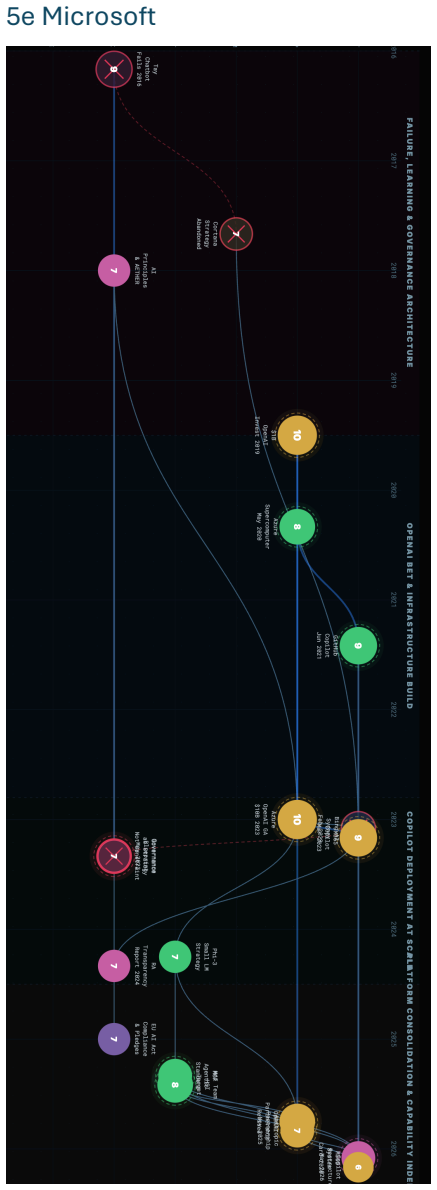

read the original abstract
Our focus are five related questions that stem from a critical software studies perspective. Underpinning this view is the acknowledged need to avoid assumptions regarding the inevitability of the current situation relating to AI. What we need to see is the closeness of the linkage between current commercial AI development and our prevailing social, political and economic circumstances. This does mean that the perspectives presented here are done so critically and conditionally. Most importantly, Artificial General Intelligence (AGI) is seen as being problematic both conceptually and definitionally. This conditioning of any view regarding AGI does lead the discussion in specific directions and to certain conclusions regarding the future. However, adopting this perspective enables the work to offer some final recommendations. We set out to ask the following questions, 1. What are the critical pathways that produced the current dominant generative AI tools (capabilities, product forms, adoption patterns)? 2. Which decision points acted as leverage nodes (small changes that had large downstream effects), and which dead ends reveal alternative possibilities that did not become dominant? 3. How do pathways differ across three foundational-model trajectories such as the frontier proprietary models, open-weight models or specific domain and sovereign models? 4. Which alternative projects branched from key leverage nodes, what is their current state, and why did some succeed, stall, fail or become absorbed? 5. Based on this analysis, what socio-technical development programmes could plausibly move toward AGI-adjacent capability while meeting requirements for transparency, moderation, wellbeing and sustainable business models?
Editorial analysis
A structured set of objections, weighed in public.
Referee Report
Summary. The manuscript adopts a critical software studies perspective to interrogate the socio-technical pathways that produced current dominant generative AI tools. It treats AGI as conceptually and definitionally problematic, rejects assumptions of inevitability, and structures its analysis around five questions concerning historical pathways, leverage nodes and dead ends, differences across proprietary/open-weight/domain-specific trajectories, the fate of alternative projects, and the derivation of socio-technical development programmes that could achieve AGI-adjacent capabilities while satisfying transparency, moderation, wellbeing and sustainability criteria.
Significance. If the interpretive historical analysis is substantiated with concrete case material, the paper could usefully reframe AGI discourse as contingent rather than teleological, thereby opening space for policy and research interventions that prioritise socio-technical values over unchecked scaling. Its conditional, non-inevitabilist stance is a strength that distinguishes it from much of the existing AGI literature.
major comments (2)
- The foundational claim that AGI is 'problematic both conceptually and definitionally' (Abstract) is asserted without engagement with specific technical definitions or debates in the AGI literature (e.g., those centred on generality, human-level performance, or benchmark suites). Because this claim conditions the direction of all five questions and the final recommendations, the absence of such engagement weakens the load-bearing premise of the argument.
- Question 5 and the concluding recommendations section: the socio-technical programmes are presented as plausible outcomes of the pathway analysis, yet the manuscript does not supply an explicit mapping showing how particular leverage nodes, dead ends, or trajectory differences identified in questions 1-4 directly support the proposed programmes. This missing linkage is central to the paper's claim to offer actionable conclusions.
minor comments (4)
- Abstract: 'Our focus are five' is grammatically incorrect; revise to 'We focus on five' or 'Our focus is on five'.
- Abstract: the sentence 'This does mean that the perspectives presented here are done so critically and conditionally' is awkward and redundant; a clearer phrasing would be 'This implies that the perspectives presented here are critical and conditional.'
- The term 'critical software studies perspective' is used without an early definition or key references; adding a brief characterisation in the introduction would improve accessibility for an AI readership.
- The five questions are enumerated but the manuscript would benefit from a short roadmap paragraph indicating which sections address each question.
Simulated Author's Rebuttal
We thank the referee for their constructive comments on our manuscript. We address each of the major comments in turn below, indicating where revisions will be made to strengthen the paper.
read point-by-point responses
-
Referee: The foundational claim that AGI is 'problematic both conceptually and definitionally' (Abstract) is asserted without engagement with specific technical definitions or debates in the AGI literature (e.g., those centred on generality, human-level performance, or benchmark suites). Because this claim conditions the direction of all five questions and the final recommendations, the absence of such engagement weakens the load-bearing premise of the argument.
Authors: While our analysis adopts a critical software studies perspective that inherently questions the conceptual foundations of AGI as a socio-technical construct rather than a purely technical one, we recognize that the abstract presents this claim without direct reference to specific technical debates. To address this, we will expand the introduction section to briefly engage with prominent AGI definitions from the literature, such as those focusing on generality across tasks, human-level performance on benchmarks, and related discussions. This addition will clarify how our socio-technical critique builds upon and diverges from these technical framings, thereby reinforcing the premise without altering the paper's core direction. revision: yes
-
Referee: Question 5 and the concluding recommendations section: the socio-technical programmes are presented as plausible outcomes of the pathway analysis, yet the manuscript does not supply an explicit mapping showing how particular leverage nodes, dead ends, or trajectory differences identified in questions 1-4 directly support the proposed programmes. This missing linkage is central to the paper's claim to offer actionable conclusions.
Authors: We agree that making the linkages explicit would enhance the coherence and actionability of our conclusions. In the revised version, we will include a new subsection following the analysis of questions 1-4 that explicitly maps each element of the proposed socio-technical development programmes to specific leverage nodes, dead ends, and trajectory differences identified earlier. This will demonstrate how, for instance, certain open-weight trajectories inform recommendations for transparency-focused programmes. revision: yes
Circularity Check
No significant circularity in interpretive critical analysis
full rationale
The paper advances a conditional, perspectival argument from a critical software studies viewpoint, structured around five explicitly posed questions about AI pathways, leverage nodes, and socio-technical alternatives. It states upfront that AGI is treated as conceptually and definitionally problematic and that assumptions of inevitability are to be avoided, but these are framing choices rather than derivations. No equations, fitted parameters, predictions, or load-bearing self-citations appear; the analysis rests on historical interpretation and internal coherence of the questions themselves. The central claims do not reduce to prior inputs by construction, satisfying the default expectation of non-circularity for non-mathematical interpretive work.
Axiom & Free-Parameter Ledger
axioms (2)
- domain assumption The current situation relating to AI is not inevitable and is closely linked to prevailing social, political and economic circumstances.
- domain assumption AGI is problematic both conceptually and definitionally.
Reference graph
Works this paper leans on
-
[1]
The consequence was a structural shift in the search advertising market and Google was forced into a panic that would force Bard too quickly to market (and ironically produce reputational damage) followed by the Gemini demonstration. The alternative pathway suggests that if Google had decided to deploy LaMDA in mid-2021, in a similar form to the ChatGPT o...
work page 2021
-
[2]
This event typifies what happens when an organisation whose competitive advantage is based on research rigour is forced to operate at the pace that a consumer culture demands. Google’s misstep is a symptom of the organisational mismatch between how and what it does - previously without significant competition - and what being in a competitive situation re...
work page 2023
-
[3]
the Pause Giant AI Experiments letter signed and immediately contradicted by the founding of a competing lab and the 2024 lawsuit are all pivotal in evolution of Grok (Future of Life Institute, 2023; Musk v. Altman et al., 2024a, 2024b). All the features in the original grievance then shape every subsequent decision with the positioning of the tool as “an...
work page 2024
-
[4]
Barret Zoph, Luke Metz, Sam Schoenholz and Liam Fedus were all Google Brain researchers before joining OpenAI. Chris Olah was at Google Brain from 2015 to 2018 before joining OpenAI and then subsequently co-founding Anthropic. His mechanistic interpretability research is the foundation for Anthropic's safety methodology. What happened and was learned at G...
work page 2015
-
[5]
Schulman's personal pathway confirms a wider pattern in which the individuals who bear the most concentrated knowledge regarding the foundational approaches to alignment and post-training do not remain linked to any single organisation over the duration of their most productive years. The crisis of November 2023, when Sam Altman was briefly removed as CEO...
work page 2023
-
[6]
Ilya Sutskever, who had voted with the board to remove Altman but then signed the letter supporting his reinstatement, left OpenAI in June 2024 to co-found Safe Superintelligence (SSI). This new company has the stated aim of building a safe superintelligence before commercialising any capabilities. Lilian Weng, who had held roles including head of applied...
work page 2024
-
[7]
These departures are not separate unrelated incidents. The November 2023 crisis exposed the fundamental unresolved tension in OpenAI between the rapid pace of commercialisation, supported by Altman, and a more cautious orientation toward capability and safety research. Those departing were most closely associated with the latter position. The impact was t...
work page 2023
-
[8]
His subsequent public statement that OpenAI's safety culture and processes had not kept pace with its product and capabilities teams was the most direct public statement regarding these internal tensions (Milmo, 2024). Leike joined Anthropic, and consolidated a pattern in which OpenAI's most safety-focused researchers migrate toward Anthropic. 6c Thinking...
work page 2024
-
[9]
before co-founding xAI from May 2023 to July
work page 2023
-
[10]
Kyle Kosic, who had been an OpenAI engineer from April 2021, co-founded xAI in May 2023, then returned to OpenAI in May
work page 2021
-
[11]
The xAI personnel network reveals a distinct structural constraint
The pattern here from OpenAI to xAI and returning to OpenAI reflects a common dynamic bounding from the excitement of founding a new venture against the pull of superior resources and scale at the original organisation. The xAI personnel network reveals a distinct structural constraint. xAI's founding group do not constitute a coherent intellectual progra...
-
[12]
Elon Musk reportedly left OpenAI's board in 2018 after Sam Altman and other cofounders rejected his plan to run the company. Business Insider. https://www.businessinsider.com/elon-musk-reportedly-tried-lead-openai-left-after-founders-objected-2023-3 Jin, H., & Dang, S. (2023, April 18). Elon Musk says he will launch rival to Microsoft-backed ChatGPT. Reut...
-
[13]
State Department switches to OpenAI as US agencies start phasing out Anthropic. Reuters. https://www.reuters.com/business/us-treasury-ending-all-use-anthropic-products-says-bessent-2026-03-02 Senju, A. (2012). Spontaneous theory of mind and its absence in autism spectrum disorders. The Neuroscientist, 18(2), 108–113. https://doi.org/10.1177/10738584103972...
discussion (0)
Sign in with ORCID, Apple, or X to comment. Anyone can read and Pith papers without signing in.