Recognition: unknown
Safety Certification is Classification
Pith reviewed 2026-05-08 10:35 UTC · model grok-4.3
The pith
Treating safety certification as classification on trajectory data enables direct estimation of T-step safety probabilities without recursive error buildup.
A machine-rendered reading of the paper's core claim, the machinery that carries it, and where it could break.
Core claim
Safety certification is reframed as a kernel-based classification problem on trajectory data that directly estimates the T-step safety probability. The approach subsumes barrier certificates and robust Markov models, bypasses compounding errors across the horizon, and certifies systems with non-Markovian dynamics.
What carries the argument
Kernel embedding of finite trajectory samples for direct binary classification of complete safe versus unsafe trajectories, yielding a non-recursive lower bound on the T-step safety probability.
If this is right
- The direct estimator's accuracy remains independent of the certification horizon T, unlike DP recursion whose error compounds.
- Certification applies to non-Markovian systems where future evolution depends on trajectory history.
- Existing methods such as barrier certificates arise as special cases of the classification view.
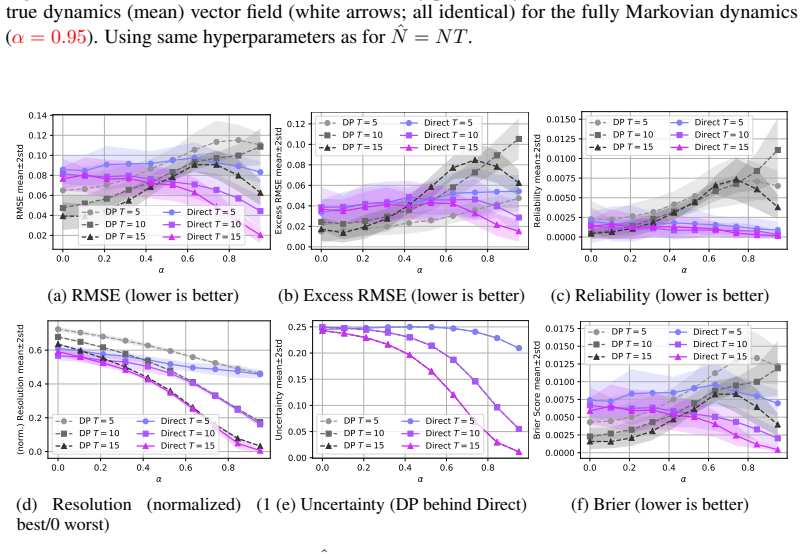
- Simulation results on a quadrotor confirm that recursive certificates become unsound while the direct method stays stable.
Where Pith is reading between the lines
- The classification perspective could incorporate modern supervised learning models beyond kernels for systems with high-dimensional state spaces.
- Data collection policies that focus on near-boundary trajectories might tighten the certified lower bound more efficiently than uniform sampling.
- For deployed controllers, periodic re-certification on fresh trajectory batches could maintain soundness over changing environments.
Load-bearing premise
Finite trajectory samples plus a suitable kernel embedding produce a sound lower bound on the true T-step safety probability without the classification step introducing bias or variance that invalidates the certificate.
What would settle it
Generate ground-truth safety probabilities for a known non-Markovian system via exhaustive simulation or exact analysis, then check whether the kernel classifier's lower bound ever exceeds that ground truth as more trajectories are added.
Figures




read the original abstract
The goal of this paper is certifying safety of dynamical systems subject to uncertainty. Existing approaches use trajectory data to estimate transition probabilities, and compute safety probabilities recursively via dynamic programming (DP). This recursion may lead to compounding errors in the certified safety probability, thus collapsing to a vacuous lower bound for growing horizons $T$. We propose a kernel embedding framework that treats safety certification as a classification problem on trajectory data, directly estimating the $T$-step safety probability without recursion. We show that the framework subsumes well-established approaches from the literature (e.g., barrier certificates, robust Markov models) as special cases, and allows us to go beyond their limitations. As the main consequence, it bypasses compounding error across the horizon and enables certification for systems with non-Markovian dynamics. We demonstrate that direct estimators remain stable independent of the certification horizon and in the non-Markovian setting, whilst DP-based certificates silently go unsound -- confirmed in simulation on a neural-controlled quadrotor.
Editorial analysis
A structured set of objections, weighed in public.
Referee Report
Summary. The paper proposes reframing safety certification of uncertain dynamical systems as a kernel-based classification task on full trajectory samples. This yields a direct estimator for the T-step safety probability that avoids recursive dynamic programming, thereby sidestepping compounding approximation error. The framework is positioned as a generalization that recovers barrier certificates and robust Markov models as special cases and extends to non-Markovian dynamics. Empirical support is provided via simulation on a neural-controlled quadrotor, where the direct estimator remains numerically stable for large T while DP-based bounds become vacuous.
Significance. A sound, non-recursive method for producing non-vacuous lower bounds on finite-horizon safety probabilities would be a useful contribution to safe control and formal verification, especially for systems whose dynamics or controllers induce non-Markovian behavior. The subsumption claim and the reported stability contrast with DP are potentially valuable if backed by appropriate guarantees; the quadrotor demonstration illustrates the practical issue the authors target.
major comments (3)
- [Section 3 (Kernel Embedding Framework) and Theorem 1] The central claim that the kernel classifier produces a valid (non-overestimating) lower bound on the true T-step safety probability from finite trajectories is not supported by an explicit one-sided concentration inequality or conservative surrogate (e.g., slack variables or worst-case embedding) that accounts for both sampling variance and RKHS approximation error. This is load-bearing for the certification interpretation and is especially acute for non-Markovian dynamics where the trajectory measure has high effective dimension.
- [Section 3.3 (Special Cases)] The subsumption of barrier certificates and robust Markov models as special cases is asserted but not accompanied by a precise statement of the kernel and label choices that recover each prior method; without this, it is unclear whether the generalization preserves the soundness properties of the special cases or merely their functional form.
- [Section 5 (Experiments)] The quadrotor simulation (Section 5) demonstrates numerical stability of the direct estimator but reports no statistical confidence intervals, bootstrap estimates, or worst-case analysis on the certified probabilities. Consequently the experiments show empirical behavior rather than verified certificates, weakening the claim that DP-based methods “silently go unsound” while the new method remains sound.
minor comments (2)
- [Section 3.1] The notation for the trajectory kernel and the safety label function should be introduced with an explicit definition of the feature map and the RKHS inner product before the classification objective is stated.
- [Introduction] Several sentences in the introduction equate “stable numerical value” with “certificate”; this terminology should be replaced by precise statements about lower bounds once the theoretical guarantee is supplied.
Simulated Author's Rebuttal
Thank you for the constructive review and for highlighting these important points regarding guarantees, subsumption, and experimental validation. We address each major comment below and will incorporate revisions to strengthen the manuscript.
read point-by-point responses
-
Referee: [Section 3 (Kernel Embedding Framework) and Theorem 1] The central claim that the kernel classifier produces a valid (non-overestimating) lower bound on the true T-step safety probability from finite trajectories is not supported by an explicit one-sided concentration inequality or conservative surrogate (e.g., slack variables or worst-case embedding) that accounts for both sampling variance and RKHS approximation error. This is load-bearing for the certification interpretation and is especially acute for non-Markovian dynamics where the trajectory measure has high effective dimension.
Authors: Theorem 1 establishes consistency of the estimator to the true safety probability in the infinite-sample limit. The direct (non-recursive) formulation avoids compounding error by design, but we agree that an explicit finite-sample one-sided bound is needed to fully support the certification claim, particularly in high-dimensional non-Markovian settings. We will revise Section 3 to include a discussion of conservative lower bounds derived from existing concentration results on kernel mean embeddings (e.g., via Hilbert-norm deviation bounds) together with a slack-variable surrogate on the classification threshold. revision: yes
-
Referee: [Section 3.3 (Special Cases)] The subsumption of barrier certificates and robust Markov models as special cases is asserted but not accompanied by a precise statement of the kernel and label choices that recover each prior method; without this, it is unclear whether the generalization preserves the soundness properties of the special cases or merely their functional form.
Authors: We will expand Section 3.3 with explicit constructions: barrier certificates are recovered by an indicator kernel on the safe set with labels given by the barrier-function sign; robust Markov models are recovered by a feature map that embeds the transition kernel with labels equal to the one-step safety indicator. These choices ensure the general estimator reduces exactly to the original sound methods, thereby inheriting their guarantees. revision: yes
-
Referee: [Section 5 (Experiments)] The quadrotor simulation (Section 5) demonstrates numerical stability of the direct estimator but reports no statistical confidence intervals, bootstrap estimates, or worst-case analysis on the certified probabilities. Consequently the experiments show empirical behavior rather than verified certificates, weakening the claim that DP-based methods “silently go unsound” while the new method remains sound.
Authors: The simulations are designed to illustrate the practical phenomenon that DP bounds become vacuous for large T while the direct estimator remains stable. We agree that statistical quantification would better support the soundness contrast. In the revision we will add bootstrap confidence intervals computed over independent trajectory batches and a brief worst-case sensitivity analysis. revision: yes
Circularity Check
No circularity: direct kernel classification estimator is independent of recursive DP inputs
full rationale
The paper's central derivation reframes safety certification as kernel mean embedding classification over full trajectories to produce a direct T-step probability estimate. No equations or self-citations in the abstract or described framework reduce this estimate to a fitted parameter, prior result, or input quantity by construction. The subsumption of barrier certificates and Markov models is presented as a derived special case rather than a definitional equivalence, and the avoidance of compounding error follows from the non-recursive structure without circular re-use of DP quantities. The approach is positioned against external benchmarks (recursive DP) with independent data requirements, making the derivation self-contained.
Axiom & Free-Parameter Ledger
axioms (1)
- domain assumption Trajectory data can be embedded via kernels to enable accurate classification of multi-step safety properties.
Reference graph
Works this paper leans on
-
[1]
International Conference on Foundations of Software Technology and Theoretical Computer Science , pages=
Model Checking , author=. International Conference on Foundations of Software Technology and Theoretical Computer Science , pages=. 1997 , organization=
1997
-
[2]
2009 , publisher=
Verification and Control of Hybrid Systems: A Symbolic Approach , author=. 2009 , publisher=
2009
-
[3]
Journal of the American Statistical Association , volume=
Strictly proper scoring rules, prediction, and estimation , author=. Journal of the American Statistical Association , volume=. 2007 , publisher=
2007
-
[4]
Journal of Applied Meteorology and Climatology , volume=
A new vector partition of the probability score , author=. Journal of Applied Meteorology and Climatology , volume=. 1973 , publisher=
1973
-
[5]
Advances in large margin classifiers , volume=
Probabilistic outputs for support vector machines and comparisons to regularized likelihood methods , author=. Advances in large margin classifiers , volume=. 1999 , publisher=
1999
-
[6]
International conference on machine learning , pages=
On calibration of modern neural networks , author=. International conference on machine learning , pages=. 2017 , organization=
2017
-
[7]
Robust anytime learning of
Suilen, Marnix and Sim. Robust anytime learning of. Advances in Neural Information Processing Systems , volume=
-
[8]
Sampling-based robust control of autonomous systems with non-
Badings, Thom S and Abate, Alessandro and Jansen, Nils and Parker, David and Poonawala, Hasan A and Stoelinga, Marielle , booktitle=. Sampling-based robust control of autonomous systems with non-
-
[9]
Proceedings of the AAAI Conference on Artificial Intelligence , volume=
Casablanca, Ernesto and Sch. Proceedings of the AAAI Conference on Artificial Intelligence , volume=
-
[10]
Abate, Alessandro and Ahmed, Daniele and Edwards, Alec and Giacobbe, Mirco and Peruffo, Andrea , booktitle=
-
[11]
Proceedings of the IEEE/CVF Conference on Computer Vision and Pattern Recognition , pages=
Generating useful accident-prone driving scenarios via a learned traffic prior , author=. Proceedings of the IEEE/CVF Conference on Computer Vision and Pattern Recognition , pages=
-
[12]
Proceedings of the IEEE/CVF Conference on Computer Vision and Pattern Recognition , pages=
On adversarial robustness of trajectory prediction for autonomous vehicles , author=. Proceedings of the IEEE/CVF Conference on Computer Vision and Pattern Recognition , pages=
-
[13]
Transportation Research Part A: Policy and Practice , volume =
Driving to safety: How many miles of driving would it take to demonstrate autonomous vehicle reliability? , author =. Transportation Research Part A: Policy and Practice , volume =. 2016 , doi =
2016
-
[14]
Abate, Alessandro and Althoff, Matthias and Bu, Lei and Ernst, Gidon and Frehse, Goran and Geretti, Luca and Johnson, Taylor T and Menghi, Claudio and Mitsch, Stefan and Schupp, Stefan and others , booktitle=. The. 2023 , publisher=
2023
-
[15]
Safe Control With Learned Certificates: A Survey of Neural
Dawson, Charles and Gao, Sicun and Fan, Chuchu , journal=. Safe Control With Learned Certificates: A Survey of Neural. 2023 , volume=
2023
-
[16]
A Safe Exploration Approach to Constrained
Ni, Tingting and Kamgarpour, Maryam , booktitle=. A Safe Exploration Approach to Constrained. 2025 , organization=
2025
-
[17]
Journal of Machine Learning Research , volume=
A comprehensive survey on safe reinforcement learning , author=. Journal of Machine Learning Research , volume=
-
[18]
Annual Review of Control, Robotics, and Autonomous Systems , volume=
Safe learning in robotics: From learning-based control to safe reinforcement learning , author=. Annual Review of Control, Robotics, and Autonomous Systems , volume=. 2022 , publisher=
2022
-
[19]
Advances in Neural Information Processing Systems , volume=
Safe model-based reinforcement learning with stability guarantees , author=. Advances in Neural Information Processing Systems , volume=
-
[20]
Communications of the ACM , volume=
Toward verified artificial intelligence , author=. Communications of the ACM , volume=. 2022 , publisher=
2022
-
[21]
2017 , organization=
Bansal, Somil and Chen, Mo and Herbert, Sylvia and Tomlin, Claire J , booktitle=. 2017 , organization=
2017
-
[22]
Advances in Neural Information Processing Systems , volume=
Risk-driven design of perception systems , author=. Advances in Neural Information Processing Systems , volume=
-
[23]
Advances in Neural Information Processing Systems , volume=
Neural abstractions , author=. Advances in Neural Information Processing Systems , volume=
-
[24]
1995 , isbn=
The Nature of Statistical Learning Theory , author=. 1995 , isbn=
1995
-
[25]
Proceedings of the 25th ACM SIGKDD International Conference on Knowledge Discovery & Data Mining , pages=
Optuna: A next-generation hyperparameter optimization framework , author=. Proceedings of the 25th ACM SIGKDD International Conference on Knowledge Discovery & Data Mining , pages=
-
[26]
arXiv preprint arXiv:2509.18666 , year=
Distributionally Robust Safe Motion Planning with Contextual Information , author=. arXiv preprint arXiv:2509.18666 , year=
-
[27]
Robustness of temporal logic specifications for continuous-time signals , journal =. 2009 , issn =. doi:10.1016/j.tcs.2009.06.021 , url_ =
-
[28]
Thorpe, Adam and Oishi, Meeko , booktitle=
-
[29]
A data-driven approach for safety quantification of non-linear stochastic systems with unknown additive noise distribution , author=. arXiv:2410.06662 , year=
-
[30]
Piecewise Control Barrier Functions for Stochastic Systems , author=. arXiv:2507.17703 , year=
-
[31]
Proceedings of the IEEE Conference on Decision and Control , pages=
Distributionally robust optimal and safe control of stochastic systems via kernel conditional mean embedding , author=. Proceedings of the IEEE Conference on Decision and Control , pages=. 2023 , organization=
2023
-
[32]
Proceedings of the American Mathematical Society , volume=
Separability of reproducing kernel spaces , author=. Proceedings of the American Mathematical Society , volume=
-
[33]
2024 , organization=
Wooding, Ben and Lavaei, Abolfazl , booktitle=. 2024 , organization=
2024
-
[34]
Bounded-parameter
Givan, Robert and Leach, Sonia and Dean, Thomas , journal=. Bounded-parameter. 2000 , publisher=
2000
-
[35]
IEEE Transactions on Automatic Control , volume=
Formal verification and synthesis for discrete-time stochastic systems , author=. IEEE Transactions on Automatic Control , volume=. 2015 , publisher=
2015
-
[36]
2024 , publisher=
Mathiesen, Frederik Baymler and Lahijanian, Morteza and Laurenti, Luca , journal=. 2024 , publisher=
2024
-
[37]
and Parker, David and Jansen, Nils , editor =
Suilen, Marnix and Badings, Thom and Bovy, Eline M. and Parker, David and Jansen, Nils , editor =. Robust. Principles of Verification: Cycling the Probabilistic Landscape : Essays Dedicated to Joost-Pieter Katoen on the Occasion of His 60th Birthday, Part III , year =
-
[38]
arXiv:2211.08875 , howpublished=
Learning linear operators: Infinite-dimensional regression as a well-behaved non-compact inverse problem , author=. arXiv:2211.08875 , howpublished=
-
[39]
Automatica , volume=
Probabilistic reachability and safety for controlled discrete time stochastic hybrid systems , author=. Automatica , volume=. 2008 , publisher=
2008
-
[40]
Data-Driven Stochastic Control via Non-iid Trajectories: Foundations and Guarantees , author=. arXiv:2507.23280 , year=
-
[41]
Rozwood, Preston and Mehrez, Edward and Paehler, Ludger and Sun, Wen and Brunton, Steven L , journal=
-
[42]
Data-driven
Zhong, Zhengang and del Rio-Chanona, Ehecatl Antonio and Petsagkourakis, Panagiotis , journal=. Data-driven. 2025 , publisher=
2025
-
[43]
Robust approximation of the stochastic
Wanner, Mathias and Mezic, Igor , journal=. Robust approximation of the stochastic. 2022 , publisher=
2022
-
[44]
2020 , publisher=
Das, Suddhasattwa and Giannakis, Dimitrios , journal=. 2020 , publisher=
2020
-
[45]
Brunton, Steven L and Budi. Modern. SIAM Review , year=
-
[46]
Data-driven discovery of
Kaiser, Eurika and Kutz, J Nathan and Brunton, Steven L , journal=. Data-driven discovery of. 2021 , publisher=
2021
-
[47]
Schön, Oliver and Zhong, Zhengang and Soudjani, Sadegh , title =
-
[48]
Advances in Neural Information Processing Systems , volume=
Learning with little mixing , author=. Advances in Neural Information Processing Systems , volume=
-
[49]
Advances in Neural Information Processing Systems , volume=
Fast learning from non-iid observations , author=. Advances in Neural Information Processing Systems , volume=
-
[50]
Proceedings of the 41st International Conference on Machine Learning , pages=
On the consistency of kernel methods with dependent observations , author=. Proceedings of the 41st International Conference on Machine Learning , pages=
-
[51]
Operations Research , volume=
A nonparametric algorithm for optimal stopping based on robust optimization , author=. Operations Research , volume=. 2023 , publisher=
2023
-
[52]
nternational Conference on Machine Learning , pages=
Guarantees for Nonlinear Representation Learning: Non-identical Covariates, Dependent Data, Fewer Samples , author=. nternational Conference on Machine Learning , pages=
-
[53]
Proceedings of the IEEE Conference on Decision and Control , pages=
A tutorial on the non-asymptotic theory of system identification , author=. Proceedings of the IEEE Conference on Decision and Control , pages=. 2023 , organization=
2023
-
[54]
Recovering distributions from
Kanagawa, Motonobu and Fukumizu, Kenji , booktitle=. Recovering distributions from. 2014 , organization=
2014
-
[55]
2025 (to appear, preprint at https://arxiv.org/abs/2404.05424)
Meggendorfer, Tobias and Weininger, Maximilian and Wienh. What are the odds?. arXiv:2404.05424 , year=
-
[56]
Journal of machine learning research , volume=
Classes of kernels for machine learning: a statistics perspective , author=. Journal of machine learning research , volume=
-
[57]
APL Machine Learning , volume=
A unifying perspective on non-stationary kernels for deeper Gaussian processes , author=. APL Machine Learning , volume=. 2024 , publisher=
2024
-
[58]
Journal of the American Statistical Association , volume=
Nonparametric estimation of nonstationary spatial covariance structure , author=. Journal of the American Statistical Association , volume=. 1992 , publisher=
1992
-
[59]
Data-driven abstractions via binary-tree
Sch. Data-driven abstractions via binary-tree. IFAC-PapersOnLine , volume=. 2024 , publisher=
2024
-
[60]
Bridging Logic and Learning: Decoding Temporal Logic Embeddings via Transformers , author=. arXiv:2507.07808 , year=
-
[61]
International Conference on Tools and Algorithms for the Construction and Analysis of Systems , pages=
Learning model checking and the kernel trick for signal temporal logic on stochastic processes , author=. International Conference on Tools and Algorithms for the Construction and Analysis of Systems , pages=. 2022 , organization=
2022
-
[62]
Proceedings of the American Control Conference , pages=
Approximate stochastic reachability for high dimensional systems , author=. Proceedings of the American Control Conference , pages=. 2021 , organization=
2021
-
[63]
Quantitative model-checking of controlled discrete-time
Tkachev, Ilya and Mereacre, Alexandru and Katoen, Joost-Pieter and Abate, Alessandro , journal=. Quantitative model-checking of controlled discrete-time. 2017 , publisher=
2017
-
[64]
Data-Driven Distributionally Robust Control for Interacting Agents under Logical Constraints , author=. arXiv:2503.09816 , year=
-
[65]
IEEE Transactions on Automatic Control , year=
A unifying perspective for safety of stochastic systems: From barrier functions to finite abstractions , author=. IEEE Transactions on Automatic Control , year=
-
[66]
Journal of Machine Learning Research , volume=
Kernels for sequentially ordered data , author=. Journal of Machine Learning Research , volume=
-
[67]
International Symposium on Formal Techniques in Real-Time and Fault-Tolerant Systems , pages=
Monitoring temporal properties of continuous signals , author=. International Symposium on Formal Techniques in Real-Time and Fault-Tolerant Systems , pages=. 2004 , organization=
2004
-
[68]
Journal of Computational Physics , volume=
Kernel methods are competitive for operator learning , author=. Journal of Computational Physics , volume=. 2024 , publisher=
2024
-
[69]
Robust uncertainty bounds in reproducing kernel
Scharnhorst, Paul and Maddalena, Emilio T and Jiang, Yuning and Jones, Colin N , journal=. Robust uncertainty bounds in reproducing kernel. 2022 , publisher=
2022
-
[70]
Reproducing Kernel
Ghojogh, Benyamin and Ghodsi, Ali and Karray, Fakhri and Crowley, Mark , journal=. Reproducing Kernel
-
[71]
Conference on Robot Learning , pages=
Differentiable logic layer for rule guided trajectory prediction , author=. Conference on Robot Learning , pages=. 2021 , organization=
2021
-
[72]
Integrated Formal Methods: 13th International Conference, IFM 2017, Turin, Italy, September 20-22, 2017, Proceedings 13 , pages=
Formalising and monitoring traffic rules for autonomous vehicles in Isabelle/HOL , author=. Integrated Formal Methods: 13th International Conference, IFM 2017, Turin, Italy, September 20-22, 2017, Proceedings 13 , pages=. 2017 , organization=
2017
-
[73]
2020 IEEE 3rd Connected and Automated Vehicles Symposium (CAVS) , pages=
Formalizing traffic rules for machine interpretability , author=. 2020 IEEE 3rd Connected and Automated Vehicles Symposium (CAVS) , pages=. 2020 , organization=
2020
-
[74]
Automatica , volume=
Formal methods to comply with rules of the road in autonomous driving: State of the art and grand challenges , author=. Automatica , volume=. 2023 , publisher=
2023
-
[75]
2016 , publisher=
An introduction to the theory of reproducing kernel Hilbert spaces , author=. 2016 , publisher=
2016
-
[76]
Computational Statistics & Data Analysis , volume=
Embedding and learning with signatures , author=. Computational Statistics & Data Analysis , volume=. 2021 , publisher=
2021
-
[77]
Advances in Neural Information Processing Systems , volume=
Deep signature transforms , author=. Advances in Neural Information Processing Systems , volume=
-
[78]
Advances in Neural Information Processing Systems , volume=
Higher order kernel mean embeddings to capture filtrations of stochastic processes , author=. Advances in Neural Information Processing Systems , volume=
-
[79]
Artificial Intelligence , volume=
Convolutional spectral kernel learning with generalization guarantees , author=. Artificial Intelligence , volume=. 2022 , publisher=
2022
-
[80]
Benchmarking uncertainty disentanglement: Specialized uncertainties for specialized tasks , author=. arXiv:2402.19460 , year=
discussion (0)
Sign in with ORCID, Apple, or X to comment. Anyone can read and Pith papers without signing in.