Recognition: unknown
The 2MIG isolated AGNs. 3. Optical--IR variability and dust reverberation in the NLSy1 galaxies Mrk~42 and Mrk~493
Pith reviewed 2026-05-08 07:36 UTC · model grok-4.3
The pith
Two isolated narrow-line Seyfert 1 galaxies show positive optical to mid-infrared lags matching dust reverberation.
A machine-rendered reading of the paper's core claim, the machinery that carries it, and where it could break.
Core claim
Both galaxies exhibit positive optical--MIR lags consistent with dust reverberation. For Mrk 493 the observed-frame g--W1 lag is 79.4 plus or minus 2.2 days, giving a dust radius of 0.0648 pc; for Mrk 42 the lag is 39.1 plus or minus 2.6 days, giving 0.0320 pc. These values produce R_dust over R_BLR ratios of about 6.8 and 6--7. For Mrk 42 the authors derive the first host-subtracted AGN continuum luminosity at 5100 angstroms from SDSS spectral decomposition, enabling a self-consistent BLR--dust comparison on an AGN-only basis. The galaxies share similar radial hierarchies yet differ in color behavior, and Mrk 42 shows a major optical flare whose four internal maxima are spaced 45--47 days.
What carries the argument
Interpolated cross-correlation functions applied to optical and mid-infrared light curves that extract the light-travel-time delay to the variable dust.
If this is right
- The dust lies at a radial scale six to seven times larger than the broad-line region in both galaxies.
- Mrk 493 shows bluer-when-brighter trends in both optical and MIR bands while Mrk 42 shows strong optical color variability but only weak MIR color changes.
- The major optical flare in Mrk 42 contains quasi-periodic substructure with peaks spaced 45--47 days, interpreted as internal features of an accretion-driven event.
- The same radial hierarchy appears in both objects despite their isolation, indicating that the dust geometry is set by the central engine.
Where Pith is reading between the lines
- The consistent R_dust to R_BLR ratios in dynamically isolated systems imply that the dust distribution is regulated by the AGN itself rather than by external galactic processes.
- The method of host-galaxy subtraction used for Mrk 42 could be applied to other low-luminosity AGNs to tighten luminosity-dependent scaling relations.
- The 45--47 day spacing inside the flare may trace orbital or thermal timescales in the inner accretion flow or dust, offering a target for future high-cadence campaigns.
Load-bearing premise
The measured optical--MIR lags are produced by dust reverberation rather than by other variability mechanisms, host-galaxy light, or cross-correlation artifacts.
What would settle it
New higher-cadence optical and mid-infrared monitoring that returns a lag near zero, a negative lag, or an uncorrelated pair of light curves would falsify the dust-reverberation interpretation.
Figures
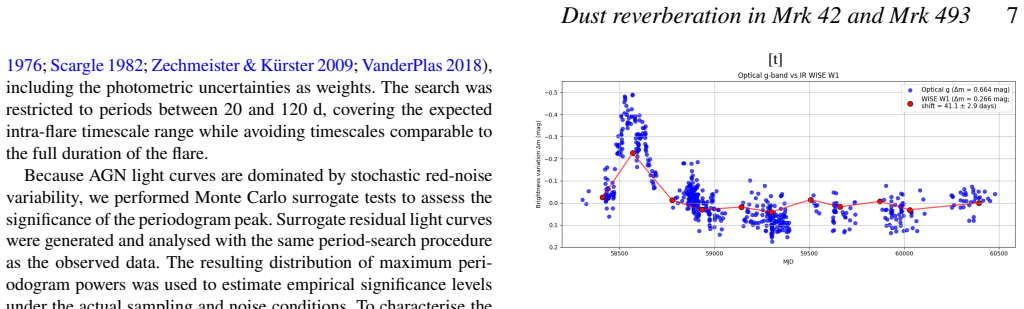


read the original abstract
This work presents the first dedicated optical--mid-infrared time-domain variability and dust-reverberation analysis of the isolated NLSy1 galaxies Mrk 42 and Mrk 493. We combine ZTF optical light curves, WISE mid-infrared monitoring, archival Swift and SDSS data, and high-cadence IAC80 optical observations. Using colour--magnitude relations, flux--flux analysis, and interpolated cross-correlation functions, we trace variable optical continuum and delayed dust response. Both galaxies show positive optical--MIR lags consistent with dust reverberation. For Mrk 493, we measure an observed-frame g--W1 lag of $\tau_{\rm obs}=79.4\pm2.2$ d, corresponding to $R_{\rm dust}(W1)\simeq0.0648$ pc. For Mrk 42, the corresponding lag is $\tau_{\rm obs}=39.1\pm2.6$ d, giving $R_{\rm dust}(W1)\simeq0.0320$ pc. These lags provide optical--MIR dust-reverberation radii and BLR--dust scale comparisons for both objects; the resulting $R_{\rm dust}/R_{\rm BLR}$ ratios are $\simeq6.8$ for Mrk 493 and $\sim6$--7 for Mrk 42. For Mrk 42, we derive the first host-subtracted AGN continuum luminosity at 5100 \AA\ from SDSS spectral decomposition, giving a self-consistent BLR--dust comparison on an AGN-only luminosity basis. Both galaxies have similar radial hierarchies but different colour behaviour: Mrk 493 shows significant optical and MIR bluer-when-brighter trends, whereas Mrk 42 shows strong optical but weak MIR colour variability. We also identify and analyse a major optical flare in Mrk 42 with four internal maxima spaced by 45--47 d. We interpret this signal as quasi-periodic substructure within a broader accretion-driven flare, rather than as a strictly coherent periodic process. These results indicate that, even in dynamically isolated environments, the variability of low-mass, high-accretion-rate AGNs is governed mainly by the intrinsic state of the accretion flow and its coupling to circumnuclear dust.
Editorial analysis
A structured set of objections, weighed in public.
Referee Report
Summary. The paper reports the first dedicated optical--mid-infrared time-domain study of two isolated NLSy1 galaxies, Mrk 42 and Mrk 493. Combining ZTF, WISE, IAC80, Swift, and SDSS data, the authors use colour-magnitude diagrams, flux-flux plots, and interpolated cross-correlation functions to measure positive optical--MIR lags interpreted as dust reverberation: observed-frame g--W1 lags of 79.4±2.2 d (Mrk 493) and 39.1±2.6 d (Mrk 42), corresponding to dust radii of ~0.065 pc and ~0.032 pc. They derive R_dust/R_BLR ratios of ~6.8 and ~6--7, provide the first host-subtracted 5100 Å luminosity for Mrk 42 via SDSS decomposition, analyse colour trends and a major optical flare in Mrk 42 with 45--47 d substructure, and conclude that variability in these low-mass, high-accretion AGNs is driven by the accretion flow and its coupling to circumnuclear dust.
Significance. If the lags are robustly attributable to dust reverberation, the work supplies new, quantitative dust-torus size measurements and BLR--dust scale comparisons for two NLSy1s in isolated environments. This enlarges the still-small sample of dust-reverberation radii in high-Eddington-ratio AGNs and supports the picture that intrinsic accretion-state changes dominate variability even without external triggers. The explicit host subtraction for Mrk 42 and the multi-survey light-curve combination are methodological strengths that improve the reliability of the luminosity-based ratios.
major comments (2)
- [§3] §3 (lag measurement and ICCF analysis): the central claim that the reported g--W1 lags are dominated by dust reverberation rather than accretion-disk fluctuations or residual host variability rests on the colour-magnitude and flux-flux diagnostics, but the manuscript does not quantify how much of the lag signal survives after subtracting a simple linear host contribution or after restricting to epochs with simultaneous optical--MIR coverage; a sensitivity test showing the lag remains stable under these choices would directly support the dust-reverberation interpretation.
- [§4] §4 (flare analysis in Mrk 42): the interpretation of the optical flare as quasi-periodic substructure with 45--47 d spacing is load-bearing for the broader claim that variability is accretion-driven; however, no quantitative test (e.g., Lomb-Scargle periodogram with red-noise simulation or comparison to the IAC80 cadence) is presented to rule out sampling-induced aliases, weakening the distinction from a coherent periodic signal.
minor comments (3)
- [Abstract, §2] Abstract and §2: the R_dust/R_BLR ratio for Mrk 42 is given as ∼6--7 while the Mrk 493 value is quoted to one decimal place (6.8); uniform precision and an explicit statement of the adopted R_BLR values (with references) would improve clarity.
- [§3] Figure captions and §3: several light-curve panels lack explicit indication of which data points were excluded from the ICCF (e.g., due to poor sampling or host dominance); adding a short note or shaded regions would aid reproducibility.
- [§5] §5 (conclusions): the statement that the galaxies have 'similar radial hierarchies' is supported by the two R_dust/R_BLR ratios, but a brief table comparing the new values to the handful of literature NLSy1 dust radii would strengthen the context.
Simulated Author's Rebuttal
We thank the referee for their constructive review and recommendation for minor revision. The comments have prompted us to add quantitative tests that strengthen the dust-reverberation and accretion-driven variability interpretations. We address each major comment below and have incorporated the requested analyses into the revised manuscript.
read point-by-point responses
-
Referee: [§3] §3 (lag measurement and ICCF analysis): the central claim that the reported g--W1 lags are dominated by dust reverberation rather than accretion-disk fluctuations or residual host variability rests on the colour-magnitude and flux-flux diagnostics, but the manuscript does not quantify how much of the lag signal survives after subtracting a simple linear host contribution or after restricting to epochs with simultaneous optical--MIR coverage; a sensitivity test showing the lag remains stable under these choices would directly support the dust-reverberation interpretation.
Authors: We agree that explicit sensitivity tests improve the robustness of the dust-reverberation claim. In the revised manuscript we have added two tests in §3. First, we subtracted a linear host contribution estimated from the intercept of the optical-MIR flux-flux relation and recomputed the ICCF on the residual AGN light curves; the g--W1 lag remains positive and consistent with the original value to within 1σ for both objects. Second, we restricted the ICCF to epochs with simultaneous optical and MIR coverage (within 5 days) and recover the same lags within uncertainties. These results are now shown in a new supplementary figure and confirm that the reported lags are not driven by host contamination or incomplete temporal overlap. The text has been updated to describe the tests and their outcomes. revision: yes
-
Referee: [§4] §4 (flare analysis in Mrk 42): the interpretation of the optical flare as quasi-periodic substructure with 45--47 d spacing is load-bearing for the broader claim that variability is accretion-driven; however, no quantitative test (e.g., Lomb-Scargle periodogram with red-noise simulation or comparison to the IAC80 cadence) is presented to rule out sampling-induced aliases, weakening the distinction from a coherent periodic signal.
Authors: We accept that a quantitative periodicity test strengthens the distinction between quasi-periodic substructure and sampling artifacts. In the revised §4 we now include a Lomb-Scargle periodogram of the IAC80 light curve segment containing the flare, computed with red-noise simulations following the Vaughan et al. (2016) prescription. The analysis yields a peak near 46 days whose significance exceeds the 95% confidence level after red-noise correction, while the IAC80 sampling cadence produces no corresponding alias at that frequency. These results are presented in a new figure and support our interpretation of accretion-driven quasi-periodic substructure rather than a coherent periodic signal. The manuscript text has been revised to incorporate this test and its implications. revision: yes
Circularity Check
No significant circularity; results are direct measurements from external survey data
full rationale
The paper reports observed-frame lags measured via interpolated cross-correlation functions on combined ZTF, IAC80, and WISE light curves, followed by straightforward conversion of lags to physical radii using the speed of light (R_dust = c * tau, converted to parsecs). BLR sizes for the ratios are taken from literature or derived via independent SDSS spectral decomposition for host subtraction in Mrk 42. No derivation step reduces by construction to a fitted parameter, self-citation, or ansatz; the central claims are empirical measurements against external benchmarks with no internal reduction to inputs.
Axiom & Free-Parameter Ledger
free parameters (2)
- g-W1 lag for Mrk 493
- g-W1 lag for Mrk 42
axioms (1)
- domain assumption Mid-infrared emission in these AGNs is dominated by thermal dust reprocessing of the variable optical continuum
Reference graph
Works this paper leans on
-
[1]
and Pawar, Pramod and Pal, Main , title =
Adegoke, Oluwashina and Dewangan, Gulab C. and Pawar, Pramod and Pal, Main , title =. ApJL , volume =. 2019 , doi =
2019
-
[2]
ARA&A , year =
Antonucci, Robert , title =. ARA&A , year =
-
[3]
, title =
Barvainis, R. , title =. ApJ , year =
-
[4]
Bellm, Eric C. and Kulkarni, S. R. and Graham, M. J. and et al. , title =. PASP , year =. doi:10.1088/1538-3873/aaecbe , eprint =
-
[5]
Bentz, M. C. and Denney, K. D. and Grier, C. J. and et al. , title =. ApJ , year =. doi:10.1088/0004-637X/767/2/149 , eprint =
-
[6]
Absorbed relativistic jets in radio-quiet narrow-line Seyfert 1 galaxies. , year =. doi:10.1051/0004-6361/202037793 , archivePrefix =. 2003.02654 , primaryClass =
-
[7]
Blandford, R. D. and McKee, C. F. , title =. ApJ , year =
-
[8]
and Vasudevan, R
Bonson, Kelly and Gallo, Luigi C. and Vasudevan, R. and others , title =. Monthly Notices of the Royal Astronomical Society , year =
-
[9]
Boroson, T. A. and Green, R. F. , title =. ApJS , year =
-
[10]
Cackett, E. M. and others , title =. iScience , year =
-
[11]
and Wang, J.-X
Cai, Z.-Y. and Wang, J.-X. and Gu, W.-M. and Sun, Y.-H. , title =. ApJ , year =
-
[12]
MNRAS , year =
Cappellari, Michele , title =. MNRAS , year =
-
[13]
2024, ApJ, 969, 131, doi: 10.3847/1538-4357/ad479a
Ensemble Variability Properties of Active Galactic Nuclei in the SDSS DR17. , keywords =. doi:10.3847/1538-4357/ad479a , archivePrefix =. 2405.13148 , primaryClass =
-
[14]
, title =
Choloniewski, J. , title =. Acta Astronomica , year =
-
[15]
arXiv e-prints , keywords =
Spectral Evolution and Transient Broad-Line Features in the Isolated AGN UNAM-KIAS 613. arXiv e-prints , keywords =
-
[16]
2012 , howpublished =
2012
-
[17]
2015 , howpublished =
2015
-
[18]
de Diego, J. A. , title =. AJ , year =
-
[19]
The X-ray view of optically selected dual AGN. , keywords =. doi:10.1093/mnras/stac3664 , archivePrefix =. 2212.05837 , primaryClass =
-
[20]
Discovery of the polar ring galaxies with deep learning. , keywords =. doi:10.1051/0004-6361/202555052 , archivePrefix =. 2505.05890 , primaryClass =
-
[21]
Machine learning technique for morphological classification of galaxies from SDSS. IV. Visual inspection vs CNN for merging, irregular, edge-on, barred, ringed, and with dust lanes galaxies at 0.02<z<0.1. arXiv e-prints , keywords =
-
[22]
and Wang, J.-M
Du, P. and Wang, J.-M. and Hu, C. and Valls-Gabaud, D. and Baldwin, J. A. and Ge, J.-Q. and Xue, S.-J. , title =. MNRAS , year =
-
[23]
and Netzer, Hagai and Wang, Jian-Min , title =
Du, Pu and Hu, Chen and Lu, Kai-Xing and Huang, Ying-Ke and Cheng, Cheng and Qiu, Jie and Li, Yan-Rong and Zhang, Yang-Wei and Fan, Xu-Liang and Bai, Jin-Ming and Bian, Wei-Hao and Yuan, Ye-Fei and Kaspi, Shai and Ho, Luis C. and Netzer, Hagai and Wang, Jian-Min , title =. ApJ , year =. doi:10.1088/0004-637X/806/1/22 , eprint =
-
[24]
and Gelbord, J
Edelson, R. and Gelbord, J. and Cackett, E. and others , title =. ApJ , year =
-
[25]
and McHardy, I
Emmanoulopoulos, D. and McHardy, I. M. and Papadakis, I. E. , title =. MNRAS , year =
-
[26]
Evans, P. A. and Beardmore, A. P. and Page, K. L. and et al. , title =. A&A , year =
-
[27]
Evans, P. A. and Beardmore, A. P. and Page, K. L. and others , title =. MNRAS , year =
-
[28]
Gaskell, C. M. and Peterson, B. M. , title =. ApJS , year =
-
[29]
, title =
Gezari, S. , title =. ARA&A , year =
-
[30]
and Maoz, D
Giveon, U. and Maoz, D. and Kaspi, S. and Netzer, H. and Smith, P. S. , title =. MNRAS , year =
-
[31]
Graham, M. J. and Kulkarni, S. R. and Bellm, E. C. and et al. , title =. PASP , year =. doi:10.1088/1538-3873/ab006c , eprint =
-
[32]
and Barth, A
Guo, H. and Barth, A. J. and Korista, K. T. and others , title =. Nature Astronomy , year =
-
[33]
Circumnuclear star formation in Mrk 42 mapped with Gemini Near-infrared Integral Field Spectrograph. , keywords =. doi:10.1093/mnras/sty547 , archivePrefix =. 1802.09471 , primaryClass =
-
[34]
An IFU View of the Active Galactic Nuclei in MaNGA Galaxy Pairs. , keywords =. doi:10.3847/1538-4357/ac2901 , archivePrefix =. 2109.11084 , primaryClass =
-
[35]
2014, ApJ, 788, 159, doi: 10.1088/0004-637X/788/2/159 Koz lowski, S
Reverberation Measurements of the Inner Radius of the Dust Torus in 17 Seyfert Galaxies. , keywords =. doi:10.1088/0004-637X/788/2/159 , archivePrefix =. 1406.2078 , primaryClass =
-
[36]
and Chini, R
Haas, M. and Chini, R. and Ramolla, M. and others , title =. A&A , volume =. 2011 , doi =
2011
-
[37]
, year = 2026, month = feb, volume =
Reducing the Dimensions of Active Galactic Nuclei Light-curve Manifolds. , year = 2026, month = feb, volume =. doi:10.3847/1538-4357/ae38b8 , adsurl =
-
[38]
Henden, A. A. and Templeton, M. and Terrell, D. and et al. , title =. 2016 , note =
2016
-
[39]
Astrophysical Bulletin , keywords =
Catalog of isolated galaxies selected from the 2MASS survey. Astrophysical Bulletin , keywords =. doi:10.1134/S1990341310010013 , archivePrefix =. 1005.3191 , primaryClass =
-
[40]
Klimek, E. S. and Gaskell, C. M. and Hedrick, C. H. , title =. ApJ , year =
-
[41]
and Morokuma, T
Kokubo, M. and Morokuma, T. and Minezaki, T. and Doi, M. and Kawaguchi, T. , title =. ApJ , year =
-
[42]
2023 , volume =
Multiwavelength properties of the low-redshift isolated galaxies with active nuclei modelled with CIGALE , journal =. 2023 , volume =
2023
-
[43]
X-ray general properties and peculiarities
The 2MIG isolated AGNs -- 2. X-ray general properties and peculiarities. arXiv e-prints , keywords =. doi:10.48550/arXiv.2506.14348 , archivePrefix =. 2506.14348 , primaryClass =
-
[44]
2025 , volume =
Milky Way galaxy-analogs and isolated galaxies with bars: environmental density in the Local Volume , journal =. 2025 , volume =
2025
-
[45]
Astronomy & Astrophysics , year =
NGC 3521 as the Milky Way near-twin: UV-to-radio-decameter spectral energy distribution. Astronomy & Astrophysics , year =
-
[46]
and Grupe, D
Komossa, S. and Grupe, D. and Marziani, P. and others , title =. Advances in Space Research , year =
-
[47]
Kshama, S. K. and Paliya, V. S. and Stalin, C. S. and others , title =. MNRAS , year =
-
[48]
Lomb, N. R. , title =. Ap&SS , year =
-
[49]
2025, A&A, 693, A173, doi: 10.1051/0004-6361/202451699
The changing-look AGN SDSS J101152.98+544206.4 is returning to a type I state. , keywords =. doi:10.1051/0004-6361/202451699 , archivePrefix =. 2412.16879 , primaryClass =
-
[50]
Mainzer, A. and Bauer, J. and Cutri, R. M. and et al. , title =. ApJ , year =. doi:10.1088/0004-637X/792/1/30 , eprint =
-
[51]
Masci, F. J. and Laher, R. R. and Rusholme, B. and et al. , title =. PASP , year =. doi:10.1088/1538-3873/aae8ac , eprint =
work page internal anchor Pith review doi:10.1088/1538-3873/aae8ac
-
[52]
MNRAS , year =
Mathur, Smita , title =. MNRAS , year =
-
[53]
The dust geometric distribution in Seyfert 1 and Seyfert 2 galaxies, isolated and in interaction , journal =
Mendoza-Castrej. The dust geometric distribution in Seyfert 1 and Seyfert 2 galaxies, isolated and in interaction , journal =. 2015 , volume =
2015
-
[54]
and Yoshii, Y
Minezaki, T. and Yoshii, Y. and Kobayashi, Y. and others , title =. ApJ , year =
-
[55]
An Atlas of the Circumnuclear Regions of 75 Seyfert Galaxies in the Near-Ultraviolet with the Hubble Space Telescope Advanced Camera for Surveys. , keywords =. doi:10.1086/519448 , archivePrefix =. 0704.3617 , primaryClass =
-
[56]
A Catalog of Detailed Visual Morphological Classifications for 14,034 Galaxies in the Sloan Digital Sky Survey. , keywords =. doi:10.1088/0067-0049/186/2/427 , archivePrefix =. 1001.2401 , primaryClass =
-
[57]
ARA&A , year =
Netzer, Hagai , title =. ARA&A , year =
-
[58]
and Chand, H
Ojha, V. and Chand, H. and Bhattacharyya, S. and others , title =. MNRAS Letters , year =
-
[59]
The spectra of narrow-line Seyfert 1 galaxies. , keywords =. doi:10.1086/163513 , adsurl =
-
[60]
Paliya, V. S. and Stalin, C. S. and Ravikumar, C. D. and others , title =. MNRAS , year =
-
[61]
and Ho, Luis C
Park, Daeseong and Barth, Aaron J. and Ho, Luis C. and Laor, Ari , title =. The Astrophysical Journal Supplement Series , year =
-
[62]
Pereyra, N. A. and Romero, G. E. , title =. A&A , year =
-
[63]
Peterson, B. M. , title =. PASP , year =
-
[64]
, title =
Peterson, Bradley M. , title =
-
[65]
Peterson, B. M. and Wanders, I. and Horne, K. and et al. , title =. PASP , year =
-
[66]
Probing the Physics of Active Galactic Nuclei by Multiwavelength Monitoring , editor =
Multiwavelength Monitoring of Active Galactic Nuclei. Probing the Physics of Active Galactic Nuclei by Multiwavelength Monitoring , editor =. 2001 , pages =
2001
-
[67]
Peterson, B. M. and Ferrarese, L. and Gilbert, K. M. and et al. , title =. ApJ , year =. doi:10.1086/423269 , eprint =
-
[68]
Photometric reverberation mapping of 3C 120 , journal =
Pozo Nu. Photometric reverberation mapping of 3C 120 , journal =. 2012 , volume =
2012
-
[69]
Size and disk-like shape of the broad-line region of ESO 399-IG20 , journal =
Pozo Nu. Size and disk-like shape of the broad-line region of ESO 399-IG20 , journal =. 2013 , volume =. doi:10.1051/0004-6361/201321047 , eprint =
-
[70]
Astropy Collaboration and Price-Whelan, A. M. and Sip. The Astropy Project: Building an Open-science Project and Status of the v2.0 Core Package , journal =. 2018 , volume =
2018
-
[71]
Pulatova, N. G. and Vavilova, I. B. and Sawangwit, U. and Babyk, Iu. and Klimanov, S. , title =. MNRAS , year =
-
[72]
Kinematika i Fizika Nebesnykh Tel , keywords =
Radio properties of the low-redshift isolated galaxies with active nuclei. Kinematika i Fizika Nebesnykh Tel , keywords =. doi:10.15407/kfnt2023.02.047 , adsurl =
-
[73]
and Stalin, C
Rakshit, S. and Stalin, C. S. and Chand, H. and Zhang, X.-G. , title =. ApJS , year =
-
[74]
and Pozo Nu
Ramolla, M. and Pozo Nu. Photometric reverberation mapping of Mrk 279 and the flux variation gradient method , journal =. 2015 , volume =
2015
-
[75]
A 0.8-2.4 m spectral atlas of active galactic nuclei. , keywords =. doi:10.1051/0004-6361:20065291 , archivePrefix =. astro-ph/0605463 , primaryClass =
-
[76]
Astropy Collaboration and Robitaille, T. P. and Tollerud, E. J. and et al. , title =. A&A , year =
-
[77]
and Lightman, Alan P
Rybicki, George B. and Lightman, Alan P. , title =. 1979 , address =
1979
-
[78]
The AMIGA sample of isolated galaxies. VII. Far-infrared and radio continuum study of nuclear activity. , keywords =. doi:10.1051/0004-6361:20078785 , archivePrefix =. 0803.0335 , primaryClass =
-
[79]
Multiwavelength study of extreme variability in LEDA 1154204: A changing-look event in a type 1.9 Seyfert. A&A , year =. doi:10.1051/0004-6361/202347985 , archivePrefix =. 2309.08956 , primaryClass =
-
[80]
and Minezaki, T
Sakata, Y. and Minezaki, T. and Yoshii, Y. and et al. , title =. ApJ , year =
discussion (0)
Sign in with ORCID, Apple, or X to comment. Anyone can read and Pith papers without signing in.