Recognition: unknown
Hybrid Quantum-Classical GANs for the Generation of Adversarial Network Flows
Pith reviewed 2026-05-08 12:04 UTC · model grok-4.3
The pith
A hybrid quantum-classical GAN encodes latent vectors as quantum states in a variational generator to produce synthetic malicious network traffic flows.
A machine-rendered reading of the paper's core claim, the machinery that carries it, and where it could break.
Core claim
By encoding the latent vector as a quantum state inside a variational quantum generator, the hybrid QC-GAN produces synthetic network flows that a classical discriminator cannot reliably distinguish from real malicious traffic, allowing the generated flows to bypass both random-forest and convolutional-neural-network intrusion detection models.
What carries the argument
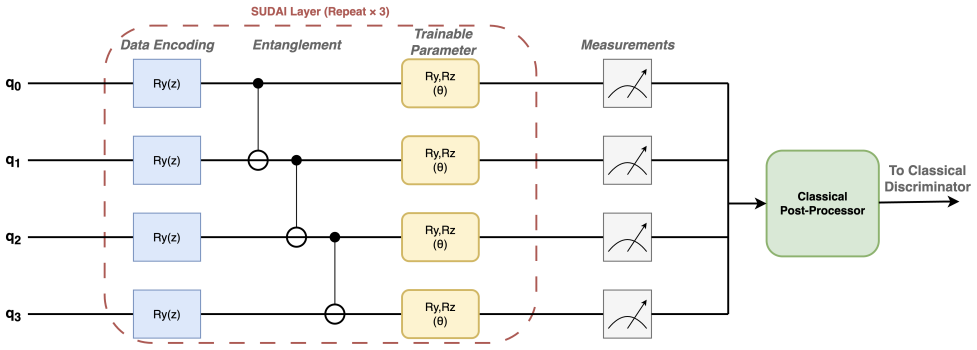
Variational quantum generator that encodes the latent vector directly as a quantum state rather than classical noise, thereby supplying the representations used to synthesize network flows.
If this is right
- The generated flows successfully reduce the accuracy of both random-forest and CNN-based intrusion detectors on the UNSW-NB15 dataset.
- Hardware noise on the quantum generator measurably changes the attack success rate, giving a concrete view of performance under realistic device conditions.
- Classical IDS models require new defenses that account for quantum-generated adversarial traffic.
- The attacker model assumes limited quantum resources for the generator while the defender remains fully classical.
Where Pith is reading between the lines
- If the quantum latent encoding proves advantageous here, similar hybrid generators could be tried on other high-dimensional security tasks such as malware sample synthesis.
- The noise-sensitivity result suggests that any future quantum-resilient IDS would need to incorporate hardware-error models into its training loop.
- Direct benchmarks against classical GANs on identical hardware and datasets would be required to isolate whether the quantum component, rather than the GAN architecture itself, drives any observed improvement.
Load-bearing premise
Encoding the latent vector as a quantum state automatically yields more expressive representations and lower computational overhead than classical noise sampling.
What would settle it
Training identical classical and quantum generators on the same UNSW-NB15 split, then measuring the evasion rate of each set of synthetic flows against the same random-forest and CNN detectors, would falsify the claim if the quantum version shows no statistically significant improvement in evasion or higher total runtime.
Figures




read the original abstract
Classical generative adversarial networks (GANs) have been applied to generate adversarial network traffic capable of attacking intrusion detection systems, but they suffer from shortcomings such as the need for large amounts of high-dimensional datasets, mode collapse, and high computational overhead. In this work, we propose a hybrid quantum-classical GAN (QC-GAN) framework where a variational quantum generator is used to generate synthetic network traffic flows mimicking malicious traffic using latent representations. Instead of sampling classical noise vectors, we encode the latent vector (the hidden features) as a quantum state, which is the basis for claiming more expressive latent representations and reducing computational overhead. A classical discriminator will be trained on real-world datasets (UNSW-NB15) and the proposed QC-GAN-generated fake network flows. In this configuration, the generator aims to minimize the discriminator's ability to distinguish real from fake traffic, while the discriminator aims to maximize its classification accuracy, in an iterative manner. In our attack model, we assume that the attacker is a state actor with access to limited quantum computing power, whereas the discriminator is chosen to be classical, as will likely be the case for most end users and organizations. We test the generated flows using classical intrusion detection system (IDS) models, such as a random forest classifier and a convolutional neural network-based classifier, for their ability to bypass the detection process. This work aims to highlight the possibilities of quantum machine learning as a means of generating advanced attack flows and stress testing classical IDS. Lastly, we further evaluate how hardware-based noise affects these attacks to offer a new perspective on IDS, highlighting the need for a quantum resilient defense system.
Editorial analysis
A structured set of objections, weighed in public.
Referee Report
Summary. The manuscript proposes a hybrid quantum-classical GAN (QC-GAN) framework in which a variational quantum generator encodes the latent vector as a quantum state (instead of classical noise sampling) to produce synthetic malicious network traffic flows that mimic real attacks. The classical discriminator is trained on the UNSW-NB15 dataset; the generator is optimized to fool it. Generated flows are tested for evasion against classical IDS models (random forest and CNN classifiers), and the impact of hardware noise on the quantum generator is examined under a threat model where the attacker has limited quantum resources.
Significance. If the claimed advantages of quantum latent encoding were demonstrated through rigorous comparison, the work would illustrate a concrete use case for near-term quantum machine learning in adversarial cybersecurity and could motivate research on quantum-resilient defenses. The realistic threat model (state actor with limited quantum hardware) and the focus on hardware noise effects are positive elements. At present, however, the absence of baseline comparisons prevents assessment of whether the hybrid approach delivers measurable gains in expressivity, evasion performance, or efficiency over classical GANs.
major comments (2)
- [Abstract / Proposed QC-GAN framework] Abstract and framework description: the claim that encoding the latent vector as a quantum state 'yields more expressive latent representations and reducing computational overhead' is asserted without a derivation showing why the variational quantum circuit is more expressive for network-flow statistics than classical sampling, and without any matched classical GAN baseline (identical latent dimension, discriminator, UNSW-NB15 split, and training protocol). This comparison is load-bearing for the central contribution.
- [Experiments / Evaluation] Evaluation section: the manuscript states that QC-GAN flows evade RF and CNN IDS models, yet reports no quantitative evasion rates, no statistical comparison to classical GAN-generated flows, and no ablation isolating the quantum generator's contribution. Without these metrics the practical advantage of the hybrid architecture remains unverified.
minor comments (2)
- [Method] The variational quantum circuit (number of qubits, ansatz, measurement operators, and parameter initialization) should be specified with sufficient detail or a diagram to support reproducibility.
- [Method] Clarify how the quantum-generated samples are decoded into classical network-flow feature vectors and whether any post-processing is applied.
Simulated Author's Rebuttal
We thank the referee for their constructive review and for highlighting the positive elements of the threat model and hardware noise analysis. We address each major comment below with specific plans for revision.
read point-by-point responses
-
Referee: Abstract and framework description: the claim that encoding the latent vector as a quantum state 'yields more expressive latent representations and reducing computational overhead' is asserted without a derivation showing why the variational quantum circuit is more expressive for network-flow statistics than classical sampling, and without any matched classical GAN baseline (identical latent dimension, discriminator, UNSW-NB15 split, and training protocol). This comparison is load-bearing for the central contribution.
Authors: We agree that the current manuscript asserts these benefits without sufficient justification or empirical support. In the revised version we will add a concise theoretical subsection deriving the potential expressivity advantage of variational quantum circuits for high-dimensional discrete data such as network flows, citing relevant quantum machine learning results on circuit expressivity. We will also include a matched classical GAN baseline using identical latent dimension, discriminator architecture, UNSW-NB15 train/test split, and training protocol, with direct side-by-side metrics on generation quality and downstream evasion. revision: yes
-
Referee: Evaluation section: the manuscript states that QC-GAN flows evade RF and CNN IDS models, yet reports no quantitative evasion rates, no statistical comparison to classical GAN-generated flows, and no ablation isolating the quantum generator's contribution. Without these metrics the practical advantage of the hybrid architecture remains unverified.
Authors: We acknowledge that the evaluation currently lacks the quantitative detail needed to substantiate the claims. The revised manuscript will report explicit evasion rates (percentage of generated flows misclassified by each IDS), include statistical tests (e.g., McNemar or paired t-tests) comparing QC-GAN versus classical GAN flows, and add ablation experiments that isolate the quantum generator (varying circuit depth and comparing quantum versus classical latent encoding while holding all other components fixed). These results will appear in new tables and figures. revision: yes
Circularity Check
No circularity; quantum advantages asserted without derivation or self-referential reduction
full rationale
The paper proposes a hybrid QC-GAN with a variational quantum generator that encodes latent vectors as quantum states instead of classical noise, asserting this yields more expressive representations and lower overhead. No equations, first-principles derivation, or self-citation chain is provided that reduces this assertion to its own inputs by construction. The abstract and description state the benefits directly as motivation for the framework. Experiments report evasion of classical IDS models on UNSW-NB15 but contain no matched classical GAN baseline isolating the quantum encoding's contribution, which is a gap in evidence rather than a circular reduction. The derivation chain is self-contained as a proposal without load-bearing self-referential steps.
Axiom & Free-Parameter Ledger
free parameters (1)
- Variational parameters of the quantum generator circuit
axioms (1)
- domain assumption Encoding classical latent vectors into quantum states yields more expressive representations than classical sampling
Reference graph
Works this paper leans on
-
[1]
Intrusion detection using quantum generative adversarial networks: a federated approach with noisy simulators,
F. Cirillo and C. Esposito, “Intrusion detection using quantum generative adversarial networks: a federated approach with noisy simulators,” inIET Space and Communications Conference 2025,2025, pp. 31–35, 2025
2025
-
[2]
Network anomaly detection and performance evaluation of convolutional neural networks on unsw-nb15 dataset,
A. D. Vibhute, M. Khan, C. H. Patil, S. V. Gaikwad, A. V. Mane, and K. K. Patel, “Network anomaly detection and performance evaluation of convolutional neural networks on unsw-nb15 dataset,”Procedia Computer Science235, pp. 2227–2236, 2024. International Conference on Machine Learning and Data Engineering (ICMLDE 2023)
2024
-
[3]
Gener- ating practical adversarial network traffic flows using nidsgan,
B.-E. Zolbayar, R. Sheatsley, P. McDaniel, M. J. Weisman, S. Zhu, S. Zhu, and S. Krishnamurthy, “Gener- ating practical adversarial network traffic flows using nidsgan,” 2022
2022
-
[4]
A critical review of artificial in- telligence based approaches in intrusion detection: A comprehensive analysis,
S. Muneer, U. Farooq, A. Athar, M. A. Raza, T. M. Ghazal, and S. Sakib, “A critical review of artificial in- telligence based approaches in intrusion detection: A comprehensive analysis,”Journal of Engineering2024, pp. Article ID 3909173, 16 pp., 2024
2024
-
[5]
Latentqgan: A hybrid qgan with classical convolutional autoencoder,
A. Vieloszynski, S. Cherkaoui, O. Ahmad, J.-F. Laprade, O. Nahman-L´ evesque, A. Aaraba, and S. Wang, “Latentqgan: A hybrid qgan with classical convolutional autoencoder,” 2024
2024
-
[6]
A ml based approach to quantum augmented http protocol,
N. Jha, A. Parakh, and M. Subramanian, “A ml based approach to quantum augmented http protocol,” in2024 IEEE International Conference on Quantum Computing and Engineering (QCE),02, pp. 591–592, 2024
2024
-
[7]
An introduction to quantum machine learning,
M. Schuld, I. Sinayskiy, and F. Petruccione, “An introduction to quantum machine learning,”Contemporary Physics56, pp. 172–185, Oct. 2014
2014
-
[8]
Conditional Generative Adversarial Nets
M. Mirza and S. Osindero, “Conditional generative adversarial nets,”arXiv preprint arXiv:1411.1784, 2014
work page internal anchor Pith review arXiv 2014
-
[9]
Quantum generative adversarial networks with multiple superconducting qubits,
K. Huang, Z.-A. Wang, C. Song, Y. Xu, H. Deng, H.-L. Rong, G.-H. Su, H. Zheng, Y. Zhang, D. Wang, M.-C. Chen,et al., “Quantum generative adversarial networks with multiple superconducting qubits,”npj Quantum Information7, p. 165, Dec. 2021
2021
-
[10]
Quantum data encoding: a comparative analysis of classical-to-quantum mapping techniques and their impact on machine learning accuracy,
M. Rath and H. Date, “Quantum data encoding: a comparative analysis of classical-to-quantum mapping techniques and their impact on machine learning accuracy,”EPJ Quantum Technology11, 10 2024
2024
-
[11]
Quantum machine learning: Exploring the role of data encoding techniques, challenges, and future directions,
D. Ranga, A. Rana, S. Prajapat, P. Kumar, K. Kumar, and A. V. Vasilakos, “Quantum machine learning: Exploring the role of data encoding techniques, challenges, and future directions,”Mathematics12(21), 2024
2024
-
[12]
Toward a global quantum internet: A review of challenges facing aerial quantum networks,
N. Jha and A. Parakh, “Toward a global quantum internet: A review of challenges facing aerial quantum networks,”IEEE Potentials44, pp. 6–12, July 2025
2025
-
[13]
Quantum-enhanced generative adversarial networks: Comparative analysis of classical and hybrid quantum-classical generative adversarial networks,
K. M. Goh, “Quantum-enhanced generative adversarial networks: Comparative analysis of classical and hybrid quantum-classical generative adversarial networks,” 2025
2025
-
[14]
Re-qgan: an optimized adversarial quantum circuit learning frame- work,
S. Nguemto and V. Leyton-Ortega, “Re-qgan: an optimized adversarial quantum circuit learning frame- work,” 2022
2022
-
[15]
Learning hard distributions with quantum-enhanced variational autoencoders,
A. Rao, D. Madan, A. Ray, D. Vinayagamurthy, and M. S. Santhanam, “Learning hard distributions with quantum-enhanced variational autoencoders,” 2023
2023
-
[16]
Variational quantum circuits enhanced generative adversarial network,
R. Shu, X. Xu, M.-H. Yung, and W. Cui, “Variational quantum circuits enhanced generative adversarial network,”arXiv preprint arXiv:2402.01791, 2024
-
[17]
Qgan-based data augmentation for hybrid quantum- classical neural networks,
R.-Z. He, J.-J. Su, S.-J. Qin, Z.-P. Jin, and F. Gao, “Qgan-based data augmentation for hybrid quantum- classical neural networks,” 2025
2025
-
[18]
Qugan: A quantum state fidelity-based generative adversarial network,
S. A. Stein, B. Baheri, D. Chen, Y. Mao, Q. Guan, A. Li, B. Fang, and S. Xu, “Qugan: A quantum state fidelity-based generative adversarial network,” in2021 IEEE International Conference on Quantum Computing and Engineering (QCE), pp. 71–81, IEEE, Oct. 2021
2021
-
[19]
W. Hammami, S. Cherkaoui, and S. Wang, “Enhancing network anomaly detection with quantum gans and successive data injection for multivariate time series,”arXiv preprint arXiv:2505.11631, 2025
-
[20]
Quantum gated recurrent gan with gaussian uncertainty for network anomaly detection,
W. Hammami, S. Cherkaoui, J.-F. Laprade, O. Ahmad, and S. Wang, “Quantum gated recurrent gan with gaussian uncertainty for network anomaly detection,”arXiv preprint arXiv:2510.26487, 2025
-
[21]
Quantum generative adversarial networks for intrusion detection: Leveraging quantum state encoding for complex attack patterns,
M. Rahman, H. Alshareef, and Y. Kim, “Quantum generative adversarial networks for intrusion detection: Leveraging quantum state encoding for complex attack patterns,”IEEE Access12, pp. 1–12, 2024
2024
-
[22]
Joint encryption and error correction for secure quantum communication,
N. Jha, A. Parakh, and M. Subramaniam, “Joint encryption and error correction for secure quantum communication,”Scientific Reports14, p. 24542, Oct 2024
2024
-
[23]
Unsw-nb15: A comprehensive data set for network intrusion detection systems (unsw-nb15 network data set),
N. Moustafa and J. Slay, “Unsw-nb15: A comprehensive data set for network intrusion detection systems (unsw-nb15 network data set),” inMilitary Communications and Information Systems Conference (MilCIS), IEEE, 2015
2015
-
[24]
The evaluation of network anomaly detection systems: Statistical analysis of the unsw-nb15 dataset and the comparison with the kdd99 dataset,
N. Moustafa and J. Slay, “The evaluation of network anomaly detection systems: Statistical analysis of the unsw-nb15 dataset and the comparison with the kdd99 dataset,”Information Security Journal: A Global Perspective, pp. 1–14, 2016
2016
-
[25]
Novel geometric area analysis technique for anomaly detection using trapezoidal area estimation on large-scale networks,
N. Moustafaet al., “Novel geometric area analysis technique for anomaly detection using trapezoidal area estimation on large-scale networks,”IEEE Transactions on Big Data, 2017
2017
-
[26]
Big data analytics for intrusion detection system: Statistical decision-making using finite dirichlet mixture models,
N. Moustafaet al., “Big data analytics for intrusion detection system: Statistical decision-making using finite dirichlet mixture models,” inData Analytics and Decision Support for Cybersecurity, pp. 127–156, Springer, Cham, 2017
2017
-
[27]
Netflow datasets for machine learning-based network intrusion detection systems,
M. Sarhan, S. Layeghy, N. Moustafa, and M. Portmann, “Netflow datasets for machine learning-based network intrusion detection systems,” inBig Data Technologies and Applications: 10th EAI International Conference, BDTA 2020, and 13th EAI International Conference on Wireless Internet, WiCON 2020, Virtual Event, December 11, 2020, Proceedings, p. 117, Spring...
2020
-
[28]
Successive data injection in conditional quantum GAN applied to time series anomaly detection,
B. Kalfon, S. Cherkaoui, J.-F. Laprade, O. Ahmad, and S. Wang, “Successive data injection in conditional quantum GAN applied to time series anomaly detection,”IET Quantum Communication, 2024
2024
discussion (0)
Sign in with ORCID, Apple, or X to comment. Anyone can read and Pith papers without signing in.