REVIEW 2 major objections 2 minor 62 references
DPM++: Dynamic Masked Metric Learning for Occluded Person Re-identification
T0 review · 2 major / 2 minor · reviewed 2026-06-30 · grok-4.3
Pith's one-line read DPM++ learns an input-adaptive masked metric in classifier-prototype space to match only the visible parts of occluded people.
desk verdict DPM++ integrates dynamic masked metrics, CLIP prototype transfer, and saliency synthesis for occluded ReID, but the abstract supplies no numbers so the performance claims stay uncheckable. read the letter →
The pith
A machine-rendered reading of the paper's core claim, the machinery that carries it, and where it could break.
The reading
What carries the argument
Input-adaptive masked metric that dynamically selects reliable identity subspaces for visibility-consistent matching in the classifier-prototype space.
What would settle it
If ablating the CLIP two-stage supervision or replacing saliency-guided patch transfer with random erasing produced no accuracy gain on standard occluded re-identification benchmarks, the claim that these components enable superior dynamic masked matching would be falsified.
Extended reading notes
Core claim
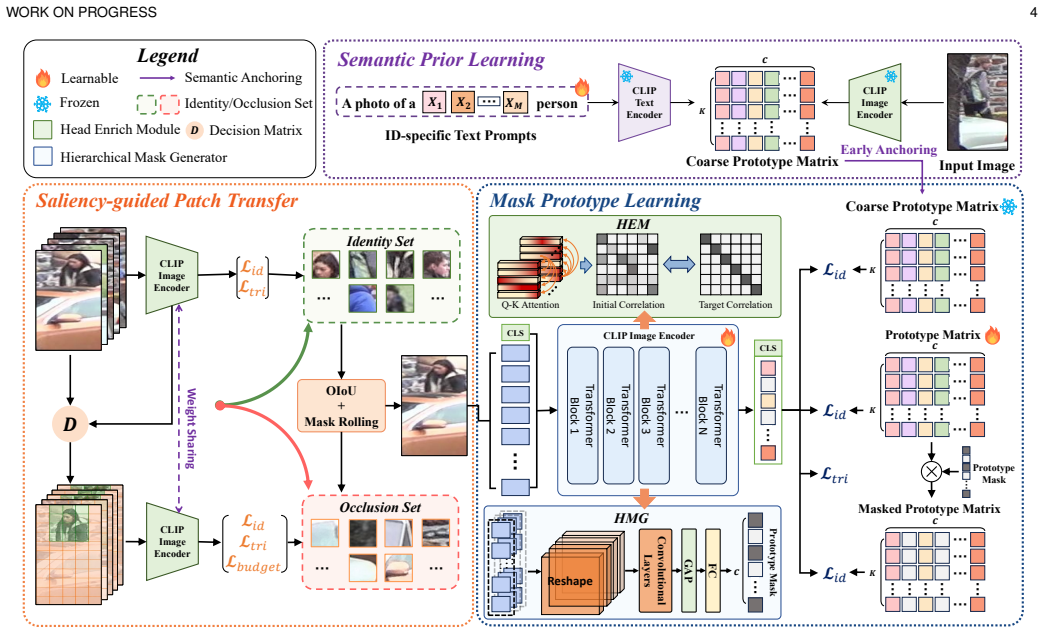
DPM++ learns an input-adaptive masked metric that dynamically selects reliable identity subspaces for each occluded instance, enabling matching to emphasize visibility-consistent evidence while suppressing unreliable components, with the metric built on a CLIP-based two-stage supervision scheme that transfers ID-level text priors into the classifier-prototype space and strengthened by saliency-guided patch transfer for photo-realistic occluded samples.
Load-bearing premise
CLIP text-branch semantic priors transfer effectively into the classifier-prototype space to enable reliable dynamic masked matching, and saliency-guided patch transfer supplies richer supervision than random erasing under realistic occlusion patterns.
Editorial extensions
If this is right
- Matching emphasizes visibility-consistent evidence while suppressing unreliable components from occluders and background.
- The method improves accuracy on both occluded and holistic person re-identification benchmarks over prior state-of-the-art approaches.
- Saliency-guided patch transfer exposes the model to realistic partial observations and supplies richer supervision than random erasing.
- Occlusion-aware sample pairing and mask-guided optimization increase the stability of the overall framework.
Reading between the lines
- The same dynamic subspace selection might reduce error rates in other vision tasks where only partial object views are available, such as tracking in crowds.
- Transferring text priors could allow re-identification models to start from weaker visual backbones without losing identity discrimination.
- The approach might generalize to non-person categories if the saliency guidance is replaced with class-specific masks.
Editorial analysis
A structured set of objections, weighed in public.
Referee Report
Summary. The paper proposes DPM++, a Dynamic Masked Metric Learning framework for occluded person re-identification. It introduces an input-adaptive masked metric that dynamically selects reliable identity subspaces, built on a CLIP-based two-stage supervision scheme transferring ID-level semantic priors from the text branch into the classifier-prototype space, combined with a saliency-guided patch transfer strategy for synthesizing realistic occluded samples, occlusion-aware sample pairing, and mask-guided optimization. The central claim is that this unified approach enables visibility-consistent matching and consistently outperforms prior state-of-the-art methods on both occluded and holistic person re-identification benchmarks.
Significance. If the empirical claims hold with rigorous validation, the work could advance occluded ReID by offering a framework that avoids reliance on separate pre-trained visibility estimators and instead embeds semantic priors directly into metric learning while using photo-realistic augmentation grounded in scene priors; this addresses a practical gap in handling background clutter and partial observations without ad-hoc alignment modules.
major comments (2)
- Abstract: the central empirical claim that DPM++ 'consistently outperforms previous state-of-the-art methods in both holistic and occlusion scenarios' is stated without any quantitative results, tables, dataset names, error bars, or ablation evidence, rendering the claim unverifiable from the supplied manuscript and load-bearing for acceptance.
- Method description (paragraph on two-stage supervision and saliency-guided strategy): the assumption that CLIP text-branch semantic priors transfer effectively into the classifier-prototype space for reliable dynamic masked matching, and that saliency-guided patch transfer supplies richer supervision than random erasing, is presented without supporting derivation, ablation, or analysis of failure modes under realistic occlusion patterns.
minor comments (2)
- Abstract: the term 'classifier-prototype space' is introduced without prior definition or reference, which may confuse readers unfamiliar with the specific embedding used.
- Abstract: 'Dynamic masked metric' is listed as a core contribution but lacks an equation or algorithmic outline even at a high level, hindering immediate understanding of the masking mechanism.
Simulated Author's Rebuttal
We thank the referee for the thoughtful comments on the abstract and method assumptions. We address each point below and will revise the manuscript accordingly where appropriate.
read point-by-point responses
-
Referee: [—] Abstract: the central empirical claim that DPM++ 'consistently outperforms previous state-of-the-art methods in both holistic and occlusion scenarios' is stated without any quantitative results, tables, dataset names, error bars, or ablation evidence, rendering the claim unverifiable from the supplied manuscript and load-bearing for acceptance.
Authors: We agree that the abstract presents the performance claim at a high level without numbers. The full manuscript contains the supporting evidence in Tables 1–4 (comparisons on Occluded-DukeMTMC, Occluded-ReID, Market-1501, DukeMTMC-reID) with standard deviations from multiple runs and ablation tables. To make the claim more immediately verifiable, we will revise the abstract to include one or two key quantitative highlights (e.g., mAP gains on occluded benchmarks) while preserving conciseness. revision: yes
-
Referee: [—] Method description (paragraph on two-stage supervision and saliency-guided strategy): the assumption that CLIP text-branch semantic priors transfer effectively into the classifier-prototype space for reliable dynamic masked matching, and that saliency-guided patch transfer supplies richer supervision than random erasing, is presented without supporting derivation, ablation, or analysis of failure modes under realistic occlusion patterns.
Authors: The transfer effectiveness and superiority over random erasing are supported by the ablation studies in Sections 4.3 and 4.4, which quantify the contribution of each component. However, we acknowledge the absence of an explicit derivation of the prior transfer and a dedicated failure-mode analysis. In the revision we will add a short paragraph in Section 3.2 deriving the supervision transfer and include a new subsection (or extended caption) discussing observed failure cases under heavy background clutter. revision: partial
Circularity Check
No significant circularity identified
full rationale
The paper describes an empirical framework for occluded ReID using dynamic masked metrics, CLIP text priors transferred to classifier-prototype space, and saliency-guided patch synthesis. No equations, derivations, fitted parameters renamed as predictions, or self-citation chains appear in the abstract or method outline. Claims rest on experimental outperformance rather than internal reductions to inputs by construction. This is a standard applied ML contribution with independent empirical content.
Assumptions & free parameters
assumptions (2)
- domain assumption CLIP text encoder supplies transferable ID-level semantic priors that improve dynamic masked matching in the visual prototype space
- domain assumption Saliency-guided patch transfer produces more realistic and useful occluded training samples than random erasing
invented entities (1)
-
Dynamic masked metric
Cite this review
Pith. "Pith review of DPM++: Dynamic Masked Metric Learning for Occluded Person Re-identification." pith.science (2026). https://pith.science/paper/D6JC2HJM
@misc{pith2026260506637,
  author       = {Pith},
  title        = {Pith review of: DPM++: Dynamic Masked Metric Learning for Occluded Person Re-identification},
  year         = {2026},
  howpublished = {\url{https://pith.science/paper/D6JC2HJM}},
  note         = {Machine review of arXiv:2605.06637}
}
read the original abstract
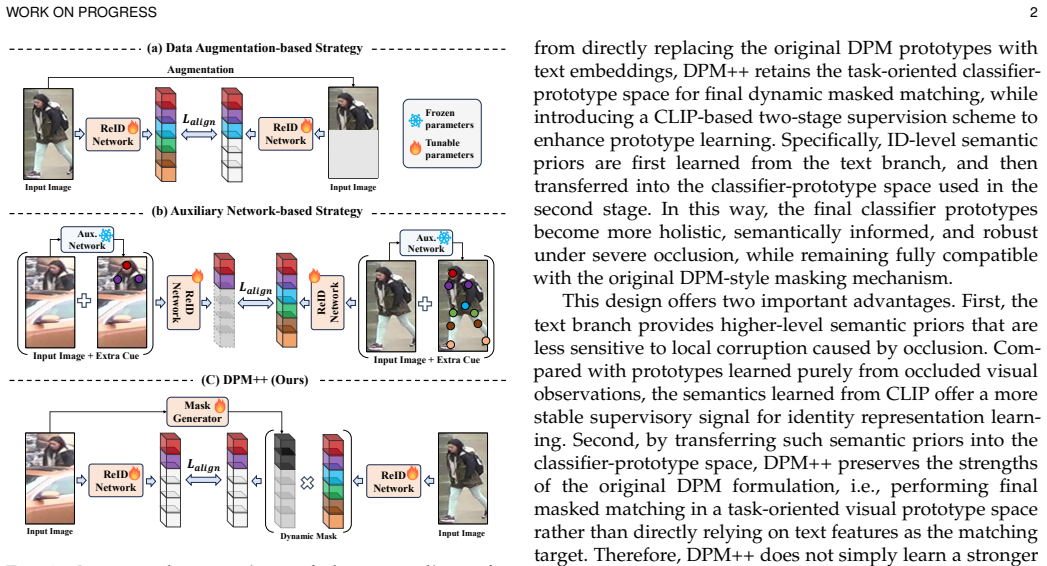
Although person re-identification has made impressive progress, occlusion caused by obstacles remains an unsettled issue in real applications. The difficulty lies in the mismatch between incomplete occluded samples and holistic identity representations. Severe occlusion removes discriminative body cues and introduces interference from background clutter and occluders, making global metric learning unreliable. Existing methods mainly rely on extra pre-trained models to estimate visible parts for alignment or construct occluded samples via data augmentation, but still lack a unified framework that learns robust visibility-consistent matching under realistic occlusion patterns. In this paper, we propose DPM++, a Dynamic Masked Metric Learning framework for occluded person re-identification. DPM++ learns an input-adaptive masked metric that dynamically selects reliable identity subspaces for each occluded instance, enabling matching to emphasize visibility-consistent evidence while suppressing unreliable components. Built upon the classifier-prototype space, DPM++ introduces a CLIP-based two-stage supervision scheme, where ID-level semantic priors are learned from the text branch and transferred into the classifier-prototype space for dynamic masked matching. To strengthen the masked metric, we introduce a saliency-guided patch transfer strategy to synthesize controllable and photo-realistic occluded samples during training. Exploiting real scene priors, this strategy exposes the model to realistic partial observations and provides richer supervision than random erasing. In addition, occlusion-aware sample pairing and mask-guided optimization improve the stability and effectiveness of the framework. Experiments on occluded and holistic person re-identification benchmarks show that DPM++ consistently outperforms previous state-of-the-art methods in both holistic and occlusion scenarios.
Figures
Figures from the paper (1 more)
Reference graph
Works this paper leans on
-
[1]
Aaformer: Auto-aligned transformer for person re-identification,
K. Zhu, H. Guo, S. Zhang, Y. Wang, J. Liu, J. Wang, and M. Tang, “Aaformer: Auto-aligned transformer for person re-identification,” IEEE transactions on neural networks and learning systems, vol. 35, no. 12, pp. 17 307–17 317, 2023. 1, 3, 10
work page 2023
-
[2]
arXiv preprint arXiv:2408.16684 , year=
L. Tan, P . Dai, J. Chen, L. Cao, Y. Wu, and R. Ji, “Partformer: Awakening latent diverse representation from vision transformer for object re-identification,”arXiv preprint arXiv:2408.16684, 2024. 1, 3
-
[3]
Dc-former: Diverse and compact transformer for person re-identification,
W. Li, C. Zou, M. Wang, F. Xu, J. Zhao, R. Zheng, Y. Cheng, and W. Chu, “Dc-former: Diverse and compact transformer for person re-identification,” inProceedings of the AAAI Conference on Artificial Intelligence, vol. 37, no. 2, 2023, pp. 1415–1423. 1, 3
work page 2023
-
[4]
Transreid: Transformer-based object re-identification,
S. He, H. Luo, P . Wang, F. Wang, H. Li, and W. Jiang, “Transreid: Transformer-based object re-identification,” inProceedings of the IEEE/CVF International Conference on Computer Vision, 2021, pp. 15 013–15 022. 1, 3, 7, 9, 10
work page 2021
-
[5]
Pha: Patch-wise high-frequency augmentation for transformer-based person re- identification,
G. Zhang, Y. Zhang, T. Zhang, B. Li, and S. Pu, “Pha: Patch-wise high-frequency augmentation for transformer-based person re- identification,” inProceedings of the IEEE/CVF conference on computer vision and pattern recognition, 2023, pp. 14 133–14 142. 1, 10
work page 2023
-
[6]
Occluded person re-identification via saliency-guided patch transfer,
L. Tan, J. Xia, W. Liu, P . Dai, Y. Wu, and L. Cao, “Occluded person re-identification via saliency-guided patch transfer,” inProceedings of the AAAI conference on artificial intelligence, vol. 38, no. 5, 2024, pp. 5070–5078. 1, 3, 4, 9, 10, 11 WORK ON PROGRESS 15
work page 2024
-
[7]
Attention disturbance and dual-path constraint network for occluded person re-identification,
J. Xia, L. Tan, P . Dai, M. Zhao, Y. Wu, and L. Cao, “Attention disturbance and dual-path constraint network for occluded person re-identification,” inProceedings of the AAAI conference on artificial intelligence, vol. 38, no. 6, 2024, pp. 6198–6206. 1, 4, 5, 10
work page 2024
-
[8]
Dynamic feature pruning and consolidation for occluded person re-identification,
Y. Ye, H. Zhou, J. Cai, C. Gao, Y. Zhang, J. Wang, Q. Hu, J. Yu, and W. Yang, “Dynamic feature pruning and consolidation for occluded person re-identification,” inProceedings of the AAAI conference on artificial intelligence, vol. 38, no. 7, 2024, pp. 6684–6692. 1, 4
work page 2024
Show all 62 references
-
[9]
High-order information matters: Learning relation and topology for occluded person re-identification,
G. Wang, S. Yang, H. Liu, Z. Wang, Y. Yang, S. Wang, G. Yu, E. Zhou, and J. Sun, “High-order information matters: Learning relation and topology for occluded person re-identification,” inProceedings of the IEEE/CVF Conference on Computer Vision and Pattern Recognition, 2020, p...
2020
-
[10]
Pose-guided visible part matching for occluded person reid,
S. Gao, J. Wang, H. Lu, and Z. Liu, “Pose-guided visible part matching for occluded person reid,” inProceedings of the IEEE/CVF Conference on Computer Vision and Pattern Recognition, 2020, pp. 11 744–11 752. 1, 4, 9, 10
2020
-
[11]
Pose-guided feature disentangling for occluded person re-identification based on transformer,
T. Wang, H. Liu, P . Song, T. Guo, and W. Shi, “Pose-guided feature disentangling for occluded person re-identification based on transformer,” inProceedings of the AAAI conference on artificial intelligence, vol. 36, no. 3, 2022, pp. 2540–2549. 1, 7, 10
2022
-
[12]
Random erasing data augmentation
Z. Zhong, L. Zheng, G. Kang, S. Li, and Y. Yang, “Random erasing data augmentation.” inProceedings of the AAAI, 2020. 1, 4, 5, 9, 14
2020
-
[13]
Feature eras- ing and diffusion network for occluded person re-identification,
Z. Wang, F. Zhu, S. Tang, R. Zhao, L. He, and J. Song, “Feature eras- ing and diffusion network for occluded person re-identification,” in Proceedings of the IEEE/CVF conference on computer vision and pattern recognition, 2022, pp. 4754–4763. 1, 4, 5, 10
2022
-
[14]
Occlude them all: Occlusion-aware attention network for occluded person re-id,
P . Chen, W. Liu, P . Dai, J. Liu, Q. Ye, M. Xu, Q. Chen, and R. Ji, “Occlude them all: Occlusion-aware attention network for occluded person re-id,” inProceedings of the IEEE/CVF international conference on computer vision, 2021, pp. 11 833–11 842. 1, 4, 5, 7, 10
2021
-
[15]
Dynamic prototype mask for occluded person re-identification,
L. Tan, P . Dai, R. Ji, and Y. Wu, “Dynamic prototype mask for occluded person re-identification,” inProceedings of the 30th ACM international conference on multimedia, 2022, pp. 531–540. 2, 3, 4, 9, 10, 11
2022
-
[16]
Covariance descriptor based on bio- inspired features for person re-identification and face verification,
B. Ma, Y. Su, and F. Jurie, “Covariance descriptor based on bio- inspired features for person re-identification and face verification,” Image and Vision Computing, vol. 32, no. 6-7, pp. 379–390, 2014. 3
2014
-
[17]
Salient color names for person re-identification,
Y. Yang, J. Yang, J. Yan, S. Liao, D. Yi, and S. Z. Li, “Salient color names for person re-identification,” inEuropean conference on computer vision. Springer, 2014, pp. 536–551. 3
2014
-
[18]
Person re-identification by local maximal occurrence representation and metric learning,
S. Liao, Y. Hu, X. Zhu, and S. Z. Li, “Person re-identification by local maximal occurrence representation and metric learning,” in Proceedings of the IEEE conference on computer vision and pattern recognition, 2015, pp. 2197–2206. 3
2015
-
[19]
Reidentification by relative distance comparison,
W.-S. Zheng, S. Gong, and T. Xiang, “Reidentification by relative distance comparison,”IEEE transactions on pattern analysis and machine intelligence, vol. 35, no. 3, pp. 653–668, 2012. 3
2012
-
[20]
Large scale metric learning from equivalence constraints,
M. Koestinger, M. Hirzer, P . Wohlhart, P . M. Roth, and H. Bischof, “Large scale metric learning from equivalence constraints,” in2012 IEEE conference on computer vision and pattern recognition. IEEE, 2012, pp. 2288–2295. 3
2012
-
[21]
Mask r-cnn,
K. He, G. Gkioxari, P . Doll ´ar, and R. Girshick, “Mask r-cnn,” in Proceedings of the IEEE international conference on computer vision, 2017, pp. 2961–2969. 3
2017
-
[22]
Plugnet: Degradation aware scene text recognition supervised by a pluggable super-resolution unit,
Y. Mou, L. Tan, H. Yang, J. Chen, L. Liu, R. Yan, and Y. Huang, “Plugnet: Degradation aware scene text recognition supervised by a pluggable super-resolution unit,” inEuropean Conference on Computer Vision. Springer, 2020, pp. 158–174. 3
2020
-
[23]
E2net: Excitative- expansile learning for weakly supervised object localization,
Z. Chen, L. Cao, Y. Shen, F. Lian, Y. Wu, and R. Ji, “E2net: Excitative- expansile learning for weakly supervised object localization,” in Proceedings of the 29th ACM International Conference on Multimedia, 2021, pp. 573–581. 3
2021
-
[24]
Knowledge-driven generative adversarial network for text-to- image synthesis,
J. Peng, Y. Zhou, X. Sun, L. Cao, Y. Wu, F. Huang, and R. Ji, “Knowledge-driven generative adversarial network for text-to- image synthesis,”IEEE Transactions on Multimedia, 2021. 3
2021
-
[25]
Towards a unified middle modality learning for visible-infrared person re-identification,
Y. Zhang, Y. Yan, Y. Lu, and H. Wang, “Towards a unified middle modality learning for visible-infrared person re-identification,” in Proceedings of the 29th ACM International Conference on Multimedia, 2021, pp. 788–796. 3
2021
-
[26]
Bag of tricks and a strong baseline for deep person re-identification,
H. Luo, Y. Gu, X. Liao, S. Lai, and W. Jiang, “Bag of tricks and a strong baseline for deep person re-identification,” inProceedings of the IEEE/CVF conference on computer vision and pattern recognition workshops, 2019, pp. 0–0. 3
2019
-
[27]
Mixed high-order attention net- work for person re-identification,
B. Chen, W. Deng, and J. Hu, “Mixed high-order attention net- work for person re-identification,” inProceedings of the IEEE/CVF International Conference on Computer Vision (ICCV), October 2019. 3
2019
-
[28]
Joint discriminative and generative learning for person re-identification,
Z. Zheng, X. Yang, Z. Yu, L. Zheng, Y. Yang, and J. Kautz, “Joint discriminative and generative learning for person re-identification,” inproceedings of the IEEE/CVF conference on computer vision and pattern recognition, 2019, pp. 2138–2147. 3
2019
-
[29]
Deep learning for person re-identification: A survey and outlook,
M. Ye, J. Shen, G. Lin, T. Xiang, L. Shao, and S. C. Hoi, “Deep learning for person re-identification: A survey and outlook,”IEEE Transactions on Pattern Analysis and Machine Intelligence, 2021. 3
2021
-
[30]
Beyond part models: Person retrieval with refined part pooling (and a strong convolutional baseline),
Y. Sun, L. Zheng, Y. Yang, Q. Tian, and S. Wang, “Beyond part models: Person retrieval with refined part pooling (and a strong convolutional baseline),” inProceedings of the ECCV, 2018, pp. 480–
2018
-
[31]
Learning discriminative features with multiple granularities for person re- identification,
G. Wang, Y. Yuan, X. Chen, J. Li, and X. Zhou, “Learning discriminative features with multiple granularities for person re- identification,” inProceedings of the ACM MM, 2018, pp. 274–282. 3, 10
2018
-
[32]
Pyramidal person re-identification via multi-loss dynamic training,
F. Zheng, C. Deng, X. Sun, X. Jiang, X. Guo, Z. Yu, F. Huang, and R. Ji, “Pyramidal person re-identification via multi-loss dynamic training,” inProceedings of the CVPR, 2019, pp. 8514–8522. 3
2019
-
[33]
Clip-reid: exploiting vision-language model for image re-identification without concrete text labels,
S. Li, L. Sun, and Q. Li, “Clip-reid: exploiting vision-language model for image re-identification without concrete text labels,” in Proceedings of the AAAI conference on artificial intelligence, vol. 37, no. 1, 2023, pp. 1405–1413. 3, 7, 9, 10, 11
2023
-
[34]
A pedestrian is worth one prompt: Towards language guidance person re- identification,
Z. Yang, D. Wu, C. Wu, Z. Lin, J. Gu, and W. Wang, “A pedestrian is worth one prompt: Towards language guidance person re- identification,” inProceedings of the IEEE/CVF conference on computer vision and pattern recognition, 2024, pp. 17 343–17 353. 3
2024
-
[35]
Instruct-reid: A multi-purpose person re- identification task with instructions,
W. He, Y. Deng, S. Tang, Q. Chen, Q. Xie, Y. Wang, L. Bai, F. Zhu, R. Zhao, W. Ouyanget al., “Instruct-reid: A multi-purpose person re- identification task with instructions,” inProceedings of the IEEE/CVF Conference on Computer Vision and Pattern Recognition, 2024, pp. 17 521...
2024
-
[36]
Climb-reid: A hybrid clip-mamba framework for person re-identification,
C. Yu, X. Liu, J. Zhu, Y. Wang, P . Zhang, and H. Lu, “Climb-reid: A hybrid clip-mamba framework for person re-identification,” in Proceedings of the AAAI Conference on Artificial Intelligence, vol. 39, no. 9, 2025, pp. 9589–9597. 3
2025
-
[37]
From poses to identity: Training-free person re-identification via feature central- ization,
C. Yuan, G. Zhang, C. Ma, T. Zhang, and G. Niu, “From poses to identity: Training-free person re-identification via feature central- ization,” inProceedings of the Computer Vision and Pattern Recognition Conference, 2025, pp. 24 409–24 418. 3
2025
-
[38]
Chatreid: Open-ended interactive person retrieval via hierarchical progressive tuning for vision language models,
K. Niu, H. Yu, M. Zhao, T. Fu, S. Yi, W. Lu, B. Li, X. Qian, and X. Xue, “Chatreid: Open-ended interactive person retrieval via hierarchical progressive tuning for vision language models,” in Proceedings of the IEEE/CVF International Conference on Computer Vision, 2025, pp. 24...
2025
-
[39]
Occluded person re- identification,
J. Zhuo, Z. Chen, J. Lai, and G. Wang, “Occluded person re- identification,” in2018 IEEE International Conference on Multimedia and Expo (ICME). IEEE, 2018, pp. 1–6. 3, 9
2018
-
[40]
Feature completion for occluded person re-identification,
R. Hou, B. Ma, H. Chang, X. Gu, S. Shan, and X. Chen, “Feature completion for occluded person re-identification,”IEEE Transactions on Pattern Analysis and Machine Intelligence, 2021. 4, 10
2021
-
[41]
Pose-guided feature alignment for occluded person re-identification,
J. Miao, Y. Wu, P . Liu, Y. Ding, and Y. Yang, “Pose-guided feature alignment for occluded person re-identification,” inProceedings of the IEEE/CVF international conference on computer vision, 2019, pp. 542–551. 4, 9, 10
2019
-
[42]
Diverse part discovery: Occluded person re-identification with part-aware transformer,
Y. Li, J. He, T. Zhang, X. Liu, Y. Zhang, and F. Wu, “Diverse part discovery: Occluded person re-identification with part-aware transformer,” inProceedings of the IEEE/CVF Conference on Computer Vision and Pattern Recognition, 2021, pp. 2898–2907. 4, 10
2021
-
[43]
Keypoint prompt- able re-identification,
V . Somers, A. Alahi, and C. D. Vleeschouwer, “Keypoint prompt- able re-identification,” inEuropean Conference on Computer Vision. Springer, 2024, pp. 216–233. 4
2024
-
[44]
Adversarially occluded samples for person re-identification,
H. Huang, D. Li, Z. Zhang, X. Chen, and K. Huang, “Adversarially occluded samples for person re-identification,” inProceedings of the IEEE Conference on Computer Vision and Pattern Recognition, 2018, pp. 5098–5107. 4
2018
-
[45]
Dynamicvit: Efficient vision transformers with dynamic token sparsification,
Y. Rao, W. Zhao, B. Liu, J. Lu, J. Zhou, and C.-J. Hsieh, “Dynamicvit: Efficient vision transformers with dynamic token sparsification,” Advances in neural information processing systems, vol. 34, pp. 13 937– 13 949, 2021. 6
2021
-
[46]
Adavit: Adaptive vision transformers for efficient image recognition,
L. Meng, H. Li, B.-C. Chen, S. Lan, Z. Wu, Y.-G. Jiang, and S.-N. Lim, “Adavit: Adaptive vision transformers for efficient image recognition,” inProceedings of the IEEE/CVF Conference on Computer Vision and Pattern Recognition, 2022, pp. 12 309–12 318. 6
2022
-
[47]
Scalable person re-identification: A benchmark,
L. Zheng, L. Shen, L. Tian, S. Wang, J. Wang, and Q. Tian, “Scalable person re-identification: A benchmark,” inProceedings of the IEEE international conference on computer vision, 2015, pp. 1116–1124. 9 WORK ON PROGRESS 16
2015
-
[48]
Unlabeled samples generated by gan improve the person re-identification baseline in vitro,
Z. Zheng, L. Zheng, and Y. Yang, “Unlabeled samples generated by gan improve the person re-identification baseline in vitro,” in Proceedings of the IEEE international conference on computer vision, 2017, pp. 3754–3762. 9
2017
-
[49]
Learning transferable visual models from natural language supervision,
A. Radford, J. W. Kim, C. Hallacy, A. Ramesh, G. Goh, S. Agarwal, G. Sastry, A. Askell, P . Mishkin, J. Clarket al., “Learning transferable visual models from natural language supervision,” inInternational conference on machine learning. PmLR, 2021, pp. 8748–8763. 9
2021
-
[50]
Part-aligned bilinear representations for person re-identification,
Y. Suh, J. Wang, S. Tang, T. Mei, and K. M. Lee, “Part-aligned bilinear representations for person re-identification,” inProceedings of the European conference on computer vision (ECCV), 2018, pp. 402–
2018
-
[51]
Fd-gan: Pose- guided feature distilling gan for robust person re-identification,
Y. Ge, Z. Li, H. Zhao, G. Yin, S. Yi, X. Wanget al., “Fd-gan: Pose- guided feature distilling gan for robust person re-identification,” Advances in neural information processing systems, vol. 31, 2018. 10
2018
-
[52]
Identity-guided human semantic parsing for person re-identification,
K. Zhu, H. Guo, Z. Liu, M. Tang, and J. Wang, “Identity-guided human semantic parsing for person re-identification,” inEuropean Conference on Computer Vision. Springer, 2020, pp. 346–363. 10
2020
-
[53]
Deep spatial feature reconstruc- tion for partial person re-identification: Alignment-free approach,
L. He, J. Liang, H. Li, and Z. Sun, “Deep spatial feature reconstruc- tion for partial person re-identification: Alignment-free approach,” inProceedings of the IEEE Conference on Computer Vision and Pattern Recognition, 2018, pp. 7073–7082. 10
2018
-
[54]
Foreground- aware pyramid reconstruction for alignment-free occluded person re-identification,
L. He, Y. Wang, W. Liu, H. Zhao, Z. Sun, and J. Feng, “Foreground- aware pyramid reconstruction for alignment-free occluded person re-identification,” inProceedings of the IEEE/CVF international conference on computer vision, 2019, pp. 8450–8459. 10
2019
-
[55]
Learning disentangled representation implicitly via transformer for occluded person re- identification,
M. Jia, X. Cheng, S. Lu, and J. Zhang, “Learning disentangled representation implicitly via transformer for occluded person re- identification,”IEEE Transactions on Multimedia, vol. 25, pp. 1294– 1305, 2022. 10
2022
-
[56]
Content-adaptive auto- occlusion network for occluded person re-identification,
C. Zhao, Z. Qu, X. Jiang, Y. Tu, and X. Bai, “Content-adaptive auto- occlusion network for occluded person re-identification,”IEEE Transactions on Image Processing, vol. 32, pp. 4223–4236, 2023. 10
2023
-
[57]
Human co-parsing guided alignment for occluded person re- identification,
S. Dou, C. Zhao, X. Jiang, S. Zhang, W.-S. Zheng, and W. Zuo, “Human co-parsing guided alignment for occluded person re- identification,”IEEE Transactions on Image Processing, vol. 32, pp. 458–470, 2022. 10
2022
-
[58]
Semi-attention partition for occluded person re-identification,
M. Jia, Y. Sun, Y. Zhai, X. Cheng, Y. Yang, and Y. Li, “Semi-attention partition for occluded person re-identification,” inProceedings of the AAAI conference on artificial intelligence, vol. 37, no. 1, 2023, pp. 998–1006. 10
2023
-
[59]
Occlusion- aware transformer with second-order attention for person re- identification,
Y. Li, Y. Liu, H. Zhang, C. Zhao, Z. Wei, and D. Miao, “Occlusion- aware transformer with second-order attention for person re- identification,”IEEE Transactions on Image Processing, vol. 33, pp. 3200–3211, 2024. 10
2024
-
[60]
Semantics-aligned representation learning for person re-identification,
X. Jin, C. Lan, W. Zeng, G. Wei, and Z. Chen, “Semantics-aligned representation learning for person re-identification,” inProceedings of the AAAI Conference on Artificial Intelligence, vol. 34, no. 07, 2020, pp. 11 173–11 180. 10
2020
-
[61]
Hat: Hierarchical aggregation transformers for person re-identification,
G. Zhang, P . Zhang, J. Qi, and H. Lu, “Hat: Hierarchical aggregation transformers for person re-identification,” inProceedings of the 29th ACM international conference on multimedia, 2021, pp. 516–525. 10
2021
-
[62]
Dual cross- attention learning for fine-grained visual categorization and object re-identification,
H. Zhu, W. Ke, D. Li, J. Liu, L. Tian, and Y. Shan, “Dual cross- attention learning for fine-grained visual categorization and object re-identification,” inProceedings of the IEEE/CVF conference on computer vision and pattern recognition, 2022, pp. 4692–4702. 10
2022
Reviewed June 30, 2026 · model on record in the stance chip above.
Discussion (0). Continue with ORCID to comment.