Recognition: 2 theorem links
· Lean TheoremOrigins of Extreme Emission-Line Ratios in z > 3 Galaxies: Insights from the Lumen Model
Pith reviewed 2026-05-11 00:45 UTC · model grok-4.3
The pith
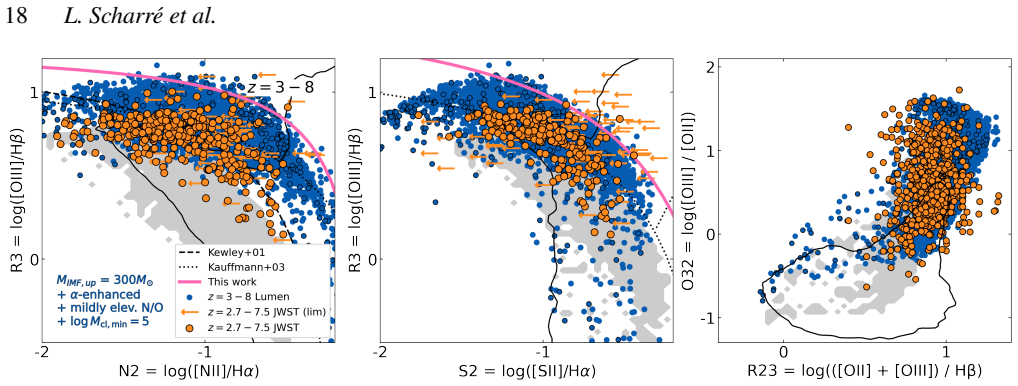
Models with harder ionizing spectra, high ionization from massive star clusters, and enhanced nitrogen reproduce extreme emission-line ratios in z>3 galaxies.
A machine-rendered reading of the paper's core claim, the machinery that carries it, and where it could break.
Core claim
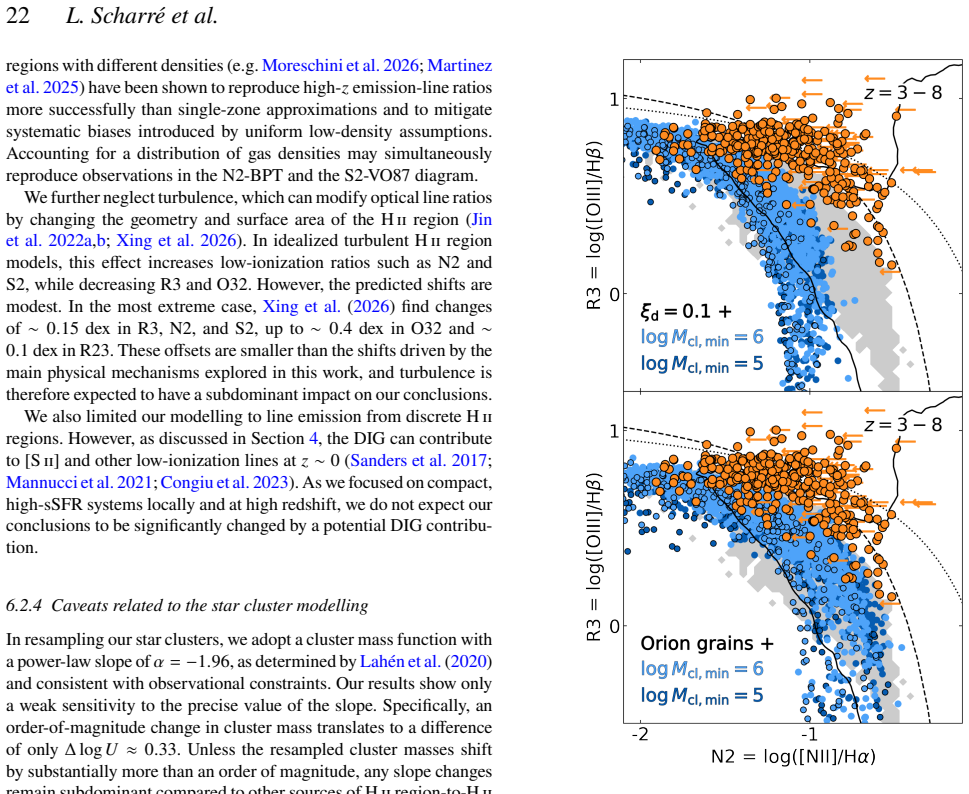
Lumen models spatially distributed HII regions inside IllustrisTNG50 and finds that the most extreme [OIII]/Hβ and [OIII]/[OII] values require high ionization parameters powered by massive star clusters, while the highest [NII]/Hα ratios additionally need enhanced nitrogen abundances; when these are combined with harder ionizing spectra the full high-redshift population is reproduced on three diagnostic diagrams, which in turn motivates new demarcation lines separating star-forming galaxies from AGN.
What carries the argument
The Lumen framework, which generates a population of HII regions with properties drawn from the simulation, computes their individual nebular spectra with photoionization models, and sums them to obtain integrated line ratios.
If this is right
- Moderate line-ratio offsets arise from alpha-enhancement together with a higher IMF upper-mass cutoff and AGN contributions, without needing extreme densities.
- Gas densities near 10^4 cm^-3 can increase several ratios but suppress [SII]/Hα, placing them in tension with current data.
- Massive star clusters of 10^5-10^6 solar masses are required to reach the highest ionization parameters consistent with recent JWST observations.
- New demarcation lines in the N2-BPT and S2-VO87 diagrams better isolate star-forming galaxies at high redshift.
Where Pith is reading between the lines
- The emphasis on clustered star formation suggests that higher-resolution imaging or simulations should detect more such massive clusters in distant galaxies.
- The requirement for rapid nitrogen enrichment implies that chemical-evolution models must incorporate efficient nitrogen production channels at early times.
- Extending the same Lumen-style post-processing to other cosmological simulations would test how sensitive the conclusions are to the underlying galaxy-formation physics.
Load-bearing premise
The spatial distribution and clustering of massive star-forming regions generated by Lumen inside IllustrisTNG50 accurately represent the structure of real high-redshift galaxies.
What would settle it
A sample of z>3 galaxies with the most extreme observed line ratios that lack star clusters above 10^5 solar masses or show normal nitrogen abundances would contradict the explanation.
Figures




read the original abstract
Optical emission-line ratios in star-forming galaxies at $z \sim 3$-8, such as [OIII]/H$\beta$ and [OIII]/[OII], are strongly offset from those at $z \sim 0$-2, pointing to more extreme ionization and ISM conditions in the early Universe. To constrain the physical origin of these offsets, we developed Lumen, a framework for modelling nebular emission from spatially distributed HII regions in cosmological simulations. We apply Lumen to IllustrisTNG50, validate its predictions at low redshift, and test a suite of proposed mechanisms for producing extreme line ratios at $z = 3$-8. We focus on the [NII]/H$\alpha$ versus [OIII]/H$\beta$ (N2-BPT) diagram, the [SII]/H$\alpha$ versus [OIII]/H$\beta$ (S2-VO87) diagram, and the [OIII]/[OII] versus ([OII]+[OIII])/H$\beta$ (O32-R23) diagram. We find that $\alpha$-enhancement alone cannot explain the bulk of observations. Moderate offsets emerge from the combined effects of $\alpha$-enhancement, a higher IMF upper-mass cutoff, and AGN contributions. The most extreme [OIII]/H$\beta$ and [OIII]/[OII] values require high ionization parameters powered by massive star clusters of $\gtrsim 10^5$-$10^6\,\mathrm{M}_\odot$, consistent with recent JWST observations. Reproducing the highest [NII]/H$\alpha$ ratios additionally requires enhanced nitrogen abundances. Although gas densities of $n \sim 10^4\,\mathrm{cm}^{-3}$ can boost several diagnostic ratios, they suppress [SII]/H$\alpha$ and are therefore in tension with current observations. Overall, models combining harder ionizing spectra, elevated ionization parameters from massive star clusters, and enhanced nitrogen abundances reproduce the observed high-$z$ galaxy population across the N2-BPT, S2-VO87, and O32-R23 diagrams. This successful model also motivates new demarcation lines for star-forming galaxies in the N2-BPT and S2-VO87 diagrams.
Editorial analysis
A structured set of objections, weighed in public.
Referee Report
Summary. The paper introduces the Lumen framework for modeling nebular emission from spatially distributed HII regions embedded in the IllustrisTNG50 cosmological simulation. After low-redshift validation, the authors systematically test proposed mechanisms (α-enhancement, harder spectra, elevated ionization parameter U from massive clusters, enhanced nitrogen, high gas density, AGN) for the observed offsets in z>3 galaxies on the N2-BPT, S2-VO87, and O32-R23 diagrams. They conclude that only the combination of harder ionizing spectra, high-U powered by ≳10^5–10^6 M⊙ clusters, and enhanced N abundances reproduces the full set of extreme line ratios, while α-enhancement alone is insufficient and high densities are in tension with [SII] data; new demarcation lines are proposed.
Significance. If the modeling chain holds, the work supplies a physically grounded account of why high-z emission-line ratios are extreme, isolates the necessary role of massive star-cluster-driven ionization and N enrichment, and supplies new diagnostic boundaries. It directly connects sub-grid ISM physics in large-volume simulations to JWST observables and offers falsifiable predictions for future cluster-scale observations.
major comments (3)
- [Methods (Lumen framework)] Methods (Lumen HII-region placement): The headline result that high ionization parameters from ≳10^5–10^6 M⊙ clusters are required rests on Lumen’s sub-grid mapping of TNG50 star particles. Because TNG50’s baryonic resolution (~8×10^4 M⊙) does not resolve <100 pc clustering, the high-U tail is an output of the chosen cluster-mass and spatial-distribution assumptions rather than an emergent prediction; no sensitivity test varying the volume-filling factor or luminosity-weighted U prescription is shown to demonstrate robustness.
- [Results (N2-BPT, O32-R23)] Results (N2-BPT and O32-R23 panels): The necessity of enhanced nitrogen is demonstrated only after the high-U channel is already included; the paper does not quantify the minimum N enhancement required or test whether the same extreme ratios can be recovered with a different combination (e.g., higher U plus modest AGN contribution) without N enhancement.
- [Validation] Validation section: Low-redshift validation is reported, but the manuscript does not show whether the same Lumen parameter choices that reproduce z~0 line ratios also produce the high-U tail at z>3, or whether retuning is required; this leaves open the possibility that the high-z success is partly post-hoc.
minor comments (2)
- [Figures] Figure captions for the diagnostic diagrams should explicitly state the redshift range and selection cuts applied to both the simulated and observed samples for each panel.
- [Results] The abstract states that gas densities n~10^4 cm^{-3} suppress [SII]/Hα; the corresponding quantitative prediction (e.g., the factor by which [SII]/Hα drops) should be shown in a dedicated panel or table.
Simulated Author's Rebuttal
We thank the referee for their constructive and detailed comments, which help clarify key aspects of our modeling framework and strengthen the presentation of results. We address each major comment below and indicate the revisions planned for the next version of the manuscript.
read point-by-point responses
-
Referee: [Methods (Lumen framework)] Methods (Lumen HII-region placement): The headline result that high ionization parameters from ≳10^5–10^6 M⊙ clusters are required rests on Lumen’s sub-grid mapping of TNG50 star particles. Because TNG50’s baryonic resolution (~8×10^4 M⊙) does not resolve <100 pc clustering, the high-U tail is an output of the chosen cluster-mass and spatial-distribution assumptions rather than an emergent prediction; no sensitivity test varying the volume-filling factor or luminosity-weighted U prescription is shown to demonstrate robustness.
Authors: We agree that the high-U tail depends on our sub-grid assumptions for cluster masses and spatial distributions, given TNG50's resolution limits. In the revised manuscript we will add an appendix with sensitivity tests that vary the cluster mass function slope and the HII-region volume-filling factor. These tests will show that the requirement for ≳10^5–10^6 M⊙ clusters to reach the most extreme observed ratios remains robust across plausible variations, while we will also expand the methods text to explicitly discuss the limitations of the sub-grid approach and the luminosity-weighted U prescription. revision: yes
-
Referee: [Results (N2-BPT, O32-R23)] Results (N2-BPT and O32-R23 panels): The necessity of enhanced nitrogen is demonstrated only after the high-U channel is already included; the paper does not quantify the minimum N enhancement required or test whether the same extreme ratios can be recovered with a different combination (e.g., higher U plus modest AGN contribution) without N enhancement.
Authors: We acknowledge that the current presentation does not isolate the minimum N enhancement or fully explore alternative combinations. In the revision we will add new model grids that (i) quantify the lowest N enhancement factor needed to reproduce the highest [NII]/Hα ratios once high-U is fixed, and (ii) test whether elevated U combined with modest AGN contributions (but no N enhancement) can recover the same extreme ratios. These additional runs will be shown in the results section and will demonstrate that N enhancement remains necessary for the upper envelope of the observed [NII]/Hα distribution. revision: yes
-
Referee: [Validation] Validation section: Low-redshift validation is reported, but the manuscript does not show whether the same Lumen parameter choices that reproduce z~0 line ratios also produce the high-U tail at z>3, or whether retuning is required; this leaves open the possibility that the high-z success is partly post-hoc.
Authors: We thank the referee for highlighting this point. The Lumen parameters were held fixed after low-z validation and applied directly to the z>3 snapshots. In the revised manuscript we will add a direct comparison (new figure panel in the validation section) of the ionization-parameter distribution at z>3 using exactly the same parameter set as the z~0 models. This will confirm that the high-U tail emerges naturally from the higher star-formation activity and more massive star particles present at high redshift, without any retuning. revision: yes
Circularity Check
No significant circularity in Lumen framework or high-z line ratio modeling
full rationale
The paper introduces the Lumen framework for spatially distributed HII region emission and applies it to the external IllustrisTNG50 simulation. It validates low-redshift predictions and tests physical mechanisms (harder spectra, high ionization parameters from massive clusters, enhanced N) against observed high-z diagnostics without any equations or steps that reduce the target line ratios (N2-BPT, S2-VO87, O32-R23) to quantities fitted from the high-z data itself. No self-citations are load-bearing for the central claim, no ansatzes are smuggled, and no uniqueness theorems or renamings create self-referential loops. The derivation chain remains independent and externally benchmarked.
Axiom & Free-Parameter Ledger
free parameters (2)
- ionization parameter
- nitrogen abundance enhancement
axioms (1)
- domain assumption IllustrisTNG50 provides a sufficiently realistic spatial distribution of HII regions at z=3-8
Lean theorems connected to this paper
-
IndisputableMonolith/Foundation/RealityFromDistinction.leanreality_from_one_distinction unclear?
unclearRelation between the paper passage and the cited Recognition theorem.
Master model combines harder spectra (m_up=300, alpha-enhancement), high-U from M_cl,min=10^5 M_sun, and +0.1 dex N/O to reproduce N2-BPT, S2-VO87, O32-R23 offsets (Section 5).
What do these tags mean?
- matches
- The paper's claim is directly supported by a theorem in the formal canon.
- supports
- The theorem supports part of the paper's argument, but the paper may add assumptions or extra steps.
- extends
- The paper goes beyond the formal theorem; the theorem is a base layer rather than the whole result.
- uses
- The paper appears to rely on the theorem as machinery.
- contradicts
- The paper's claim conflicts with a theorem or certificate in the canon.
- unclear
- Pith found a possible connection, but the passage is too broad, indirect, or ambiguous to say the theorem truly supports the claim.
Reference graph
Works this paper leans on
-
[1]
Hirschmann, Michaela and Charlot, Stephane and Feltre, Anna and Curtis-Lake, Emma and Somerville, Rachel S. and Chevallard, Jacopo and Choi, Ena and Nelson, Dylan and Morisset, Christophe and Plat, Adele and Vidal-Garcia, Alba , number =. 2023 , journal =. doi:10.1093/mnras/stad2955 , issn =
-
[2]
Hirschmann, Michaela and Charlot, Stephane and Somerville, Rachel S. , number =. 2023 , journal =. doi:10.1093/MNRAS/STAD2745 , issn =
-
[3]
Liu, Xin and Shapley, Alice E. and Coil, Alison L. and Brinchmann, Jarle and Ma, Chung‐Pei , number =. 2008 , journal =. doi:10.1086/529030 , issn =
-
[4]
and Fischera, Jorg and Sutherland, Ralph S
Dopita, Michael A. and Fischera, Jorg and Sutherland, Ralph S. and Kewley, Lisa J. and Leitherer, Claus and Tuffs, Richard J. and Popescu, Cristina C. and van Breugel, Wil and Groves, Brent A. , number =. 2006 , journal =. doi:10.1086/508261/FULLTEXT/ , issn =
-
[5]
and Fischera, Jorg and Sutherland, Ralph S
Dopita, Michael A. and Fischera, Jorg and Sutherland, Ralph S. and Kewley, Lisa J. and Tuffs, Richard J. and Popescu, Cristina C. and van Breugel, Wil and Groves, Brent A. and Leitherer, Claus , number =. 2006 , journal =. doi:10.1086/505418/FULLTEXT/ , issn =
-
[6]
Maier, C. and Lilly, S. J. and Carollo, C. M. and Meisenheimer, K. and Hippelein, H. and Stockton, A. , number =. 2006 , journal =. doi:10.1086/499518/FULLTEXT/ , issn =
-
[7]
2013 , journal =
Cielo, S and Antonuccio-Delogu, V and Macci. 2013 , journal =
2013
-
[8]
Hayashi, Masao and Tanaka, Masayuki and Shimakawa, Rhythm and Furusawa, Hisanori and Momose, Rieko and Koyama, Yusei and Silverman, John D. and Kodama, Tadayuki and Komiyama, Yutaka and Leauthaud, Alexie and Lin, Yen Ting and Miyazaki, Satoshi and Nagao, Tohru and Nishizawa, Atsushi J. and Ouchi, Masami and Shibuya, Takatoshi and Tadaki, Ken Ichi and Yabe...
-
[9]
doi:10.1093/mnras/stz2278 , arxivId =
2019 , author =. doi:10.1093/mnras/stz2278 , arxivId =
-
[10]
1985 , booktitle =
POLLACK ANt CHRISTOPHER P McKAY, James B and Christofferson, Bruce M , pages =. 1985 , booktitle =
1985
-
[11]
2023 , author =. doi:10.3847/2041-8213/ace619 , arxivId =
-
[12]
doi:10.1093/mnras/stae2723 , arxivId =
2025 , author =. doi:10.1093/mnras/stae2723 , arxivId =
-
[13]
Krumholz, Mark R. and Gnedin, Nickolay Y. , number =. 2011 , journal =. doi:10.1088/0004-637X/729/1/36 , issn =
-
[14]
and Schaye, Joop and Crain, Robert A
Turner, Monica L. and Schaye, Joop and Crain, Robert A. and Rudie, Gwen and Steidel, Charles C. and Strom, Allison and Theuns, Tom , number =. 2017 , journal =. doi:10.1093/MNRAS/STX1616 , issn =
-
[16]
A first GLIMPSE into star clusters popula- tions across cosmic time
2026 , author =. doi:10.48550/arXiv.2601.16281 , arxivId =
-
[17]
Abbott, B. P. and Abbott, R. and Abbott, T. D. and Acernese, F. and Ackley, K. and Adams, C. and Adams, T. and Addesso, P. and Adhikari, R. X. and Adya, V. B. and Affeldt, C. and Afrough, M. and Agarwal, B. and Agathos, M. and Agatsuma, K. and Aggarwal, N. and Aguiar, O. D. and Aiello, L. and Ain, A. and Ajith, P. and Allen, B. and Allen, G. and Allocca, ...
-
[18]
doi:10.1088/0067-0049/214/2/15 , arxivId =
2014 , author =. doi:10.1088/0067-0049/214/2/15 , arxivId =
-
[19]
Reddy, Naveen A. and Topping, Michael W. and Sanders, Ryan L. and Shapley, Alice E. and Brammer, Gabriel , number =. 2023 , journal =. doi:10.3847/1538-4357/acd754 , issn =
-
[20]
Sobral, David and Smail, Ian and Best, Philip N. and Geach, James E. and Matsuda, Yuichi and Stott, John P. and Cirasuolo, Michele and Kurk, Jaron , number =. 2013 , journal =. doi:10.1093/MNRAS/STS096 , issn =
-
[21]
Khostovan, A. A. and Malhotra, S. and Rhoads, J. E. and Jiang, C. and Wang, J. and Wold, I. and Zheng, Z. Y. and Barrientos, L. F. and Coughlin, A. and Harish, S. and Hu, W. and Infante, L. and Perez, L. A. and Pharo, J. and Valdes, F. and Walker, A. R. and Yang, H. , number =. 2020 , booktitle =. doi:10.1093/mnras/staa175 , issn =
-
[22]
and Castellano, Marco and Akins, Hollis B
Zavala, Jorge A. and Castellano, Marco and Akins, Hollis B. and Bakx, Tom J.L.C. and Burgarella, Denis and Casey, Caitlin M. and Ch. 2024 , journal =. doi:10.1038/S41550-024-02397-3 , issn =
-
[23]
doi:10.1038/s41586-024-07191-9 , arxivId =
2023 , author =. doi:10.1038/s41586-024-07191-9 , arxivId =
-
[24]
2013, MNRAS, 436, 3031, doi: 10.1093/mnras/stt1789
Vogelsberger, Mark and Genel, Shy and Sijacki, Debora and Torrey, Paul and Springel, Volker and Hernquist, Lars , month =. 2013 , journal =. doi:10.1093/mnras/stt1789 , arxivId =
-
[25]
2023, MNRAS, 522, 3809, doi: 10.1093/mnras/stad1201
Venditti, Alessandra and Graziani, Luca and Schneider, Raffaella and Pentericci, Laura and Di Cesare, Claudia and Maio, Umberto and Omukai, Kazuyuki , number =. 2023 , journal =. doi:10.1093/mnras/stad1201 , arxivId =
-
[26]
Hopkins, Philip F. , number =. 2015 , journal =. doi:10.1093/mnras/stv195 , issn =
-
[27]
and Katz, Harley and Rey, Martin P
Cameron, Alex J. and Katz, Harley and Rey, Martin P. and Cameron, Alex J. and Katz, Harley and Rey, Martin P. , number =. 2023 , journal =
2023
-
[28]
and Hernquist, Lars and Martini, Paul and Cox, Thomas J
Hopkins, Philip F. and Hernquist, Lars and Martini, Paul and Cox, Thomas J. and Robertson, Brant and Di Matteo, Tiziana and Springel, Volker , number =. 2005 , journal =. doi:10.1086/431146 , issn =
-
[29]
doi:10.3847/1538-4357/833/2/266 , arxivId =
2016 , author =. doi:10.3847/1538-4357/833/2/266 , arxivId =
-
[30]
Gordon, Karl D. and Clayton, Geoffrey C. and Misselt, K. A. and Landolt, Arlo U. and Wolff, Michael J. , number =. 2003 , journal =. doi:10.1086/376774 , arxivId =
-
[31]
Somerville, Rachel S. and Hopkins, Philip F. and Cox, Thomas J. and Robertson, Brant E. and Hernquist, Lars , number =. 2008 , journal =. doi:10.1111/j.1365-2966.2008.13805.x , issn =
-
[32]
doi:10.1093/mnras/stac3140 , arxivId =
2022 , author =. doi:10.1093/mnras/stac3140 , arxivId =
-
[33]
De Vis, P. and Jones, A. and Viaene, S. and Casasola, V. and Clark, C. J.R. and Baes, M. and Bianchi, S. and Cassara, L. P. and Davies, J. I. and De Looze, I. and Galametz, M. and Galliano, F. and Lianou, S. and Madden, S. and Manilla-Robles, A. and Mosenkov, A. V. and Nersesian, A. and Roychowdhury, S. and Xilouris, E. M. and Ysard, N. , month =. 2019 , ...
-
[34]
Stein, Robert and Velzen, Sjoert van and Kowalski, Marek and Franckowiak, Anna and Gezari, Suvi and Miller-Jones, James C.A. and Frederick, Sara and Sfaradi, Itai and Bietenholz, Michael F. and Horesh, Assaf and Fender, Rob and Garrappa, Simone and Ahumada, Tomás and Andreoni, Igor and Belicki, Justin and Bellm, Eric C. and B. 2021 , journal =. doi:10.103...
-
[35]
Reina-Campos, Marta and Kruijssen, J. M.Diederik , number =. 2017 , journal =. doi:10.1093/MNRAS/STX790 , issn =
-
[36]
Hasinger, G. , number =. 2008 , journal =. doi:10.1051/0004-6361:200809839 , issn =
-
[37]
Nicholls, David C. and Sutherland, Ralph S. and Dopita, Michael A. and Kewley, Lisa J. and Groves, Brent A. , number =. 2017 , journal =. doi:10.1093/mnras/stw3235 , issn =
-
[38]
Juneau, Stéphanie and Bournaud, Frédéric and Charlot, Stéphane and Daddi, Emanuele and Elbaz, David and Trump, Jonathan R. and Brinchmann, Jarle and Dickinson, Mark and Duc, Pierre Alain and Gobat, Raphael and Jean-Baptiste, Ingrid and Le Floc'H, Émeric and Lehnert, M. D. and Pacifici, Camilla and Pannella, Maurilio and Schreiber, Corentin , number =. 201...
-
[39]
and H., Julian , url =
Krolik, Julian H. and H., Julian , url =. 1998 , journal =
1998
-
[40]
and Springel, Volker and Li, Yuan and Burkhart, Blakesley and Choi, Ena and Faucher-Gigu
Weinberger, Rainer and Su, Kung Yi and Ehlert, Kristian and Pfrommer, Christoph and Hernquist, Lars and Bryan, Greg L. and Springel, Volker and Li, Yuan and Burkhart, Blakesley and Choi, Ena and Faucher-Gigu. 2023 , journal =. doi:10.1093/mnras/stad1396 , issn =
-
[41]
doi:10.3847/1538-4357/ada4a1 , issn =
2025 , author =. doi:10.3847/1538-4357/ada4a1 , issn =
-
[42]
doi:10.1051/0004-6361/202449601 , arxivId =
2024 , author =. doi:10.1051/0004-6361/202449601 , arxivId =
-
[43]
Maiolino, R. and Nagao, T. and Grazian, A. and Cocchia, F. and Marconi, A. and Mannucci, F. and Cimatti, A. and Pipino, A. and Ballero, S. and Calura, F. and Chiappini, C. and Fontana, A. and Granato, L. and Matteucci, F. and Pastorini, G. and Pentericci, L. and Risaliti, G. and Salvati, M. and Silva, L. , number =. 2008 , journal =. doi:10.1051/0004-6361...
-
[44]
Kubo, Mariko and Umehata, Hideki and Matsuda, Yuichi and Kajisawa, Masaru and Steidel, Charles C. and Yamada, Toru and Tanaka, Ichi and Hatsukade, Bunyo and Tamura, Yoichi and Nakanishi, Kouichiro and Kohno, Kotaro and Lee, Kianhong and Matsuda, Keiichi and Ao, Yiping and Nagao, Tohru and Yun, Min S. , number =. 2022 , journal =. doi:10.3847/1538-4357/ac7...
-
[45]
Fitzpatrick, E. L. and Massa, D. , number =. 2007 , journal =. doi:10.1086/518158/XML , issn =
-
[46]
doi:10.1093/mnras/staa3000 , arxivId =
2020 , author =. doi:10.1093/mnras/staa3000 , arxivId =
-
[47]
2018 , journal =
Hernquist, Lars and Springel, Volker , number =. 2018 , journal =
2018
-
[48]
Hernquist, Lars and Springel, Volker , number =. 2003 , journal =. doi:10.1046/j.1365-8711.2003.06499.x , issn =
-
[49]
doi:10.3847/1538-4357/ad701c , arxivId =
2023 , author =. doi:10.3847/1538-4357/ad701c , arxivId =
-
[50]
De Barros, S. and Vanzella, E. and Amor. 2016 , journal =. doi:10.1051/0004-6361/201527046 , issn =
-
[51]
Covelo-Paz, Alba and Giovinazzo, Emma and Oesch, Pascal A. and Meyer, Romain A. and Weibel, Andrea and Brammer, Gabriel and Fudamoto, Yoshinobu and Kerutt, Josephine and Lin, Jamie and Matharu, Jasleen and Naidu, Rohan P. and Velichko, Anna and Bollo, Victoria and Bouwens, Rychard and Chisholm, John and Illingworth, Garth D. and Kramarenko, Ivan and Magee...
-
[52]
Moustakas, John and Kennicutt, Jr., Robert C. , number =. 2006 , journal =. doi:10.1086/500971 , issn =
-
[53]
Heckman, T. M. and. 1980 , journal =
1980
-
[54]
Baroch, D. and Gim. 2021 , journal =. doi:10.1051/0004-6361/202040004 , issn =
-
[55]
Messa, Matteo and Vanzella, E. and Loiacono, F. and Bergamini, P. and Castellano, M. and Sun, B. and Willott, C. and Windhorst, R. A. and Yan, H. and Angora, G. and Rosati, P. and Adamo, A. and Annibali, F. and Bolamperti, A. and Brada. 2025 , journal =. doi:10.1051/0004-6361/202451695 , arxivId =
-
[56]
doi:10.1093/mnras/stad1225 , arxivId =
2023 , author =. doi:10.1093/mnras/stad1225 , arxivId =
-
[57]
2023 , author =. doi:10.1093/mnras/stad3484 , arxivId =
-
[58]
Ferland, Gary J. and Netzer, Hagai , month =. 1983 , journal =. doi:10.1086/160577 , issn =
-
[59]
2021, A&A, 649, A18, doi: 10.1051/0004-6361/202039701
Galliano, Frédéric and Nersesian, Angelos and Bianchi, Simone and De Looze, Ilse and Roychowdhury, Sambit and Baes, Maarten and Casasola, Viviana and Cassar. 2021 , journal =. doi:10.1051/0004-6361/202039701 , keywords =
-
[60]
Carraro, R and Rodighiero, G and Cassata, P and Brusa, M and Shankar, F and Baronchelli, I and Daddi, E and Delvecchio, I and Franceschini, A and Griffiths, R and Gruppioni, C and L. 2020 , journal =. doi:10.1051/0004-6361/201936649 , keywords =
-
[61]
Paradis, D and Bernard, J.-Ph and M. 2009 , journal =. doi:10.1051/0004-6361/200811246 , keywords =
-
[62]
Wiseman, P and Schady, P and Bolmer, J and Kr. 2017 , journal =. doi:10.1051/0004-6361/201629228 , keywords =
-
[63]
Chastenet, Jérémy and Bot, Caroline and Gordon, Karl D and Bocchio, Marco and Roman-Duval, Julia and Jones, Anthony P and Ysard, Nathalie , pages =. 2017 , journal =. doi:10.1051/0004-6361/201629133 , keywords =
-
[64]
and Ferland, Gary J
Osterbrock, Donald E. and Ferland, Gary J. , publisher =. 2006 , booktitle =
2006
-
[65]
doi:10.1093/mnras/stad2267 , arxivId =
2023 , author =. doi:10.1093/mnras/stad2267 , arxivId =
-
[66]
Mitchell, Peter D. and Schaye, Joop , month =. 2021 , journal =. doi:10.1093/mnras/stab3686 , arxivId =
-
[67]
doi:10.48550/arXiv.1810.01883 , keywords =
2019 , author =. doi:10.48550/arXiv.1810.01883 , keywords =
-
[68]
Dave, Romeel and Cen, Renyue and Ostriker, Jeremiah P. and Bryan, Greg L. and Hernquist, Lars and Katz, Neal and Weinberg, David H. and Norman, Michael L. and O’Shea, Brian , number =. 2001 , journal =. doi:10.1086/320548 , issn =
-
[69]
2022 , journal =
Vidal-Garc. 2022 , journal =
2022
-
[70]
Concas, Alice and Maiolino, Roberto and Curti, Mirko and Hayden-Pawson, Connor and Cirasuolo, Michele and Jones, Gareth C. and Mercurio, Amata and Belfiore, Francesco and Cresci, Giovanni and Cullen, Fergus and Mannucci, Filippo and Marconi, Alessandro and Cappellari, Michele and Cicone, Claudia and Peng, Yingjie and Troncoso, Paulina , number =. 2022 , j...
-
[71]
Roberts-Borsani, Guido and Treu, Tommaso and Shapley, Alice and Fontana, Adriano and Pentericci, Laura and Castellano, Marco and Morishita, Takahiro and Bergamini, Pietro and Rosati, Piero , number =. 2024 , journal =. doi:10.3847/1538-4357/ad85d3 , issn =
-
[72]
Stasi. 2005 , journal =. doi:10.1051/0004-6361:20042216 , issn =
-
[73]
Sanders, Ryan L. and Shapley, Alice E. and Zhang, Kai and Yan, Renbin , number =. 2017 , journal =. doi:10.3847/1538-4357/aa93e4 , issn =
-
[75]
Eldridge, J. J. and Stanway, E. R. and Xiao, L. and McClelland, L. A.S. and Taylor, G. and Ng, M. and Greis, S. M.L. and Bray, J. C. , pages =. 2017 , journal =. doi:10.1017/pasa.2017.51 , issn =
-
[76]
Thomas, Nicole and Dav. 2019 , journal =. doi:10.1093/mnras/stz1703 , arxivId =
-
[77]
and Vanzella, Eros and Claeyssens, Adélaïde and Welch, Brian and Diego, Jose M
Adamo, Angela and Bradley, Larry D. and Vanzella, Eros and Claeyssens, Adélaïde and Welch, Brian and Diego, Jose M. and Mahler, Guillaume and Oguri, Masamune and Sharon, Keren and. 2024 , journal =. doi:10.1038/s41586-024-07703-7 , issn =
-
[78]
Murphy, E. J. and Condon, J. J. and Schinnerer, E. and Kennicutt, R. C. and Calzetti, D. and Armus, L. and Helou, G. and Turner, J. L. and Aniano, G. and Beir. 2011 , journal =. doi:10.1088/0004-637X/737/2/67 , issn =
-
[79]
Nipoti, C. and Treu, T. and Auger, M. W. and Bolton, A. S. , number =. 2009 , journal =. doi:10.1088/0004-637X/706/1/L86 , issn =
-
[80]
Baugh, C. M. and Lacey, C. G. and Frenk, C. S. and Granato, G. L. and Silva, L. and Bressan, A. and Benson, A. J. and Cole, S. and Baugh, C. M. and Lacey, C. G. and Frenk, C. S. and Granato, G. L. and Silva, L. and Bressan, A. and Benson, A. J. and Cole, S. , number =. 2005 , journal =. doi:10.1111/J.1365-2966.2004.08553.X , issn =
-
[81]
doi:10.1093/mnras/stad3374 , arxivId =
2023 , author =. doi:10.1093/mnras/stad3374 , arxivId =
-
[82]
Esteban, C. and Garc. 2014 , journal =. doi:10.1093/MNRAS/STU1177 , issn =
discussion (0)
Sign in with ORCID, Apple, or X to comment. Anyone can read and Pith papers without signing in.