Recognition: 2 theorem links
· Lean TheoremThe galaxy ultraviolet luminosity function from z=7 to 15 in the COLIBRE simulations
Pith reviewed 2026-05-11 00:45 UTC · model grok-4.3
The pith
COLIBRE simulations underpredict the UV luminosities of the brightest galaxies at z=7 to 15 compared with JWST observations.
A machine-rendered reading of the paper's core claim, the machinery that carries it, and where it could break.
Core claim
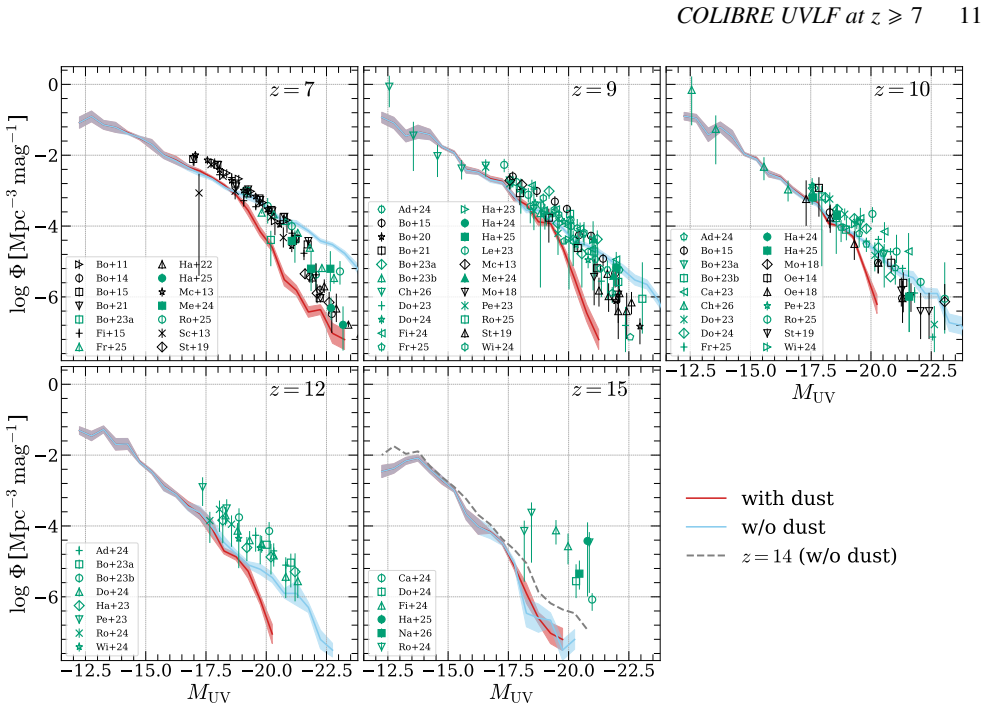
Although COLIBRE is consistent with the observed evolution of the stellar mass function up to z=12, its dust-attenuated UVLFs fall systematically below the observations at the bright end: at the number density of 10^{-6} Mpc^{-3} mag^{-1}, the brightest galaxies are underluminous by approximately 1 mag at z=7, increasing to approximately 2.5 mag at z=15. Ignoring dust attenuation allows COLIBRE to produce sufficiently bright galaxies at 7 less than or equal to z less than or equal to 12, while at z=15 COLIBRE still underpredicts the luminosities of the brightest galaxies, indicating the need for additional physical mechanisms to boost the UV luminosities at the earliest cosmic epochs, such a
What carries the argument
The COLIBRE cosmological hydrodynamics simulations together with SKIRT radiative transfer applied to the predicted stellar emission, multi-phase interstellar medium, and dust distribution to compute dust-attenuated ultraviolet luminosities.
If this is right
- The galaxy number density decreases toward higher redshifts.
- The characteristic luminosity of the UVLF becomes fainter with increasing redshift.
- The faint-end slope of the UVLF becomes steeper at higher redshifts.
- The cosmic UV luminosity density drops by a factor of approximately 300 from z=7 to z=15.
Where Pith is reading between the lines
- If similar shortfalls appear in independent simulations, the mismatch may trace to a common limitation in modeling the earliest star-forming galaxies rather than code-specific details.
- Direct constraints on the stellar initial mass function at z greater than 12 would test whether a top-heavy form is required to resolve the z=15 discrepancy.
- Underpredicted UV output at these epochs would imply slower progress toward cosmic reionization than current models assume.
Load-bearing premise
The sub-grid star-formation, feedback, and dust physics implemented in COLIBRE plus the SKIRT radiative transfer accurately capture the real interstellar medium and stellar populations at redshifts above 7.
What would settle it
A measurement of the actual ultraviolet luminosities of galaxies at number densities around 10^{-6} Mpc^{-3} mag^{-1} at z=15 that matches the observed bright end would falsify the reported shortfall.
Figures




read the original abstract
JWST has enabled the detection of galaxies in the earliest stages of cosmic history. We compare the ultraviolet luminosity functions (UVLFs) at redshifts $z=7-15$ predicted by the new cosmological hydrodynamics simulations, COLIBRE with observations, including those from JWST. The UV luminosities of COLIBRE galaxies are derived using the radiative transfer code SKIRT, which tracks stellar emission and its processing through the multi-phase interstellar medium and dust distribution predicted by COLIBRE. We find that although COLIBRE is consistent with the observed evolution of the stellar mass function up to $z=12$, its dust-attenuated UVLFs fall systematically below the observations at the bright end: at the number density of $10^{-6}\,\mathrm{Mpc^{-3}\,mag^{-1}}$, the brightest galaxies are underluminous by $\approx 1\,\rm mag$ at $z=7$, increasing to $\approx 2.5\,\rm mag$ at $z=15$. Accounting for observational uncertainties brings the COLIBRE UVLFs closer to the observational data, but does not fully resolve the discrepancy. Ignoring dust attenuation allows COLIBRE to produce sufficiently bright galaxies at $7\lesssim z \lesssim 12$, while at $z=15$, COLIBRE still underpredicts the luminosities of the brightest galaxies, indicating the need for additional physical mechanisms to boost the UV luminosities at the earliest cosmic epochs, such as a ''top-heavy'' stellar initial mass function. We fit the COLIBRE UVLFs with Schechter functions and calculate the evolution of the best-fit parameters. We find that the galaxy number density decreases, the characteristic luminosity becomes fainter and the faint-end slope becomes steeper towards higher redshifts. The UV luminosity density decreases by a factor of $\approx 300$ from $z = 7$ to $z = 15$.
Editorial analysis
A structured set of objections, weighed in public.
Referee Report
Summary. The manuscript compares the ultraviolet luminosity functions (UVLFs) at z=7–15 from the COLIBRE cosmological hydrodynamics simulations to JWST and other observational data. UV luminosities are computed via post-processing with the SKIRT radiative transfer code applied to the simulated stellar populations and multi-phase ISM/dust distribution. The central result is that dust-attenuated UVLFs lie systematically below observations at the bright end (offset of ~1 mag at z=7 growing to ~2.5 mag at z=15 at fixed number density 10^{-6} Mpc^{-3} mag^{-1}), while the stellar mass function remains consistent to z=12. Removing dust attenuation improves agreement to z=12 but leaves a residual discrepancy at z=15, which the authors interpret as possible evidence for additional high-z physics such as a top-heavy IMF. Schechter fits to the simulated UVLFs are presented, along with the redshift evolution of the parameters and the UV luminosity density (decreasing by a factor of ~300 from z=7 to 15).
Significance. If the discrepancy is shown to be robust, the work would be significant for constraining sub-grid star-formation and feedback prescriptions in high-redshift galaxy formation models, as the tension is isolated to UV luminosities rather than stellar masses. The use of full SKIRT radiative transfer on hydrodynamically evolved dust geometries is a methodological strength over simpler attenuation prescriptions. The paper also provides useful Schechter parameter evolution and luminosity density trends for comparison with future observations.
major comments (3)
- [§4] §4 (UVLF comparison): the propagation of luminosity errors, completeness corrections, and dust geometry uncertainties into the simulated vs. observed UVLF comparison is not described in sufficient detail to evaluate whether the reported 1–2.5 mag offset at fixed number density exceeds the combined uncertainties.
- [§5] §5 (Discussion and conclusions): no resolution, box-size, or sub-grid parameter convergence tests (e.g., alternative dust models or IMF variations) are presented. This is load-bearing for the claim that the z=15 residual discrepancy (even without dust) requires new physics, as the offset could be sensitive to numerical or model choices.
- [Abstract and §4.2] Abstract and §4.2: the statement that 'accounting for observational uncertainties brings the COLIBRE UVLFs closer to the observational data, but does not fully resolve the discrepancy' lacks quantitative support (e.g., explicit error bands or tabulated offsets before/after uncertainty inclusion) and therefore weakens the interpretation that additional mechanisms are needed at z=15.
minor comments (2)
- [Figures] Figure captions should explicitly indicate whether dust attenuation is included and list the exact redshift slices shown.
- [Abstract] The units in the abstract for number density (Mpc^{-3} mag^{-1}) are standard but could be written with consistent spacing and parentheses for clarity.
Simulated Author's Rebuttal
We thank the referee for their thorough and constructive report. The comments highlight important areas for clarification on uncertainty propagation and model robustness. We have revised the manuscript to provide quantitative details on uncertainties and added discussion on convergence. Below we address each major comment point-by-point.
read point-by-point responses
-
Referee: [§4] §4 (UVLF comparison): the propagation of luminosity errors, completeness corrections, and dust geometry uncertainties into the simulated vs. observed UVLF comparison is not described in sufficient detail to evaluate whether the reported 1–2.5 mag offset at fixed number density exceeds the combined uncertainties.
Authors: We agree that the original description of uncertainty propagation was too brief. In the revised §4, we have added a dedicated paragraph and new Figure 7 that explicitly details the Monte Carlo procedure used to propagate observational luminosity errors and completeness corrections into the observed UVLFs. For the simulations, we include 1σ bands from Poisson statistics plus variations in the dust-to-metal ratio (±0.2 dex) and SKIRT viewing-angle effects. These show that the offset at fixed number density remains >2σ at z=15 even after including all uncertainties, while at z=7 it is marginal (~1.2σ). revision: yes
-
Referee: [§5] §5 (Discussion and conclusions): no resolution, box-size, or sub-grid parameter convergence tests (e.g., alternative dust models or IMF variations) are presented. This is load-bearing for the claim that the z=15 residual discrepancy (even without dust) requires new physics, as the offset could be sensitive to numerical or model choices.
Authors: We acknowledge the value of explicit convergence tests. The COLIBRE suite does not currently include higher-resolution or larger-box runs at z>12 due to computational cost. However, we have added text in §5 citing resolution studies from the parent EAGLE and COLIBRE papers at lower redshifts, which show UVLF convergence to <0.3 mag at the bright end for the adopted resolution. We also discuss that the stellar mass function agreement to z=12 provides indirect support that the UV discrepancy is not primarily numerical. Full IMF variation tests are planned for future work but are beyond the scope of this paper. revision: partial
-
Referee: [Abstract and §4.2] Abstract and §4.2: the statement that 'accounting for observational uncertainties brings the COLIBRE UVLFs closer to the observational data, but does not fully resolve the discrepancy' lacks quantitative support (e.g., explicit error bands or tabulated offsets before/after uncertainty inclusion) and therefore weakens the interpretation that additional mechanisms are needed at z=15.
Authors: We have revised both the abstract and §4.2 to include quantitative support. The updated text now states that including observational uncertainties reduces the magnitude offset by 0.4–0.6 mag at z=15 (and 0.2–0.3 mag at z=7–10). We added error bands to the relevant figures and a table of offsets before/after uncertainty inclusion. The residual discrepancy at z=15 remains ~2.0 mag at 10^{-6} Mpc^{-3} mag^{-1}, supporting the interpretation that additional physics may be required. revision: yes
Circularity Check
No significant circularity; direct numerical comparison to external data
full rationale
The paper reports direct outputs from the COLIBRE hydrodynamical simulations post-processed with SKIRT radiative transfer, then compares those UVLFs and SMFs against independent observational catalogs. The Schechter-function fits are applied only to summarize the simulation results and play no role in the claimed discrepancy. No equations reduce by construction to fitted parameters, no uniqueness theorems are imported via self-citation, and no ansatz is smuggled in. The central claim is therefore a straightforward simulation-versus-data comparison whose validity rests on the fidelity of the sub-grid model rather than on any internal definitional loop.
Axiom & Free-Parameter Ledger
Reference graph
Works this paper leans on
-
[1]
A Population of Red Candidate Massive Galaxies 600
A population of red candidate massive galaxies 600 Myr after the Big Bang. , keywords =. doi:10.1038/s41586-023-05786-2 , archivePrefix =. 2207.12446 , primaryClass =
-
[2]
Oman, Kyle A. , title =. 2025 , publisher =. doi:10.21105/joss.09278 , url =
-
[3]
HYBRID-CHIMES: a model for radiative cooling and the abundances of ions and molecules in simulations of galaxy formation. , keywords =. doi:10.1093/mnras/staf1402 , archivePrefix =. 2506.15773 , primaryClass =
-
[4]
Non-equilibrium chemistry and cooling in the diffuse interstellar medium - I. Optically thin regime. , keywords =. doi:10.1093/mnras/stu525 , archivePrefix =. 1401.4719 , primaryClass =
-
[5]
Non-equilibrium chemistry and cooling in the diffuse interstellar medium - II. Shielded gas. , keywords =. doi:10.1093/mnras/stu1046 , archivePrefix =. 1403.6155 , primaryClass =
-
[6]
The COLIBRE project: cosmological hydrodynamical simulations of galaxy formation and evolution
The COLIBRE project: cosmological hydrodynamical simulations of galaxy formation and evolution. , keywords =. doi:10.1093/mnras/stag375 , archivePrefix =. 2508.21126 , primaryClass =
work page internal anchor Pith review Pith/arXiv arXiv doi:10.1093/mnras/stag375
-
[7]
A hybrid active galactic nucleus feedback model with spinning black holes, winds and jets. , keywords =. doi:10.1093/mnras/stag324 , archivePrefix =. 2509.05179 , primaryClass =
-
[8]
Durrant, Anna and others , note =
-
[9]
Gebek, Andrea and others , note =
-
[10]
arXiv e-prints , keywords =
Galaxy luminosity functions from far-UV to submillimetre at z=0 in the COLIBRE simulations. arXiv e-prints , keywords =
-
[11]
Lu, Shengdong and others , note =
-
[12]
Non-explosive pre-supernova feedback in the COLIBRE model of galaxy formation. , keywords =. doi:10.1093/mnras/stag268 , archivePrefix =. 2509.25309 , primaryClass =
-
[13]
A subgrid model for chemical enrichment in cosmological simulations. , keywords =. doi:10.1093/mnras/stag645 , archivePrefix =. 2604.00980 , primaryClass =
-
[14]
The Formation of the First Star in the Universe. Science , keywords =. doi:10.1126/science.1063991 , archivePrefix =. astro-ph/0112088 , primaryClass =
-
[15]
doi:10.1093/mnras/stad1626 , archiveprefix =
A thermal-kinetic subgrid model for supernova feedback in simulations of galaxy formation. , keywords =. doi:10.1093/mnras/stad1626 , archivePrefix =. 2211.04619 , primaryClass =
-
[16]
COLIBRE: calibrating subgrid feedback in cosmological simulations that include a cold gas phase
COLIBRE: calibrating subgrid feedback in cosmological simulations that include a cold gas phase. , keywords =. doi:10.1093/mnras/stag300 , archivePrefix =. 2509.04067 , primaryClass =
work page internal anchor Pith review Pith/arXiv arXiv doi:10.1093/mnras/stag300
-
[17]
, year = 2026, month = apr, doi =
The evolution of the galaxy stellar mass function and star formation rates in the COLIBRE simulations from redshift 17 to 0. , year = 2026, month = apr, doi =
2026
-
[18]
Dark Energy Survey Year 3 results: Cosmological constraints from galaxy clustering and weak lensing. , keywords =. doi:10.1103/PhysRevD.105.023520 , archivePrefix =. 2105.13549 , primaryClass =
-
[19]
EPOCHS. II. The Ultraviolet Luminosity Function from 7.5 < z < 13.5 Using 180 arcmin ^ 2 of Deep, Blank Fields from the PEARLS Survey and Public JWST Data. , keywords =. doi:10.3847/1538-4357/ad2a7b , archivePrefix =. 2304.13721 , primaryClass =
-
[20]
Spectroscopic Confirmation of CEERS NIRCam-selected Galaxies at z ≃ 8-10. , keywords =. doi:10.3847/2041-8213/acdd54 , archivePrefix =. 2304.05378 , primaryClass =
-
[21]
Earliest Galaxy Evolution in the CANUCS+Technicolor Fields: Galaxy Properties at z 10─16 Seen with the Full NIRCam Medium- and Broadband Filters. , keywords =. doi:10.3847/1538-4357/ae1f8d , archivePrefix =. 2507.03124 , primaryClass =
-
[22]
Revealing galaxy candidates out to z 16 with JWST observations of the lensing cluster SMACS0723. , keywords =. doi:10.1093/mnras/stac3144 , archivePrefix =. 2207.12338 , primaryClass =
-
[23]
2011, ApJS, 196, 22, doi: 10.1088/0067-0049/196/2/22
Efficient Three-dimensional NLTE Dust Radiative Transfer with SKIRT. , keywords =. doi:10.1088/0067-0049/196/2/22 , archivePrefix =. 1108.5056 , primaryClass =
-
[24]
Astronomy and Computing , keywords =
SKIRT: The design of a suite of input models for Monte Carlo radiative transfer simulations. Astronomy and Computing , keywords =. doi:10.1016/j.ascom.2015.05.006 , archivePrefix =. 1505.07708 , primaryClass =
-
[25]
The cosmic spectral energy distribution in the EAGLE simulation. , keywords =. doi:10.1093/mnras/stz302 , archivePrefix =. 1901.08878 , primaryClass =
-
[26]
The TNG50-SKIRT Atlas: Post-processing methodology and first data release. , keywords =. doi:10.1051/0004-6361/202348418 , archivePrefix =. 2401.04224 , primaryClass =
-
[27]
2024, A&A, 683, A182, doi: 10.1051/0004-6361/202348419
The TNG50-SKIRT Atlas: Wavelength dependence of the effective radius. , keywords =. doi:10.1051/0004-6361/202348419 , archivePrefix =. 2401.04225 , primaryClass =
-
[28]
IllustrisTNG in the HSC-SSP: image data release and the major role of mini mergers as drivers of asymmetry and star formation. , keywords =. doi:10.1093/mnras/stad2971 , archivePrefix =. 2308.14793 , primaryClass =
-
[29]
The ALMA REBELS Survey: the first infrared luminosity function measurement at z 7. , keywords =. doi:10.1093/mnras/stad1259 , archivePrefix =. 2303.11321 , primaryClass =
-
[30]
Two Exciting High-redshift Galaxy Candidates Turn Out to Be Two Exciting Ultra-cool Brown Dwarfs
Two Exciting High-redshift Galaxy Candidates Turn Out to Be Two Exciting Ultra-cool Brown Dwarfs , author=. arXiv preprint arXiv:2604.23668 , year=
work page internal anchor Pith review Pith/arXiv arXiv
-
[31]
2000, ApJ, 531, 613, doi:10.1086/308503 —
High-Redshift Galaxies: Their Predicted Size and Surface Brightness Distributions and Their Gravitational Lensing Probability. , keywords =. doi:10.1086/308503 , archivePrefix =. astro-ph/9906398 , primaryClass =
-
[32]
Comparingthepropertiesoflocalglobularclustersystems:implicationsfortheformationoftheGalactic halo,
Can the faint submillimetre galaxies be explained in the cold dark matter model?. , keywords =. doi:10.1111/j.1365-2966.2004.08553.x , archivePrefix =. astro-ph/0406069 , primaryClass =
-
[33]
2010, MNRAS, 401, 1670, doi: 10.1111/j.1365-2966.2009.15794.x
Cosmological simulations of the growth of supermassive black holes and feedback from active galactic nuclei: method and tests. , keywords =. doi:10.1111/j.1365-2966.2009.15043.x , archivePrefix =. 0904.2572 , primaryClass =
-
[34]
Josh Borrow and Alexei Borrisov , title =. 2020 , publisher =. doi:10.21105/joss.02430 , url =
-
[35]
Projecting SPH Particles in Adaptive Environments. arXiv e-prints , keywords =. doi:10.48550/arXiv.2106.05281 , archivePrefix =. 2106.05281 , primaryClass =
-
[36]
doi:10.1093/mnras/stab3166 , archiveprefix =
SPHENIX: smoothed particle hydrodynamics for the next generation of galaxy formation simulations. , keywords =. doi:10.1093/mnras/stab3166 , archivePrefix =. 2012.03974 , primaryClass =
-
[37]
Ultraviolet Luminosity Functions from 132 z -0.5ex 7 and z -0.5ex 8 Lyman-break Galaxies in the Ultra-deep HUDF09 and Wide-area Early Release Science WFC3/IR Observations. , keywords =. doi:10.1088/0004-637X/737/2/90 , archivePrefix =. 1006.4360 , primaryClass =
-
[38]
UV Luminosity Functions at Redshifts z 4 to z 10: 10,000 Galaxies from HST Legacy Fields. , keywords =. doi:10.1088/0004-637X/803/1/34 , archivePrefix =. 1403.4295 , primaryClass =
-
[39]
New Determinations of the UV Luminosity Functions from z 9 to 2 Show a Remarkable Consistency with Halo Growth and a Constant Star Formation Efficiency. , keywords =. doi:10.3847/1538-3881/abf83e , archivePrefix =. 2102.07775 , primaryClass =
-
[40]
UV luminosity density results at z > 8 from the first JWST/NIRCam fields: limitations of early data sets and the need for spectroscopy. , keywords =. doi:10.1093/mnras/stad1014 , archivePrefix =. 2212.06683 , primaryClass =
-
[41]
Evolution of the UV LF from z 15 to z 8 using new JWST NIRCam medium-band observations over the HUDF/XDF. , keywords =. doi:10.1093/mnras/stad1145 , archivePrefix =. 2211.02607 , primaryClass =
-
[42]
The bright end of the galaxy luminosity function at z≃7: before the onset of mass quenching?. , keywords =. doi:10.1093/mnras/stu449 , archivePrefix =. 1312.5643 , primaryClass =
-
[43]
A lack of evolution in the very bright end of the galaxy luminosity function from z ≃ 8 to 10. , keywords =. doi:10.1093/mnras/staa313 , archivePrefix =. 1911.12832 , primaryClass =
-
[44]
The First Stars. , keywords =. doi:10.1146/annurev.astro.42.053102.134034 , archivePrefix =. astro-ph/0311019 , primaryClass =
-
[45]
2003, MNRAS, 341, 1179, doi: 10.1046/j.1365-8711.2003.06473.x
Stellar population synthesis at the resolution of 2003. , keywords =. doi:10.1046/j.1365-8711.2003.06897.x , archivePrefix =. astro-ph/0309134 , primaryClass =
-
[46]
Using 3D Voronoi grids in radiative transfer simulations. , keywords =. doi:10.1051/0004-6361/201322281 , archivePrefix =. 1310.1854 , primaryClass =
-
[47]
Astronomy and Computing , keywords =
SKIRT: An advanced dust radiative transfer code with a user-friendly architecture. Astronomy and Computing , keywords =. doi:10.1016/j.ascom.2014.10.004 , archivePrefix =. 1410.1629 , primaryClass =
-
[48]
Far-infrared and dust properties of present-day galaxies in the EAGLE simulations. , keywords =. doi:10.1093/mnras/stw1735 , archivePrefix =. 1607.04402 , primaryClass =
-
[49]
Data Release of UV to Submillimeter Broadband Fluxes for Simulated Galaxies from the EAGLE Project. , keywords =. doi:10.3847/1538-4365/aaa24c , archivePrefix =. 1712.05583 , primaryClass =
-
[50]
How to Measure Galaxy Star Formation Histories. I. Parametric Models. , keywords =. doi:10.3847/1538-4357/ab04a2 , archivePrefix =. 1811.03635 , primaryClass =
-
[51]
Astronomy and Computing , keywords =
SKIRT 9: Redesigning an advanced dust radiative transfer code to allow kinematics, line transfer and polarization by aligned dust grains. Astronomy and Computing , keywords =. doi:10.1016/j.ascom.2020.100381 , archivePrefix =. 2003.00721 , primaryClass =
-
[52]
COSMOS-Web: Intrinsically Luminous z 10 Galaxy Candidates Test Early Stellar Mass Assembly. , keywords =. doi:10.3847/1538-4357/ad2075 , archivePrefix =. 2308.10932 , primaryClass =
-
[53]
Nebular dominated galaxies: insights into the stellar initial mass function at high redshift. , keywords =. doi:10.1093/mnras/stae1547 , archivePrefix =. 2311.02051 , primaryClass =
-
[54]
Spectroscopic confirmation of two luminous galaxies at a redshift of 14. , keywords =. doi:10.1038/s41586-024-07860-9 , archivePrefix =. 2405.18485 , primaryClass =
-
[55]
Early Results from GLASS-JWST. XIX. A High Density of Bright Galaxies at z 10 in the A2744 Region. , keywords =. doi:10.3847/2041-8213/accea5 , archivePrefix =. 2212.06666 , primaryClass =
-
[56]
Galactic Stellar and Substellar Initial Mass Function. , keywords =. doi:10.1086/376392 , archivePrefix =. astro-ph/0304382 , primaryClass =
work page internal anchor Pith review Pith/arXiv arXiv doi:10.1086/376392
-
[57]
doi:10.1006/jcph.1999.6355 , adsurl =
A Fast Adaptive Multipole Algorithm in Three Dimensions. Journal of Computational Physics , year = 1999, month = nov, volume =. doi:10.1006/jcph.1999.6355 , adsurl =
-
[58]
The first GLIMPSE of the faint galaxy population at Cosmic Dawn with JWST: The evolution of the ultraviolet luminosity function across z 9 - 15. , keywords =. doi:10.1093/mnras/staf2267 , archivePrefix =. 2509.24881 , primaryClass =
-
[59]
Comprehensiveanalyticformulaeforstellarevolutionasafunctionofmassandmetallicity,
Hierarchical galaxy formation. , keywords =. doi:10.1046/j.1365-8711.2000.03879.x , archivePrefix =. astro-ph/0007281 , primaryClass =
-
[60]
Predictions for deep galaxy surveys with JWST from CDM. , keywords =. doi:10.1093/mnras/stx2897 , archivePrefix =. 1702.02146 , primaryClass =
-
[61]
The EAGLE simulations of galaxy formation: calibration of subgrid physics and model variations. , keywords =. doi:10.1093/mnras/stv725 , archivePrefix =. 1501.01311 , primaryClass =
-
[62]
ASTRAEUS. IX. Impact of an evolving stellar initial mass function on early galaxies and reionisation. , keywords =. doi:10.1051/0004-6361/202349017 , archivePrefix =. 2312.12109 , primaryClass =
-
[63]
The ultraviolet continuum slopes ( ) of galaxies at z ≃ 8-16 from JWST and ground-based near-infrared imaging. , keywords =. doi:10.1093/mnras/stad073 , archivePrefix =. 2208.04914 , primaryClass =
-
[64]
The evolution of large-scale structure in a universe dominated by cold dark matter. , keywords =. doi:10.1086/163168 , adsurl =
-
[65]
Simba: Cosmological Simulations with Black Hole Growth and Feedback
SIMBA: Cosmological simulations with black hole growth and feedback. , keywords =. doi:10.1093/mnras/stz937 , archivePrefix =. 1901.10203 , primaryClass =
-
[66]
The ALMA REBELS survey: the dust content of z 7 Lyman break galaxies. , keywords =. doi:10.1093/mnras/stac537 , archivePrefix =. 2202.11118 , primaryClass =
-
[67]
doi:10.1186/s40668-014-0001-7 , archiveprefix =
A fast multipole method for stellar dynamics. Computational Astrophysics and Cosmology , keywords =. doi:10.1186/s40668-014-0001-7 , archivePrefix =. 1405.2255 , primaryClass =
-
[68]
Tracing the quenching journey across cosmic time. , keywords =. doi:10.1051/0004-6361/202349045 , archivePrefix =. 2401.06211 , primaryClass =
-
[69]
2023, MNRAS, 523, 3201, doi: 10.1093/mnras/stad1557
Efficient formation of massive galaxies at cosmic dawn by feedback-free starbursts. , keywords =. doi:10.1093/mnras/stad1557 , archivePrefix =. 2303.04827 , primaryClass =
-
[70]
The evolution of the galaxy UV luminosity function at redshifts z ≃ 8 - 15 from deep JWST and ground-based near-infrared imaging. , keywords =. doi:10.1093/mnras/stac3472 , archivePrefix =. 2207.12356 , primaryClass =
-
[71]
JWST PRIMER: a new multifield determination of the evolving galaxy UV luminosity function at redshifts z ≃ 9 - 15. , keywords =. doi:10.1093/mnras/stae2037 , archivePrefix =. 2403.03171 , primaryClass =
-
[72]
Infrared Emission from Interstellar Dust. IV. The Silicate-Graphite-PAH Model in the Post-Spitzer Era. , keywords =. doi:10.1086/511055 , archivePrefix =. astro-ph/0608003 , primaryClass =
-
[73]
Galaxy and Mass Assembly (GAMA): survey diagnostics and core data release. , keywords =. doi:10.1111/j.1365-2966.2010.18188.x , archivePrefix =. 1009.0614 , primaryClass =
-
[74]
The HORIZON-AGN simulation: morphological diversity of galaxies promoted by AGN feedback. , keywords =. doi:10.1093/mnras/stw2265 , archivePrefix =. 1606.03086 , primaryClass =
-
[75]
, year = 1913, month = mar, volume =
On a formula for correcting statistics for the effects of a known error of observation. , year = 1913, month = mar, volume =. doi:10.1093/mnras/73.5.359 , adsurl =
-
[76]
Binary Population and Spectral Synthesis Version 2.1: Construction, Observational Verification, and New Results. , keywords =. doi:10.1017/pasa.2017.51 , archivePrefix =. 1710.02154 , primaryClass =
-
[77]
2023, MNRAS, 522, 3986, doi: 10.1093/mnras/stad1095
On the stunning abundance of super-early, luminous galaxies revealed by JWST. , keywords =. doi:10.1093/mnras/stad1095 , archivePrefix =. 2208.00720 , primaryClass =
-
[78]
The 2017 Release Cloudy. , keywords =. doi:10.48550/arXiv.1705.10877 , archivePrefix =. 1705.10877 , primaryClass =
-
[79]
The Open Journal of Astrophysics , keywords =
Is feedback-free star formation possible?. The Open Journal of Astrophysics , keywords =. doi:10.33232/001c.144792 , archivePrefix =. 2509.02566 , primaryClass =
-
[80]
The Evolution of the Galaxy Rest-frame Ultraviolet Luminosity Function over the First Two Billion Years. , keywords =. doi:10.1088/0004-637X/810/1/71 , archivePrefix =. 1410.5439 , primaryClass =
discussion (0)
Sign in with ORCID, Apple, or X to comment. Anyone can read and Pith papers without signing in.