Recognition: 2 theorem links
· Lean TheoremTowards Intelligent Low-Altitude Wireless Network Deployment: Differentiable Channel Knowledge Map Construction and Trajectory Design
Pith reviewed 2026-05-11 02:06 UTC · model grok-4.3
The pith
A neural network builds differentiable channel knowledge maps from continuous UAV locations and environmental features to jointly optimize power, bandwidth, and trajectories in low-altitude networks.
A machine-rendered reading of the paper's core claim, the machinery that carries it, and where it could break.
Core claim
We propose a location-oriented CKM construction method that directly maps continuous spatial coordinates to channel gain. In particular, a shared convolutional neural network is employed to encode high-level environmental features from conditional inputs. These features are then sampled based on location information to form a fused regressor-conditional multilayer perceptron or conditional Kolmogorov-Arnold network for channel gain prediction. We further propose a joint power, bandwidth, and trajectory optimization method for multi-UAV systems, with the constructed differentiable CKM employed to evaluate the communication performance, solved via alternating optimization and successive convex
What carries the argument
The location-oriented differentiable CKM, built by encoding environmental features with a shared CNN and predicting gains via c-MLP or cKAN from sampled location features, which provides differentiable channel information for optimization.
If this is right
- Enables location-aware differentiability of the CKM for continuous UAV positions.
- Achieves higher accuracy in channel prediction than methods without environmental features.
- The CKM-JPBTO method yields significantly higher minimum throughput than statistical channel model-based approaches.
- Supports efficient deployment of low-altitude wireless networks with multiple UAVs.
Where Pith is reading between the lines
- This framework could allow real-time updates to UAV paths based on live environmental data without retraining.
- The use of conditional networks might generalize to predicting other wireless metrics like interference levels.
- In practice, it could lower the cost of network planning by relying more on learned models than exhaustive simulations.
- Extensions might include handling moving obstacles or time-varying channels in the CKM construction.
Load-bearing premise
The neural network-based CKM accurately predicts channel gains for any continuous location using the encoded environmental features, and the alternating optimization reliably finds a high-quality solution to the non-convex joint optimization problem.
What would settle it
Measuring actual channel gains at several arbitrary continuous UAV locations in a real or simulated environment and comparing them to the CKM predictions, or running the JPBTO and comparing the achieved minimum throughput against a statistical model baseline.
Figures


read the original abstract
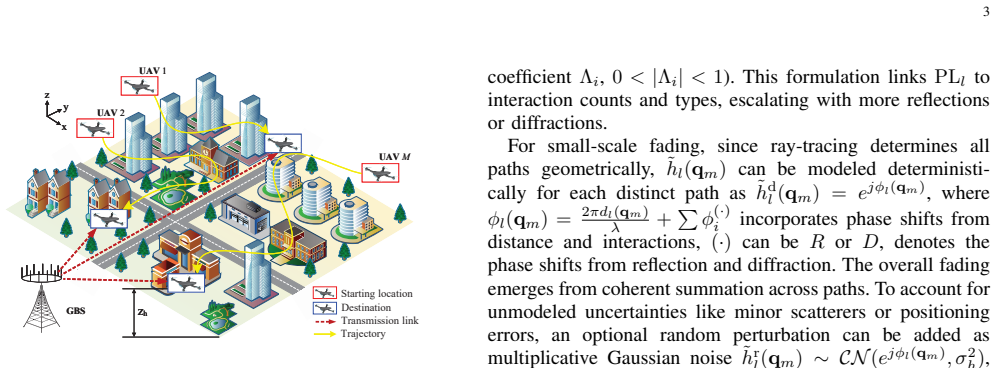
Channel knowledge map (CKM) has emerged as a promising technique to leverage prior propagation knowledge in low-altitude wireless networks (LAWNs), yet state-of-the-art grid-based CKM construction methods struggle to support efficient LAWN deployment due to their lack of differentiability with respect to continuous locations of unmanned aerial vehicles (UAVs). To overcome this limitation, we propose a differentiable CKM-triggered trajectory optimization framework for LAWNs. Firstly, we propose a location-oriented CKM construction method that directly maps continuous spatial coordinates to channel gain. In particular, a shared convolutional neural network (CNN) is employed to encode high-level environmental features from conditional inputs. These features are then sampled based on location information to form a fused regressor-conditional multilayer perceptron (c-MLP) or conditional Kolmogorov-Arnold network (cKAN)-for channel gain prediction. We further propose a joint power, bandwidth, and trajectory optimization (JPBTO) method for multi-UAV systems, with the constructed differentiable CKM employed to evaluate the communication performance. The formulated non-convex problem is solved via alternating optimization and successive convex approximation. Numerical results show that the proposed framework enables location-aware differentiability of the CKM, while achieving higher accuracy than the methods without environmental features. Furthermore, the proposed CKM-JPBTO achieves a significantly higher minimum throughput than the conventional statistical channel model-based JPBTO.
Editorial analysis
A structured set of objections, weighed in public.
Referee Report
Summary. The manuscript proposes a differentiable channel knowledge map (CKM) construction technique for low-altitude wireless networks that directly maps continuous UAV spatial coordinates to channel gains. A shared CNN encodes high-level environmental features from conditional inputs; these are location-sampled and fed to a fused c-MLP or cKAN regressor. The resulting differentiable CKM is embedded in a joint power-bandwidth-trajectory optimization (JPBTO) problem for multi-UAV systems, which is solved by alternating optimization combined with successive convex approximation. Numerical results are reported to show higher prediction accuracy than methods lacking environmental features and significantly higher minimum throughput than conventional statistical-channel-model-based JPBTO.
Significance. If the generalization and optimization claims hold, the work would provide a practical route to gradient-based trajectory design in LAWNs that exploits location-specific propagation knowledge, potentially improving spectral efficiency over purely statistical models. The explicit construction of a location-aware differentiable CKM and the exploration of cKAN regressors are technically interesting contributions that could influence future environment-aware network planning.
major comments (3)
- [Numerical results] Numerical results section: the abstract states higher accuracy and significantly higher minimum throughput, yet no information is supplied on training-set size, spatial distribution of training versus test locations, validation metrics (RMSE/MAE) with error bars, or ablation studies isolating the contribution of the CNN-encoded environmental features versus the choice of c-MLP versus cKAN. Without these, the central performance claims remain only partially supported.
- [Proposed CKM construction and JPBTO] CKM construction and JPBTO sections: the headline performance gains rest on the neural CKM supplying accurate channel gains (and their gradients) at arbitrary continuous locations queried by the trajectory optimizer. No out-of-distribution tests, sensitivity analysis to distribution shift, or verification that prediction error remains bounded along optimized trajectories are provided; any reported throughput improvement is therefore conditional on unverified generalization.
- [JPBTO formulation and solution] Optimization section: the non-convex JPBTO is addressed by alternating optimization and successive convex approximation, but the manuscript supplies neither convergence analysis nor results from multiple random initializations to establish that the obtained solutions are reliably high-quality rather than sensitive to initialization or approximation error.
minor comments (2)
- [CKM construction] Notation for the fused regressor-conditional MLP (c-MLP) and cKAN could be clarified with an explicit diagram or pseudocode showing how location sampling interfaces with the CNN feature map.
- [Numerical results] Figure captions and axis labels in the numerical results should explicitly state the number of Monte-Carlo runs and the precise definition of 'minimum throughput' (e.g., per-user or system-wide).
Simulated Author's Rebuttal
We thank the referee for the constructive and detailed comments. We address each major point below and have revised the manuscript to incorporate additional details, analyses, and clarifications that strengthen the support for our claims.
read point-by-point responses
-
Referee: [Numerical results] Numerical results section: the abstract states higher accuracy and significantly higher minimum throughput, yet no information is supplied on training-set size, spatial distribution of training versus test locations, validation metrics (RMSE/MAE) with error bars, or ablation studies isolating the contribution of the CNN-encoded environmental features versus the choice of c-MLP versus cKAN. Without these, the central performance claims remain only partially supported.
Authors: We agree that these details are essential for rigorously supporting the performance claims. In the revised manuscript, we have expanded the Numerical Results section to specify the training set size (10,000 samples generated via ray-tracing), the spatial distribution (uniform random sampling over the 1 km × 1 km area with an 80/20 train/test split), and validation metrics (RMSE and MAE reported with error bars from five independent runs). We have also added ablation studies that isolate the CNN environmental encoder's contribution and compare c-MLP versus cKAN regressors, confirming their respective impacts on accuracy. revision: yes
-
Referee: [Proposed CKM construction and JPBTO] CKM construction and JPBTO sections: the headline performance gains rest on the neural CKM supplying accurate channel gains (and their gradients) at arbitrary continuous locations queried by the trajectory optimizer. No out-of-distribution tests, sensitivity analysis to distribution shift, or verification that prediction error remains bounded along optimized trajectories are provided; any reported throughput improvement is therefore conditional on unverified generalization.
Authors: We acknowledge that explicit verification of generalization is important for the differentiable CKM. The revised manuscript now includes out-of-distribution tests on unseen location sets with altered environmental parameters. We have added sensitivity analysis to distribution shifts (e.g., changes in building density and height) and verified that prediction error remains bounded along the optimized trajectories by evaluating CKM outputs at each iteration of the JPBTO solver. These additions confirm that the reported throughput gains are not conditional on unverified assumptions. revision: yes
-
Referee: [JPBTO formulation and solution] Optimization section: the non-convex JPBTO is addressed by alternating optimization and successive convex approximation, but the manuscript supplies neither convergence analysis nor results from multiple random initializations to establish that the obtained solutions are reliably high-quality rather than sensitive to initialization or approximation error.
Authors: We thank the referee for highlighting this gap. The revised manuscript includes a convergence analysis of the alternating optimization procedure, showing that the objective stabilizes within approximately 25 iterations on average across scenarios. We have also added results from 10 independent runs with different random initializations of the UAV trajectories and resource allocations, reporting the mean and standard deviation of the achieved minimum throughput to demonstrate that the solutions are robust and not highly sensitive to initialization or approximation errors. revision: yes
Circularity Check
No significant circularity; derivation is self-contained
full rationale
The paper constructs a differentiable CKM via a CNN encoder for environmental features followed by location-sampled c-MLP or cKAN regressors trained on data, then feeds the resulting differentiable map into a standard alternating optimization + SCA solver for the JPBTO problem. All performance claims (accuracy gains, throughput improvements) rest on numerical simulations against external baselines rather than any quantity defined by construction from fitted parameters or prior self-citations. No self-definitional loops, fitted inputs renamed as predictions, or load-bearing self-citation chains appear in the derivation.
Axiom & Free-Parameter Ledger
free parameters (1)
- Neural network weights
axioms (2)
- domain assumption A shared CNN can extract high-level environmental features from conditional inputs that are useful for channel prediction across locations.
- domain assumption The formulated non-convex JPBTO problem can be solved to a good local optimum via alternating optimization and successive convex approximation.
Lean theorems connected to this paper
-
IndisputableMonolith/Cost/FunctionalEquation.leanwashburn_uniqueness_aczel unclear?
unclearRelation between the paper passage and the cited Recognition theorem.
location-oriented CKM construction method that directly maps continuous spatial coordinates to channel gain... fused regressor-conditional multilayer perceptron (c-MLP) or conditional Kolmogorov-Arnold network (cKAN)
-
IndisputableMonolith/Foundation/AlexanderDuality.leanalexander_duality_circle_linking unclear?
unclearRelation between the paper passage and the cited Recognition theorem.
gradient of the CKM with respect to q... chain rule... B-spline basis functions
What do these tags mean?
- matches
- The paper's claim is directly supported by a theorem in the formal canon.
- supports
- The theorem supports part of the paper's argument, but the paper may add assumptions or extra steps.
- extends
- The paper goes beyond the formal theorem; the theorem is a base layer rather than the whole result.
- uses
- The paper appears to rely on the theorem as machinery.
- contradicts
- The paper's claim conflicts with a theorem or certificate in the canon.
- unclear
- Pith found a possible connection, but the passage is too broad, indirect, or ambiguous to say the theorem truly supports the claim.
Reference graph
Works this paper leans on
-
[1]
Dif- ferentiable channel knowledge map reconstruction via kolmogorov- arnold networks,
L. Zhao, S. Zhao, X. Wang, J. Huang, Z. Fei, and Y . Zeng, “Dif- ferentiable channel knowledge map reconstruction via kolmogorov- arnold networks,” inIEEE Int. Conf. Wireless Commun. Signal Process. (WCSP), Chongqing, China, 2025, Accepted
work page 2025
-
[2]
Accessing from the sky: A tutorial on UA V communications for 5G and beyond,
Y . Zeng, Q. Wu, and R. Zhang, “Accessing from the sky: A tutorial on UA V communications for 5G and beyond,”Proceedings of the IEEE, vol. 107, no. 12, pp. 2327–2375, Dec. 2019
work page 2019
-
[3]
Air-ground integrated sensing and communications: Opportunities and challenges,
Z. Fei, X. Wang, N. Wu, J. Huang, and J. A. Zhang, “Air-ground integrated sensing and communications: Opportunities and challenges,” IEEE Communications Magazine, vol. 61, no. 5, pp. 55–61, 2023
work page 2023
-
[4]
S. Hu, W. Ni, X. Wang, A. Jamalipour, and D. Ta, “Joint optimization of trajectory, propulsion, and thrust powers for covert UA V-on-UA V video tracking and surveillance,”IEEE Trans. Inf. F orensics Secur ., vol. 16, pp. 1959–1972, 2021
work page 1959
-
[5]
Energy management and trajectory optimization for UA V-enabled legitimate monitoring systems,
S. Hu, Q. Wu, and X. Wang, “Energy management and trajectory optimization for UA V-enabled legitimate monitoring systems,”IEEE Trans. Wireless Commun., vol. 20, no. 1, pp. 142–155, Jan. 2021
work page 2021
-
[6]
A. Telikani, A. Sarkar, B. Du, F. Santoso, J. Shen, J. Yan, J. Yong, and E. Yap, “Unmanned aerial vehicle-aided intelligent transportation systems: Vision, challenges, and opportunities,”IEEE Commun. Surveys Tuts., pp. 1–1, 2025
work page 2025
-
[8]
H. Jiang, Z. Zhang, C.-X. Wang, J. Zhang, J. Dang, L. Wu, and H. Zhang, “A novel 3D UA V channel model for A2G communication environments using AoD and AoA estimation algorithms,”IEEE Trans. on Commun., vol. 68, no. 11, pp. 7232–7246, 2020
work page 2020
-
[9]
Energy-efficient UA V communication with trajectory optimization,
Y . Zeng and R. Zhang, “Energy-efficient UA V communication with trajectory optimization,”IEEE Trans. on Wireless Commun., vol. 16, no. 6, pp. 3747–3760, 2017
work page 2017
-
[10]
Joint trajectory and communication design for multi-UA V enabled wireless networks,
Q. Wu, Y . Zeng, and R. Zhang, “Joint trajectory and communication design for multi-UA V enabled wireless networks,”IEEE Trans. on Wireless Commun., vol. 17, no. 3, pp. 2109–2121, 2018
work page 2018
-
[11]
Hybrid offline-online design for UA V-enabled data harvesting in probabilistic LoS channels,
C. You and R. Zhang, “Hybrid offline-online design for UA V-enabled data harvesting in probabilistic LoS channels,”IEEE Trans. on Wireless Commun., vol. 19, no. 6, pp. 3753–3768, 2020
work page 2020
-
[12]
Ultra reliable UA V communication using altitude and cooperation diversity,
M. M. Azari, F. Rosas, K.-C. Chen, and S. Pollin, “Ultra reliable UA V communication using altitude and cooperation diversity,”IEEE Trans. Commun., vol. 66, no. 1, pp. 330–344, Jan. 2018
work page 2018
-
[13]
Multi-objective deployment optimization of uavs for energy-efficient wireless coverage,
X. Zhu, L. Zhai, N. Li, Y . Li, and F. Yang, “Multi-objective deployment optimization of uavs for energy-efficient wireless coverage,”IEEE Trans. on Commun., vol. 72, no. 6, pp. 3587–3601, 2024
work page 2024
-
[14]
S. Mirjalili, S. M. Mirjalili, and A. Lewis, “Grey wolf optimizer,” Advances in Engineering Software, vol. 69, pp. 46–61, 2014
work page 2014
-
[15]
Toward environment-aware 6G communications via channel knowledge map,
Y . Zeng and X. Xu, “Toward environment-aware 6G communications via channel knowledge map,”IEEE Wireless Commun., vol. 28, no. 3, pp. 84–91, June 2021
work page 2021
-
[16]
A tutorial on environment-aware communications via channel knowledge map for 6G,
Y . Zeng, J. Chen, J. Xu, D. Wu, X. Xu, S. Jin, X. Gao, D. Gesbert, S. Cui, and R. Zhang, “A tutorial on environment-aware communications via channel knowledge map for 6G,”IEEE Commun. Surveys Tuts., vol. 26, no. 3, pp. 1478–1519, Feb. 2024
work page 2024
-
[17]
An adaptablek-nearest neighbors algorithm for MMSE image interpolation,
K. S. Ni and T. Q. Nguyen, “An adaptablek-nearest neighbors algorithm for MMSE image interpolation,”IEEE Trans. Image Process., vol. 18, no. 9, pp. 1976–1987, May 2009
work page 1976
-
[18]
Fixed rank kriging for cellular coverage analysis,
H. Braham, S. B. Jemaa, G. Fort, E. Moulines, and B. Sayrac, “Fixed rank kriging for cellular coverage analysis,”IEEE Trans. V eh. Technol., vol. 66, no. 5, pp. 4212–4222, Aug. 2017
work page 2017
-
[19]
How much data is needed for channel knowledge map construction?
X. Xu and Y . Zeng, “How much data is needed for channel knowledge map construction?”IEEE Trans. Wireless Commun., vol. 23, no. 10, pp. 13 011–13 021, May 2024
work page 2024
-
[20]
RadioUNet: Fast radio map estimation with convolutional neural networks,
R. Levie, c. Yapar, G. Kutyniok, and G. Caire, “RadioUNet: Fast radio map estimation with convolutional neural networks,”IEEE Trans. Wireless Commun., vol. 20, no. 6, pp. 4001–4015, Feb. 2021
work page 2021
-
[21]
X. Li, S. Zhang, H. Li, X. Li, L. Xu, H. Xu, H. Mei, G. Zhu, N. Qi, and M. Xiao, “RadioGAT: A joint model-based and data-driven framework for multi-band radiomap reconstruction via graph attention networks,” IEEE Trans. Wireless Commun., vol. 23, no. 11, pp. 17 777–17 792, Sep. 2024
work page 2024
-
[22]
Fast and accurate cooperative radio map estimation enabled by GAN,
Z. Zhang, G. Zhu, J. Chen, and S. Cui, “Fast and accurate cooperative radio map estimation enabled by GAN,” inIEEE Int. Conf. Commun. Workshops (ICC Workshops), 2024, pp. 1641–1646
work page 2024
-
[23]
CKMDiff: A generative diffusion model for CKM construction via inverse problems with learned priors,
S. Fu, Y . Zeng, Z. Wu, D. Wu, S. Jin, C.-X. Wang, and X. Gao, “CKMDiff: A generative diffusion model for CKM construction via inverse problems with learned priors,” 2025. [Online]. Available: https://arxiv.org/abs/2504.17323
-
[24]
RadioDiff: An effective generative diffusion model for sampling-free dynamic radio map construction,
X. Wang, K. Tao, N. Cheng, Z. Yin, Z. Li, Y . Zhang, and X. Shen, “RadioDiff: An effective generative diffusion model for sampling-free dynamic radio map construction,”IEEE Trans. Cogn. Commun. Netw., 2024
work page 2024
-
[25]
3D-RadioDiff: An altitude-conditioned diffusion model for 3D radio map construction,
L. Zhao, Z. Fei, X. Wang, J. Luo, and Z. Zheng, “3D-RadioDiff: An altitude-conditioned diffusion model for 3D radio map construction,” IEEE Wireless Commun. Lett., vol. 14, no. 7, pp. 1969–1973, April 2025
work page 1969
-
[26]
X. Wang, Q. Zhang, N. Cheng, J. Chen, Z. Zhang, Z. Li, S. Cui, and X. Shen, “RadioDiff-3D: A 3D× 3D radio map dataset and generative diffusion based benchmark for 6g environment-aware communication,” IEEE Trans. on Netw. Sci. and Eng., pp. 1–18, 2025, doi:10.1109/TNSE. 2025.3590545
-
[27]
Aerial base station placement via propagation radio maps,
D. Romero, P. Q. Viet, and R. Shrestha, “Aerial base station placement via propagation radio maps,”IEEE Trans. on Commun., vol. 72, no. 9, pp. 5349–5364, 2024
work page 2024
-
[28]
Radio map-based 3D path planning for cellular- connected UA V,
S. Zhang and R. Zhang, “Radio map-based 3D path planning for cellular- connected UA V,”IEEE Trans. Wireless Commun., vol. 20, no. 3, pp. 1975–1989, Mar. 2021
work page 1975
-
[29]
Aerial video streaming over 3D cellular networks: An environment and channel knowledge map approach,
C. Zhan, H. Hu, Z. Liu, J. Wang, N. Cheng, and S. Mao, “Aerial video streaming over 3D cellular networks: An environment and channel knowledge map approach,”IEEE Trans. Wireless Commun., vol. 23, no. 2, pp. 1432–1446, Feb. 2024
work page 2024
-
[30]
Energy minimization for cellular-connected UA V: from optimization to deep reinforcement learning,
C. Zhan and Y . Zeng, “Energy minimization for cellular-connected UA V: from optimization to deep reinforcement learning,”IEEE Trans. Wireless Commun., vol. 21, no. 7, pp. 5541–5555, Jul. 2022
work page 2022
-
[31]
Y . Zeng, X. Xu, S. Jin, and R. Zhang, “Simultaneous navigation and radio mapping for cellular-connected UA V with deep reinforcement learning,”IEEE Trans. on Wireless Commun., vol. 20, no. 7, pp. 4205– 4220, 2021
work page 2021
-
[32]
Channel Knowledge Map for Environment-Aware Communications: EM Algorithm for Map Construc- tion,
K. Li, P. Li, Y . Zeng, and J. Xu, “Channel Knowledge Map for Environment-Aware Communications: EM Algorithm for Map Construc- tion,” inIEEE Wireless Commun. Netw. Conf. (WCNC), Austin, TX, USA, 2022, pp. 1659–1664
work page 2022
-
[33]
Learning radio maps for UA V- aided wireless networks: A segmented regression approach,
J. Chen, U. Yatnalli, and D. Gesbert, “Learning radio maps for UA V- aided wireless networks: A segmented regression approach,” inIEEE Int. Conf. Commun. (ICC), Paris, France, 2017, pp. 1–6
work page 2017
-
[34]
Indoor radio map construction and localization with deep Gaussian processes,
X. Wang, X. Wang, S. Mao, J. Zhang, S. Periaswamy, and J. Patton, “Indoor radio map construction and localization with deep Gaussian processes,”IEEE Internet Things J., vol. 7, no. 11, pp. 11 238–11 249, Nov. 2020
work page 2020
-
[35]
Y . Li, X. Wang, Z. Zheng, J. Guo, and Z. Fei, “Joint trajectory and transmit power design for cellular-connected UA Vs via differentiable channel knowledge map,”IEEE Trans. V eh. Technol., pp. 1–16, May 2025, doi:10.1109/TVT.2025.3567741
-
[36]
KAN: Kolmogorov-Arnold Networks
Z. Liu, Y . Wang, S. Vaidya, F. Ruehle, J. Halverson, M. Solja ˇci´c, T. Y . Hou, and M. Tegmark, “KAN: Kolmogorov-arnold networks,” 2025. [Online]. Available: https://arxiv.org/abs/2404.19756
work page internal anchor Pith review arXiv 2025
-
[37]
A survey of efficient ray-tracing techniques for mobile radio propagation analysis,
T. Imai, “A survey of efficient ray-tracing techniques for mobile radio propagation analysis,”IEICE Trans. on Commun., vol. 100, no. 5, pp. 666–679, 2017
work page 2017
-
[38]
REMCOM, Inc., “Wireless InSite®,” https://www.remcom.com/ wireless-insite-em-propagation-software
discussion (0)
Sign in with ORCID, Apple, or X to comment. Anyone can read and Pith papers without signing in.