Dynamical Systems in Elliptical Pursuit and Evasion
Pith reviewed 2026-05-25 06:35 UTC · model grok-4.3
The pith
In elliptical pursuit-evasion, a faster pursuer captures the evader in finite time with an explicit upper bound while a slower pursuer yields global asymptotic convergence to a unique periodic solution.
A machine-rendered reading of the paper's core claim, the machinery that carries it, and where it could break.
Core claim
The paper establishes that the dynamical system obtained from Barton and Eliezer's equations for an elliptical evader orbit, after complex-variable reformulation, satisfies the following: when the pursuer is faster than the evader, capture occurs in finite time and an explicit upper bound on capture time is derived; when the pursuer is slower, the system admits a unique periodic solution to which all trajectories converge globally and asymptotically.
What carries the argument
The non-autonomous dynamical system whose state is the angular difference between the players' velocity vectors and their separation distance, rewritten in a complex variable that combines the logarithm of distance with the angular difference.
If this is right
- Capture occurs in finite time with an explicit upper bound when pursuer speed exceeds evader speed.
- A unique periodic solution exists when the pursuer is slower.
- Every trajectory converges globally and asymptotically to that periodic solution.
- The elliptical system is non-autonomous and contains no equilibrium point.
- The complex-variable reformulation removes the singularity at the capture instant.
Where Pith is reading between the lines
- The contrast with the circular case implies that orbit shape qualitatively changes the long-term behavior from equilibrium to periodic oscillation.
- The explicit capture-time bound supplies a quantitative comparison between elliptical and circular pursuit that is absent from the circular analysis.
- If the trajectory-shape assumption holds for other smooth closed curves, the same finite-time versus periodic dichotomy may apply beyond ellipses.
- The periodic attractor when the pursuer is slower suggests sustained bounded oscillation in separation distance rather than monotonic approach or escape.
Load-bearing premise
The shape of the pursuer's trajectory is unaffected by the evader's speed.
What would settle it
Numerical integration of the original Barton and Eliezer simultaneous differential equations that either exceeds the stated upper bound on capture time or fails to show all trajectories approaching a single periodic orbit.
Figures


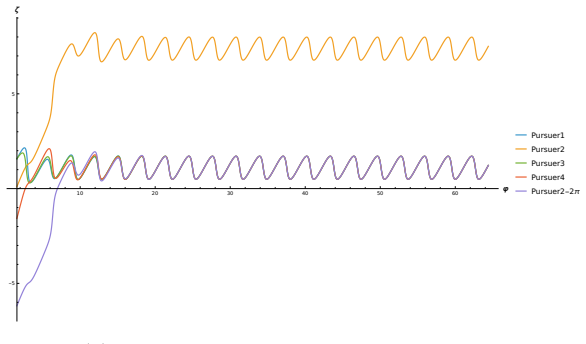

read the original abstract
This paper investigates the difference between the circular and elliptical cases in one-on-one pursuit and evasion problems. Using the simultaneous differential equation derived by Barton and Eliezer, we derive a dynamical system based on the assumption that the shape of the pursuer's trajectory is unaffected by the evader's speed. The dynamical system involves the angular difference between the velocity vectors of the players and their separation distance. When the evader orbits a circle, the dynamical system is autonomous with an asymptotically stable equilibrium point. By contrast, if the evader orbits an ellipse, the dynamical system becomes non-autonomous and lacks an equilibrium point. To handle the singularity at capture, we reformulate the system using a complex variable that includes information about the logarithmic distance and the angular difference. We establish two main results: when the pursuer is faster than the evader, the pursuer captures the evader in finite time, and we derive an explicit upper bound for the capture time; when the pursuer is slower, the system possesses a unique periodic solution to which all trajectories converge globally and asymptotically.
Editorial analysis
A structured set of objections, weighed in public.
Referee Report
Summary. The manuscript derives a reduced dynamical system for one-on-one pursuit-evasion from Barton and Eliezer's simultaneous differential equation under the explicit modeling assumption that the pursuer's trajectory shape is unaffected by the evader's speed. For circular evader orbits the resulting system is autonomous and possesses an asymptotically stable equilibrium. For elliptical orbits the system is non-autonomous; after a complex-variable reformulation that incorporates logarithmic distance and angular difference to regularize the capture singularity, the authors prove two main results: when the pursuer is faster, capture occurs in finite time with an explicit upper bound on capture time; when the pursuer is slower, the system admits a unique periodic solution that attracts all trajectories globally and asymptotically.
Significance. If the stated modeling assumption is valid, the work supplies explicit, analytically derived capture-time bounds and a global convergence result for the non-autonomous elliptical case, extending prior circular results and offering concrete predictions that could be tested in applications. The complex-variable reformulation is a clean technical device for handling the singularity. The paper is transparent that the theorems apply to the reduced model obtained under the assumption.
major comments (1)
- [section deriving the dynamical system (immediately following the citation of Barton and Eliezer)] The modeling assumption that the pursuer's trajectory shape is unaffected by the evader's speed is introduced without derivation, error estimate, or numerical verification against the original coupled Barton-Eliezer equations. This assumption directly determines the form of the reduced non-autonomous vector field for the elliptical case and is therefore load-bearing for both headline theorems (finite-time capture bound and global asymptotic convergence to the unique periodic orbit).
minor comments (2)
- The abstract states that derivations exist but supplies no proof sketches; the full manuscript should include at least a one-paragraph outline of the key steps in each main theorem for readability.
- [reformulation paragraph] Notation for the complex variable (logarithmic distance plus angular difference) should be introduced with an explicit equation number at first use.
Simulated Author's Rebuttal
We thank the referee for the careful reading of the manuscript and for highlighting the central role of the modeling assumption. We address the single major comment below.
read point-by-point responses
-
Referee: [section deriving the dynamical system (immediately following the citation of Barton and Eliezer)] The modeling assumption that the pursuer's trajectory shape is unaffected by the evader's speed is introduced without derivation, error estimate, or numerical verification against the original coupled Barton-Eliezer equations. This assumption directly determines the form of the reduced non-autonomous vector field for the elliptical case and is therefore load-bearing for both headline theorems (finite-time capture bound and global asymptotic convergence to the unique periodic orbit).
Authors: The assumption is stated explicitly in the manuscript right after the Barton-Eliezer citation, and every subsequent result (including both headline theorems) is formulated and proved strictly for the reduced dynamical system obtained under this modeling choice. The paper does not claim that the reduced system approximates the fully coupled equations with quantifiable error; its contribution lies in the analytic tractability of the decoupled non-autonomous system and the complex-variable regularization that permits the finite-time capture bound and the global convergence theorem. We agree that additional discussion of the modeling rationale would improve transparency. In the revised version we will insert a short paragraph immediately after the assumption is introduced, reiterating that all theorems apply exclusively to the reduced model and briefly motivating the assumption as a standard decoupling device that closes the system in the distance-angle variables. revision: partial
Circularity Check
No circularity; derivation rests on external DE plus one explicit modeling assumption
full rationale
The paper begins from the cited Barton-Eliezer simultaneous differential equation, states the modeling assumption that pursuer trajectory shape is independent of evader speed, and obtains the angular-difference/separation-distance system under that assumption. It then analyzes the resulting autonomous (circular) and non-autonomous (elliptical) vector fields, proves finite-time capture with explicit bound when pursuer is faster, and global asymptotic convergence to a unique periodic orbit when slower. None of these steps reduces by construction to a fitted parameter, self-defined quantity, or load-bearing self-citation; the central claims are theorems about the reduced model, not re-statements of its inputs. The assumption is external and falsifiable against the original coupled equations, so the derivation chain is self-contained.
Axiom & Free-Parameter Ledger
axioms (1)
- domain assumption the shape of the pursuer's trajectory is unaffected by the evader's speed
Reference graph
Works this paper leans on
-
[1]
Bouguer, P.: Memories de l’Academie Royale des Sciences, 1-14 (1732)
-
[2]
Hathaway, A.S., Archibald, R.C., Manning, H.P.: Problems and solutions: 2801. Am. Math. Mon. 28(2), 91–97 (1921).https://doi.org/10.2307/2973052
-
[3]
Bernhart, A.: Curves of pursuit. Scr. Math.20, 125–141 (1954)
work page 1954
-
[4]
Isaacs, R.: Differential Games: A Mathematical Theory with Applications to Warfare and Pursuit, Control and Optimization. Wiley, New York (1965)
work page 1965
-
[5]
In: 2020 American Control Conference (ACC), pp
Weintraub, I.E., Pachter, M., Garcia, E.: An introduction to pursuit-evasion differential games. In: 2020 American Control Conference (ACC), pp. 1049–1066 (2020).https://doi.org/10.23919/ ACC45564.2020.9147205
-
[6]
Kumkov, S.S., Le M´ enec, S., Patsko, V.S.: Zero-sum pursuit-evasion differential games with many objects: survey of publications. Dyn. Games Appl.7, 609–633 (2017).https://doi.org/10.1007/ s13235-016-0209-z
work page 2017
-
[7]
Azamov, A.: On a problem of escape along a prescribed curve. J. Appl. Math. Mech.46(4), 553–555 (1982).https://doi.org/10.1016/0021-8928(82)90045-4
-
[8]
Kuchkarov, A.Sh.: Solution of simple pursuit-evasion problem when evader moves on a given curve. Int. Game Theory Rev.12(3), 223–238 (2010).https://doi.org/10.1142/S0219198910002647
-
[9]
Barton, J.C., Eliezer, C.J.: On pursuit curves. J. Aust. Math. Soc. Ser. B41, 358–371 (2000). https://doi.org/10.1017/S0334270000011292
-
[10]
Springer, Singapore (2019).https://doi.org/10.1007/978-981-15-1731-0 19
Kamimura, A., Ohira, T.: Group Chase and Escape: Fusion of Pursuit-Escapes and Collective Motion. Springer, Singapore (2019).https://doi.org/10.1007/978-981-15-1731-0 19
-
[11]
Princeton University Press, Princeton (2007)
Nahin, P.J.: Chases and Escapes: The Mathematics of Pursuit and Evasion. Princeton University Press, Princeton (2007)
work page 2007
-
[12]
arXiv:2508.03841 (2025).https://doi.org/10.48550/arXiv.2508
Rozas, L.: A numerical procedure for the determination of the pursuit curve of objects with uniformly accelerated motion. arXiv:2508.03841 (2025).https://doi.org/10.48550/arXiv.2508. 03841
-
[13]
Yoshihara, S., Ohira, T.: Pursuit and evasion: from singles to groups. J. Phys. Conf. Ser.2207, 012014 (2022).https://doi.org/10.1088/1742-6596/2207/1/012014
-
[14]
Yoshihara, S.: Elliptical pursuit and evasion. J. Phys. Conf. Ser., in press (2026)
work page 2026
-
[15]
arXiv:2401.06338v3 (2024).https: //doi.org/10.48550/arXiv.2401.06338
Yoshihara, S.: Elliptical pursuit and evasion –extended version–. arXiv:2401.06338v3 (2024).https: //doi.org/10.48550/arXiv.2401.06338
-
[16]
Texts in Applied Mathematics, vol 2
Wiggins, S.: Introduction to Applied Nonlinear Dynamical Systems and Chaos, 2nd edn. Texts in Applied Mathematics, vol 2. Springer, New York (2000)
work page 2000
-
[17]
Wolfram Research, Inc., Champaign, Illinois (2024) 20
Wolfram Research, Inc.: Mathematica, Version 14.1. Wolfram Research, Inc., Champaign, Illinois (2024) 20
work page 2024
discussion (0)
Sign in with ORCID, Apple, or X to comment. Anyone can read and Pith papers without signing in.