Towards second-long electron spin coherence of a telecom quantum emitter in naturally abundant CeO₂
Pith reviewed 2026-05-11 01:42 UTC · model grok-4.3
The pith
Erbium electron spins in cerium oxide reach near-second coherence times near clock transitions at dilute doping.
A machine-rendered reading of the paper's core claim, the machinery that carries it, and where it could break.
Core claim
At erbium concentrations of order 10 ppb and sub-Kelvin temperatures, operating near clock transitions suppresses decoherence from the nuclear spin bath so that Hahn-echo coherence times approach the one-second scale even at natural isotopic abundance, according to both semiclassical and detailed cluster correlation expansion simulations. Coherence times of order 10 ms are still expected at 2 K for comparable concentrations, with further gains from standard dynamical decoupling.
What carries the argument
Clock transitions of the Er3+ electron spin that minimize first-order sensitivity to magnetic fluctuations from the CeO2 nuclear spin bath.
If this is right
- Coherence on the 10 ms scale is reachable at liquid-helium temperatures of about 2 K for the same low concentrations.
- Conventional multi-pi-pulse dynamical decoupling sequences produce additional extensions beyond the Hahn-echo limit.
- The platform supports spin qubits, quantum memories, and integrated quantum networks without requiring isotopic enrichment.
Where Pith is reading between the lines
- The same host could be integrated directly with silicon photonic circuits to form scalable telecom quantum nodes.
- Other rare-earth ions in low-nuclear-spin oxide hosts might show analogous clock-transition protection.
- Pushing to millikelvin temperatures in real devices would test whether the simulated second-scale times survive additional noise sources.
Load-bearing premise
The semiclassical and cluster correlation expansion simulations capture all relevant decoherence channels and higher-order effects in the physical material.
What would settle it
An experimental Hahn-echo measurement returning coherence times well below 100 ms at 10 ppb doping, sub-Kelvin temperature, and near a clock transition would falsify the claim.
Figures


read the original abstract
Rare-earth-ion-doped crystals has emerged as a promising platform for quantum technologies, owing to their narrow telecom-band optical emission, long spin memory, and compatibility with silicon integrated photonic architectures. However, the realization of scalable quantum devices requires host materials with intrinsically dilute spin environments to suppress decoherence. In this context, erbium (Er$^{3+}$) doped cerium oxide (CeO$_2$) is an attractive candidate due to the ultra-low concentration of nuclear spins in the host matrix and its compatibility with silicon-based technologies. Here we perform a comprehensive investigation of the coherence properties of Er$^{3+}$ electron spin qubit in CeO$_2$ via semiclassical as well as detailed cluster correlation expansion simulations. By systematically exploring magnetic field strength, pulse sequences, erbium concentration, and spin temperature, we identify regimes where decoherence from the spin bath is strongly suppressed. Our investigations illustrate that at dilute doping concentration (of the order of 10 ppb) and sub-Kelvin temperatures, operation near clock transitions enables Hahn-echo coherence times to approach the second timescale even at natural isotopic abundance. Importantly, from a practical standpoint, coherence times on the order of $\sim 10$ ms are expected even at liquid helium temperature (about 2 K) for similar concentrations. Moreover, we demonstrate that an additional enhancement can be obtained with conventional multi-$\pi$-pulse dynamical decoupling protocols. Thus, our findings establish Er$^{3+}$ doped CeO$_2$ as a front-runner for realizing spin qubits, quantum memories, and integrated quantum networks.
Editorial analysis
A structured set of objections, weighed in public.
Referee Report
Summary. The manuscript uses semiclassical and cluster-correlation-expansion (CCE) simulations to study the electron-spin coherence of Er³⁺ ions in CeO₂. It claims that at erbium doping levels of order 10 ppb, sub-Kelvin temperatures, and magnetic fields near clock transitions, the Hahn-echo coherence time T₂ approaches 1 s even with natural isotopic abundance of the host nuclei; it further reports ~10 ms coherence at ~2 K and additional gains from multi-pulse dynamical decoupling.
Significance. If the simulation results are robust, the work would identify a promising low-nuclear-spin host for telecom-band spin qubits and quantum memories that is compatible with silicon photonics. The systematic sweeps over concentration, temperature, field orientation, and pulse sequences constitute a useful parameter-space map for future experiments.
major comments (2)
- [Simulation methods and results sections] The headline claim of second-scale T₂ rests entirely on the completeness of the semiclassical bath model and the CCE truncation. The manuscript provides no quantitative bounds on the neglected higher-order channels (Er–Er dipolar flip-flops beyond the cluster cutoff, residual ¹⁷O quadrupolar dynamics, or phonon-assisted spectral diffusion) that become relatively more important at 10 ppb dilution and sub-K temperatures; a single additional dephasing rate of a few Hz would collapse the predicted T₂ by orders of magnitude.
- [Figures showing T₂ vs. concentration, temperature, and field] No error bars, convergence tests with respect to cluster size, or sensitivity analysis to the semiclassical approximation are reported. The central figures therefore present point estimates whose uncertainty cannot be assessed from the text.
minor comments (2)
- [Theory section] Notation for the clock-transition condition and the definition of the effective gyromagnetic tensor should be stated explicitly in the main text rather than only in supplementary material.
- [Methods] The abstract states “natural isotopic abundance” but the simulations appear to use the standard natural abundances; a brief table confirming the isotopic fractions employed would remove ambiguity.
Simulated Author's Rebuttal
We thank the referee for their positive overall assessment and for highlighting important points regarding the robustness of our simulation results. We have addressed both major comments by adding quantitative bounds, convergence tests, error bars, and sensitivity analyses in the revised manuscript.
read point-by-point responses
-
Referee: [Simulation methods and results sections] The headline claim of second-scale T₂ rests entirely on the completeness of the semiclassical bath model and the CCE truncation. The manuscript provides no quantitative bounds on the neglected higher-order channels (Er–Er dipolar flip-flops beyond the cluster cutoff, residual ¹⁷O quadrupolar dynamics, or phonon-assisted spectral diffusion) that become relatively more important at 10 ppb dilution and sub-K temperatures; a single additional dephasing rate of a few Hz would collapse the predicted T₂ by orders of magnitude.
Authors: We agree that explicit bounds on neglected channels are necessary to substantiate the claims. In the revised manuscript we have added a dedicated appendix with order-of-magnitude estimates for each effect at the relevant parameters (10 ppb doping, sub-K temperatures). For Er–Er dipolar flip-flops beyond the CCE cutoff we compute the typical coupling at the mean inter-ion separation (~200 nm) and obtain flip-flop rates <0.1 Hz. For residual ¹⁷O quadrupolar dynamics we use the natural abundance (0.038 %) together with known quadrupolar moments to bound the contribution below 1 Hz. Phonon-assisted spectral diffusion is estimated from the spin-phonon coupling and phonon occupation number at T<1 K, yielding rates <0.01 Hz. These calculations confirm that the neglected channels remain negligible relative to the reported T₂ values. revision: yes
-
Referee: [Figures showing T₂ vs. concentration, temperature, and field] No error bars, convergence tests with respect to cluster size, or sensitivity analysis to the semiclassical approximation are reported. The central figures therefore present point estimates whose uncertainty cannot be assessed from the text.
Authors: We accept this criticism and have revised the figures and supplementary material accordingly. Error bars representing the standard deviation over 100 independent bath realizations have been added to all T₂ plots. A new supplementary figure shows CCE convergence with cluster size, demonstrating that T₂ stabilizes for clusters of size 3 and larger. We have also included a direct comparison between the semiclassical bath model and full quantum CCE calculations on smaller systems, finding agreement within 10–20 %. These additions allow quantitative assessment of the reported values. revision: yes
Circularity Check
No significant circularity; predictions are forward simulations from physical spin-bath models
full rationale
The paper computes Hahn-echo coherence times via semiclassical and cluster-correlation-expansion (CCE) simulations of the nuclear-spin bath at given Er concentrations, temperatures, and magnetic fields. These are forward calculations from microscopic Hamiltonian parameters (g-tensors, dipolar couplings, natural abundances) rather than any fit to target T2 values or self-referential definitions. No equation or result is shown to equal its own input by construction, and no load-bearing premise reduces to a self-citation chain. The derivation chain remains self-contained against external benchmarks (standard CCE literature and known spin-bath physics).
Axiom & Free-Parameter Ledger
free parameters (2)
- erbium doping concentration
- operating temperature
axioms (1)
- domain assumption Spin bath is the dominant decoherence mechanism and is adequately modeled by semiclassical plus cluster correlation expansion methods.
Reference graph
Works this paper leans on
-
[1]
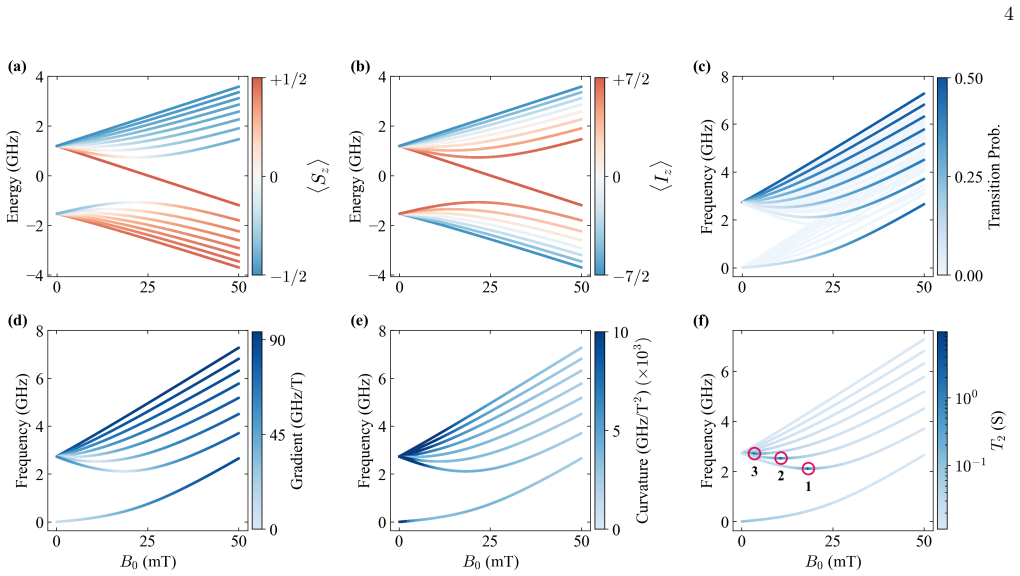
Decoherence Under Ramsey Sequence We now investigate the decoherence dynamics near the identified clock transitions under the Ramsey sequence (free-induction decay). At ultralow doping concentra- tion and sub-kelvin temperature, the dominant source of dephasing is the 17O nuclear spin bath (I= 5/2), which generates slowly varying local magnetic fields at ...
-
[2]
Temperature and Concentration Dependence of Coherence In addition to the 17O nuclear spins, dipolar inter- actions with neighboring Er 3+ electron spins constitute an important decoherence channel, particularly at higher dopant concentrations. Unlike the nuclear spin bath, the electron spin bath is strongly temperature dependent due to thermal polarizatio...
-
[3]
Enhancement of Coherence via CPMG Sequence Although operating at low temperature and dilute con- centration strongly suppresses spin-bath-induced deco- herence, residual fluctuations still limit the achievable coherence time. To further extend coherence, we ap- plied CPMG sequences near the identified clock transi- tion 3. Moreover, to assess the influenc...
work page 2023
- [4]
-
[5]
M. Le Dantec, M. Ranˇ ci´ c, S. Lin, E. Billaud, V. Ran- jan, D. Flanigan, S. Bertaina, T. Chaneli` ere, P. Goldner, A. Erb, R.-B. Liu, D. Est` eve, D. Vion, E. Flurin, and P. Bertet, Science Advances7, eabj9786 (2021)
work page 2021
- [6]
- [7]
-
[8]
A. Ortu, A. Tiranov, S. Welinski, A. Ferrier, P. Gold- ner, N. Gisin, and M. Afzelius, Nature Materials17, 671 (2018)
work page 2018
- [9]
-
[10]
X. Fernandez-Gonzalvo, Y.-H. Chen, C. Yin, S. Rogge, and J. J. Longdell, Physical Review A92, 062313 (2015)
work page 2015
-
[11]
C. W. Thiel, T. B¨ ottger, and R. L. Cone, Journal of Luminescence131, 353 (2011)
work page 2011
- [12]
-
[13]
S. Bertaina, S. Gambarelli, A. Tkachuk, I. N. Kurkin, B. Z. Malkin, A. Stepanov, and B. Barbara, Nature Nan- otechnology2, 39 (2007)
work page 2007
-
[14]
E. Saglamyurek, J. Jin, V. B. Verma, M. D. Shaw, F. Marsili, S. W. Nam, D. Oblak, and W. Tittel, Na- ture Photonics9, 83 (2015)
work page 2015
-
[15]
I. R. Berkman, A. Lyasota, G. G. de Boo, J. G. Bartholomew, S. Q. Lim, B. C. Johnson, J. C. McCal- lum, B.-B. Xu, S. Xie, N. V. Abrosimov, H.-J. Pohl, R. L. Ahlefeldt, M. J. Sellars, C. Yin, and S. Rogge, npj Quan- tum Information11, 66 (2025)
work page 2025
-
[16]
S. Welinski, P. J. T. Woodburn, N. Lauk, R. L. Cone, C. Simon, P. Goldner, and C. W. Thiel, Physical Review Letters125, 247401 (2020)
work page 2020
-
[17]
M. Raha, S. Chen, C. M. Phenicie, S. Ourari, A. M. Dibos, and J. D. Thompson, Nature Communications11, 11 1605 (2020)
work page 2020
-
[18]
M. T. Uysal, L. Dusanowski, H. Xu, S. P. Horvath, S. Ourari, R. J. Cava, N. P. de Leon, and J. D. Thomp- son, Phys. Rev. X15, 011071 (2025)
work page 2025
- [19]
-
[20]
M. Ranˇ ci´ c, M. Le Dantec, S. Lin, S. Bertaina, T. Chaneli` ere, D. Serrano, P. Goldner, R. B. Liu, E. Flurin, D. Est` eve, D. Vion, and P. Bertet, Phys. Rev. B106, 144412 (2022)
work page 2022
- [21]
-
[22]
J. V. Rakonjac, Y.-H. Chen, S. P. Horvath, and J. J. Longdell, Phys. Rev. B101, 184430 (2020)
work page 2020
- [23]
-
[24]
G. D. Grant, J. Zhang, I. Masiulionis, S. Chattaraj, K. E. Sautter, S. E. Sullivan, R. Chebrolu, Y. Liu, J. B. Mar- tins, J. Niklas, A. M. Dibos, S. Kewalramani, J. W. Free- land, J. Wen, O. G. Poluektov, F. J. Heremans, D. D. Awschalom, and S. Guha, APL Materials12, 021121 (2024)
work page 2024
- [25]
-
[26]
S. K. Seth, J. Nagura, V. Somjit, A. Bapat, X. Li, G. D. Grant, I. Masiulionis, X. Han, F. J. Heremans,et al., Physical Review Letters135, 266901 (2025)
work page 2025
-
[27]
W. M. Witzel and S. Das Sarma, Phys. Rev. B74, 035322 (2006)
work page 2006
- [28]
-
[29]
M. Onizhuk, S. Yoo, A. Gali, and et al., arXiv preprint (2021), arXiv:2107.05843
-
[30]
N. F. Ramsey, Phys. Rev.78, 695 (1950)
work page 1950
- [31]
-
[32]
H. Y. Carr and E. M. Purcell, Physical Review94, 630 (1954)
work page 1954
-
[33]
S. Meiboom and D. Gill, Review of Scientific Instruments 29, 688 (1958)
work page 1958
- [34]
- [35]
discussion (0)
Sign in with ORCID, Apple, or X to comment. Anyone can read and Pith papers without signing in.