Recognition: no theorem link
From Feasible to Practical: Pareto-Optimal Synthesis Planning
Pith reviewed 2026-05-11 01:48 UTC · model grok-4.3
The pith
MORetro* recovers the true Pareto front of synthesis routes for any fixed single-step retrosynthesis model.
A machine-rendered reading of the paper's core claim, the machinery that carries it, and where it could break.
Core claim
MORetro* formulates retrosynthesis as a multi-objective optimization task and uses weighted scalarization together with Bayesian-optimization-informed sampling inside a multi-objective A* framework. For any fixed single-step retrosynthesis model the algorithm recovers the complete Pareto front of synthesis routes, with formal optimality guarantees. On standard benchmarks the resulting fronts contain diverse, high-quality solutions that single-objective planners overlook.
What carries the argument
MORetro*, the algorithm that extends multi-objective A* search through weighted scalarization and BO-informed sampling to enumerate all non-dominated synthesis routes.
If this is right
- Planning software can return explicit sets of routes showing cost-yield-sustainability trade-offs instead of a single path.
- A chemist can select a route that matches their current priorities without needing to rerun the search under new weights.
- Routes that look inferior under one metric alone can still be optimal when all criteria are considered together.
- Any single-objective shortest-path method is guaranteed to miss at least some members of the true Pareto front.
Where Pith is reading between the lines
- If the single-step model is allowed to improve during the search, the current optimality guarantees would need to be relaxed or replaced with online updating rules.
- Non-convex portions of the front may still require additional techniques beyond scalarization to ensure full coverage.
- The Pareto sets could serve as training data for learning improved single-step models that better predict realistic trade-offs.
Load-bearing premise
The single-step retrosynthesis model stays fixed and its predictions remain accurate enough that the computed trade-offs reflect real chemical behavior.
What would settle it
Run MORetro* on a small target molecule whose complete set of routes can be enumerated exhaustively and check whether every non-dominated route appears in the reported front and no dominated route does.
Figures


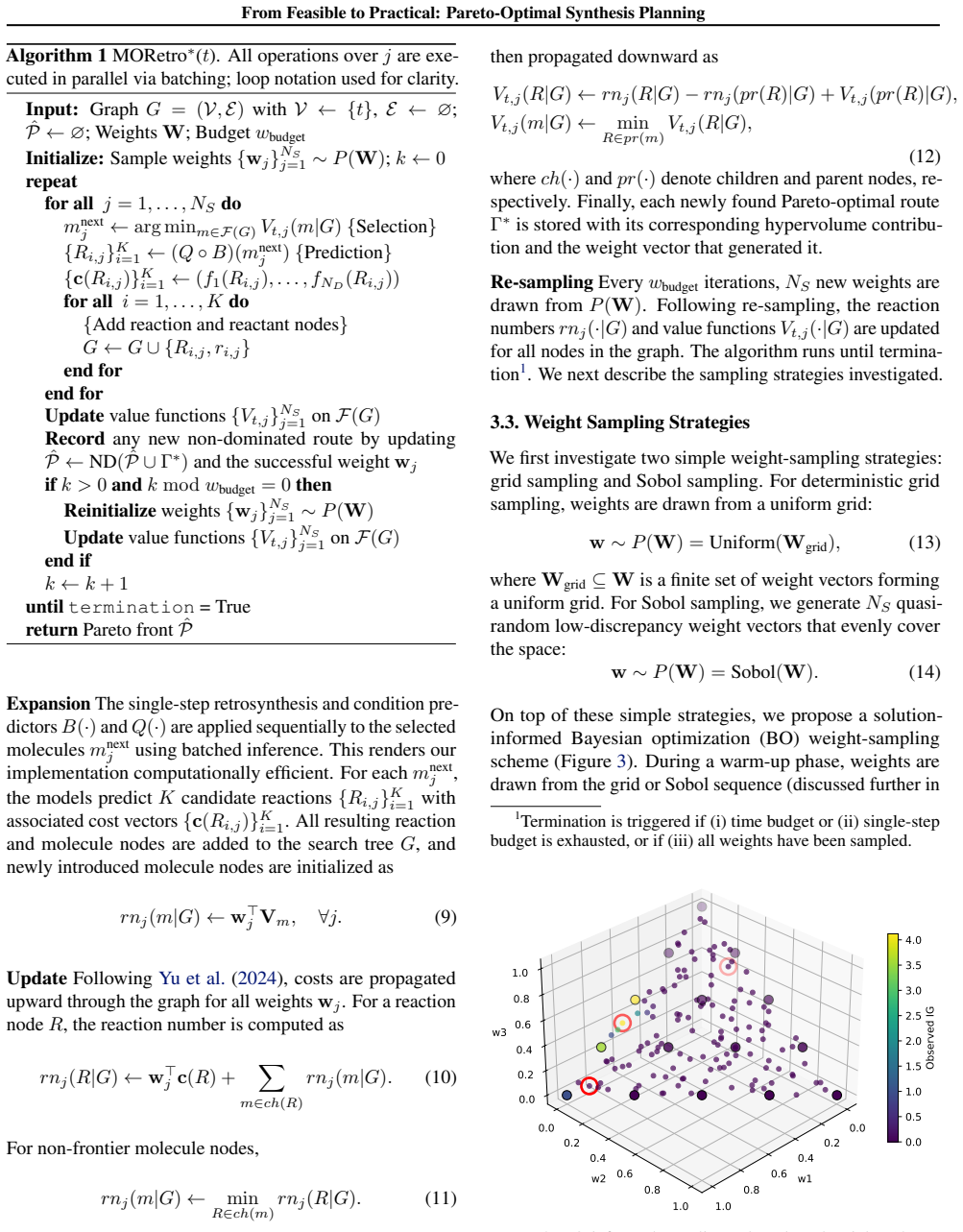


read the original abstract
Current computer-aided synthesis planning (CASP) methods often treat retrosynthesis as solved once a single feasible route is identified, focusing primarily on convergence or shortest-path metrics. This view is misaligned with real-world practice, where chemists must balance competing objectives such as cost, sustainability, toxicity, and overall yield. To address this, we formulate synthesis planning as a multi-objective search problem and introduce MORetro*, an algorithm that generates a Pareto front of synthesis routes to explicitly capture trade-offs among user-defined criteria. MORetro* uses weighted scalarization and BO-informed sampling to efficiently navigate the combinatorial search space and prioritize promising trade-offs. Building on multi-objective A*-search, we provide optimality guarantees showing that, for a fixed single-step model, MORetro* recovers the true Pareto front. Across multiple retrosynthesis benchmarks, MORetro* produces diverse, high-quality Pareto fronts, uncovering solutions overlooked by single-objective approaches and better aligning CASP outputs with industrial decision-making.
Editorial analysis
A structured set of objections, weighed in public.
Referee Report
Summary. The manuscript introduces MORetro*, a multi-objective retrosynthesis algorithm that formulates synthesis planning as a search over trade-offs among objectives such as cost, yield, sustainability, and toxicity. It employs weighted scalarization combined with Bayesian optimization-informed sampling inside a multi-objective A* framework, and claims optimality guarantees that, for any fixed single-step retrosynthesis model, the algorithm recovers the true Pareto front. Evaluations on standard retrosynthesis benchmarks are reported to produce more diverse and higher-quality route sets than single-objective baselines.
Significance. If the optimality guarantees are valid and the approach scales, the work would advance CASP by shifting focus from single feasible routes to explicit Pareto fronts that better match industrial multi-criteria decision making. The explicit provision of guarantees for a fixed single-step model is a constructive strength that distinguishes the contribution from purely heuristic multi-objective search methods.
major comments (2)
- [Abstract / MORetro* algorithm description] Abstract and method description: The central claim states that MORetro* recovers the true Pareto front via multi-objective A*-search optimality guarantees. However, the described procedure relies on weighted scalarization plus BO-informed sampling. Standard weighted-sum scalarization identifies only supported solutions on the convex hull and systematically misses non-supported points on non-convex fronts, which are expected for typical synthesis objectives (cost vs. toxicity, yield vs. sustainability). The manuscript must clarify whether epsilon-constraint methods, explicit Pareto-set maintenance, or exhaustive weight enumeration are used to restore completeness; without this, the optimality guarantee does not hold for the full front.
- [Abstract / Optimality guarantees section] Optimality guarantees paragraph: The abstract asserts that the guarantees apply for a fixed single-step model, yet no derivation, proof sketch, or reference to the specific multi-objective A* properties (e.g., admissible heuristic conditions or dominance pruning rules) is supplied. This absence prevents verification that the guarantee survives the scalarization step and is load-bearing for the paper's primary contribution.
minor comments (2)
- [Experimental evaluation] Benchmarks section: Provide explicit rules for data exclusion, error analysis of the single-step model predictions, and the exact procedure for weight sampling to support reproducibility.
- [Preliminaries] Notation: Define the Pareto front formally in the discrete space of synthesis routes and clarify how non-dominated routes are maintained during search.
Simulated Author's Rebuttal
We thank the referee for the constructive and detailed feedback. We address the major comments point by point below, with planned revisions to the manuscript.
read point-by-point responses
-
Referee: [Abstract / MORetro* algorithm description] Abstract and method description: The central claim states that MORetro* recovers the true Pareto front via multi-objective A*-search optimality guarantees. However, the described procedure relies on weighted scalarization plus BO-informed sampling. Standard weighted-sum scalarization identifies only supported solutions on the convex hull and systematically misses non-supported points on non-convex fronts, which are expected for typical synthesis objectives (cost vs. toxicity, yield vs. sustainability). The manuscript must clarify whether epsilon-constraint methods, explicit Pareto-set maintenance, or exhaustive weight enumeration are used to restore completeness; without this, the optimality guarantee does not hold for the full front.
Authors: We agree that standard weighted-sum scalarization recovers only supported solutions on the convex hull and can miss non-supported points on non-convex fronts. The MORetro* implementation maintains an explicit set of non-dominated solutions via dominance pruning within the multi-objective A* search and uses BO-informed sampling over weight vectors to explore trade-offs. However, this combination does not guarantee recovery of the complete Pareto front. We will revise the abstract and algorithm description to state that the optimality guarantees apply specifically to the supported solutions obtained from the scalarized subproblems, and we will add a discussion of the limitations for non-convex fronts along with the practical utility of the supported front for synthesis planning. revision: yes
-
Referee: [Abstract / Optimality guarantees section] Optimality guarantees paragraph: The abstract asserts that the guarantees apply for a fixed single-step model, yet no derivation, proof sketch, or reference to the specific multi-objective A* properties (e.g., admissible heuristic conditions or dominance pruning rules) is supplied. This absence prevents verification that the guarantee survives the scalarization step and is load-bearing for the paper's primary contribution.
Authors: We acknowledge that the manuscript currently lacks a derivation or proof sketch. In the revision we will add a dedicated subsection (or appendix) providing a proof sketch. The argument will rely on the standard admissibility conditions for multi-objective A* heuristics, the correctness of dominance pruning for preserving the Pareto set, and the fact that each scalarized single-objective A* search returns an optimal route for its weight vector when the single-step model is fixed. We will also include references to the multi-objective heuristic search literature to support the reasoning. revision: yes
Circularity Check
No significant circularity: optimality guarantee conditioned on external fixed model
full rationale
The paper's derivation chain centers on formulating synthesis planning as multi-objective search and invoking multi-objective A*-search to supply optimality guarantees that MORetro* recovers the true Pareto front for any fixed single-step retrosynthesis model. This guarantee is explicitly conditioned on the single-step model being an external, fixed input rather than something derived or fitted inside the method. Weighted scalarization and BO-informed sampling are presented as algorithmic choices for navigating the space, but the optimality claim is not shown to reduce to those choices by construction; it is instead asserted to inherit from the underlying A* framework. No self-definitional loops, fitted inputs renamed as predictions, or load-bearing self-citations appear in the provided abstract or described structure. The derivation therefore remains self-contained against external benchmarks and does not collapse to its own inputs.
Axiom & Free-Parameter Ledger
free parameters (1)
- objective weights
axioms (1)
- domain assumption Single-step retrosynthesis model is fixed and accurate
Reference graph
Works this paper leans on
-
[1]
The 37th International Conference on Machine Learning (ICML) , year=
Retro*: Learning Retrosynthetic Planning with Neural Guided A* Search , author=. The 37th International Conference on Machine Learning (ICML) , year=
-
[2]
Proceedings of the 28th ACM SIGKDD Conference on Knowledge Discovery and Data Mining , pages =
Xie, Shufang and Yan, Rui and Han, Peng and Xia, Yingce and Wu, Lijun and Guo, Chenjuan and Yang, Bin and Qin, Tao , title =. Proceedings of the 28th ACM SIGKDD Conference on Knowledge Discovery and Data Mining , pages =. 2022 , doi =
work page 2022
-
[3]
doi:10.1186/s13321-020-00472-1 , pages =
Journal of Cheminformatics , author =. doi:10.1186/s13321-020-00472-1 , pages =
-
[4]
and Fong, Mun Hong and Roh, Jihye and Levin, Itai and Yu, Kevin and Joung, Joonyoung F
Tu, Zhengkai and Choure, Sourabh J. and Fong, Mun Hong and Roh, Jihye and Levin, Itai and Yu, Kevin and Joung, Joonyoung F. and Morgan, Nathan and Li, Shih-Cheng and Sun, Xiaoqi and Lin, Huiqian and Murnin, Mark and Liles, Jordan P. and Struble, Thomas J. and Fortunato, Michael E. and Liu, Mengjie and Green, William H. and Jensen, Klavs F. and Coley, Conn...
work page 2025
-
[5]
Marwin H.S. Segler and Mark P. Waller , doi =. Neural-Symbolic Machine Learning for Retrosynthesis and Reaction Prediction , volume =. Chemistry – A European Journal , pages =
-
[6]
Segler, Marwin H. S. and Waller, Mark P. , year =. Planning Chemical Syntheses with Deep Neural Networks and Symbolic. Nature , volume =
-
[7]
An Algorithmic Framework for Synthetic Cost-Aware Decision Making in Molecular Design , author =. 2024 , journal =
work page 2024
-
[8]
Data-driven recommendation of agents, temperature, and equivalence ratios for organic synthesis , doi =. Chemical Science , author =
-
[9]
Chen, Shuan and Jung, Yousung , year =. Deep. JACS Au , volume =
-
[10]
Retrosynthesis Prediction with Conditional Graph Logic Network , booktitle =
Dai, Hanjun and Li, Chengtao and Coley, Connor and Dai, Bo and Song, Le , year =. Retrosynthesis Prediction with Conditional Graph Logic Network , booktitle =
-
[11]
Computer‐assisted synthetic planning: The end of the beginning
Szymku \'c , Sara and Gajewska, Ewa P and Klucznik, Tomasz and Molga, Karol and Dittwald, Piotr and Startek, Micha and Bajczyk, Micha and Grzybowski, Bartosz A. Computer‐assisted synthetic planning: The end of the beginning. Angew. Chem. Int. Ed Engl
-
[12]
Nature Communications , author =
Retrosynthesis prediction using an end-to-end graph generative architecture for molecular graph editing , volume =. Nature Communications , author =. doi:10.1038/s41467-023-38851-5 , pages =
-
[13]
Molecule edit graph attention network: Modeling chemical reactions as sequences of graph edits
Molecule Edit Graph Attention Network: Modeling Chemical Reactions as Sequences of Graph Edits , volume =. Journal of Chemical Information and Modeling , author =. doi:10.1021/acs.jcim.1c00537 , pages =
-
[14]
Thirty-Fifth Conference on Neural Information Processing Systems , year=
Learning Graph Models for Retrosynthesis Prediction , author=. Thirty-Fifth Conference on Neural Information Processing Systems , year=
-
[15]
and Bekas, Costas and Lee, Alpha A
Schwaller, Philippe and Laino, Teodoro and Gaudin, Théophile and Bolgar, Peter and Hunter, Christopher A. and Bekas, Costas and Lee, Alpha A. , year =. Molecular Transformer: A Model for Uncertainty-Calibrated Chemical Reaction Prediction , volume =. doi:10.1021/acscentsci.9b00576 , pages =
- [16]
-
[17]
Yu, Yemin and Wei, Ying and Kuang, Kun and Huang, Zhengxing and Yao, Huaxiu and Wu, Fei , year =. Advances in
-
[18]
Retrosynthetic Planning with Dual Value Networks , booktitle =
Liu, Guoqing and Xue, Di and Xie, Shufang and Xia, Yingce and Tripp, Austin and Maziarz, Krzysztof and Segler, Marwin and Qin, Tao and Zhang, Zongzhang and Liu, Tie-Yan , year =. Retrosynthetic Planning with Dual Value Networks , booktitle =
-
[19]
Schreck, John S. and Coley, Connor W. and Bishop, Kyle J. M. , year =. Learning. ACS Central Science , volume =
-
[20]
Retrosynthesis Planning via Worst-path Policy Optimisation in Tree-structured
Mianchu Wang and Giovanni Montana , booktitle=. Retrosynthesis Planning via Worst-path Policy Optimisation in Tree-structured
-
[21]
Advances in Neural Information Processing Systems , author =
Depth-First Proof-Number Search with Heuristic Edge Cost and Application to Chemical Synthesis Planning , volume =. Advances in Neural Information Processing Systems , author =
-
[22]
Self-Improved Retrosynthetic Planning
Junsu Kim and Sungsoo Ahn and Hankook Lee and Jinwoo Shin. Self-Improved Retrosynthetic Planning. Proceedings of the 38th International Conference on Machine Learning (ICML). 2021
work page 2021
-
[23]
Retro-fallback: retrosynthetic planning in an uncertain world , year =
Tripp, Austin and Maziarz, Krzysztof and Lewis, Sarah and Segler, Marwin and Hern\'. Retro-fallback: retrosynthetic planning in an uncertain world , year =. International Conference on Representation Learning (ICLR) , pages =
-
[24]
Communications Chemistry , author =
Efficient retrosynthetic planning with. Communications Chemistry , author =. doi:10.1038/s42004-024-01133-2 , pages =
-
[25]
Tango*: constrained synthesis planning using chemically informed value functions
Armstrong, Daniel and Jončev, Zlatko and Guo, Jeff and Schwaller, Philippe. Tango*: constrained synthesis planning using chemically informed value functions. Digital Discovery. 2025. doi:10.1039/D5DD00130G
- [26]
-
[27]
and Saigiridharan, Lakshidaa and Genheden, Samuel
Westerlund, Annie M. and Saigiridharan, Lakshidaa and Genheden, Samuel. Human-guided synthesis planning via prompting. Chemical Science. 2025. doi:10.1039/D5SC00927H
-
[28]
Vaucher, Andrea Byekwaso, Philippe Schwaller, Alessandra Toniato, and Teodoro Laino
Thakkar, Amol and Vaucher, Alain C. and Byekwaso, Andrea and Schwaller, Philippe and Toniato, Alessandra and Laino, Teodoro , year =. Unbiasing Retrosynthesis Language Models with Disconnection Prompts , volume =. doi:10.1021/acscentsci.3c00372 , pages =
-
[29]
Multistep retrosynthesis combining a disconnection aware triple transformer loop with a route penalty score guided tree search , volume =. Chemical Science , author =. doi:10.1039/D3SC01604H , pages =
-
[30]
and Jončev, Zlatko and Schwaller, Philippe , year =
Xuan-Vu, Nguyen and Armstrong, Daniel and Wehrbach, Milena and Bran, Andres M. and Jončev, Zlatko and Schwaller, Philippe , year =. Synthelite: Chemist-aligned and feasibility-aware synthesis planning with. doi:10.48550/arXiv.2512.16424 , publisher =
-
[31]
and Clevert, Djork-Arné and Preuss, Mike and Genheden, Samuel , year =
Lai, Helen and Kannas, Christos and Hassen, Alan Kai and Granqvist, Emma and Westerlund, Annie M. and Clevert, Djork-Arné and Preuss, Mike and Genheden, Samuel , year =. Multi-objective synthesis planning by means of Monte Carlo Tree search , volume =. doi:10.1016/j.ailsci.2025.100130 , journal =
-
[32]
Alan Kai Hassen and Helen Lai and Samuel Genheden and Mike Preuss and Djork-Arné Clevert , title =. ChemRxiv , year =
-
[34]
doi:10.1021/acs.jcim.0c01426 , pages =
Journal of Chemical Information and Modeling , author =. doi:10.1021/acs.jcim.0c01426 , pages =
-
[35]
Chemical Society Reviews , author =
Chemical data intelligence for sustainable chemistry , volume =. Chemical Society Reviews , author =. doi:10.1039/D1CS00477H , pages =
-
[36]
doi:10.1186/s40360-018-0282-6 , pages =
Pu, Limeng and Naderi, Misagh and Liu, Tairan and Wu, Hsiao-Chun and Mukhopadhyay, Supratik and Brylinski, Michal , year =. doi:10.1186/s40360-018-0282-6 , pages =
-
[37]
doi:10.1186/s13321-025-01076-3 , pages =
Journal of Cheminformatics , author =. doi:10.1186/s13321-025-01076-3 , pages =
-
[38]
Towards efficient discovery of green synthetic pathways with Monte Carlo tree search and reinforcement learning , volume =. Chemical Science , author =. doi:10.1039/D0SC04184J , pages =
-
[39]
Gao, Hanyu and Struble, Thomas J. and Coley, Connor W. and Wang, Yuran and Green, William H. and Jensen, Klavs F. , year =. Using Machine Learning To Predict Suitable Conditions for Organic Reactions , volume =. doi:10.1021/acscentsci.8b00357 , pages =
-
[40]
Moss, Henry B. and Leslie, David S. and Gonz\'. GIBBON: general-purpose information-based Bayesian optimisation , year =. J. Mach. Learn. Res. , articleno =
-
[41]
Estimation of synthetic accessibility score of drug-like molecules based on molecular complexity and fragment contributions , volume =. Journal of Cheminformatics , author =. doi:10.1186/1758-2946-1-8 , pages =
-
[42]
Robert and Abou-Shehada, Sarah and Dunn, Peter J
Prat, Denis and Wells, Andy and Hayler, John and Sneddon, Helen and McElroy, C. Robert and Abou-Shehada, Sarah and Dunn, Peter J. CHEM21 selection guide of classical- and less classical-solvents. Green Chem. 2016. doi:10.1039/C5GC01008J
-
[43]
ACS Sustainable Chemistry & Engineering , volume =
Bystrzanowska, Marta and Petkov, Petko and Tobiszewski, Marek , title =. ACS Sustainable Chemistry & Engineering , volume =. 2019 , doi =
work page 2019
-
[44]
Mirza, Adrian and Alampara, Nawaf and Kunchapu, Sreekanth and R. A framework for evaluating the chemical knowledge and reasoning abilities of large language models against the expertise of chemists , journal=. 2025 , day=
work page 2025
- [45]
-
[46]
Multiobjective A* search with consistent heuristics , volume =
Mandow, Lawrence and. Multiobjective A* search with consistent heuristics , volume =. J. doi:10.1145/1754399.1754400 , pages =
-
[47]
Stewart, Bradley S. and White, Chelsea C. , title =. 1991 , volume =. doi:10.1145/115234.115368 , journal =
-
[48]
Proceedings of the 14th Annual Conference on Genetic and Evolutionary Computation , pages =
Brockhoff, Dimo and Wagner, Tobias and Trautmann, Heike , title =. Proceedings of the 14th Annual Conference on Genetic and Evolutionary Computation , pages =. 2012 , doi =
work page 2012
-
[49]
A simple similarity metric for comparing synthetic routes
Genheden, Samuel and Shields, Jason D. A simple similarity metric for comparing synthetic routes. Digital Discovery. 2025. doi:10.1039/D4DD00292J
discussion (0)
Sign in with ORCID, Apple, or X to comment. Anyone can read and Pith papers without signing in.