Recognition: unknown
GASim: A Graph-Accelerated Hybrid Framework for Social Simulation
Pith reviewed 2026-05-11 03:01 UTC · model grok-4.3
The pith
Graph optimizations let hybrid social simulators run nearly 10 times faster while using under 20 percent of the tokens.
A machine-rendered reading of the paper's core claim, the machinery that carries it, and where it could break.
Core claim
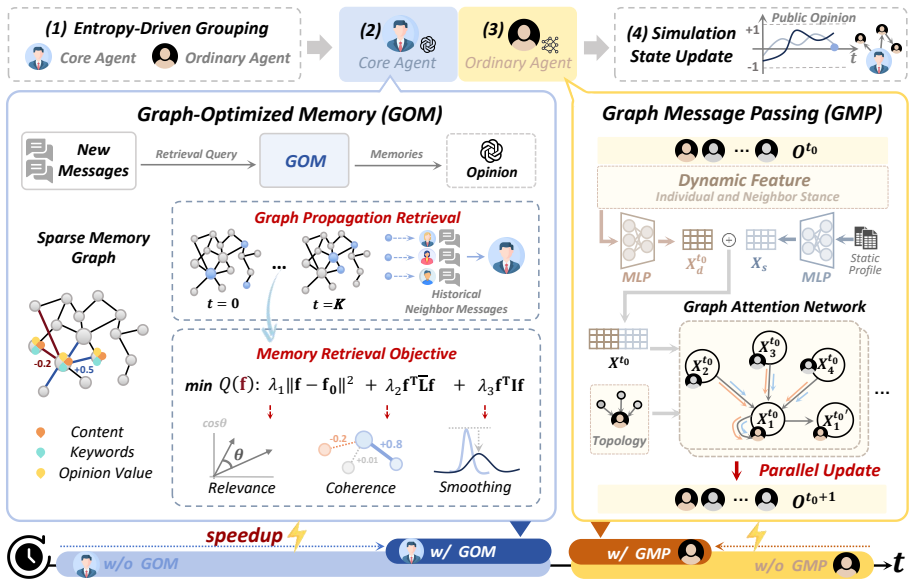
GASim replaces LLM-based memory retrieval with lightweight propagation over a sparse memory graph for core agents, substitutes sequential ABM execution with parallel updates by fine-grained feature aggregation and Graph Attention Network for ordinary agents, and coordinates the split through Entropy-Driven Grouping that identifies emergent core agents in information-diverse neighborhoods, delivering a 9.94-fold end-to-end speedup and less than 20 percent baseline token use while preserving alignment with real-world public opinion trends.
What carries the argument
Graph-Optimized Memory (GOM) for core LLM agents together with Graph Message Passing (GMP) and Entropy-Driven Grouping (EDG) that partitions agents by information entropy.
If this is right
- End-to-end simulation runtime drops by a factor of 9.94 relative to the traditional hybrid baseline.
- Token consumption for the LLM component falls below 20 percent of the original level.
- Alignment between simulated opinion dynamics and observed real-world public opinion trends is maintained.
- The hybrid framework can therefore support larger agent populations without proportional growth in latency or cost.
Where Pith is reading between the lines
- The same substitution of graph operations for sequential retrieval and execution steps might apply to other mixed-agent systems that combine reasoning-heavy and rule-based components.
- Entropy-based identification of core agents could be reused in network simulations to locate nodes where richer modeling yields the largest accuracy gains.
- Lower overall resource demands open the possibility of running social models interactively or over extended time periods that were previously impractical.
Load-bearing premise
The graph approximations for memory propagation and message passing plus the entropy-based partitioning keep the behavioral fidelity of both LLM and ordinary agents intact across the tested scenarios.
What would settle it
Direct comparison of simulated public opinion trends against real-world data or against an unapproximated baseline at substantially larger population sizes or longer time horizons showing clear divergence.
Figures



read the original abstract
Large-scale social simulators are essential for studying complex social patterns. Prior work explores hybrid methods to scale up simulations, combining large language models (LLM)-based agents with numerical agent-based models (ABM). However, this incurs high latency due to expensive memory retrieval and sequential ABM execution. To address this challenge, we propose GASim, a graph-accelerated hybrid multi-agent framework for large-scale social simulations. For core agents driven by LLM, GASim introduces Graph-Optimized Memory (GOM) to replace intensive LLM-based retrieval pipelines with lightweight propagation over a sparse memory graph. For the majority of ordinary agents, GASim employs Graph Message Passing (GMP), substituting sequential ABM execution with parallel updates by fine-grained feature aggregation and Graph Attention Network. We further introduce Entropy-Driven Grouping (EDG) that coordinates this hybrid partitioning, leveraging information entropy to dynamically identify emergent core agents situated in information-diverse neighborhoods. Extensive experiments show that GASim not only delivers a substantial 9.94-fold end-to-end speedup over the traditional hybrid framework but also consumes less than 20% of baseline tokens, significantly reducing costs while preserving strong alignment with real-world public opinion trends. Our code is available at https://github.com/Jasmine0201/GASim.
Editorial analysis
A structured set of objections, weighed in public.
Referee Report
Summary. The paper proposes GASim, a graph-accelerated hybrid multi-agent framework for large-scale social simulations. It replaces LLM-based memory retrieval for core agents with Graph-Optimized Memory (GOM) propagation over a sparse graph, substitutes sequential ABM execution for ordinary agents with parallel Graph Message Passing (GMP) using Graph Attention Networks, and introduces Entropy-Driven Grouping (EDG) to dynamically partition agents based on information entropy. Experiments claim a 9.94-fold end-to-end speedup and less than 20% baseline token consumption while preserving alignment with real-world public opinion trends; code is released at https://github.com/Jasmine0201/GASim.
Significance. If the graph approximations maintain behavioral fidelity, the framework could substantially lower the cost of hybrid LLM-ABM social simulations, enabling larger agent populations and longer horizons that are currently prohibitive. The public code release is a clear strength that supports reproducibility and community validation of the reported speedups and alignment.
major comments (3)
- [Abstract] Abstract: the central claim that GASim 'preserves strong alignment with real-world public opinion trends' while delivering the 9.94-fold speedup is load-bearing, yet the abstract (and by extension the experimental section) provides no quantitative fidelity metrics such as KL divergence on opinion distributions, Pearson correlation with ground-truth trends, or per-step trajectory error accumulation to demonstrate statistical indistinguishability from the non-approximated baseline.
- [§3] §3 (GOM and GMP descriptions): the Graph-Optimized Memory propagation and GMP updates with GAT are presented as faithful substitutes for full LLM retrieval and sequential ABM, but no ablation or direct divergence comparison (e.g., opinion-distribution KL or agent-behavior correlation) is reported to bound behavioral drift across the tested agent counts and time scales.
- [§4] §4 (experimental results): the reported 9.94× speedup and <20% token figures lack error bars, run-to-run variance, or statistical significance tests, and no component-wise ablations isolate the contribution of GOM, GMP, and EDG, leaving open whether the gains reflect acceleration or altered dynamics.
minor comments (2)
- [Abstract] Abstract: the scale of the simulations (agent count, number of time steps) and the specific real-world datasets used for trend alignment are not stated, which would help readers assess the scope of the claims.
- [§3] Notation: the definitions of information entropy in EDG and the exact GAT update rules in GMP could be clarified with explicit equations to aid reproducibility.
Simulated Author's Rebuttal
We thank the referee for the constructive and detailed feedback. The comments highlight important aspects of result presentation and validation that we will address in the revision. We respond point-by-point below.
read point-by-point responses
-
Referee: [Abstract] Abstract: the central claim that GASim 'preserves strong alignment with real-world public opinion trends' while delivering the 9.94-fold speedup is load-bearing, yet the abstract (and by extension the experimental section) provides no quantitative fidelity metrics such as KL divergence on opinion distributions, Pearson correlation with ground-truth trends, or per-step trajectory error accumulation to demonstrate statistical indistinguishability from the non-approximated baseline.
Authors: We agree that the abstract does not report quantitative fidelity metrics and that this weakens the central claim. The experimental section presents visual comparisons of opinion trends against real-world data and states qualitative alignment, but does not include the suggested statistical measures. In the revised manuscript we will add Pearson correlation, KL divergence on opinion distributions, and per-step error metrics computed against both the non-approximated baseline and ground-truth trends. revision: yes
-
Referee: [§3] §3 (GOM and GMP descriptions): the Graph-Optimized Memory propagation and GMP updates with GAT are presented as faithful substitutes for full LLM retrieval and sequential ABM, but no ablation or direct divergence comparison (e.g., opinion-distribution KL or agent-behavior correlation) is reported to bound behavioral drift across the tested agent counts and time scales.
Authors: Section 3 focuses on the design rationale for GOM and GMP. While end-to-end comparisons between GASim and the baseline hybrid framework are shown in §4, we did not include component-specific divergence metrics or ablations that isolate behavioral drift. We will add these analyses (KL divergence and agent-behavior correlation) across varying agent counts and horizons in the revised version to bound any approximation error. revision: yes
-
Referee: [§4] §4 (experimental results): the reported 9.94× speedup and <20% token figures lack error bars, run-to-run variance, or statistical significance tests, and no component-wise ablations isolate the contribution of GOM, GMP, and EDG, leaving open whether the gains reflect acceleration or altered dynamics.
Authors: The reported 9.94× speedup and token consumption are based on the experimental runs described in §4, but we acknowledge the absence of error bars, variance reporting, significance tests, and component-wise ablations. We will re-run the experiments with multiple random seeds, report means and standard deviations, include statistical tests, and add ablations that isolate the contribution of each component (GOM, GMP, EDG) to both speedup and behavioral fidelity. revision: yes
Circularity Check
No circularity: empirical performance claims only
full rationale
The paper's load-bearing claims are measured experimental outcomes (9.94-fold speedup, <20% token usage, alignment with real-world opinion trends) obtained by running the proposed GASim components against baselines and external data. No first-principles derivation, fitted-parameter prediction, or self-citation chain is presented that reduces the reported results to the inputs by construction. GOM, GMP, and EDG are introduced as new algorithmic approximations whose behavioral fidelity is assessed via external benchmarks rather than internal redefinition or renaming of known quantities.
Axiom & Free-Parameter Ledger
Reference graph
Works this paper leans on
-
[1]
Shaked Brody, Uri Alon, and Eran Yahav. 2022. How attentive are graph attention networks? In The Tenth International Conference on Learning Representations, pages 1-- 26
work page 2022
- [2]
-
[3]
Weize Chen, Yusheng Su, Jingwei Zuo, Cheng Yang, Chenfei Yuan, Chi - Min Chan, Heyang Yu, Yaxi Lu, Yi - Hsin Hung, Chen Qian, Yujia Qin, Xin Cong, Ruobing Xie, Zhiyuan Liu, Maosong Sun, and Jie Zhou. 2024. Agentverse: Facilitating multi-agent collaboration and exploring emergent behaviors. In The Twelfth International Conference on Learning Representation...
work page 2024
-
[4]
Prateek Chhikara, Dev Khant, Saket Aryan, Taranjeet Singh, and Deshraj Yadav. 2025. Mem0 : Building production-ready AI agents with scalable long-term memory. CoRR, abs/2504.19413
work page internal anchor Pith review Pith/arXiv arXiv 2025
-
[5]
Yun - Shiuan Chuang, Agam Goyal, Nikunj Harlalka, Siddharth Suresh, Robert Hawkins, Sijia Yang, Dhavan Shah, Junjie Hu, and Timothy T. Rogers. 2024. Simulating opinion dynamics with networks of llm-based agents. In Findings of the Association for Computational Linguistics, pages 3326--3346
work page 2024
-
[6]
Guillaume Deffuant, Frédéric Amblard, Gérard Weisbuch, and Thierry Faure. 2002. How can extremism prevail? a study based on the relative agreement interaction model. Journal of Artificial Societies and Social Simulation, 5(04)
work page 2002
-
[7]
Matthijs Douze, Alexandr Guzhva, Chengqi Deng, Jeff Johnson, Gergely Szilvasy, Pierre - Emmanuel Mazar \' e , Maria Lomeli, Lucas Hosseini, and Herv \' e J \' e gou. 2024. The faiss library. CoRR, abs/2401.08281
work page internal anchor Pith review arXiv 2024
-
[8]
Goldberg, Xiaojin Zhu, and Stephen Wright
Andrew B. Goldberg, Xiaojin Zhu, and Stephen Wright. 2007. Dissimilarity in graph-based semi-supervised classification. In Proceedings of the Eleventh International Conference on Artificial Intelligence and Statistics, pages 155--162
work page 2007
-
[9]
Rainer Hegselmann and Ulrich Krause. 2002. Opinion dynamics and bounded confidence models, analysis and simulation. Journal of Artificial Societies and Social Simulation, 5(03)
work page 2002
-
[10]
Zhiwei Jin, Juan Cao, Yongdong Zhang, and Jiebo Luo. 2016. News verification by exploiting conflicting social viewpoints in microblogs. In Proceedings of the Thirtieth AAAI Conference on Artificial Intelligence, page 2972–2978
work page 2016
-
[11]
Bai Jinbo and Li Hongbo. 2019. Study on a pareto principle case of social network. In Proceedings of the 2019 4th International Conference on Social Sciences and Economic Development, pages 113--117
work page 2019
-
[12]
Lazarsfeld, Bernard Berelson, and Hazel Gaudet
Paul F. Lazarsfeld, Bernard Berelson, and Hazel Gaudet. 2021. The People's Choice: How the Voter Makes Up His Mind in a Presidential Campaign. Columbia University Press
work page 2021
-
[13]
Kun Liu, Qi Liu, Xinchen Liu, Jie Li, Yongdong Zhang, Jiebo Luo, Xiaodong He, and Wu Liu. 2025 a . Hoigen-1m: A large-scale dataset for human-object interaction video generation. In IEEE/CVF Conference on Computer Vision and Pattern Recognition , pages 24001--24010
work page 2025
-
[14]
Kun Liu, Mengxue Qu, Yang Liu, Yunchao Wei, Wenming Zhe, Yao Zhao, and Wu Liu. 2025 b . Single-frame supervision for spatio-temporal video grounding. IEEE Transactions on Pattern Analysis and Machine Intelligence, 47(7):5177--5191
work page 2025
-
[15]
Yijun Liu, Wu Liu, Xiaoyan Gu, Yong Rui, Xiaodong He, and Yongdong Zhang. 2026. LMAgent : A large-scale multimodal agents society for multi-user simulation. IEEE Transactions on Multimedia, pages 1--12
work page 2026
-
[16]
Jan Lorenz, Martin Neumann, and Tobias Schröder. 2021. Individual attitude change and societal dynamics: Computational experiments with psychological theories. Psychological Review, 128(04):623--642
work page 2021
-
[17]
Adyasha Maharana, Dong - Ho Lee, Sergey Tulyakov, Mohit Bansal, Francesco Barbieri, and Yuwei Fang. 2024. Evaluating very long-term conversational memory of LLM agents. In Proceedings of the 62nd Annual Meeting of the Association for Computational Linguistics, pages 13851--13870
work page 2024
-
[18]
Huiyu Min, Jiuxin Cao, Jiawei Ge, and Bo Liu. 2024. A multi-agent system for fine-grained opinion dynamics analysis in online social networks. IEEE Trans. Comput. Soc. Syst. , 11(1):815--828
work page 2024
-
[19]
Xinyi Mou, Zhongyu Wei, and Xuanjing Huang. 2024. Unveiling the truth and facilitating change: Towards agent-based large-scale social movement simulation. In Findings of the Association for Computational Linguistics, pages 4789--4809
work page 2024
-
[20]
Joon Sung Park, Joseph O'Brien, Carrie Jun Cai, Meredith Ringel Morris, Percy Liang, and Michael S. Bernstein. 2023. Generative Agents : Interactive simulacra of human behavior. In Proceedings of the 36th Annual ACM Symposium on User Interface Software and Technology, page 1–22
work page 2023
-
[21]
Preston Rasmussen, Pavlo Paliychuk, Travis Beauvais, Jack Ryan, and Daniel Chalef. 2025. Zep: A temporal knowledge graph architecture for agent memory. CoRR, abs/2501.13956
work page internal anchor Pith review arXiv 2025
- [22]
-
[23]
V \' ctor Vargas - P \' e rez, Jes \' u s Gir \' a ldez - Cru, Pablo Mesejo, and Oscar Cord \' o n. 2025. Unveiling agents' confidence in opinion dynamics models via graph neural networks. IEEE Trans. Comput. Soc. Syst. , 12(2):725--737
work page 2025
-
[24]
Kun Xiang, Zhili Liu, Terry Jingchen Zhang, Yinya Huang, Yunshuang Nie, Kaixin Cai, Yiyang Yin, Runhui Huang, Hanhui Li, Yihan Zeng, Yu-Jie Yuan, Jianhua Han, Lanqing Hong, Hang Xu, and Xiaodan Liang. 2026. AtomThink : Multimodal slow thinking with atomic step reasoning. IEEE Transactions on Pattern Analysis and Machine Intelligence, 48(5):5725--5741
work page 2026
-
[25]
Wujiang Xu, Zujie Liang, Kai Mei, Hang Gao, Juntao Tan, and Yongfeng Zhang. 2025. A-Mem : Agentic memory for LLM agents. In The Thirty-ninth Annual Conference on Neural Information Processing Systems, pages 1--28
work page 2025
-
[26]
Ziyi Yang, Zaibin Zhang, Zirui Zheng, Yuxian Jiang, Ziyue Gan, Zhiyu Wang, Zijian Ling, Jinsong Chen, Martz Ma, Bowen Dong, Prateek Gupta, Shuyue Hu, Zhenfei Yin, Guohao Li, Xu Jia, Lijun Wang, Bernard Ghanem, Huchuan Lu, Chaochao Lu, and 4 others. 2024. OASIS: open agent social interaction simulations with one million agents. CoRR, abs/2411.11581
-
[27]
Jun Zhang, Yuwei Yan, Junbo Yan, Zhiheng Zheng, Jinghua Piao, Depeng Jin, and Yong Li. 2025. A parallelized framework for simulating large-scale LLM agents with realistic environments and interactions. In Proceedings of the 63rd Annual Meeting of the Association for Computational Linguistics, pages 1339--1349
work page 2025
-
[28]
Kun Liu and Qi Liu and Xinchen Liu and Jie Li and Yongdong Zhang and Jiebo Luo and Xiaodong He and Wu Liu , title =
-
[29]
Single-Frame Supervision for Spatio-Temporal Video Grounding , year=
Kun Liu and Mengxue Qu and Yang Liu and Yunchao Wei and Wenming Zhe and Yao Zhao and Wu Liu , journal=. Single-Frame Supervision for Spatio-Temporal Video Grounding , year=
-
[30]
Xiang, Kun and Liu, Zhili and Zhang, Terry Jingchen and Huang, Yinya and Nie, Yunshuang and Cai, Kaixin and Yin, Yiyang and Huang, Runhui and Li, Hanhui and Zeng, Yihan and Yuan, Yu-Jie and Han, Jianhua and Hong, Lanqing and Xu, Hang and Liang, Xiaodan , journal=. 2026 , volume=
work page 2026
-
[31]
IEEE Transactions on Multimedia , pages =
Yijun Liu and Wu Liu and Xiaoyan Gu and Yong Rui and Xiaodong He and Yongdong Zhang , title =. IEEE Transactions on Multimedia , pages =
-
[32]
Prateek Chhikara and Dev Khant and Saket Aryan and Taranjeet Singh and Deshraj Yadav , title =. CoRR , volume =
-
[33]
Wujiang Xu and Zujie Liang and Kai Mei and Hang Gao and Juntao Tan and Yongfeng Zhang , booktitle=
-
[34]
Preston Rasmussen and Pavlo Paliychuk and Travis Beauvais and Jack Ryan and Daniel Chalef , title =. CoRR , volume =
-
[35]
Yanhui Sun and Wu Liu and Wentao Wang and Hantao Yao and Jiebo Luo and Yong. CoRR , volume =
- [36]
-
[37]
Zhang, Jun and Yan, Yuwei and Yan, Junbo and Zheng, Zhiheng and Piao, Jinghua and Jin, Depeng and Li, Yong. A Parallelized Framework for Simulating Large-Scale LLM Agents with Realistic Environments and Interactions. Proceedings of the 63rd Annual Meeting of the Association for Computational Linguistics. 2025
work page 2025
-
[38]
Ziyi Yang and Zaibin Zhang and Zirui Zheng and Yuxian Jiang and Ziyue Gan and Zhiyu Wang and Zijian Ling and Jinsong Chen and Martz Ma and Bowen Dong and Prateek Gupta and Shuyue Hu and Zhenfei Yin and Guohao Li and Xu Jia and Lijun Wang and Bernard Ghanem and Huchuan Lu and Chaochao Lu and Wanli Ouyang and Yu Qiao and Philip Torr and Jing Shao , title =....
-
[39]
Jin, Zhiwei and Cao, Juan and Zhang, Yongdong and Luo, Jiebo , title =. 2016 , booktitle =
work page 2016
-
[40]
Very Large-Scale Multi-Agent Simulation in AgentScope , journal =
Xuchen Pan and Dawei Gao and Yuexiang Xie and Zhewei Wei and Yaliang Li and Bolin Ding and Ji. Very Large-Scale Multi-Agent Simulation in AgentScope , journal =
-
[41]
Jinyuan Chen and Jiuchen Shi and Quan Chen and Minyi Guo , title =. CoRR , volume =
-
[42]
Xinyi Mou and Zhongyu Wei and Xuanjing Huang , editor =. Unveiling the Truth and Facilitating Change: Towards Agent-based Large-scale Social Movement Simulation , booktitle =
-
[43]
The Tenth International Conference on Learning Representations , year =
Shaked Brody and Uri Alon and Eran Yahav , title =. The Tenth International Conference on Learning Representations , year =
- [44]
-
[45]
Mou, Xinyi and Wei, Zhongyu and Huang, Xuanjing , year =. Unveiling the Truth and Facilitating Change: Towards Agent-based Large-scale Social Movement Simulation , doi =
-
[46]
The People's Choice: How the Voter Makes Up His Mind in a Presidential Campaign , author =. 2021 , publisher =
work page 2021
-
[47]
Study on a Pareto Principle Case of Social Network , author=. 2019 , booktitle=
work page 2019
-
[48]
Dissimilarity in Graph-Based Semi-Supervised Classification , author =. Proceedings of the Eleventh International Conference on Artificial Intelligence and Statistics , pages =
-
[49]
Opinion Dynamics and Bounded Confidence Models, Analysis and Simulation , volume =
Hegselmann, Rainer and Krause, Ulrich , year =. Opinion Dynamics and Bounded Confidence Models, Analysis and Simulation , volume =
-
[50]
How Can Extremism Prevail? a Study Based on the Relative Agreement Interaction Model , volume =
Deffuant, Guillaume and Amblard, Frédéric and Weisbuch, Gérard and Faure, Thierry , year =. How Can Extremism Prevail? a Study Based on the Relative Agreement Interaction Model , volume =
-
[51]
Lorenz, Jan and Neumann, Martin and Schröder, Tobias , year =. Individual Attitude Change and Societal Dynamics: Computational Experiments With Psychological Theories , volume =
-
[52]
A Survey on the Memory Mechanism of Large Language Model-based Agents , journal =
Zeyu Zhang and Quanyu Dai and Xiaohe Bo and Chen Ma and Rui Li and Xu Chen and Jieming Zhu and Zhenhua Dong and Ji. A Survey on the Memory Mechanism of Large Language Model-based Agents , journal =
-
[53]
AgentVerse: Facilitating Multi-Agent Collaboration and Exploring Emergent Behaviors , booktitle =
Weize Chen and Yusheng Su and Jingwei Zuo and Cheng Yang and Chenfei Yuan and Chi. AgentVerse: Facilitating Multi-Agent Collaboration and Exploring Emergent Behaviors , booktitle =
-
[54]
Matthijs Douze and Alexandr Guzhva and Chengqi Deng and Jeff Johnson and Gergely Szilvasy and Pierre. The Faiss library , journal =
-
[55]
Haoyu Han and Yu Wang and Harry Shomer and Kai Guo and Jiayuan Ding and Yongjia Lei and Mahantesh Halappanavar and Ryan A. Rossi and Subhabrata Mukherjee and Xianfeng Tang and Qi He and Zhigang Hua and Bo Long and Tong Zhao and Neil Shah and Amin Javari and Yinglong Xia and Jiliang Tang , title =. CoRR , volume =
-
[56]
Huiyu Min and Jiuxin Cao and Jiawei Ge and Bo Liu , title =
-
[57]
Unveiling Agents' Confidence in Opinion Dynamics Models via Graph Neural Networks , journal =
V. Unveiling Agents' Confidence in Opinion Dynamics Models via Graph Neural Networks , journal =
-
[58]
Kipf and Max Welling , title =
Thomas N. Kipf and Max Welling , title =. 5th International Conference on Learning Representations,
-
[59]
Simulating Opinion Dynamics with Networks of LLM-based Agents , booktitle =
Yun. Simulating Opinion Dynamics with Networks of LLM-based Agents , booktitle =
-
[60]
Evaluating Very Long-Term Conversational Memory of
Adyasha Maharana and Dong. Evaluating Very Long-Term Conversational Memory of. Proceedings of the 62nd Annual Meeting of the Association for Computational Linguistics , pages =
discussion (0)
Sign in with ORCID, Apple, or X to comment. Anyone can read and Pith papers without signing in.