Recognition: 2 theorem links
· Lean TheoremHigh-Q Fano resonance in all-dielectric metasurfaces for molecular fingerprint detection
Pith reviewed 2026-05-11 02:18 UTC · model grok-4.3
The pith
A scaled all-dielectric meta-atom with tunable high-Q Fano resonance supports dense pixel arrays for spectrometer-free molecular fingerprint detection.
A machine-rendered reading of the paper's core claim, the machinery that carries it, and where it could break.
Core claim
The designed meta-atom supports a single sharp Fano resonance whose center frequency is shifted across the molecular fingerprint window solely by uniform scaling of the structure dimensions. Numerical results show that the resonance retains an average quality factor of 2000 and does not overlap with neighboring resonances when the scaling increment is reduced, allowing each metapixel to address a finer frequency interval. The pixelated metasurface built from these meta-atoms therefore converts the infrared absorption spectrum of a target molecule into a spatially resolved transmission pattern that can be read out without dispersive optics.
What carries the argument
The all-dielectric meta-atom whose geometry produces a single, high-Q Fano resonance that shifts rigidly with uniform scaling while preserving linewidth and avoiding overlap with adjacent pixels.
Load-bearing premise
The high quality factor and absence of resonance overlap seen in simulations will survive fabrication imperfections, material losses, and realistic illumination after the metasurface is built.
What would settle it
Fabricate the pixelated metasurface with the proposed smaller scaling steps and measure its transmission spectrum under broadband illumination; overlap between adjacent resonances or a drop in measured Q below roughly 1000 would falsify the central performance claim.
Figures





read the original abstract
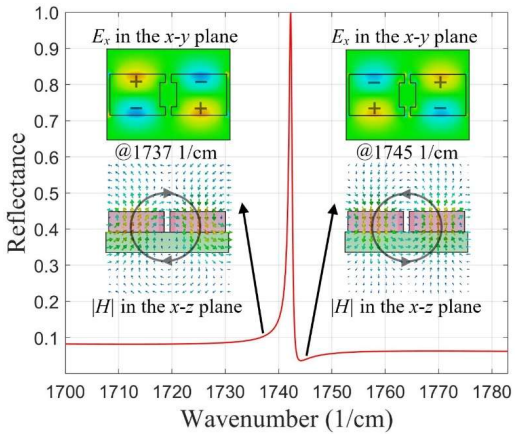
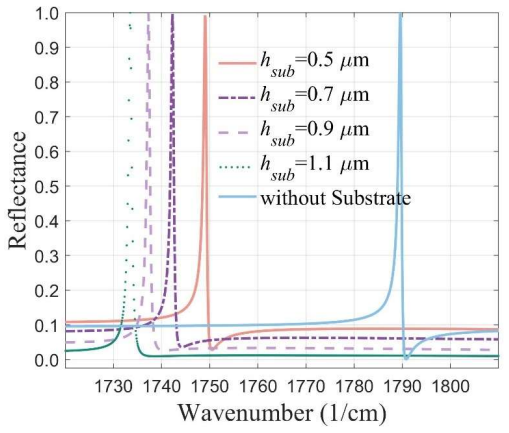
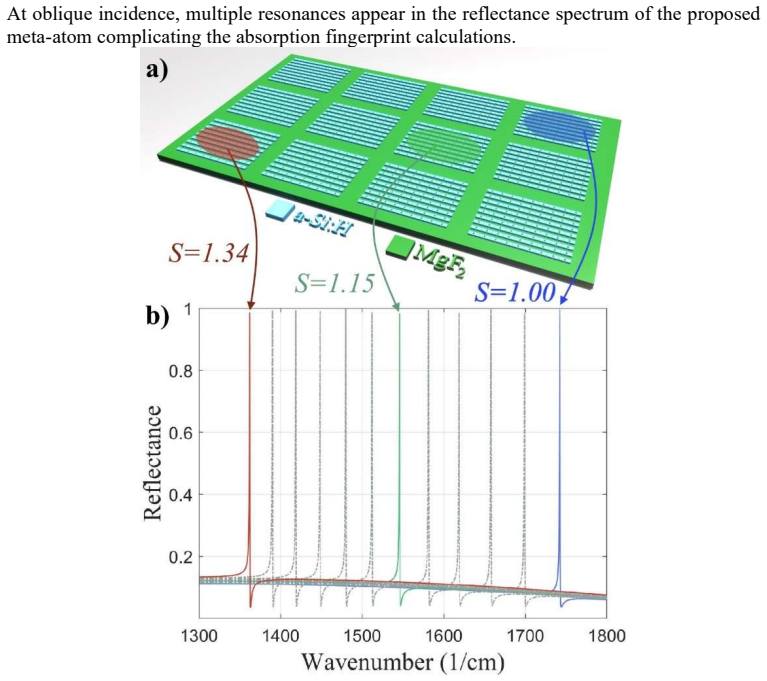
We present and numerically investigate a high-quality factor (high-Q) meta-atom with Fano resonance. Numerical simulations indicate that the designed meta-atom has a single sharp Fano resonance in the 1350-1750 1/cm range. Moreover, the frequency of the single resonance can be tuned in this frequency range by scaling the meta-atom. We exploit these properties to design a pixelated metasurface for spectrometer-less molecular fingerprint retrieval. The proposed meta-atom with an average quality factor of 2000 makes it possible to decrease the scaling step of metapixels without introducing any resonance overlap between the metapixels leading to higher precision in label-free and non-destructive identification of the molecular fingerprints.
Editorial analysis
A structured set of objections, weighed in public.
Referee Report
Summary. The manuscript presents a numerically designed all-dielectric meta-atom supporting a single sharp Fano resonance tunable across 1350-1750 cm⁻¹ by geometric scaling. With an average quality factor of ~2000, the design is used to construct a pixelated metasurface that enables spectrometer-less, label-free molecular fingerprint retrieval at higher spectral precision by permitting smaller scaling increments without resonance overlap.
Significance. If the reported Q-factor and non-overlapping tunability hold, the work could advance compact mid-IR sensing platforms by reducing the need for external spectrometers and improving fingerprint resolution. The all-dielectric approach and simple scaling-based tuning are practical strengths for potential fabrication.
major comments (3)
- [Abstract] Abstract: The central claims of a single sharp Fano resonance, average Q ≈ 2000, and absence of overlap under scaling rest entirely on unspecified numerical simulations. No information is given on the solver, mesh density, convergence criteria, material dispersion (including imaginary index), or excitation conditions, rendering the reported performance unverifiable and load-bearing for the fingerprint-retrieval advantage.
- [Numerical results] Numerical results section: No robustness analysis is provided for fabrication tolerances (e.g., ±1-2 % variation in critical dimensions) or realistic material losses. Such perturbations typically broaden Fano linewidths and shift resonances in mid-IR all-dielectric structures, directly threatening the claimed ability to use finer scaling steps without overlap.
- [Metasurface design] Metasurface design: The pixelated array is asserted to allow decreased scaling steps without overlap, yet no quantitative spectral overlay (figure or table) demonstrates the response of multiple adjacent scaled meta-atoms at the proposed step size, leaving the precision-gain claim unsupported.
minor comments (2)
- [Figures] Figure captions should explicitly state the polarization, incidence angle, and substrate configuration used in all simulations.
- [Introduction] The manuscript would benefit from a brief comparison table of the achieved Q against prior all-dielectric Fano metasurfaces in the same band.
Simulated Author's Rebuttal
We thank the referee for the constructive comments, which have helped us improve the clarity and rigor of the manuscript. We have addressed all major concerns by adding details on the numerical simulations, including a robustness analysis, and providing quantitative evidence for the metasurface performance. The revised manuscript includes new sections, figures, and tables as detailed below.
read point-by-point responses
-
Referee: [Abstract] Abstract: The central claims of a single sharp Fano resonance, average Q ≈ 2000, and absence of overlap under scaling rest entirely on unspecified numerical simulations. No information is given on the solver, mesh density, convergence criteria, material dispersion (including imaginary index), or excitation conditions, rendering the reported performance unverifiable and load-bearing for the fingerprint-retrieval advantage.
Authors: We agree that additional details on the numerical methodology are necessary to make the results verifiable. In the revised version, we have expanded the Methods section to specify the simulation software (FDTD method implemented in Lumerical), mesh resolution (minimum 10 nm in critical regions), convergence criteria (field residuals below 10^{-5}), material properties (real and imaginary refractive indices from Palik database for silicon and air), and excitation (normal-incidence plane wave with appropriate polarization). These additions ensure the reported Q-factor and tunability can be reproduced. revision: yes
-
Referee: [Numerical results] Numerical results section: No robustness analysis is provided for fabrication tolerances (e.g., ±1-2 % variation in critical dimensions) or realistic material losses. Such perturbations typically broaden Fano linewidths and shift resonances in mid-IR all-dielectric structures, directly threatening the claimed ability to use finer scaling steps without overlap.
Authors: We acknowledge this valid concern regarding practical implementation. To address it, we have conducted additional simulations accounting for fabrication tolerances of ±2% in key dimensions (e.g., pillar radii and heights) and included realistic material losses. The updated results, presented in a new subsection and Supplementary Figure S1, show that the average Q-factor remains above 1800, and the resonance shifts are small enough (less than 5 cm⁻¹) to still allow the proposed scaling increments without overlap. This supports the robustness of the design. revision: yes
-
Referee: [Metasurface design] Metasurface design: The pixelated array is asserted to allow decreased scaling steps without overlap, yet no quantitative spectral overlay (figure or table) demonstrates the response of multiple adjacent scaled meta-atoms at the proposed step size, leaving the precision-gain claim unsupported.
Authors: We thank the referee for highlighting this gap. We have added a new figure (Figure 4) that overlays the reflectance spectra for a series of adjacent meta-atoms scaled in 0.5% increments across the 1350-1750 cm⁻¹ range. The figure clearly shows non-overlapping resonances with sufficient separation relative to their linewidths, quantitatively demonstrating the feasibility of finer scaling steps and the resulting improvement in spectral precision for fingerprint detection. A corresponding table of resonance positions and Q-factors is also included in the revised text. revision: yes
Circularity Check
No circularity: forward numerical design and simulation results applied to proposed application
full rationale
The paper reports a meta-atom design whose single sharp Fano resonance and tunability by scaling are established directly by numerical simulations in the 1350-1750 cm⁻¹ band, with an average Q of 2000 stated as a simulation outcome. These properties are then used to argue that smaller scaling increments become feasible without overlap for a pixelated metasurface. No equations define resonance frequency or Q in terms of the target fingerprint-retrieval precision, no parameters are fitted to a subset and then relabeled as predictions, and no self-citations or uniqueness theorems are invoked to close the argument. The chain is therefore a standard forward simulation-to-application sequence rather than a reduction of the claimed result to its own inputs by construction.
Axiom & Free-Parameter Ledger
free parameters (2)
- meta-atom dimensions and scaling factors
- pixel scaling step size
axioms (1)
- domain assumption Numerical electromagnetic simulations accurately predict the resonance behavior of the all-dielectric structure
Lean theorems connected to this paper
-
IndisputableMonolith/Foundation/RealityFromDistinction.leanreality_from_one_distinction unclear?
unclearRelation between the paper passage and the cited Recognition theorem.
the frequency of the single resonance can be tuned in this frequency range by scaling the meta-atom... average quality factor of 2000... decrease the scaling step of metapixels without introducing any resonance overlap
-
IndisputableMonolith/Cost/FunctionalEquation.leanwashburn_uniqueness_aczel unclear?
unclearRelation between the paper passage and the cited Recognition theorem.
The designed meta-atom is composed of two hydrogenated amorphous silicon (a-Si:H) rectangles with a length and width of l=1.9 µm and w=1.4 µm, respectively. A rectangular indentation with a size of lr=α1×l and wr= α2×w, where α1=0.1 and α2=0.6
What do these tags mean?
- matches
- The paper's claim is directly supported by a theorem in the formal canon.
- supports
- The theorem supports part of the paper's argument, but the paper may add assumptions or extra steps.
- extends
- The paper goes beyond the formal theorem; the theorem is a base layer rather than the whole result.
- uses
- The paper appears to rely on the theorem as machinery.
- contradicts
- The paper's claim conflicts with a theorem or certificate in the canon.
- unclear
- Pith found a possible connection, but the passage is too broad, indirect, or ambiguous to say the theorem truly supports the claim.
Reference graph
Works this paper leans on
-
[1]
Recent advances in the metamaterial-inspired biosensors,
A. Salim and S. Lim, "Recent advances in the metamaterial-inspired biosensors," Biosensors and Bioelectronics 117, 398-402 (2018)
work page 2018
-
[2]
S. H. Badri and M. Gilarlue, "Silicon nitride waveguide devices based on gradient-index lenses implemented by subwavelength silicon grating metamaterials," Applied Optics 59, 5269-5275 (2020)
work page 2020
-
[3]
Broadband switchable terahertz half-/quarter-wave plate based on metal- VO 2 metamaterials,
J. Luo, X. Shi, X. Luo, F. Hu, and G. Li, "Broadband switchable terahertz half-/quarter-wave plate based on metal- VO 2 metamaterials," Optics Express 28, 30861-30870 (2020)
work page 2020
-
[4]
S. H. Badri, M. Gilarlue, and S. Gavgani, "Ultra-thin silicon-on-insulator waveguide bend based on truncated Eaton lens implemented by varying the guiding layer thickness," Photonics and Nanostructures-Fundamentals and Applications 39, 100766 (2020)
work page 2020
-
[5]
Optical switching of a metamaterial by temperature controlling,
W.-x. Huang, X.-g. Yin, C.-p. Huang, Q.-j. Wang, T.-f. Miao, and Y.-y. Zhu, "Optical switching of a metamaterial by temperature controlling," Applied Physics Letters 96, 261908 (2010)
work page 2010
-
[6]
Coupling silica waveguides to photonic crystal waveguides through a multilayered Luneburg lens,
S. H. Badri and M. Gilarlue, "Coupling silica waveguides to photonic crystal waveguides through a multilayered Luneburg lens," JOSA B 37, 104-109 (2020)
work page 2020
-
[7]
Spectrally selective chiral silicon metasurfaces based on infrared Fano resonances,
C. Wu, N. Arju, G. Kelp, J. A. Fan, J. Dominguez, E. Gonzales, E. Tutuc, I. Brener, and G. Shvets, "Spectrally selective chiral silicon metasurfaces based on infrared Fano resonances," Nature communications 5, 1-9 (2014)
work page 2014
-
[8]
S. H. Badri, M. Gilarlue, S. SaeidNahaei, and J. S. KIM, "Narrowband-to-broadband switchable and polarization- insensitive terahertz metasurface absorber enabled by phase-change material," Journal of Optics (2021). https://doi.org/10.1088/2040-8986/ac3c50
-
[9]
W. Su, Y. Ding, Y. Luo, and Y. Liu, "A high figure of merit refractive index sensor based on Fano resonance in all-dielectric metasurface," Results in Physics 16, 102833 (2020)
work page 2020
-
[10]
A high-performance refractive index sensor based on Fano resonance in Si split-ring metasurface,
G.-D. Liu, X. Zhai, L.-L. Wang, Q. Lin, S.-X. Xia, X. Luo, and C.-J. Zhao, "A high-performance refractive index sensor based on Fano resonance in Si split-ring metasurface," Plasmonics 13, 15-19 (2018)
work page 2018
-
[11]
R. Ahmed, M. O. Ozen, M. G. Karaaslan, C. A. Prator, C. Thanh, S. Kumar, L. Torres, N. Iyer, S. Munter, and S. Southern, "Tunable fano‐resonant metasurfaces on a disposable plastic‐template for multimodal and multiplex biosensing," Advanced Materials 32, 1907160 (2020)
work page 2020
-
[12]
Lasing action in Fano-resonant superlattice metagratings,
Z.-L. Deng, X.-C. Qiao, Y.-B. Chen, T. Shi, X. Li, and J.-W. Dong, "Lasing action in Fano-resonant superlattice metagratings," Journal of Physics D: Applied Physics 54, 345101 (2021)
work page 2021
-
[13]
Multiple fano resonances in symmetry-breaking silicon metasurface for manipulating light emission,
C. Cui, C. Zhou, S. Yuan, X. Qiu, L. Zhu, Y. Wang, Y. Li, J. Song, Q. Huang, and Y. Wang, "Multiple fano resonances in symmetry-breaking silicon metasurface for manipulating light emission," ACS Photonics 5, 4074- 4080 (2018)
work page 2018
-
[14]
N. Dabidian, I. Kholmanov, A. B. Khanikaev, K. Tatar, S. Trendafilov, S. H. Mousavi, C. Magnuson, R. S. Ruoff, and G. Shvets, "Electrical switching of infrared light using graphene integration with plasmonic Fano resonant metasurfaces," Acs Photonics 2, 216-227 (2015)
work page 2015
-
[15]
J. Ou, X.-Q. Luo, Y.-L. Luo, W.-H. Zhu, Z.-Y. Chen, W.-M. Liu, and X.-L. Wang, "Near-infrared dual-wavelength plasmonic switching and digital metasurface unveiled by plasmonic Fano resonance," Nanophotonics 10, 947-957 (2021)
work page 2021
-
[16]
Fano-resonance-assisted metasurface for color routing,
C. Yan, K.-Y. Yang, and O. J. Martin, "Fano-resonance-assisted metasurface for color routing," Light: Science & Applications 6, e17017-e17017 (2017)
work page 2017
-
[17]
Broadband wavelength demultiplexer using Fano-resonant metasurface,
S.-E. Mun, C. Choi, J. Hong, and B. Lee, "Broadband wavelength demultiplexer using Fano-resonant metasurface," Nanophotonics 9, 1015-1022 (2020)
work page 2020
-
[18]
Enhanced second-harmonic generation using broken symmetry III–V semiconductor fano metasurfaces,
P. P. Vabishchevich, S. Liu, M. B. Sinclair, G. A. Keeler, G. M. Peake, and I. Brener, "Enhanced second-harmonic generation using broken symmetry III–V semiconductor fano metasurfaces," Acs Photonics 5, 1685-1690 (2018)
work page 2018
-
[19]
The Fano resonance in plasmonic nanostructures and metamaterials,
B. Luk'yanchuk, N. I. Zheludev, S. A. Maier, N. J. Halas, P. Nordlander, H. Giessen, and C. T. Chong, "The Fano resonance in plasmonic nanostructures and metamaterials," Nature materials 9, 707-715 (2010)
work page 2010
-
[20]
Tunable Fano resonance in photonic crystal slabs,
J. Song, R. P. Zaccaria, M. Yu, and X. Sun, "Tunable Fano resonance in photonic crystal slabs," Optics express 14, 8812-8826 (2006)
work page 2006
-
[21]
Near-complete transmission through subwavelength hole arrays in phonon-polaritonic thin films,
P. B. Catrysse and S. Fan, "Near-complete transmission through subwavelength hole arrays in phonon-polaritonic thin films," Physical Review B 75, 075422 (2007)
work page 2007
-
[22]
Y. Sonnefraud, N. Verellen, H. Sobhani, G. A. Vandenbosch, V. V. Moshchalkov, P. Van Dorpe, P. Nordlander, and S. A. Maier, "Experimental realization of subradiant, superradiant, and Fano resonances in ring/disk plasmonic nanocavities," ACS nano 4, 1664-1670 (2010)
work page 2010
-
[23]
Modulation of plasmonic Fano resonance by the shape of the nanoparticles in ordered arrays,
M. Lisunova, J. Norman, P. Blake, G. T. Forcherio, D. F. DeJarnette, and D. K. Roper, "Modulation of plasmonic Fano resonance by the shape of the nanoparticles in ordered arrays," Journal of Physics D: Applied Physics 46, 485103 (2013)
work page 2013
-
[24]
Metasurface‐based molecular biosensing aided by artificial intelligence,
A. Tittl, A. John‐Herpin, A. Leitis, E. R. Arvelo, and H. Altug, "Metasurface‐based molecular biosensing aided by artificial intelligence," Angewandte Chemie International Edition 58, 14810-14822 (2019)
work page 2019
-
[25]
Y. Xie, X. Liu, F. Li, J. Zhu, and N. Feng, "Ultra-wideband enhancement on mid-infrared fingerprint sensing for 2D materials and analytes of monolayers by a metagrating," Nanophotonics 9, 2927-2935 (2020)
work page 2020
-
[26]
Imaging-based molecular barcoding with pixelated dielectric metasurfaces,
A. Tittl, A. Leitis, M. Liu, F. Yesilkoy, D.-Y. Choi, D. N. Neshev, Y. S. Kivshar, and H. Altug, "Imaging-based molecular barcoding with pixelated dielectric metasurfaces," Science 360, 1105-1109 (2018)
work page 2018
-
[27]
Asymmetric metasurfaces with high-Q resonances governed by bound states in the continuum,
K. Koshelev, S. Lepeshov, M. Liu, A. Bogdanov, and Y. Kivshar, "Asymmetric metasurfaces with high-Q resonances governed by bound states in the continuum," Physical review letters 121, 193903 (2018)
work page 2018
-
[28]
N. Li, Y. H. Fu, Y. Dong, T. Hu, Z. Xu, Q. Zhong, D. Li, K. H. Lai, S. Zhu, Q. Lin, Y. Gu, and N. Singh, "Large- area pixelated metasurface beam deflector on a 12-inch glass wafer for random point generation," Nanophotonics 8, 1855-1861 (2019)
work page 2019
-
[29]
C. Zhang, J. Hu, Y. Dong, A. Zeng, H. Huang, and C. Wang, "High efficiency all-dielectric pixelated metasurface for near-infrared full-Stokes polarization detection," Photonics Research 9, 583-589 (2021)
work page 2021
-
[30]
Full-Stokes imaging polarimetry using dielectric metasurfaces,
E. Arbabi, S. M. Kamali, A. Arbabi, and A. Faraon, "Full-Stokes imaging polarimetry using dielectric metasurfaces," Acs Photonics 5, 3132-3140 (2018)
work page 2018
-
[31]
Metasurface-driven OLED displays beyond 10,000 pixels per inch,
W.-J. Joo, J. Kyoung, M. Esfandyarpour, S.-H. Lee, H. Koo, S. Song, Y.-N. Kwon, S. H. Song, J. C. Bae, and A. Jo, "Metasurface-driven OLED displays beyond 10,000 pixels per inch," Science 370, 459-463 (2020)
work page 2020
-
[32]
Structural colors enabled by lattice resonance on silicon nitride metasurfaces,
J.-H. Yang, V. E. Babicheva, M.-W. Yu, T.-C. Lu, T.-R. Lin, and K.-P. Chen, "Structural colors enabled by lattice resonance on silicon nitride metasurfaces," ACS nano 14, 5678-5685 (2020)
work page 2020
-
[33]
Pixelated metasurface for dual-band and multi- polarization electromagnetic energy harvesting,
B. Ghaderi, V. Nayyeri, M. Soleimani, and O. M. Ramahi, "Pixelated metasurface for dual-band and multi- polarization electromagnetic energy harvesting," Scientific reports 8, 1-12 (2018)
work page 2018
-
[34]
H. Li, S. Gao, Y. Li, C. Zhang, and W. Yue, "Dielectric metasurfaces based on a rectangular lattice of a-Si: H nanodisks for color pixels with high saturation and stability," Optics express 27, 35027-35040 (2019)
work page 2019
-
[35]
All-dielectric full-color printing with TiO2 metasurfaces,
S. Sun, Z. Zhou, C. Zhang, Y. Gao, Z. Duan, S. Xiao, and Q. Song, "All-dielectric full-color printing with TiO2 metasurfaces," ACS nano 11, 4445-4452 (2017)
work page 2017
-
[36]
Angle-multiplexed all-dielectric metasurfaces for broadband molecular fingerprint retrieval,
A. Leitis, A. Tittl, M. Liu, B. H. Lee, M. B. Gu, Y. S. Kivshar, and H. Altug, "Angle-multiplexed all-dielectric metasurfaces for broadband molecular fingerprint retrieval," Science advances 5, eaaw2871 (2019)
work page 2019
-
[37]
Multiple Fano resonances excitation on all-dielectric nanohole arrays metasurfaces,
L. Yang, S. Yu, H. Li, and T. Zhao, "Multiple Fano resonances excitation on all-dielectric nanohole arrays metasurfaces," Optics Express 29, 14905-14916 (2021)
work page 2021
-
[38]
S. Yu, H. Li, Y. Wang, Z. Gao, T. Zhao, and J. Yu, "Multiple Fano resonance excitation of all-dielectric nanoholes cuboid arrays in near infrared region," Results in Physics 28, 104569 (2021)
work page 2021
-
[39]
W. Wang, J. Qi, and B. Li, "Double toroidal switches based on the different multipole responses in the all-dielectric metasurface," Journal of Nanophotonics 14, 036010 (2020)
work page 2020
-
[40]
Exact multipolar decompositions with applications in nanophotonics,
R. Alaee, C. Rockstuhl, and I. Fernandez‐Corbaton, "Exact multipolar decompositions with applications in nanophotonics," Advanced Optical Materials 7, 1800783 (2019)
work page 2019
-
[41]
Multipolar interference effects in nanophotonics,
W. Liu and Y. S. Kivshar, "Multipolar interference effects in nanophotonics," Philosophical Transactions of the Royal Society A: Mathematical, Physical and Engineering Sciences 375, 20160317 (2017)
work page 2017
-
[42]
Ultrahigh- quality factor resonant dielectric metasurfaces based on hollow nanocuboids,
J. Algorri, D. Zografopoulos, A. Ferraro, B. García-Cámara, R. Beccherelli, and J. Sánchez-Pena, "Ultrahigh- quality factor resonant dielectric metasurfaces based on hollow nanocuboids," Optics express 27, 6320-6330 (2019)
work page 2019
-
[43]
MENP: an open-source MATLAB implementation of multipole expansion for nanophotonics,
T. Hinamoto and M. Fujii, "MENP: an open-source MATLAB implementation of multipole expansion for nanophotonics," OSA Continuum 4, 1640-1648 (2021)
work page 2021
-
[44]
An electromagnetic multipole expansion beyond the long- wavelength approximation,
R. Alaee, C. Rockstuhl, and I. Fernandez-Corbaton, "An electromagnetic multipole expansion beyond the long- wavelength approximation," Optics Communications 407, 17-21 (2018)
work page 2018
-
[45]
Multipolar engineering of subwavelength dielectric particles for scattering enhancement,
S. Krasikov, M. Odit, D. Dobrykh, I. Yusupov, A. Mikhailovskaya, D. Shakirova, A. Shcherbakov, A. Slobozhanyuk, P. Ginzburg, and D. Filonov, "Multipolar engineering of subwavelength dielectric particles for scattering enhancement," Physical Review Applied 15, 024052 (2021)
work page 2021
-
[46]
H. Liu, X. Zhang, B. Zhao, B. Wu, H. Zhang, and S. Tang, "Simultaneous Measurements of Refractive Index and Methane Concentration through Electromagnetic Fano Resonance Coupling in All-Dielectric Metasurface," Sensors 21, 3612 (2021)
work page 2021
-
[47]
Trimeric metasurfaces for independent control of bright and dark modes of Fano resonances,
Z.-L. Deng, T. Fu, Z. Ouyang, and G. P. Wang, "Trimeric metasurfaces for independent control of bright and dark modes of Fano resonances," Applied Physics Letters 108, 081109 (2016)
work page 2016
-
[48]
T. Fu, F. Liu, Y. An, Q. Li, G.-l. Xiao, T.-y. Sun, and H.-o. Li, "Narrow-band asymmetric transmission based on the dark mode of Fano resonance on symmetric trimeric metasurfaces," Optics Express 28, 30141-30149 (2020)
work page 2020
-
[49]
Mid-infrared plasmonic biosensing with graphene,
D. Rodrigo, O. Limaj, D. Janner, D. Etezadi, F. J. G. De Abajo, V. Pruneri, and H. Altug, "Mid-infrared plasmonic biosensing with graphene," Science 349, 165-168 (2015)
work page 2015
discussion (0)
Sign in with ORCID, Apple, or X to comment. Anyone can read and Pith papers without signing in.