Generalized master equation for driven quantum oscillators: microscopic origin of nonlinear dissipation and asymmetric resonances
Pith reviewed 2026-05-11 02:46 UTC · model grok-4.3
The pith
Retaining full nonlinear and time-dependent dynamics when building the dissipator generates nonlinear, drive-dependent dissipation in quantum oscillators.
A machine-rendered reading of the paper's core claim, the machinery that carries it, and where it could break.
Core claim
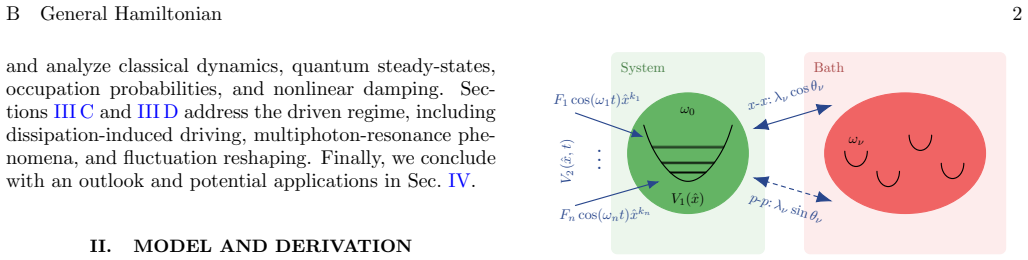
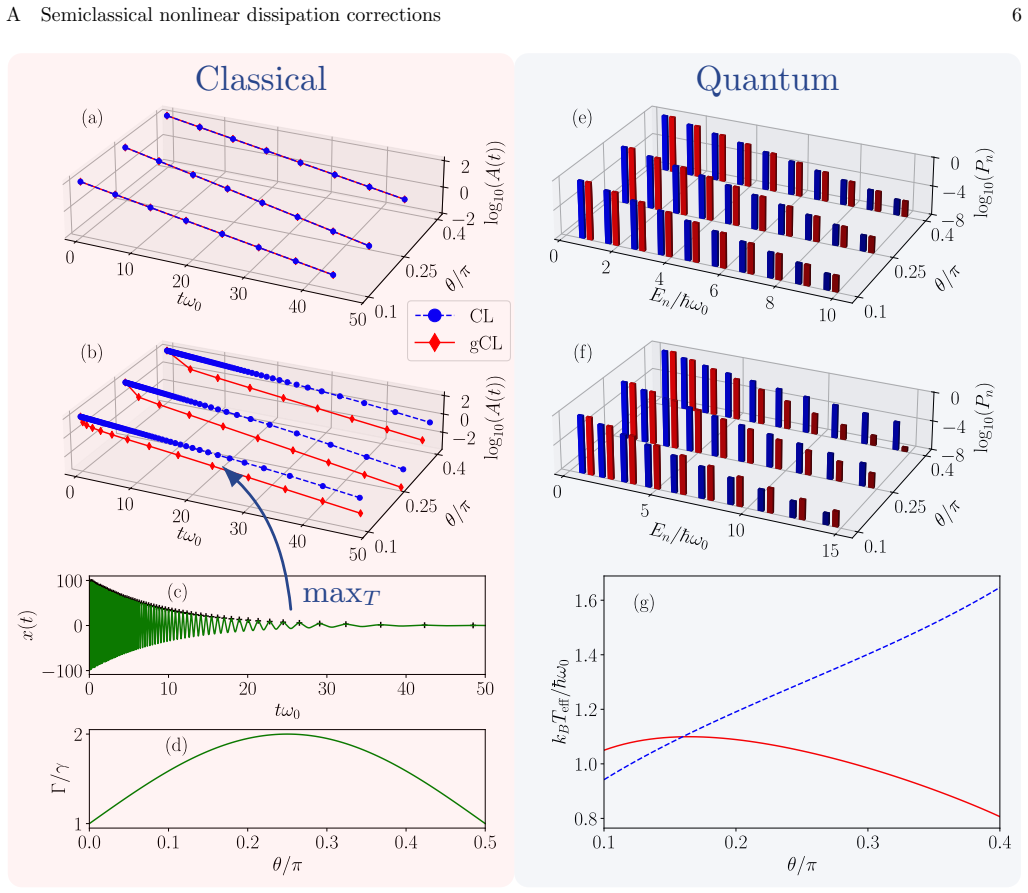
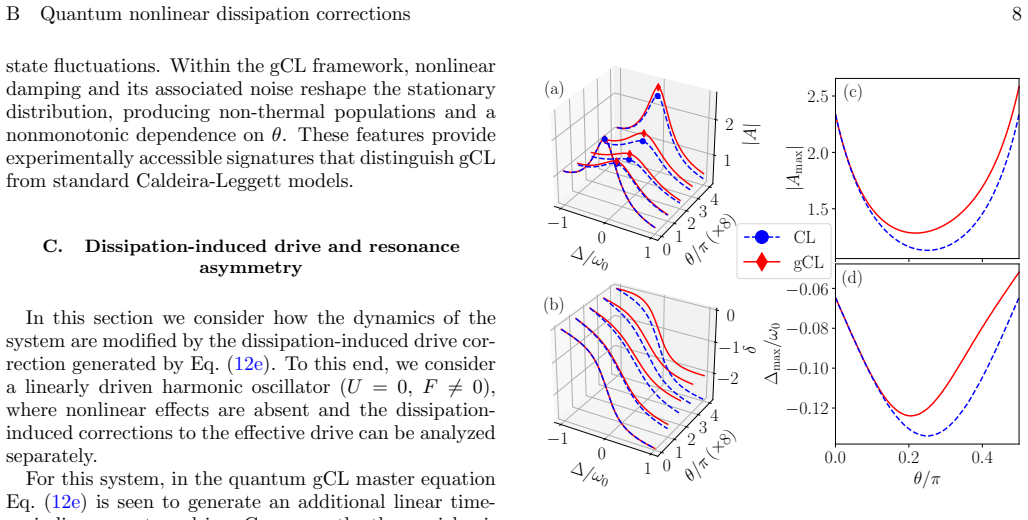
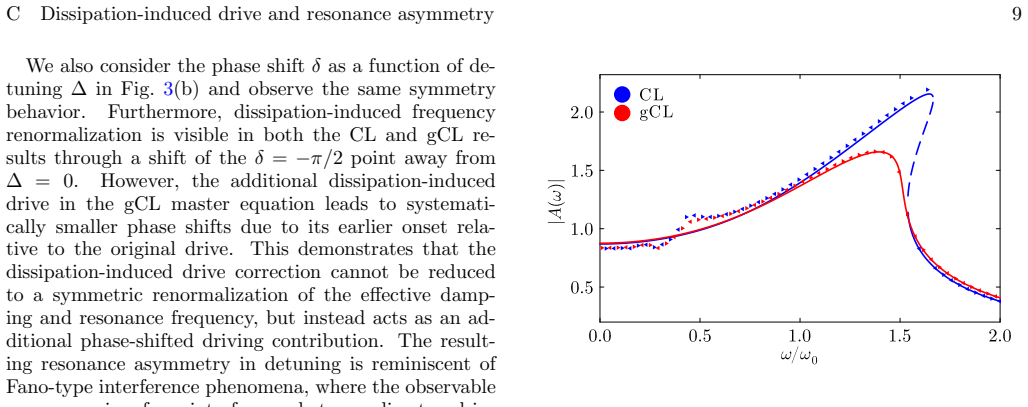
By retaining the full nonlinear and time-dependent system dynamics in the construction of the dissipator, the dissipator itself becomes dynamically dressed, generating nonlinear and drive-dependent dissipative channels beyond conventional fixed-dissipator approaches. This produces nonlinear damping together with dissipation-induced corrections to the effective drive. The resulting dissipative dynamics suppress large-amplitude excitations and reduce phase-space fluctuations. For a driven Kerr oscillator, this leads to the suppression of bistability, asymmetric resonance responses, and strongly modified fluctuation distributions.
What carries the argument
The dynamically dressed dissipator obtained by inserting the full nonlinear, time-dependent system evolution into the system-bath coupling when the master equation is derived.
If this is right
- Nonlinear damping appears automatically once the dissipator is allowed to depend on the instantaneous system state.
- The effective drive felt by the oscillator acquires a small correction generated by the dressed dissipation.
- Large-amplitude excitations are suppressed, eliminating bistability in the driven Kerr case.
- Resonance responses become asymmetric in frequency and power.
- Phase-space fluctuations are reduced and their distribution is altered compared with fixed-dissipator models.
Where Pith is reading between the lines
- The same construction can be applied to other strongly driven nonlinear systems such as optomechanical resonators or Josephson-junction circuits to obtain more accurate predictions of steady-state statistics.
- Experimental signatures of the asymmetry could be searched for in the lineshape of a driven superconducting qubit or mechanical resonator.
- Standard Lindblad treatments may systematically underestimate nonlinear loss channels once driving amplitudes become comparable to the nonlinearity strength.
Load-bearing premise
The system-bath interaction depends on both position and momentum, and the usual open-system approximations remain valid even after the full nonlinear system dynamics are kept inside the dissipator.
What would settle it
Compare the resonance curve and the amplitude-dependent linewidth of a driven Kerr oscillator measured in a circuit-QED experiment against predictions of the new master equation versus a standard fixed-dissipator Lindblad or Caldeira-Leggett equation; asymmetry or suppression of the upper bistable branch would support the claim.
Figures
read the original abstract
Driven nonlinear quantum oscillators are a central platform for quantum technologies, yet their dissipative dynamics are typically described using Lindblad or Caldeira-Leggett master equations derived under assumptions that exclude nonlinearities and driving. Here, we derive a generalized Caldeira-Leggett master equation for driven nonlinear oscillators by retaining the full nonlinear and time-dependent system dynamics in the construction of the dissipator. For position- and momentum-dependent system-bath coupling, the dissipator itself becomes dynamically dressed, generating nonlinear and drive-dependent dissipative channels beyond conventional fixed-dissipator approaches. This produces nonlinear damping together with dissipation-induced corrections to the effective drive. The resulting dissipative dynamics suppress large-amplitude excitations and reduce phase-space fluctuations. For a driven Kerr oscillator, this leads to the suppression of bistability, asymmetric resonance responses, and strongly modified fluctuation distributions. More broadly, our results establish a microscopic framework in which nonlinear dynamics and driving directly reshape the dissipative sector of driven open quantum systems.
Editorial analysis
A structured set of objections, weighed in public.
Referee Report
Summary. The paper derives a generalized Caldeira-Leggett master equation for driven nonlinear quantum oscillators from a microscopic system-bath model with position- and momentum-dependent coupling. By retaining the full nonlinear and time-dependent system Hamiltonian inside the interaction-picture operators when constructing the dissipator, the resulting master equation acquires dynamically dressed nonlinear damping channels and drive-dependent corrections. Applied to a driven Kerr oscillator, the approach is claimed to suppress bistability, produce asymmetric resonance responses, and modify phase-space fluctuation distributions relative to standard fixed-dissipator treatments.
Significance. If the derivation and approximations hold, the work supplies a parameter-free microscopic route to drive- and nonlinearity-dependent dissipation in open quantum systems. This is relevant for platforms such as driven superconducting circuits and optomechanical resonators where conventional Lindblad or Caldeira-Leggett forms are known to be insufficient. The absence of ad-hoc parameters and the explicit retention of system dynamics inside the dissipator are positive features.
major comments (1)
- [Derivation of the generalized master equation (around the interaction-picture transformation and secular approximation)] The central technical step—retaining the full driven nonlinear H_S(t) inside the interaction-picture operators when deriving the dissipator—directly challenges the timescale separation required for the Born-Markov approximation. The manuscript must demonstrate that bath correlation times remain much shorter than the instantaneous system timescales (which vary with drive amplitude and detuning) in the regime where bistability suppression is reported. Without explicit bounds or numerical checks on this separation, the validity of the resulting master equation is not established.
minor comments (2)
- [Abstract] The abstract states the main results at a high level but contains no explicit equations, limiting conditions, or numerical benchmarks; the main text should include a concise summary of the final master equation form and the key parameter regimes.
- [Model and Hamiltonian section] Notation for the position- and momentum-dependent coupling operators and the resulting dressed dissipator should be introduced with a clear table or explicit definitions to aid readability.
Simulated Author's Rebuttal
We thank the referee for the careful reading of our manuscript and for identifying the need to explicitly validate the Born-Markov approximation under the time-dependent nonlinear system Hamiltonian. We address this point below.
read point-by-point responses
-
Referee: The central technical step—retaining the full driven nonlinear H_S(t) inside the interaction-picture operators when deriving the dissipator—directly challenges the timescale separation required for the Born-Markov approximation. The manuscript must demonstrate that bath correlation times remain much shorter than the instantaneous system timescales (which vary with drive amplitude and detuning) in the regime where bistability suppression is reported. Without explicit bounds or numerical checks on this separation, the validity of the resulting master equation is not established.
Authors: We agree that explicit demonstration of the timescale separation is required to rigorously justify the Born-Markov approximation when the full driven nonlinear H_S(t) is retained in the interaction-picture operators. In the revised manuscript we have added a new subsection (Sec. III C) that derives explicit bounds on the bath correlation time relative to the instantaneous system frequencies, including the drive-induced Rabi frequency and detuning-dependent terms. For an Ohmic bath with cutoff frequency ω_c ≫ max(Ω, |Δ|, K), where Ω is the drive amplitude, we show analytically that the integrated bath correlations decay on timescales τ_bath ∼ 1/ω_c that remain shorter than the inverse instantaneous system timescales throughout the bistability-suppression regime. We further include numerical plots of the bath correlation functions evaluated at the drive amplitudes and detunings where bistability is suppressed, confirming that the Markovian approximation holds to high accuracy. These additions establish the validity of the generalized master equation in the parameter regimes discussed in the paper. revision: yes
Circularity Check
No circularity: derivation self-contained from microscopic Hamiltonian
full rationale
The paper starts from a standard microscopic system-bath model with position- and momentum-dependent coupling and constructs the dissipator by retaining the full nonlinear time-dependent system Hamiltonian in the interaction-picture operators. This produces the claimed dressed nonlinear damping and drive corrections as a direct consequence of the modified perturbative expansion, without fitting parameters to data, without renaming known results, and without load-bearing self-citations that reduce the central claim to prior unverified work by the same authors. The steps follow conventional Born-Markov and secular approximations applied to an extended interaction picture; the output master equation is not equivalent to its inputs by construction.
Axiom & Free-Parameter Ledger
axioms (1)
- domain assumption The bath is treated as a collection of harmonic oscillators with coupling to system position and momentum that can be retained in full during dissipator construction.
Reference graph
Works this paper leans on
-
[1]
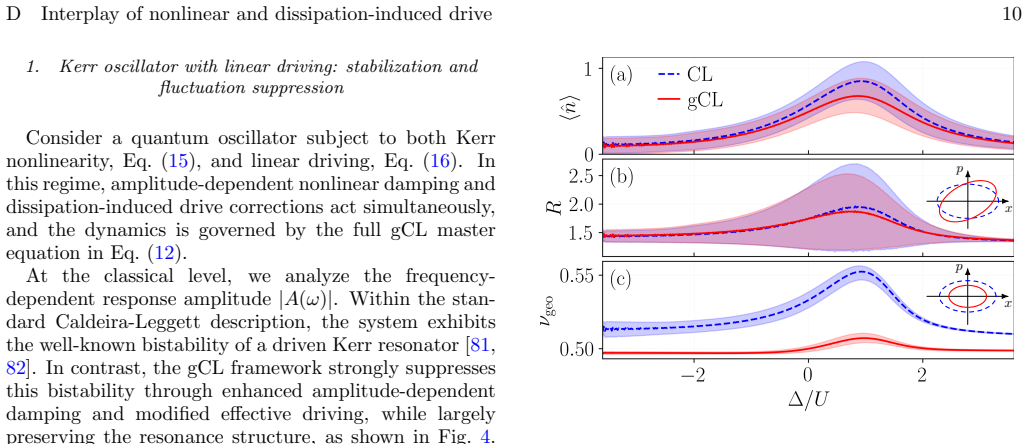
Kerr oscillator with linear driving: stabilization and fluctuation suppression Consider a quantum oscillator subject to both Kerr nonlinearity, Eq. (15), and linear driving, Eq. (16). In this regime, amplitude-dependent nonlinear damping and dissipation-induced drive corrections act simultaneously, and the dynamics is governed by the full gCL master equat...
-
[2]
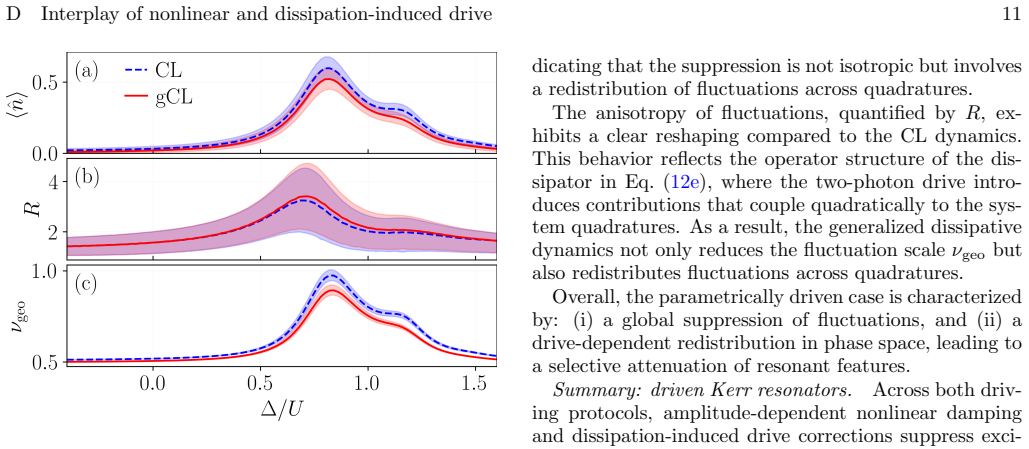
Kerr oscillator with two-photon driving: reshaping of parametrically driven resonances We next consider a Kerr oscillator subject to two- photon driving, V2(ˆx, t) =F2 cos(2ωt)ˆx2.(21) This system provides a complementary probe of the gen- eralized dissipative dynamics. Unlike linear driving, the two-photon drive generates nontrivial operator structures w...
work page 2025
-
[3]
H.-P. Breuer and F. Petruccione,The Theory of Open Quantum Systems, 1st ed. (Oxford University Press, Ox- ford [u.a.], 2002)
work page 2002
-
[4]
M. A. Nielsen and I. L. Chuang,Quantum Computa- tion and Quantum Information: 10th Anniversary Edi- tion(Cambridge University Press, 2010)
work page 2010
-
[5]
H. M. Wiseman and G. J. Milburn,Quantum Measure- ment and Control(Cambridge University Press, 2010)
work page 2010
-
[6]
C. Gardiner and P. Zoller,Quantum Noise: A Handbook of Markovian and Non-Markovian Quantum Stochastic Methods with Applications to Quantum Optics, 3rd ed., Springer Series in Synergetics (Springer, Berlin, 2004)
work page 2004
-
[7]
P. T¨ urschmann, H. Le Jeannic, S. F. Simonsen, H. R. Haakh, S. G¨ otzinger, V. Sandoghdar, P. Lodahl and N. Rotenberg,Coherent nonlinear optics of quantum emitters in nanophotonic waveguides, Nanophotonics8, 1641–1657 (2019)
work page 2019
-
[8]
T. Herr, K. Hartinger, J. Riemensberger, C. Y. Wang, E. Gavartin, R. Holzwarth, M. L. Gorodetsky and T. J. Kippenberg,Universal formation dynamics and noise of Kerr-frequency combs in microresonators, Nature Pho- tonics6, 480 (2012)
work page 2012
-
[9]
N. Goldman and J. Dalibard,Periodically Driven Quan- tum Systems: Effective Hamiltonians and Engineered Gauge Fields, Physical Review X4, 031027 (2014)
work page 2014
- [10]
-
[11]
M. Rudner and N. Lindner,The Floquet Engineer’s Handbook, arXiv: Mesoscale and Nanoscale Physics (2020)
work page 2020
-
[12]
J. F. Poyatos, J. I. Cirac and P. Zoller,Quantum Reser- voir Engineering with Laser Cooled Trapped Ions, Physi- cal Review Letters77, 4728 (1996)
work page 1996
-
[13]
F. Verstraete, M. M. Wolf and J. Ignacio Cirac,Quan- tum computation and quantum-state engineering driven by dissipation, Nature Physics5, 633 (2009)
work page 2009
-
[14]
S. Shankar, M. Hatridge, Z. Leghtas, K. M. Sliwa, A. Narla, U. Vool, S. M. Girvin, L. Frunzio, M. Mirrahimi and M. H. Devoret,Autonomously stabilized entangle- ment between two superconducting quantum bits, Nature 504, 419 (2013)
work page 2013
-
[15]
Z. Leghtas, S. Touzard, I. M. Pop, A. Kou, B. Vlas- takis, A. Petrenko, K. M. Sliwa, A. Narla, S. Shankar, M. J. Hatridge, M. Reagor, L. Frunzio, R. J. Schoelkopf, M. Mirrahimi and M. H. Devoret,Confining the state of light to a quantum manifold by engineered two-photon loss, Science347, 853 (2015)
work page 2015
-
[16]
R. Di Candia, F. Minganti, K. V. Petrovnin, G. S. Paraoanu and S. Felicetti,Critical parametric quantum sensing, npj Quantum Information9, 23 (2023)
work page 2023
-
[17]
T. L. Heugel, M. Biondi, O. Zilberberg and R. Chi- tra,Quantum Transducer Using a Parametric Driven- Dissipative Phase Transition, Phys. Rev. Lett.123, 173601 (2019)
work page 2019
- [18]
-
[19]
M. F. Gelin, R. Borrelli and L. Chen,Hierarchical Equations-of-Motion Method for Momentum System- Bath Coupling, J. Phys. Chem. B125, 4863 (2021)
work page 2021
-
[20]
M. Fitzpatrick, N. M. Sundaresan, A. C. Y. Li, J. Koch and A. A. Houck,Observation of a Dissipative Phase Transition in a One-Dimensional Circuit QED Lattice, Phys. Rev. X7, 011016 (2017)
work page 2017
-
[21]
G. Lindblad,On the generators of quantum dynamical semigroups, Communications in Mathematical Physics 48, 119 (1976)
work page 1976
-
[22]
D. Chru´ sci´ nski and S. Pascazio,A Brief History of the GKLS Equation, Open Systems & Information Dynamics 24, 1740001 (2017)
work page 2017
-
[23]
A. O. Caldeira and A. J. Leggett,Path integral approach to quantum Brownian motion, Physica A: Statistical Me- chanics and its Applications121, 587 (1983)
work page 1983
-
[24]
A. O. Caldeira and A. J. Leggett,Quantum tunnelling in a dissipative system, Annals of Physics149, 374 (1983)
work page 1983
-
[25]
M. A. Schlosshauer,Decoherence, edited by M. P. Silver- man and J. Tuszynski, The Frontiers Collection (Springer Berlin / Heidelberg, Berlin, Heidelberg, 2008) description based on publisher supplied metadata and other sources
work page 2008
-
[26]
J. Venkatraman, R. G. Cortinas, N. E. Frattini, X. Xiao and M. H. Devoret,A driven quantum superconduct- ing circuit with multiple tunable degeneracies(2023), arXiv:2211.04605 [quant-ph]. 13
-
[27]
J. Venkatraman, X. Xiao, R. G. Corti˜ nas and M. H. De- voret,Nonlinear dissipation in a driven superconducting circuit, Phys. Rev. A110, 042411 (2024)
work page 2024
-
[28]
S. N. A. Duffus, K. N. Bjergstrom, V. M. Dwyer, J. H. Samson, T. P. Spiller, A. M. Zagoskin, W. J. Munro, K. Nemoto and M. J. Everitt,Some implications of su- perconducting quantum interference to the application of master equations in engineering quantum technologies, Phys. Rev. B94, 064518 (2016)
work page 2016
-
[29]
S. N. A. Duffus, V. M. Dwyer and M. J. Everitt,Open quantum systems, effective Hamiltonians, and device characterization, Physical Review B96, 134520 (2017)
work page 2017
-
[30]
S. N. Duffus,Open quantum systems, effective Hamilto- nians and device characterisation, (2018)
work page 2018
-
[32]
A. Eichler, J. Moser, J. Chaste, M. Zdrojek, I. Wilson- Rae and A. Bachtold,Nonlinear damping in mechanical resonators made from carbon nanotubes and graphene, Nature Nanotechnology6, 339 (2011)
work page 2011
-
[33]
D. F. Walls,Quantum Optics, 2nd ed., edited by G. J. Milburn, Springer eBook Collection (Imprint: Springer, Berlin, Heidelberg, 2008)
work page 2008
- [34]
- [35]
-
[36]
Ullersma,An exactly solvable model for Brownian mo- tion: I
P. Ullersma,An exactly solvable model for Brownian mo- tion: I. Derivation of the Langevin equation, Physica32, 27 (1966)
work page 1966
-
[37]
D. F. Walls,Higher order effects in the master equation for coupled systems, Zeitschrift f¨ ur Physik A Hadrons and nuclei234, 231 (1970)
work page 1970
-
[38]
Y.-W. Huang and W.-M. Zhang,Exact master equation for generalized quantum Brownian motion with momentum-dependent system-environment cou- plings, Phys. Rev. Res.4, 033151 (2022)
work page 2022
-
[39]
S. Bhattacharjee, K. Mandal and S. Sinha,Decoherence of a charged Brownian particle in a magnetic field : an analysis of the roles of coupling via position and momen- tum variables(2024), arXiv:2404.13883 [quant-ph]
- [40]
-
[41]
H. Grabert, P. Schramm and G.-L. Ingold,Quantum Brownian motion: The functional integral approach, Physics Reports168, 115 (1988)
work page 1988
-
[42]
B. L. Hu, J. P. Paz and Y. Zhang,Quantum Brownian motion in a general environment: Exact master equation with nonlocal dissipation and colored noise, Phys. Rev. D 45, 2843 (1992)
work page 1992
-
[43]
A. Isar, A. Sandulescu, H. Scutaru, E. Stefanescu and W. Scheid,OPEN QUANTUM SYSTEMS, International Journal of Modern Physics E03, 635–714 (1994)
work page 1994
-
[44]
C. Zerbe and P. H¨ anggi,Brownian parametric quantum oscillator with dissipation, Phys. Rev. E52, 1533 (1995)
work page 1995
-
[45]
V. Peano and M. Thorwart,Macroscopic quantum effects in a strongly driven nanomechanical resonator, Phys. Rev. B70, 235401 (2004)
work page 2004
-
[46]
H. Grabert and M. Thorwart,Quantum mechanical re- sponse to a driven Caldeira-Leggett bath, Phys. Rev. E 98, 012122 (2018)
work page 2018
-
[47]
R. Dann, A. Levy and R. Kosloff,Time-dependent Markovian quantum master equation, Phys. Rev. A98, 052129 (2018)
work page 2018
- [48]
-
[49]
B. Vacchini,Quantum optical versus quantum Brownian motion master equation in terms of covariance and equi- librium properties, Journal of Mathematical Physics43, 5446–5458 (2002)
work page 2002
-
[50]
S. Banerjee and R. Ghosh,General quantum Brownian motion with initially correlated and nonlinearly coupled environment, Phys. Rev. E67, 056120 (2003)
work page 2003
-
[51]
Gao,Dissipative Quantum Dynamics with a Lindblad Functional, Phys
S. Gao,Dissipative Quantum Dynamics with a Lindblad Functional, Phys. Rev. Lett.79, 3101 (1997)
work page 1997
-
[52]
G. Rastelli,Dissipation-induced enhancement of quantum fluctuations, New Journal of Physics18, 053033 (2016)
work page 2016
-
[53]
B. L. Hu, J. P. Paz and Y. Zhang,Quantum Brownian motion in a general environment. II. Nonlinear coupling and perturbative approach, Phys. Rev. D47, 1576 (1993)
work page 1993
-
[54]
L. Di´ osi,Calderia-Leggett master equation and medium temperatures, Physica A: Statistical Mechanics and its Applications199, 517 (1993)
work page 1993
-
[55]
[1, 21, 23, 26– 28, 44, 45, 48, 49, 56, 62, 65]
See Supplemental Material for details on the derivation of the generalized Caldeira-Leggett master equation, dis- sipation kernels, adjoint equations of motion, Lindblad representation, path-integral formulation, and classical Wigner/Langevin limits, including Refs. [1, 21, 23, 26– 28, 44, 45, 48, 49, 56, 62, 65]
-
[56]
The frequency factors ensure consistent dimensions of the position and momentum coupling terms
-
[57]
A. Cuccoli, A. Fubini, V. Tognetti and R. Vaia,Quantum thermodynamics of systems with anomalous dissipative coupling, Phys. Rev. E64, 066124 (2001)
work page 2001
-
[58]
A. V. Dodonov, S. S. Mizrahi and V. V. Dodonov, Quantum master equations from classical Lagrangians with two stochastic forces, Physical Review E75(2007), 10.1103/physreve.75.011132
-
[59]
Di´ osi,Ohmic vs Markovian heat bath - two page- tutorial(2012)
L. Di´ osi,Ohmic vs Markovian heat bath - two page- tutorial(2012)
work page 2012
- [60]
-
[61]
R. Karrlein and H. Grabert,Exact time evolution and master equations for the damped harmonic oscillator, Phys. Rev. E55, 153 (1997)
work page 1997
-
[62]
R. A. Mulder, M. A. Caracanhas and C. M. Smith,Quan- tizing L´ evy flights, Phys. Rev. B103, 174301 (2021)
work page 2021
-
[63]
Y. Tanimura and P. G. Wolynes,Quantum and classical Fokker-Planck equations for a Gaussian-Markovian noise bath, Phys. Rev. A43, 4131 (1991)
work page 1991
-
[64]
Dekker,Quantization of the linearly damped harmonic oscillator, Phys
H. Dekker,Quantization of the linearly damped harmonic oscillator, Phys. Rev. A16, 2126 (1977)
work page 1977
-
[65]
R. Christie and J. Eastman,Quantum tunnelling and thermally driven transitions in a double-well potential at finite temperature, Journal of Physics A: Mathematical and Theoretical57, 235005 (2024)
work page 2024
-
[66]
A. Sˇ andulescu and H. Scutaru,Open quantum systems and the damping of collective modes in deep inelastic col- 14 lisions, Annals of Physics173, 277 (1987)
work page 1987
-
[67]
L. Ferialdi,Dissipation in the Caldeira-Leggett model, Physical Review A95(2017), 10.1103/phys- reva.95.052109
-
[68]
B. Gul´ acsi and G. Burkard,Temporally correlated quan- tum noise in driven quantum systems with applications to quantum gate operations, Phys. Rev. Res.7, 023073 (2025)
work page 2025
-
[69]
L. Bernazzani, B. Gul´ acsi and G. Burkard,Universal dis- sipators for driven open quantum systems and the correc- tion to linear response, Quantum Science and Technology 10, 045050 (2025)
work page 2025
-
[70]
J. Ko lody´ nski, J. B. Brask, M. Perarnau-Llobet and B. Bylicka,Adding dynamical generators in quantum master equations, Phys. Rev. A97, 062124 (2018)
work page 2018
-
[71]
G. W. Ford, J. T. Lewis and R. F. O’Connell,Quantum Langevin equation, Phys. Rev. A37, 4419 (1988)
work page 1988
-
[72]
P. Gaspard and M. Nagaoka,Slippage of initial conditions for the Redfield master equation, The Journal of Chemical Physics111, 5668 (1999)
work page 1999
-
[73]
A. Eichler, T. L. Heugel, A. Leuch, C. L. Degen, R. Chi- tra and O. Zilberberg,A parametric symmetry breaking transducer, Applied Physics Letters112(2018)
work page 2018
-
[74]
P. Massignan, A. Lampo, J. Wehr and M. Lewenstein, Quantum Brownian motion with inhomogeneous damping and diffusion, Phys. Rev. A91, 033627 (2015)
work page 2015
-
[75]
S. Zaitsev, O. Shtempluck, E. Buks and O. Gottlieb,Non- linear damping in a micromechanical oscillator(2009), arXiv:0911.0833 [cond-mat.other]
-
[76]
S. Zaitsev, O. Shtempluck, E. Buks and O. Gottlieb,Non- linear damping in a micromechanical oscillator, Nonlin- ear Dynamics67, 859 (2012)
work page 2012
-
[77]
E. Buks and B. Yurke,Mass detection with a nonlinear nanomechanical resonator, Physical Review E—Statistical, Nonlinear, and Soft Matter Physics74, 046619 (2006)
work page 2006
-
[78]
P. M. Polunin, Y. Yang, M. I. Dykman, T. W. Kenny and S. W. Shaw,Characterization of MEMS resonator non- linearities using the ringdown response, Journal of Mi- croelectromechanical Systems25, 297 (2016)
work page 2016
-
[79]
L. Catalini, M. Rossi, E. C. Langman and A. Schliesser, Modeling and observation of nonlinear damping in dissipation-diluted nanomechanical resonators, Physical Review Letters126, 174101 (2021)
work page 2021
- [80]
-
[81]
Fano,Effects of Configuration Interaction on Intensi- ties and Phase Shifts, Phys
U. Fano,Effects of Configuration Interaction on Intensi- ties and Phase Shifts, Phys. Rev.124, 1866 (1961)
work page 1961
discussion (0)
Sign in with ORCID, Apple, or X to comment. Anyone can read and Pith papers without signing in.