Towards Interpretable Damage Detection based on Aerodynamic Pressure Measurements
Pith reviewed 2026-05-12 01:35 UTC · model grok-4.3
The pith
Aerodynamic pressure measurements enable real-time detection and quantification of structural damage in elastic beam-like structures under turbulent flow.
A machine-rendered reading of the paper's core claim, the machinery that carries it, and where it could break.
Core claim
The results demonstrate that pressure measurements can effectively enable real-time detection and quantification of damage in elastic, beam-like structures subjected to mildly turbulent flow and varying operational conditions. Incorporating physics-based insights and explainable machine learning methods into the pipeline improves transparency, robustness, and physical consistency in data-driven monitoring of elastic, aerodynamically loaded structures.
What carries the argument
Convolutional neural network trained on aerodynamic pressure signals, enhanced by physics-based insights and explainable machine learning to link damage effects to changes in the pressure field and dynamic response.
Load-bearing premise
The small-scale laboratory setup with saw cuts on a cantilever beam accurately represents real structural damage and aerodynamic loading on full-scale wind turbine blades.
What would settle it
A test on a full-scale wind turbine blade or under stronger turbulence where the pressure-based model fails to detect or correctly quantify known damage would falsify the central claim.
Figures








read the original abstract
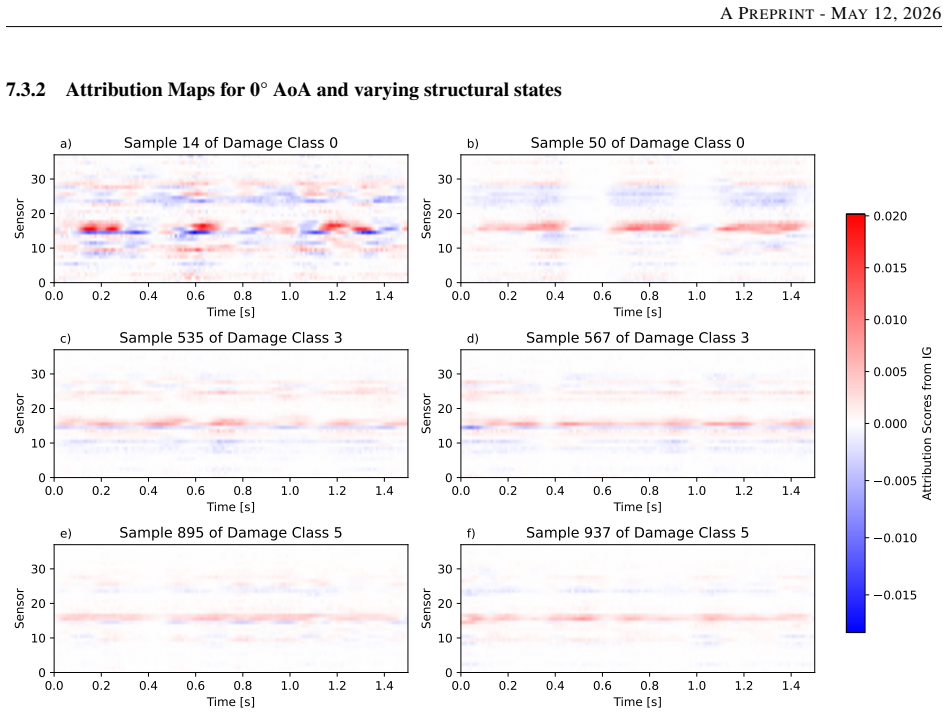
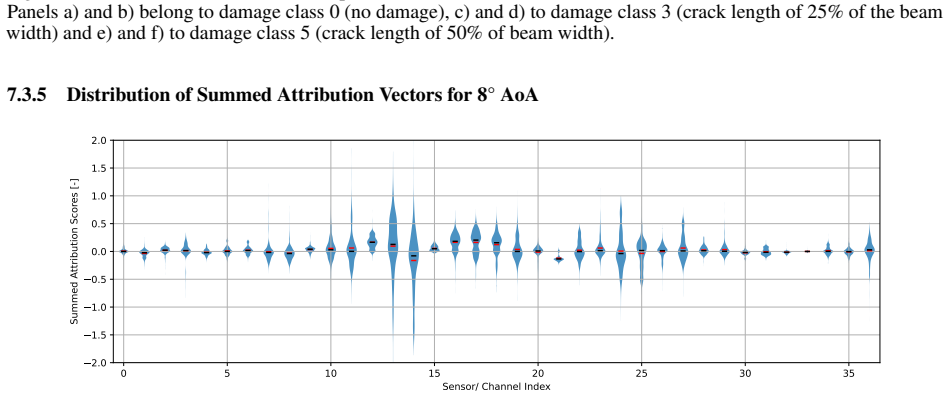
The increasing flexibility of modern large wind turbine blades necessitates cost-efficient and reliable structural monitoring solutions. For this purpose, we propose to use aerodynamic pressure measurements obtained via Aerosense, a novel, non-intrusive and economical sensing system. In former work [Franz et al., 2025], we investigated the potential of aerodynamic pressure measurements for structural damage detection on elastic and aerodynamically loaded structures. An experimental campaign was conducted on a NACA 633418 airfoil mounted on a vertically vibrating cantilever beam within an open wind tunnel. Structural damage was introduced progressively through controlled saw cuts near the beam support. Aerodynamic pressure distributions were recorded under varying inflow conditions and structural states. Based on this data set, we developed a convolutional neural network to detect structural damage and classify its severity using only aerodynamic pressure signals. The results demonstrate that pressure measurements can effectively enable real-time detection and quantification of damage in elastic, beam-like structures subjected to mildly turbulent flow and varying operational conditions. Recognizing the limitations of pure black-box classification, in this study, we further incorporate physics-based insights and explainable machine learning methods to interpret how structural damage influences both the dynamic response and the aerodynamic pressure field. This leads to an enhanced damage detection pipeline, aiming to improve transparency, robustness, and physical consistency in data-driven monitoring of elastic, aerodynamically loaded structures.
Editorial analysis
A structured set of objections, weighed in public.
Referee Report
Summary. The manuscript extends prior experimental work on aerodynamic pressure-based structural health monitoring for flexible wind turbine blades. It describes wind-tunnel tests on a NACA 633418 airfoil mounted on a vertically vibrating cantilever beam, with progressive saw cuts introduced near the support to simulate damage. Pressure distributions are recorded across structural states and varying inflow conditions; a convolutional neural network is trained to detect damage presence and classify severity from pressure signals alone. The current contribution adds explainable AI methods to extract physics-based insights on how damage alters the dynamic response and pressure field, aiming for a more transparent and robust monitoring pipeline.
Significance. If the laboratory results hold, the work demonstrates a non-intrusive, economical sensing approach capable of real-time damage detection and quantification under mildly turbulent flow and changing operational conditions. The addition of XAI methods is a positive step toward interpretability and physical consistency. The experimental design is tightly scoped to the beam-like elastic structure in controlled conditions, avoiding unsupported extrapolation claims; however, the representativeness of saw-cut damage and the specific airfoil-cantilever setup for full-scale blades remains an open question for broader applicability.
major comments (2)
- [Abstract] Abstract: The central claim that pressure measurements 'can effectively enable real-time detection and quantification of damage' is asserted without any quantitative performance metrics (accuracy, F1-score, error bars, or cross-validation details) presented in the manuscript. The results are referenced to the prior unpublished work [Franz et al., 2025] without independent verification or new tabulated results here, which weakens the standalone evidential basis for the effectiveness assertion.
- [Abstract] The manuscript states that XAI methods are incorporated to interpret damage effects on dynamics and pressure fields, yet no specific XAI techniques (e.g., SHAP, LIME, or attention maps), no example interpretations, and no comparison of interpretability gains versus the prior black-box CNN are described. This makes it difficult to assess whether the enhanced pipeline delivers the claimed improvements in transparency and physical consistency.
minor comments (1)
- [Abstract] The abstract refers to 'mildly turbulent flow' and 'varying operational conditions' without defining the turbulence intensity levels or the specific inflow parameter ranges tested; adding these details would improve reproducibility.
Simulated Author's Rebuttal
We thank the referee for the constructive and detailed review. We address the two major comments point by point below.
read point-by-point responses
-
Referee: [Abstract] Abstract: The central claim that pressure measurements 'can effectively enable real-time detection and quantification of damage' is asserted without any quantitative performance metrics (accuracy, F1-score, error bars, or cross-validation details) presented in the manuscript. The results are referenced to the prior unpublished work [Franz et al., 2025] without independent verification or new tabulated results here, which weakens the standalone evidential basis for the effectiveness assertion.
Authors: We agree that the abstract would benefit from quantitative support to strengthen its standalone character. Although the full performance evaluation (including accuracy, F1-scores, and validation details) was the focus of the referenced prior work, we will revise the abstract and add a concise summary of the key CNN performance metrics in the introduction of the revised manuscript. This will provide the requested evidential basis without duplicating the prior analysis. revision: yes
-
Referee: [Abstract] The manuscript states that XAI methods are incorporated to interpret damage effects on dynamics and pressure fields, yet no specific XAI techniques (e.g., SHAP, LIME, or attention maps), no example interpretations, and no comparison of interpretability gains versus the prior black-box CNN are described. This makes it difficult to assess whether the enhanced pipeline delivers the claimed improvements in transparency and physical consistency.
Authors: We thank the referee for highlighting the need for greater specificity. The XAI component is described in the body of the manuscript, but we acknowledge that the abstract does not name the techniques or provide examples. We will revise the abstract to explicitly identify the XAI methods employed and note the interpretability improvements. We will also ensure that example interpretations and comparisons to the black-box baseline are clearly highlighted in the revised text. revision: yes
Circularity Check
Minor self-citation to prior work on data collection, but central claims remain independently grounded in new experimental results and XAI analysis
full rationale
The paper grounds its claims in a new experimental campaign using aerodynamic pressure data from a NACA 633418 airfoil on a vibrating cantilever beam with progressive saw cuts, recorded under varying inflow conditions. A CNN is trained on this dataset for damage detection, followed by incorporation of physics-based insights and explainable ML methods for interpretability. The sole self-citation [Franz et al., 2025] refers to the prior data-collection effort and does not bear the load of the current interpretability or quantification results. No derivation reduces by construction to fitted inputs, self-defined quantities, or unverified self-citations; the empirical pipeline is self-contained against the described laboratory setup.
Axiom & Free-Parameter Ledger
axioms (1)
- domain assumption Controlled saw cuts near the beam support produce damage states representative of real structural degradation in aerodynamically loaded elastic structures.
Reference graph
Works this paper leans on
-
[1]
Franz, Philip and Abdallah, I. and Duth\'e, G. and Deparday, J. and Jafarabadi, A. and Jian, X. and von Danwitz, M. and Popp, A. and Barber, S. and Chatzi, E. , TITLE =. Wind Energy Science , VOLUME =. 2025 , NUMBER =
work page 2025
- [2]
-
[3]
Fauvel, Kevin and Lin, Tao and Masson, V. Mathematics , doi =. 2021 , title =
work page 2021
-
[4]
Shedding vortex characteristics analysis of NACA 0012 airfoil at low Reynolds numbers , pages =
Chang, Jianlong and Zhang, Qingui and He, Liujing and Zhou, Yi , year =. Shedding vortex characteristics analysis of NACA 0012 airfoil at low Reynolds numbers , pages =. Energy Reports , doi =
-
[5]
Jang, Hyeongwon and Kim, Changhun and Yang, Eunho , booktitle =. 2025 , editor =
work page 2025
-
[6]
Virtanen, Pauli and Gommers, Ralf and Oliphant, Travis E. and Haberland, Matt and Reddy, Tyler and Cournapeau, David and Burovski, Evgeni and Peterson, Pearu and Weckesser, Warren and Bright, Jonathan and. Nature Methods , year =
-
[7]
Bhat, Darshankumar and Muench, Stefan and Roellig, Mike , year =. Application of machine learning algorithms in prognostics and health monitoring of electronic systems: A review , pages =. e-Prime - Advances in Electrical Engineering, Electronics and Energy , doi =
-
[8]
Deep Learning-based Anomaly Detection in Cyber-physical Systems , pages =
Luo, Yuan and Xiao, Ya and Cheng, Long and Peng, Guojun and Yao, Danfeng , year =. Deep Learning-based Anomaly Detection in Cyber-physical Systems , pages =. ACM Computing Surveys , doi =
-
[9]
Automation in Construction , doi =
Cha, Young-Jin and Ali, Rahmat and Lewis, John and B. Automation in Construction , doi =. 2024 , title =
work page 2024
-
[10]
Deep Learning Methods for Vibration-Based Structural Health Monitoring: A Review , pages =
Wang, Hao and Wang, Baoli and Cui, Caixia , year =. Deep Learning Methods for Vibration-Based Structural Health Monitoring: A Review , pages =. Iranian Journal of Science
-
[11]
Baker, Nathan and Alexander, Frank and Bremer, Timo and Hagberg, Aric and Kevrekidis, Yannis and Najm, Habib and Parashar, Manish and Patra, Abani and Sethian, James and Wild, Stefan and Willcox, Karen and Lee, Steven , year =. Workshop Report on Basic Research Needs for Scientific Machine Learning: Core Technologies for Artificial Intelligence , doi =
-
[12]
Optimal Strouhal numbers for oscillatory propulsion in density stratified fluids , volume=
Wang, Jiadong and Kandel, Prabal and Deng, Jian , year=. Optimal Strouhal numbers for oscillatory propulsion in density stratified fluids , volume=. doi:10.1017/jfm.2025.283 , journal=
-
[13]
Triantafyllou, M. S. and Triantafyllou, G. S. and Yue, D. K. P. , year =. Hydrodynamics of Fishlike Swimming , pages =. Annual Review of Fluid Mechanics , doi =
-
[14]
Quarteroni, Alfio and Gervasio, Paola and Regazzoni, Francesco , year =. Combining physics-based and data-driven models: advancing the frontiers of research with scientific machine learning , pages =. Mathematical Models and Methods in Applied Sciences , doi =
-
[15]
He, Wenchong and Jiang, Zhe and Xiao, Tingsong and Xu, Zelin and Li, Yukun , title =. 2026 , issue_date =. doi:10.1145/3786319 , journal =
-
[16]
and Lu, Lu and Perdikaris, Paris and Wang, Sifan and Yang, Liu , year =
Karniadakis, George Em and Kevrekidis, Ioannis G. and Lu, Lu and Perdikaris, Paris and Wang, Sifan and Yang, Liu , year =. Physics-informed machine learning , pages =. Nature Reviews Physics , doi =
- [17]
-
[18]
Breiman, Leo , year =. Random Forests , pages =. Machine Learning , doi =
-
[19]
Jerome H. Friedman , journal =. Greedy Function Approximation: A Gradient Boosting Machine , urldate =
- [20]
-
[21]
Webb, Germain Forestier, and Mahsa Salehi
Mohammadi Foumani, Navid and Miller, Lynn and Tan, Chang Wei and Webb, Geoffrey I. and Forestier, Germain and Salehi, Mahsa , title =. 2024 , issue_date =. doi:10.1145/3649448 , journal =
-
[22]
Zamanzadeh Darban, Zahra and Webb, Geoffrey I. and Pan, Shirui and Aggarwal, Charu and Salehi, Mahsa , title =. 2024 , issue_date =. doi:10.1145/3691338 , journal =
-
[23]
International Journal of Machine Learning and Cybernetics , doi =
Kong, Xiangjie and Chen, Zhenghao and Liu, Weiyao and Ning, Kaili and Zhang, Lechao and. International Journal of Machine Learning and Cybernetics , doi =. 2025 , title =
work page 2025
-
[24]
2017 International Joint Conference on Neural Networks (IJCNN) , year =
Wang, Zhiguang and Yan, Weizhong and Oates, Tim , title =. 2017 International Joint Conference on Neural Networks (IJCNN) , year =
work page 2017
-
[25]
Understanding the difficulty of training deep feedforward neural networks, in: Proceedings of the Thirteenth International Conference on Artificial Intelligence and Statistics , author =. 2010 , editor =
work page 2010
-
[26]
Physics-Enhanced Machine Learning: a position paper for dynamical systems investigations , volume=
Cicirello, Alice , title =. doi:10.1088/1742-6596/2909/1/012034 , year =
-
[27]
Explainable AI for Time Series Classification: A Review, Taxonomy and Research Directions , year=
Theissler, Andreas and Spinnato, Francesco and Schlegel, Udo and Guidotti, Riccardo , journal=. Explainable AI for Time Series Classification: A Review, Taxonomy and Research Directions , year=
-
[28]
Proceedings of the 34th International Conference on Machine Learning - Volume 70 , pages =
Sundararajan, Mukund and Taly, Ankur and Yan, Qiqi , title =. Proceedings of the 34th International Conference on Machine Learning - Volume 70 , pages =. 2017 , publisher =
work page 2017
-
[29]
Barber, Sarah and Deparday, J. and Marykovskiy, Y. and Chatzi, E. and Abdallah, I. and Duth\'e, G. and Magno, M. and Polonelli, T. and Fischer, R. and M\"uller, H. , TITLE =. Wind Energy Science , VOLUME =. 2022 , NUMBER =
work page 2022
-
[30]
The Fourteenth International Conference on Learning Representations , year=
Geometric Autoencoder Priors for Bayesian Inversion: Learn First Observe Later , author=. The Fourteenth International Conference on Learning Representations , year=
discussion (0)
Sign in with ORCID, Apple, or X to comment. Anyone can read and Pith papers without signing in.