Simultaneous Monitoring of Shape and Surface Color via 4D Point Clouds: A Registration-free Approach
Pith reviewed 2026-05-12 01:42 UTC · model grok-4.3
The pith
Spectral properties of the Laplace-Beltrami operator applied to unregistered 4D point clouds enable simultaneous detection of shape deformations and color anomalies without registration or mesh reconstruction.
A machine-rendered reading of the paper's core claim, the machinery that carries it, and where it could break.
Core claim
The central claim is that Laplace-Beltrami operator spectral properties, when computed on unregistered 4D point clouds, capture both geometric structure and the shape-surface color relationship sufficiently well to support a joint monitoring procedure that identifies shape deformations and color anomalies, plus a spatially-aware diagnostic routine that determines the origin of change and localizes color anomalies, all without requiring registration or mesh reconstruction.
What carries the argument
Laplace-Beltrami operator spectral properties computed on unregistered 4D point clouds, used to extract geometric features and the shape-color relationship for monitoring.
If this is right
- Shape deformations and color anomalies can be flagged in a single monitoring pass on raw point-cloud sequences.
- A post-detection diagnostic step can identify whether a signal stems from geometry or color and can localize the color anomaly in space.
- No registration or mesh reconstruction is required, removing two common sources of error and computational cost.
- The method shows strong detection performance on subtle defects in both Monte Carlo simulations and real functionally graded material parts.
Where Pith is reading between the lines
- The registration-free property could allow direct application to streaming sensor data in additive manufacturing lines without pausing for alignment.
- The same spectral representation might be tested on time-varying point clouds from other domains such as biomedical surface imaging where shape and texture both matter.
- If the spectral signatures prove stable across different sampling densities, the framework could scale to very large or sparse 4D datasets without additional preprocessing.
Load-bearing premise
The spectral properties of the Laplace-Beltrami operator on unregistered 4D point clouds are rich enough to distinguish and track both shape changes and color anomalies.
What would settle it
A controlled experiment in which known shape deformations and color shifts are introduced into 4D point clouds, yet the spectral features fail to separate or detect the two types of change at rates above random guessing.
Figures


read the original abstract
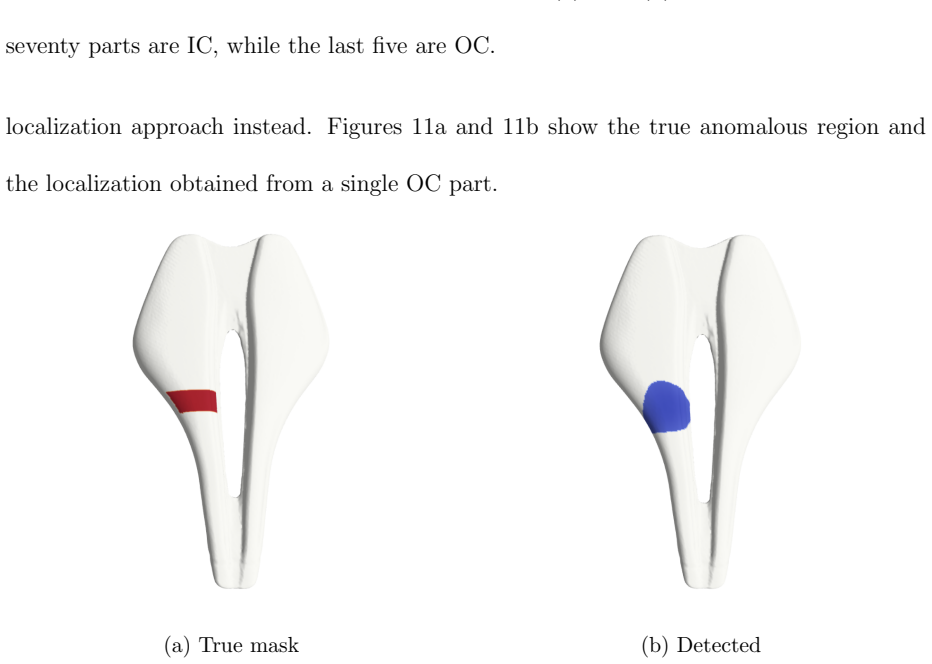
Advanced manufacturing technologies allow for the production of intricate parts featuring high shape complexity and spatially-varying material composition. Data fusion of point clouds with chromatic attributes provides 4D point clouds, a compact and informative representation that encodes both shape and material information. In this paper, we present a registration-free framework for Simultaneous Monitoring of shApe and Color (SMAC) via 4D point clouds. The proposed framework leverages Laplace-Beltrami operator spectral properties to capture and monitor geometric features and the relationship between shape and surface color. A combined monitoring scheme is proposed to effectively detect shape deformations and color anomalies, along with a spatially-aware post-signal diagnostic procedure to determine the source of change and localize color anomalies. Importantly, neither component relies on registration or mesh reconstruction, eliminating error-prone and computationally expensive preprocessing steps. A Monte Carlo simulation study and a case study on functionally graded materials demonstrate that SMAC achieves effective detection performance, particularly for subtle defects, while providing diagnostic capabilities to identify the source and location of anomalies.
Editorial analysis
A structured set of objections, weighed in public.
Referee Report
Summary. The paper proposes SMAC, a registration-free framework for simultaneous monitoring of shape deformations and surface color anomalies in 4D point clouds (3D geometry plus chromatic attributes). It leverages spectral properties of the Laplace-Beltrami operator to capture geometric features and shape-color relationships, introduces a combined monitoring scheme for detection, and adds a spatially-aware post-signal diagnostic procedure for localizing anomalies. Validation is provided via a Monte Carlo simulation study and a case study on functionally graded materials, claiming effective performance especially for subtle defects without requiring registration or mesh reconstruction.
Significance. If the central claims hold, the work would be significant for advanced manufacturing applications involving complex geometries and spatially varying materials, as it removes error-prone and computationally costly preprocessing steps. The empirical components (Monte Carlo study and case study) provide concrete evidence of practical utility, and the spectral approach offers a compact, registration-free representation that jointly encodes shape and color information.
major comments (2)
- [Method / Spectral properties section] The discretization of the Laplace-Beltrami operator for raw unregistered 4D point clouds is not specified (e.g., graph Laplacian, kernel-based, or other approximation), and no sensitivity analysis or stability verification under varying sampling density, noise levels, or local point distributions is provided. This is load-bearing for the registration-free claim, as independent scans can differ in these factors, potentially affecting the consistency of eigenvalues/eigenfunctions needed for the combined monitoring scheme and diagnostics (see the method description of the spectral feature extraction and the Monte Carlo setup).
- [Monte Carlo simulation study] The Monte Carlo simulation claims effective detection of subtle defects, but the available description provides no quantitative metrics (e.g., detection rates, false positive rates, ROC curves, or error analysis with confidence intervals), making it difficult to evaluate whether the data supports the performance assertions relative to baselines or under realistic sampling variations.
minor comments (1)
- [Abstract] The abstract and introduction would benefit from a brief statement of the specific quantitative performance metrics achieved in the simulation and case study to allow readers to immediately gauge the strength of the empirical results.
Simulated Author's Rebuttal
We are grateful to the referee for the thorough review and valuable suggestions. We have carefully considered the major comments and will revise the manuscript to address the concerns regarding methodological details and empirical validation. Our point-by-point responses are provided below.
read point-by-point responses
-
Referee: [Method / Spectral properties section] The discretization of the Laplace-Beltrami operator for raw unregistered 4D point clouds is not specified (e.g., graph Laplacian, kernel-based, or other approximation), and no sensitivity analysis or stability verification under varying sampling density, noise levels, or local point distributions is provided. This is load-bearing for the registration-free claim, as independent scans can differ in these factors, potentially affecting the consistency of eigenvalues/eigenfunctions needed for the combined monitoring scheme and diagnostics (see the method description of the spectral feature extraction and the Monte Carlo setup).
Authors: We agree with the referee that the discretization of the Laplace-Beltrami operator needs to be explicitly described for reproducibility and to support the registration-free claim. In the original manuscript, we used a graph Laplacian approximation constructed from the 4D point cloud, where the affinity matrix incorporates both spatial distances and color differences to define the operator on the combined geometry-color manifold. However, this was not detailed sufficiently. In the revised manuscript, we will add a dedicated subsection describing the discretization method and include sensitivity analyses demonstrating the stability of the extracted spectral features (eigenvalues and eigenfunctions) under variations in sampling density, added noise, and irregular point distributions. These additions will directly address the concerns about consistency across independent scans. revision: yes
-
Referee: [Monte Carlo simulation study] The Monte Carlo simulation claims effective detection of subtle defects, but the available description provides no quantitative metrics (e.g., detection rates, false positive rates, ROC curves, or error analysis with confidence intervals), making it difficult to evaluate whether the data supports the performance assertions relative to baselines or under realistic sampling variations.
Authors: We acknowledge that the Monte Carlo study section would benefit from more quantitative reporting to allow proper evaluation of the claims. While the manuscript states that SMAC achieves effective detection performance for subtle defects, specific numerical results such as detection rates, false positive rates, and ROC analysis were summarized rather than fully tabulated. In the revision, we will expand this section to include detailed quantitative metrics, including average detection rates with confidence intervals, false positive rates, ROC curves, and comparisons to relevant baselines under the simulated sampling variations. This will provide stronger evidence for the performance assertions. revision: yes
Circularity Check
No circularity; derivation applies established LBO properties to new monitoring task
full rationale
The paper's core claim is that spectral properties of the Laplace-Beltrami operator, when applied to unregistered 4D point clouds, suffice to capture geometric features and shape-color relationships for a combined monitoring scheme and post-signal diagnostics. This is an application of known operator properties to a registration-free setting, not a self-definition, fitted-input prediction, or self-citation chain. No equations or steps in the provided description reduce the result to its own inputs by construction. The Monte Carlo study and case study serve as external validation rather than circular confirmation. The framework introduces new elements (combined scheme, spatially-aware diagnostics) without tautological reduction.
Axiom & Free-Parameter Ledger
axioms (1)
- domain assumption Laplace-Beltrami operator spectral properties capture geometric features and the relationship between shape and surface color on 4D point clouds
Lean theorems connected to this paper
-
IndisputableMonolith/Foundation/AlexanderDuality.leanalexander_duality_circle_linking unclear?
unclearRelation between the paper passage and the cited Recognition theorem.
leverages Laplace-Beltrami operator spectral properties... eigenfunctions as functional basis... yi = Ui βi + εi... combined CUSUM on λi and |β̂i|
-
IndisputableMonolith/Cost/FunctionalEquation.leanwashburn_uniqueness_aczel unclear?
unclearRelation between the paper passage and the cited Recognition theorem.
discrete LBO... generalized eigenvalue problem Li ui,j = λi,j Mi ui,j
What do these tags mean?
- matches
- The paper's claim is directly supported by a theorem in the formal canon.
- supports
- The theorem supports part of the paper's argument, but the paper may add assumptions or extra steps.
- extends
- The paper goes beyond the formal theorem; the theorem is a base layer rather than the whole result.
- uses
- The paper appears to rely on the theorem as machinery.
- contradicts
- The paper's claim conflicts with a theorem or certificate in the canon.
- unclear
- Pith found a possible connection, but the passage is too broad, indirect, or ambiguous to say the theorem truly supports the claim.
Reference graph
Works this paper leans on
-
[1]
Journal of Machine Learning Research , volume=
Neighborhood structure assisted non-negative matrix factorization and its application in unsupervised point-wise anomaly detection , author=. Journal of Machine Learning Research , volume=
-
[2]
Jelena ˇZarko, Gojko Vladi´ c, Magdolna P´ al, and Sandra Dedijer
Kilian Wasmer and Matthias Wüst and Di Cui and Giulio Masinelli and Vigneashwara Pandiyan and Sergey Shevchik , title =. Virtual and Physical Prototyping , volume =. 2023 , publisher =. doi:10.1080/17452759.2023.2189599 , URL =
-
[3]
Journal of Intelligent Manufacturing , volume=
Statistical process monitoring approach for high-density point clouds , author=. Journal of Intelligent Manufacturing , volume=. 2013 , publisher=
work page 2013
-
[4]
Sue E. Stankus and Krystel K. Castillo-Villar , title =. International Journal of Production Research , volume =. 2019 , publisher =. doi:10.1080/00207543.2018.1518600 , URL =
-
[5]
Colosimo, Bianca Maria and Grasso, Marco and Garghetti, Federica and Rossi, Beatrice , title =. Journal of Quality Technology , volume =. 2022 , publisher =. doi:10.1080/00224065.2021.1926377 , URL =
-
[6]
Precision Engineering , volume=
Detection and monitoring of defects on three-dimensional curved surfaces based on high-density point cloud data , author=. Precision Engineering , volume=. 2018 , publisher=
work page 2018
-
[7]
Registration-Free Monitoring of Unstructured Point Cloud Data via Intrinsic Geometrical Properties , author=. 2025 , eprint=
work page 2025
-
[8]
arXiv preprint arXiv:2511.05623 , year =
Patalano, Mariafrancesca and Capizzi, Giovanna and Paynabar, Kamran , title =. arXiv preprint arXiv:2511.05623 , year =
-
[9]
A Monitoring and Diagnostic Approach for Stochastic Textured Surfaces , volume =
Bui, Anh and Apley, Daniel , year =. A Monitoring and Diagnostic Approach for Stochastic Textured Surfaces , volume =. Technometrics , doi =
-
[10]
Anh Tuan Bui and Daniel W. Apley , title =. Journal of Quality Technology , volume =. 2018 , publisher =. doi:10.1080/00224065.2018.1507559 , URL =
-
[11]
The International Journal of Advanced Manufacturing Technology , volume=
A fast and robust convolutional neural network-based defect detection model in product quality control , author=. The International Journal of Advanced Manufacturing Technology , volume=. 2018 , publisher=
work page 2018
-
[12]
Liu, Yang and Xu, Ke and Xu, Jinwu , TITLE =. Applied Sciences , VOLUME =. 2019 , NUMBER =
work page 2019
-
[13]
Cui, Wenyuan and Zhang, Yunlu and Zhang, Xinchang and Li, Lan and Liou, Frank , TITLE =. Applied Sciences , VOLUME =. 2020 , NUMBER =
work page 2020
-
[14]
Scimone, Riccardo and Taormina, Tommaso and Colosimo, Bianca Maria and Grasso, Marco and Menafoglio, Alessandra and Secchi, Piercesare , title =. Technometrics , volume =. 2022 , publisher =. doi:10.1080/00401706.2021.1961870 , URL =
-
[15]
Bianca Maria Colosimo and Federica Garghetti and Marco Grasso and Luca Pagani , keywords =. On-line inspection of lattice structures and metamaterials via in-situ imaging in additive manufacturing , journal =. 2024 , issn =. doi:https://doi.org/10.1016/j.addma.2024.104538 , url =
-
[16]
N. Senin and S. Catalucci and M. Moretti and R.K. Leach , keywords =. Statistical point cloud model to investigate measurement uncertainty in coordinate metrology , journal =. 2021 , issn =. doi:https://doi.org/10.1016/j.precisioneng.2021.01.008 , url =
-
[17]
Besl, P.J. and McKay, Neil D. , journal=. A method for registration of. 1992 , volume=
work page 1992
-
[18]
and Therriault, Daniel , title =
Rafiee, Mohammad and Farahani, Rouhollah D. and Therriault, Daniel , title =. Advanced Science , volume =. doi:https://doi.org/10.1002/advs.201902307 , url =. https://advanced.onlinelibrary.wiley.com/doi/pdf/10.1002/advs.201902307 , abstract =
-
[19]
Experimental Mathematics , volume =
Pinkall, Ulrich and Polthier, Konrad , title =. Experimental Mathematics , volume =
-
[20]
Karimzadeh, Mohammad and Basvoju, Deekshith and Vakanski, Aleksandar and Charit, Indrajit and Xu, Fei and Zhang, Xinchang , TITLE =. Materials , VOLUME =. 2024 , NUMBER =
work page 2024
- [21]
-
[22]
Laplace-Beltrami Eigenfunctions Towards an Algorithm That Understands Geometry , volume =
Levy, Bruno , year =. Laplace-Beltrami Eigenfunctions Towards an Algorithm That Understands Geometry , volume =. IEEE International Conference on Shape Modeling and Applications (SMI) , doi =
-
[23]
Martin Reuter and Silvia Biasotti and Daniela Giorgi and Giuseppe Patanè and Michela Spagnuolo , keywords =. Discrete Laplace–Beltrami operators for shape analysis and segmentation , journal =. 2009 , issn =. doi:https://doi.org/10.1016/j.cag.2009.03.005 , url =
-
[24]
Martin Reuter and Franz-Erich Wolter and Martha Shenton and Marc Niethammer , keywords =. Laplace–Beltrami eigenvalues and topological features of eigenfunctions for statistical shape analysis , journal =. 2009 , issn =. doi:https://doi.org/10.1016/j.cad.2009.02.007 , url =
- [25]
-
[26]
Salient spectral geometric features for shape matching and retrieval , author=. The Visual Computer , volume=. 2009 , doi=
work page 2009
-
[27]
Kim, Seung-Goo and Chung, Moo K. and Schaefer, Stacey M. and van Reekum, Carien and Davidson, Richard J. , title =. Proceedings of the Workshop on Mathematical Methods in Biomedical Image Analysis (MMBIA) , pages =. 2012 , doi =
work page 2012
-
[28]
Niu, Dongmei and Guo, Han and Zhao, Xiuyang and Zhang, Caiming , title =. The Visual Computer , year =
-
[29]
Anqi Qiu and Bitouk, D. and Miller, M.I. , journal=. Smooth functional and structural maps on the neocortex via orthonormal bases of the Laplace-Beltrami operator , year=
-
[30]
Lai, Rongjie and Shi, Yonggang and Dinov, Ivo and Chan, Tony F. and Toga, Arthur W. , booktitle=. Laplace-Beltrami nodal counts: A new signature for 3D shape analysis , year=
-
[31]
Journal of Machine Learning Research , year =
Laurens van der Maaten and Geoffrey Hinton , title =. Journal of Machine Learning Research , year =
- [32]
-
[33]
Image-Based Process Monitoring Using Low-Rank Tensor Decomposition , year=
Yan, Hao and Paynabar, Kamran and Shi, Jianjun , journal=. Image-Based Process Monitoring Using Low-Rank Tensor Decomposition , year=
-
[34]
In: Proceedings of the 24th National Conference, pp
Cuthill, E. and McKee, J. , title =. Proceedings of the 1969 24th National Conference , pages =. 1969 , isbn =. doi:10.1145/800195.805928 , abstract =
-
[35]
Shashua, A. and Levin, A. , booktitle=. Linear image coding for regression and classification using the tensor-rank principle , year=
-
[36]
Deadman, Edvin and Higham, Nicholas J. and Ralha, Rui. Blocked Schur Algorithms for Computing the Matrix Square Root. Applied Parallel and Scientific Computing. 2013
work page 2013
-
[37]
Journal of the American Statistical Association , volume =
Jianqing Fan , title =. Journal of the American Statistical Association , volume =. 1996 , publisher =. doi:10.1080/01621459.1996.10476936 , URL =
- [38]
-
[39]
Bertero, Mario and Boccacci, Patrizia and De Mol, Clara , title =. 2021 , doi =
work page 2021
-
[40]
Montgomery, Douglas C. , address =. Introduction to statistical quality control , year =. Introduction to statistical quality control , edition =
-
[41]
Extended Bayesian information criteria for model selection with large model spaces , author=. Biometrika , volume=. 2008 , publisher=
work page 2008
-
[42]
Journal of computational and graphical statistics , volume=
A sparse-group lasso , author=. Journal of computational and graphical statistics , volume=. 2013 , publisher=
work page 2013
-
[43]
Changliang Zou and Wei Jiang and Fugee Tsung , title =. Technometrics , volume =. 2011 , publisher =. doi:10.1198/TECH.2011.10034 , URL =
-
[44]
Annals of Operations Research , volume =
Changliang Zou and Xuefeng Ning and Fugee Tsung , title =. Annals of Operations Research , volume =. 2010 , doi =
work page 2010
-
[45]
Modeling an Augmented Lagrangian for Blackbox Constrained Optimization
Chen, Nan and Zi, Xuemin and Zou, Changliang , title =. Technometrics , volume =. 2016 , publisher =. doi:10.1080/00401706.2015.1049750 , URL =
-
[46]
International journal of production research , volume=
Data-reduction method for spatial data using a structured wavelet model , author=. International journal of production research , volume=. 2007 , publisher=
work page 2007
-
[47]
Computational Statistics & Data Analysis , volume=
Fitting multiple change-point models to data , author=. Computational Statistics & Data Analysis , volume=. 2001 , publisher=
work page 2001
-
[48]
Journal of Quality Technology , volume=
Phase I analysis of high-dimensional covariance matrices based on sparse leading eigenvalues , author=. Journal of Quality Technology , volume=. 2021 , publisher=
work page 2021
-
[49]
Giovanna Capizzi and Guido Masarotto , title =. Technometrics , volume =. 2017 , publisher =. doi:10.1080/00401706.2016.1272494 , URL =
- [50]
-
[51]
2013 IEEE International Conference on Acoustics, Speech and Signal Processing , pages=
A greedy algorithm for model selection of tensor decompositions , author=. 2013 IEEE International Conference on Acoustics, Speech and Signal Processing , pages=. 2013 , organization=
work page 2013
-
[52]
Jeong, Myong K and Lu, J-C and Wang, Ni , journal=. Wavelet-based. 2006 , publisher=
work page 2006
-
[53]
Paynabar, Kamran and Zou, Changliang and Qiu, Peihua , journal=. A change-point approach for. 2016 , publisher=
work page 2016
-
[54]
INFORMS Journal on Data Science , year =
Zhao, Xueqi and del Castillo, Enrique , title =. INFORMS Journal on Data Science , year =
-
[55]
and Ovsjanikov, Maks and Azencot, Omri and Ben-Chen, Mirela and Chazal, Fr\'
Rustamov, Raif M. and Ovsjanikov, Maks and Azencot, Omri and Ben-Chen, Mirela and Chazal, Fr\'. Map-based exploration of intrinsic shape differences and variability , year =. ACM Trans. Graph. , month = jul, articleno =. doi:10.1145/2461912.2461959 , abstract =
-
[56]
Michael Garland and Paul S. Heckbert , title =. Proceedings of the 24th Annual Conference on Computer Graphics and Interactive Techniques (SIGGRAPH '97) , year =. doi:10.1145/258734.258849 , url =
-
[57]
Global Versus Local Methods in Nonlinear Dimensionality Reduction , url =
Silva, Vin and Tenenbaum, Joshua , booktitle =. Global Versus Local Methods in Nonlinear Dimensionality Reduction , url =
-
[58]
Tenenbaum, Vin de Silva, and John C
Joshua B. Tenenbaum and Vin de Silva and John C. Langford , title =. Science , volume =. 2000 , doi =. https://www.science.org/doi/pdf/10.1126/science.290.5500.2319 , abstract =
-
[59]
Fast Euclidean minimum spanning tree: algorithm, analysis, and applications , author=. Proceedings of the 16th ACM SIGKDD international conference on Knowledge discovery and data mining , pages=
-
[60]
Recursive Approach in Sparse Matrix LU Factorization , volume =
Dongarra, Jack and Eijkhout, Victor and Luszczek, Piotr , year =. Recursive Approach in Sparse Matrix LU Factorization , volume =. Scientific Programming , doi =
- [61]
- [62]
-
[63]
Golub, Gene H. and Van Loan, Charles F. , title =. 2013 , publisher =
work page 2013
-
[64]
The wave kernel signature: A quantum mechanical approach to shape analysis , year=
Aubry, Mathieu and Schlickewei, Ulrich and Cremers, Daniel , booktitle=. The wave kernel signature: A quantum mechanical approach to shape analysis , year=
-
[65]
Stephen M. Smith and Thomas E. Nichols , keywords =. Threshold-free cluster enhancement: Addressing problems of smoothing, threshold dependence and localisation in cluster inference , journal =. 2009 , issn =. doi:https://doi.org/10.1016/j.neuroimage.2008.03.061 , url =
-
[66]
Journal of Neuroscience Methods164(1), 177–190 (2007)
Eric Maris and Robert Oostenveld , keywords =. Nonparametric statistical testing of EEG- and MEG-data , journal =. 2007 , issn =. doi:https://doi.org/10.1016/j.jneumeth.2007.03.024 , url =
-
[67]
Proceedings of the Twentieth Annual ACM-SIAM Symposium on Discrete Algorithms , pages =
Belkin, Mikhail and Sun, Jian and Wang, Yusu , title =. Proceedings of the Twentieth Annual ACM-SIAM Symposium on Discrete Algorithms , pages =. 2009 , publisher =
work page 2009
-
[68]
Point-Based Manifold Harmonics , year=
Liu, Yang and Prabhakaran, Balakrishnan and Guo, Xiaohu , journal=. Point-Based Manifold Harmonics , year=
-
[69]
Clarenz, U. and Rumpf, M. and Telea, A. , year =. SPBG'04 Symposium on Point - Based Graphics 2004 , editor =
work page 2004
-
[70]
Discrete combinatorial Laplacian operators for digital geometry processing , volume =
Zhang, Hao , year =. Discrete combinatorial Laplacian operators for digital geometry processing , volume =
-
[71]
Advances in Multiresolution for Geometric Modelling , year=
Surface Parameterization: a Tutorial and Survey , author=. Advances in Multiresolution for Geometric Modelling , year=
-
[72]
Proceedings of the ACM Symposium on Computational Fabrication , articleno =
Wade, Charles and Beck, Devon and MacCurdy, Robert , title =. Proceedings of the ACM Symposium on Computational Fabrication , articleno =. 2025 , isbn =. doi:10.1145/3745778.3766659 , abstract =
-
[73]
Proceedings of the Symposium on Geometry Processing , pages =
Sun, Jian and Ovsjanikov, Maks and Guibas, Leonidas , title =. Proceedings of the Symposium on Geometry Processing , pages =. 2009 , publisher =
work page 2009
-
[74]
Computer Aided Geometric Design , volume=
Localized discrete Laplace--Beltrami operator over triangular mesh , author=. Computer Aided Geometric Design , volume=. 2015 , publisher=
work page 2015
-
[75]
E. S. Page , journal =. Continuous Inspection Schemes , urldate =
-
[76]
Bianca M. Colosimo and Marco Grasso , title =. Journal of Quality Technology , volume =. 2018 , publisher =. doi:10.1080/00224065.2018.1507563 , URL =
-
[77]
Quality and Reliability Engineering International , volume =
Yang, Wei and Grasso, Marco and Colosimo, Bianca Maria and Paynabar, Kamran , title =. Quality and Reliability Engineering International , volume =. doi:https://doi.org/10.1002/qre.3223 , url =. https://onlinelibrary.wiley.com/doi/pdf/10.1002/qre.3223 , year =
-
[78]
Modeling an Augmented Lagrangian for Blackbox Constrained Optimization
Hao Yan and Kamran Paynabar and Jianjun Shi , title =. Technometrics , volume =. 2017 , publisher =. doi:10.1080/00401706.2015.1102764 , URL =
-
[79]
Chaos: An Interdisciplinary Journal of Nonlinear Science , volume=
Hierarchical clustering in minimum spanning trees , author=. Chaos: An Interdisciplinary Journal of Nonlinear Science , volume=. 2015 , publisher=
work page 2015
-
[80]
arXiv preprint cs/0307038 , year=
Manifold learning with geodesic minimal spanning trees , author=. arXiv preprint cs/0307038 , year=
work page internal anchor Pith review arXiv
discussion (0)
Sign in with ORCID, Apple, or X to comment. Anyone can read and Pith papers without signing in.