Recognition: no theorem link
SynerDiff: Synergetic Continuous Batching for Fast and Parallel Diffusion Model Inference
Pith reviewed 2026-05-12 02:26 UTC · model grok-4.3
The pith
SynerDiff resolves UNet-VAE contention in diffusion serving to deliver 1.6 times higher throughput and up to 78.7 percent lower latencies.
A machine-rendered reading of the paper's core claim, the machinery that carries it, and where it could break.
Core claim
SynerDiff builds continuous batching on intra-inter level synergy: VAE Chunking and Adaptive Skip-CFG prune component-specific bottlenecks at the intra level, while a threshold-aware scheduler plans concurrent sequences and a feedback controller tunes the threshold according to queue load, jointly raising throughput 1.6 times and cutting average and P99 E2E latencies by up to 78.7 percent while preserving image fidelity.
What carries the argument
The intra-inter level synergy of SynerDiff, which uses VAE Chunking plus Adaptive Skip-CFG inside tasks and a threshold-aware scheduler with feedback controller across tasks.
If this is right
- Diffusion serving clusters can process more concurrent image-generation requests on the same GPUs.
- User-perceived response times for AI content tools become shorter even under bursty demand.
- Multi-stage generative pipelines gain a template for balancing encoder and decoder stages.
- Resource provisioning for diffusion-based services can be reduced while meeting the same latency targets.
Where Pith is reading between the lines
- The same contention-mitigation pattern may transfer to other generative models that alternate heavy and light compute stages.
- Energy use per generated image could drop in proportion to the throughput gain if the techniques scale to larger clusters.
- Hardware vendors might expose finer-grained scheduling hooks once software schedulers demonstrate clear value from them.
Load-bearing premise
VAE Chunking and Adaptive Skip-CFG cut contention without any drop in image fidelity, and the scheduler plus controller can keep UNet throughput high across changing loads without adding new overhead.
What would settle it
Measure FID scores and P99 tail latency while running increasing numbers of simultaneous diffusion tasks; if either metric falls below the reported baseline the central claim fails.
Figures


read the original abstract
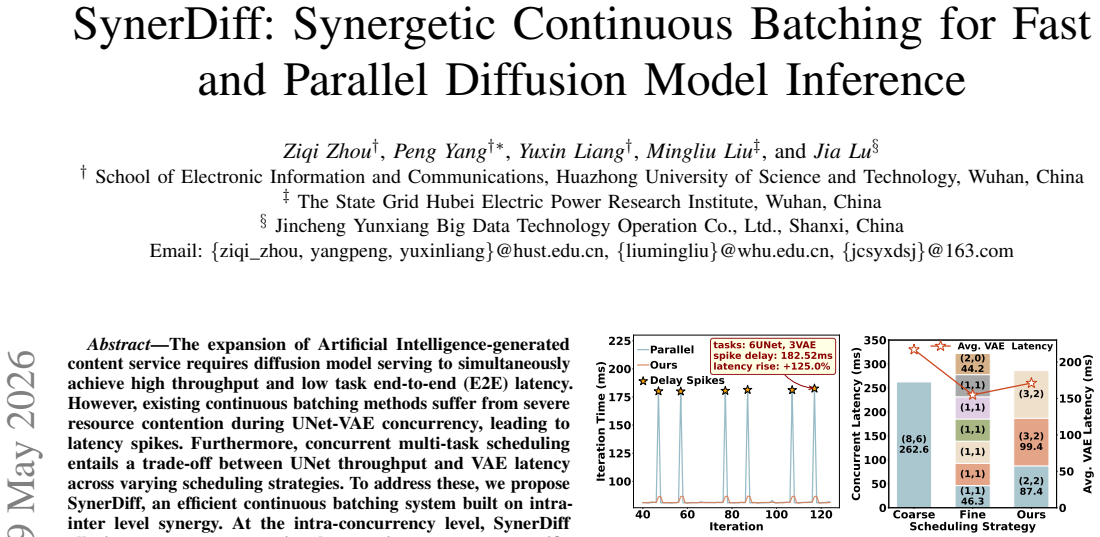
The expansion of Artificial Intelligence-generated content service requires diffusion model serving to simultaneously achieve high throughput and low task end-to-end (E2E) latency. However, existing continuous batching methods suffer from severe resource contention during UNet-VAE concurrency, leading to latency spikes. Furthermore, concurrent multi-task scheduling entails a trade-off between UNet throughput and VAE latency across varying scheduling strategies. To address these, we propose SynerDiff, an efficient continuous batching system built on intra-inter level synergy. At the intra-concurrency level, SynerDiff alleviates resource contention by pruning component-specific resource bottlenecks via VAE Chunking and Adaptive Skip-CFG. At the inter-concurrency level, leveraging components' differential sensitivity to scheduling granularities, a threshold-aware scheduler plans concurrent sequences and tunes intra-concurrency decisions to minimize VAE latency while maintaining UNet within high-throughput threshold. Additionally, a feedback controller dynamically adjusts this threshold based on queue loads to boost system capacity ceiling. Experimental results show that, SynerDiff improves throughput by 1.6$\times$ and decreases both average E2E and P99 tail latencies by up to 78.7\%, compared to benchmarks while guaranteeing high image fidelity.
Editorial analysis
A structured set of objections, weighed in public.
Referee Report
Summary. The paper proposes SynerDiff, a continuous batching system for diffusion model serving that targets UNet-VAE resource contention and scheduling trade-offs. At the intra-concurrency level, it introduces VAE Chunking and Adaptive Skip-CFG to prune bottlenecks. At the inter-concurrency level, a threshold-aware scheduler plans sequences and tunes decisions to keep UNet above a high-throughput threshold while minimizing VAE latency, augmented by a feedback controller that adjusts the threshold based on queue loads. Experiments claim 1.6× throughput gains and up to 78.7% reductions in average E2E and P99 latencies versus baselines, with preserved image fidelity.
Significance. If the experimental claims hold under rigorous benchmarking, the work offers a practical advance in high-throughput, low-latency serving of diffusion models for AIGC workloads. The intra-inter synergy design directly addresses contention points that existing continuous batching overlooks, and the explicit mechanisms (chunking, skip-CFG, threshold planning, feedback) provide a concrete, implementable path to better resource utilization without fidelity loss.
minor comments (4)
- The abstract and introduction should explicitly state the baseline systems used for the 1.6× and 78.7% comparisons (e.g., specific continuous batching variants or frameworks) and report error bars or statistical significance for the latency and throughput numbers.
- Clarify the definition and tuning procedure for the 'high-throughput threshold' parameter; if it is workload-dependent, describe how it is set or learned in the experimental sections.
- Include a dedicated ablation study isolating the contribution of VAE Chunking versus Adaptive Skip-CFG versus the scheduler/controller to the overall gains.
- Add a limitations or future-work paragraph discussing potential overheads of the feedback controller under extreme load spikes or very large batch sizes.
Simulated Author's Rebuttal
We thank the referee for their positive summary of SynerDiff, recognition of its practical contributions to diffusion model serving, and recommendation for minor revision. No specific major comments were raised in the report.
Circularity Check
No significant circularity; claims rest on experimental benchmarks
full rationale
The paper describes a systems engineering contribution: intra-level optimizations (VAE Chunking, Adaptive Skip-CFG) and inter-level scheduling (threshold-aware planner + feedback controller) to reduce UNet-VAE contention in continuous batching for diffusion models. All performance numbers (1.6× throughput, up to 78.7% latency reduction) are presented as outcomes of concrete implementation choices measured against external baselines. No equations, fitted parameters, uniqueness theorems, or self-citations are invoked as load-bearing derivations; the argument chain is therefore self-contained against external benchmarks and contains none of the enumerated circularity patterns.
Axiom & Free-Parameter Ledger
free parameters (1)
- high-throughput threshold
axioms (1)
- domain assumption UNet and VAE components exhibit differential sensitivity to scheduling granularities
Reference graph
Works this paper leans on
-
[1]
Non-uniform timestep sampling: Towards faster diffusion model training,
T. Zhenget al., “Non-uniform timestep sampling: Towards faster diffusion model training,” inProc. of ACM MM, 2024, pp. 7036–7045
work page 2024
-
[2]
High-resolution image synthesis with latent diffusion models,
R. Rombachet al., “High-resolution image synthesis with latent diffusion models,” inProc. of IEEE CVPR, 2022, pp. 10 684–10 695
work page 2022
-
[3]
Distributed and controllable mobile text-to- image generation with user preference guarantee,
Y . Kong, P. Yanget al., “Distributed and controllable mobile text-to- image generation with user preference guarantee,”IEEE Trans. Mob. Comput., vol. 25, no. 3, pp. 3712–3727, 2026
work page 2026
-
[4]
Q-refine: A perceptual quality refiner for ai-generated image,
C. Li, H. Wuet al., “Q-refine: A perceptual quality refiner for ai-generated image,” inProc. of IEEE ICME, 2024, pp. 1–6
work page 2024
-
[5]
Deepcache: Accelerating diffusion models for free,
X. Ma, G. Fanget al., “Deepcache: Accelerating diffusion models for free,” inProc. of IEEE CVPR, 2024, pp. 15 762–15 772
work page 2024
-
[6]
Approximate caching for efficiently serving Text-to- Image diffusion models,
S. Agarwalet al., “Approximate caching for efficiently serving Text-to- Image diffusion models,” inProc. of NSDI, 2024, pp. 1173–1189
work page 2024
-
[7]
Characterizing and scheduling of diffusion process for text-to-image generation in edge networks,
S. Gao, P. Yanget al., “Characterizing and scheduling of diffusion process for text-to-image generation in edge networks,”IEEE Trans. Mob. Comput., vol. 24, no. 10, pp. 11 137–11 150, 2025
work page 2025
-
[8]
Taming throughput-latency tradeoff in LLM inference with sarathi-serve,
A. Agrawalet al., “Taming throughput-latency tradeoff in LLM inference with sarathi-serve,” inProc. of OSDI, 2024, pp. 117–134
work page 2024
-
[9]
Adaptive on-device model update for responsive video analytics in adverse environments,
Y . Kong, P. Yanget al., “Adaptive on-device model update for responsive video analytics in adverse environments,”IEEE Trans. Circuits Syst. Video Technol., vol. 35, no. 1, pp. 857–873, 2025
work page 2025
-
[10]
Networked edge resource orchestration for mobile ai-generated content services,
Y . Liang, P. Yanget al., “Networked edge resource orchestration for mobile ai-generated content services,”IEEE Trans. Cogn. Commun. Netw., vol. 12, pp. 5063–5076, 2026
work page 2026
-
[11]
Dinov2: Learning robust visual features without supervision,
M. Oquabet al., “Dinov2: Learning robust visual features without supervision,”Trans. Mach. Learn. Res., vol. 2024, 2024
work page 2024
-
[12]
Text-to-image diffusion models are ai-generated image quality scorers,
X. Shenget al., “Text-to-image diffusion models are ai-generated image quality scorers,” inProc. of IEEE ICME, 2025, pp. 1–6
work page 2025
-
[13]
Diffusiondb: A large-scale prompt gallery dataset for text-to-image generative models,
Z. J. Wanget al., “Diffusiondb: A large-scale prompt gallery dataset for text-to-image generative models,” inProc. of ACL, 2023, pp. 893–911
work page 2023
-
[14]
InstGenIE: Generative image editing made efficient with mask-aware caching and scheduling,
X. Jianget al., “InstGenIE: Generative image editing made efficient with mask-aware caching and scheduling,”arXiv, vol. 2505.20600, 2025
-
[15]
Clipscore: A reference-free evaluation metric for image captioning,
J. Hesselet al., “Clipscore: A reference-free evaluation metric for image captioning,” inProc. of EMNLP, 2021, pp. 7514–7528
work page 2021
discussion (0)
Sign in with ORCID, Apple, or X to comment. Anyone can read and Pith papers without signing in.