Cross-Cultural Transfer of Emoji Semantics and Sentiment in Financial Social Media
Pith reviewed 2026-05-12 03:59 UTC · model grok-4.3
The pith
Emojis carry largely stable sentiment signals across languages and asset communities in financial social media.
A machine-rendered reading of the paper's core claim, the machinery that carries it, and where it could break.
Core claim
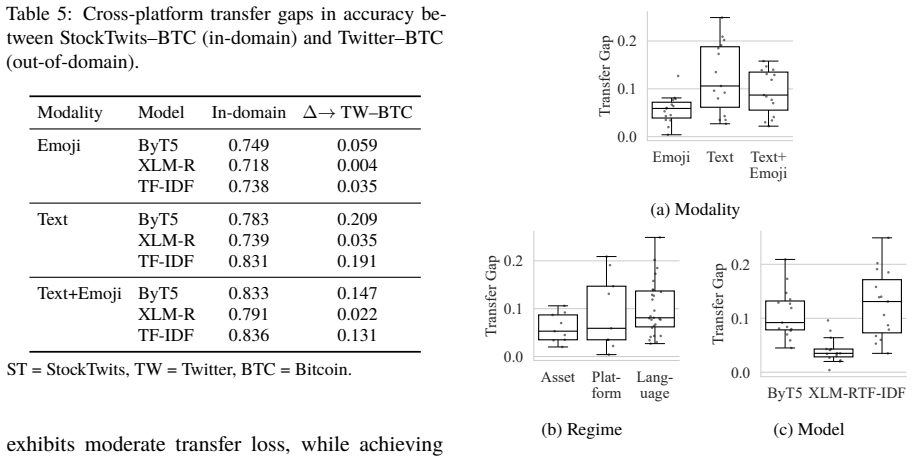
Financial communication exhibits a partially shared emoji code in which emoji semantics and sentiment polarity remain largely stable across communities despite differences in frequency, particularly across languages. Cross-asset transfer shows minimal degradation while cross-language transfer is more difficult, yet including emojis reduces these gaps compared to text-only models. Emojis thus serve as compact, language-independent sentiment cues that improve model generalization across markets and platforms.
What carries the argument
Cross-community divergence measurement of emoji frequencies, semantics, and sentiment polarity, evaluated through zero-shot sentiment transfer experiments using emoji-only, text-only, and combined inputs on multilingual financial corpora.
If this is right
- Sentiment models incorporating emojis show improved generalization when applied to new asset communities with minimal performance loss.
- Emojis help mitigate the larger challenges of cross-language sentiment transfer in financial discussions.
- A shared emoji-based sentiment code exists that operates independently of specific languages or platforms.
- Using emojis as features can make automated analysis of financial social media more robust across diverse markets.
Where Pith is reading between the lines
- The stability could allow for emoji-augmented models to monitor international financial sentiment with less need for per-language retraining.
- Similar shared codes might exist in other specialized online communities, such as those discussing technology or health.
- Testing the approach on emerging platforms or additional languages would further validate the extent of the shared emoji code.
Load-bearing premise
Differences in how well models perform are taken to reflect the stability of emoji semantics rather than differences in post quality or unique language styles within each community.
What would settle it
A direct comparison showing that human raters assign significantly different sentiment values to the same emojis in different financial language communities would falsify the stability of sentiment polarity.
Figures
read the original abstract
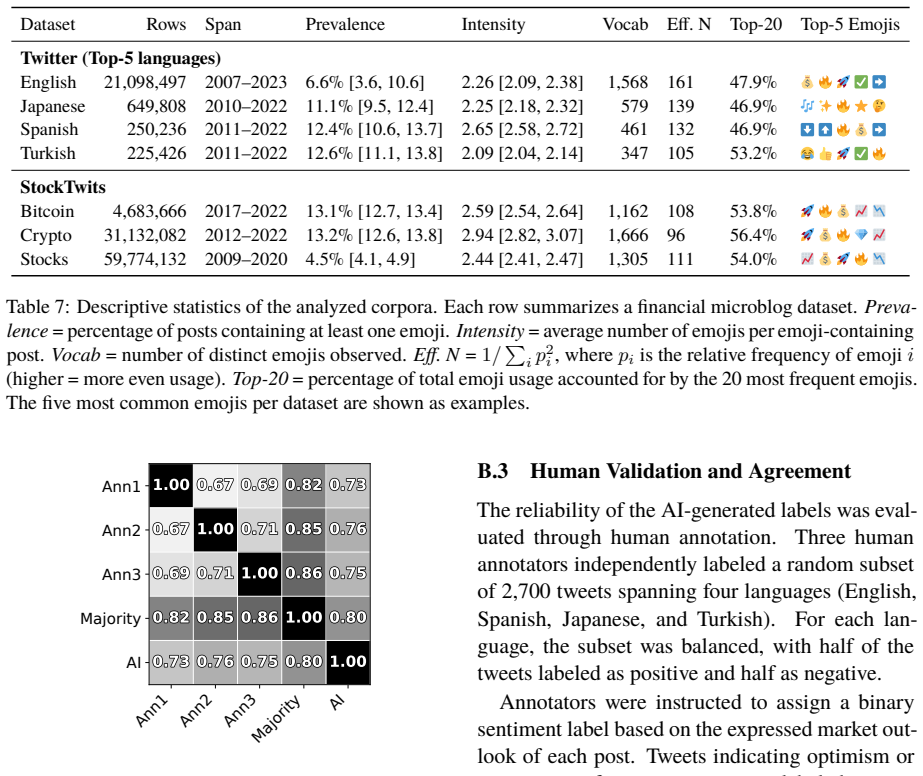
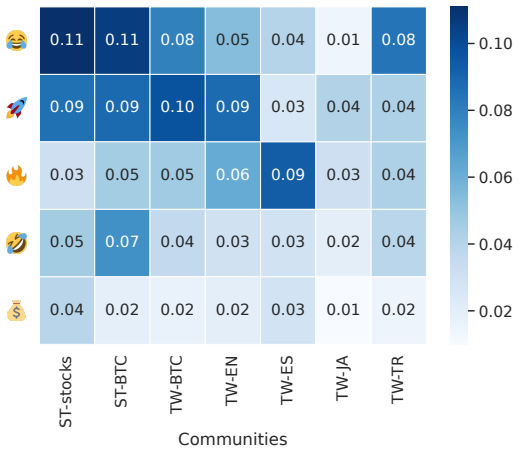
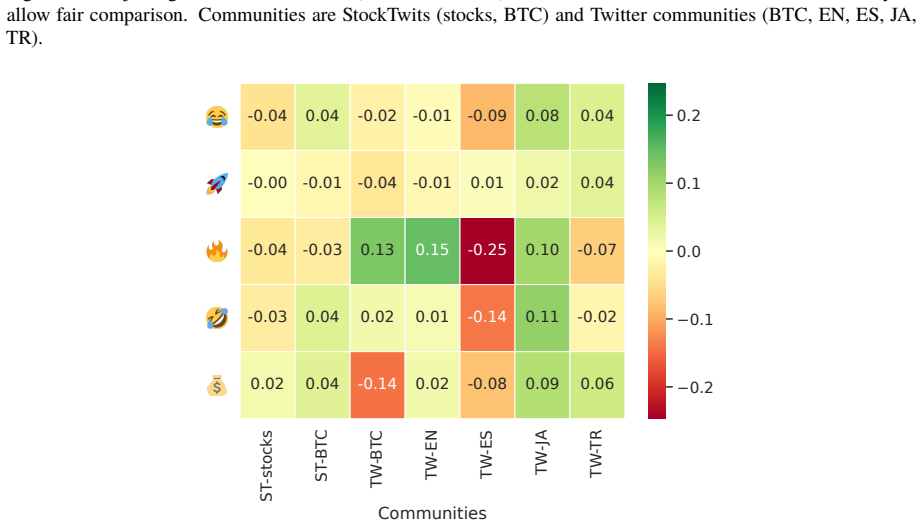
Emojis are widely used in online financial communication, but it is unclear whether they provide transferable sentiment signals across languages, platforms, and asset communities. This study examines the extent to which emoji usage, semantics, and sentiment polarity remain stable across financial communities, and how these layers influence zero-shot sentiment transfer. Using large corpora of Twitter and StockTwits posts in four languages, we measure cross-community divergence and evaluate sentiment models trained under emoji-only, text-only, and text+emoji inputs. We find that emoji frequencies differ across communities, especially across languages, but their semantics and sentiment polarity are largely stable. Cross-asset transferability shows minimal degradation, while cross-language transfer remains the most challenging. Including emojis consistently reduces transfer gaps relative to text-only models. These results indicate that financial communication exhibits a partially shared ``emoji code,'' and that emojis provide compact, language-independent sentiment cues that improve model generalization across markets and platforms.
Editorial analysis
A structured set of objections, weighed in public.
Referee Report
Summary. The paper examines emoji usage, semantics, and sentiment polarity in financial social media across languages, platforms, and asset communities. Using large Twitter and StockTwits corpora in four languages, it quantifies cross-community divergence in emoji frequencies and evaluates sentiment models trained on emoji-only, text-only, and text+emoji inputs. The central findings are that emoji frequencies vary (especially across languages) but semantics and polarity remain largely stable, cross-asset transfer shows little degradation while cross-language transfer is harder, and including emojis consistently narrows transfer gaps relative to text-only baselines, supporting a partially shared 'emoji code' that supplies compact, language-independent sentiment cues.
Significance. If the empirical comparisons hold after controlling for confounds, the work supplies concrete evidence that emojis function as stable, transferable signals in financial discourse. This has direct value for zero-shot multilingual sentiment systems in finance and for broader theories of cross-cultural digital pragmatics. The multi-corpus, multi-input design is a strength that allows falsifiable tests of stability versus frequency divergence.
major comments (1)
- [Evaluation / Results] The interpretation that performance gaps between text-only and text+emoji models directly index emoji semantic stability (rather than differences in text length, lexical diversity, or community-specific phrasing) is load-bearing for the 'partially shared emoji code' claim. The manuscript should report explicit controls or ablation checks for these factors in the model comparison sections.
minor comments (1)
- [Abstract / Methods] The abstract and methods summary omit concrete details on corpus sizes, annotation procedures, model architectures, and statistical tests for stability; adding these (e.g., exact token counts per language/platform and significance thresholds) would improve reproducibility without altering the central argument.
Simulated Author's Rebuttal
We thank the referee for the constructive feedback and positive overall assessment. We address the single major comment below and will revise the manuscript accordingly.
read point-by-point responses
-
Referee: [Evaluation / Results] The interpretation that performance gaps between text-only and text+emoji models directly index emoji semantic stability (rather than differences in text length, lexical diversity, or community-specific phrasing) is load-bearing for the 'partially shared emoji code' claim. The manuscript should report explicit controls or ablation checks for these factors in the model comparison sections.
Authors: We agree that the performance gaps are central to the 'partially shared emoji code' interpretation and that potential confounds must be explicitly ruled out. Our current design trains and evaluates all model variants on identical post sets, differing only in emoji token inclusion. Nevertheless, we acknowledge that sequence length, lexical diversity, and community phrasing could contribute. In the revised manuscript we will add: (1) summary statistics on average token length and type-token ratio per community and input condition; (2) a length-matched ablation (truncation/padding to equal sequence lengths); and (3) a control replacing emojis with frequency-matched neutral tokens. These checks will be reported in the model comparison sections to strengthen the causal link to emoji semantics. revision: yes
Circularity Check
No significant circularity
full rationale
The paper is a purely empirical study that measures emoji frequency, semantics, and polarity stability across four languages and two platforms using external corpora (Twitter and StockTwits) and standard ML baselines (emoji-only, text-only, and combined models). All reported results—cross-community divergence, transfer gaps, and generalization improvements—are obtained by direct evaluation on held-out data splits rather than by any internal derivation, fitted parameter renamed as prediction, or self-citation chain. No equations, uniqueness theorems, or ansatzes are invoked that reduce to the paper’s own inputs; the central claim follows from observable performance differences on independent test sets.
Axiom & Free-Parameter Ledger
axioms (1)
- domain assumption Social media data from financial platforms accurately reflects user sentiments and emoji usage patterns.
Reference graph
Works this paper leans on
-
[1]
Proceedings of the World Wide Web Conference , pages=
Emoji-powered representation learning for cross-lingual sentiment classification , author=. Proceedings of the World Wide Web Conference , pages=. 2019 , organization=
work page 2019
-
[2]
Regulaton (EU) 2016/679 (General Date Protection Regulation) , journal =
work page 2016
-
[3]
Proceedings of the thirteenth language resources and evaluation conference , pages=
XLM-T: Multilingual language models in Twitter for sentiment analysis and beyond , author=. Proceedings of the thirteenth language resources and evaluation conference , pages=
-
[4]
Mahrous, Ahmed and Di Pietro, Roberto , title =. 2026 , publisher =. doi:10.5281/zenodo.19660908 , url =
-
[5]
The model arena for cross-lingual sentiment analysis: a comparative study in the era of large language models , author=. Proceedings of the 14th Workshop on Computational Approaches to Subjectivity, Sentiment, & Social Media Analysis , pages=
-
[6]
Unsupervised Cross-lingual Representation Learning at Scale , author=. Proceedings of the 58th Annual Meeting of the Association for Computational Linguistics (ACL) , pages=
-
[7]
Proceedings of the International AAAI Conference on Web and Social Media , volume=
Studying cultural differences in emoji usage across the east and the west , author=. Proceedings of the International AAAI Conference on Web and Social Media , volume=
-
[8]
Language and Semiotic Studies , volume=
Communication challenges and transformations in the Digital Era: emoji language and emoji translation , author=. Language and Semiotic Studies , volume=
-
[9]
Learning from the ubiquitous language: an empirical analysis of emoji usage of smartphone users , author=. Proceedings of the 2016 ACM International Joint Conference on Pervasive and Ubiquitous Computing , pages=
work page 2016
-
[10]
International Conference on Human-Computer Interaction , pages=
Emoji Interpretation and Usage in Bilingual Communication , author=. International Conference on Human-Computer Interaction , pages=. 2024 , publisher=
work page 2024
-
[11]
Proceedings of the 24th ACM International Conference on Multimedia , pages=
How cosmopolitan are emojis? Exploring emoji usage and meaning over different languages with distributional semantics , author=. Proceedings of the 24th ACM International Conference on Multimedia , pages=
-
[12]
Journal of Pragmatics , volume=
Digitally saving face: An experimental investigation of cross-cultural differences in the use of emoticons and emoji , author=. Journal of Pragmatics , volume=
-
[13]
Computers in Human Behavior , volume=
Age and gender in language, emoji, and emoticon usage in instant messages , author=. Computers in Human Behavior , volume=
-
[14]
International Journal of Web Information Systems , volume=
Multilingual emoji prediction using BERT for sentiment analysis , author=. International Journal of Web Information Systems , volume=
-
[15]
Frontiers in Psychology , volume=
A systematic review of emoji: Current research and future perspectives , author=. Frontiers in Psychology , volume=
-
[16]
Proceedings of the 10th Web as Corpus Workshop (WAC-X) and the EmpiriST Shared Task , pages=
A Global Analysis of Emoji Usage , author=. Proceedings of the 10th Web as Corpus Workshop (WAC-X) and the EmpiriST Shared Task , pages=. 2016 , organization=
work page 2016
-
[17]
International Journal of Forecasting , volume =
The impact of sentiment and attention measures on stock market volatility , author =. International Journal of Forecasting , volume =
-
[18]
Progress in Artificial Intelligence (EPIA 2013) , series =
On the Predictability of Stock Market Behavior Using StockTwits Sentiment and Posting Volume , author =. Progress in Artificial Intelligence (EPIA 2013) , series =. 2013 , publisher =
work page 2013
- [19]
-
[20]
ChatGPT Label: Comparing the Quality of Human-Generated and LLM-Generated Annotations in Low-Resource Language NLP Tasks , author =. IEEE Access , volume =
-
[21]
Proceedings of the National Academy of Sciences , year =
ChatGPT Outperforms Crowd Workers for Text Annotation Tasks , author =. Proceedings of the National Academy of Sciences , year =
-
[22]
doi:10.48550/arXiv.2303.16854 , abstract =
AnnoLLM: Making Large Language Models to Be Better Crowdsourced Annotators , author =. arXiv preprint arXiv:2303.16854 , year =
-
[23]
Information and Software Technology , volume=
Benchmarking large language models for automated labeling: The case of issue report classification , author=. Information and Software Technology , volume=
-
[24]
arXiv preprint arXiv:2411.05045 , year=
Performance-Guided LLM Knowledge Distillation for Efficient Text Classification at Scale , author=. arXiv preprint arXiv:2411.05045 , year=
-
[25]
B y T 5: Towards a Token-Free Future with Pre-trained Byte-to-Byte Models
Xue, Linting and Barua, Aditya and Constant, Noah and Al-Rfou, Rami and Narang, Sharan and Kale, Mihir and Roberts, Adam and Raffel, Colin , editor =. B y T 5: Towards a Token-Free Future with Pre-trained Byte-to-Byte Models. Transactions of the Association for Computational Linguistics , volume =. 2022 , pages =
work page 2022
-
[26]
MediaPipe Language Detector , year =
- [27]
-
[28]
Proceedings of the ACL 2012 System Demonstrations , year =
Marco Lui and Timothy Baldwin , title =. Proceedings of the ACL 2012 System Demonstrations , year =
work page 2012
-
[29]
Armand Joulin and Edouard Grave and Piotr Bojanowski and Tomas Mikolov , title =. Proceedings of the 15th Conference of the European Chapter of the Association for Computational Linguistics (EACL) , year =
-
[30]
StockTwits Classified Sentiment and Stock Returns , author =. Digital Finance , volume =
-
[31]
Why Don't We Agree? Evidence from a Social Network of Investors , author =. Journal of Finance , volume =
-
[32]
Emoji Statistics , year =
-
[33]
Industrial Management & Data Systems , volume=
An empirical analysis of emoji usage on Twitter , author=. Industrial Management & Data Systems , volume=
-
[34]
Proceedings of the 2019 CHI Conference on Human Factors in Computing Systems , pages=
Examining the ``global'' language of emojis: Designing for cultural representation , author=. Proceedings of the 2019 CHI Conference on Human Factors in Computing Systems , pages=
work page 2019
-
[35]
Intercultural Pragmatics , volume=
Do you kiss when you text? Cross-cultural differences in the use of the kissing emojis in three WhatsApp corpora , author=. Intercultural Pragmatics , volume=
-
[36]
Individual differences in emoji comprehension: Gender, age, and culture , author=. PLOS ONE , volume=
-
[37]
Proceedings of the International AAAI Conference on Web and Social Media , volume=
Understanding emoji ambiguity in context: The role of text in emoji-related miscommunication , author=. Proceedings of the International AAAI Conference on Web and Social Media , volume=
-
[38]
Proceedings of the Sixth Arabic Natural Language Processing Workshop , pages=
Arabic emoji sentiment lexicon (Arab-ESL): A comparison between Arabic and European emoji sentiment lexicons , author=. Proceedings of the Sixth Arabic Natural Language Processing Workshop , pages=
-
[39]
Proceedings of the International AAAI Conference on Web and Social Media , volume=
``Blissfully happy'' or ``ready to fight'': Varying interpretations of emoji , author=. Proceedings of the International AAAI Conference on Web and Social Media , volume=
-
[40]
Proceedings of The 12th International Workshop on Semantic Evaluation , pages=
SemEval-2018 Task 2: Multilingual Emoji Prediction , author=. Proceedings of The 12th International Workshop on Semantic Evaluation , pages=
work page 2018
-
[41]
Journal of International and Intercultural Communication , volume=
Understanding emojis: Cultural influences in interpretation and choice of emojis , author=. Journal of International and Intercultural Communication , volume=
-
[42]
Proceedings of the International Conference on Information Systems (ICIS) , year=
Understanding emojis for financial sentiment analysis , author=. Proceedings of the International Conference on Information Systems (ICIS) , year=
-
[43]
The role of emojis in sentiment analysis of financial microblogs , author=. 2023 Fourth International Conference on Intelligent Data Science Technologies and Applications (IDSTA) , pages=. 2023 , organization=
work page 2023
-
[44]
Review of Behavioral Finance , volume=
Emojis and stock returns , author=. Review of Behavioral Finance , volume=
-
[45]
Journal of Information Systems , volume=
Is an emoji worth a thousand words? The effect of emoji usage on nonprofessional investors' perceptions , author=. Journal of Information Systems , volume=
-
[46]
Computational Management Science , volume=
A comprehensive study of domain-specific emoji meanings in sentiment classification , author=. Computational Management Science , volume=
-
[47]
Sentiment analysis and machine learning in finance: A comparison of methods and models on one million messages , author=. Digital Finance , volume=
-
[48]
Bitcoin Twitter Sentiment Dataset (2013--2023) , author =. 2023 , howpublished =
work page 2013
-
[49]
Bitcoin Tweets 2016-01-01 to 2019-03-29 , author =. 2019 , howpublished =
work page 2016
discussion (0)
Sign in with ORCID, Apple, or X to comment. Anyone can read and Pith papers without signing in.