Generating synthetic electronic health record data using agent-based models to evaluate machine learning robustness under mass casualty incidents
Pith reviewed 2026-05-12 03:43 UTC · model grok-4.3
The pith
Agent-based models of emergency departments generate synthetic EHR data to test whether machine learning models for length-of-stay prediction lose performance under mass casualty incident conditions.
A machine-rendered reading of the paper's core claim, the machinery that carries it, and where it could break.
Core claim
We observed consistent declines in recall under MCI conditions relative to baseline system conditions, resulting in an increase in the number of patients with prolonged length of stay that were missed by the ML models.
Load-bearing premise
That changing parameters in the agent-based model to reflect plausible MCI scenarios produces synthetic EHR data whose statistical properties and clinical implications match those that would arise in an actual mass casualty incident.
Figures
read the original abstract
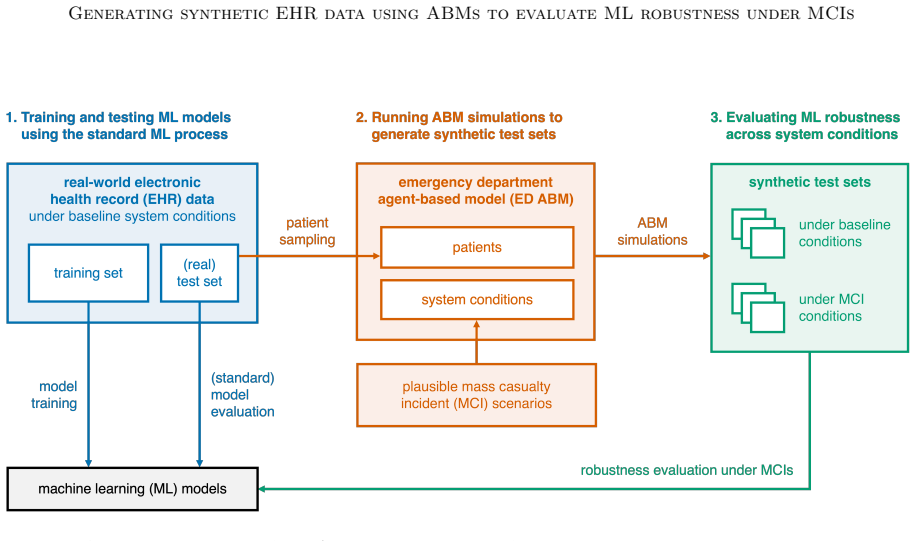
ML models in healthcare are typically evaluated using curated real-world EHR data. A key limitation of such evaluations is that they may fail to assess the robustness of ML models to changes in the data at deployment, which is a common issue because EHR data used for ML model development cannot capture all such changes. Mass casualty incidents (MCIs) caused by disasters are critical instances where this will be an issue, as they induce rare, uncertain, and novel changes to routine system conditions. Because real-world EHR data from MCIs are often limited or unavailable, assessing ML robustness under such conditions before deployment remains challenging. Here, we propose an agent-based modelling approach for generating synthetic EHR data to evaluate the robustness of ML models under MCI scenarios. We use real-world EHR data to develop and calibrate an agent-based model (ABM) of an emergency department (ED) that explicitly models patient arrivals, resource capacity, and clinical workflow. By changing these system conditions to reflect plausible MCI scenarios, the ED model generates synthetic versions of the real-world EHR data that exhibit shifts in system behaviour. Using these synthetic data, we test ML models for predicting length of stay. We observed consistent declines in recall under MCI conditions relative to baseline system conditions, resulting in an increase in the number of patients with prolonged length of stay that were missed by the ML models. These results highlight the impact of changes in system conditions on patient outcomes, EHR data, and ML model performance. Our work establishes ABM-based synthetic EHR data generation as a proactive and systematic approach for evaluating the robustness of ML models under MCI or other system conditions not captured in real-world EHR data, supporting the safer and more effective deployment of ML models in healthcare systems.
Editorial analysis
A structured set of objections, weighed in public.
Referee Report
Summary. The manuscript proposes calibrating an agent-based model (ABM) of an emergency department on real-world EHR data, then perturbing exogenous parameters (patient arrival rates, resource capacities, workflow) to generate synthetic EHR under plausible mass casualty incident (MCI) conditions. ML models for predicting length of stay (LOS) are evaluated on both baseline and MCI synthetic data, with the central empirical claim being consistent declines in recall under MCI conditions that result in more missed patients with prolonged LOS.
Significance. If the ABM perturbations produce data whose statistical and clinical properties match those of actual MCIs, the work supplies a practical method for stress-testing healthcare ML models against rare distribution shifts not present in standard training sets. This could support more robust deployment decisions and extend to other system-level disruptions.
major comments (2)
- [Abstract] Abstract and ABM description: the reported declines in recall and increase in missed prolonged-LOS cases rest on the assumption that MCI-parameterized synthetic data reproduce the relevant statistical and clinical shifts of real incidents, yet no quantitative validation against held-out real MCI records, no sensitivity checks on chosen parameter ranges, and no error bars or statistical tests on the recall changes are supplied.
- [Methods] Methods (ABM calibration and perturbation): the workflow first fits the ABM to routine EHR then applies unvalidated 'plausible' MCI changes; because the performance drop is measured exclusively on the resulting out-of-distribution synthetic samples, the absence of any direct comparison to real MCI data or known MCI signatures (e.g., surge arrival distributions) makes the robustness claim dependent on an untested modeling assumption.
minor comments (1)
- [Abstract] The abstract states 'consistent declines' without numerical values, confidence intervals, or the number of models and runs; adding these would improve clarity.
Simulated Author's Rebuttal
We thank the referee for their constructive comments, which highlight important aspects of validating our synthetic data generation approach. We address each major comment below and indicate where revisions will be made to strengthen the manuscript.
read point-by-point responses
-
Referee: [Abstract] Abstract and ABM description: the reported declines in recall and increase in missed prolonged-LOS cases rest on the assumption that MCI-parameterized synthetic data reproduce the relevant statistical and clinical shifts of real incidents, yet no quantitative validation against held-out real MCI records, no sensitivity checks on chosen parameter ranges, and no error bars or statistical tests on the recall changes are supplied.
Authors: We acknowledge that the manuscript would benefit from greater transparency on the validation of the MCI scenarios. Real MCI EHR data is scarce and typically unavailable for direct held-out comparison, which is the core motivation for the ABM-based synthetic generation method. In revision we will add sensitivity analyses varying the perturbation ranges (e.g., arrival rate multipliers and capacity reductions), report error bars on all recall metrics, and include statistical tests (paired t-tests or Wilcoxon signed-rank tests with p-values) for the observed declines. The abstract will be updated to explicitly state that MCI conditions are generated via literature-informed plausible perturbations rather than direct empirical matching. revision: partial
-
Referee: [Methods] Methods (ABM calibration and perturbation): the workflow first fits the ABM to routine EHR then applies unvalidated 'plausible' MCI changes; because the performance drop is measured exclusively on the resulting out-of-distribution synthetic samples, the absence of any direct comparison to real MCI data or known MCI signatures (e.g., surge arrival distributions) makes the robustness claim dependent on an untested modeling assumption.
Authors: The ABM is calibrated and validated against the real routine EHR dataset for patient flow statistics, arrival patterns, and resource utilization under normal conditions. MCI perturbations are drawn from documented effects in the disaster medicine literature (e.g., 2- to 5-fold arrival surges and temporary capacity constraints). We will expand the Methods section to cite specific MCI signature references and add a new subsection comparing our chosen parameter shifts to observed surge distributions from historical incidents. Direct empirical comparison to real MCI records remains impossible given data scarcity, but the revised text will clarify this limitation and position the work as a framework that can incorporate such data when available. revision: partial
- Direct quantitative validation or comparison against held-out real MCI records, as such data is limited or unavailable.
Circularity Check
No significant circularity; ABM calibration and parameter perturbation remain independent of ML evaluation outcomes
full rationale
The paper calibrates an ABM on real-world EHR to model baseline ED arrivals, capacity and workflow, then applies exogenous parameter changes to generate synthetic EHR under MCI scenarios before evaluating pre-trained ML models for length-of-stay prediction on that data. This chain does not reduce any load-bearing claim to its own inputs by construction: the MCI perturbations are not fitted to the recall metric, the synthetic data statistics are produced by the ABM rules rather than redefined from the ML results, and no self-citation or uniqueness theorem is invoked to force the method. The observed recall decline is a direct computation on the generated outputs and therefore constitutes an independent simulation experiment rather than a tautology.
Axiom & Free-Parameter Ledger
free parameters (2)
- MCI patient arrival rates
- ED resource capacities under MCI
axioms (1)
- domain assumption The agent-based model of patient arrivals, resource capacity, and clinical workflow captures the key mechanisms that alter EHR distributions during MCIs.
Lean theorems connected to this paper
-
IndisputableMonolith/Foundation/AbsoluteFloorClosure.leanreality_from_one_distinction unclear?
unclearRelation between the paper passage and the cited Recognition theorem.
We use real-world EHR data to develop and calibrate an agent-based model (ABM) of an emergency department (ED) that explicitly models patient arrivals, resource capacity, and clinical workflow. By changing these system conditions to reflect plausible MCI scenarios...
-
IndisputableMonolith/Cost/FunctionalEquation.leanwashburn_uniqueness_aczel unclear?
unclearRelation between the paper passage and the cited Recognition theorem.
We observed consistent declines in recall under MCI conditions relative to baseline system conditions...
What do these tags mean?
- matches
- The paper's claim is directly supported by a theorem in the formal canon.
- supports
- The theorem supports part of the paper's argument, but the paper may add assumptions or extra steps.
- extends
- The paper goes beyond the formal theorem; the theorem is a base layer rather than the whole result.
- uses
- The paper appears to rely on the theorem as machinery.
- contradicts
- The paper's claim conflicts with a theorem or certificate in the canon.
- unclear
- Pith found a possible connection, but the passage is too broad, indirect, or ambiguous to say the theorem truly supports the claim.
Reference graph
Works this paper leans on
-
[1]
A scoping review of robustness concepts for machine learning in healthcare
Alan Balendran, C \'e line Beji, Florie Bouvier, Ottavio Khalifa, Theodoros Evgeniou, Philippe Ravaud, and Rapha \"e l Porcher. A scoping review of robustness concepts for machine learning in healthcare. npj Digital Medicine, 8 0 (1): 0 38, January 2025. ISSN 2398-6352. URL https://doi.org/10.1038/s41746-024-01420-1
-
[2]
Steven L. Bernstein, Dominik Aronsky, Reena Duseja, Stephen Epstein, Dan Handel, Ula Hwang, Melissa McCarthy, K. John McConnell, Jesse M. Pines, Niels Rathlev, Robert Schafermeyer, Frank Zwemer, Michael Schull, Brent R. Asplin, and Society for Academic Emergency Medicine, Emergency Department Crowding Task Force . The Effect of Emergency Department Crowdi...
-
[3]
Agent-based modeling: Methods and techniques for simulating human systems
Eric Bonabeau. Agent-based modeling: Methods and techniques for simulating human systems. Proceedings of the National Academy of Sciences, 99 0 (suppl\_3): 0 7280--7287, May 2002. ISSN 0027-8424, 1091-6490. URL https://doi.org/10.1073/pnas.082080899
-
[4]
Dawn M. Bravata, Anthony J. Perkins, Laura J. Myers, Greg Arling, Ying Zhang, Alan J. Zillich, Lindsey Reese, Andrew Dysangco, Rajiv Agarwal, Jennifer Myers, Charles Austin, Ali Sexson, Samuel J. Leonard, Sharmistha Dev, and Salomeh Keyhani. Association of Intensive Care Unit Patient Load and Demand With Mortality Rates in US Department of Veterans Affair...
-
[5]
Evaluation of synthetic electronic health records: A systematic review and experimental assessment
Emmanuella Budu, Kobra Etminani, Amira Soliman, and Thorsteinn R \"o gnvaldsson. Evaluation of synthetic electronic health records: A systematic review and experimental assessment. Neurocomputing, 603: 0 128253, October 2024. ISSN 09252312. URL https://doi.org/10.1016/j.neucom.2024.128253
-
[6]
Carrington, Jamie Ranse, and Karen Hammad
Mercedes A. Carrington, Jamie Ranse, and Karen Hammad. The impact of disasters on emergency department resources: Review against the Sendai framework for disaster risk reduction 2015--2030. Australasian Emergency Care, 24 0 (1): 0 55--60, March 2021. ISSN 2588994X. URL https://doi.org/10.1016/j.auec.2020.09.003
-
[7]
Roben Delos Reyes, Daniel Capurro, and Nicholas Geard. Modelling patient trajectories in emergency department simulations using retrospective patient cohorts. Computers in Biology and Medicine, 182: 0 109147, November 2024. ISSN 00104825. URL https://doi.org/10.1016/j.compbiomed.2024.109147
-
[8]
Data assimilation in emergency department simulations for real-time disaster response
Roben Delos Reyes, Daniel Capurro, and Nicholas Geard. Data assimilation in emergency department simulations for real-time disaster response. International Journal of Disaster Risk Reduction, 133: 0 105995, February 2026. ISSN 22124209. URL https://doi.org/10.1016/j.ijdrr.2026.105995
-
[9]
Raheleh Mahboub Farimani, Hesam Karim, Alireza Atashi, Fariba Tohidinezhad, Kambiz Bahaadini, Ameen Abu-Hanna , and Saeid Eslami. Models to predict length of stay in the emergency department: A systematic literature review and appraisal. BMC Emergency Medicine, 24 0 (1): 0 54, April 2024. ISSN 1471-227X. URL https://doi.org/10.1186/s12873-024-00965-4
-
[10]
Samuel G. Finlayson, Adarsh Subbaswamy, Karandeep Singh, John Bowers, Annabel Kupke, Jonathan Zittrain, Isaac S. Kohane, and Suchi Saria. The Clinician and Dataset Shift in Artificial Intelligence . New England Journal of Medicine, 385 0 (3): 0 283--286, July 2021. ISSN 0028-4793, 1533-4406. URL https://doi.org/10.1056/NEJMc2104626
-
[11]
Roberto Forero, Shizar Nahidi, Josephine De Costa, Daniel Fatovich, Gerry FitzGerald, Sam Toloo, Sally McCarthy, David Mountain, Nick Gibson, Mohammed Mohsin, and Wing Nicola Man. Perceptions and experiences of emergency department staff during the implementation of the four-hour rule/national emergency access target policy in Australia : A qualitative so...
-
[12]
Synthetic Population Dynamics : A Model of Household Demography
Nicholas Geard, James M McCaw, Alan Dorin, Kevin B Korb, and Jodie McVernon. Synthetic Population Dynamics : A Model of Household Demography . Journal of Artificial Societies and Social Simulation, 16 0 (1): 0 8, January 2013. ISSN 1460-7425. URL https://doi.org/10.18564/jasss.2098
-
[13]
Ary L. Goldberger, Luis A. N. Amaral, Leon Glass, Jeffrey M. Hausdorff, Plamen Ch. Ivanov, Roger G. Mark, Joseph E. Mietus, George B. Moody, Chung-Kang Peng, and H. Eugene Stanley. PhysioBank , PhysioToolkit , and PhysioNet : Components of a New Research Resource for Complex Physiologic Signals . Circulation, 101 0 (23), June 2000. ISSN 0009-7322, 1524-45...
-
[14]
Aldren Gonzales, Guruprabha Guruswamy, and Scott R. Smith. Synthetic data in health care: A narrative review. PLOS Digital Health, 2 0 (1): 0 e0000082, January 2023. ISSN 2767-3170. URL https://doi.org/10.1371/journal.pdig.0000082
-
[15]
Synthetic data generation for tabular health records: A systematic review
Mikel Hernandez, Gorka Epelde, Ane Alberdi, Rodrigo Cilla, and Debbie Rankin. Synthetic data generation for tabular health records: A systematic review. Neurocomputing, 493: 0 28--45, July 2022. ISSN 09252312. URL https://doi.org/10.1016/j.neucom.2022.04.053
-
[16]
C. Beau Hilton, Alex Milinovich, Christina Felix, Nirav Vakharia, Timothy Crone, Chris Donovan, Andrew Proctor, and Aziz Nazha. Personalized predictions of patient outcomes during and after hospitalization using artificial intelligence. npj Digital Medicine, 3 0 (1): 0 51, April 2020. ISSN 2398-6352. URL https://doi.org/10.1038/s41746-020-0249-z
-
[17]
Alistair Johnson, Lucas Bulgarelli, Tom Pollard, Leo Anthony Celi, Roger Mark, and Steven Horng. MIMIC-IV-ED . PhysioNet , January 2023 a . URL https://doi.org/10.13026/5ntk-km72. Version 2.2
-
[18]
Alistair Johnson, Lucas Bulgarelli, Tom Pollard, Steven Horng, Leo Anthony Celi, and Roger Mark. MIMIC-IV . PhysioNet , January 2023 b . URL https://doi.org/10.13026/6mm1-ek67. Version 2.2
-
[19]
Alistair E. W. Johnson, Lucas Bulgarelli, Lu Shen, Alvin Gayles, Ayad Shammout, Steven Horng, Tom J. Pollard, Sicheng Hao, Benjamin Moody, Brian Gow, Li-wei H. Lehman, Leo A. Celi, and Roger G. Mark. MIMIC-IV , a freely accessible electronic health record dataset. Scientific Data, 10 0 (1): 0 1, January 2023 c . ISSN 2052-4463. URL https://doi.org/10.1038...
-
[20]
Kadri, Junfeng Sun, Alexander Lawandi, Jeffrey R
Sameer S. Kadri, Junfeng Sun, Alexander Lawandi, Jeffrey R. Strich, Lindsay M. Busch, Michael Keller, Ahmed Babiker, Christina Yek, Seidu Malik, Janell Krack, John P. Dekker, Alicen B. Spaulding, Emily Ricotta, John H. Powers, Chanu Rhee, Michael Klompas, Janhavi Athale, Tegan K. Boehmer, Adi V. Gundlapalli, William Bentley, S. Deblina Datta, Robert L. Da...
-
[21]
Yi-Chih Lee, Chip-Jin Ng, Chun-Chuan Hsu, Chien-Wei Cheng, and Shou-Yen Chen. Machine learning models for predicting unscheduled return visits to an emergency department: A scoping review. BMC Emergency Medicine, 24 0 (1): 0 20, January 2024. ISSN 1471-227X. URL https://doi.org/10.1186/s12873-024-00939-6
-
[22]
Karim Lekadir, Alejandro F Frangi, Antonio R Porras, Ben Glocker, Celia Cintas, Curtis P Langlotz, Eva Weicken, Folkert W Asselbergs, Fred Prior, Gary S Collins, Georgios Kaissis, Gianna Tsakou, Ir \`e ne Buvat, Jayashree Kalpathy-Cramer , John Mongan, Julia A Schnabel, Kaisar Kushibar, Katrine Riklund, Kostas Marias, Lameck M Amugongo, Lauren A Fromont, ...
-
[23]
Zhengchun Liu, Dolores Rexachs, Francisco Epelde, and Emilio Luque. An agent-based model for quantitatively analyzing and predicting the complex behavior of emergency departments. Journal of Computational Science, 21: 0 11--23, July 2017. ISSN 18777503. URL https://doi.org/10.1016/j.jocs.2017.05.015
-
[24]
Kernbach, Roshan Kenia, Julian N
Luyang Luo, Sung Eun Kim, Xiaoman Zhang, Julius M. Kernbach, Roshan Kenia, Julian N. Acosta, Larry A. Nathanson, Adrian D. Haimovich, Adam Rodman, Ethan Goh, Jonathan H. Chen, Nigam H. Shah, David A. Kim, James Zou, Faisal Mahmood, Jakob Nikolas Kather, Matthew Lungren, Vivek Natarajan, Eric J. Topol, and Pranav Rajpurkar. A clinical environment simulator...
-
[25]
Peterson, Jim Stankovich, and Leigh Kinsman
Claire Morley, Maria Unwin, Gregory M. Peterson, Jim Stankovich, and Leigh Kinsman. Emergency department crowding: A systematic review of causes, consequences and solutions. PLOS ONE, 13 0 (8): 0 e0203316, August 2018. ISSN 1932-6203. URL https://doi.org/10.1371/journal.pone.0203316
-
[26]
Bret Nestor, Matthew B A McDermott, Willie Boag, Gabriela Berner, Tristan Naumann, Michael C Hughes, Anna Goldenberg, and Marzyeh Ghassemi. Feature Robustness in Non-stationary Health Records: Caveats to Deployable Model Performance in Common Clinical Machine Learning Tasks . In Proceedings of the 4th Machine Learning for Healthcare Conference, volume 106...
work page 2019
-
[27]
Eric G Poon, Christy Harris Lemak, Juan C Rojas, Janet Guptill, and David Classen. Adoption of artificial intelligence in healthcare: Survey of health system priorities, successes, and challenges. Journal of the American Medical Informatics Association, 32 0 (7): 0 1093--1100, July 2025. ISSN 1067-5027, 1527-974X. URL https://doi.org/10.1093/jamia/ocaf065
-
[28]
A synthetic population for agent-based modelling in Canada
Manon Pr \'e dhumeau and Ed Manley. A synthetic population for agent-based modelling in Canada . Scientific Data, 10 0 (1): 0 148, March 2023. ISSN 2052-4463. URL https://doi.org/10.1038/s41597-023-02030-4
-
[29]
Process mining in healthcare: A literature review
Eric Rojas, Jorge Munoz-Gama , Marcos Sep \'u lveda, and Daniel Capurro. Process mining in healthcare: A literature review. Journal of Biomedical Informatics, 61: 0 224--236, June 2016. ISSN 15320464. URL https://doi.org/10.1016/j.jbi.2016.04.007
-
[30]
Florian Stertz, Juergen Mangler, and Stefanie Rinderle-Ma . Temporal Conformance Checking at Runtime based on Time-infused Process Models , August 2020. URL https://doi.org/10.48550/arXiv.2008.07262
-
[31]
A systematic review of the prediction of hospital length of stay: Towards a unified framework
Kieran Stone, Reyer Zwiggelaar, Phil Jones, and Neil Mac Parthal \'a in. A systematic review of the prediction of hospital length of stay: Towards a unified framework. PLOS Digital Health, 1 0 (4): 0 e0000017, April 2022. ISSN 2767-3170. URL https://doi.org/10.1371/journal.pdig.0000017
-
[32]
Melissa Tracy, Magdalena Cerd \'a , and Katherine M. Keyes. Agent- Based Modeling in Public Health : Current Applications and Future Directions . Annual Review of Public Health, 39 0 (1): 0 77--94, April 2018. ISSN 0163-7525, 1545-2093. URL https://doi.org/10.1146/annurev-publhealth-040617-014317
-
[33]
Can You Rely on Your Model Evaluation ? Improving Model Evaluation with Synthetic Test Data
Boris van Breugel , Nabeel Seedat, Fergus Imrie, and Mihaela van der Schaar . Can You Rely on Your Model Evaluation ? Improving Model Evaluation with Synthetic Test Data . In Advances in Neural Information Processing Systems, volume 36, pages 1889--1904. Curran Associates, Inc., December 2023. URL https://proceedings.neurips.cc/paper_files/paper/2023/file...
work page 1904
-
[34]
Lien Vanbrabant, Kris Braekers, Katrien Ramaekers, and Inneke Van Nieuwenhuyse. Simulation of emergency department operations: A comprehensive review of KPIs and operational improvements. Computers & Industrial Engineering, 131: 0 356--381, May 2019. ISSN 03608352. URL https://doi.org/10.1016/j.cie.2019.03.025
-
[35]
Paraskevas Vezyridis and Stephen Timmons. National targets, process transformation and local consequences in an NHS emergency department ( ED ): A qualitative study. BMC Emergency Medicine, 14 0 (1): 0 12, December 2014. ISSN 1471-227X. URL https://doi.org/10.1186/1471-227X-14-12
-
[36]
Synthetic population generation with public health characteristics for spatial agent-based models
Emma Von Hoene, Amira Roess, Hamdi Kavak, and Taylor Anderson. Synthetic population generation with public health characteristics for spatial agent-based models. PLOS Computational Biology, 21 0 (3): 0 e1012439, March 2025. ISSN 1553-7358. URL https://doi.org/10.1371/journal.pcbi.1012439
-
[37]
Wiler, Shari Welch, Jesse Pines, Jeremiah Schuur, Nick Jouriles, and Suzanne Stone-Griffith
Jennifer L. Wiler, Shari Welch, Jesse Pines, Jeremiah Schuur, Nick Jouriles, and Suzanne Stone-Griffith. Emergency Department Performance Measures Updates : Proceedings of the 2014 Emergency Department Benchmarking Alliance Consensus Summit . Academic Emergency Medicine, 22 0 (5): 0 542--553, May 2015. ISSN 1069-6563, 1553-2712. URL https://doi.org/10.111...
-
[38]
Lander Willem, Frederik Verelst, Joke Bilcke, Niel Hens, and Philippe Beutels. Lessons from a decade of individual-based models for infectious disease transmission: A systematic review (2006-2015). BMC Infectious Diseases, 17 0 (1): 0 612, December 2017. ISSN 1471-2334. URL https://doi.org/10.1186/s12879-017-2699-8
-
[39]
Feng Xie, Jun Zhou, Jin Wee Lee, Mingrui Tan, Siqi Li, Logasan S/O Rajnthern, Marcel Lucas Chee, Bibhas Chakraborty, An-Kwok Ian Wong, Alon Dagan, Marcus Eng Hock Ong, Fei Gao, and Nan Liu. Benchmarking emergency department prediction models with machine learning and public electronic health records. Scientific Data, 9 0 (1): 0 658, October 2022. ISSN 205...
-
[40]
Chao Yan, Yao Yan, Zhiyu Wan, Ziqi Zhang, Larsson Omberg, Justin Guinney, Sean D. Mooney, and Bradley A. Malin. A Multifaceted benchmarking of synthetic electronic health record generation models. Nature Communications, 13 0 (1): 0 7609, December 2022. ISSN 2041-1723. URL https://doi.org/10.1038/s41467-022-35295-1
-
[41]
PLOS Medicine15(11), e1002683 (2018)
John R. Zech, Marcus A. Badgeley, Manway Liu, Anthony B. Costa, Joseph J. Titano, and Eric Karl Oermann. Variable generalization performance of a deep learning model to detect pneumonia in chest radiographs: A cross-sectional study. PLOS Medicine, 15 0 (11): 0 e1002683, November 2018. ISSN 1549-1676. URL https://doi.org/10.1371/journal.pmed.1002683
-
[42]
Angela Zhang, Lei Xing, James Zou, and Joseph C. Wu. Shifting machine learning for healthcare from development to deployment and from models to data. Nature Biomedical Engineering, 6 0 (12): 0 1330--1345, July 2022. ISSN 2157-846X. URL https://doi.org/10.1038/s41551-022-00898-y
-
[43]
Johnson, Alistair E. W. and Bulgarelli, Lucas and Shen, Lu and Gayles, Alvin and Shammout, Ayad and Horng, Steven and Pollard, Tom J. and Hao, Sicheng and Moody, Benjamin and Gow, Brian and Lehman, Li-wei H. and Celi, Leo A. and Mark, Roger G. , year = 2023, month = jan, journal =
work page 2023
-
[44]
Johnson, Alistair and Bulgarelli, Lucas and Pollard, Tom and Horng, Steven and Celi, Leo Anthony and Mark, Roger , title =. 2023 , month = jan, note =
work page 2023
-
[45]
Johnson, Alistair and Bulgarelli, Lucas and Pollard, Tom and Celi, Leo Anthony and Mark, Roger and Horng, Steven , title =. 2023 , month = jan, note =
work page 2023
-
[46]
Goldberger, Ary L. and Amaral, Luis A. N. and Glass, Leon and Hausdorff, Jeffrey M. and Ivanov, Plamen Ch. and Mark, Roger G. and Mietus, Joseph E. and Moody, George B. and Peng, Chung-Kang and Stanley, H. Eugene , year = 2000, month = jun, journal =
work page 2000
-
[47]
Benchmarking Emergency Department Prediction Models with Machine Learning and Public Electronic Health Records , author =. Scientific Data , volume =
-
[48]
Computers in Biology and Medicine , volume =
Modelling Patient Trajectories in Emergency Department Simulations Using Retrospective Patient Cohorts , author =. Computers in Biology and Medicine , volume =
-
[49]
Poon, Eric G and Lemak, Christy Harris and Rojas, Juan C and Guptill, Janet and Classen, David , year = 2025, month = jul, journal =. Adoption of Artificial Intelligence in Healthcare: Survey of Health System Priorities, Successes, and Challenges , shorttitle =
work page 2025
-
[50]
Lee, Yi-Chih and Ng, Chip-Jin and Hsu, Chun-Chuan and Cheng, Chien-Wei and Chen, Shou-Yen , year = 2024, month = jan, journal =. Machine Learning Models for Predicting Unscheduled Return Visits to an Emergency Department: A Scoping Review , shorttitle =
work page 2024
-
[51]
A Systematic Review of the Prediction of Hospital Length of Stay:
Stone, Kieran and Zwiggelaar, Reyer and Jones, Phil and Mac Parthal. A Systematic Review of the Prediction of Hospital Length of Stay:. PLOS Digital Health , volume =
-
[52]
npj Digital Medicine , volume =
Personalized Predictions of Patient Outcomes during and after Hospitalization Using Artificial Intelligence , author =. npj Digital Medicine , volume =
-
[53]
Zech, John R. and Badgeley, Marcus A. and Liu, Manway and Costa, Anthony B. and Titano, Joseph J. and Oermann, Eric Karl , editor =. Variable Generalization Performance of a Deep Learning Model to Detect Pneumonia in Chest Radiographs:. PLOS Medicine , volume =
-
[54]
Nestor, Bret and McDermott, Matthew B A and Boag, Willie and Berner, Gabriela and Naumann, Tristan and Hughes, Michael C and Goldenberg, Anna and Ghassemi, Marzyeh , booktitle=. 2019 , volume=
work page 2019
-
[55]
Lekadir, Karim and Frangi, Alejandro F and Porras, Antonio R and Glocker, Ben and Cintas, Celia and Langlotz, Curtis P and Weicken, Eva and Asselbergs, Folkert W and Prior, Fred and Collins, Gary S and Kaissis, Georgios and Tsakou, Gianna and Buvat, Ir. BMJ , volume =
-
[56]
Synthetic Data Generation for Tabular Health Records:
Hernandez, Mikel and Epelde, Gorka and Alberdi, Ane and Cilla, Rodrigo and Rankin, Debbie , year = 2022, month = jul, journal =. Synthetic Data Generation for Tabular Health Records:
work page 2022
-
[57]
Gonzales, Aldren and Guruswamy, Guruprabha and Smith, Scott R. , editor =. Synthetic Data in Health Care:. PLOS Digital Health , volume =
-
[58]
npj Digital Medicine , volume =
A Scoping Review of Robustness Concepts for Machine Learning in Healthcare , author =. npj Digital Medicine , volume =
-
[59]
Yan, Chao and Yan, Yao and Wan, Zhiyu and Zhang, Ziqi and Omberg, Larsson and Guinney, Justin and Mooney, Sean D. and Malin, Bradley A. , year = 2022, month = dec, journal =. A
work page 2022
-
[60]
Evaluation of Synthetic Electronic Health Records:
Budu, Emmanuella and Etminani, Kobra and Soliman, Amira and R. Evaluation of Synthetic Electronic Health Records:. Neurocomputing , volume =
-
[61]
Bernstein, Steven L. and Aronsky, Dominik and Duseja, Reena and Epstein, Stephen and Handel, Dan and Hwang, Ula and McCarthy, Melissa and John McConnell, K. and Pines, Jesse M. and Rathlev, Niels and Schafermeyer, Robert and Zwemer, Frank and Schull, Michael and Asplin, Brent R. and. The. Academic Emergency Medicine , volume =
-
[62]
and Stankovich, Jim and Kinsman, Leigh , editor =
Morley, Claire and Unwin, Maria and Peterson, Gregory M. and Stankovich, Jim and Kinsman, Leigh , editor =. Emergency Department Crowding:. PLOS ONE , volume =
-
[63]
Farimani, Raheleh Mahboub and Karim, Hesam and Atashi, Alireza and Tohidinezhad, Fariba and Bahaadini, Kambiz and. Models to Predict Length of Stay in the Emergency Department: A Systematic Literature Review and Appraisal , shorttitle =. BMC Emergency Medicine , volume =
-
[64]
Advances in Neural Information Processing Systems , pages =
Can. Advances in Neural Information Processing Systems , pages =
-
[65]
Tracy, Melissa and Cerd. Agent-. Annual Review of Public Health , volume =
-
[66]
Bonabeau, Eric , year = 2002, month = may, journal =. Agent-Based Modeling:
work page 2002
-
[67]
Journal of Computational Science , volume =
An Agent-Based Model for Quantitatively Analyzing and Predicting the Complex Behavior of Emergency Departments , author =. Journal of Computational Science , volume =
-
[68]
National Targets, Process Transformation and Local Consequences in an
Vezyridis, Paraskevas and Timmons, Stephen , year = 2014, month = dec, journal =. National Targets, Process Transformation and Local Consequences in an
work page 2014
-
[69]
Forero, Roberto and Nahidi, Shizar and De Costa, Josephine and Fatovich, Daniel and FitzGerald, Gerry and Toloo, Sam and McCarthy, Sally and Mountain, David and Gibson, Nick and Mohsin, Mohammed and Man, Wing Nicola , year = 2019, month = dec, journal =. Perceptions and Experiences of Emergency Department Staff during the Implementation of the Four-Hour R...
work page 2019
- [70]
-
[71]
Willem, Lander and Verelst, Frederik and Bilcke, Joke and Hens, Niel and Beutels, Philippe , year = 2017, month = dec, journal =. Lessons from a Decade of Individual-Based Models for Infectious Disease Transmission: A Systematic Review (2006-2015) , shorttitle =
work page 2017
-
[72]
Simulation of Emergency Department Operations:
Vanbrabant, Lien and Braekers, Kris and Ramaekers, Katrien and Van Nieuwenhuyse, Inneke , year = 2019, month = may, journal =. Simulation of Emergency Department Operations:
work page 2019
-
[73]
Wiler, Jennifer L. and Welch, Shari and Pines, Jesse and Schuur, Jeremiah and Jouriles, Nick and Stone-Griffith, Suzanne , editor =. Emergency. Academic Emergency Medicine , volume =
-
[74]
and Ranse, Jamie and Hammad, Karen , year = 2021, month = mar, journal =
Carrington, Mercedes A. and Ranse, Jamie and Hammad, Karen , year = 2021, month = mar, journal =. The Impact of Disasters on Emergency Department Resources: Review against the
work page 2021
- [75]
-
[76]
A Synthetic Population for Agent-Based Modelling in
Pr. A Synthetic Population for Agent-Based Modelling in. Scientific Data , volume =
-
[77]
PLOS Computational Biology , volume =
Synthetic Population Generation with Public Health Characteristics for Spatial Agent-Based Models , author =. PLOS Computational Biology , volume =
-
[78]
Rojas, Eric and. Process Mining in Healthcare:. Journal of Biomedical Informatics , volume =
-
[79]
Nature Biomedical Engineering , volume =
Shifting Machine Learning for Healthcare from Development to Deployment and from Models to Data , author =. Nature Biomedical Engineering , volume =
-
[80]
Bravata, Dawn M. and Perkins, Anthony J. and Myers, Laura J. and Arling, Greg and Zhang, Ying and Zillich, Alan J. and Reese, Lindsey and Dysangco, Andrew and Agarwal, Rajiv and Myers, Jennifer and Austin, Charles and Sexson, Ali and Leonard, Samuel J. and Dev, Sharmistha and Keyhani, Salomeh , year = 2021, month = jan, journal =. Association of
work page 2021
discussion (0)
Sign in with ORCID, Apple, or X to comment. Anyone can read and Pith papers without signing in.