Recognition: no theorem link
Synthetic Pre-Pre-Training Improves Language Model Robustness to Noisy Pre-Training Data
Pith reviewed 2026-05-12 03:31 UTC · model grok-4.3
The pith
Synthetic pre-pre-training on structured data lets models match baseline loss with up to 49% fewer noisy pre-training tokens.
A machine-rendered reading of the paper's core claim, the machinery that carries it, and where it could break.
Core claim
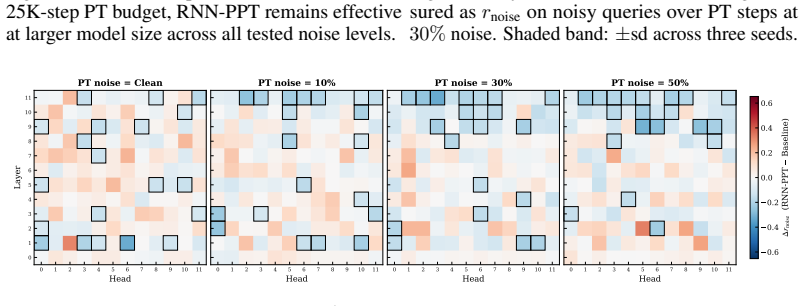
A lightweight pre-pre-training stage on synthetic data that possesses learnable temporal structure improves robustness to noise during the main pre-training phase on natural text. The initialized models reach the same final loss as a baseline while consuming up to 49 percent fewer natural-text tokens across noise levels. Rather than immediately suppressing attention to noisy tokens, the PPT initialization causes the model to progressively reduce attention weights between corrupted tokens, inhibiting noise self-modeling and reshaping the optimization trajectory.
What carries the argument
The synthetic pre-pre-training stage on data with learnable temporal structure, which supplies an initialization that inhibits noise self-modeling and redirects the subsequent optimization path.
If this is right
- Equivalent final loss is achievable with substantially smaller quantities of natural-text pre-training data.
- Relative gains increase as the noise level in the pre-training corpus rises.
- The model gradually down-weights attention between corrupted tokens rather than blocking noisy tokens at the outset.
- The robustness benefit appears across multiple corruption settings and model sizes.
Where Pith is reading between the lines
- Structured synthetic data may offer a general way to bootstrap robustness in other noisy training regimes.
- This method could reduce dependence on expensive filtering steps in large-scale language-model pipelines.
- Varying the temporal structure of the synthetic data might produce different robustness profiles worth testing.
Load-bearing premise
The initialization created by the synthetic pre-pre-training stage continues to shape optimization behavior throughout the much longer noisy pre-training phase.
What would settle it
An experiment in which a PPT-initialized model fails to reach the baseline final loss with equal or fewer natural-text tokens, or in which attention weights to corrupted tokens do not decrease over training.
Figures


read the original abstract
Large language models (LLMs) rely on web-scale corpora for pre-training. The noise inherent in these datasets tends to obscure meaningful patterns and ultimately degrade model performance. Data curation mitigates but cannot eliminate such noise, so pre-training corpora remain noisy in practice. We therefore study whether a lightweight pre-pre-training (PPT) stage based on synthetic data with learnable temporal structure helps resist noisy data during the pre-training (PT) stage. Across various corruption settings, our method consistently improves robustness to noise during PT, with larger relative gains at higher noise levels. For a 1B-parameter model, a synthetic PPT stage with only 65M tokens achieves the same final loss as the baseline while using up to 49\% fewer natural-text PT tokens across different noise levels. Mechanistic analyses suggest PPT does not immediately suppress attention to noisy tokens. Rather, PPT-initialized models gradually downweight attention between corrupted tokens during noisy PT. This indicates that synthetic PPT inhibits noise self-modeling and shapes the subsequent optimization trajectory. Code is available at https://github.com/guox18/formal-language-prepretraining.
Editorial analysis
A structured set of objections, weighed in public.
Referee Report
Summary. The paper claims that a lightweight synthetic pre-pre-training (PPT) stage on data with learnable temporal structure improves LLM robustness to noise in subsequent natural-text pre-training (PT). Across corruption settings, PPT yields consistent gains, with a 1B-parameter model using only 65M synthetic tokens achieving baseline final loss while requiring up to 49% fewer PT tokens; mechanistic attention analysis indicates PPT-initialized models gradually downweight attention to corrupted tokens rather than immediately suppressing it.
Significance. If the empirical results and mechanistic observations hold under full controls, the work would be significant for efficient pre-training on noisy web data, demonstrating that a short synthetic initialization can shape optimization trajectories and reduce data needs without heavy curation. The public code release is a clear strength supporting direct verification.
major comments (3)
- [Abstract] Abstract and experimental results section: the headline claim of matching baseline loss with up to 49% fewer natural-text PT tokens lacks reported variance across runs, statistical tests, or explicit confirmation that total compute (not just token count) is controlled; this is load-bearing for the efficiency and robustness assertions.
- [Methods] Methods and data construction sections: insufficient detail is provided on the exact generation procedure for the synthetic PPT data, the specific form of its 'learnable temporal structure,' and how it differs from the natural-text baselines; without these, the central claim that this structure creates a beneficial initialization cannot be fully evaluated or replicated.
- [Mechanistic Analysis] Mechanistic analysis section: the observation that PPT models 'gradually downweight attention between corrupted tokens' is presented without quantitative metrics (e.g., attention weight trajectories or ablation controls) or figures showing the effect across training steps and noise levels, weakening support for the claim that PPT inhibits noise self-modeling.
minor comments (2)
- [Figures] Figure captions and attention visualizations would benefit from explicit axis labels and scale information to clarify the down-weighting trends.
- [Experiments] The paper should include a brief comparison table of all baselines (standard PT, PPT variants, data-curation alternatives) with exact hyper-parameters and token counts.
Simulated Author's Rebuttal
We thank the referee for the constructive and detailed feedback. We have revised the manuscript to incorporate additional statistical reporting, expanded methodological details, and quantitative mechanistic analyses as suggested. These changes strengthen the presentation of our efficiency and robustness claims without altering the core findings.
read point-by-point responses
-
Referee: [Abstract] Abstract and experimental results section: the headline claim of matching baseline loss with up to 49% fewer natural-text PT tokens lacks reported variance across runs, statistical tests, or explicit confirmation that total compute (not just token count) is controlled; this is load-bearing for the efficiency and robustness assertions.
Authors: We agree that variance reporting and compute clarification strengthen the claims. In the revised version, we report results across three random seeds with standard deviations in the experimental results section and Table 1. Since all runs use identical model architecture, optimizer, batch size, and hardware, PT token count is directly proportional to compute in the natural-data stage. The fixed 65M synthetic PPT tokens represent a small, one-time overhead that is more than offset by the reported PT savings; we have added an explicit statement to this effect in the abstract and methods. revision: yes
-
Referee: [Methods] Methods and data construction sections: insufficient detail is provided on the exact generation procedure for the synthetic PPT data, the specific form of its 'learnable temporal structure,' and how it differs from the natural-text baselines; without these, the central claim that this structure creates a beneficial initialization cannot be fully evaluated or replicated.
Authors: We have substantially expanded the Methods and data construction sections. The revised text now includes the precise generation procedure (a context-free grammar producing sequences with explicit long-range temporal dependencies and nested structures), pseudocode, and concrete examples. We also added a comparison subsection quantifying differences from natural-text baselines (e.g., dependency length distributions and n-gram entropy). These additions enable full replication and directly support the claim that the learnable structure provides a beneficial initialization. revision: yes
-
Referee: [Mechanistic Analysis] Mechanistic analysis section: the observation that PPT models 'gradually downweight attention between corrupted tokens' is presented without quantitative metrics (e.g., attention weight trajectories or ablation controls) or figures showing the effect across training steps and noise levels, weakening support for the claim that PPT inhibits noise self-modeling.
Authors: We have augmented the mechanistic analysis with quantitative support. The revised section now includes plots of average attention weights to corrupted tokens across training steps (new Figure 4) for multiple noise levels, plus explicit numerical trajectories. We also added ablation experiments that remove the temporal structure from the PPT data, confirming its necessity for the observed gradual downweighting. These metrics and controls provide stronger evidence that PPT inhibits noise self-modeling rather than immediate suppression. revision: yes
Circularity Check
No significant circularity
full rationale
The paper is an empirical study reporting experimental results on synthetic pre-pre-training for robustness to noisy data. The abstract and described analyses rely on measured losses, token counts, and mechanistic observations (e.g., attention down-weighting) rather than any derivation chain, equations, or first-principles predictions. No load-bearing steps reduce by construction to fitted parameters, self-citations, or ansatzes; the central claim is directly supported by reported experiments and code availability for verification. This is a standard non-circular empirical finding.
Axiom & Free-Parameter Ledger
axioms (1)
- domain assumption A short pre-pre-training stage on synthetic data with learnable temporal structure produces an initialization that shapes attention dynamics during later noisy pre-training
Reference graph
Works this paper leans on
-
[1]
Between Circuits and Chomsky: Pre-pretraining on Formal Languages Imparts Linguistic Biases , author =. 2025 , eprint =
work page 2025
-
[2]
Learning Music Helps You Read: Using Transfer to Study Linguistic Structure in Language Models , author =. 2020 , eprint =
work page 2020
-
[3]
Injecting structural hints: Using language models to study inductive biases in language learning , author =. 2023 , eprint =
work page 2023
-
[4]
Modeling rapid language learning by distilling Bayesian priors into artificial neural networks , author=. 2023 , eprint=
work page 2023
-
[5]
The LAMBADA dataset: Word prediction requiring a broad discourse context , author=. 2016 , eprint=
work page 2016
-
[6]
Pythia: A Suite for Analyzing Large Language Models Across Training and Scaling , author=. 2023 , eprint=
work page 2023
-
[7]
Journal of machine learning research , volume=
Exploring the limits of transfer learning with a unified text-to-text transformer , author=. Journal of machine learning research , volume=
-
[8]
Counting Like Transformers: Compiling Temporal Counting Logic Into Softmax Transformers , author=. 2024 , eprint=
work page 2024
-
[9]
The Expressive Power of Transformers with Chain of Thought , author=. 2024 , eprint=
work page 2024
- [10]
-
[11]
Proceedings of the 26th annual international conference on machine learning , pages=
Curriculum learning , author=. Proceedings of the 26th annual international conference on machine learning , pages=
- [12]
-
[13]
The FineWeb Datasets: Decanting the Web for the Finest Text Data at Scale , author=. 2024 , eprint=
work page 2024
-
[14]
Perplexed by Perplexity: Perplexity-Based Data Pruning With Small Reference Models , author=. 2024 , eprint=
work page 2024
-
[15]
Geng, Xinyang and Liu, Hao , title =
-
[16]
Scaling Language Models: Methods, Analysis & Insights from Training Gopher , author=. 2022 , eprint=
work page 2022
-
[17]
The RefinedWeb Dataset for Falcon LLM: Outperforming Curated Corpora with Web Data, and Web Data Only , author=. 2023 , eprint=
work page 2023
-
[18]
CCNet: Extracting High Quality Monolingual Datasets from Web Crawl Data , author=. 2019 , eprint=
work page 2019
-
[19]
Similarity of Neural Network Representations Revisited , author=. 2019 , eprint=
work page 2019
-
[20]
What is being transferred in transfer learning? , author=. 2021 , eprint=
work page 2021
-
[21]
Deduplicating Training Data Makes Language Models Better , author=. 2022 , eprint=
work page 2022
- [22]
- [23]
-
[24]
PIQA: Reasoning about Physical Commonsense in Natural Language , author =. 2019 , eprint =
work page 2019
-
[25]
An Empirical Study on Noisy Data and LLM Pretraining Loss Divergence , author =. 2026 , eprint =
work page 2026
-
[26]
A Pretrainer's Guide to Training Data: Measuring the Effects of Data Age, Domain Coverage, Quality and Toxicity , author =. 2023 , eprint =
work page 2023
-
[27]
MVP: Multi-task Supervised Pre-training for Natural Language Generation , author=. 2023 , eprint=
work page 2023
-
[28]
Training Language Models via Neural Cellular Automata , author=. 2026 , eprint=
work page 2026
-
[29]
Universal pre-training by iterated random computation , author =. 2025 , eprint =
work page 2025
-
[30]
Transformers Pretrained on Procedural Data Contain Modular Structures for Algorithmic Reasoning , author =. 2025 , eprint =
work page 2025
-
[31]
Procedural Pretraining: Warming Up Language Models with Abstract Data , author =. 2026 , eprint =
work page 2026
-
[32]
Do we really have to filter out random noise in pre-training data for language models? , author =. 2025 , eprint =
work page 2025
-
[33]
Dynamic Loss-Based Sample Reweighting for Improved Large Language Model Pretraining , author=. 2025 , eprint=
work page 2025
-
[34]
COCO-LM: Correcting and Contrasting Text Sequences for Language Model Pretraining , author=. 2021 , eprint=
work page 2021
-
[35]
Robustification of Multilingual Language Models to Real-world Noise in Crosslingual Zero-shot Settings with Robust Contrastive Pretraining , author=. 2023 , eprint=
work page 2023
-
[36]
CharBERT: Character-aware Pre-trained Language Model , url=
Ma, Wentao and Cui, Yiming and Si, Chenglei and Liu, Ting and Wang, Shijin and Hu, Guoping , year=. CharBERT: Character-aware Pre-trained Language Model , url=. doi:10.18653/v1/2020.coling-main.4 , booktitle=
-
[37]
Back-Translated Task Adaptive Pretraining: Improving Accuracy and Robustness on Text Classification , author=. 2021 , eprint=
work page 2021
-
[38]
Curriculum Learning for LLM Pretraining: An Analysis of Learning Dynamics , author=. 2026 , eprint=
work page 2026
-
[39]
Proceedings of the fifth annual workshop on Computational learning theory , pages=
On the computational power of neural nets , author=. Proceedings of the fifth annual workshop on Computational learning theory , pages=
-
[40]
The “echo state” approach to analysing and training recurrent neural networks-with an erratum note , author=. Bonn, Germany: German national research center for information technology gmd technical report , volume=. 2001 , publisher=
work page 2001
-
[41]
Proceedings of the 58th Annual Meeting of the Association for Computational Linguistics , pages=
A formal hierarchy of RNN architectures , author=. Proceedings of the 58th Annual Meeting of the Association for Computational Linguistics , pages=
-
[42]
Datacomp- LM : In search of the next generation of training sets for language models
Jeffrey Li and Alex Fang and Georgios Smyrnis and Maor Ivgi and Matt Jordan and Samir Gadre and Hritik Bansal and Etash Guha and Sedrick Keh and Kushal Arora and Saurabh Garg and Rui Xin and Niklas Muennighoff and Reinhard Heckel and Jean Mercat and Mayee Chen and Suchin Gururangan and Mitchell Wortsman and Alon Albalak and Yonatan Bitton and Marianna Nez...
-
[43]
22 Kaiqiang Song, Xiaoyang Wang, Sangwoo Cho, Xiaoman Pan, and Dong Yu
Luca Soldaini and Rodney Kinney and Akshita Bhagia and Dustin Schwenk and David Atkinson and Russell Authur and Ben Bogin and Khyathi Chandu and Jennifer Dumas and Yanai Elazar and Valentin Hofmann and Ananya Harsh Jha and Sachin Kumar and Li Lucy and Xinxi Lyu and Nathan Lambert and Ian Magnusson and Jacob Morrison and Niklas Muennighoff and Aakanksha Na...
-
[44]
Nemotron-cc: Transforming common crawl into a refined long-horizon pretraining dataset
Dan Su and Kezhi Kong and Ying Lin and Joseph Jennings and Brandon Norick and Markus Kliegl and Mostofa Patwary and Mohammad Shoeybi and Bryan Catanzaro , year=. 2412.02595 , archivePrefix=
-
[45]
An Empirical Exploration in Quality Filtering of Text Data , author=. 2021 , eprint=
work page 2021
-
[46]
Co-teaching: Robust Training of Deep Neural Networks with Extremely Noisy Labels , author =. 2018 , eprint =
work page 2018
-
[47]
Generalized Cross Entropy Loss for Training Deep Neural Networks with Noisy Labels , author =. 2018 , eprint =
work page 2018
-
[48]
Mitigating Memorization of Noisy Labels by Clipping the Model Prediction , author =. 2023 , eprint =
work page 2023
-
[49]
Take the Bull by the Horns: Hard Sample-Reweighted Continual Training Improves LLM Generalization , author =. 2024 , eprint =
work page 2024
-
[50]
arXiv preprint arXiv:2310.20707 , year=
What's In My Big Data? , author=. arXiv preprint arXiv:2310.20707 , year=
-
[51]
arXiv preprint arXiv:2309.14316 , year=
Physics of language models: Part 3.1, knowledge storage and extraction , author=. arXiv preprint arXiv:2309.14316 , year=
-
[52]
Physics of language models: Part 3.3, knowledge capacity scaling laws , author=. arXiv preprint arXiv:2404.05405 , year=
-
[53]
IEEE transactions on neural networks and learning systems , volume =
Learning from noisy labels with deep neural networks: A survey , author =. IEEE transactions on neural networks and learning systems , volume =. 2022 , publisher =
work page 2022
-
[54]
A survey on data selection for language models
A survey on data selection for language models , author =. arXiv preprint arXiv:2402.16827 , year =
-
[55]
FastText.zip: Compressing text classification models
FastText.zip: Compressing text classification models , author =. arXiv preprint arXiv:1612.03651 , year =
-
[56]
Using Pre-Training Can Improve Model Robustness and Uncertainty , author =. 2019 , eprint =
work page 2019
-
[57]
arXiv preprint arXiv:2309.17002 , year =
Understanding and mitigating the label noise in pre-training on downstream tasks , author =. arXiv preprint arXiv:2309.17002 , year =
-
[58]
Understanding deep learning requires rethinking generalization , author =. 2017 , eprint =
work page 2017
-
[59]
A Closer Look at Memorization in Deep Networks , author =. 2017 , eprint =
work page 2017
-
[60]
Neural Networks and the Chomsky Hierarchy , author =. 2023 , eprint =
work page 2023
-
[61]
Findings of the Association for Computational Linguistics: EMNLP 2024 , pages=
Leveraging web-crawled data for high-quality fine-tuning , author=. Findings of the Association for Computational Linguistics: EMNLP 2024 , pages=
work page 2024
-
[62]
arXiv preprint arXiv:2505.22308 , year=
Transformers pretrained on procedural data contain modular structures for algorithmic reasoning , author=. arXiv preprint arXiv:2505.22308 , year=
discussion (0)
Sign in with ORCID, Apple, or X to comment. Anyone can read and Pith papers without signing in.