Recognition: 2 theorem links
· Lean TheoremWolf-Rayet stars as tracers of gamma-ray emission: Isolated stars and stellar clusters/associations
Pith reviewed 2026-05-12 04:40 UTC · model grok-4.3
The pith
Wolf-Rayet stars and clusters show spatial links to unidentified GeV sources, consistent with particle acceleration at wind termination shocks.
A machine-rendered reading of the paper's core claim, the machinery that carries it, and where it could break.
Core claim
By treating the number of Wolf-Rayet stars per distance squared as a proxy for expected gamma-ray flux from collective wind termination shocks, the authors find a marginal correlation (≲3σ) between WR-hosting clusters and unidentified GeV sources, together with eleven new candidate associations; they also note spatial coincidences for four isolated WR stars (WR110, WR114, WR111, WR14) that possess particularly large wind-power-to-distance-squared values, although isolated stars as a whole show no population-level correlation.
What carries the argument
The ranking quantity of Wolf-Rayet star count (or wind mechanical power) divided by distance squared, which scales directly with the expected gamma-ray flux assuming particle acceleration at wind termination shocks.
Load-bearing premise
Spatial coincidences between the ranked Wolf-Rayet clusters or stars and unidentified gamma-ray sources reflect physical associations driven by wind-powered particle acceleration rather than chance alignments or unrelated emitters.
What would settle it
A future gamma-ray observation with better angular resolution or sensitivity that either fails to detect emission from the highest-ranked candidates at the predicted level or shows the emission is centered away from the WR stars or clusters.
Figures


read the original abstract
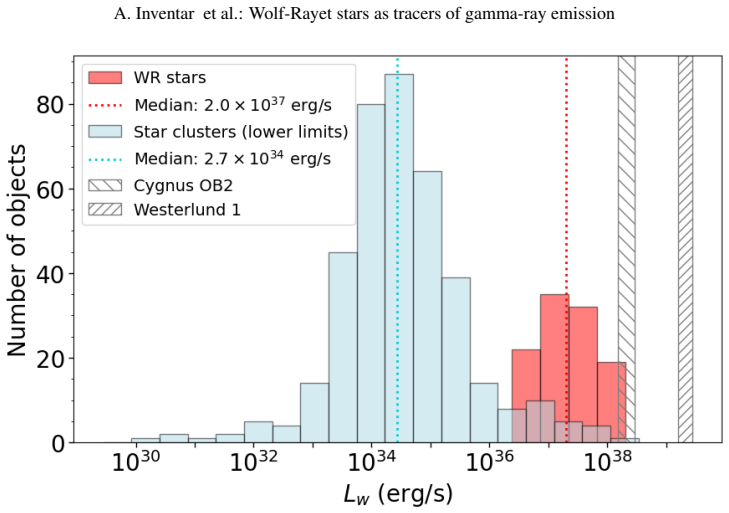
Context: Recent gamma-ray observations of young star clusters revealed that stellar wind termination shocks accelerate particles, with the energy reservoir provided by the mechanical power of massive-star winds. Aims: Our goal is to identify promising targets for future gamma-ray studies of stellar clusters and associations powered by massive stars. As the wind power of a single Wolf-Rayet (WR) star can rival the cumulative wind power of the most massive clusters, we also investigate isolated WR stars, many of which are indeed isolated. Methods: We ranked a large sample of stellar clusters and associations according to the number of member WR stars divided by the distance squared, a quantity proportional to the expected gamma-ray signal, and searched for spatial correlations with known gamma-ray sources. We repeated the same procedure for individual WR stars with known wind mechanical powers and distances. Results: We found a hint ($\lesssim 3 \sigma$ confidence) for a correlation between WR-hosting clusters and unidentified GeV gamma-ray sources, and identified new spatial associations for 11 clusters. We also found spatial coincidences between 4 isolated WR stars (WR110, WR114, WR111, and WR14) and unidentified gamma-ray sources. Although no significant correlation is found for isolated WR stars as a population, these 4 objects exhibit particularly large wind-power-to-distance-squared ratios, a necessary condition for detectability with current instruments. Assuming the gamma-ray emission is powered by WR winds, it can be interpreted as arising from interactions between particles accelerated at the wind termination shock and ambient matter or radiation fields. Conclusions: Since the wind power of an individual WR star can rival that of an entire stellar cluster, we provide a ranking of stellar clusters and isolated WR stars that may constitute potential gamma-ray emitters.
Editorial analysis
A structured set of objections, weighed in public.
Referee Report
Summary. The paper ranks stellar clusters/associations by the number of Wolf-Rayet (WR) member stars divided by distance squared and individual WR stars by wind mechanical power over distance squared, then searches for spatial coincidences with unidentified GeV gamma-ray sources from external catalogs. It reports a marginal (≲3σ) population-level hint of correlation for WR-hosting clusters, identifies new associations for 11 clusters, and notes coincidences for four isolated WR stars (WR110, WR114, WR111, WR14) that have high wind-power-to-distance-squared ratios, interpreting these as potential evidence for particle acceleration at wind termination shocks.
Significance. If the reported associations prove physical rather than chance alignments, the work would strengthen the case that stellar winds supply the energy for gamma-ray emission in young clusters and would supply a practical ranked target list for future observations with current and upcoming instruments. The approach of using an observationally motivated ranking metric without fitted parameters is a strength, but the marginal significance limits the immediate implications for the broader field of cosmic-ray acceleration in massive-star environments.
major comments (3)
- [Results] Results section (paragraph on cluster correlation): the claimed ≲3σ hint relies on counting spatial coincidences after pre-ranking by (N_WR/d²), but the manuscript provides no Monte Carlo assessment of the expected random coincidence rate given the surface density of unidentified GeV sources, the adopted matching radius, and the ranking step itself. Without this, the significance cannot be evaluated and chance alignments remain plausible.
- [Results] Results section (isolated WR stars paragraph): after stating that no significant population correlation exists for isolated WR stars, the paper highlights four specific objects (WR110, WR114, WR111, WR14) with spatial coincidences. This post-selection on the highest-ranked objects requires a quantitative false-positive probability calculation; otherwise the interpretation that these coincidences indicate wind-driven emission is weakened.
- [Methods] Methods/Results (statistical procedure): details are missing on background estimation, the precise definition of the matching radius, and any correction for multiple comparisons across the ranked sample. These elements are load-bearing for the central claim that the overlaps trace physical associations rather than background fluctuations.
minor comments (2)
- [Abstract] Abstract: the phrase 'hint (≲ 3 σ confidence)' should specify the exact statistical test and whether it accounts for the pre-ranking procedure.
- [Results] The manuscript would benefit from an explicit table listing the 11 clusters and 4 stars with their ranking metric values, angular separation to the gamma-ray source, and any available flux upper limits or non-detections.
Simulated Author's Rebuttal
We thank the referee for the constructive and detailed comments. We agree that additional quantitative statistical assessments are required to robustly support the reported correlations and will revise the manuscript accordingly by adding Monte Carlo simulations and expanded methodological details.
read point-by-point responses
-
Referee: [Results] Results section (paragraph on cluster correlation): the claimed ≲3σ hint relies on counting spatial coincidences after pre-ranking by (N_WR/d²), but the manuscript provides no Monte Carlo assessment of the expected random coincidence rate given the surface density of unidentified GeV sources, the adopted matching radius, and the ranking step itself. Without this, the significance cannot be evaluated and chance alignments remain plausible.
Authors: We agree that a Monte Carlo simulation is necessary to properly evaluate the significance, incorporating the pre-ranking by N_WR/d², the surface density of unidentified GeV sources, and the matching radius. In the revised manuscript we will perform such simulations to compute the expected random coincidence rate and provide a data-driven significance estimate for the cluster associations. revision: yes
-
Referee: [Results] Results section (isolated WR stars paragraph): after stating that no significant population correlation exists for isolated WR stars, the paper highlights four specific objects (WR110, WR114, WR111, WR14) with spatial coincidences. This post-selection on the highest-ranked objects requires a quantitative false-positive probability calculation; otherwise the interpretation that these coincidences indicate wind-driven emission is weakened.
Authors: We acknowledge that post-selection on the highest-ranked objects requires a quantitative false-positive assessment. We will add a calculation of the chance coincidence probability for these four stars, using the same Monte Carlo framework developed for the clusters, to evaluate whether the observed overlaps are consistent with background fluctuations. revision: yes
-
Referee: [Methods] Methods/Results (statistical procedure): details are missing on background estimation, the precise definition of the matching radius, and any correction for multiple comparisons across the ranked sample. These elements are load-bearing for the central claim that the overlaps trace physical associations rather than background fluctuations.
Authors: We will expand the Methods section to include explicit descriptions of the background estimation procedure, the exact definition and justification of the matching radius (tied to positional uncertainties of the gamma-ray sources), and any adjustments applied for multiple comparisons across the ranked lists. These additions will provide the necessary transparency for assessing the statistical robustness of the results. revision: yes
Circularity Check
No significant circularity: ranking uses a priori physical scaling on external catalogs
full rationale
The paper constructs a ranking metric for clusters (number of WR stars / d²) and isolated stars (wind power / d²) directly from the physical expectation that gamma-ray flux scales with mechanical wind power over distance squared. This metric is applied to prioritize targets before searching for spatial coincidences in independent external GeV catalogs. No parameters are fitted to the gamma-ray data, no self-referential definitions equate the metric to the observed associations, and no self-citation chains or uniqueness theorems are invoked to justify the central claim. The analysis remains self-contained against external benchmarks.
Axiom & Free-Parameter Ledger
axioms (1)
- domain assumption Gamma-ray emission from stellar wind termination shocks scales proportionally with the mechanical wind power divided by distance squared.
Lean theorems connected to this paper
-
IndisputableMonolith/Cost/FunctionalEquation.leanwashburn_uniqueness_aczel unclear?
unclearRelation between the paper passage and the cited Recognition theorem.
We ranked a large sample of stellar clusters and associations according to the number of member WR stars divided by the distance squared... searched for spatial correlations with known gamma-ray sources.
-
IndisputableMonolith/Foundation/AlphaCoordinateFixation.leanJ_uniquely_calibrated_via_higher_derivative unclear?
unclearRelation between the paper passage and the cited Recognition theorem.
Assuming the gamma-ray emission is powered by WR winds, it can be interpreted as arising from interactions between particles accelerated at the wind termination shock and ambient matter or radiation fields.
What do these tags mean?
- matches
- The paper's claim is directly supported by a theorem in the formal canon.
- supports
- The theorem supports part of the paper's argument, but the paper may add assumptions or extra steps.
- extends
- The paper goes beyond the formal theorem; the theorem is a base layer rather than the whole result.
- uses
- The paper appears to rely on the theorem as machinery.
- contradicts
- The paper's claim conflicts with a theorem or certificate in the canon.
- unclear
- Pith found a possible connection, but the passage is too broad, indirect, or ambiguous to say the theorem truly supports the claim.
Reference graph
Works this paper leans on
- [1]
-
[2]
U., Albert , A., Alfaro , R., et al
Abeysekara , A. U., Albert , A., Alfaro , R., et al. 2017, , 843, 40
work page 2017
-
[3]
U., Albert , A., Alfaro , R., et al
Abeysekara , A. U., Albert , A., Alfaro , R., et al. 2021, Nature Astronomy, 5, 465
work page 2021
-
[4]
Abramowski , A., Acero , F., Aharonian , F., et al. 2012, , 537, A114
work page 2012
- [5]
-
[6]
Ackermann , M., Ajello , M., Allafort , A., et al. 2011, Science, 334, 1103
work page 2011
-
[7]
Aharonian , F., Akhperjanian , A. G., Bazer-Bachi , A. R., et al. 2007, , 467, 1075
work page 2007
- [8]
-
[9]
2019, Nature Astronomy, 3, 561
Aharonian , F., Yang , R., & de O \ n a Wilhelmi , E. 2019, Nature Astronomy, 3, 561
work page 2019
-
[10]
Ajello , M., Atwood , W. B., Baldini , L., et al. 2017, , 232, 18
work page 2017
- [11]
-
[12]
Astiasarain , X., Tibaldo , L., Martin , P., Kn \"o dlseder , J., & Remy , Q. 2023, , 671, A47
work page 2023
-
[13]
H., Lott, B., & The Fermi-LAT collaboration
Ballet , J., Bruel , P., Burnett , T. H., Lott , B., & The Fermi-LAT collaboration . 2023, arXiv e-prints, arXiv:2307.12546
- [14]
-
[15]
B., De Becker , M., Saha , A., Tej , A., & Benaglia , P
Blanco , A. B., De Becker , M., Saha , A., Tej , A., & Benaglia , P. 2024, , 690, A78
work page 2024
-
[16]
Bolatto , A. D., Wolfire , M., & Leroy , A. K. 2013, , 51, 207
work page 2013
-
[17]
Borissova , J., Bonatto , C., Kurtev , R., et al. 2011, , 532, A131
work page 2011
- [18]
-
[19]
2025, Science China Physics, Mechanics, and Astronomy, 68, 279502
Cao , Z., Aharonian , F., Axikegu , et al. 2025, Science China Physics, Mechanics, and Astronomy, 68, 279502
work page 2025
- [20]
- [21]
- [22]
- [23]
-
[24]
Celli , S., Specovius , A., Menchiari , S., Mitchell , A., & Morlino , G. 2024, , 686, A118
work page 2024
-
[25]
Cesarsky , C. J. & Montmerle , T. 1983, , 36, 173
work page 1983
-
[26]
Chambery , P., Lemoine-Goumard , M., Jardin-Blicq , A., Sinha , A., & Eagle , J. 2023, , 959, 97
work page 2023
-
[27]
N., Borissova , J., Bonatto , C., et al
Chen \'e , A. N., Borissova , J., Bonatto , C., et al. 2013, , 549, A98
work page 2013
- [28]
-
[29]
Cristofari , P., Gabici , S., Casanova , S., Terrier , R., & Parizot , E. 2013, , 434, 2748
work page 2013
-
[30]
Crowther , P. A. 2007, , 45, 177
work page 2007
-
[31]
M., Hartmann , D., & Thaddeus , P
Dame , T. M., Hartmann , D., & Thaddeus , P. 2001, , 547, 792
work page 2001
-
[32]
Davies , B., de La Fuente , D., Najarro , F., et al. 2012, , 419, 1860
work page 2012
- [33]
-
[34]
Drissen , L., Moffat , A. F. J., Walborn , N. R., & Shara , M. M. 1995, , 110, 2235
work page 1995
-
[35]
2023, arXiv e-prints, arXiv:2307.01596
Gabici , S. 2023, arXiv e-prints, arXiv:2307.01596
-
[36]
2024, in 7th Heidelberg International Symposium on High-Energy Gamma-Ray Astronomy, 16
Gabici , S. 2024, in 7th Heidelberg International Symposium on High-Energy Gamma-Ray Astronomy, 16
work page 2024
- [37]
-
[38]
Gabici , S., Casanova , S., Aharonian , F. A., & Rowell , G. 2010, in SF2A-2010: Proceedings of the Annual meeting of the French Society of Astronomy and Astrophysics, ed. S. Boissier , M. Heydari-Malayeri , R. Samadi , & D. Valls-Gabaud , 313
work page 2010
-
[39]
Ge , T.-T., Sun , X.-N., Yang , R.-Z., Liang , Y.-F., & Liang , E.-W. 2022, , 517, 5121
work page 2022
-
[40]
Green , D. A. 2025, Journal of Astrophysics and Astronomy, 46, 14
work page 2025
- [41]
-
[42]
B., Sharma , P., & Eichler , D
Gupta , S., Nath , B. B., Sharma , P., & Eichler , D. 2020, , 493, 3159
work page 2020
-
[43]
H. E. S. S. Collaboration , Abdalla , H., Abramowski , A., et al. 2018 a , , 612, A11
work page 2018
-
[44]
H. E. S. S. Collaboration , Abdalla , H., Abramowski , A., et al. 2018 b , , 612, A1
work page 2018
-
[45]
H. E. S. S. Collaboration , Abramowski , A., Acero , F., et al. 2011, , 525, A46
work page 2011
-
[46]
H. E. S. S. Collaboration , Aharonian , F., Ait Benkhali , F., et al. 2023, , 672, A103
work page 2023
-
[47]
Hahn , J., Romoli , C., & Breuhaus , M. 2022, GAMERA: Source modeling in gamma astronomy , Astrophysics Source Code Library, record ascl:2203.007
work page 2022
-
[48]
R., Gr \"a fener , G., Liermann , A., et al
Hamann , W. R., Gr \"a fener , G., Liermann , A., et al. 2019, , 625, A57
work page 2019
-
[49]
H \"a rer , L., Vieu , T., Schulze , F., Larkin , C. J. K., & Reville , B. 2025, , 703, A111
work page 2025
-
[50]
K., Reville , B., Hinton , J., Mohrmann , L., & Vieu , T
H \"a rer , L. K., Reville , B., Hinton , J., Mohrmann , L., & Vieu , T. 2023, , 671, A4
work page 2023
-
[51]
HESS Collaboration , Abramowski , A., Aharonian , F., et al. 2016, , 531, 476
work page 2016
-
[52]
Hillas , A. M. 1984, , 22, 425
work page 1984
-
[53]
Hillas , A. M. 2005, Journal of Physics G Nuclear Physics, 31, R95
work page 2005
- [54]
-
[55]
Hunt , E. L. & Reffert , S. 2024, , 686, A42
work page 2024
-
[56]
2025, in Proceedings of 39th International Cosmic Ray Conference PoS(ICRC2025), Vol
Inventar, A., Peron, G., Recchia, S., & Gabici, S. 2025, in Proceedings of 39th International Cosmic Ray Conference PoS(ICRC2025), Vol. 501, 693
work page 2025
-
[57]
Kafexhiu , E., Aharonian , F., Taylor , A. M., & Vila , G. S. 2014, , 90, 123014
work page 2014
-
[58]
Kaul , R. K. & Mitra , A. K. 1997, in American Institute of Physics Conference Series, Vol. 410, Proceedings of the Fourth Compton Symposium, ed. C. D. Dermer , M. S. Strickman , & J. D. Kurfess (AIP), 1271--1274
work page 1997
-
[59]
Lemoine-Goumard , M., Ferrara , E., Grondin , M. H., Martin , P., & Renaud , M. 2011, , 82, 739
work page 2011
-
[60]
2025, Nature Communications, 16, 10820
Lemoine-Goumard , M., H \"a rer , L., Mohrmann , L., et al. 2025, Nature Communications, 16, 10820
work page 2025
-
[61]
2024, Science Bulletin, 69, 449
Lhaaso Collaboration . 2024, Science Bulletin, 69, 449
work page 2024
- [62]
- [63]
- [64]
-
[65]
Manchanda , R. K., Polcaro , V. F., Norci , L., et al. 1996, , 305, 457
work page 1996
-
[66]
Manchester , R. N., Hobbs , G. B., Teoh , A., & Hobbs , M. 2005, , 129, 1993
work page 2005
- [67]
-
[68]
Mart \' -Devesa , G., Reimer , O., Li , J., & Torres , D. F. 2020, , 635, A141
work page 2020
-
[69]
Menchiari , S., Morlino , G., Amato , E., Bucciantini , N., & Beltr \'a n , M. T. 2024, , 686, A242
work page 2024
-
[70]
Mercer , E. P., Clemens , D. P., Meade , M. R., et al. 2005, , 635, 560
work page 2005
- [71]
- [72]
- [73]
-
[74]
Munar-Adrover , P., Paredes , J. M., & Romero , G. E. 2011, , 530, A72
work page 2011
-
[75]
Negueruela , I., Alfaro , E. J., Dorda , R., et al. 2022, , 664, A146
work page 2022
- [76]
-
[77]
2025, in 39th International Cosmic Ray Conference, 1390
Peron , G. 2025, in 39th International Cosmic Ray Conference, 1390
work page 2025
-
[78]
2024 a , Nature Astronomy, 8, 530
Peron , G., Casanova , S., Gabici , S., Baghmanyan , V., & Aharonian , F. 2024 a , Nature Astronomy, 8, 530
work page 2024
-
[79]
Peron , G., Menchiari , S., Morlino , G., & Amato , E. 2025, , 703, L8
work page 2025
-
[80]
Peron , G., Morlino , G., Gabici , S., et al. 2024 b , , 972, L22
work page 2024
discussion (0)
Sign in with ORCID, Apple, or X to comment. Anyone can read and Pith papers without signing in.