Recognition: no theorem link
Foundations of Reliable Inference: Reliability-Efficiency Co-Design
Pith reviewed 2026-05-12 03:18 UTC · model grok-4.3
The pith
Reliable AI inference with trustworthy uncertainty estimates is achievable efficiently through co-design of reliability and efficiency in a unified framework.
A machine-rendered reading of the paper's core claim, the machinery that carries it, and where it could break.
Core claim
This thesis develops a unified framework from two perspectives to address the central question of whether we can efficiently perform reliable inference, defined as providing trustworthy uncertainty estimates alongside accurate predictions, by co-designing reliability and efficiency to reduce computational overhead while preserving the benefits of Bayesian uncertainty quantification.
What carries the argument
The unified framework for reliability-efficiency co-design, which adapts Bayesian learning advances to jointly optimize trustworthy uncertainty quantification and computational efficiency from two complementary perspectives.
If this is right
- AI systems can maintain reliable uncertainty quantification in settings with strict limits on computation time or memory.
- The computational overhead traditionally associated with Bayesian methods can be reduced without sacrificing the quality of uncertainty estimates.
- Inference procedures become viable for wider deployment in practical applications that require both accuracy and calibrated uncertainty.
- Design criteria for AI models shift from reliability alone to explicit joint consideration of efficiency metrics.
Where Pith is reading between the lines
- The framework might extend to hardware-specific optimizations where efficiency accounts for energy use or latency on edge devices.
- If successful, it could reduce reliance on post-hoc calibration techniques by building reliability directly into efficient training and inference pipelines.
- Connections may exist to safety-critical domains where both low compute and reliable uncertainty are required for real-time decision making.
Load-bearing premise
Reliability and efficiency can be jointly optimized in one framework without fundamental trade-offs that would undermine the trustworthiness of the uncertainty estimates.
What would settle it
An empirical result showing that models trained under the proposed co-design framework exhibit worse uncertainty calibration, such as higher expected calibration error, than standard Bayesian baselines at equivalent accuracy levels would disprove the central claim.
Figures










read the original abstract
Reliable inference requires that artificial intelligence (AI) models provide trustworthy uncertainty estimates, not merely accurate predictions. Recent advances in Bayesian learning have made significant progress toward this goal, and growing concerns about computational overhead have jointly shifted the design criterion from reliability alone to the co-design of reliability and efficiency, i.e., reducing computational overhead while preserving trustworthy uncertainty quantification. This thesis develops a unified framework from two perspectives to address the central question: can we efficiently perform reliable inference?
Editorial analysis
A structured set of objections, weighed in public.
Referee Report
Summary. The manuscript claims to develop a unified framework from two perspectives for co-designing reliability and efficiency in AI models, enabling efficient reliable inference while preserving trustworthy uncertainty quantification by adapting recent Bayesian learning advances.
Significance. Co-designing reliability and efficiency is a relevant goal for deploying uncertainty-aware models in resource-constrained settings. If the framework delivered concrete constructions, assumptions, derivations, and validations showing that efficiency reductions preserve calibration and coverage without introducing fundamental trade-offs, it could advance trustworthy AI. The current manuscript supplies none of these elements, so no such contribution can be assessed.
major comments (1)
- [Abstract] Abstract: The central claim that a unified framework from two perspectives enables efficient reliable inference is asserted without any description of the perspectives, framework construction, assumptions, derivations, or empirical results. This absence makes it impossible to evaluate whether joint optimization is feasible without compromising uncertainty quantification (e.g., calibration or coverage guarantees).
Simulated Author's Rebuttal
We thank the referee for their review. We address the major comment on the abstract below and note that the manuscript body supplies the requested details on the framework, perspectives, assumptions, derivations, and validations.
read point-by-point responses
-
Referee: [Abstract] Abstract: The central claim that a unified framework from two perspectives enables efficient reliable inference is asserted without any description of the perspectives, framework construction, assumptions, derivations, or empirical results. This absence makes it impossible to evaluate whether joint optimization is feasible without compromising uncertainty quantification (e.g., calibration or coverage guarantees).
Authors: Abstracts are concise by design and summarize rather than detail. The full manuscript develops the unified framework explicitly from two perspectives (Bayesian approximation methods for reliability and co-design optimizations for efficiency), with concrete constructions, stated assumptions, derivations demonstrating that efficiency gains preserve calibration and coverage guarantees, and empirical results validating trustworthy uncertainty quantification. We will revise the abstract to include a brief outline of the two perspectives and key results to aid evaluation. revision: yes
Circularity Check
No derivations, equations or load-bearing steps present; abstract-only content yields no circularity
full rationale
The provided abstract and context contain no equations, parameter fits, self-citations, ansatzes, or derivation chains. The central claim is a high-level thesis statement about developing a unified framework, with no specific constructions that could reduce to inputs by definition or self-reference. Per rules, this is the common honest non-finding when the text supplies no inspectable steps; score remains 0 with empty steps list.
Axiom & Free-Parameter Ledger
Reference graph
Works this paper leans on
-
[1]
Conditionaltestingbasedonlocalized conformal p-values.arXiv preprint arXiv:2409.16829
Wu,X.,Lu,L.,Wang,Z.,andZou,C.(2024). Conditionaltestingbasedonlocalized conformal p-values.arXiv preprint arXiv:2409.16829
-
[2]
Xu, Z., Wang, R., and Ramdas, A. (2021). A unified framework for bandit multiple testing.Advances in Neural Information Processing Systems, 34:16833–16845
work page 2021
-
[3]
arXiv preprint arXiv:2405.01563 , year=
Yadkori, Y. A., Kuzborskij, I., Stutz, D., György, A., Fisch, A., Doucet, A., Beloshapka, I., Weng, W.-H., Yang, Y.-Y., Szepesvári, C., etal.(2024). MitigatingLLM hallucinations via conformal abstention.arXiv preprint arXiv:2405.01563
-
[4]
Yeh,C.,Christianson,N.,Wierman,A.,andYue,Y.(2025). Conformalrisktraining: End-to-end optimization of conformal risk control.arXiv preprint arXiv:2510.08748
-
[5]
Yoon, H. S., Tee, J. T. J., Yoon, E., Yoon, S., Kim, G., Li, Y., and Yoo, C. D. (2023). ESD: Expected squared difference as a tuning-free trainable calibration measure.arXiv preprint arXiv:2303.02472
-
[6]
Zaffalon, M. (2002). The naive credal classifier.Journal of statistical planning and inference, 105(1):5–21
work page 2002
-
[7]
Zaffran, M., Féron, O., Goude, Y., Josse, J., and Dieuleveut, A. (2022). Adaptive conformal predictions for time series. InInternational conference on machine learning, pages 25834–25866. PMLR
work page 2022
-
[8]
Zagoruyko, S. and Komodakis, N. (2016). Wide residual networks.arXiv preprint arXiv:1605.07146
work page internal anchor Pith review arXiv 2016
-
[9]
Zecchin, M., Park, S., and Simeone, O. (2024). Forking uncertainties: Reliable predictionandmodelpredictivecontrolwithsequencemodelsviaconformalriskcontrol. IEEE Journal on Selected Areas in Information Theory
work page 2024
-
[10]
Zecchin, M., Park, S., Simeone, O., Kountouris, M., and Gesbert, D. (2023). RobustPACm: Training ensemble models under misspecification and outliers.IEEE Transactions on Neural Networks and Learning Systems
work page 2023
-
[11]
Zhu, D., Lei, B., Zhang, J., Fang, Y., Xie, Y., Zhang, R., and Xu, D. (2023). Rethinking data distillation: Do not overlook calibration. InProceedings of the IEEE/CVF International Conference on Computer Vision, pages 4935–4945
work page 2023
-
[12]
Zhu, M., Zecchin, M., Park, S., Guo, C., Feng, C., Popovski, P., and Simeone, O. (2025). Conformal distributed remote inference in sensor networks under reliability and communication constraints.IEEE Transactions on Signal Processing
work page 2025
-
[13]
Zuk, O., Margel, S., and Domany, E. (2012). On the number of samples needed to learn the correct structure of a Bayesian network.arXiv preprint arXiv:1206.6862. 138 Appendix A Chapter 3 Supplementary Material This appendix provides supplementary material for Chapter 3, consisting of five sections. Sec. A.1 demonstrates the generality of the proposed frame...
-
[14]
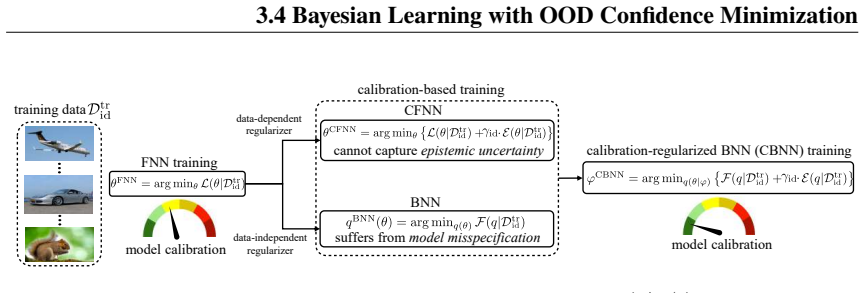
Weighted MMCE:In [92], the WMMCE metric was defined as an estimate of the ECE (2.6). To introduce it, define asκ(·,·) a kernel function operating on scalar inputs, such asκ(x1, x2) =exp(−|x 1 −x 2|/h) for someh >0 . Using the training datasetDtr id, the WMMCE first computes confidence scores{ri} |Dtr id| i=1 and correctness scores{ci} |Dtr id| i=1 as defi...
-
[15]
To simplify this calculation, reference
Gradient of the Weighted MMCE:In order to evaluate the gradient∇θE(θ|Dtr id) required for both CFNN and CBNN, one needs to calculate the gradients∇θri and ∇θci of the confidence and correctness scores, respectively. To simplify this calculation, reference
-
[16]
implicitly ignored the dependence of the point classification decisionˆy(x)in (2.9) on the model parameterθ. Accordingly, the gradient of the correctness score was set to zero; and the gradient∇θri was evaluated as∇θp(ˆy(x)|x, θ), whereˆy(x)is treated as a constant. This approximation of the gradient is motivated by the non-differentiable nature of the de...
-
[17]
Architecture:For all the experiments related to calibration-regularized learning, we adopt the WideResNet-40-2 architecture [176]
-
[18]
Specifically, weusetheSGDoptimizerwithmomentum 146 A.5 Experiment Details Fig
Hyperparameters:For fair comparison, we use the same training policy for both frequentistandBayesianlearning. Specifically, weusetheSGDoptimizerwithmomentum 146 A.5 Experiment Details Fig. A.6 Test accuracy versus OOD detection probability on CIFAR-10 (ID) and LSUN (OOD) for FNN-OCM (benchmark), CFNN-OCM, BNN-OCM, and CBNN-OCM (ours), with test ECE as the...
-
[19]
Dataset Split and Augmentations:As mentioned in Sec. 3.6.1, we choose CIFAR- 100 dataset [91] for the ID samples, which is a dataset composed of60,000 images each with label information chosen among100different classes. In particular, CIFAR-100 splits the dataset into two parts:50,000 for training and10,000 for testing; and we further split thetrainingdat...
-
[20]
Architecture:Since we use the same predictor for OOD detection, the corresponding architecture remains the same, i.e., WideResNet-40-2, as described above
-
[21]
Uncertainty datasetDunl ood is constructed by randomly choosing 6,000 input data from TinyImageNet
Hyperparameters:Following the original OCM paper [32], OOD confidence minimization (3.9) and (3.13) is carried out by fine-tuning based on the corresponding pre- trained models, e.g., CBNN-OCM is obtained via fine-tuning with the OCM-regularized training loss given the pre-trained CBNN. Uncertainty datasetDunl ood is constructed by randomly choosing 6,000...
-
[22]
Dataset Split and Augmentations:TinyImageNet dataset [103] contains10,000 images that corresponds to different200 classes. We split the input data of TinyImageNet dataset into two parts,6,000 and 4,000, and use them for the uncertainty datasetDunl ood and for the OOD test dataset, respectively. During fine-tuning, we apply the same standard random flip an...
-
[23]
Architecture:For the selector implementation, we use a3-layer feed-forward neural network with64neurons in each hidden layer, activated by ReLU. 2)Hyperparameters:Forselectortraining(3.19)and(3.25),weusetheAdamoptimizer, with learning rate0.001 and weight decay coefficient10−5. We train the model for5 epochs, each epoch consisting50,000 iterations, and ea...
-
[24]
We utilize the standard random flip and random crop augmentations during selector training
Dataset Split and Augmentations:As described above,Dval has 5,000 examples obtained from CIFAR-100 dataset. We utilize the standard random flip and random crop augmentations during selector training. 149 Appendix B Chapter 6 Supplementary Material This appendix provides supplementary material for Chapter 6, consisting of the proof of Proposition 6.1. B.1 ...
discussion (0)
Sign in with ORCID, Apple, or X to comment. Anyone can read and Pith papers without signing in.