Recognition: 1 theorem link
Dynamic Competition of Fast and Collisional Neutrino Flavor Instabilities with Collisional Damping in Spatially Inhomogeneous Systems
Pith reviewed 2026-05-12 05:15 UTC · model grok-4.3
The pith
In core-collapse supernovae, competing neutrino flavor instabilities with damping always converge to the same equilibrated state.
A machine-rendered reading of the paper's core claim, the machinery that carries it, and where it could break.
Core claim
Numerical simulations of quantum kinetic neutrino transport that include spatial advection and collision terms show that the interplay of fast and collisional flavor instabilities with damping produces rich dynamics. Collisional damping alters collective flavor oscillation pathways beyond mere decoherence. In every case where flavor instability occurs, the system converges to the same flavor-equilibrated asymptotic state regardless of the diversity in intermediate evolution.
What carries the argument
Quantum kinetic equations incorporating fast flavor instability, collisional flavor instability, collisional damping, and spatial advection in inhomogeneous neutrino systems.
If this is right
- Collisional damping modifies the dynamics of flavor oscillations substantially instead of causing only decoherence.
- The final asymptotic state is flavor-equilibrated and identical across all unstable scenarios.
- The competition changes the conventional understanding of collisionless fast flavor instability.
- Studies of flavor conversions in core-collapse supernovae must account for realistic collisional effects.
Where Pith is reading between the lines
- The robustness of the final state suggests that neutrino flavor outcomes in supernovae are predictable even with complex instability competitions.
- This may have implications for modeling neutrino emission and heavy element formation in astrophysical explosions.
- Investigations in other high-density neutrino environments could reveal similar convergence behaviors.
Load-bearing premise
The specific forms of the collision terms and the chosen profiles for spatial inhomogeneity in the quantum kinetic equations correctly model the post-bounce conditions in core-collapse supernovae.
What would settle it
A calculation demonstrating that different sequences of fast and collisional instabilities produce distinct final flavor distributions under supernova-like conditions would disprove the convergence result.
Figures







read the original abstract
Neutrino flavor evolution in dense astrophysical environments such as core-collapse supernova (CCSN) is influenced by collective effects. While the Fast Flavor Instability (FFI) and the Collisional Flavor Instability (CFI) are recognized as key drivers of rapid flavor conversion, their non-linear competition with collisional damping in spatially varying environments remains poorly understood. Motivated by recent findings that FFI and resonance-like CFI co-occur in the post-bounce phase in CCSN, we scrutinize their dynamic competitions and asymptotic states. To this end, we perform numerical simulations of the quantum kinetic neutrino transport, incorporating both spatial advection and the collision terms. We demonstrate that the interplay between these coexisting neutrino flavor instabilities and collisions leads to rich dynamics. Rather than merely inducing simple decoherence, collisional damping can substantially alter the overall dynamics of collective flavor oscillations, driving the system through complex evolutionary pathways. In all cases where flavor instability develops, we find that the system converges to the same flavor-equilibrated asymptotic state, despite the diversity of intermediate dynamics. Our results suggest that this dynamic competition could alter the widely accepted picture of collisionless FFI, highlighting the need to incorporate realistic collisional effects into studies of flavor conversions in CCSN models.
Editorial analysis
A structured set of objections, weighed in public.
Referee Report
Summary. The manuscript numerically integrates the quantum kinetic equations for neutrino flavor evolution in spatially inhomogeneous systems, incorporating advection and collision terms that include both damping and source contributions. It examines the competition between fast flavor instability (FFI) and collisional flavor instability (CFI) and reports that, whenever instability develops, the system reaches an identical flavor-equilibrated asymptotic state independent of the specific intermediate dynamical pathway.
Significance. If the reported attractor is robust, the result would imply that collisional effects impose a universal late-time flavor state in CCSN environments, altering the standard collisionless FFI picture and motivating inclusion of realistic collisions in supernova simulations. The work supplies direct numerical evidence rather than an algebraic reduction, which is a strength when accompanied by adequate verification.
major comments (2)
- [Abstract and results section] Abstract and results section: the central claim that the system converges to the same flavor-equilibrated asymptotic state in all unstable cases is presented without reported convergence tests, resolution studies, or error bars on the final flavor fractions. This absence makes it impossible to verify that the attractor is not an artifact of the chosen discretization or integration tolerances.
- [Methods section on collision terms] Methods section on collision terms: the adopted collision operator (damping plus possible source terms) and the specific spatial inhomogeneity profiles are not benchmarked against standard neutrino-nucleon or neutrino-electron scattering rates at post-bounce densities and temperatures. Without such comparison, it remains unclear whether the observed universal state is a generic physical feature or tied to the particular model choices.
minor comments (2)
- Figure captions and axis labels should explicitly state the neutrino energy bins and the spatial grid resolution used in each run to allow direct reproduction.
- The notation for the flavor density matrix elements and the definition of the asymptotic equilibration metric should be collected in a single table or appendix for clarity.
Simulated Author's Rebuttal
We thank the referee for the thoughtful and constructive report. The comments highlight important aspects of numerical validation and model justification that we will address in the revision. Below we respond point by point to the major comments.
read point-by-point responses
-
Referee: [Abstract and results section] Abstract and results section: the central claim that the system converges to the same flavor-equilibrated asymptotic state in all unstable cases is presented without reported convergence tests, resolution studies, or error bars on the final flavor fractions. This absence makes it impossible to verify that the attractor is not an artifact of the chosen discretization or integration tolerances.
Authors: We agree that explicit convergence tests strengthen the central claim. We have performed additional resolution studies by varying the spatial grid spacing (by factors of 2 and 4) and tightening integration tolerances, finding that the final flavor fractions agree to within 2% across these choices for all unstable cases examined. In the revised manuscript we will add a dedicated paragraph in the Results section (with an accompanying figure) that documents these tests and will attach error bars to the reported asymptotic flavor fractions reflecting the maximum variation observed. revision: yes
-
Referee: [Methods section on collision terms] Methods section on collision terms: the adopted collision operator (damping plus possible source terms) and the specific spatial inhomogeneity profiles are not benchmarked against standard neutrino-nucleon or neutrino-electron scattering rates at post-bounce densities and temperatures. Without such comparison, it remains unclear whether the observed universal state is a generic physical feature or tied to the particular model choices.
Authors: The collision operator is a phenomenological model chosen to isolate the competition between fast and collisional instabilities while retaining the essential damping and source effects. The damping coefficients and spatial profiles are scaled to lie within the range of effective rates reported in the CCSN literature for post-bounce conditions. We will expand the Methods section with a new paragraph that explicitly relates our parameter choices to typical neutrino-nucleon and neutrino-electron scattering rates at relevant densities and temperatures, citing representative values from the literature. A full, self-consistent benchmarking against a detailed microphysical transport code is beyond the scope of this work, which focuses on the dynamical consequences of the instability competition rather than on microphysical fidelity. revision: partial
Circularity Check
Numerical integration produces independent results; no circular reduction to inputs or self-citations
full rationale
The paper's central claim—that the neutrino system converges to the same flavor-equilibrated asymptotic state in all cases where instability develops—is obtained from direct numerical simulations of the quantum kinetic transport equations that include spatial advection and the chosen collision terms. No algebraic derivation, parameter fitting, or renaming of known results is presented as a 'prediction.' The abstract and described methodology contain no load-bearing self-citations, uniqueness theorems imported from the authors' prior work, or ansatzes smuggled via citation. The observed convergence is an output of the integrations across varied pathways rather than a quantity defined into the model or forced by construction. The analysis remains self-contained against the reported numerical benchmarks.
Axiom & Free-Parameter Ledger
axioms (1)
- domain assumption Quantum kinetic equations govern neutrino flavor evolution including advection and collision terms
Reference graph
Works this paper leans on
-
[1]
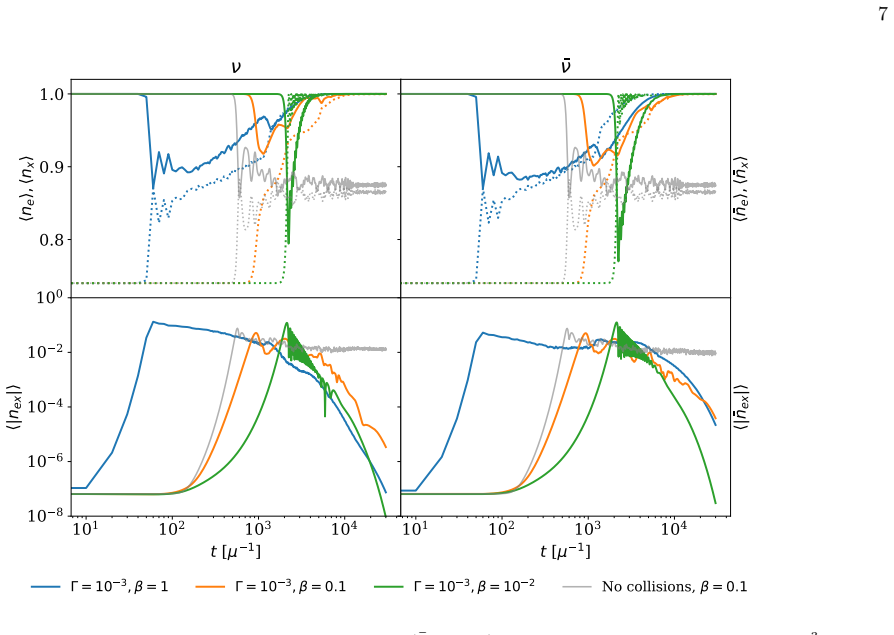
Deep Crossing In this regime (β= 1.0, blue lines in Fig. 2), the FFI dominates the early dynamics. Because the initial state contains an excess of electron flavors compared to heavy- lepton flavors, the FFI drives the number densities to- ward almost perfect flavor equipartition, which signifi- cantly reduces the number of electron-type neutrinos. Followi...
-
[2]
and quasi-steady evolution of flavor conversion re- 6 0.8 0.9 1.0ne , nx ne , nx 101 102 103 104 105 t [ 1] 10 8 10 6 10 4 10 2 100 |nex| 101 102 103 104 105 t [ 1] |nex| = 10 4, = 1 = 10 4, = 0.1 = 10 4, = 10 2 No collisions, = 0.1 FIG. 2. Time evolution of the spatially-averaged angular moments in the idealized case of symmetric collision rates ( ¯Γ = Γ...
-
[3]
2), the early-phase FFI is weaker compared to the deep crossing case
Intermediate Crossing For a moderate initial crossing (β= 0.1, orange lines in Fig. 2), the early-phase FFI is weaker compared to the deep crossing case. Consequently, the initial flavor equipartition is also weaker, leaving the system in a state of incomplete mixing. The system then enters a quasi- steady evolution. Similar to the case with deep crossing...
-
[4]
Shallow Crossing In the shallow regime (β= 0.01, green lines in Fig. 2), collisions are sufficiently frequent to rapidly isotropize the angular distributions, effectively erasing the initial ELN-XLN crossing. Because the CFI is prohibited in this symmetric setup, no flavor conversions can develop once the ELN-XLN crossing condition vanishes. Conse- quentl...
-
[5]
deep” here, in contrast to its “intermediate
Deep Crossing This regime encompasses three cases: the large initial crossings (β= 1.0) for both collision rates (Γ = 10 −3 and 10 −4, blue lines in Figs. 3 and 4), as well as the moderate crossing (β= 0.1) for the collision rate of Γ = 10−4 (orange lines in Fig. 4). It should be noted that theβ= 0.1 case with Γ = 10 −4 is classified as “deep” here, in co...
-
[6]
Intermediate Crossing When the initial crossing is moderate and the colli- sion rate is relatively high (β= 0.1 with Γ = 10 −3, orange lines in Fig. 3), the system falls into the inter- mediate crossing regime of the asymmetric case, where the growth timescales of the FFI and CFI become com- parable. It should be noted, however, that this model has distin...
-
[7]
3 and 4) ex- hibits the most pronounced deviations from the symmet- ric cases
Shallow Crossing The asymmetric collision model with shallow initial crossing (β= 0.01, green lines in Figs. 3 and 4) ex- hibits the most pronounced deviations from the symmet- ric cases. In the early phase, the initial ELN-XLN cross- ing is rapidly eliminated by frequent collisions, effectively suppressing the FFI. However, due to the asymmetric col- lis...
-
[8]
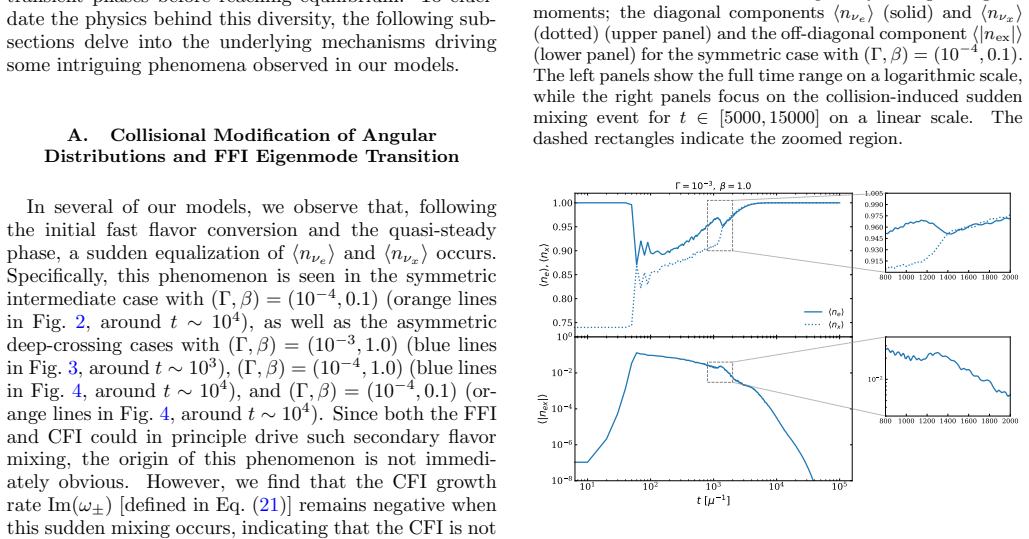
Symmetric case We begin with introducing two useful quantities: the spatially and angularly integrated ELN and XLN num- 0.75 0.80 0.85 0.90 0.95 1.00ne , nx = 10 4, = 0.1 6000 8000 10000 12000 14000 0.88 0.89 0.90 0.91 0.92 0.93 0.94 0.95 0.96 0.97 ne nx 101 102 103 104 105 t [ 1] 10 8 10 6 10 4 10 2 100 |nex| 6000 8000 10000 12000 14000 10 2 3 × 10 3 4 ×...
work page 2000
-
[9]
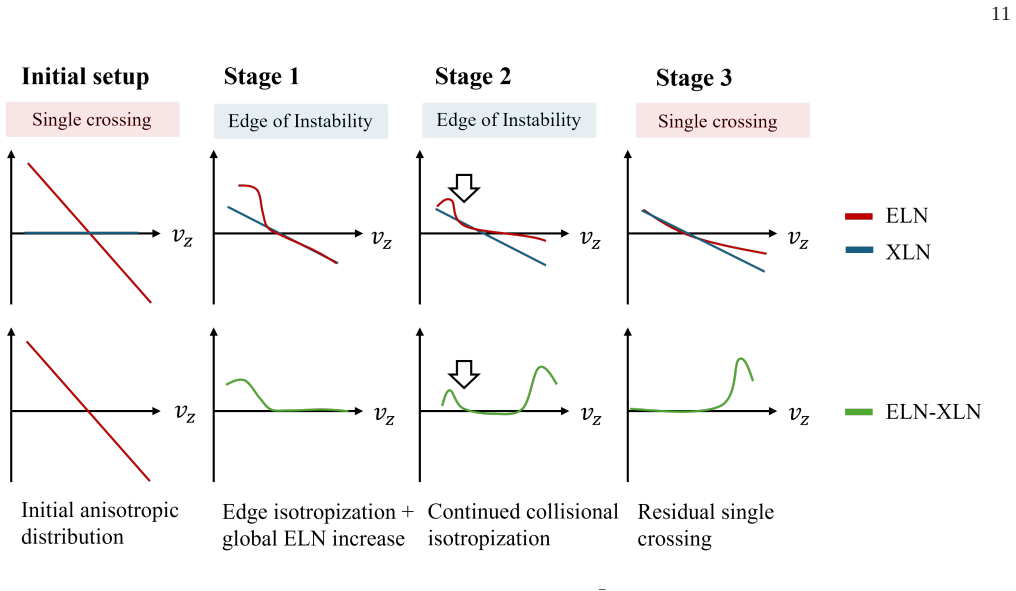
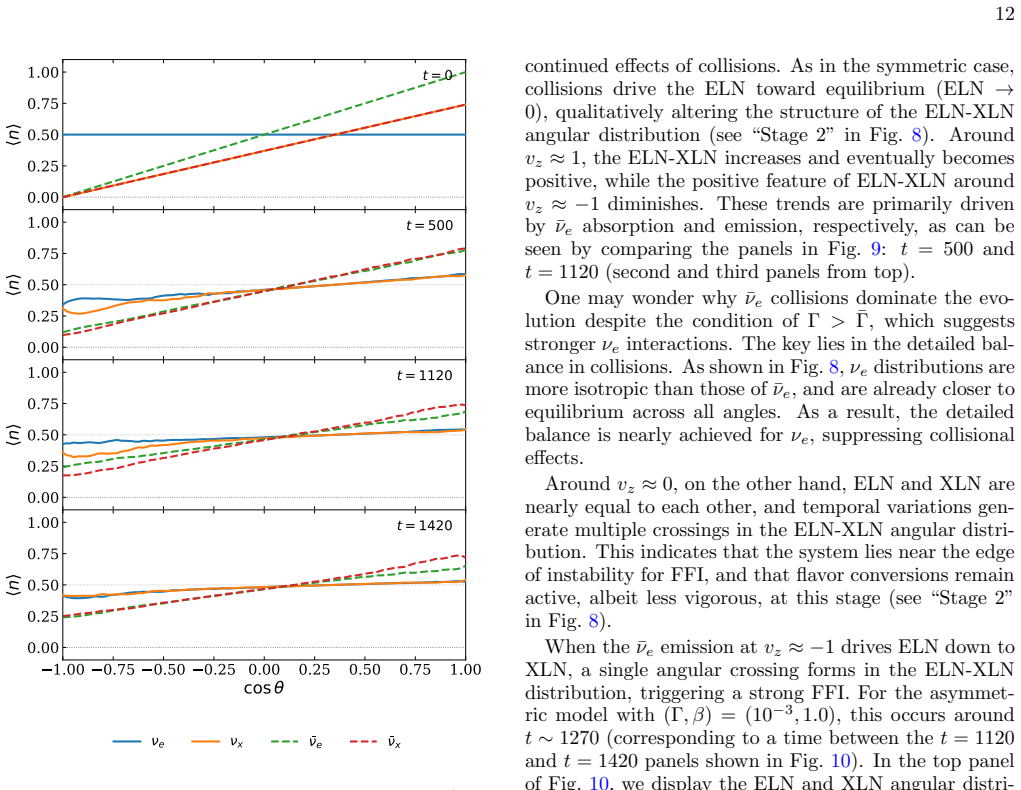
Asymmetric case In the asymmetric case, the time evolution of the sys- tem is broadly similar to that of the symmetric case, but the interplay between FFI and collisions becomes some- what more complex due to the non-conservation of ELN number density (see below for more details). Here, we delve into the physical processes by focusing on the asym- metric ...
work page 2000
-
[10]
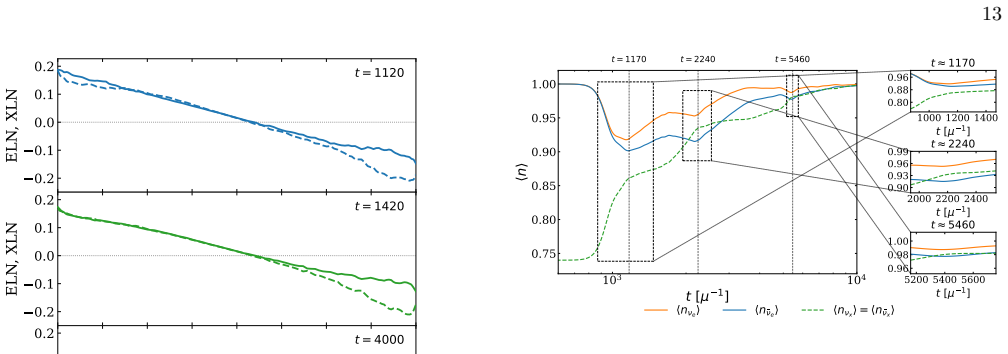
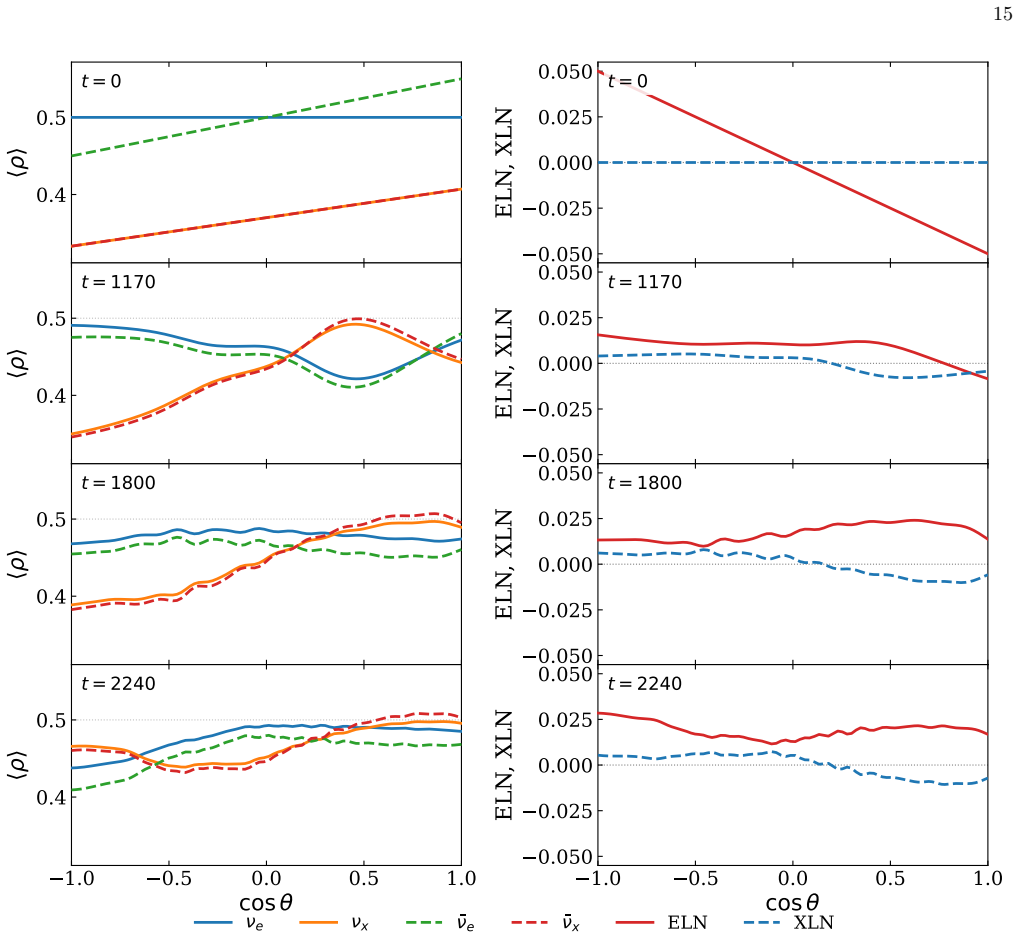
First mixing event by FFI The first mixing event att≈1170 is primarily driven by FFI. In this model, the FFI timescale is somewhat shorter than the resonance-like CFI, which can be seen by comparing with green and orange curves, where the green curve corresponds to a model with dominant resonance- like CFI in Fig. 3. On the other hand, the growth of the F...
work page 2000
-
[11]
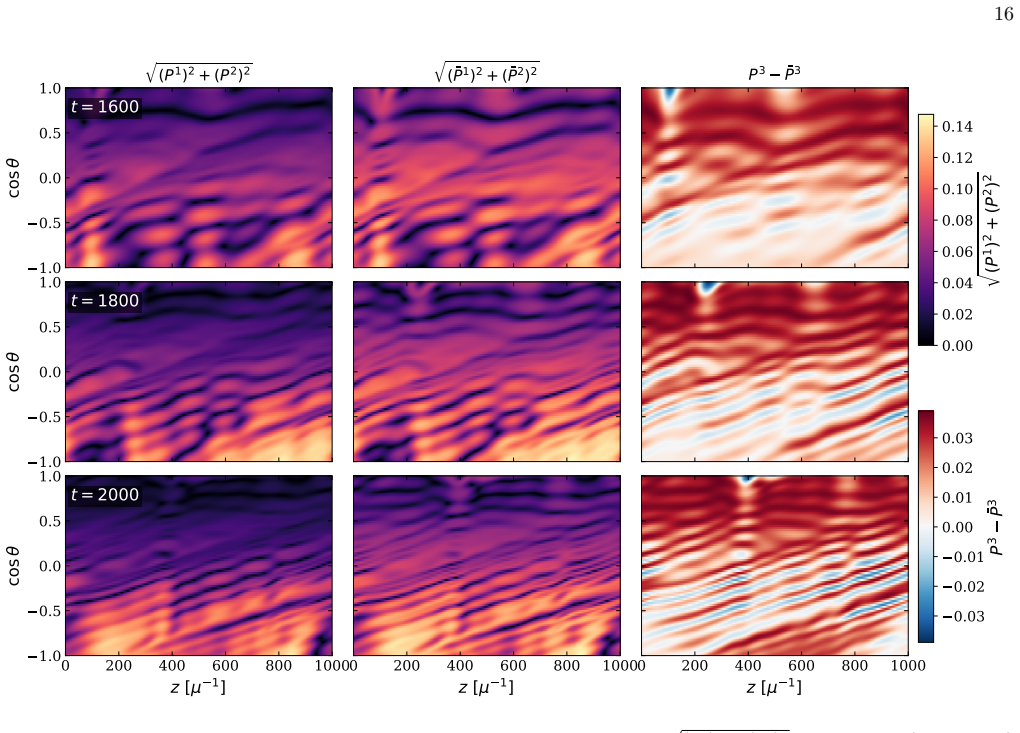
Transition phase between the first and second mixing episodes:1170≲t≲2240 In the short time window 1170≲t≲1500 (imme- diately following the first FFI), the growth rate of CFI (Im(ω+)), which is displayed in the top panel of Fig. 12, remains positive. This residual CFI may contribute to the growth of⟨|n ex|⟩during this phase. However,Acon- tinues to grow a...
work page 2000
-
[12]
11 and 12, the local FFI subsides at t∼2240
Termination of the local FFI aroundt∼2240 As shown in Figs. 11 and 12, the local FFI subsides at t∼2240. At this time, the ELN–XLN angular distribu- tion exhibits a widened gap atv z ≲0 (see bottom row of Fig. 13): the ELN has increased there, while the XLN remains nearly unchanged. This behavior can be under- stood as follows. Prior to the onset of local...
-
[13]
As shown in the bottom panel of Fig
Collisional thermalization and transition to the non-resonant CFI (t≳2240) In the subsequent phase (t≳2240), collisions govern the time evolution of the system. As shown in the bottom panel of Fig. 12,Gincreases with time, whileAdecreases untilt∼3500. As a result, the system enters an unstable regime for non-resonant CFI (see the green line in the top pan...
work page 2000
-
[14]
H. Duan, G. M. Fuller, and Y.-Z. Qian, Annual Review of Nuclear and Particle Science60, 569–594 (2010)
work page 2010
-
[15]
A. Mirizzi, I. Tamborra, H.-T. Janka, N. Sa- viano, K. Scholberg, R. Bollig, L. H¨ udepohl, and S. Chakraborty, La Rivista del Nuovo Cimento39, 1–112 (2016)
work page 2016
-
[16]
I. Tamborra and S. Shalgar, Annual Review of Nuclear and Particle Science71, 165–188 (2021)
work page 2021
-
[17]
S. Richers and M. Sen, Fast flavor transformations, in Handbook of Nuclear Physics(Springer Nature Singa- pore, 2022) p. 1–17
work page 2022
- [18]
-
[19]
T. Fischer, G. Guo, K. Langanke, G. Mart´ ınez-Pinedo, Y.-Z. Qian, and M.-R. Wu, Progress in Particle and Nu- clear Physics137, 104107 (2024)
work page 2024
- [20]
-
[23]
I. Izaguirre, G. Raffelt, and I. Tamborra, Physical Review Letters118, 10.1103/physrevlett.118.021101 (2017)
-
[25]
Dasgupta, Physical Review Letters128, 10.1103/physrevlett.128.081102 (2022)
B. Dasgupta, Physical Review Letters128, 10.1103/physrevlett.128.081102 (2022)
- [26]
-
[27]
B. Dasgupta, A. Mirizzi, and M. Sen, Journal of Cosmol- ogy and Astroparticle Physics2017(02), 019–019
-
[28]
Abbar, Journal of Cosmology and Astroparticle Physics2020(05), 027–027
S. Abbar, Journal of Cosmology and Astroparticle Physics2020(05), 027–027
-
[29]
H. Nagakura and L. Johns, Physical Review D104, 10.1103/physrevd.104.063014 (2021)
-
[30]
H. Nagakura, A. Burrows, L. Johns, and G. M. Fuller, Phys. Rev. D104, 083025 (2021)
work page 2021
-
[31]
M. Cornelius, I. Tamborra, M. Heinlein, and H.-T. Janka, Physical Review D112, 10.1103/gqd7-4ynz (2025)
-
[34]
H. Nagakura, T. Morinaga, C. Kato, and S. Yamada, The Astrophysical Journal886, 139 (2019)
work page 2019
-
[36]
T. Morinaga, H. Nagakura, C. Kato, and S. Ya- mada, Physical Review Research2, 10.1103/physrevre- search.2.012046 (2020)
-
[37]
R. Glas, H.-T. Janka, F. Capozzi, M. Sen, B. Dasgupta, A. Mirizzi, and G. Sigl, Phys. Rev. D101, 063001 (2020)
work page 2020
- [38]
- [39]
-
[41]
Z. Xiong, M.-R. Wu, N. K. Largani, T. Fischer, and G. Mart´ ınez-Pinedo, Occurrence of fast neutrino flavor conversions in qcd phase-transition supernovae (2025), arXiv:2505.19592 [astro-ph.HE]
-
[42]
M.-R. Wu and I. Tamborra, Physical Review D95, 10.1103/physrevd.95.103007 (2017)
- [44]
-
[45]
J. Froustey, S. Richers, E. Grohs, S. D. Flynn, F. Foucart, J. P. Kneller, and G. C. McLaughlin, Physical Review D 109, 10.1103/physrevd.109.043046 (2024)
-
[46]
J. Froustey, F. Foucart, C. Hall, J. P. Kneller, D. Kundu, Z. Lin, G. C. McLaughlin, and S. Richers, Neutrino flavor instabilities in neutron star mergers with mo- ment transport: slow, fast, and collisional modes (2026), arXiv:2601.02461 [astro-ph.HE]
-
[47]
K. Kawaguchi, S. Fujibayashi, and M. Shibata, Phys. Rev. D111, 023015 (2025)
work page 2025
-
[48]
H. Nagakura, K. Sumiyoshi, S. Fujibayashi, Y. Sekiguchi, and M. Shibata, Neutrino flavor instabilities in a binary neutron star merger remnant: Roles of a long-lived hy- permassive neutron star (2025), arXiv:2504.20143 [astro- ph.HE]
-
[49]
S. Bhattacharyya and B. Dasgupta, Physical Review Let- ters126, 10.1103/physrevlett.126.061302 (2021)
- [50]
-
[51]
S. Richers, D. Willcox, and N. Ford, Physical Review D 104, 10.1103/physrevd.104.103023 (2021)
-
[52]
S. Richers, H. Duan, M.-R. Wu, S. Bhattacharyya, M. Za- izen, M. George, C.-Y. Lin, and Z. Xiong, Phys. Rev. D 106, 043011 (2022)
work page 2022
-
[53]
M. Zaizen and H. Nagakura, Physical Review D107, 10.1103/physrevd.107.123021 (2023)
-
[54]
Z. Xiong, M.-R. Wu, S. Abbar, S. Bhattacharyya, M. George, and C.-Y. Lin, Physical Review D108, 10.1103/physrevd.108.063003 (2023)
- [55]
- [56]
-
[57]
S. Shalgar and I. Tamborra, Physical Review D103, 10.1103/physrevd.103.063002 (2021)
-
[58]
C. Kato and H. Nagakura, Physical Review D106, 10.1103/physrevd.106.123013 (2022)
-
[59]
R. S. Hansen, S. Shalgar, and I. Tamborra, Physical Re- view D105, 10.1103/physrevd.105.123003 (2022)
-
[60]
H. Sasaki and T. Takiwaki, Progress of Theoretical and Experimental Physics2022, 10.1093/ptep/ptac082 (2022)
-
[61]
L. Johns and H. Nagakura, Physical Review D106, 10.1103/physrevd.106.043031 (2022)
-
[62]
I. Padilla-Gay, I. Tamborra, and G. G. Raffelt, Physical Review D106, 10.1103/physrevd.106.103031 (2022)
-
[63]
M. D. Azari, H. Sasaki, T. Takiwaki, and H. Okawa, Progress of Theoretical and Experimental Physics2024, 10.1093/ptep/ptae144 (2024)
-
[64]
C. Kato, H. Nagakura, and M. Zaizen, Physical Review D108, 10.1103/physrevd.108.023006 (2023)
-
[65]
J. D. Martin, J. Carlson, V. Cirigliano, and H. Duan, Physical Review D103, 10.1103/physrevd.103.063001 (2021)
-
[67]
Z. Xiong, M.-R. Wu, G. Mart´ ınez-Pinedo, T. Fischer, M. George, C.-Y. Lin, and L. Johns, Phys. Rev. D107, 083016 (2023)
work page 2023
-
[68]
Nagakura, Physical Review Letters130, 10.1103/physrevlett.130.211401 (2023)
H. Nagakura, Physical Review Letters130, 10.1103/physrevlett.130.211401 (2023)
-
[69]
Z. Xiong, M.-R. Wu, M. George, C.-Y. Lin, N. K. Largani, T. Fischer, and G. Mart´ ınez-Pinedo, Phys. Rev. D109, 123008 (2024)
work page 2024
-
[70]
S. Shalgar and I. Tamborra, Journal of Cosmology and Astroparticle Physics2024(09), 021
-
[71]
D. N. Blaschke and V. Cirigliano, Physical Review D94, 10.1103/physrevd.94.033009 (2016)
-
[74]
Z. Xiong, L. Johns, M.-R. Wu, and H. Duan, Physical Review D108, 10.1103/physrevd.108.083002 (2023)
-
[75]
J. Liu, M. Zaizen, and S. Yamada, Physical Review D 107, 10.1103/physrevd.107.123011 (2023)
-
[76]
C. Kato, H. Nagakura, and L. Johns, Phys. Rev. D109, 19 103009 (2024)
work page 2024
-
[77]
J. Liu, H. Nagakura, R. Akaho, A. Ito, M. Zaizen, S. Furusawa, and S. Yamada, Physical Review D110, 10.1103/physrevd.110.043039 (2024)
-
[78]
Quantum semipara- metric estimation.Phys
M. Zaizen, Physical Review D111, 10.1103/phys- revd.111.103029 (2025)
- [79]
-
[80]
H. Nagakura, M. Zaizen, J. Liu, and L. Johns, Resolution requirements for numerical modeling of neutrino quan- tum kinetics (2025), arXiv:2501.14145 [astro-ph.HE]
-
[81]
Fast Neutrino-Flavor Conversion with Attenuation and Global Lepton Gradient
M. Zaizen and H. Nagakura, Fast neutrino-flavor conver- sion with attenuation and global lepton gradient (2026), arXiv:2604.13617 [astro-ph.HE]
work page internal anchor Pith review Pith/arXiv arXiv 2026
-
[82]
D. F. Fiorillo and G. G. Raffelt, Physical Review Letters 133, 10.1103/physrevlett.133.221004 (2024)
-
[83]
J. Liu, H. Nagakura, M. Zaizen, L. Johns, R. Akaho, and S. Yamada, Phys. Rev. D111, 023051 (2025)
work page 2025
-
[84]
E. Urquilla and L. Johns, Testing common approx- imations of neutrino fast flavor conversion (2025), arXiv:2510.23917 [astro-ph.HE]
work page internal anchor Pith review arXiv 2025
-
[85]
M. Zaizen and H. Nagakura, Physical Review D107, 10.1103/physrevd.107.103022 (2023)
-
[86]
S. Bhattacharyya and B. Dasgupta, Journal of Cosmol- ogy and Astroparticle Physics2021(07), 023
-
[87]
H. Nagakura and M. Zaizen, Physical Review Letters 129, 10.1103/physrevlett.129.261101 (2022)
-
[88]
H. Nagakura and M. Zaizen, Basic characteristics of neutrino flavor conversions in the post-shock regions of core-collapse supernova (2023), arXiv:2308.14800 [astro- ph.HE]
-
[89]
Neutrino transport and flavor instabilities in a post-merger disk
E. Urquilla, S. Shankar, D. Kundu, J. Froustey, S. Rich- ers, J. M. Miller, G. C. McLaughlin, J. P. Kneller, and F. Foucart, Neutrino transport and flavor instabilities in a post-merger disk (2026), arXiv:2604.06404 [astro- ph.HE]
work page internal anchor Pith review Pith/arXiv arXiv 2026
discussion (0)
Sign in with ORCID, Apple, or X to comment. Anyone can read and Pith papers without signing in.