Hypergraph-Enhanced Training-Free and Language-Free Few-Shot Anomaly Detection
Pith reviewed 2026-05-12 05:16 UTC · model grok-4.3
The pith
HyperFSAD uses sparsemax-selected hyperedges on DINOv3 features to perform training-free and language-free few-shot anomaly detection that outperforms prior approaches across six datasets.
A machine-rendered reading of the paper's core claim, the machinery that carries it, and where it could break.
Core claim
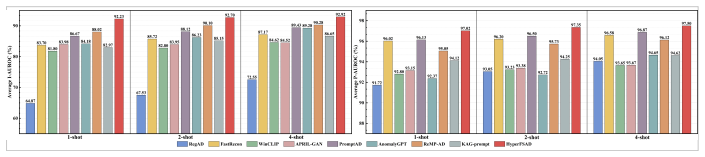
HyperFSAD performs inference by first extracting patch features from DINOv3, then applying sparsemax to select the most relevant support patches for aggregation into hyperedges that serve as normal prototypes, and finally computing anomaly scores via Dual-Branch Image Scoring that fuses a patch-grid anomaly map with global deviation measured by support-aware CLS matching, all without optimization or text, to achieve state-of-the-art results on MVTecAD, VisA, MPDD, BTAD, RESC, and BraTS.
What carries the argument
Sparse Hyper Matching, in which sparsemax selects support patches that are aggregated into hyperedges as compact normal evidence, combined with Dual-Branch Image Scoring that merges spatial patch-grid anomaly maps and support-aware CLS token matching.
If this is right
- Anomaly detection systems can be deployed on new tasks or domains with no fine-tuning or prompt engineering required.
- Background noise and distractors in patch features are suppressed through hyperedge aggregation rather than simple nearest-neighbor selection.
- Image-level decisions gain reliability by balancing local spatial evidence with global semantic deviation in a single visual pipeline.
- The same framework applies uniformly to both industrial manufacturing defects and medical imaging anomalies.
- Labor-intensive creation of text prompts or dataset-specific training loops becomes unnecessary for competitive performance.
Where Pith is reading between the lines
- Replacing DINOv3 with stronger future self-supervised backbones could improve results while keeping the hypergraph and dual-branch logic unchanged.
- The hyperedge construction may transfer to other few-shot visual tasks such as classification or segmentation that also rely on patch-level comparisons.
- In resource-limited settings the absence of training steps could enable rapid on-site setup of inspection systems.
- Higher-order relations captured by hypergraphs might reduce sensitivity to patch-level outliers compared with pairwise matching alone.
Load-bearing premise
That DINOv3 patch features will contain sufficient domain-general information so that sparsemax-selected hyperedges can reliably represent normal patterns without any further adaptation.
What would settle it
A new dataset containing anomalies that depend on semantic relationships or contextual cues absent from DINOv3 patch embeddings, where the method would fail to separate normal from anomalous images despite the hypergraph construction.
Figures




read the original abstract
Few-shot anomaly detection (FSAD) has made significant strides, yet existing methods still face critical challenges: (i) dependence on task- or dataset-specific training/fine-tuning, (ii) reliance on language supervision or carefully hand-crafted prompts, and (iii) limited robustness across domains. In this paper, we introduce HyperFSAD, a novel FSAD framework that is training-free, language-free, and robust across domains, offering a powerful solution to these challenges. Built upon DINOv3 and a hypergraph-based inference mechanism, our approach performs inference without any task-specific optimization or text prompts, while remaining competitive. Specifically, we replace sensitive nearest-neighbor / top-$n$ matching with \textbf{Sparse Hyper Matching}: \textit{sparsemax} first selects the most relevant support patches, which are then aggregated into a \textit{hyperedge} as compact normal evidence to suppress background noise and distractors. We further introduce \textbf{Dual-Branch Image Scoring}, which fuses \emph{spatial anomaly evidence} from the patch-grid anomaly map with \emph{global semantic deviation} captured by support-aware CLS matching, yielding a robust image-level anomaly score in a strictly visual manner. Notably, all components of HyperFSAD are purely visual, eliminating the need for labor-intensive hand-crafted text prompts. Under the stringent training-free and language-free setting, HyperFSAD achieves state-of-the-art performance across six datasets spanning four industrial datasets (MVTecAD, VisA, MPDD, BTAD) and two medical datasets (RESC, BraTS).
Editorial analysis
A structured set of objections, weighed in public.
Referee Report
Summary. The paper introduces HyperFSAD, a training-free and language-free few-shot anomaly detection method built on DINOv3 patch features. It replaces nearest-neighbor matching with Sparse Hyper Matching, where sparsemax selects relevant support patches that are aggregated into hyperedges serving as compact normal evidence. A Dual-Branch Image Scoring module then fuses a patch-grid anomaly map (spatial evidence) with support-aware CLS token matching (global semantic deviation) to produce the final image-level score. The central claim is that this purely visual pipeline achieves state-of-the-art performance on six datasets (MVTecAD, VisA, MPDD, BTAD, RESC, BraTS) under strict training-free and language-free constraints.
Significance. If the performance claims are substantiated with rigorous quantitative results, ablations, and fair comparisons, the work would be significant for practical FSAD deployment. It removes the need for task-specific fine-tuning or prompt engineering, which is a common bottleneck in industrial and medical imaging applications where data is scarce and domain shifts are frequent. The parameter-free nature of the hyperedge construction and the dual-branch fusion are particularly attractive strengths.
major comments (2)
- [Abstract] Abstract: The assertion of 'state-of-the-art performance' is made without any numerical metrics, baseline comparisons, AUC/F1 scores, or error bars. This is load-bearing for the central claim; the abstract supplies no evidence that allows evaluation of the magnitude or statistical significance of the reported gains.
- [Methods] Methods (Sparse Hyper Matching): The description states that sparsemax selects support patches which are then aggregated into a hyperedge, yet no equation or algorithmic detail is supplied showing how the hyperedge embedding is computed or how background suppression is guaranteed. Without this, it is impossible to verify that the method is truly parameter-free or that it avoids the very sensitivity issues it claims to solve.
minor comments (2)
- [Abstract] The abstract lists four industrial and two medical datasets but does not name the exact splits or few-shot shot counts used; these details should appear in the experimental protocol section for reproducibility.
- [Methods] Notation for the dual-branch score fusion (spatial map + CLS matching) is introduced only descriptively; an explicit equation would improve clarity.
Simulated Author's Rebuttal
We thank the referee for the constructive feedback on our manuscript. We address each major comment below with point-by-point responses, indicating where revisions have been made to strengthen the paper.
read point-by-point responses
-
Referee: [Abstract] Abstract: The assertion of 'state-of-the-art performance' is made without any numerical metrics, baseline comparisons, AUC/F1 scores, or error bars. This is load-bearing for the central claim; the abstract supplies no evidence that allows evaluation of the magnitude or statistical significance of the reported gains.
Authors: We agree that the abstract would be strengthened by including concrete quantitative evidence. In the revised manuscript, we have updated the abstract to report key performance metrics, including average AUC-ROC scores across the six datasets, specific gains over leading baselines, and reference to error bars from repeated runs. This provides immediate substantiation for the state-of-the-art claim while preserving the abstract's brevity. revision: yes
-
Referee: [Methods] Methods (Sparse Hyper Matching): The description states that sparsemax selects support patches which are then aggregated into a hyperedge, yet no equation or algorithmic detail is supplied showing how the hyperedge embedding is computed or how background suppression is guaranteed. Without this, it is impossible to verify that the method is truly parameter-free or that it avoids the very sensitivity issues it claims to solve.
Authors: We acknowledge that the original Methods description of Sparse Hyper Matching was insufficiently detailed. We have revised the section to include the explicit equations for hyperedge construction: the sparsemax operator produces selection weights over support patches, which are then used to compute the hyperedge embedding as a convex combination of the selected patch features. Background suppression is achieved through the sparsity property of sparsemax, which assigns near-zero weights to irrelevant patches. These additions confirm the parameter-free character of the approach and provide the algorithmic rigor needed for verification and reproducibility. revision: yes
Circularity Check
No significant circularity
full rationale
The abstract and method outline rely on an external pre-trained DINOv3 model for patch features, standard sparsemax for hyperedge selection, and a dual-branch scoring rule that fuses patch-grid maps with CLS matching. No equations, fitted parameters, or derivations are shown that reduce the claimed SOTA performance to quantities defined by the same data or by self-citation chains. All components are described as training-free and language-free, drawing on independent external models and fixed operations rather than any self-referential construction. The derivation chain is therefore self-contained against external benchmarks.
Axiom & Free-Parameter Ledger
axioms (2)
- domain assumption DINOv3 produces patch features that separate normal from anomalous regions across domains without fine-tuning
- domain assumption Sparsemax selection followed by hyperedge aggregation suppresses background noise better than standard top-n matching
invented entities (1)
-
hyperedge as compact normal evidence
no independent evidence
Lean theorems connected to this paper
-
IndisputableMonolith/Cost/FunctionalEquation.leanwashburn_uniqueness_aczel unclear?
unclearRelation between the paper passage and the cited Recognition theorem.
we replace sensitive nearest-neighbor / top-n matching with Sparse Hyper Matching: sparsemax first selects the most relevant support patches, which are then aggregated into a hyperedge as compact normal evidence
-
IndisputableMonolith/Foundation/AbsoluteFloorClosure.leanabsolute_floor_iff_bare_distinguishability unclear?
unclearRelation between the paper passage and the cited Recognition theorem.
Dual-Branch Image Scoring, which fuses spatial anomaly evidence from the patch-grid anomaly map with global semantic deviation captured by support-aware CLS matching
What do these tags mean?
- matches
- The paper's claim is directly supported by a theorem in the formal canon.
- supports
- The theorem supports part of the paper's argument, but the paper may add assumptions or extra steps.
- extends
- The paper goes beyond the formal theorem; the theorem is a base layer rather than the whole result.
- uses
- The paper appears to rely on the theorem as machinery.
- contradicts
- The paper's claim conflicts with a theorem or certificate in the canon.
- unclear
- Pith found a possible connection, but the passage is too broad, indirect, or ambiguous to say the theorem truly supports the claim.
Reference graph
Works this paper leans on
-
[1]
Bergmann, P., Fauser, M., Sattlegger, D., Steger, C.: Mvtec ad–a comprehensive real-world dataset for unsupervised anomaly detection. In: IEEE Conf. Comput. Vis. Pattern Recog. pp. 9592–9600 (2019)
work page 2019
-
[2]
Cao, Y., Zhang, J., Frittoli, L., Cheng, Y., Shen, W., Boracchi, G.: Adaclip: Adapt- ing clip with hybrid learnable prompts for zero-shot anomaly detection. In: Eur. Conf. Comput. Vis. pp. 55–72 (2024)
work page 2024
-
[3]
Chen, Q., Luo, H., Yao, H., Luo, W., Qu, Z., Lv, C., Zhang, Z.: Center-aware resid- ual anomaly synthesis for multiclass industrial anomaly detection. IEEE Trans. Ind. Informatics1(2025)
work page 2025
-
[4]
Chen, X., Han, Y., Zhang, J.: April-gan: A zero-/few-shot anomaly classifica- tion and segmentation method for cvpr 2023 vand workshop challenge tracks 1&2: 1st place on zero-shot ad and 4th place on few-shot ad. arXiv preprint arXiv:2305.17382 (2023)
-
[5]
Fang, Z., Wang, X., Li, H., Liu, J., Hu, Q., Xiao, J.: Fastrecon: Few-shot industrial anomaly detection via fast feature reconstruction. In: Int. Conf. Comput. Vis. pp. 17481–17490 (2023)
work page 2023
-
[6]
IEEE transactions on pattern analysis and machine intelligence47(4), 2388–2401 (2024)
Feng, Y., Huang, J., Du, S., Ying, S., Yong, J.H., Li, Y., Ding, G., Ji, R., Gao, Y.: Hyper-yolo: When visual object detection meets hypergraph computation. IEEE transactions on pattern analysis and machine intelligence47(4), 2388–2401 (2024)
work page 2024
- [7]
-
[8]
Fixelle, J.: Hypergraph vision transformers: Images are more than nodes, more than edges. In: IEEE Conf. Comput. Vis. Pattern Recog. pp. 9751–9761 (2025)
work page 2025
-
[9]
IEEE TPAMI44(5), 2548–2566 (2020)
Gao, Y., Zhang, Z., Lin, H., Xu, X., Ti, J.R., Utschick, W.: Hypergraph learning: Methods and practices. IEEE TPAMI44(5), 2548–2566 (2020)
work page 2020
-
[10]
Journal of Sensors and Sensor Systems14(2), 119–132 (2025)
Goodarzi, P., Sch¨ utze, A., Schneider, T.: Domain shifts in industrial condition monitoring: a comparative analysis of automated machine learning models. Journal of Sensors and Sensor Systems14(2), 119–132 (2025)
work page 2025
- [11]
-
[12]
Guo, B., Lu, D., Szumel, G., Gui, R., Wang, T., Konz, N., Mazurowski, M.A.: The impact of scanner domain shift on deep learning performance in medical imaging: an experimental study. arXiv preprint arXiv:2409.04368 (2024)
-
[13]
Han, Y., Wang, P., Kundu, S., Ding, Y., Wang, Z.: Vision hgnn: An image is more than a graph of nodes. In: Int. Conf. Comput. Vis. pp. 19878–19888 (2023)
work page 2023
-
[14]
Medical image analysis55, 216–227 (2019)
Hu, J., Chen, Y., Yi, Z.: Automated segmentation of macular edema in oct using deep neural networks. Medical image analysis55, 216–227 (2019)
work page 2019
-
[15]
Huang, C., Guan, H., Jiang, A., Zhang, Y., Spratling, M., Wang, Y.F.: Registration based few-shot anomaly detection. In: Eur. Conf. Comput. Vis. pp. 303–319 (2022)
work page 2022
-
[16]
Jeong, J., Zou, Y., Kim, T., Zhang, D., Ravichandran, A., Dabeer, O.: Winclip: Zero-/few-shot anomaly classification and segmentation. In: IEEE Conf. Comput. Vis. Pattern Recog. pp. 19606–19616 (2023)
work page 2023
-
[17]
Jezek, S., Jonak, M., Burget, R., Dvorak, P., Skotak, M.: Deep learning-based de- fect detection of metal parts: evaluating current methods in complex conditions. In: 2021 13th International congress on ultra modern telecommunications and control systems and workshops (ICUMT). pp. 66–71. IEEE (2021)
work page 2021
-
[18]
Yolov13: Real-time object detection with hypergraph-enhanced adaptive visual perception
Lei, M., Li, S., Wu, Y., Hu, H., Zhou, Y., Zheng, X., Ding, G., Du, S., Wu, Z., Gao, Y.: Yolov13: Real-time object detection with hypergraph-enhanced adaptive visual perception. arXiv preprint arXiv:2506.17733 (2025)
-
[19]
Li, X., Zhang, Z., Tan, X., Chen, C., Qu, Y., Xie, Y., Ma, L.: Promptad: Learning prompts with only normal samples for few-shot anomaly detection. In: IEEE Conf. Comput. Vis. Pattern Recog. pp. 16838–16848 (2024)
work page 2024
-
[20]
Ma, H., Yang, G., Zhao, D., Ji, Y., Zuo, W.: Remp-ad: Retrieval-enhanced multi- modal prompt fusion for few-shot industrial visual anomaly detection. In: Int. Conf. Comput. Vis. pp. 20425–20434 (2025)
work page 2025
-
[21]
Mahapatra, D., Bozorgtabar, B., Ge, Z.: Medical image classification using gener- alized zero shot learning. In: Int. Conf. Comput. Vis. pp. 3344–3353 (2021)
work page 2021
-
[22]
Martins, A., Astudillo, R.: From softmax to sparsemax: A sparse model of attention and multi-label classification. In: Int. Conf. Mach. Learn. pp. 1614–1623 (2016)
work page 2016
-
[23]
Menze, B.H., Jakab, A., Bauer, S., Kalpathy-Cramer, J., Farahani, K., Kirby, J., Burren, Y., Porz, N., Slotboom, J., Wiest, R., et al.: The multimodal brain tumor image segmentation benchmark (brats). IEEE Trans. Med. Imaging34(10), 1993– 2024 (2014)
work page 1993
-
[24]
In: IEEE International Symposium on Industrial Electronics
Mishra, P., Verk, R., Fornasier, D., Piciarelli, C., Foresti, G., et al.: Vt-adl: A vision transformer network for image anomaly detection and localization. In: IEEE International Symposium on Industrial Electronics. pp. 01–06 (2021)
work page 2021
- [25]
-
[26]
Qu, Z., Tao, X., Prasad, M., Shen, F., Zhang, Z., Gong, X., Ding, G.: Vcp-clip: A visual context prompting model for zero-shot anomaly segmentation. In: Eur. Conf. Comput. Vis. pp. 301–317 (2024)
work page 2024
-
[27]
Qu, Z., Tao, X., Shen, F., Zhang, Z., Li, T.: Investigating shift equivalence of convolutional neural networks in industrial defect segmentation. IEEE Trans. In- strumentation and Measurement72, 1–17 (2023)
work page 2023
-
[28]
Sim´ eoni, O., Vo, H.V., Seitzer, M., Baldassarre, F., Oquab, M., Jose, C., Khali- dov, V., Szafraniec, M., Yi, S., Ramamonjisoa, M., et al.: Dinov3. arXiv preprint arXiv:2508.10104 (2025)
work page internal anchor Pith review Pith/arXiv arXiv 2025
- [29]
-
[30]
Journal of Intelligent Manufac- turing36(7), 4963–4975 (2025)
Wang, F., Wu, J., Yang, Z., Song, Y.: Industrial vision inspection using digital twins: bridging cad models and realistic scenarios. Journal of Intelligent Manufac- turing36(7), 4963–4975 (2025)
work page 2025
- [31]
-
[32]
Zhou, Q., Pang, G., Tian, Y., He, S., Chen, J.: Anomalyclip: Object-agnostic prompt learning for zero-shot anomaly detection. In: Int. Conf. Learn. Represent. pp. 49705–49737 (2024)
work page 2024
-
[33]
Zou, Y., Jeong, J., Pemula, L., Zhang, D., Dabeer, O.: Spot-the-difference self- supervised pre-training for anomaly detection and segmentation. In: Eur. Conf. Comput. Vis. pp. 392–408 (2022) A Detailed Results on Additional Metrics In this section, we report detailed quantitative results on additional evaluation metrics beyond the AUROC results presented...
discussion (0)
Sign in with ORCID, Apple, or X to comment. Anyone can read and Pith papers without signing in.