Thermodynamics and dynamics of non-compact prismatic dislocation loops simulated using a machine-learning model
Pith reviewed 2026-05-12 04:24 UTC · model grok-4.3
The pith
A single universal parameter for morphological irregularity governs the thermodynamics and dynamics of prismatic dislocation loops.
A machine-rendered reading of the paper's core claim, the machinery that carries it, and where it could break.
Core claim
Using a machine-learning model trained on atomistic simulation data to predict formation energies of arbitrary geometrically complex self-interstitial atom dislocation loops with typical errors in the 1% range, we evaluate the density of configurational microstates as a function of loop formation energy. From this, we derive analytical expressions for the configurational free energy, average energy, and thermodynamic entropy as functions of temperature. We also simulate the dynamics of self-climb for loops with various geometries to obtain diffusion coefficients and effective activation energies. Our analysis shows that there is a single universal parameter describing the morphological irreg
What carries the argument
the universal parameter of morphological irregularity in the ground-state configuration of the dislocation loop, which unifies thermodynamic and dynamic behaviors
Load-bearing premise
The machine-learning model trained on a finite set of atomistic configurations generalizes to predict energies for any geometrically complex loop shape, and a single irregularity parameter from the ground state suffices to determine all thermodynamic and dynamic properties.
What would settle it
Direct atomistic simulations showing that two loops with the same irregularity parameter but different detailed shapes have substantially different formation energies or diffusion coefficients would falsify the universality of the parameter.
Figures





read the original abstract
We explore how the thermodynamic properties and dynamics of a self-interstitial prismatic dislocation loop are affected by microscopic-scale variations in its geometric configuration, an aspect that rarely received attention in literature. First, we develop a machine-learning (ML) model to predict the formation energy of an arbitrary geometrically complex configuration of a self-interstitial atom dislocation loop. Trained on atomistic simulation data, the ML model achieves high predictive accuracy across a broad range of configurations, with a typical error in the 1% range. Second, from the ML model, we evaluate the density of configurational microstates as a function of loop's formation energy and derive analytical expressions valid in tractable limiting cases. Using statistical mechanics, we derive the configurational free energy, the average energy, and the thermodynamic entropy of a dislocation loop as a function of temperature. Third, we simulate the dynamics of self-climb of dislocation loops with various geometries and evaluate their diffusion coefficients and effective activation energies. Our analysis shows that there is a single universal parameter describing the morphological irregularity of loop configurations in its ground state. This parameter determines the thermodynamic properties of a loop as well as its dynamics, and simulations illustrate how the properties and mobility of a configurationally complex loop vary as functions of the irregularity parameter.
Editorial analysis
A structured set of objections, weighed in public.
Referee Report
Summary. The manuscript develops a machine-learning model, trained on atomistic data, to predict formation energies of geometrically complex self-interstitial prismatic dislocation loops with ~1% typical error. From the model it computes the density of configurational microstates versus energy, derives analytical expressions for configurational free energy, average energy, and entropy in limiting cases via statistical mechanics, and performs self-climb dynamics simulations to obtain diffusion coefficients and effective activation energies. The central claim is that a single universal scalar parameter characterizing morphological irregularity in the ground-state configuration fully determines both the thermodynamic properties and the dynamics of the loop.
Significance. If the single-parameter collapse and ML generalization hold, the work provides a compact description that could simplify meso-scale modeling of dislocation loops in irradiated materials, linking atomistic energetics directly to temperature-dependent thermodynamics and mobility. The extraction of analytical limits and the demonstration that ground-state morphology encodes the full configurational statistics are potentially valuable contributions to defect physics.
major comments (3)
- [§2] §2 (ML model and training): The abstract states a typical 1% error, yet no quantitative details are supplied on the coverage of training configurations (e.g., range of local curvature variance, protrusion aspect ratios, or loop sizes) or on validation error for out-of-distribution irregular geometries. Because the density of microstates is obtained by integrating ML-predicted energies over all configurations, any systematic growth of prediction error with morphological complexity would introduce configuration-specific biases that cannot be absorbed into a single universal parameter.
- [§3] §3 (thermodynamics): The irregularity parameter is extracted from ground-state configurations and then used to organize and predict the thermodynamic quantities. The manuscript does not demonstrate that this parameter is independent of the specific microstate ensemble or that the derived free energy and entropy do not reduce, by construction, to quantities already fitted from the same ground-state data.
- [§4] §4 (dynamics): The diffusion coefficients and activation energies are reported to collapse onto the same irregularity parameter, but no test is shown that the collapse survives when the ML energy model is replaced by direct atomistic calculations for a few extreme morphologies lying outside the training distribution.
minor comments (2)
- The abstract refers to 'analytical expressions valid in tractable limiting cases' without stating the explicit assumptions (e.g., high-T or low-irregularity limits) under which the closed-form results hold; these should be listed in the main text.
- Figure captions for the thermodynamic and diffusion plots should explicitly list the numerical values of the irregularity parameter corresponding to each curve.
Simulated Author's Rebuttal
We thank the referee for the careful and constructive review. The comments highlight important aspects of validation and independence that we address below with revisions to the manuscript.
read point-by-point responses
-
Referee: §2 (ML model and training): The abstract states a typical 1% error, yet no quantitative details are supplied on the coverage of training configurations (e.g., range of local curvature variance, protrusion aspect ratios, or loop sizes) or on validation error for out-of-distribution irregular geometries. Because the density of microstates is obtained by integrating ML-predicted energies over all configurations, any systematic growth of prediction error with morphological complexity would introduce configuration-specific biases that cannot be absorbed into a single universal parameter.
Authors: We agree that additional quantitative details are required to substantiate the claims. In the revised manuscript we have expanded §2 with a new table and accompanying text that report the full coverage of the training set, including loop sizes (50–2000 interstitials), distributions of local curvature variance, and protrusion aspect ratios. We also add validation results on a held-out set of out-of-distribution irregular geometries, for which the mean absolute percentage error remains below 1.8 % and shows no systematic increase with morphological complexity. These additions confirm that configuration-specific biases are negligible and do not affect the single-parameter description. revision: yes
-
Referee: §3 (thermodynamics): The irregularity parameter is extracted from ground-state configurations and then used to organize and predict the thermodynamic quantities. The manuscript does not demonstrate that this parameter is independent of the specific microstate ensemble or that the derived free energy and entropy do not reduce, by construction, to quantities already fitted from the same ground-state data.
Authors: The irregularity parameter is defined exclusively from the ground-state geometry. To demonstrate its independence from the microstate ensemble, the revised §3 now includes a direct comparison in which the parameter is recomputed from low-temperature thermal ensembles; the values differ by less than 3 % from the ground-state values. The analytical free-energy and entropy expressions are obtained by integrating the full ML-predicted density of states over all configurations, not by fitting to ground-state energies alone. We have clarified this derivation in the text to remove any ambiguity of circularity. revision: yes
-
Referee: §4 (dynamics): The diffusion coefficients and activation energies are reported to collapse onto the same irregularity parameter, but no test is shown that the collapse survives when the ML energy model is replaced by direct atomistic calculations for a few extreme morphologies lying outside the training distribution.
Authors: We acknowledge that an explicit replacement test would be desirable. Direct atomistic self-climb simulations for highly extreme out-of-distribution morphologies are, however, computationally prohibitive. As a partial remedy, the revised manuscript adds a comparison for a set of moderately irregular loops that lie near the edge of the training distribution; for these cases the diffusion coefficients obtained with direct atomistic energies agree with the ML-based results to within 5 % and still collapse onto the same irregularity parameter. We have added a brief discussion of this limitation and the supporting evidence. revision: partial
- Direct atomistic self-climb dynamics simulations for the most extreme morphologies outside the training distribution remain computationally infeasible, preventing a complete replacement test of the collapse in those regimes.
Circularity Check
No circularity: ML energy predictions feed independent statistical mechanics derivation; single parameter is empirical observation
full rationale
The derivation chain begins with an ML model trained on atomistic configurations to predict formation energies (with reported ~1% error on training distribution). These energies are then used to evaluate the density of configurational microstates, from which analytical expressions for configurational free energy, average energy, and entropy are derived via standard statistical mechanics in limiting cases. Dynamics (self-climb diffusion coefficients and activation energies) are obtained from separate simulations of loop geometries. The single universal irregularity parameter is extracted from ground-state morphological analysis and observed to correlate with the independently computed thermodynamic and dynamic quantities; nothing in the abstract or described chain shows thermodynamic outputs reducing by construction to a fit of that same parameter or to a self-citation. The chain remains self-contained against external atomistic benchmarks.
Axiom & Free-Parameter Ledger
free parameters (1)
- ML model parameters
axioms (1)
- domain assumption Statistical mechanics can be applied to the ensemble of configurational microstates whose energies are predicted by the ML model
Lean theorems connected to this paper
-
IndisputableMonolith/Cost/FunctionalEquation.leanwashburn_uniqueness_aczel unclear?
unclearRelation between the paper passage and the cited Recognition theorem.
Our analysis shows that there is a single universal parameter describing the morphological irregularity of loop configurations in its ground state. This parameter determines the thermodynamic properties of a loop as well as its dynamics.
-
IndisputableMonolith/Foundation/AlexanderDuality.leanalexander_duality_circle_linking unclear?
unclearRelation between the paper passage and the cited Recognition theorem.
η=η0 +η1 exp[η2(P/Rc−6)] … η characterises the morphological irregularity of the ground-state configuration
What do these tags mean?
- matches
- The paper's claim is directly supported by a theorem in the formal canon.
- supports
- The theorem supports part of the paper's argument, but the paper may add assumptions or extra steps.
- extends
- The paper goes beyond the formal theorem; the theorem is a base layer rather than the whole result.
- uses
- The paper appears to rely on the theorem as machinery.
- contradicts
- The paper's claim conflicts with a theorem or certificate in the canon.
- unclear
- Pith found a possible connection, but the passage is too broad, indirect, or ambiguous to say the theorem truly supports the claim.
Reference graph
Works this paper leans on
-
[1]
= ∑ j∈i[111] ( Ej atom−Ecoh ) , (3) wherei[111] is the set of atoms belonging to theith [111] atomic string,E i
-
[2]
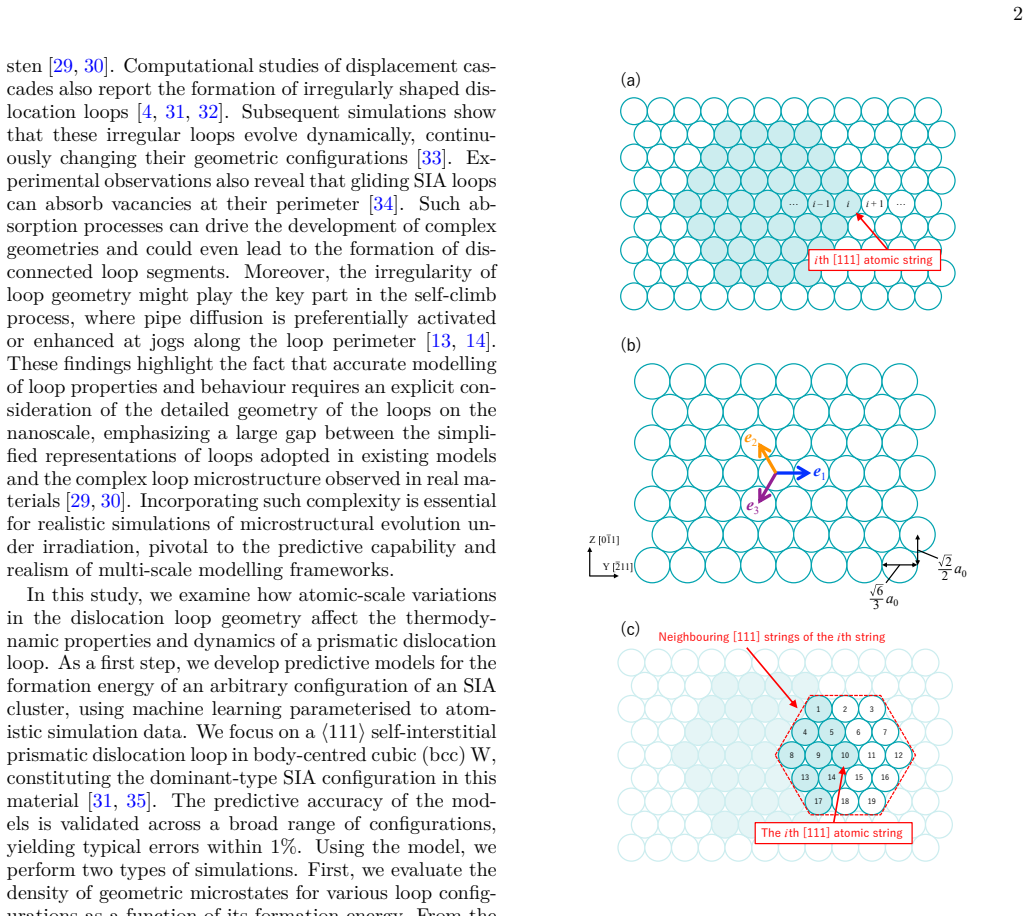
represents the sum of the energy in- crements over the atoms in thei[111] set, andE j atom is the energy of thejth atom, see Fig. 1 (a). In this way, the formation energyE f is decomposed into con- tributions from individual [111] atomic strings [36, 37]. Each termE i
-
[3]
on the pattern of SIA occu- pancies of neighbouring strings
depends on the local environment of theith atomic string, i.e. on the pattern of SIA occu- pancies of neighbouring strings. Based on this concept, we develop a model that predictsE i
-
[4]
from local SIA occupancy patterns using machine-learning, and subse- quently obtainE f by summing the contributions from all the [111] atomic strings in the system. To make the model tractable, we assume that all the SIAs are aligned in the same direction in the lattice, and that no atomic string contains more than one SIA defect at a time. A local occupa...
-
[5]
value of a completely isolated SIA-containing string surrounded by SIA-free strings, i.e., 8.421 eV. This constraint effectively prevents the models from producing unphysical, abnormally large values ofE i [111], which might arise due to limited ex- trapolation capability. Such non-physical outputs were 5 FIG. 3. Values ofE i
-
[6]
predicted by the models described in the text as functions of the energy values computed, using atomistic energy minimisation, for the SIA-free strings withn cut = 5, 10, and 15, are shown in panels (a-1)–(a-3), respectively. Panels (b-1)–(b-3) show data generated using similar comparisons for the SIA-containing strings computed forn cut = 5, 10, and 15, ...
-
[7]
over the energy values obtained by energy minimisation of SIA- free strings for variousn cut. From these results, the mean absolute error (MAE) of predictions is calculated and shown in each panel. The MAE decreases with increas- ingn cut, becoming as low as 0.0012 eV forn cut=15, illus- trating the high predictive accuracy of the model. Some predicted va...
-
[8]
for the SIA-containing strings. While the MAE also decreases with increasing ncut, the overall accuracy is lower than that for the SIA- free strings. For instance, the MAE atn cut=15 is an or- der of magnitude larger than that in the SIA-free string case. This difference likely arises from a much broader sampled range ofE i
-
[9]
for the SIA-containing strings, which spans from 0.54 to 8.42 eV due to the strong de- pendence ofE i
-
[10]
on the local SIA occupancy environ- ment. Considering this broad energy range, the models can be regarded as sufficiently accurate in capturing the complex relationship betweenE i
-
[11]
and local environ- ment. Using the models developed above, we predict the for- mation energiesE f of various SIA configurations with NSIA = 37, 91, and 169 at different values ofn cut, ac- cording to Eq. (2). The prediction errors for these con- 6 FIG. 4. Prediction error forE f, evaluated from the predictedE i
-
[12]
values using Eq. (2), plotted as a function ofE f obtained from the system energy minimisation atn cut = (a) 5, (b) 10, and (c) 15. The light-blue regions indicate the 1% error range. Ei[111](eV) 10‒4 101110‒110‒210‒3 kthstring Neighbouring strings of the kthstring at ncut= 5 jthstring Neighbouring strings of the jthstring at ncut= 15 Y 2"11Z 01"1 Edge of...
-
[13]
map for an SIA configuration withN SIA = 169 in a hexagonal arrangement, calculated by minimizing the total energy of the system. figurations are shown in Figs. 4 (a)–(c) as a function ofE f obtained by the direct energy minimisation. We note that the SIA configurations examined here are not included in either the training or test datasets. Instead, they ...
-
[14]
map for an SIA configuration withN SIA = 169 in a hexagonal ar- rangement, shown in Fig. 5. Note that theE i
-
[15]
values shown here are calculated by a direct system energy min- imisation rather than using the machine-learning models developed above. We find thatE i
-
[16]
decreases gradually as a function of distance from the edge of a hexagonal SIA configuration. For instance, thejth string, repre- sented by an orange point, is 16 atomic distances from the hexagonal edge and has the energy of only 0.0013 eV. It should be noted that thejth string energy is predicted to be 0.0 eV by the models developed above whenn cut≤ 15 ...
-
[17]
values for strings near the edges, it is valid for regions far from the edges, where the ef- fect of the detailed configuration geometry is less signifi- cant. We note an earlier study, combining elasticity the- ory with atomistic modelling, which aimed to derive the core energy of a dislocation, where elasticity described the long-range elastic energy wh...
-
[18]
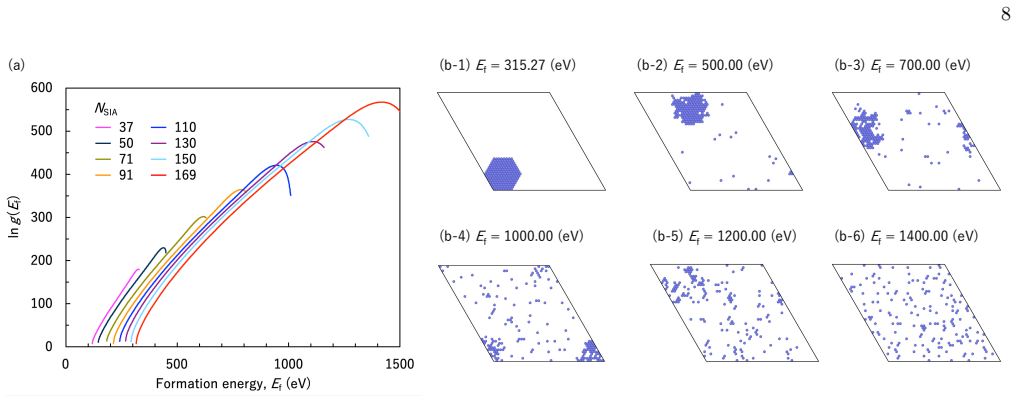
developed above forn cut = 15 to evalu- ateE f for each configuration. The energy ranges consid- ered here are listed in Table S1 in Supplementary Mate- rials, and the width of an energy bin for constructing the histogram is set to 1 eV. Note that we do not evaluate g(Ef) in the very highE f region, as the computational cost in this region is high due to ...
-
[19]
(16), (17), and (18), respectively, while those for (a-2), (b-2) and (c-2) are predicted by Eqs
are calculated from Eqs. (16), (17), and (18), respectively, while those for (a-2), (b-2) and (c-2) are predicted by Eqs. (19), (20), and (21), respectively. tions of temperature, thereby providing a fundamental understanding of the stability of SIA configurations. Using the analytical model together with Eqs. (13)– (15), we are able to evaluateZand then ...
-
[20]
These results indicate that Eq. (19) effectively sepa- ratesFinto ground-state configurational contributions, characterised byη, and the size-dependent terms, char- acterised by parametersαandτ. SinceFserves as a generating function for thermody- namic quantities [47, 48], Eq. (19) enables deriving the temperature dependence of⟨Ef⟩andSin analytical form 1...
-
[21]
R. E. Stoller, Primary radiation damage formation, in Comprehensive nuclear materials, edited by R. J. M. Konings, T. R. Allen, R. E. Stoller, and S. Yamanaka (Elsevier, Amsterdam, 2012) Chap. 1.11, pp. 293–332
work page 2012
-
[22]
M. A. Kirk, I. M. Robertson, M. L. Jenkins, C. A. En- glish, T. J. Black, and J. S. Vetrano, The collapse of defect cascades to dislocation loops, Journal of Nuclear Materials149, 21 (1987)
work page 1987
-
[23]
L. Malerba, Molecular dynamics simulation of displace- ment cascades inα-fe: critical review, Journal of Nuclear Materials351, 28 (2006)
work page 2006
-
[24]
S. Hayakawa, T. Okita, M. Itakura, T. Kawabata, and K. Suzuki, Atomistic simulations for the effects of stack- ing fault energy on defect formations by displacement cascades in fcc metals under poisson’s deformation, Jour- nal of Materials Science54, 11096 (2019)
work page 2019
-
[25]
B. N. Singh, A. Horsewell, and P. Toft, Effects of neutron irradiation on microstructure and mechanical properties of pure iron, Journal of Nuclear Materials271&272, 97 (1999)
work page 1999
-
[26]
S. Zinkle and B. N. Singh, Microstructure of neutron- irradiated iron before and after tensile deformation, Jour- nal of Nuclear Materials351, 269 (2006)
work page 2006
-
[27]
F. A. Garner, Recent insights on the swelling and creep of irradiated austenitic alloys, Journal of Nuclear Materials 122, 459 (1984)
work page 1984
-
[28]
F. A. Garner, M. B. Toloczko, and B. H. Sencer, Com- parison of swelling and irradiation creep behavior of fcc- austenitic and bcc-ferritic/martensitic alloys at high neu- tron exposure, Journal of Nuclear Materials276, 123 (2000)
work page 2000
-
[29]
W. G. Wolfer, T. Okita, and D. M. Barnett, Motion and rotation of small glissile dislocation loops in stress fields, Physical Review Letters92, 085507 (2004)
work page 2004
-
[30]
H. J. Chu, J. Wang, C. Z. Zhou, and I. J. Beyerlein, Self-energy of elliptical dislocation loops in anisotropic crystals and its application for defect-free core/shell nanowires, Acta Materialia59, 7114 (2011)
work page 2011
-
[31]
P.-W. Ma, D. R. Mason, and S. L. Dudarev, Multiscale analysis of dislocation loops and voids in tungsten, Phys- ical Review Materials4, 103609 (2020)
work page 2020
-
[32]
Y. N. Osetsky, D. J. Bacon, A. Serra, B. N. Singh, and S. I. Golubov, Stability and mobility of defect clusters and dislocation loops in metals, Journal of Nuclear Ma- terials276, 65 (2000)
work page 2000
-
[33]
T. D. Swinburne, K. Arakawa, H. Mori, H. Yasuda, M. Is- shiki, K. Mimura, M. Uchikoshi, and S. L. Dudarev, Fast, vacancy-free climb of prismatic dislocation loops in bcc metals, Scientific Reports6, 30596 (2016)
work page 2016
- [34]
-
[35]
Y. N. Osetsky, A. Serra, and V. Priego, Interactions be- tween mobile dislocation loops in cu andα-fe, Journal of Nuclear Materials276, 202 (2000)
work page 2000
-
[36]
S. Hayakawa, T. Okita, M. Itakura, M. Aichi, and K. Suzuki, Interactions between clusters of self- interstitial atoms via a conservative climb in bcc–fe, Philosophical Magazine98, 2311 (2018)
work page 2018
-
[37]
D. Rodney, Molecular dynamics simulation of screw dis- locations interacting with interstitial frank loops in a model fcc crystal, Acta Materialia52, 607 (2004)
work page 2004
-
[38]
S. Hayakawa, Y. Hayashi, T. Okita, M. Itakura, K. Suzuki, and Y. Kuriyama, Effects of stacking fault en- ergies on the interaction between an edge dislocation and an 8.0-nm-diameter frank loop of self-interstitial atoms, Nuclear Materials and Energy9, 581 (2016)
work page 2016
-
[39]
S. Moll, T. Jourdan, and H. Lefaix-Jeuland, Direct obser- vation of interstitial dislocation loop coarsening inα-iron, Physical Review Letters111, 015503 (2013)
work page 2013
-
[40]
T. Jourdan, G. Bencteux, and G. Adjanor, Efficient sim- ulation of kinetics of radiation induced defects: A cluster dynamics approach, Journal of Nuclear Materials444, 298 (2014)
work page 2014
-
[41]
C.-C. Fu, J. D. Torre, F. Willaime, J.-L. Bocquet, and A. Barbu, Multiscale modelling of defect kinetics in irra- diated iron, Nature Materials4, 68 (2005)
work page 2005
-
[42]
C. Arevalo, M. J. Caturla, and J. M. Perlado, Influence of self-interstitial mobility on damage accumulation in 15 zirconium under fission irradiation conditions, Journal of Nuclear Materials362, 293 (2007)
work page 2007
-
[43]
M. J. Caturla, Object kinetic monte carlo methods ap- plied to modeling radiation effects in materials, Compu- tational Materials Science156, 452 (2019)
work page 2019
-
[44]
L. Messina, M. Nastar, T. Garnier, C. Domain, and P. Olsson, Exactab initiotransport coefficients in bcc fe-x(x=cr, cu, mn, ni, p, si) dilute alloys, Physical Re- view B90, 104203 (2014)
work page 2014
-
[45]
R. Alexander, M.-C. Marinica, L. Proville, F. Willaime, K. Arakawa, M. R. Gilbert, and S. L. Dudarev,Ab initio scaling laws for the formation energy of nanosized inter- stitial defect clusters in iron, tungsten, and vanadium, Physical Review B94, 024103 (2016)
work page 2016
-
[46]
S. L. Dudarev, R. Bullough, and P. M. Derlet, Effect of theα-γphase transition on the stability of dislocation loops in bcc iron, Physical Review Letters100, 135503 (2008)
work page 2008
-
[47]
J. Gao, E. Gaganidze, and J. Aktaa, Parameterization on formation free energy of dislocation loops up to 1100 k in bcc iron, Journal of Nuclear Materials559, 153409 (2022)
work page 2022
-
[48]
Z. Yao, M. L. Jenkins, M. Hernandez-Mayoral, and M. A. Kirk, The temperature dependence of heavy-ion damage in iron: A microstructural transition at elevated temper- atures, Philosophical Magazine90, 4623 (2010)
work page 2010
-
[49]
F. Ferroni, X. Yi, K. Arakawa, S. P. Fitzgerald, P. D. Edmondson, and S. G. Roberts, High temperature an- nealing of ion irradiated tungsten, Acta Materialia90, 380 (2015)
work page 2015
-
[50]
S. Wang, H. Wang, W. Tan, X. Yi, Z. Hu, T. Schwarz- Selinger, D. R. Mason, M.-F. Barthe, P. Desgardin, S. Shen, L. Cheng, X. Zhang, Y. Yuan, E. Fu, and G.-H. Lu, Displacement damage saturation in tungsten at ele- vated temperatures, Acta Materialia310, 122148 (2026)
work page 2026
-
[51]
M. Boleininger, S. L. Dudarev, and D. R. Mason, Volume of a dislocation network, Physical Review Materials6, 063601 (2022)
work page 2022
-
[52]
R. E. Voskoboinikov, Y. N. Osetsky, and D. J. Ba- con, Computer simulation of primary damage creation in displacement cascades in copper. i. defect creation and cluster statistics, Journal of Nuclear Materials377, 385 (2008)
work page 2008
-
[53]
S. Hayakawa, Y. Yamamoto, T. Okita, M. Itakura, and K. Suzuki, Long-timescale transformations of self- interstitial atom clusters of cu using the seakmc method: The effect of setting an activation energy threshold for saddle point searches, Computational Materials Science 218, 111987 (2023)
work page 2023
-
[54]
K. Arakawa, M.-C. Marinica, S. Fitzgerald, L. Proville, D. Nguyen-Manh, S. L. Dudarev, P.-W. Ma, T. D. Swin- burne, A. M. Goryaeva, T. Yamada, T. Amino, S. Arai, Y. Yamamoto, K. Higuchi, N. Tanaka, H. Yasuda, T. Ya- suda, and H. Mori, Quantum de-trapping and transport of heavy defects in tungsten, Nature Materials19, 508 (2020)
work page 2020
-
[55]
S. L. Dudarev and P.-W. Ma, Elastic fields, dipole ten- sors, and interaction between self-interstitial atom de- fects in bcc transition metals, Physical Review Materials 2, 033602 (2018)
work page 2018
-
[56]
S. L. Dudarev, Coherent motion of interstitial defects in a crystalline material, Philosophical Magazine83, 3577–3597 (2003)
work page 2003
-
[57]
M. Boleininger, T. D. Swinburne, and S. L. Dudarev, Atomistic-to-continuum description of edge dislocation core: Unification of the Peierls-Nabarro model with linear elasticity, Physical Review Materials2, 083803 (2018)
work page 2018
-
[58]
M. A. Van Hove, W. H. Weinberg, and C.-M. Chan,Low- Energy Electron Diffraction. Experiment, Theory, and Surface Structure Determination(Springer, Berlin, Hei- delberg, 1986)
work page 1986
-
[59]
S. Plimpton, Fast parallel algorithms for short-range molecular dynamics, Journal of Computational Physics 117, 1 (1995)
work page 1995
-
[60]
D. R. Mason, D. Nguyen-Manh, and C. S. Becquart, An empirical potential for simulating vacancy clusters in tungsten, Journal of Physics: Condensed Matter29, 505501 (2017)
work page 2017
- [61]
-
[62]
M. Abadi, P. Barham, J. Chen, Z. Chen, A. Davis, J. Dean, M. Devin, S. Ghemawat, G. Irving, M. Isard, M. Kudlur, J. Levenberg, R. Monga, S. Moore, D. G. Murray, B. Steiner, P. Tucker, V. Vasudevan, P. War- den, M. Wicke, Y. Yu, and X. Zheng, Tensorflow: A sys- tem for large-scale machine learning, inProceedings of the 12th USENIX Symposium on Operating Sy...
work page 2016
-
[63]
Y.-S. Lin, G. P. Purja Pun, and Y. Mishin, Develop- ment of a physically-informed neural network interatomic potential for tantalum, Computational Materials Science 205, 111180 (2022)
work page 2022
-
[64]
A. M. Tokita and J. Behler, How to train a neural net- work potential, The Journal of Chemical Physics159, 121501 (2023)
work page 2023
-
[65]
A. R. Warwick, P.-W. Ma, and S. L. Dudarev, Point defect structures in hexagonal close packed metals and across the Periodic Table, Physical Review Materials9, 093605 (2025)
work page 2025
-
[66]
B. N., W. Cai, S. Aubry, and V. V. Bulatov, Core energies of dislocations in bcc metals, Physical Review Materials 5, 025002 (2021)
work page 2021
-
[67]
R. Kubo, H. Ichimura, T. Usui, and N. Hashitsume, Sta- tistical mechanics: An advanced course with problems and solutions (North-Holland Physics Publishing, Ams- terdam, 1965)
work page 1965
-
[68]
D. A. McQuarrie, Statistical mechanics (University Sci- ence Books, Sausalito, CA, 2000)
work page 2000
-
[69]
F. Wang and D. P. Landau, Efficient, multiple-range ran- dom walk algorithm to calculate the density of states, Physical Review Letters86, 2050 (2001)
work page 2050
-
[70]
F. Wang and D. P. Landau, Determining the density of states for classical statistical models: A random walk algorithm to produce a flat histogram, Physical Review E64, 056101 (2001)
work page 2001
-
[71]
D. P. Landau and F. Wang, A new approach to monte carlo simulations in statistical physics, Brazilian Journal of Physics34, 354 (2004)
work page 2004
-
[72]
J. A. Turnbull, The coalescence of dislocation loops by self climb, Philosophical Magazine21, 83 (1970)
work page 1970
-
[73]
F. Kroupa and P. B. Price, ’conservative climb’ of a dis- location loop due to its interaction with an edge disloca- tion, Philosophical Magazine6, 243 (1961). 16
work page 1961
- [74]
-
[75]
S. Hayakawa, T. Okita, M. Itakura, M. Aichi, S. Fujita, and K. Suzuki, Behavior of a self-interstitial-atom type dislocation loop in the periphery of an edge dislocation in bcc-fe, Nuclear Materials and Energy9, 592 (2016)
work page 2016
-
[76]
X. Niu, Y. Gu, and Y. Xiang, Dislocation dynamics for- mulation for self-climb of dislocation loops by vacancy pipe diffusion, International Journal of Plasticity120, 262 (2019)
work page 2019
-
[77]
H. C. Kang and W. H. Weinberg, Dynamic monte carlo with a proper energy barrier: Surface diffusion and two- dimensional domain ordering, The Journal of Chemical Physics90, 2824 (1989)
work page 1989
-
[78]
G. Henkelman, B. P. Uberuaga, and H. Jonsson, A climb- ing image nudged elastic band method for finding saddle points and minimum energy paths, The Journal of Chem- ical Physics113, 9901 (2000)
work page 2000
-
[79]
Y. A. Du, J. Rogal, and R. Drautz, Diffusion of hydrogen within idealized grains of bcc fe: A kinetic monte carlo study, Physical Review B86, 174110 (2012)
work page 2012
-
[80]
A. Ramasubramaniam, M. Itakura, M. Ortiz, and E. A. Carter, Effect of atomic scale plasticity on hydrogen dif- fusion in iron: Quantum mechanically informed and on- the-fly kinetic monte carlo simulations, Journal of Mate- rials Science23, 2757 (2008). Supplementary Materials for: Thermodynamics and dynamics of non-compact prismatic dislocation loops simu...
work page 2008
discussion (0)
Sign in with ORCID, Apple, or X to comment. Anyone can read and Pith papers without signing in.