Recognition: no theorem link
Oxygen vacancies beyond the dilute limit in doped CaMnO3 perovskites and implications for screening materials in thermochemical applications
Pith reviewed 2026-05-12 04:17 UTC · model grok-4.3
The pith
The single oxygen vacancy formation energy from the stoichiometric crystal is the wrong reference for screening CaMnO3 perovskites because vacancies are already present at operating temperatures.
A machine-rendered reading of the paper's core claim, the machinery that carries it, and where it could break.
Core claim
In CaMnO3 perovskites the stoichiometric compound is not the minimum-energy reference state for oxygen vacancy formation because vacancies form inherently at operating temperatures. Ab initio density functional theory calculations of vacancy formation energy as a function of concentration establish the equilibrium vacancy concentration as the correct reference point, and the resulting curves align with experimentally measured reduction enthalpies. A-site dopants modify the landscape primarily through strain relaxation and symmetry breaking, while B-site dopants reshape the local redox environment and introduce strong configurational dependence. A thermodynamic model that incorporates only a.
What carries the argument
Concentration-dependent oxygen vacancy formation energy curves from density functional theory, referenced to the equilibrium vacancy concentration as the minimum-energy state, combined with a configurational-entropy thermodynamic model.
Load-bearing premise
The density functional theory calculations of vacancy formation energies at varying concentrations accurately represent real-material behavior without large errors from exchange-correlation functionals or finite-size effects, and the configurational entropy model is sufficient without explicit interaction terms.
What would settle it
A measured oxygen non-stoichiometry or reduction enthalpy in undoped or doped CaMnO3 at a chosen temperature and oxygen partial pressure that deviates substantially from the model's prediction would falsify the reference-state correction.
Figures




read the original abstract
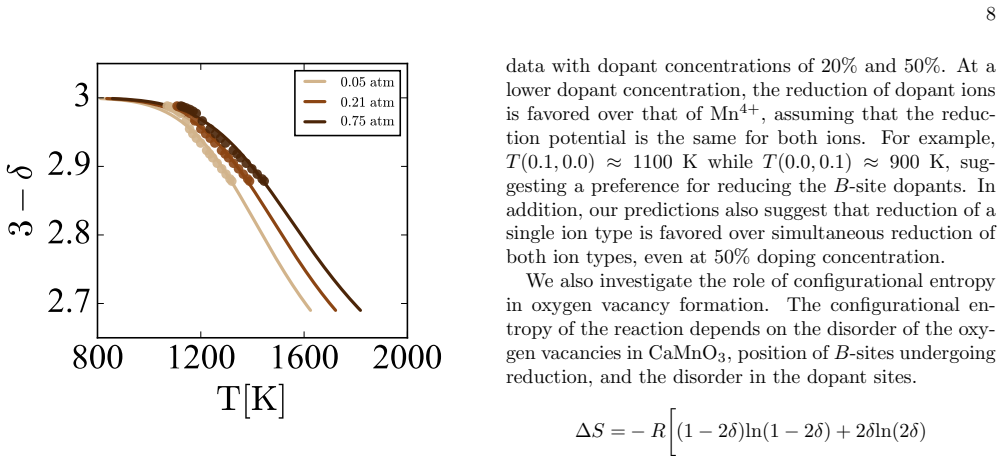
Thermochemical energy storage (TCES) in oxide perovskites relies on reversible oxygen vacancy formation, and computational high-throughput screening of candidate materials has predominantly used the single oxygen vacancy formation energy (OVFE) as the key descriptor. We demonstrate that the OVFE is insufficient for screening cubic CaMnO3 perovskites, because the stoichiometric compound is not the minimum energy reference state; vacancies are inherently present at operating temperatures. Materials with negative single OVFEs are routinely excluded from screening datasets as unsuitable, but this reflects a mischoice of reference state rather than a genuine materials limitation, and risks discarding promising TCES candidates. We address this by computing OVFEs as a function of vacancy concentration using ab initio density functional theory, establishing the equilibrium vacancy concentration as the correct reference point. OVFE curves referenced to this minimum align with experimentally measured reduction enthalpies, providing a framework directly comparable to experiments. We further show that A-site and B-site doping modify the vacancy formation landscape through distinct mechanisms. A-site dopants act primarily through strain relaxation and symmetry breaking, while B-site dopants reshape the local redox environment and introduce strong configurational dependence. Finally, we develop a thermodynamic model incorporating configurational entropy that accurately predicts equilibrium oxygen stoichiometry as a function of temperature and oxygen partial pressure and reveals that selective reduction of Mn4+ versus B-site dopant ions can tune the onset temperature for vacancy formation. These results establish a screening framework for perovskite TCES materials and provide practical guidance for extending high-throughput workflows beyond the single-vacancy paradigm.
Editorial analysis
A structured set of objections, weighed in public.
Referee Report
Summary. The manuscript argues that the single oxygen vacancy formation energy (OVFE) is an insufficient descriptor for high-throughput screening of cubic CaMnO3 perovskites for thermochemical energy storage, as the stoichiometric compound is not the minimum-energy reference state at operating temperatures. Using ab initio DFT, the authors compute OVFE as a function of vacancy concentration, establish the equilibrium vacancy concentration as the proper reference, demonstrate that the resulting OVFE curves (referenced to this minimum) align with experimentally measured reduction enthalpies, analyze distinct mechanisms by which A-site and B-site dopants modify the vacancy formation landscape, and develop a thermodynamic model incorporating configurational entropy to predict equilibrium oxygen stoichiometry versus temperature and oxygen partial pressure.
Significance. If the central claims hold, the work offers a practical improvement to screening workflows for perovskite TCES materials by replacing the single-vacancy paradigm with concentration-dependent OVFE curves that are directly comparable to experiment. The thermodynamic model and the mechanistic distinction between A-site strain/symmetry effects and B-site redox/configurational effects constitute clear strengths. The explicit identification of a free parameter in the configurational entropy term is noted but does not undermine the overall contribution if the DFT-derived OVFE trends are robust.
major comments (1)
- [DFT calculations of concentration-dependent OVFE and comparison to experiment] The central claim that OVFE curves referenced to the minimum align with experimental reduction enthalpies (stated in the abstract and developed in the results) is load-bearing for the proposed screening framework. However, the manuscript reports no calculations with a second functional (e.g., hybrid or meta-GGA) or with systematically larger supercells to quantify sensitivity of the OVFE minimum location and slope to exchange-correlation choice and finite-size effects. A shift of 0.3–0.5 eV in the minimum, as possible in Mn 3d systems, would alter the reference state and the predicted alignment with measured enthalpies.
minor comments (3)
- [Thermodynamic model] The configurational entropy scaling factor is listed as a free parameter; its determination (fitting procedure, sensitivity analysis, or physical justification) should be stated explicitly in the thermodynamic model section to allow readers to assess transferability.
- [Figures] Figure captions and axis labels for the OVFE-vs-concentration plots should include the specific supercell sizes and k-point meshes used, as these directly affect the non-dilute results.
- [Doping analysis] A brief statement on the choice of reference state for the doped compositions (e.g., whether the minimum is always taken at the same vacancy fraction) would improve clarity when comparing A-site versus B-site doping effects.
Simulated Author's Rebuttal
We thank the referee for their careful and constructive review of our manuscript. The point raised about validating the sensitivity of the concentration-dependent OVFE results is well taken, and we address it directly below while clarifying the scope and robustness of our approach.
read point-by-point responses
-
Referee: The central claim that OVFE curves referenced to the minimum align with experimental reduction enthalpies (stated in the abstract and developed in the results) is load-bearing for the proposed screening framework. However, the manuscript reports no calculations with a second functional (e.g., hybrid or meta-GGA) or with systematically larger supercells to quantify sensitivity of the OVFE minimum location and slope to exchange-correlation choice and finite-size effects. A shift of 0.3–0.5 eV in the minimum, as possible in Mn 3d systems, would alter the reference state and the predicted alignment with measured enthalpies.
Authors: We acknowledge that explicit benchmarking with hybrid functionals or systematically larger supercells would strengthen quantitative confidence. Our calculations employ a standard DFT+U setup validated for Mn perovskites in the literature, with supercell sizes chosen to capture the dominant vacancy-vacancy and dopant-vacancy interactions up to the concentrations relevant for TCES operation. The key result—the location of the OVFE minimum and the shape of the curve—is determined from relative energies computed consistently within the same framework, so systematic functional shifts tend to preserve the position of the minimum and the slope trends that align with experiment. Absolute energies may carry an offset, but the experimental comparison is to reduction enthalpies derived from the same reference state. In the revised manuscript we have added a paragraph in the Methods section discussing functional choice, prior benchmarks for CaMnO3, and an estimate of finite-size uncertainty, together with a brief note in the Discussion on why the concentration-dependent framework remains useful even if absolute values shift modestly. Full hybrid-functional scans over the required supercell series lie outside the present scope but would be a natural extension. revision: partial
Circularity Check
No significant circularity; derivation rests on independent DFT computations and standard thermodynamic modeling
full rationale
The paper computes oxygen vacancy formation energies (OVFEs) directly from ab initio DFT as a function of concentration, identifies the equilibrium vacancy concentration as the reference state from those energies, and constructs a thermodynamic model using configurational entropy to predict stoichiometry versus T and pO2. These steps are first-principles calculations and standard ideal-mixing entropy assumptions, not reductions to fitted parameters or self-referential definitions. Alignment with experimental reduction enthalpies is presented as post-hoc validation rather than an input to the derivation. No load-bearing self-citations, uniqueness theorems, or ansatzes imported from prior author work are invoked to force the central results. The chain is self-contained against external benchmarks.
Axiom & Free-Parameter Ledger
free parameters (1)
- configurational entropy scaling factor
axioms (2)
- domain assumption DFT-computed vacancy formation energies are sufficiently accurate for trends across doping concentrations
- domain assumption Configurational entropy can be treated with a simple mixing model without strong vacancy-vacancy interactions
Reference graph
Works this paper leans on
-
[1]
Intergovernmental Panel on Climate Change (IPCC), Climate Change 2021 - The Physical Science Basis: Working Group I Contribution to the Sixth Assess- ment Report of the Intergovernmental Panel on Climate Change(Cambridge University Press, 2023)
work page 2021
-
[2]
The mu- tual dependence of negative emission technologies and energy systems,
Felix Creutzig, Christian Breyer, J´ erˆ ome Hilaire, Jan Minx, Glen P Peters, and Robert Socolow, “The mu- tual dependence of negative emission technologies and energy systems,” Energy & Environmental Science12, 1805–1817 (2019)
work page 2019
-
[3]
Mitigation pathways compatible with 1.5 C in the context of sustainable development,
Joeri Rogelj, Drew Shindell, Kejun Jiang, Solomone Fi- fita, Piers Forster, Veronika Ginzburg, Collins Handa, Haroon Kheshgi, Shigeki Kobayashi, Elmar Kriegler, et al., “Mitigation pathways compatible with 1.5 C in the context of sustainable development,” inGlobal warming of 1.5 C(Intergovernmental Panel on Climate Change,
-
[4]
Renewable energy: a response to cli- mate change,
Ralph EH Sims, “Renewable energy: a response to cli- mate change,” Solar energy76, 9–17 (2004)
work page 2004
-
[5]
Ayman Elshkaki, “The implications of material and en- ergy efficiencies for the climate change mitigation poten- tial of global energy transition scenarios,” Energy267, 126596 (2023)
work page 2023
-
[6]
Analyzing major challenges of wind and solar variability in power systems,
Falko Ueckerdt, Robert Brecha, and Gunnar Luderer, “Analyzing major challenges of wind and solar variability in power systems,” Renewable energy81, 1–10 (2015)
work page 2015
-
[7]
Philip J Heptonstall and Robert JK Gross, “A system- atic review of the costs and impacts of integrating vari- able renewables into power grids,” nature energy6, 72–83 (2021)
work page 2021
-
[8]
The role of energy storage with renewable elec- tricity generation,
Paul Denholm, Erik Ela, Brendan Kirby, and Michael Milligan, “The role of energy storage with renewable elec- tricity generation,” (2010)
work page 2010
-
[9]
Peter D Lund, Juuso Lindgren, Jani Mikkola, and Jyri Salpakari, “Review of energy system flexibility measures to enable high levels of variable renewable electricity,” Renewable and sustainable energy reviews45, 785–807 (2015)
work page 2015
-
[10]
Electrical energy storage for the grid: a battery of choices,
Bruce Dunn, Haresh Kamath, and Jean-Marie Taras- con, “Electrical energy storage for the grid: a battery of choices,” Science334, 928–935 (2011)
work page 2011
-
[11]
A review on high temperature thermochemical heat energy storage,
Pedro Pardo, Alexandre Deydier, Zo´ e Anxionnaz- Minvielle, Sylvie Roug´ e, Michel Cabassud, and Patrick Cognet, “A review on high temperature thermochemical heat energy storage,” Renewable and Sustainable Energy Reviews32, 591–610 (2014)
work page 2014
-
[12]
Jaume Cot-Gores, Albert Castell, and Luisa F. Cabeza, “Thermochemical energy storage and conversion: A- state-of-the-art review of the experimental research un- der practical conditions,” Renewable and Sustainable En- ergy Reviews16, 5207–5224 (2012)
work page 2012
-
[13]
Alfonso J. Carrillo, Jos´ e Gonz´ alez-Aguilar, Manuel Romero, and Juan M. Coronado, “Solar energy on de- mand: A review on high temperature thermochemical heat storage systems and materials,” Chemical Reviews 119, 4777–4816 (2019)
work page 2019
-
[14]
Review of technology: Thermochemi- cal energy storage for concentrated solar power plants,
Cristina Prieto, Patrick Cooper, A. In´ es Fern´ andez, and Luisa F. Cabeza, “Review of technology: Thermochemi- cal energy storage for concentrated solar power plants,” Renewable and Sustainable Energy Reviews60, 909–929 (2016)
work page 2016
-
[15]
Applications and lim- itations of two step metal oxide thermochemical redox cycles; a review,
Brendan Bulfin, Josua Vieten, Christos Agrafiotis, Mar- tin Roeb, and Christian Sattler, “Applications and lim- itations of two step metal oxide thermochemical redox cycles; a review,” Journal of Materials Chemistry A5, 18951–18966 (2017)
work page 2017
-
[16]
Design principles of per- ovskites for thermochemical oxygen separation,
Miriam Ezbiri, Kyle M. Allen, Maria E. G´ alvez, Ronald Michalsky, and Aldo Steinfeld, “Design principles of per- ovskites for thermochemical oxygen separation,” Chem- SusChem8, 1966–1971 (2015)
work page 1966
-
[17]
James E. Miller, Anthony H. McDaniel, and Mark D. Allendorf, “Considerations in the design of materials for solar-driven fuel production using metal-oxide thermo- chemical cycles,” Advanced Energy Materials4, 1300469 (2014)
work page 2014
-
[18]
Oxygen ex- change materials for solar thermochemical splitting of H2O and CO 2: a review,
Jonathan R. Scheffe and Aldo Steinfeld, “Oxygen ex- change materials for solar thermochemical splitting of H2O and CO 2: a review,” Materials Today17, 341–348 (2014)
work page 2014
-
[19]
Thermodynamics of CeO 2 thermochemical fuel production,
Brendan Bulfin, Friedemann Call, Matthias Lange, O Lubben, Christian Sattler, Robert Pitz-Paal, and IV Shvets, “Thermodynamics of CeO 2 thermochemical fuel production,” Energy & Fuels29, 1001–1009 (2015)
work page 2015
-
[20]
Metal oxides for thermochemical energy storage: A comparison of several metal oxide systems,
Tina Block and Martin Schm¨ ucker, “Metal oxides for thermochemical energy storage: A comparison of several metal oxide systems,” Solar Energy126, 195–207 (2016). 11
work page 2016
-
[21]
Xiangyu Han, Liang Wang, Haoshu Ling, Zhiwei Ge, Xipeng Lin, Xingjian Dai, and Haisheng Chen, “Critical review of thermochemical energy storage systems based on cobalt, manganese, and copper oxides,” Renewable and Sustainable Energy Reviews158, 112076 (2022)
work page 2022
-
[22]
Splitting CO2 with a ceria-based redox cycle in a solar-driven ther- mogravimetric analyzer,
Michael Takacs, Simon Ackermann, Alexander Bonk, Martina Neises-von Puttkamer, Ph Haueter, Jonathan R Scheffe, Ulrich F Vogt, and Aldo Steinfeld, “Splitting CO2 with a ceria-based redox cycle in a solar-driven ther- mogravimetric analyzer,” AIChE Journal63, 1263–1271 (2017)
work page 2017
-
[23]
Alfonso J. Carrillo, David P. Serrano, Patricia Pizarro, and Juan M. Coronado, “Thermochemical heat storage based on the Mn 2O3/Mn3O4 redox couple: influence of the initial particle size on the morphological evolu- tion and cyclability,” J. Mater. Chem. A2, 19435–19443 (2014)
work page 2014
-
[24]
Sr-and Mn-doped LaAlO3−δ for solar thermochemical H 2 and CO produc- tion,
Anthony H McDaniel, Elizabeth C Miller, Darwin Ar- ifin, Andrea Ambrosini, Eric N Coker, Ryan O’Hayre, William C Chueh, and Jianhua Tong, “Sr-and Mn-doped LaAlO3−δ for solar thermochemical H 2 and CO produc- tion,” Energy & Environmental Science6, 2424–2428 (2013)
work page 2013
-
[25]
Nonstoi- chiometry and reductive decomposition of CaMnO 3−δ,
Egil Bakken, Truls Norby, and Svein Stølen, “Nonstoi- chiometry and reductive decomposition of CaMnO 3−δ,” Solid State Ionics176, 217–223 (2005)
work page 2005
-
[26]
Jonathan R Scheffe, David Weibel, and Aldo Steinfeld, “Lanthanum-strontium-manganese perovskites as redox materials for solar thermochemical splitting of H 2O and CO2,” Energy & Fuels27, 4250–4257 (2013)
work page 2013
-
[27]
L Nalbandian, A Evdou, and V Zaspalis, “La 1−xSrxMO3 (M= Mn, Fe) perovskites as materials for thermochemi- cal hydrogen production in conventional and membrane reactors,” international journal of hydrogen energy34, 7162–7172 (2009)
work page 2009
-
[28]
Alicia Bayon, Alberto de la Calle, Krishna Kamol Ghose, Alister Page, and Robbie McNaughton, “Experimen- tal, computational and thermodynamic studies in per- ovskites metal oxides for thermochemical fuel production: A review,” International Journal of Hydrogen Energy45, 12653–12679 (2020)
work page 2020
-
[29]
Factors governing oxygen vacancy formation in oxide perovskites,
Robert B. Wexler, Gopalakrishnan Sai Gautam, Ellen B. Stechel, and Emily A. Carter, “Factors governing oxygen vacancy formation in oxide perovskites,” Journal of the American Chemical Society143, 13212–13227 (2021)
work page 2021
-
[30]
Impact of La doping on the thermochemical heat storage properties of CaMnO 3−δ,
Emanuela Mastronardo, Xin Qian, Juan M. Coronado, and Sossina M. Haile, “Impact of La doping on the thermochemical heat storage properties of CaMnO 3−δ,” Journal of Energy Storage40, 102793 (2021)
work page 2021
-
[31]
Redox chemistry of CaMnO3 and Ca0.8Sr0.2MnO3 oxy- gen storage perovskites,
Brandon Bulfin, Josua Vieten, DE Starr, A Azarpira, C Zach¨ aus, Michael H¨ avecker, Katarzyna Skorupska, Martin Schm¨ ucker, Martin Roeb, and Christian Sattler, “Redox chemistry of CaMnO3 and Ca0.8Sr0.2MnO3 oxy- gen storage perovskites,” Journal of Materials Chemistry A5, 7912–7919 (2017)
work page 2017
-
[32]
Antoine A Emery and Chris Wolverton, “High- throughput DFT calculations of formation energy, stabil- ity and oxygen vacancy formation energy of ABO 3 per- ovskites,” Scientific data4, 170153 (2017)
work page 2017
-
[33]
Bianca Baldassarri, Jiangang He, Abhijith Gopakumar, Sean Griesemer, Adolfo JA Salgado-Casanova, Tzu-Chen Liu, Steven B Torrisi, and Chris Wolverton, “Oxy- gen vacancy formation energy in metal oxides: High- throughput computational studies and machine-learning predictions,” Chemistry of Materials35, 10619–10634 (2023)
work page 2023
-
[34]
Runxia Cai, Hilal Bektas, Xijun Wang, Kyle McClintock, Lauren Teague, Kunran Yang, and Fanxing Li, “Accel- erated perovskite oxide development for thermochemical energy storage by a high-throughput combinatorial ap- proach,” Advanced Energy Materials13, 2203833 (2023)
work page 2023
-
[35]
Antoine A Emery, James E Saal, Scott Kirklin, Vinay I Hegde, and Chris Wolverton, “High-throughput com- putational screening of perovskites for thermochemical water splitting applications,” Chemistry of Materials28, 5621–5634 (2016)
work page 2016
-
[36]
Xijun Wang, Yunfei Gao, Emily Krzystowczyk, Sher- afghan Iftikhar, Jian Dou, Runxia Cai, Haiying Wang, Chongyan Ruan, Sheng Ye, and Fanxing Li, “High- throughput oxygen chemical potential engineering of per- ovskite oxides for chemical looping applications,” Energy Environ. Sci.15, 1512–1528 (2022)
work page 2022
-
[37]
The favourable thermodynamic properties of Fe-doped CaMnO3 for thermochemical heat storage,
Emanuela Mastronardo, Xin Qian, Juan M Coronado, and Sossina M Haile, “The favourable thermodynamic properties of Fe-doped CaMnO3 for thermochemical heat storage,” Journal of materials chemistry A8, 8503–8517 (2020)
work page 2020
-
[38]
Redox thermodynamics and phase composition in the system SrFeO3−δ-SrMnO3−δ,
Josua Vieten, Brendan Bulfin, Marion Senholdt, Martin Roeb, Christian Sattler, and Martin Schm¨ ucker, “Redox thermodynamics and phase composition in the system SrFeO3−δ-SrMnO3−δ,” Solid State Ionics308, 149–155 (2017)
work page 2017
-
[39]
High-temperature phase transition of CaMnO 3−δ,
Hideki Taguchi, M Nagao, T Sato, and M Shimada, “High-temperature phase transition of CaMnO 3−δ,” Journal of Solid State Chemistry78, 312–315 (1989)
work page 1989
-
[40]
Fe-doped CaMnO 3 for thermochem- ical heat storage application,
Emanuela Mastronardo, Xin Qian, Juan M. Coronado, and Sossina Haile, “Fe-doped CaMnO 3 for thermochem- ical heat storage application,” AIP Conference Proceed- ings2126, 210005 (2019)
work page 2019
-
[41]
Evolutions of geometry and electronic state in- troduced by oxygen vacancy for CaMnO 3 compound,
C.S. Huang, H. Fang, Z.H. Xu, X. Zheng, and X.X. Ruan, “Evolutions of geometry and electronic state in- troduced by oxygen vacancy for CaMnO 3 compound,” Results in Physics13, 102337 (2019)
work page 2019
-
[42]
Amit Mishra, Tianyang Li, Fanxing Li, and Erik E. San- tiso, “Oxygen vacancy creation energy in Mn-containing perovskites: An effective indicator for chemical looping with oxygen uncoupling,” Chemistry of Materials31, 689–698 (2019)
work page 2019
-
[43]
Duygu Yilmaz, Esraa Darwish, and Henrik Leion, “Uti- lization of promising calcium manganite oxygen carri- ers for potential thermochemical energy storage applica- tion,” Industrial & Engineering Chemistry Research60, 1250–1258 (2021)
work page 2021
-
[44]
Georg Kresse and J¨ urgen Furthm¨ uller, “Efficient itera- tive schemes for ab initio total-energy calculations us- ing a plane-wave basis set,” Physical review B54, 11169 (1996)
work page 1996
-
[45]
From ultrasoft pseu- dopotentials to the projector augmented-wave method,
Georg Kresse and Daniel Joubert, “From ultrasoft pseu- dopotentials to the projector augmented-wave method,” Physical review b59, 1758 (1999)
work page 1999
-
[46]
Generalized gradient approximation made simple,
John P Perdew, Kieron Burke, and Matthias Ernzer- hof, “Generalized gradient approximation made simple,” Physical review letters77, 3865 (1996)
work page 1996
-
[47]
Band theory and Mott insulators: Hubbard U instead of Stoner I,
Vladimir I Anisimov, Jan Zaanen, and Ole K Andersen, “Band theory and Mott insulators: Hubbard U instead of Stoner I,” Physical Review B44, 943 (1991). 12
work page 1991
-
[48]
Jiawang Hong, Alessandro Stroppa, Jorge ´I˜ niguez, Sil- via Picozzi, and David Vanderbilt, “Spin-phonon cou- pling effects in transition-metal perovskites: A DFT + Uand hybrid-functional study,” Phys. Rev. B85, 054417 (2012)
work page 2012
-
[49]
Gopalakrishnan Sai Gautam and Emily A. Carter, “Eval- uating transition metal oxides within DFT-SCAN and SCAN+Uframeworks for solar thermochemical applica- tions,” Phys. Rev. Mater.2, 095401 (2018)
work page 2018
-
[50]
Oxygen vacancy diffusion in rutile TiO 2: Insight from deep neural network potential simulations,
Zhihong Wu, Wen-Jin Yin, Bo Wen, Dongwei Ma, and Li-Min Liu, “Oxygen vacancy diffusion in rutile TiO 2: Insight from deep neural network potential simulations,” The Journal of Physical Chemistry Letters14, 2208–2214 (2023)
work page 2023
-
[51]
Strain-controlled oxygen vacancy formation and ordering in CaMnO 3,
Ulrich Aschauer, Reto Pfenninger, Sverre M. Selbach, Tor Grande, and Nicola A. Spaldin, “Strain-controlled oxygen vacancy formation and ordering in CaMnO 3,” Phys. Rev. B88, 054111 (2013)
work page 2013
-
[52]
Sean M. Babiniec, Eric N. Coker, James E. Miller, and Andrea Ambrosini, “Investigation of LaxSr1−xCoyM1−yO3−d (M=Mn, Fe) perovskite mate- rials as thermochemical energy storage media,” Solar Energy118, 451 – 459 (2015)
work page 2015
-
[53]
Oxygen stoichiometry and structural proper- ties of La1−xAxMnO3±δ (A = Ca or Sr and 0≤x≤1),
Lisbeth Rørmark, Kjell Wiik, Svein Stølen, and Tor Grande, “Oxygen stoichiometry and structural proper- ties of La1−xAxMnO3±δ (A = Ca or Sr and 0≤x≤1),” J. Mater. Chem.12, 1058–1067 (2002)
work page 2002
-
[54]
Gopalakrishnan Sai Gautam, Ellen B. Stechel, and Emily A. Carter, “Exploring Ca-Ce-M-O (M = 3d tran- sition metal) oxide perovskites for solar thermochemi- cal applications,” Chemistry of Materials32, 9964–9982 (2020)
work page 2020
-
[55]
Astrid Marthinsen, Carina Faber, Ulrich Aschauer, Nicola A Spaldin, and Sverre M Selbach, “Coupling and competition between ferroelectricity, magnetism, strain, and oxygen vacancies in AMnO3 perovskites,” MRS com- munications6, 182–191 (2016)
work page 2016
-
[56]
Thomas Cooper, Jonathan R. Scheffe, Maria E. Galvez, Roger Jacot, Greta Patzke, and Aldo Steinfeld, “Lan- thanum manganite perovskites with Ca/Sr A-site and Al B-site doping as effective oxygen exchange materials for solar thermochemical fuel production,” Energy Technol- ogy3, 1130–1142 (2015)
work page 2015
-
[57]
Xijun Wang, Emily Krzystowczyk, Jian Dou, and Fanx- ing Li, “Net electronic charge as an effective electronic descriptor for oxygen release and transport properties of SrFeO3-based oxygen sorbents,” Chemistry of Materials 33, 2446–2456 (2021)
work page 2021
-
[58]
CeTi2O6 a promising oxide for solar thermochemical hy- drogen production,
S. Shahab Naghavi, Jiangang He, and C. Wolverton, “CeTi2O6 a promising oxide for solar thermochemical hy- drogen production,” ACS Applied Materials & Interfaces 12, 21521–21527 (2020)
work page 2020
-
[59]
Redox energetics of perovskite-related oxides,
Egil Bakken, Truls Norby, and Svein Stølen, “Redox energetics of perovskite-related oxides,” J. Mater. Chem. 12, 317–323 (2002)
work page 2002
discussion (0)
Sign in with ORCID, Apple, or X to comment. Anyone can read and Pith papers without signing in.