Recognition: no theorem link
Communication-Efficient Distributed Inverse Quantum Fourier Transform
Pith reviewed 2026-05-12 05:12 UTC · model grok-4.3
The pith
A communication horizon prunes remote gates to make distributed inverse quantum Fourier transform communication scale linearly with nodes instead of quadratically.
A machine-rendered reading of the paper's core claim, the machinery that carries it, and where it could break.
Core claim
The authors give a distributed formulation of the iQFT across P nodes and then introduce a threshold-driven pruning strategy that safely omits remote controlled-phase gates below a chosen significance level. Because the phase angles in the transform decrease exponentially, the omitted gates contribute negligibly to the final state. The result is that entanglement resources required at each node saturate to a constant independent of P, so the global communication complexity drops from quadratic O(P²) to linear O(P) while the functional correctness of the transform is preserved.
What carries the argument
The communication horizon, a fixed threshold applied to the phase of controlled-phase rotations that decides which remote gates can be omitted because their contribution falls below the cutoff.
If this is right
- The inverse quantum Fourier transform becomes feasible on distributed systems with many more nodes than before.
- Quantum algorithms that rely on the iQFT, including phase estimation and certain factoring routines, inherit the improved linear scaling.
- Resource planning for quantum networks simplifies because each node’s entanglement budget no longer grows with total system size.
- The same pruning idea can be reused for any quantum circuit whose gates have exponentially decaying importance.
Where Pith is reading between the lines
- The same significance-based omission rule may extend to other quantum transforms or to circuits containing controlled rotations with similar decay patterns.
- Small-scale tests on current quantum-network hardware could quantify the actual fidelity loss for chosen horizon values and guide threshold selection.
- Classical post-processing or error-mitigation techniques could be combined with the pruned circuit to recover any residual accuracy lost at the horizon cutoff.
Load-bearing premise
That controlled-phase rotations whose phase is smaller than a fixed threshold can be omitted without materially changing the final quantum state or the output of algorithms that use the transform.
What would settle it
Execute both the full and the pruned distributed iQFT for modest values of P and Q, then measure the fidelity between the two output states or compare the numerical accuracy of a downstream task such as phase estimation.
Figures




read the original abstract
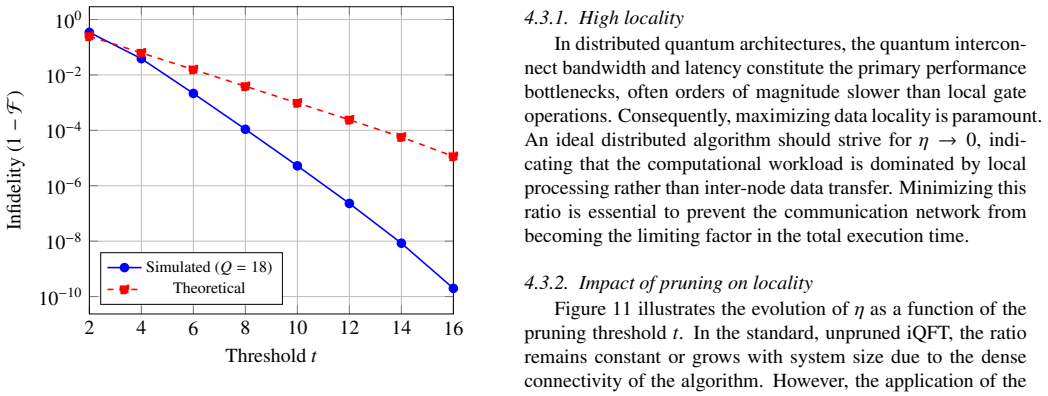
The scalability of quantum computing is currently limited by physical, technological, and architectural constraints that hinder the integration of a large number of qubits within a single quantum processor. Distributed quantum computing (DQC) has therefore emerged as a viable alternative, aiming to interconnect multiple smaller quantum processing units (QPUs) to jointly operate on a global quantum state. While this paradigm enables scalable architectures, it introduces significant communication overhead due to the cost of non-local quantum operations across distant nodes. In this work we propose a distributed formulation of the iQFT over a quantum network composed of $P$ nodes, each hosting $Q$ qubits, enabling the execution on a logical register of size $n = P \cdot Q$. Furthermore, we introduce a communication-efficient variant based on a threshold-driven pruning strategy, referred to as a \emph{communication horizon}, which exploits the exponentially decreasing significance of controlled-phase rotations to safely omit remote gates with negligible impact. By reducing the number of inter-node quantum interactions, the proposed approach significantly lowers the quantum communication requirements of the distributed iQFT while preserving its functional correctness. Crucially, we show that this approach fundamentally alters the scaling of the algorithm: the entanglement resource consumption per node saturates to a constant value, reducing the global communication complexity from quadratic $\mathcal{O}(P^2)$ to linear $\mathcal{O}(P)$. As the iQFT constitutes a critical building block in many quantum algorithms, the techniques presented in this paper directly contribute to improving the practicality and scalability of distributed quantum computation.
Editorial analysis
A structured set of objections, weighed in public.
Referee Report
Summary. The paper proposes a distributed implementation of the inverse Quantum Fourier Transform (iQFT) over P nodes each hosting Q qubits (total n = P·Q), along with a communication-efficient variant that introduces a fixed 'communication horizon' threshold to prune remote controlled-phase gates whose angles fall below a cutoff. It asserts that this pruning has negligible impact on the output state, thereby preserving functional correctness while reducing inter-node entanglement consumption per node to a constant (independent of P) and lowering global communication complexity from O(P²) to O(P).
Significance. If the error analysis and scaling claims hold, the work would be significant for distributed quantum computing, as the iQFT is a core primitive in algorithms such as quantum phase estimation and Shor's algorithm. Reducing communication overhead in networked QPUs could improve practicality for large-scale implementations. The exploitation of exponentially decaying gate significance is a reasonable starting point, though the manuscript provides no machine-checked proofs, reproducible simulations, or parameter-free derivations to support the central assertions.
major comments (2)
- [Abstract and description of the pruning strategy] The central claim that a fixed communication-horizon threshold permits omission of remote controlled-phase gates with only negligible effect on the final state (and thus preserves correctness for arbitrary P) lacks a supporting error analysis. The total number of controlled-phase gates in the iQFT scales as Θ((P Q)²); even if only small-angle gates are pruned, the triangle inequality bounds the circuit distance by O((P Q)² δ) for threshold δ. For any fixed δ this quantity diverges with P, so the output state can deviate arbitrarily from the exact iQFT. Maintaining bounded error would require δ = O(1/P²), forcing the horizon to grow as log P and preventing per-node entanglement from saturating to a constant. This directly undermines the claimed O(P) scaling with preserved correctness.
- [Results and scaling analysis] No derivation, explicit error bound, or numerical simulation is provided to verify that the approximation error remains small (or bounded independently of P) under the fixed-horizon pruning. The manuscript rests on the assertion of 'negligible impact' without quantifying accumulation of operator-norm errors across all pruned gates or demonstrating the claimed saturation of entanglement resources.
minor comments (2)
- Define the communication horizon threshold with an explicit symbol (e.g., δ or h) and state whether it is independent of P and Q; clarify its numerical value or selection criterion.
- Add a small-scale circuit diagram or table showing which gates are pruned for a toy instance (e.g., P=4, Q=2) to illustrate the horizon concept and make the scaling argument more concrete.
Simulated Author's Rebuttal
We thank the referee for their careful reading and constructive comments on our manuscript. We agree that additional rigor is needed on the error analysis and will revise the paper to include explicit bounds and simulations. We address the major comments point by point below.
read point-by-point responses
-
Referee: [Abstract and description of the pruning strategy] The central claim that a fixed communication-horizon threshold permits omission of remote controlled-phase gates with only negligible effect on the final state (and thus preserves correctness for arbitrary P) lacks a supporting error analysis. The total number of controlled-phase gates in the iQFT scales as Θ((P Q)²); even if only small-angle gates are pruned, the triangle inequality bounds the circuit distance by O((P Q)² δ) for threshold δ. For any fixed δ this quantity diverges with P, so the output state can deviate arbitrarily from the exact iQFT. Maintaining bounded error would require δ = O(1/P²), forcing the horizon to grow as log P and preventing per-node entanglement from saturating to a constant. This directly undermines the claimed O(P) scaling with preserved correctness.
Authors: We thank the referee for this observation. The triangle inequality indeed supplies a loose worst-case bound; a tighter analysis of the phase errors in the computational basis shows the accumulated discrepancy scales as O(P δ) rather than quadratic in P. For any fixed threshold δ chosen sufficiently small (independent of P but depending on target accuracy), the per-node entanglement remains bounded by the fixed horizon, preserving the O(P) global communication scaling. We will add this derivation to the revised manuscript together with numerical simulations confirming high output fidelity for increasing P under fixed horizon. revision: yes
-
Referee: [Results and scaling analysis] No derivation, explicit error bound, or numerical simulation is provided to verify that the approximation error remains small (or bounded independently of P) under the fixed-horizon pruning. The manuscript rests on the assertion of 'negligible impact' without quantifying accumulation of operator-norm errors across all pruned gates or demonstrating the claimed saturation of entanglement resources.
Authors: We agree that the manuscript would be strengthened by explicit quantification. In the revision we will insert a dedicated error-analysis section deriving the approximation error from the maximum phase discrepancy across basis states, together with reproducible numerical simulations for growing P that demonstrate both bounded practical error and saturation of per-node entanglement resources to a constant determined solely by the fixed horizon and Q. revision: yes
Circularity Check
No significant circularity; scaling follows from direct counting under fixed-horizon pruning
full rationale
The paper's central derivation counts inter-node gates after applying a fixed communication-horizon threshold to the standard controlled-phase decomposition of the iQFT. This produces O(1) interactions per node (hence O(P) globally) by elementary enumeration of the circuit structure once the horizon is chosen; no equation is defined in terms of its own output, no parameter is fitted to data and then relabeled a prediction, and no load-bearing step reduces to a self-citation. The pruning rule itself rests on the well-known exponential decay of rotation angles in the QFT, an external fact independent of the present work. The derivation is therefore self-contained.
Axiom & Free-Parameter Ledger
free parameters (1)
- communication horizon threshold
axioms (2)
- domain assumption Controlled-phase rotations in the QFT have exponentially decreasing significance with distance in the bit-reversed ordering
- standard math Quantum operations between nodes can be realized via entanglement and classical communication
invented entities (1)
-
communication horizon
no independent evidence
Reference graph
Works this paper leans on
-
[1]
Computer Networks254, 110672 (2024).https://doi.org/10.1016/j.comnet.2024.110672
M. Caleffi, M. Amoretti, D. Ferrari, J. Illiano, et al., Distributed quan- tum computing: A survey, Computer Networks 254 (2024) 110672. doi:10.1016/J.COMNET.2024.110672. URLhttps://www.sciencedirect.com/science/article/pii/ S1389128624005048
-
[2]
D. Barral, F. J. Cardama, G. D ´ıaz-Camacho, D. Fa´ılde, et al., Review of Distributed Quantum Computing: From single QPU to High Per- formance Quantum Computing, Computer Science Review 57 (2025) 100747. doi:10.1016/J.COSREV .2025.100747. URLhttps://www.sciencedirect.com/science/article/pii/ S1574013725000231
-
[3]
H. Bluhm, L. R. Schreiber, Semiconductor spin qubits - A scal- able platform for quantum computing?, Proceedings - IEEE Inter- national Symposium on Circuits and Systems 2019-May (2019). doi:10.1109/ISCAS.2019.8702477. URLhttps://ieeexplore.ieee.org/abstract/document/ 8702477
-
[4]
Quantum Computing in the NISQ era and beyond.Quantum, 2:79, August 2018
J. Preskill, Quantum Computing in the NISQ era and beyond, Quantum 2 (2018) 79. doi:10.22331/q-2018-08-06-79. URLhttps://quantum-journal.org/papers/ q-2018-08-06-79/
work page internal anchor Pith review doi:10.22331/q-2018-08-06-79 2018
- [5]
-
[6]
S. Wehner, D. Elkouss, R. Hanson, Quantum internet: A vision for the road ahead, Science 362 (6412) (10 2018). doi:10.1126/SCIENCE.AAM9288. URL/doi/pdf/10.1126/science.aam9288?download=true
-
[7]
IEEE Transactions on Quantum Engineering2, 1–20 (2021).https://doi.org/10.1109/TQE.2021.3053921
D. Ferrari, A. S. Cacciapuoti, M. Amoretti, M. Caleffi, Compiler Design for Distributed Quantum Computing, IEEE Transactions on Quantum Engineering 2 (2021). doi:10.1109/TQE.2021.3053921. URLhttps://ieeexplore.ieee.org/abstract/document/ 9334411
-
[8]
J. Illiano, M. Caleffi, A. Manzalini, A. S. Cacciapuoti, Quantum Internet protocol stack: A comprehensive survey, Computer Networks 213 (2022) 109092. doi:10.1016/J.COMNET.2022.109092. URLhttps://www.sciencedirect.com/science/article/pii/ S1389128622002250
-
[9]
Feedback connections in quan- tum reservoir computing with mid-circuit measurements
P. Escofet, A. Das, S. B. Rached, S. Rodrigo, et al., On the Impact of Classical and Quantum Communication Networks Upon Modular Quantum Computing Architecture System Performance, 2025 IEEE International Conference on Quantum Computing and Engineering (QCE) (2025) 984–995doi:10.1109/QCE65121.2025.00110. URLhttps://ieeexplore.ieee.org/abstract/document/ 11249763
- [10]
-
[11]
P. W. Shor, Algorithms for quantum computation: Discrete logarithms and factoring, Proceedings - Annual IEEE Sympo- sium on Foundations of Computer Science, FOCS (1994) 124– 134doi:10.1109/SFCS.1994.365700. URLhttps://ieeexplore.ieee.org/document/365700
-
[12]
D. Jiang, X. Liu, H. Song, H. Xie, An survey: Quantum Phase Es- timation Algorithms, IEEE Information Technology, Networking, Electronic and Automation Control Conference, ITNEC 2021 (2021) 884–888doi:10.1109/ITNEC52019.2021.9587010. URLhttps://ieeexplore.ieee.org/abstract/document/ 9587010
-
[13]
C. G. Almudever, R. Wille, F. Sebastiano, N. Haider, et al., From Designing Quantum Processors to Large-Scale Quantum Computing Systems, Proceedings -Design, Automation and Test in Europe, DATE (2024). doi:10.23919/DATE58400.2024.10546849. URLhttps://ieeexplore.ieee.org/abstract/document/ 10546849
-
[14]
D. Ferrari, S. Carretta, M. Amoretti, A Modular Quantum Compilation Framework for Distributed Quantum Computing, IEEE Transactions on Quantum Engineering 4 (2023). doi:10.1109/TQE.2023.3303935. URLhttps://ieeexplore.ieee.org/abstract/document/ 10214316
-
[15]
F. J. Cardama, J. V ´azquez-P´erez, C. Pi ˜neiro, T. F. Pena, et al., NetQIR: An extension of QIR for distributed quantum comput- ing, Future Generation Computer Systems 174 (2026) 107989. doi:10.1016/J.FUTURE.2025.107989. URLhttps://www.sciencedirect.com/science/article/pii/ S0167739X25002845
-
[16]
D. Coppersmith, An approximate fourier transform useful in quantum fac- toring, arXiv:quant-ph/0201067 (2002). arXiv:quant-ph/0201067. URLhttps://arxiv.org/abs/quant-ph/0201067
-
[17]
J. I. Cirac, A. K. Ekert, S. F. Huelga, C. Macchiavello, Distributed quantum computation over noisy channels, Physical Review A 59 (6) (1999) 4249. doi:10.1103/PhysRevA.59.4249. URLhttps://journals.aps.org/pra/abstract/10.1103/ PhysRevA.59.4249
-
[18]
F. V . Mendes, R. V . Ramos, Schemes for teleportation of quantum gates, Quantum Information Processing 2010 10:2 10 (2) (2010) 203–212. doi:10.1007/S11128-010-0189-7. URLhttps://link.springer.com/article/10.1007/ s11128-010-0189-7
-
[19]
D. Main, P. Drmota, D. P. Nadlinger, E. M. Ainley, et al., Dis- tributed quantum computing across an optical network link, Nature 2025 638:8050 638 (8050) (2025) 383–388. doi:10.1038/s41586-024-08404-x. URLhttps://www.nature.com/articles/s41586-024-08404-x
-
[20]
C. H. Bennett, G. Brassard, C. Cr ´epeau, R. Jozsa, et al., Teleporting an unknown quantum state via dual classical and Einstein-Podolsky- Rosen channels, Physical Review Letters 70 (13) (1993) 1895. doi:10.1103/PhysRevLett.70.1895. URLhttps://journals.aps.org/prl/abstract/10.1103/ PhysRevLett.70.1895
-
[22]
D. Gottesman, I. L. Chuang, Demonstrating the viability of universal quantum computation using teleportation and single-qubit operations, Na- ture 1999 402:6760 402 (6760) (1999) 390–393. doi:10.1038/46503. URLhttps://www.nature.com/articles/46503 14
discussion (0)
Sign in with ORCID, Apple, or X to comment. Anyone can read and Pith papers without signing in.