Recognition: no theorem link
Probing Cross-modal Information Hubs in Audio-Visual LLMs
Pith reviewed 2026-05-13 02:59 UTC · model grok-4.3
The pith
Audio-visual LLMs encode integrated cross-modal information primarily in a subset of sink tokens.
A machine-rendered reading of the paper's core claim, the machinery that carries it, and where it could break.
Core claim
Through an analysis of multiple recent AVLLMs, we uncover two common findings. First, AVLLMs primarily encode integrated audio-visual information in sink tokens. Second, sink tokens do not uniformly hold cross-modal information. Instead, a distinct subset of sink tokens, which we term cross-modal sink tokens, specializes in storing such information. Based on these findings, we further propose a simple training-free hallucination mitigation method by encouraging reliance on integrated cross-modal information within cross-modal sink tokens.
What carries the argument
Cross-modal sink tokens: the distinct subset of sink tokens that specializes in storing and serving as the hub for integrated audio-visual information.
If this is right
- A simple training-free method can reduce hallucinations by directing the model to rely more on the cross-modal sink tokens.
- The same pattern of specialization appears across the different AVLLM architectures examined.
- Targeting these tokens provides a direct handle on cross-modal information flow without changing model weights.
- Not all sink tokens perform equivalent roles in multimodal integration.
Where Pith is reading between the lines
- The emergence of specialized cross-modal hubs may reflect a general organizational tendency in multimodal models when fusing sensory streams.
- Probing techniques similar to those used here could locate analogous integration points in other multimodal LLMs.
- If the tokens remain stable across inputs, they could become reliable sites for monitoring or editing fused knowledge in deployed systems.
Load-bearing premise
The concentration of cross-modal information in a particular subset of sink tokens is representative across AVLLMs and that intervening on these tokens will reduce hallucinations without introducing new errors.
What would settle it
Analysis of additional AVLLMs showing cross-modal information distributed evenly across all sink tokens rather than concentrated in a subset, or the hallucination-mitigation intervention producing no consistent improvement or new errors when applied to the identified tokens.
Figures
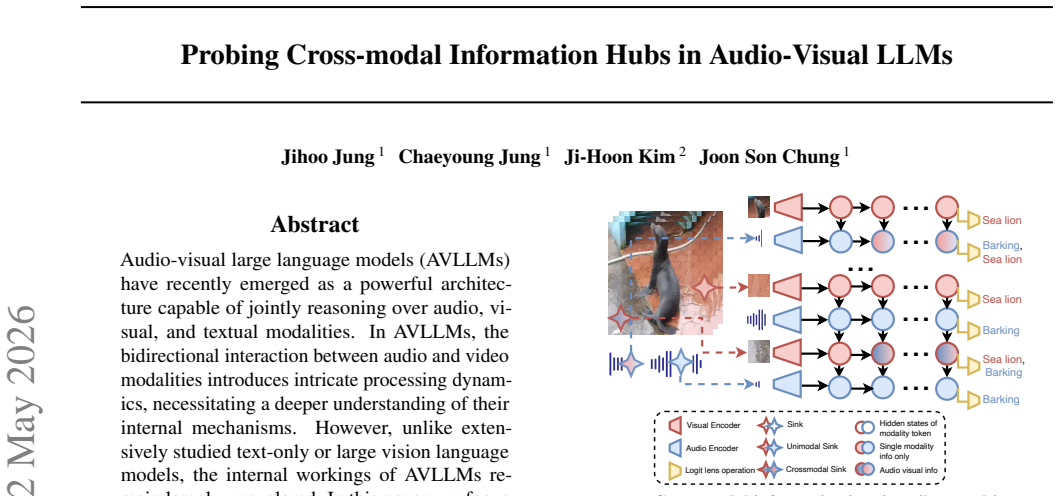


read the original abstract
Audio-visual large language models (AVLLMs) have recently emerged as a powerful architecture capable of jointly reasoning over audio, visual, and textual modalities. In AVLLMs, the bidirectional interaction between audio and video modalities introduces intricate processing dynamics, necessitating a deeper understanding of their internal mechanisms. However, unlike extensively studied text-only or large vision language models, the internal workings of AVLLMs remain largely unexplored. In this paper, we focus on cross-modal information flow between audio and visual modalities in AVLLMs, investigating where information derived from one modality is encoded within the token representations of the other modality. Through an analysis of multiple recent AVLLMs, we uncover two common findings. First, AVLLMs primarily encode integrated audio-visual information in sink tokens. Second, sink tokens do not uniformly hold cross-modal information. Instead, a distinct subset of sink tokens, which we term cross-modal sink tokens, specializes in storing such information. Based on these findings, we further propose a simple training-free hallucination mitigation method by encouraging reliance on integrated cross-modal information within cross-modal sink tokens. Our code is available at https://github.com/kaistmm/crossmodal-hub.
Editorial analysis
A structured set of objections, weighed in public.
Referee Report
Summary. The paper analyzes internal mechanisms of audio-visual large language models (AVLLMs), claiming that integrated cross-modal information is primarily encoded in sink tokens rather than uniformly across representations. It identifies a specialized subset of these, termed cross-modal sink tokens, that store audio-visual information, and proposes a simple training-free intervention to mitigate hallucinations by encouraging reliance on these tokens. The claims are supported by empirical analysis across multiple recent AVLLMs.
Significance. If the findings hold, this provides new mechanistic insight into how AVLLMs integrate audio and visual modalities, an area less explored than text-only or vision-language models. The identification of cross-modal sink tokens and the associated training-free hallucination mitigation method could offer a practical, low-cost way to improve reliability in multimodal systems, with potential for broader application if the patterns generalize.
major comments (2)
- [Methods] Methods section: The analysis of sink tokens and cross-modal specialization lacks explicit controls for confounding factors such as token position, sequence length, or modality-specific attention patterns. Without these, it is unclear whether the observed encoding is due to cross-modal integration or other architectural biases, undermining the two common findings.
- [Experiments] Experiments on hallucination mitigation: The proposed intervention's evaluation does not sufficiently demonstrate robustness across diverse tasks or models, nor does it quantify potential degradation in other capabilities or introduction of new errors, as noted in the weakest assumption. This makes the practical utility of the method hard to assess.
minor comments (2)
- [Figures] Figure captions and legends could be expanded to include exact definitions of 'sink tokens' and 'cross-modal sink tokens' for clarity.
- [Introduction] The abstract mentions 'multiple recent AVLLMs' but the specific models and selection criteria should be listed earlier in the introduction for reproducibility.
Simulated Author's Rebuttal
Thank you for the constructive feedback on our paper. We address the major comments point by point below, and indicate where revisions will be made to the manuscript.
read point-by-point responses
-
Referee: [Methods] Methods section: The analysis of sink tokens and cross-modal specialization lacks explicit controls for confounding factors such as token position, sequence length, or modality-specific attention patterns. Without these, it is unclear whether the observed encoding is due to cross-modal integration or other architectural biases, undermining the two common findings.
Authors: We thank the referee for pointing this out. Our analyses were conducted across multiple AVLLMs to demonstrate consistency, which helps control for model-specific biases. However, we agree that explicit controls for token position and sequence length would strengthen the claims. In the revision, we will include additional experiments that ablate these factors, such as position-normalized attention maps and fixed-length sequence comparisons, to better isolate cross-modal effects. revision: yes
-
Referee: [Experiments] Experiments on hallucination mitigation: The proposed intervention's evaluation does not sufficiently demonstrate robustness across diverse tasks or models, nor does it quantify potential degradation in other capabilities or introduction of new errors, as noted in the weakest assumption. This makes the practical utility of the method hard to assess.
Authors: We acknowledge the need for more comprehensive evaluation. The original experiments focused on key hallucination benchmarks in AVLLMs, but to address this, we will expand the evaluation to additional tasks and models in the revised manuscript. We will also report metrics on general capability preservation and any introduced errors to better assess the method's utility and trade-offs. revision: yes
Circularity Check
No circularity: purely empirical observational claims with no derivations or self-referential reductions
full rationale
The paper reports observational findings from analyzing multiple AVLLMs (sink tokens encoding integrated audio-visual information, with a specialized subset termed cross-modal sink tokens) and proposes a training-free intervention based on those observations. No equations, fitted parameters, uniqueness theorems, or self-citations are invoked as load-bearing steps in any derivation chain. The claims reduce directly to the empirical patterns observed across tested models rather than to any input by construction, making the analysis self-contained.
Axiom & Free-Parameter Ledger
Reference graph
Works this paper leans on
-
[1]
Chen, T., Chakka, C., Akula, A. R., Thomas, X., and Ghadi- yaram, D. Some modalities are more equal than oth- ers: Decoding and architecting multimodal integration in mllms.arXiv:2511.22826,
-
[2]
VideoLLaMA 2: Advancing Spatial-Temporal Modeling and Audio Understanding in Video-LLMs
Cheng, Z., Leng, S., Zhang, H., Xin, Y ., Li, X., Chen, G., Zhu, Y ., Zhang, W., Luo, Z., Zhao, D., et al. Vide- oLLaMA 2: Advancing spatial-temporal modeling and audio understanding in video-llms.arXiv:2406.07476,
work page internal anchor Pith review Pith/arXiv arXiv
-
[3]
Jiang, X., Wu, J., Choudhari, V ., and Mesgarani, N. Bridg- ing ears and eyes: Analyzing audio and visual large lan- guage models to humans in visible sound recognition and reducing their sensory gap via cross-modal distillation. arXiv:2505.06803,
- [4]
-
[5]
arXiv preprint arXiv:2306.09093 , year=
Lyu, C., Wu, M., Wang, L., Huang, X., Liu, B., Du, Z., Shi, S., and Tu, Z. Macaw-llm: Multi-modal language modeling with image, audio, video, and text integration. arXiv:2306.09093,
-
[6]
On the au- dio hallucinations in large audio-video language models
Nishimura, T., Nakada, S., and Kondo, M. On the au- dio hallucinations in large audio-video language models. arXiv:2401.09774,
-
[7]
Sun, M., Chen, X., Kolter, J. Z., and Liu, Z. Massive activations in large language models. InProc. COLM, 2024b. Tang, C., Li, Y ., Yang, Y ., Zhuang, J., Sun, G., Li, W., Ma, Z., and Zhang, C. video-SALMONN 2: Captioning-enhanced audio-visual large language models. arXiv:2506.15220,
-
[8]
LLaMA: Open and Efficient Foundation Language Models
Touvron, H., Lavril, T., Izacard, G., Martinet, X., Lachaux, M.-A., Lacroix, T., Rozi`ere, B., Goyal, N., Hambro, E., Azhar, F., et al. Llama: Open and efficient foundation language models.arXiv:2302.13971,
work page internal anchor Pith review Pith/arXiv arXiv
-
[9]
Vig, J., Gehrmann, S., Belinkov, Y ., Qian, S., Nevo, D., Sakenis, S., Huang, J., Singer, Y ., and Shieber, S. Causal mediation analysis for interpreting neural nlp: The case of gender bias.arXiv:2004.12265,
-
[10]
Xu, J., Guo, Z., He, J., Hu, H., He, T., Bai, S., Chen, K., Wang, J., Fan, Y ., Dang, K., et al. Qwen2. 5-omni techni- cal report.arXiv:2503.20215, 2025a. Xu, J., Guo, Z., Hu, H., Chu, Y ., Wang, X., He, J., Wang, Y ., Shi, X., He, T., Zhu, X., Lv, Y ., Wang, Y ., Guo, D., Wang, H., Ma, L., Zhang, P., Zhang, X., Hao, H., Guo, Z., Yang, B., Zhang, B., Ma, ...
work page internal anchor Pith review Pith/arXiv arXiv
-
[11]
The structure is organized as follows: A
11 Probing Cross-modal Information Hubs in Audio-Visual LLMs Appendix Outline The appendix provides detailed implementations, additional analyses, and qualitative examples supporting the main paper. The structure is organized as follows: A. Implementation Details •A.1. Sink Tokens –A.1.1. Definition of Sink Tokens –A.1.2. Selection of Sink Dimension •A.2....
work page 2025
-
[12]
reported that, even after multimodal fine-tuning, the dimensions exhibiting massive activations remain largely consistent with those of the base LLM. Specifically, visual sink tokens in VLMs exhibit massive activation along the same dimensions as the BOS token in the base LLM. Following this observation, we select sink dimensions based on BOS-token activa...
work page 2025
-
[13]
reduces statistical priors and hallucinations by contrasting the original output logits with logits derived from distorted visual inputs. While the original VCD applies noise solely to the image modality, we extend this approach to the audio-visual domain. Specifically, we apply noise to both audio and video inputs to generate the distorted logits for con...
work page 2022
-
[14]
Consistent with the main results, we observe that cross-modal information is predominantly concentrated in sink tokens, with cross-modal sink tokens exhibiting the strongest effects. B.1.4. LAYERWISEANALYSIS Fig. 10 shows layer-wise causal patching results for the audio-dominant setting on Qwen2.5-Omni (7B), where we patch all tokens from the non-dominant...
work page 2025
-
[15]
Table 12.Distribution statistics of the Modality Dominance Score (MDS) for video and audio sink tokens, computed over 100 samples across five backbones. Metric Modality Qwen2.5-Omni(7B) Qwen2.5-Omni(3B) video-SALMONN-o1(7B) video-SALMONN2+(7B) video-SALMONN2+(3B) Median Video 0.45 0.49 0.56 0.84 0.79 Audio−0.49−0.50−0.77−0.18−0.59 IQR Video 0.34 0.34 0.39...
work page 2025
-
[16]
and FMD (Jung et al., 2025). As shown in Tab. 16, ASD consistently achieves the strongest overall performance across the three datasets, attaining the bestC s andC i scores on every benchmark and the highest ALOHa on the two VGGSound subsets. B.2.5. LATENCYOVERHEAD OFASD Although ASD proves effective, it comes at the cost of increased inference latency (3...
work page 2025
discussion (0)
Sign in with ORCID, Apple, or X to comment. Anyone can read and Pith papers without signing in.