Homogenization of rod-like metamaterials as a special Cosserat rod
Pith reviewed 2026-05-13 06:23 UTC · model grok-4.3
The pith
Rod-like metamaterials homogenize to a special Cosserat rod by solving one microstructural unit under helically periodic boundary conditions.
A machine-rendered reading of the paper's core claim, the machinery that carries it, and where it could break.
Core claim
By assuming the metamaterial structure to be strained uniformly at the macroscale along its arc length, the full structure problem reduces to solving its microstructural unit subjected to helically periodic boundary conditions. The microscale variational problem for the rod network, incorporating joint constraints, then provides the expressions for the homogenized rod's internal contact force, moment, and stiffnesses.
What carries the argument
Reduction of the metamaterial to a single microstructural unit under helically periodic boundary conditions within special Cosserat rod theory.
If this is right
- The homogenized model captures arbitrary large deformations of the metamaterial structure.
- Design parameters of the representative volume elements can be tuned to achieve specific macroscopic responses such as auxetic behavior.
- The method validates against existing literature for simple RVEs and extends to complex ones like helical rods for artificial muscles.
- Explicit expressions for stress resultants and stiffnesses enable efficient computation of the effective rod behavior.
Where Pith is reading between the lines
- This framework could be applied to design metamaterials with tailored nonlinear properties for engineering applications.
- It may connect to other periodic homogenization methods in solid mechanics for one-dimensional structures.
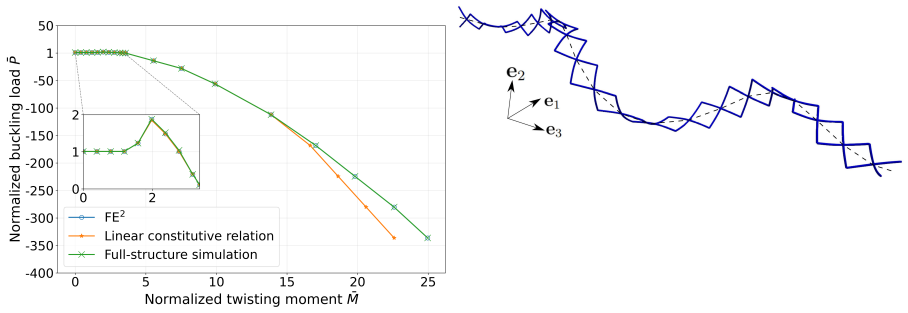
- Testing the homogenized model against full simulations of extended structures under varying loads would confirm its range of applicability.
Load-bearing premise
The metamaterial structure experiences uniform strain along its arc length at the macroscale.
What would settle it
If a full simulation of multiple connected units under non-uniform loading like torsion or bending deviates from the predictions of the single-unit homogenized Cosserat rod, the uniform-strain assumption would be falsified.
Figures




read the original abstract
Rod-like metamaterials are the structures that are obtained by periodically assembling its microstructural unit (network of rods) in just one direction. In this work, we present a scheme for obtaining the nonlinear constitutive response of such structures when homogenized macroscopically as a continuum rod. To capture accurately arbitrary and large deformation, the geometrically exact special Cosserat rod theory is used for modeling the rod at both micro and macro scales. By assuming the metamaterial structure to be strained uniformly (at macroscale) along its arc length, the full structure problem is reduced to just that of its microstructural unit but subjected to helically periodic boundary condition. The microscale problem, consisting of a network of rods and formulated in a variational setting, is solved in the presence of rod joint constraints and helically periodic boundary conditions. The expressions for the macroscale/homogenized rod's stress resultants (internal contact force and moment) and stiffnesses are then obtained. Finally, several numerical examples having different microstructural units/RVEs are presented to demonstrate our method. We start with simpler square and cross RVEs to validate our results with the existing literature. We then take up more complex RVEs such as square RVEs having helical constituent rods which have application as artificial muscle material and eventually we work on the homogenization of auxetic tubular metamaterials. We show how various design parameters of these RVEs can be tuned to obtain the desired macroscopic response.
Editorial analysis
A structured set of objections, weighed in public.
Referee Report
Summary. The manuscript presents a homogenization scheme for rod-like metamaterials by modeling both the microstructural network and the macroscale structure with the geometrically exact special Cosserat rod theory. Assuming uniform macroscale strain along the arc length, the full problem reduces to solving a single microstructural unit subject to helically periodic boundary conditions. The microscale variational problem, incorporating rod joint constraints, is solved to obtain explicit expressions for the macroscale stress resultants (contact force and moment) and tangent stiffnesses. The method is demonstrated on square, cross, helical, and auxetic tubular RVEs, with validation against literature for the simpler cases.
Significance. If the uniform-strain reduction proves accurate, the work supplies an efficient, parameter-free route to nonlinear constitutive relations for rod-based metamaterials, supporting design of tunable structures such as artificial muscles. Strengths include the consistent Cosserat kinematics at both scales, the variational extraction of homogenized quantities, and the progression from validated simple RVEs to complex auxetic tubes. These elements position the contribution as a practical bridge between microscale rod networks and macroscale rod models.
major comments (2)
- [Abstract] Abstract (homogenization procedure): The central reduction assumes macroscale strain measures (extension, shear, curvature) are constant along the arc length, permitting a single microstructural unit with helically periodic BCs. For tubular auxetic RVEs, however, nonzero macro curvature produces linearly varying microscale extensions and rotations across the cross-section because constituent rods lie at different radial distances from the centerline. The helical periodicity applied to one unit does not automatically enforce this cross-sectional variation; the resulting macro stress resultants and stiffnesses may therefore be inconsistent with the true homogenized Cosserat rod. A quantitative comparison against a multi-unit or full-structure simulation for a curved configuration is required to bound the error.
- [Numerical examples] Numerical examples (auxetic tubular RVE): While square and cross RVEs are stated to match existing literature, the auxetic tubular and helical-rod cases provide no error metrics, mesh-convergence data, or direct comparison with a reference solution that retains macro curvature. Without such checks, it is impossible to confirm that the extracted stiffnesses remain reliable when the uniform-strain assumption is relaxed.
minor comments (2)
- The abstract is information-dense; separating the description of the reduction procedure from the list of numerical examples would improve readability.
- Ensure that the precise averaging or virtual-work expressions used to obtain macroscale force, moment, and stiffness from the microscale solution are written explicitly and referenced to the relevant equations.
Simulated Author's Rebuttal
We thank the referee for the careful reading and constructive comments. We address each major comment below with clarifications on the method's assumptions and commitments to strengthen the numerical validation.
read point-by-point responses
-
Referee: [Abstract] Abstract (homogenization procedure): The central reduction assumes macroscale strain measures (extension, shear, curvature) are constant along the arc length, permitting a single microstructural unit with helically periodic BCs. For tubular auxetic RVEs, however, nonzero macro curvature produces linearly varying microscale extensions and rotations across the cross-section because constituent rods lie at different radial distances from the centerline. The helical periodicity applied to one unit does not automatically enforce this cross-sectional variation; the resulting macro stress resultants and stiffnesses may therefore be inconsistent with the true homogenized Cosserat rod. A quantitative comparison against a multi-unit or full-structure simulation for a curved configuration is required to bound the error.
Authors: We appreciate the referee drawing attention to the treatment of curvature in the homogenization. In the formulation, the macroscale strain measures (including curvature and twist) are imposed directly on the microstructural RVE via position-dependent boundary conditions on the individual rods. For the auxetic tubular RVE, the repeating unit spans the entire cross-section, so rods at different radial distances receive the appropriate extensions and rotations consistent with the special Cosserat kinematics (linear variation due to curvature). The helically periodic conditions then enforce consistency along the length for the periodic microstructure. This is the standard first-order homogenization procedure for extracting effective constitutive relations under locally uniform macrostrain. We agree that a clarifying statement on the scope of the uniform-strain assumption would be beneficial. In the revision we will update the abstract and Section 2 to explicitly note that the scheme yields the leading-order response and briefly discuss its applicability to moderately curved configurations, while higher-order effects would require a different (non-periodic) microscale problem. revision: partial
-
Referee: [Numerical examples] Numerical examples (auxetic tubular RVE): While square and cross RVEs are stated to match existing literature, the auxetic tubular and helical-rod cases provide no error metrics, mesh-convergence data, or direct comparison with a reference solution that retains macro curvature. Without such checks, it is impossible to confirm that the extracted stiffnesses remain reliable when the uniform-strain assumption is relaxed.
Authors: We accept that additional quantitative checks are warranted for the more complex RVEs. In the revised manuscript we will add mesh-convergence plots, relative-error metrics on the extracted stress resultants and stiffnesses, and direct comparisons against full-structure simulations performed under uniform macrostrain (constant extension, curvature, etc.) for both the helical-rod and auxetic-tubular cases. Regarding reference solutions that retain macro curvature (i.e., non-uniform strain along the arc length), we note that the homogenization procedure is constructed precisely to furnish the local constitutive law that the macroscale Cosserat rod model then integrates along its length. Full multi-unit simulations of long, curved metamaterial rods are computationally expensive and lie outside the present scope; however, we will include a short discussion of this point together with a simple illustrative example of a mildly curved configuration to illustrate the expected accuracy. revision: yes
Circularity Check
No significant circularity; derivation is self-contained from standard kinematics and variational principles
full rationale
The paper's core reduction assumes uniform macroscale strain along the rod arc length to map the full periodic structure onto a single microstructural unit subject to helically periodic boundary conditions. This is an explicit modeling hypothesis drawn from standard periodic homogenization practice, not a self-definition or fitted input. The macro stress resultants and tangent stiffnesses are then obtained by solving the resulting variational microscale problem (network of rods with joint constraints) using geometrically exact special Cosserat kinematics at both scales. No parameter is fitted to a subset of data and then relabeled as a prediction; no load-bearing uniqueness theorem or ansatz is imported via self-citation; and the final expressions are computed outputs rather than identities by construction. The derivation therefore remains independent of its target homogenized response.
Axiom & Free-Parameter Ledger
axioms (2)
- standard math Geometrically exact special Cosserat rod theory applies at both micro and macro scales
- domain assumption Uniform macroscale strain along arc length
Lean theorems connected to this paper
-
IndisputableMonolith/Cost/FunctionalEquation.leanwashburn_uniqueness_aczel unclear?
unclearRelation between the paper passage and the cited Recognition theorem.
The expressions for the macroscale/homogenized rod's stress resultants (internal contact force and moment) and stiffnesses are then obtained.
What do these tags mean?
- matches
- The paper's claim is directly supported by a theorem in the formal canon.
- supports
- The theorem supports part of the paper's argument, but the paper may add assumptions or extra steps.
- extends
- The paper goes beyond the formal theorem; the theorem is a base layer rather than the whole result.
- uses
- The paper appears to rely on the theorem as machinery.
- contradicts
- The paper's claim conflicts with a theorem or certificate in the canon.
- unclear
- Pith found a possible connection, but the passage is too broad, indirect, or ambiguous to say the theorem truly supports the claim.
Reference graph
Works this paper leans on
-
[1]
Sperl, Georg and Narain, Rahul and Wojtan, Chris , number =. 2020 , journal =. doi:10.1145/3386569.3392412 , issn =
-
[2]
Journal of the Mechanics and Physics of Solids , volume=
Asymptotic derivation of high-order rod models from non-linear 3D elasticity , author=. Journal of the Mechanics and Physics of Solids , volume=. 2021 , publisher=
work page 2021
-
[3]
European Journal of Mechanics-A/Solids , volume=
Uniformly strained anisotropic elastoplastic rods: determination of elastoplastic constitutive relations and yield surface in terms of rod’s variables , author=. European Journal of Mechanics-A/Solids , volume=. 2023 , publisher=
work page 2023
-
[4]
Computer Methods in Applied Mechanics and Engineering , volume=
A computational approach to obtain nonlinearly elastic constitutive relations of strips modeled as a special Cosserat rod , author=. Computer Methods in Applied Mechanics and Engineering , volume=. 2024 , publisher=
work page 2024
-
[5]
SIAM journal on applied mathematics , volume=
Mathematical modeling of vascular stents , author=. SIAM journal on applied mathematics , volume=. 2010 , publisher=
work page 2010
-
[6]
Mechanical Systems and Signal Processing , volume=
Metamaterial shaft with a low Poisson’s ratio lattice structure for torsional vibration isolation , author=. Mechanical Systems and Signal Processing , volume=. 2025 , publisher=
work page 2025
-
[7]
Recent Advances in Twisted and Coiled Artificial Muscles and Their Applications , author=. SmartBot , pages=. 2025 , publisher=
work page 2025
-
[8]
Mechanics of Materials , volume=
Linear multiscale analysis and finite element validation of stretching and bending dominated lattice materials , author=. Mechanics of Materials , volume=. 2012 , publisher=
work page 2012
-
[9]
Computer methods in applied mechanics and engineering , volume=
Stiffness and strength of tridimensional periodic lattices , author=. Computer methods in applied mechanics and engineering , volume=. 2012 , publisher=
work page 2012
- [10]
-
[11]
Smart Materials and Structures , volume=
Origami interleaved tube cellular materials , author=. Smart Materials and Structures , volume=. 2014 , publisher=
work page 2014
-
[12]
Nonlinear Problems of Elasticity , pages=
Problems in nonlinear elasticity , author=. Nonlinear Problems of Elasticity , pages=. 2005 , publisher=
work page 2005
-
[13]
International Journal of Solids and Structures , volume=
A comprehensive kinematic model of single-manifold cosserat beam structures with application to a finite strain measurement model for strain gauges , author=. International Journal of Solids and Structures , volume=. 2019 , publisher=
work page 2019
-
[14]
International Journal of Solids and Structures , volume=
A geometrically-exact rod model incorporating shear and torsion-warping deformation , author=. International Journal of Solids and Structures , volume=. 1991 , publisher=
work page 1991
-
[15]
Computational Mechanics , volume=
Multiscale computational homogenisation of shear-flexible beam elements: a Direct FE2 approach , author=. Computational Mechanics , volume=. 2022 , publisher=
work page 2022
-
[16]
Computer Methods in Applied Mechanics and Engineering , volume=
Variationally consistent homogenisation of plates , author=. Computer Methods in Applied Mechanics and Engineering , volume=. 2023 , publisher=
work page 2023
-
[17]
Pantographic beam: a complete second gradient 1D-continuum in plane , author=. Zeitschrift f. 2019 , publisher=
work page 2019
-
[18]
Rahali, Yosra and Giorgio, Ivan and Ganghoffer, Jean-Fran. Homogenization. International Journal of Engineering Science , volume=. 2015 , publisher=
work page 2015
-
[19]
International journal of engineering science , volume=
Variational asymptotic beam sectional analysis--an updated version , author=. International journal of engineering science , volume=. 2012 , publisher=
work page 2012
-
[20]
Applied Mechanics Reviews , volume=
Aspects of computational homogenization at finite deformations: a unifying review from Reuss' to Voigt's bound , author=. Applied Mechanics Reviews , volume=. 2016 , publisher=
work page 2016
-
[21]
International Journal of Solids and Structures , volume=
Effective stiffness, strength, buckling and anisotropy of foams based on nine unique triple periodic minimal surfaces , author=. International Journal of Solids and Structures , volume=. 2022 , publisher=
work page 2022
-
[22]
Archive of applied mechanics , volume=
Size effects of mechanical metamaterials: a computational study based on a second-order asymptotic homogenization method , author=. Archive of applied mechanics , volume=. 2021 , publisher=
work page 2021
-
[23]
International Journal of Solids and Structures , volume=
Continualization method of lattice materials and analysis of size effects revisited based on Cosserat models , author=. International Journal of Solids and Structures , volume=. 2022 , publisher=
work page 2022
-
[24]
International Journal of Non-Linear Mechanics , volume=
Nonlinear micromorphic Timoshenko beam modeling and vibration analysis of microstructured beams , author=. International Journal of Non-Linear Mechanics , volume=. 2024 , publisher=
work page 2024
-
[25]
Computational Mechanics , volume=
Nonlinear multiscale simulation of elastic beam lattices with anisotropic homogenized constitutive models based on artificial neural networks , author=. Computational Mechanics , volume=. 2021 , publisher=
work page 2021
-
[26]
Africa and Daniel Arndt and Wolfgang Bangerth and Bruno Blais and Marc Fehling and Rene Gassm
Pasquale C. Africa and Daniel Arndt and Wolfgang Bangerth and Bruno Blais and Marc Fehling and Rene Gassm. The deal.II library, Version 9.6 , journal =
-
[27]
Cytoskeletal bundle mechanics , author=. Biophysical journal , volume=. 2008 , publisher=
work page 2008
-
[28]
Protein unfolding accounts for the unusual mechanical behavior of fibrin networks , author=. Acta biomaterialia , volume=. 2011 , publisher=
work page 2011
-
[29]
Journal of biomechanics , volume=
Three-dimensional bending, torsion and axial compression of the femoropopliteal artery during limb flexion , author=. Journal of biomechanics , volume=. 2014 , publisher=
work page 2014
-
[30]
Composites Part B: Engineering , volume=
A novel combined auxetic tubular structure with enhanced tunable stiffness , author=. Composites Part B: Engineering , volume=. 2021 , publisher=
work page 2021
-
[31]
Revolutionary auxetic intravascular medical stents for angioplasty applications , author=. Materials & Design , volume=. 2023 , publisher=
work page 2023
-
[32]
Computer methods in applied mechanics and engineering , volume=
Optimal design of vascular stents using a network of 1D slender curved rods , author=. Computer methods in applied mechanics and engineering , volume=. 2022 , publisher=
work page 2022
-
[33]
Medical engineering & physics , volume=
Assessment of structural and hemodynamic performance of vascular stents modelled as periodic lattices , author=. Medical engineering & physics , volume=. 2018 , publisher=
work page 2018
-
[34]
The beam-like behavior of space trusses , author=. AIAA journal , volume=
-
[35]
Computers & structures , volume=
Equivalent beam-column analysis of guyed towers , author=. Computers & structures , volume=. 1995 , publisher=
work page 1995
-
[36]
Aerospace Science and Technology , volume=
Extended continuum model for dynamic analysis of beam-like truss structures with geometrical nonlinearity , author=. Aerospace Science and Technology , volume=. 2020 , publisher=
work page 2020
-
[37]
Acta Mechanica Sinica , volume=
Equivalent continuum modeling of beam-like truss structures with flexible joints , author=. Acta Mechanica Sinica , volume=. 2019 , publisher=
work page 2019
-
[38]
Asymptotic analysis for periodic structures , author=. 2011 , publisher=
work page 2011
-
[39]
Homogenization of reticulated structures , author=. 2012 , publisher=
work page 2012
-
[40]
International Journal of Mechanical Sciences , volume=
Bending and twisting rigidities of 2D materials , author=. International Journal of Mechanical Sciences , volume=. 2024 , publisher=
work page 2024
-
[41]
Computers & Structures , volume=
Finite element formulation of a homogenized beam for reticulated structure dynamics , author=. Computers & Structures , volume=. 2022 , publisher=
work page 2022
-
[42]
Higher-order effective modeling of periodic heterogeneous beams. I. Asymptotic expansion method , author=. International Journal of Solids and Structures , volume=. 2001 , publisher=
work page 2001
-
[43]
Computers & Structures , volume=
Solid and 3D beam finite element models for the nonlinear elastic analysis of helical strands within a computational homogenization framework , author=. Computers & Structures , volume=. 2021 , publisher=
work page 2021
-
[44]
Influence of negative Poisson’s ratio on stent applications , author=. Adv. Mater , volume=
-
[45]
A geometrically exact rod model including in-plane cross-sectional deformation , author=
-
[46]
Modelling and Simulation in Materials Science and Engineering , volume=
Multi-scale computational homogenization of structured thin sheets , author=. Modelling and Simulation in Materials Science and Engineering , volume=. 2007 , publisher=
work page 2007
-
[47]
Computational Mechanics , volume=
A new homogenization scheme for beam and plate structures without a priori requirements on boundary conditions , author=. Computational Mechanics , volume=. 2022 , publisher=
work page 2022
-
[48]
International Journal of Engineering Science , volume=
Bifurcation instabilities in finite bending of circular cylindrical shells , author=. International Journal of Engineering Science , volume=. 2017 , publisher=
work page 2017
-
[49]
Mimicking biological stress--strain behaviour with synthetic elastomers , author=. Nature , volume=. 2017 , publisher=
work page 2017
-
[50]
International Journal of Solids and Structures , volume=
A strain-gradient elastic theory for special Cosserat rods , author=. International Journal of Solids and Structures , volume=. 2024 , publisher=
work page 2024
-
[51]
Computer Methods in Applied Mechanics and Engineering , volume=
Physics-augmented neural networks for constitutive modeling of hyperelastic geometrically exact beams , author=. Computer Methods in Applied Mechanics and Engineering , volume=. 2025 , publisher=
work page 2025
-
[52]
Computer Methods in Applied Mechanics and Engineering , volume=
Computational homogenization of higher-order electro-mechanical materials with built-in generalized periodicity conditions , author=. Computer Methods in Applied Mechanics and Engineering , volume=. 2024 , publisher=
work page 2024
-
[53]
Programmable constitutive mode-coupling in tubular origami metamaterials , author=. npj Metamaterials , volume=. 2025 , publisher=
work page 2025
-
[54]
Double-network-inspired mechanical metamaterials , author=. Nature Materials , pages=. 2025 , publisher=
work page 2025
-
[55]
Advanced Materials Technologies , volume=
Braided liquid crystal elastomer fiber actuator with programmable deformation for artificial muscles , author=. Advanced Materials Technologies , volume=. 2023 , publisher=
work page 2023
-
[56]
Computer methods in applied mechanics and engineering , volume=
On the dynamics in space of rods undergoing large motions—a geometrically exact approach , author=. Computer methods in applied mechanics and engineering , volume=. 1988 , publisher=
work page 1988
-
[57]
Journal of Elasticity , volume=
Importance and effectiveness of representing the shapes of Cosserat rods and framed curves as paths in the special Euclidean algebra , author=. Journal of Elasticity , volume=. 2018 , publisher=
work page 2018
-
[58]
International journal for numerical methods in engineering , volume=
A discrete mechanics approach to the Cosserat rod theory—Part 1: static equilibria , author=. International journal for numerical methods in engineering , volume=. 2011 , publisher=
work page 2011
-
[59]
Part II: Computational aspects , author=
A three-dimensional finite-strain rod model. Part II: Computational aspects , author=. Computer methods in applied mechanics and engineering , volume=. 1986 , publisher=
work page 1986
-
[60]
ACM SIGGRAPH 2008 papers , pages=
Discrete elastic rods , author=. ACM SIGGRAPH 2008 papers , pages=
work page 2008
-
[61]
Journal of Elasticity , volume=
Discrete Cosserat rod kinematics constructed on the basis of the difference geometry of framed curves—part I: discrete Cosserat curves on a staggered grid , author=. Journal of Elasticity , volume=. 2020 , publisher=
work page 2020
-
[62]
Proceedings of the Royal Society A , volume=
Simple deformation measures for Discrete elastic rods and ribbons , author=. Proceedings of the Royal Society A , volume=. 2021 , publisher=
work page 2021
-
[63]
Journal of Applied Mechanics , volume=
Implicit contact model for discrete elastic rods in knot tying , author=. Journal of Applied Mechanics , volume=. 2021 , publisher=
work page 2021
-
[64]
Computer Graphics Forum , volume=
An adaptive contact model for the robust simulation of knots , author=. Computer Graphics Forum , volume=. 2008 , organization=
work page 2008
-
[65]
Extreme Mechanics Letters , volume=
A fully implicit method for robust frictional contact handling in elastic rods , author=. Extreme Mechanics Letters , volume=. 2023 , publisher=
work page 2023
-
[66]
Extreme Mechanics Letters , volume=
A discrete differential geometry-based approach to numerical simulation of Timoshenko beam , author=. Extreme Mechanics Letters , volume=. 2020 , publisher=
work page 2020
-
[67]
Computer Graphics Forum , volume=
Super-Clothoids , author=. Computer Graphics Forum , volume=. 2012 , organization=
work page 2012
-
[68]
Royal Society open science , volume=
Forward and inverse problems in the mechanics of soft filaments , author=. Royal Society open science , volume=. 2018 , publisher=
work page 2018
-
[69]
Computer Methods in Applied Mechanics and Engineering , volume=
A discrete, geometrically exact method for simulating nonlinear, elastic and inelastic beams , author=. Computer Methods in Applied Mechanics and Engineering , volume=. 2020 , publisher=
work page 2020
-
[70]
Extreme Mechanics Letters , pages=
A discrete model for the geometrically nonlinear mechanics of hard-magnetic slender structures , author=. Extreme Mechanics Letters , pages=. 2023 , publisher=
work page 2023
-
[71]
IEEE Transactions on Visualization and Computer Graphics , volume=
Cosserat nets , author=. IEEE Transactions on Visualization and Computer Graphics , volume=. 2008 , publisher=
work page 2008
-
[72]
ACM Transactions on Graphics (TOG) , volume=
Yarn-level simulation of woven cloth , author=. ACM Transactions on Graphics (TOG) , volume=. 2014 , publisher=
work page 2014
-
[73]
ACM Transactions on Graphics (TOG) , volume=
Design and fabrication of flexible rod meshes , author=. ACM Transactions on Graphics (TOG) , volume=. 2015 , publisher=
work page 2015
-
[74]
arXiv preprint arXiv:2210.11324 , year=
Self-Ordering of Buckling, Bending, Bumping Beams , author=. arXiv preprint arXiv:2210.11324 , year=
-
[75]
Computer Methods in Applied Mechanics and Engineering , volume=
Stability of elastic rods with self-contact , author=. Computer Methods in Applied Mechanics and Engineering , volume=. 2014 , publisher=
work page 2014
-
[76]
Computer Methods in Applied Mechanics and Engineering , volume=
A finite element approach for the line-to-line contact interaction of thin beams with arbitrary orientation , author=. Computer Methods in Applied Mechanics and Engineering , volume=. 2016 , publisher=
work page 2016
-
[77]
Computer Methods in Applied Mechanics and Engineering , volume=
A unified approach for beam-to-beam contact , author=. Computer Methods in Applied Mechanics and Engineering , volume=. 2017 , publisher=
work page 2017
-
[78]
Computer Methods in Applied Mechanics and Engineering , volume=
A locking-free finite element formulation and reduced models for geometrically exact Kirchhoff rods , author=. Computer Methods in Applied Mechanics and Engineering , volume=. 2015 , publisher=
work page 2015
-
[79]
Multibody System Dynamics , volume=
A comparison of finite elements for nonlinear beams: the absolute nodal coordinate and geometrically exact formulations , author=. Multibody System Dynamics , volume=. 2008 , publisher=
work page 2008
-
[80]
International Journal of Non-Linear Mechanics , volume=
Self-contact in closed and open Kirchhoff rods , author=. International Journal of Non-Linear Mechanics , volume=. 2021 , publisher=
work page 2021
discussion (0)
Sign in with ORCID, Apple, or X to comment. Anyone can read and Pith papers without signing in.