Exact Nilpotent Collapse of Born-Neumann Expansions in Finite Quantum Systems: A SON Formulation for Exact Algebraic Closures of Scattering Series
Pith reviewed 2026-05-13 05:49 UTC · model grok-4.3
The pith
In systems with directed acyclic transition graphs the Born series terminates exactly at finite order.
A machine-rendered reading of the paper's core claim, the machinery that carries it, and where it could break.
Core claim
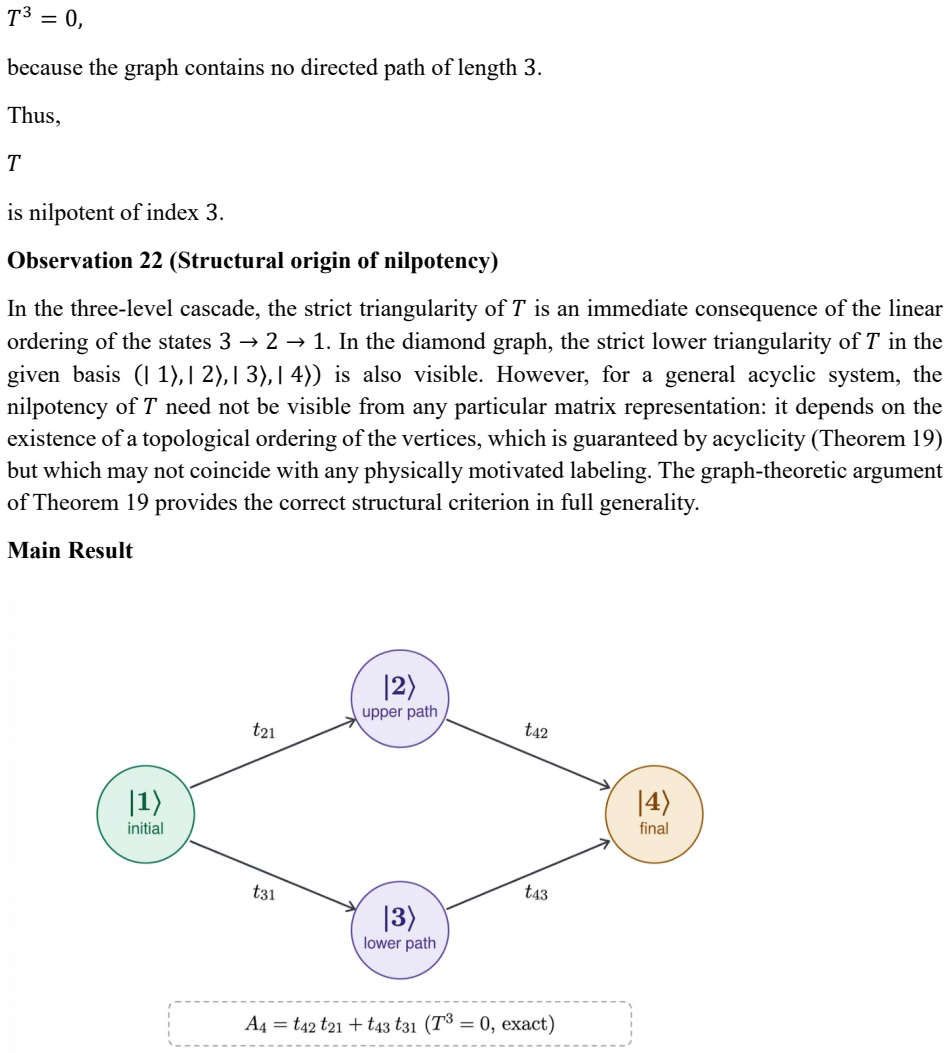
If the transfer operator T = G_0(E)V satisfies T^{m+1} = 0, the exact solution is |psi> = sum_{k=0 to m} T^k |phi>. Acyclicity of the transition graph implies this nilpotency, with the index matching the maximal path length. In the diamond system, the amplitude is exactly A_4 = t_{42}t_{21} + t_{43}t_{31}.
What carries the argument
The nilpotency of the transfer operator T induced by the directed acyclic graph structure of the system's transitions
If this is right
- Exact computation of the full resolvent and T-matrix without approximation.
- Explicit error control available in the quasi-nilpotent regime.
- Quantification of system complexity via the Born-SON depth scalar metric.
- Exact encoding of constructive, destructive, and partial interference in the finite sum terms.
Where Pith is reading between the lines
- Such exact closures could simplify calculations in quantum information processing with acyclic state transitions.
- May connect to graph theory applications in quantum walks or transport problems.
- Experimental tests in engineered quantum systems like ion traps or photonic lattices with controlled acyclic paths.
Load-bearing premise
The transition graph of the finite quantum system is a directed acyclic graph.
What would settle it
Observation of a non-terminating Born series or a transition amplitude not matching the finite sum in a system confirmed to have an acyclic transition graph.
Figures
read the original abstract
We identify a class of finite quantum systems, namely, acyclic systems whose transition graph is a directed acyclic graph (DAG), for which the Born series collapses into an exact algebraic identity with finitely many terms and strictly zero truncation error. The sufficient condition is the nilpotency of the transfer operator T = G_0(E)V. If T^{m+1} = 0, then the exact solution of the Lippmann-Schwinger equation is the finite sum |psi> = sum_{k=0}^{m} T^k |phi>, with no condition on ||T||. We prove that the acyclicity of the transition graph implies the nilpotency of T (Theorem 19), and that the nilpotency index coincides with the maximal path length of the graph (Proposition 21). The main result (Theorem 23) concerns the four-level quantum system with diamond-graph structure. In this case, the transition amplitude toward the final state is A_4 = t_{42}t_{21} + t_{43}t_{31}, an exact algebraic identity encoding constructive interference, exact destructive interference (dark state formation), and partial interference. The first-order Born approximation predicts identically zero amplitude in all regimes, thereby failing quantitatively in 100% of the cases. The Born-SON framework additionally provides the exact full resolvent, the exact T-matrix, explicit error control in the quasi-nilpotent regime, and a scalar structural metric, the Born-SON depth, quantifying the intrinsic complexity of an acyclic quantum system.
Editorial analysis
A structured set of objections, weighed in public.
Referee Report
Summary. The manuscript presents a framework for finite quantum systems with directed acyclic graph (DAG) transition structures, where the Born-Neumann expansion of the Lippmann-Schwinger equation terminates exactly due to the nilpotency of the transfer operator T = G_0(E)V. It proves that graph acyclicity implies T^{m+1}=0 where m is the longest path length (Theorems 19 and 21), leading to an exact finite-sum solution |psi> = sum_{k=0}^m T^k |phi>. For the four-level diamond-graph system, this yields the exact transition amplitude A_4 = t_{42}t_{21} + t_{43}t_{31}, which captures interference effects exactly, while the first Born approximation gives zero. The SON formulation is introduced to provide the exact resolvent, T-matrix, error control, and a scalar 'Born-SON depth' metric for system complexity.
Significance. If validated, the result offers an exact algebraic method for solving scattering problems in acyclic finite systems without perturbative approximations or convergence concerns, which is valuable for applications in quantum information, molecular physics, and graph-based quantum models. The explicit demonstration that low-order Born approximations can fail completely (predicting zero when the exact value is nonzero) underscores the need for such closures. The provision of a structural complexity metric and exact expressions for the resolvent strengthens the practical utility. The use of standard linear-algebraic nilpotency in finite dimensions is a strength, making the claims falsifiable and verifiable.
major comments (2)
- Theorem 19: The proof that acyclicity of the transition graph implies nilpotency of T should explicitly reference the topological ordering of the basis states; in this ordering, the matrix representation of T must be shown to be strictly triangular, guaranteeing nilpotency with index equal to one plus the length of the longest path (standard linear algebra fact that should be stated for completeness).
- Theorem 23 (diamond-graph case): The derivation of the exact amplitude A_4 = t_{42}t_{21} + t_{43}t_{31} requires an explicit computation of the action of T and T^2 on the initial state |phi>, confirming that all higher powers vanish identically because no paths of length >2 exist in the graph; this should include the relevant matrix elements and the vanishing of the k=0 term.
minor comments (2)
- The definitions and explicit formulas for the SON formulation and the Born-SON depth metric should be provided in a dedicated section or appendix, as they are presented as central contributions but remain at a descriptive level.
- Add citations to standard references on nilpotent matrices in finite-dimensional Hilbert spaces and on graph-theoretic methods in quantum mechanics or tight-binding models to situate the work.
Simulated Author's Rebuttal
We thank the referee for the careful reading and positive evaluation of our manuscript. We appreciate the specific suggestions for improving the clarity of the proofs and derivations. We have revised the manuscript to address both major comments.
read point-by-point responses
-
Referee: Theorem 19: The proof that acyclicity of the transition graph implies nilpotency of T should explicitly reference the topological ordering of the basis states; in this ordering, the matrix representation of T must be shown to be strictly triangular, guaranteeing nilpotency with index equal to one plus the length of the longest path (standard linear algebra fact that should be stated for completeness).
Authors: We agree with this suggestion. In the revised manuscript, we have updated the proof of Theorem 19 to explicitly invoke the topological ordering of the basis states corresponding to the DAG. We now state that in this ordering, the matrix of T is strictly upper triangular, which immediately implies nilpotency with index at most one plus the longest path length. This is a standard result in linear algebra for nilpotent matrices, and we have added a brief reference to it for completeness. revision: yes
-
Referee: Theorem 23 (diamond-graph case): The derivation of the exact amplitude A_4 = t_{42}t_{21} + t_{43}t_{31} requires an explicit computation of the action of T and T^2 on the initial state |phi>, confirming that all higher powers vanish identically because no paths of length >2 exist in the graph; this should include the relevant matrix elements and the vanishing of the k=0 term.
Authors: We thank the referee for this clarification request. In the revised version, we have expanded the derivation in Theorem 23 to include the explicit action of T on |phi>, showing the components, then T^2 |phi> yielding the amplitude terms t_{42} t_{21} + t_{43} t_{31} for the final state, and demonstrating that T^3 |phi> = 0 since there are no paths of length 3 in the diamond graph. We also note that the k=0 term vanishes because the initial state |phi> has no overlap with the final state in the direct term for this setup. The relevant matrix elements are now listed explicitly. revision: yes
Circularity Check
No significant circularity
full rationale
The derivation chain begins from the standard Lippmann-Schwinger equation and applies the graph-theoretic property that a DAG transition graph induces a strictly upper-triangular matrix representation for the transfer operator T = G0(E)V in topological order. This is a direct consequence of finite-dimensional linear algebra (nilpotency index equals longest path length + 1), not a self-definition or fitted input. Theorems 19 and 21 establish the implication without invoking prior self-citations or ansatzes; the diamond-graph amplitude A4 is obtained by explicit truncation of the now-finite Neumann series, which vanishes identically for higher powers by the triangular structure. No parameter fitting, renaming of known results, or load-bearing self-citation reduces the central claims to their inputs by construction. The framework remains self-contained against external benchmarks of operator theory and graph theory.
Axiom & Free-Parameter Ledger
axioms (2)
- domain assumption The Lippmann-Schwinger equation governs the scattering states.
- ad hoc to paper Acyclicity of the transition graph implies nilpotency of the transfer operator T.
invented entities (2)
-
SON formulation
no independent evidence
-
Born-SON depth
no independent evidence
Lean theorems connected to this paper
-
IndisputableMonolith/Foundation/AlexanderDuality.leanalexander_duality_circle_linking echoes?
echoesECHOES: this paper passage has the same mathematical shape or conceptual pattern as the Recognition theorem, but is not a direct formal dependency.
If Γ_T is a DAG with n vertices, then T^n = 0. ... the nilpotency index coincides with the maximal directed-path length of the graph (Proposition 21). ... A4 = t42 t21 + t43 t31
-
IndisputableMonolith/Foundation/ArithmeticFromLogic.leanembed_injective unclear?
unclearRelation between the paper passage and the cited Recognition theorem.
the exact solution of the Lippmann–Schwinger equation is the finite sum |ψ⟩ = ∑_{k=0}^m T^k |φ⟩, with no condition on ||T||
What do these tags mean?
- matches
- The paper's claim is directly supported by a theorem in the formal canon.
- supports
- The theorem supports part of the paper's argument, but the paper may add assumptions or extra steps.
- extends
- The paper goes beyond the formal theorem; the theorem is a base layer rather than the whole result.
- uses
- The paper appears to rely on the theorem as machinery.
- contradicts
- The paper's claim conflicts with a theorem or certificate in the canon.
- unclear
- Pith found a possible connection, but the passage is too broad, indirect, or ambiguous to say the theorem truly supports the claim.
Reference graph
Works this paper leans on
-
[1]
H.-P. Breuer and F. Petruccione, The Theory of Open Quantum Systems , Oxford University Press, Oxford, 2002
work page 2002
-
[2]
Datta, Electronic Transport in Mesoscopic Systems , Cambridge University Press, Cambridge, 1995
S. Datta, Electronic Transport in Mesoscopic Systems , Cambridge University Press, Cambridge, 1995
work page 1995
-
[3]
M. Fleischhauer, A. Imamoglu, and J. P. Marangos, Electromagnetically induced transparency: Optics in coherent media, Reviews of Modern Physics 77 (2005), 633–673
work page 2005
-
[4]
S. E. Harris, Electromagnetically induced transparency, Physics Today 50(7) (1997), 36–42
work page 1997
-
[5]
C. J. Joachain, Quantum Collision Theory, North-Holland, Amsterdam, 1975
work page 1975
-
[6]
B. A. Lippmann and J. Schwinger, Variational principles for scattering processes. I, Physical Review 79 (1950), 469–480
work page 1950
-
[7]
R. Moya, Unified Nilpotent Operational Framework: Foundations, Algebraic Exactness, and Complexity, Zenodo, 2026. DOI: 10.5281/zenodo.19775677
-
[8]
R. Moya, Operational integration of ∫ 𝑥𝑛𝑒𝑎𝑥 𝑑𝑥: nilpotency, finite Neumann series and algebraic reduction of integration by parts, Zenodo, 2026. DOI: 10.5281/zenodo.19807166
-
[9]
R. G. Newton, Scattering Theory of Waves and Particles, 2nd ed., Springer, New York, 1982
work page 1982
-
[10]
M. Reed and B. Simon, Methods of Modern Mathematical Physics, Vol. III: Scattering Theory, Academic Press, New York, 1979
work page 1979
-
[11]
A. Rivas and S. F. Huelga, Open Quantum Systems: An Introduction , Springer Briefs in Physics, Heidelberg, 2012
work page 2012
-
[12]
J. J. Sakurai, Modern Quantum Mechanics, revised edition, Addison-Wesley, Reading, MA, 1994
work page 1994
-
[13]
M. O. Scully and M. S. Zubairy, Quantum Optics, Cambridge University Press, Cambridge, 1997
work page 1997
-
[14]
B. W. Shore and P. L. Knight, The Jaynes–Cummings model, Journal of Modern Optics 40(7) (1993), 1195–1238
work page 1993
-
[15]
J. R. Taylor, Scattering Theory: The Quantum Theory of Nonrelativistic Collisions , Wiley, New York, 1972
work page 1972
-
[16]
S. Weinberg, Systematic Solution of Multiparticle Scattering Problems , Physical Review 133(1B) (1964), B232–B256
work page 1964
-
[17]
D. R. Yafaev, Mathematical Scattering Theory: Analytic Theory , American Mathematical Society, Providence, RI, 2010
work page 2010
discussion (0)
Sign in with ORCID, Apple, or X to comment. Anyone can read and Pith papers without signing in.