Recognition: no theorem link
Chemical signatures of planetary systems in their host stars. Near-infrared spectroscopy of four planet-hosting wide binaries
Pith reviewed 2026-05-13 00:44 UTC · model grok-4.3
The pith
Planet-hosting wide binaries show varied chemical abundance trends with condensation temperature.
A machine-rendered reading of the paper's core claim, the machinery that carries it, and where it could break.
Core claim
Near-infrared spectroscopy of four planet-hosting wide binaries yields differential abundances between components that display diverse trends versus condensation temperature: significant correlations in WASP-160 A/B and WASP-127/TYC 4916-897-1, a weaker correlation in HD 20782/HD 20781, and a flat relation in K2-54/K2-54 B. Literature comparisons suggest extreme Tc slopes occur more frequently among planet-hosting wide binaries at large separations. These observations establish that chemical signatures are not universal but vary across systems, with planetary architectures potentially linked to some patterns while multiple processes contribute overall.
What carries the argument
Differential abundance trends with condensation temperature (Tc) measured between the two stars in each wide binary, which isolates possible planetary effects under the assumption of identical birth compositions.
Load-bearing premise
The two stars in each wide binary formed with identical initial chemical compositions so that measured differences can be attributed to planetary processes rather than measurement error, stellar evolution, or binary-specific effects.
What would settle it
A large sample of wide binaries in which Tc trends show no statistical association with the presence of planets, or in which non-planet-hosting pairs exhibit the same range of abundance differences as the planet-hosting ones.
Figures
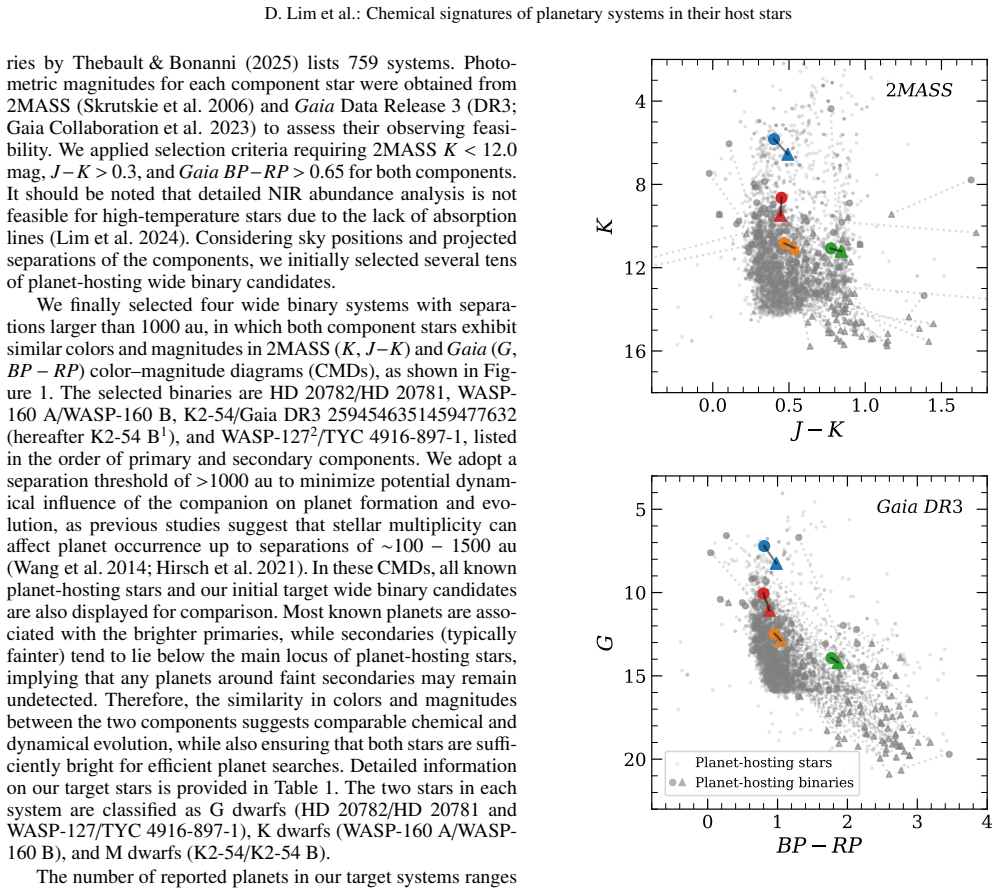


read the original abstract
An important open question in exoplanet studies is whether planets leave detectable chemical fingerprints on their host stars. While several studies have suggested possible planetary chemical signatures in planet-hosting stars, their origin remains debated because of stellar birth conditions and evolutionary effects. Wide binaries, whose components share a common formation environment, provide an ideal testbed for identifying planetary signatures. Such signatures are often characterized by differential abundance trends with condensation temperature (Tc), which traces the partitioning between gaseous and rocky planetary material. We investigate whether these trends are associated with planetary architectures in wide binaries. We obtained high-resolution NIR spectra of four planet-hosting wide binaries. We measured abundances for both components and analyzed differential abundances in each system. We also compiled literature measurements for planet-hosting and non-hosting wide binaries and compared their Tc trends. WASP-160 A/B and WASP-127/TYC 4916-897-1 exhibit significant abundance trends with Tc, while HD 20782/HD 20781 shows a weaker correlation and K2-54/K2-54 B is consistent with a flat relation. The trends are diverse, including both volatile- and refractory-enhanced patterns in planet-hosting stars. Literature comparisons indicate that extreme Tc slopes may occur more frequently among planet-hosting wide binaries, particularly at large separations, although the statistics remain limited by sample size and definition. Our results indicate that chemical signatures in planet-hosting wide binaries are not universal but vary across systems. While planetary architectures may be associated with some host-star abundance patterns, multiple processes are likely to contribute. Larger samples are essential for disentangling planetary signatures from stellar and binary effects.
Editorial analysis
A structured set of objections, weighed in public.
Referee Report
Summary. The paper reports high-resolution near-infrared spectroscopic observations of four planet-hosting wide binary systems (WASP-160 A/B, WASP-127/TYC 4916-897-1, HD 20782/HD 20781, and K2-54/K2-54 B). Differential abundances between binary components are measured and analyzed for trends with condensation temperature (Tc). Two systems show significant Tc trends, one a weaker correlation, and one a flat relation; literature comparisons suggest extreme slopes may be more common in planet-hosting wide binaries at large separations. The central claim is that chemical signatures are not universal but vary across systems, with planetary architectures possibly linked to some patterns while multiple processes contribute.
Significance. If the differential abundances prove robust, the work supplies concrete new data showing diversity in Tc slopes among planet-hosting wide binaries, directly supporting the conclusion of non-universality and the need for larger samples. It strengthens the case for wide binaries as controlled testbeds while acknowledging limited literature statistics and the role of non-planetary effects.
major comments (3)
- [Abstract] Abstract: the statements that two systems 'exhibit significant abundance trends' and one shows a 'weaker correlation' are load-bearing for the diversity claim, yet no explicit significance thresholds, statistical errors, or systematic uncertainty floors (e.g., from stellar-parameter covariances, line-list choices, or NIR-specific effects) are provided; if realistic systematics of 0.02–0.05 dex are folded in, the reported slopes may be consistent with zero.
- [Discussion] The interpretation that measured differentials arise from planetary processes rests on the assumption that the binary components formed with identical initial compositions; the manuscript does not quantify possible contributions from differential atomic diffusion, convective mixing, or small formation-environment differences at separations of hundreds to thousands of AU, which could mimic or mask Tc trends.
- [Results] Results section: the Tc-slope analysis for the four systems and the literature compilation requires expanded details on abundance derivation (line selection, stellar-parameter determination, error propagation) to evaluate whether the observed volatile- versus refractory-enhanced patterns exceed measurement uncertainties.
minor comments (2)
- [Abstract] Binary nomenclature is inconsistent (e.g., 'WASP-127/TYC 4916-897-1'); adopt a uniform format throughout.
- A summary table of Tc slopes, uncertainties, and significance for each system plus literature objects would improve clarity and allow direct comparison.
Simulated Author's Rebuttal
We thank the referee for the detailed and constructive report. The comments have helped us identify areas where the manuscript can be clarified and strengthened. Below we respond point-by-point to the major comments. We have prepared a revised manuscript that incorporates the suggested changes.
read point-by-point responses
-
Referee: [Abstract] Abstract: the statements that two systems 'exhibit significant abundance trends' and one shows a 'weaker correlation' are load-bearing for the diversity claim, yet no explicit significance thresholds, statistical errors, or systematic uncertainty floors (e.g., from stellar-parameter covariances, line-list choices, or NIR-specific effects) are provided; if realistic systematics of 0.02–0.05 dex are folded in, the reported slopes may be consistent with zero.
Authors: We agree that the abstract would benefit from greater precision on this point. In the revised manuscript we will explicitly define 'significant' as slopes exceeding three times their total uncertainty (including both statistical and a systematic floor of ~0.025 dex derived from parameter sensitivities and line-list variations) and will add a short clause noting that the two strongest trends remain >2.5 sigma even after inflating the error budget by an additional 0.03 dex. The weaker correlation and flat relation are already consistent with zero within uncertainties, which is why we describe them differently. These clarifications will be cross-referenced to the detailed error analysis now expanded in Section 3. revision: yes
-
Referee: [Discussion] The interpretation that measured differentials arise from planetary processes rests on the assumption that the binary components formed with identical initial compositions; the manuscript does not quantify possible contributions from differential atomic diffusion, convective mixing, or small formation-environment differences at separations of hundreds to thousands of AU, which could mimic or mask Tc trends.
Authors: This is a fair criticism. While the introduction states that the components share a common formation environment, we will expand the discussion section to include quantitative literature estimates: atomic diffusion in solar-type stars at the relevant ages and metallicities produces abundance differences typically below 0.01 dex, and convective-mixing variations are negligible at separations >200 AU. We will also note that any residual formation-environment differences at these separations are expected to be smaller than the observed differentials and would not systematically produce Tc trends. We already mention non-planetary contributions as possible, but the added quantification will make the caveats more explicit without changing the central conclusion that multiple processes are at work. revision: partial
-
Referee: [Results] Results section: the Tc-slope analysis for the four systems and the literature compilation requires expanded details on abundance derivation (line selection, stellar-parameter determination, error propagation) to evaluate whether the observed volatile- versus refractory-enhanced patterns exceed measurement uncertainties.
Authors: We will revise the results section to supply the requested information. A new table will list the NIR lines used, their excitation potentials, and adopted log gf values. We will describe the iterative stellar-parameter determination (equivalent-width analysis with excitation and ionization balance) and provide the full error-propagation procedure, including covariance terms between Teff, log g, and [Fe/H] as well as the adopted systematic floor. These additions will allow readers to confirm that the reported volatile- and refractory-enhanced patterns in the two systems exceed the total uncertainties. revision: yes
Circularity Check
No circularity: empirical measurements and external literature comparisons
full rationale
The paper reports new high-resolution NIR spectra for four planet-hosting wide binaries, derives differential abundances directly from those spectra, and compares the resulting Tc trends against an independent literature compilation. No equations, fitted parameters, or self-citations are used to generate the reported trends; the diversity of slopes is presented as an observational finding. The premise that binary components share identical birth compositions is an external astrophysical assumption, not a self-derived quantity. The analysis is therefore self-contained against external benchmarks.
Axiom & Free-Parameter Ledger
axioms (1)
- domain assumption Wide binary components share a common formation environment and therefore identical initial chemical compositions.
Reference graph
Works this paper leans on
-
[1]
Adibekyan, V . Z., González Hernández, J. I., Delgado Mena, E., et al. 2014, A&A, 564, L15
work page 2014
-
[2]
Adibekyan, V . Z., Sousa, S. G., Santos, N. C., et al. 2012, A&A, 545, A32
work page 2012
-
[3]
Asplund, M., Grevesse, N., Sauval, A. J., & Scott, P. 2009, ARA&A, 47, 481
work page 2009
-
[4]
Bazinet, L., Pelletier, S., Benneke, B., Salinas, R., & Mace, G. N. 2024, AJ, 167, 206
work page 2024
-
[5]
Bedell, M., Bean, J. L., Meléndez, J., et al. 2018, ApJ, 865, 68
work page 2018
-
[6]
Behmard, A., Dai, F., Brewer, J. M., Berger, T. A., & Howard, A. W. 2023, MNRAS, 521, 2969
work page 2023
-
[7]
Bergemann, M., Kudritzki, R.-P., Plez, B., et al. 2012, ApJ, 751, 156
work page 2012
- [8]
-
[9]
Booth, R. A. & Owen, J. E. 2020, MNRAS, 493, 5079
work page 2020
-
[10]
Buchhave, L. A., Latham, D. W., Johansen, A., et al. 2012, Nature, 486, 375
work page 2012
-
[11]
Carlos, M., Amarsi, A. M., Nissen, P. E., & Canocchi, G. 2025, A&A, 700, A127
work page 2025
- [12]
- [13]
-
[14]
Cowley, C. R. & Yüce, K. 2022, MNRAS, 512, 3684
work page 2022
-
[15]
L., Sordo, R., Pailler, F., et al
Creevey, O. L., Sordo, R., Pailler, F., et al. 2023, A&A, 674, A26
work page 2023
-
[16]
Desidera, S., Gratton, R. G., Scuderi, S., et al. 2004, A&A, 420, 683
work page 2004
-
[17]
Dotter, A., Conroy, C., Cargile, P., & Asplund, M. 2017, ApJ, 840, 99
work page 2017
-
[18]
Eker, Z., Bakı¸ s, V ., Bilir, S., et al. 2018, MNRAS, 479, 5491
work page 2018
-
[19]
El-Badry, K., Rix, H.-W., & Heintz, T. M. 2021, MNRAS, 506, 2269
work page 2021
-
[20]
Fischer, D. A. & Valenti, J. 2005, ApJ, 622, 1102
work page 2005
-
[21]
2024, MNRAS, 527, 10016 Gaia Collaboration, Vallenari, A., Brown, A
Flores, M., Yana Galarza, J., Miquelarena, P., et al. 2024, MNRAS, 527, 10016 Gaia Collaboration, Vallenari, A., Brown, A. G. A., et al. 2023, A&A, 674, A1
work page 2024
-
[22]
2026, ApJ, 998, 301 González Hernández, J
Ghezzi, L., Costa-Almeida, E., Loaiza-Tacuri, V ., & Cunha, K. 2026, ApJ, 998, 301 González Hernández, J. I., Delgado-Mena, E., Sousa, S. G., et al. 2013, A&A, 552, A6
work page 2026
-
[23]
M., Schlafly, E., Zucker, C., Speagle, J
Green, G. M., Schlafly, E., Zucker, C., Speagle, J. S., & Finkbeiner, D. 2019, ApJ, 887, 93
work page 2019
-
[24]
Gustafsson, B., Edvardsson, B., Eriksson, K., et al. 2008, A&A, 486, 951
work page 2008
-
[25]
Hawkins, K., Lucey, M., Ting, Y .-S., et al. 2020, MNRAS, 492, 1164
work page 2020
-
[26]
Hinkel, N. R., Timmes, F. X., Young, P. A., Pagano, M. D., & Turnbull, M. C. 2014, AJ, 148, 54
work page 2014
-
[27]
Hirsch, L. A., Rosenthal, L., Fulton, B. J., et al. 2021, AJ, 161, 134
work page 2021
-
[28]
Holman, M. J. & Wiegert, P. A. 1999, AJ, 117, 621 Hühn, L.-A. & Bitsch, B. 2023, A&A, 676, A87 Jofré, E., Gómez Maqueo Chew, Y ., Petrucci, R., et al. 2025, MNRAS, 544, 3994 Jofré, E., Petrucci, R., Maqueo Chew, Y . G., et al. 2021, AJ, 162, 291
work page 1999
- [29]
-
[30]
Kane, S. R. & Hinkel, N. R. 2013, ApJ, 762, 7
work page 2013
- [31]
-
[32]
R., Weiner Mansfield, M., et al
Kanumalla, K., Line, M. R., Weiner Mansfield, M., et al. 2024, AJ, 168, 201
work page 2024
-
[33]
Kaplan, K., Lee, J.-J., Sawczynec, E., Kim, H.-J., & Gullikson, K. 2024, igrins/plp 3.0.0
work page 2024
-
[34]
J., Grundahl, F., Richard, O., et al
Korn, A. J., Grundahl, F., Richard, O., et al. 2007, ApJ, 671, 402
work page 2007
-
[35]
Kouwenhoven, M. B. N., Goodwin, S. P., Parker, R. J., et al. 2010, MNRAS, 404, 1835
work page 2010
-
[36]
Lam, K. W. F., Faedi, F., Brown, D. J. A., et al. 2017, A&A, 599, A3
work page 2017
- [37]
-
[38]
Lendl, M., Anderson, D. R., Bonfanti, A., et al. 2019, MNRAS, 482, 301
work page 2019
-
[39]
J., Chun, S.-H., Hong, S., & Lee, Y .-W
Lim, D., Koch-Hansen, A. J., Chun, S.-H., Hong, S., & Lee, Y .-W. 2022, A&A, 666, A62
work page 2022
- [40]
-
[41]
J., Hong, S., Chun, S.-H., & Lee, Y .-W
Lim, D., Koch-Hansen, A. J., Hong, S., Chun, S.-H., & Lee, Y .-W. 2024, AJ, 167, 3
work page 2024
-
[42]
2025, Journal of Korean Astronomical Soci- ety, 58, 81
Lim, D., Lee, Y .-W., Yun, S., et al. 2025, Journal of Korean Astronomical Soci- ety, 58, 81
work page 2025
-
[43]
Liu, F., Asplund, M., Ramirez, I., Yong, D., & Melendez, J. 2014, MNRAS, 442, L51
work page 2014
-
[44]
Liu, F., Bitsch, B., Asplund, M., et al. 2021, MNRAS, 508, 1227
work page 2021
-
[45]
Liu, F., Ting, Y .-S., Yong, D., et al. 2024, Nature, 627, 501
work page 2024
- [46]
-
[47]
Lodders, K., Fegley, B., Mezger, K., & Ebel, D. 2025, Space Sci. Rev., 221, 54
work page 2025
-
[48]
2018, in Society of Photo-Optical Instru- mentation Engineers (SPIE) Conference Series, V ol
Mace, G., Sokal, K., Lee, J.-J., et al. 2018, in Society of Photo-Optical Instru- mentation Engineers (SPIE) Conference Series, V ol. 10702, Ground-based and Airborne Instrumentation for Astronomy VII, ed. C. J. Evans, L. Simard, & H. Takami, 107020Q
work page 2018
-
[49]
Mack, III, C. E., Schuler, S. C., Stassun, K. G., & Norris, J. 2014, ApJ, 787, 98
work page 2014
-
[50]
Mack, III, C. E., Stassun, K. G., Schuler, S. C., Hebb, L., & Pepper, J. A. 2016, ApJ, 818, 54 Article number, page 15 A&A proofs:manuscript no. Lim_2026
work page 2016
-
[51]
T., Meléndez, J., Lorenzo-Oliveira, D., Spina, L., & Jofré, P
Maia, M. T., Meléndez, J., Lorenzo-Oliveira, D., Spina, L., & Jofré, P. 2019, A&A, 628, A126 Meléndez, J., Asplund, M., Gustafsson, B., & Yong, D. 2009, ApJ, 704, L66
work page 2019
-
[52]
Miquelarena, P., Saffe, C., Flores, M., et al. 2024, A&A, 688, A73
work page 2024
-
[53]
Mucciarelli, A., Bellazzini, M., & Massari, D. 2021, A&A, 653, A90
work page 2021
- [54]
-
[55]
Nagar, T., Spina, L., & Karakas, A. I. 2020, ApJ, 888, L9
work page 2020
-
[56]
Nelson, T., Ting, Y .-S., Hawkins, K., et al. 2021, ApJ, 921, 118
work page 2021
- [57]
-
[58]
Nissen, P. E. 2015, A&A, 579, A52
work page 2015
-
[59]
Nordlander, T., Korn, A. J., Richard, O., & Lind, K. 2012, ApJ, 753, 48
work page 2012
-
[60]
2024, in Society of Photo-Optical Instrumentation Engineers (SPIE) Conference Series, V ol
Oh, H., Park, C., Kim, S., et al. 2024, in Society of Photo-Optical Instrumentation Engineers (SPIE) Conference Series, V ol. 13096, Ground-based and Airborne Instrumentation for Astronomy X, ed. J. J. Bryant, K. Motohara, & J. R. D. Vernet, 1309608
work page 2024
-
[61]
Oh, S., Price-Whelan, A. M., Brewer, J. M., et al. 2018, ApJ, 854, 138 Önehag, A., Gustafsson, B., & Korn, A. 2014, A&A, 562, A102
work page 2018
-
[62]
Pignatari, M., Trueman, T. C. L., Womack, K. A., et al. 2023, MNRAS, 524, 6295
work page 2023
-
[63]
Quinn, D. P. & Smith, M. C. 2009, MNRAS, 400, 2128 Ramírez, I., Khanal, S., Aleo, P., et al. 2015, ApJ, 808, 13 Ramírez, I., Khanal, S., Lichon, S. J., et al. 2019, MNRAS, 490, 2448 Ramírez, I., Meléndez, J., & Asplund, M. 2009, A&A, 508, L17 Ramírez, I., Meléndez, J., & Asplund, M. 2014, A&A, 561, A7
work page 2009
-
[64]
Raymond, S. N., Armitage, P. J., Moro-Martín, A., et al. 2011, A&A, 530, A62
work page 2011
- [65]
-
[66]
Ryabchikova, T., Pakhomov, Y ., Mashonkina, L., & Sitnova, T. 2022, MNRAS, 514, 4958
work page 2022
-
[67]
Saffe, C., Flores, M., Jaque Arancibia, M., Buccino, A., & Jofré, E. 2016, A&A, 588, A81
work page 2016
- [68]
-
[69]
Saffe, C., Jofré, E., Miquelarena, P., et al. 2019, A&A, 625, A39
work page 2019
-
[70]
Santos, N. C., Israelian, G., & Mayor, M. 2004, A&A, 415, 1153
work page 2004
-
[71]
Sawczynec, E., Kaplan, K. F., Mace, G. N., et al. 2025, PASP, 137, 034505
work page 2025
-
[72]
C., Flateau, D., Cunha, K., et al
Schuler, S. C., Flateau, D., Cunha, K., et al. 2011, ApJ, 732, 55
work page 2011
-
[73]
V ., Lendl, M., Bourrier, V ., et al
Seidel, J. V ., Lendl, M., Bourrier, V ., et al. 2020, A&A, 643, A45
work page 2020
-
[74]
Skrutskie, M. F., Cutri, R. M., Stiening, R., et al. 2006, AJ, 131, 1163
work page 2006
-
[75]
Sneden, C. A. 1973, PhD thesis, University of Texas, Austin
work page 1973
-
[76]
G., Adibekyan, V ., Delgado-Mena, E., et al
Sousa, S. G., Adibekyan, V ., Delgado-Mena, E., et al. 2021, A&A, 656, A53
work page 2021
- [77]
- [78]
- [79]
-
[80]
Thygesen, E., Ranshaw, J. A., Rodriguez, J. E., et al. 2023, AJ, 165, 155
work page 2023
discussion (0)
Sign in with ORCID, Apple, or X to comment. Anyone can read and Pith papers without signing in.