Recognition: no theorem link
Two-loop neutrino mass model with modular S₄ symmetry
Pith reviewed 2026-05-13 02:33 UTC · model grok-4.3
The pith
A modular S4 symmetry generates neutrino masses only at two loops while stabilizing dark matter candidates.
A machine-rendered reading of the paper's core claim, the machinery that carries it, and where it could break.
Core claim
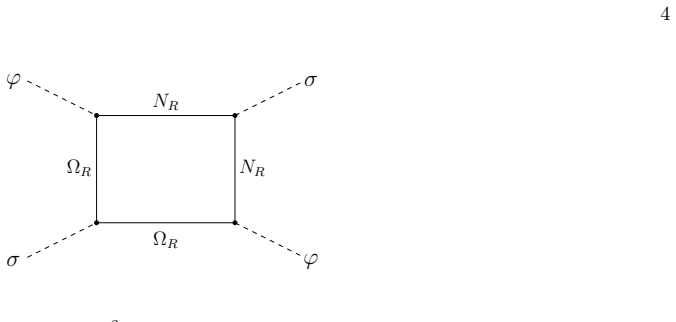
The model is based on the modular Γ4 ≃ S4 flavour symmetry supplemented by a discrete Z3 symmetry. Spontaneous breaking of the modular symmetry produces a remnant Z2 symmetry that guarantees the radiative origin of active neutrino masses at two loops and stabilizes dark matter candidates. The construction reproduces charged lepton masses and neutrino oscillation data for normal ordering, predicts observable rates for charged lepton flavour violation, and identifies parameter regions consistent with relic density, LFV constraints, and direct detection limits for both scalar and fermionic dark matter.
What carries the argument
The remnant Z2 symmetry that emerges after spontaneous breaking of the modular S4 symmetry, which both enforces two-loop neutrino masses and protects dark matter particles from decaying.
If this is right
- Charged lepton flavor violation processes occur at observable rates.
- Viable scalar dark matter candidates arise from singlet-doublet mixing.
- A fermionic dark matter candidate is strongly linked to lepton flavor violation.
- The model accommodates neutrino data specifically for normal ordering.
Where Pith is reading between the lines
- Extensions to other modular symmetries could generate different loop orders for neutrino masses.
- The correlation between fermionic dark matter and LFV rates offers a way to test the model in combined searches.
- Similar remnant symmetries might apply to other flavor problems such as the hierarchy of quark masses.
Load-bearing premise
The modular S4 symmetry must break in a way that leaves a Z2 remnant capable of forbidding all lower-order contributions to neutrino masses.
What would settle it
Non-observation of the predicted charged lepton flavor violation signals at the sensitivity of experiments like MEG-II or Mu3e would rule out the viable parameter regions.
Figures


read the original abstract
We propose a two-loop radiative neutrino mass model based on the modular $\Gamma_4 \simeq S_4$ flavour symmetry supplemented by a discrete $Z_3$ symmetry. After spontaneous modular symmetry breaking, a remnant $Z_2$ symmetry guarantees both the radiative origin of active neutrino masses and stabilizes dark matter candidates. The model successfully reproduces charged lepton masses and neutrino oscillation data for normal ordering. It also predicts observable rates for charged lepton flavour violation (LFV). Due to the singlet-doublet mixing the model provides a viable scalar dark matter candidate. A fermionic dark matter candidate, strongly linked to LFV, is also present. We identify parameter regions consistent with relic density, LFV constraints, and direct detection limits, providing testable benchmark configurations.
Editorial analysis
A structured set of objections, weighed in public.
Referee Report
Summary. The paper proposes a two-loop radiative neutrino mass model based on modular S4 (Gamma4) flavor symmetry supplemented by a Z3 discrete symmetry. Spontaneous breaking of the modular symmetry is claimed to leave a remnant Z2 that both enforces the two-loop origin of neutrino masses and stabilizes dark matter candidates. The model is stated to reproduce charged lepton masses and neutrino oscillation data for normal ordering, while predicting observable charged lepton flavor violation (LFV) rates. Viable scalar (singlet-doublet mixed) and fermionic DM candidates are identified in regions consistent with relic density, LFV bounds, and direct detection limits.
Significance. If the remnant Z2 protection is rigorously verified, the construction provides a unified modular-symmetry explanation for radiative neutrino masses, flavor mixing, and DM stability, with testable LFV predictions. The modular S4 approach is current and the two-loop structure is a non-trivial feature. However, the extensive fitting of Yukawa couplings, VEVs, and other parameters to neutrino data, relic density, and LFV constraints introduces significant circularity, making the LFV and DM 'predictions' largely post-fit rather than independent outputs. This reduces the model's falsifiability and overall impact unless the symmetry protection is shown to be parameter-independent.
major comments (3)
- [Model construction / symmetry breaking] Model construction and symmetry breaking section: The central claim that the remnant Z2 (arising after the modulus tau acquires its VEV) forbids all one-loop neutrino mass operators must be demonstrated explicitly. List the S4 representations, Z3 charges, and modular weights of the lepton doublets, right-handed neutrinos, and scalars; then enumerate all possible dimension-5 and one-loop effective operators allowed before and after breaking to confirm none survive. Without this explicit check, the two-loop suppression and DM stabilization rest on an unverified assumption.
- [Neutrino mass generation] Neutrino mass generation section (likely around the two-loop diagrams): The abstract asserts reproduction of oscillation data for normal ordering, but the fitting procedure for the free Yukawa couplings and VEVs must be shown to leave the two-loop diagrams as the dominant contribution without additional fine-tuning or cancellation. Specify which parameters are fixed by the modular weights versus those adjusted post-hoc.
- [DM and LFV phenomenology] DM and LFV phenomenology section: The claimed link between the fermionic DM candidate and LFV processes requires quantitative demonstration that the parameter regions satisfying the relic density (and direct detection) automatically produce LFV rates within current bounds without further adjustment. If the regions are selected after fitting, the predictivity for future LFV searches is weakened.
minor comments (2)
- [Model construction] Clarify the notation for modular weights and the specific form of the modular forms used in the Yukawa couplings; ensure consistency between text and any tables of field assignments.
- [Phenomenology] In the numerical results, provide a table or plot showing the range of predicted LFV branching ratios for the benchmark points that satisfy all constraints, rather than only stating 'observable rates'.
Simulated Author's Rebuttal
We thank the referee for the careful reading and constructive comments. We address each major point below with clarifications and indicate revisions where they strengthen the manuscript without altering its core results.
read point-by-point responses
-
Referee: Model construction and symmetry breaking section: The central claim that the remnant Z2 (arising after the modulus tau acquires its VEV) forbids all one-loop neutrino mass operators must be demonstrated explicitly. List the S4 representations, Z3 charges, and modular weights of the lepton doublets, right-handed neutrinos, and scalars; then enumerate all possible dimension-5 and one-loop effective operators allowed before and after breaking to confirm none survive. Without this explicit check, the two-loop suppression and DM stabilization rest on an unverified assumption.
Authors: We agree that an explicit operator enumeration will make the remnant Z2 protection fully transparent. In the revised manuscript we will add a dedicated table listing the S4 representations, Z3 charges and modular weights of all lepton doublets, right-handed neutrinos and scalar fields. We will then enumerate every dimension-5 and one-loop effective operator allowed by the unbroken symmetries and show that each is forbidden once the modulus VEV breaks S4 to the remnant Z2, while the two-loop diagrams remain permitted. This addition confirms the protection is symmetry-based and parameter-independent. revision: yes
-
Referee: Neutrino mass generation section (likely around the two-loop diagrams): The abstract asserts reproduction of oscillation data for normal ordering, but the fitting procedure for the free Yukawa couplings and VEVs must be shown to leave the two-loop diagrams as the dominant contribution without additional fine-tuning or cancellation. Specify which parameters are fixed by the modular weights versus those adjusted post-hoc.
Authors: The modular weights and S4 assignments fix the allowed Yukawa structures and modular forms, leaving only the modulus tau and a small set of scalar VEVs as free parameters. By construction the unbroken symmetries forbid all lower-order neutrino mass operators, so the two-loop diagrams are the sole contribution; no cancellations are imposed by hand. The numerical fit to normal-ordering data is performed within these symmetry-allowed ranges without additional tuning. We will insert a clarifying table that distinguishes symmetry-fixed quantities from the fitted parameters. revision: partial
-
Referee: DM and LFV phenomenology section: The claimed link between the fermionic DM candidate and LFV processes requires quantitative demonstration that the parameter regions satisfying the relic density (and direct detection) automatically produce LFV rates within current bounds without further adjustment. If the regions are selected after fitting, the predictivity for future LFV searches is weakened.
Authors: The scan first fits the symmetry-allowed parameters to neutrino and charged-lepton data. Only afterward are relic-density and direct-detection constraints applied to identify viable regions for the fermionic DM candidate. These same regions automatically satisfy current LFV bounds because the DM annihilation channels share the same Yukawa couplings that mediate LFV. No extra tuning is performed to enforce LFV compliance. The resulting benchmark points therefore constitute genuine predictions for future LFV searches. We will add explicit statements and reference the existing figures to emphasize this sequential, adjustment-free consistency. revision: no
Circularity Check
No significant circularity; derivation is self-contained model construction
full rationale
The paper defines a Lagrangian with modular S4 and Z3 symmetries, assigns representations and weights to fields, invokes spontaneous breaking to a remnant Z2, and states that this Z2 forbids tree-level and one-loop neutrino mass terms while allowing two-loop ones. It then numerically fits a finite set of free parameters (Yukawa couplings, VEVs, modulus tau) to reproduce charged-lepton masses and neutrino oscillation data, after which it computes LFV branching ratios and DM relic density for the same parameter points. None of these steps reduces by construction to its own inputs: the symmetry-allowed operators are fixed by group theory before any fit, the two-loop suppression is a direct consequence of the charge assignments rather than a redefinition of the data, and the LFV/DM outputs are distinct observables computed from the fitted parameters. No self-citation is used to justify uniqueness or to smuggle an ansatz; the central claims rest on explicit symmetry analysis and numerical reproduction of external data. The structure is therefore a standard, non-circular model-building exercise.
Axiom & Free-Parameter Ledger
free parameters (1)
- Yukawa couplings and VEVs
axioms (2)
- domain assumption Modular S4 symmetry with specific modular forms and weights
- ad hoc to paper Spontaneous breaking leaves a remnant Z2 symmetry
invented entities (2)
-
scalar DM candidate from singlet-doublet mixing
no independent evidence
-
fermionic DM candidate linked to LFV
no independent evidence
Reference graph
Works this paper leans on
-
[1]
Pure cases To characterize the phenomenology of the DM candidate in the pure limits, we will discuss in general terms the main annihilation channels, direct detection channels and their behaviour in both regimes. We begin by noting that the exact pure limits are not phenomenologically viable, since the active neutrino mass mechanism is directly controlled...
-
[2]
Mixed case and numerical results The richest scalar DM phenomenology is found in the intermediate mixing region between doublet and singlet compo- nents, where both the scalar portal and gauge interactions can be simultaneously active. This mixed region interpolates between the phenomenology of the pure limits, opening viable regions compatible with both ...
work page 2018
-
[3]
The role of the radiative splitting The distinctive feature of this model is that at tree-level, the light inert CP-even and CP-odd states are exactly degenerate but a mass splitting between them is radiatively generated. The relevant question is whether the two states can be dynamically distinguished by the thermal bath at freeze-out. If the splitting re...
work page 2018
-
[4]
From the trees to the forest: a review of radiative neutrino mass models,
Y. Cai, J. Herrero-Garc´ ıa, M. A. Schmidt, A. Vicente, and R. R. Volkas, “From the trees to the forest: a review of radiative neutrino mass models,”Front. in Phys.5(2017) 63,arXiv:1706.08524 [hep-ph]
-
[5]
Minimal realizations of Dirac neutrino mass from generic one-loop and two-loop topologies atd= 5,
S. Jana, P. K. Vishnu, and S. Saad, “Minimal realizations of Dirac neutrino mass from generic one-loop and two-loop topologies atd= 5,”JCAP04(2020) 018,arXiv:1910.09537 [hep-ph]
-
[6]
How many 1-loop neutrino mass models are there?,
C. Arbel´ aez, R. Cepedello, J. C. Helo, M. Hirsch, and S. Kovalenko, “How many 1-loop neutrino mass models are there?,”JHEP08(2022) 023,arXiv:2205.13063 [hep-ph]
-
[7]
Quark Mixings and Mass Hierarchy From Radiative Corrections,
B. S. Balakrishna, A. L. Kagan, and R. N. Mohapatra, “Quark Mixings and Mass Hierarchy From Radiative Corrections,”Phys. Lett. B205(1988) 345–352
work page 1988
-
[8]
Radiative Quark and Lepton Masses Through Soft Supersymmetry Breaking,
E. Ma, “Radiative Quark and Lepton Masses Through Soft Supersymmetry Breaking,”Phys. Rev. D39(1989) 1922
work page 1989
-
[9]
One Loop Induced Fermion Masses and Exotic Interactions in a Standard Model Context,
E. Ma, D. Ng, J. T. Pantaleone, and G.-G. Wong, “One Loop Induced Fermion Masses and Exotic Interactions in a Standard Model Context,”Phys. Rev. D40(1989) 1586
work page 1989
-
[10]
Hierarchical Radiative Quark and Lepton Mass Matrices,
E. Ma, “Hierarchical Radiative Quark and Lepton Mass Matrices,”Phys. Rev. Lett.64(1990) 2866–2869
work page 1990
-
[11]
Pathways to naturally small neutrino masses,
E. Ma, “Pathways to naturally small neutrino masses,”Phys. Rev. Lett.81(1998) 1171–1174,arXiv:hep-ph/9805219
-
[12]
Radiative seesaw mechanism at weak scale,
Z.-j. Tao, “Radiative seesaw mechanism at weak scale,”Phys. Rev. D54(1996) 5693–5697,arXiv:hep-ph/9603309
-
[13]
Verifiable radiative seesaw mechanism of neutrino mass and dark matter,
E. Ma, “Verifiable radiative seesaw mechanism of neutrino mass and dark matter,”Phys. Rev. D73(2006) 077301, arXiv:hep-ph/0601225
-
[14]
Radiative Neutrino Mass, Dark Matter and Leptogenesis,
P.-H. Gu and U. Sarkar, “Radiative Neutrino Mass, Dark Matter and Leptogenesis,”Phys. Rev. D77(2008) 105031, arXiv:0712.2933 [hep-ph]
-
[15]
Fermion Triplet Dark Matter and Radiative Neutrino Mass,
E. Ma and D. Suematsu, “Fermion Triplet Dark Matter and Radiative Neutrino Mass,”Mod. Phys. Lett. A24(2009) 583–589,arXiv:0809.0942 [hep-ph]. 29
-
[16]
WIMP dark matter as radiative neutrino mass messenger,
M. Hirsch, R. A. Lineros, S. Morisi, J. Palacio, N. Rojas, and J. W. F. Valle, “WIMP dark matter as radiative neutrino mass messenger,”JHEP10(2013) 149,arXiv:1307.8134 [hep-ph]
-
[17]
A. Aranda and E. Peinado, “A new radiative neutrino mass generation mechanism with higher dimensional scalar representations and custodial symmetry,”Phys. Lett. B754(2016) 11–13,arXiv:1508.01200 [hep-ph]
-
[18]
Radiative Neutrino Masses in the Singlet-Doublet Fermion Dark Matter Model with Scalar Singlets,
D. Restrepo, A. Rivera, M. S´ anchez-Pel´ aez, O. Zapata, and W. Tangarife, “Radiative Neutrino Masses in the Singlet-Doublet Fermion Dark Matter Model with Scalar Singlets,”Phys. Rev. D92no. 1, (2015) 013005, arXiv:1504.07892 [hep-ph]
-
[19]
R. Longas, D. Portillo, D. Restrepo, and O. Zapata, “The Inert Zee Model,”JHEP03(2016) 162,arXiv:1511.01873 [hep-ph]
-
[20]
Verifiable Associated Processes from Radiative Lepton Masses with Dark Matter,
S. Fraser, E. Ma, and M. Zakeri, “Verifiable Associated Processes from Radiative Lepton Masses with Dark Matter,” Phys. Rev. D93no. 11, (2016) 115019,arXiv:1511.07458 [hep-ph]
-
[21]
Type II Radiative Seesaw Model of Neutrino Mass with Dark Matter,
S. Fraser, C. Kownacki, E. Ma, and O. Popov, “Type II Radiative Seesaw Model of Neutrino Mass with Dark Matter,” Phys. Rev. D93no. 1, (2016) 013021,arXiv:1511.06375 [hep-ph]
-
[22]
Radiative linear seesaw model, dark matter, andU(1) B−L,
W. Wang and Z.-L. Han, “Radiative linear seesaw model, dark matter, andU(1) B−L,”Phys. Rev. D92(2015) 095001, arXiv:1508.00706 [hep-ph]
-
[23]
Radiative Seesaw-type Mechanism of Fermion Masses and Non-trivial Quark Mixing,
C. Arbel´ aez, A. E. C´ arcamo Hern´ andez, S. Kovalenko, and I. Schmidt, “Radiative Seesaw-type Mechanism of Fermion Masses and Non-trivial Quark Mixing,”Eur. Phys. J. C77no. 6, (2017) 422,arXiv:1602.03607 [hep-ph]
-
[24]
Radiative Type III Seesaw Model and its collider phenomenology,
F. von der Pahlen, G. Palacio, D. Restrepo, and O. Zapata, “Radiative Type III Seesaw Model and its collider phenomenology,”Phys. Rev. D94no. 3, (2016) 033005,arXiv:1605.01129 [hep-ph]
-
[25]
Radiatively induced Quark and Lepton Mass Model,
T. Nomura and H. Okada, “Radiatively induced Quark and Lepton Mass Model,”Phys. Lett. B761(2016) 190–196, arXiv:1606.09055 [hep-ph]
-
[26]
GaugeU(1) dark symmetry and radiative light fermion masses,
C. Kownacki and E. Ma, “GaugeU(1) dark symmetry and radiative light fermion masses,”Phys. Lett. B760(2016) 59–62,arXiv:1604.01148 [hep-ph]
-
[27]
Loop induced type-II seesaw model and GeV dark matter withU(1) B−L gauge symmetry,
T. Nomura and H. Okada, “Loop induced type-II seesaw model and GeV dark matter withU(1) B−L gauge symmetry,” Phys. Lett. B774(2017) 575–581,arXiv:1704.08581 [hep-ph]
-
[28]
Radiative neutrino mass in an alternativeU(1) B−L gauge symmetry,
T. Nomura and H. Okada, “Radiative neutrino mass in an alternativeU(1) B−L gauge symmetry,”Nucl. Phys. B941 (2019) 586–599,arXiv:1705.08309 [hep-ph]
-
[29]
Fermion masses and mixings and dark matter constraints in a model with radiative seesaw mechanism,
N. Bernal, A. E. C´ arcamo Hern´ andez, I. de Medeiros Varzielas, and S. Kovalenko, “Fermion masses and mixings and dark matter constraints in a model with radiative seesaw mechanism,”JHEP05(2018) 053,arXiv:1712.02792 [hep-ph]
-
[30]
TheB−LScotogenic Models for Dirac Neutrino Masses,
W. Wang, R. Wang, Z.-L. Han, and J.-Z. Han, “TheB−LScotogenic Models for Dirac Neutrino Masses,”Eur. Phys. J. C77no. 12, (2017) 889,arXiv:1705.00414 [hep-ph]
-
[31]
Dark matter stability and Dirac neutrinos using only Standard Model symmetries,
C. Bonilla, S. Centelles-Chuli´ a, R. Cepedello, E. Peinado, and R. Srivastava, “Dark matter stability and Dirac neutrinos using only Standard Model symmetries,”Phys. Rev. D101no. 3, (2020) 033011,arXiv:1812.01599 [hep-ph]
-
[32]
Minimal radiative Dirac neutrino mass models,
J. Calle, D. Restrepo, C. E. Yaguna, and ´O. Zapata, “Minimal radiative Dirac neutrino mass models,”Phys. Rev. D99 no. 7, (2019) 075008,arXiv:1812.05523 [hep-ph]
-
[33]
Phenomenology of scotogenic scalar dark matter,
I. M. ´Avila, V. De Romeri, L. Duarte, and J. W. F. Valle, “Phenomenology of scotogenic scalar dark matter,”Eur. Phys. J. C80no. 10, (2020) 908,arXiv:1910.08422 [hep-ph]
-
[34]
Muon anomalies and theSU(5) Yukawa relations,
A. E. C´ arcamo Hern´ andez and S. F. King, “Muon anomalies and theSU(5) Yukawa relations,”Phys. Rev. D99no. 9, (2019) 095003,arXiv:1803.07367 [hep-ph]
-
[35]
Phenomenology of fermion dark matter as neutrino mass mediator with gauged B-L,
C. Alvarado, C. Bonilla, J. Leite, and J. W. F. Valle, “Phenomenology of fermion dark matter as neutrino mass mediator with gauged B-L,”Phys. Lett. B817(2021) 136292,arXiv:2102.07216 [hep-ph]
-
[36]
The simplest scoto-seesaw model: WIMP dark matter phenomenology and Higgs vacuum stability,
S. Mandal, R. Srivastava, and J. W. F. Valle, “The simplest scoto-seesaw model: WIMP dark matter phenomenology and Higgs vacuum stability,”Phys. Lett. B819(2021) 136458,arXiv:2104.13401 [hep-ph]
-
[37]
Neutrino masses, flavor anomalies, and muon g-2 from dark loops,
R. Cepedello, P. Escribano, and A. Vicente, “Neutrino masses, flavor anomalies, and muon g-2 from dark loops,”Phys. Rev. D107no. 3, (2023) 035034,arXiv:2209.02730 [hep-ph]
-
[38]
Phenomenology of extended multiHiggs doublet models withS 4 family symmetry,
A. E. C´ arcamo Hern´ andez, C. Espinoza, J. C. G´ omez-Izquierdo, J. Marchant Gonz´ alez, and M. Mondrag´ on, “Phenomenology of extended multiHiggs doublet models withS 4 family symmetry,”Eur. Phys. J. C84no. 11, (2024) 1239,arXiv:2212.12000 [hep-ph]
-
[39]
Dynamical scoto-seesaw mechanism with gauged B-L symmetry,
J. Leite, S. Sadhukhan, and J. W. F. Valle, “Dynamical scoto-seesaw mechanism with gauged B-L symmetry,”Phys. Rev. D109no. 3, (2024) 035023,arXiv:2307.04840 [hep-ph]
-
[40]
Dirac Scoto inverse-seesaw from A 4 flavor symmetry,
R. Kumar, N. Nath, R. Srivastava, and S. Yadav, “Dirac Scoto inverse-seesaw from A 4 flavor symmetry,”JHEP10 30 (2025) 088,arXiv:2505.01407 [hep-ph]
-
[41]
Flavor imprints on novel low mass dark matter,
R. Kumar, H. K. Prajapati, R. Srivastava, and S. Yadav, “Flavor imprints on novel low mass dark matter,”JHEP11 (2025) 094,arXiv:2510.02972 [hep-ph]
-
[42]
Two-loop Dirac neutrino mass and WIMP dark matter,
C. Bonilla, E. Ma, E. Peinado, and J. W. F. Valle, “Two-loop Dirac neutrino mass and WIMP dark matter,”Phys. Lett. B762(2016) 214–218,arXiv:1607.03931 [hep-ph]
-
[43]
A Two Loop Radiative Neutrino Model,
S. Baek, H. Okada, and Y. Orikasa, “A Two Loop Radiative Neutrino Model,”Nucl. Phys. B941(2019) 744–754, arXiv:1703.00685 [hep-ph]
-
[44]
Origin of a two-loop neutrino mass from SU(5) grand unification,
S. Saad, “Origin of a two-loop neutrino mass from SU(5) grand unification,”Phys. Rev. D99no. 11, (2019) 115016, arXiv:1902.11254 [hep-ph]
-
[45]
A two loop induced neutrino mass model with modularA 4 symmetry,
T. Nomura and H. Okada, “A two loop induced neutrino mass model with modularA 4 symmetry,”Nucl. Phys. B966 (2021) 115372,arXiv:1906.03927 [hep-ph]
-
[46]
Radiative type-I seesaw neutrino masses,
C. Arbel´ aez, A. E. C´ arcamo Hern´ andez, R. Cepedello, M. Hirsch, and S. Kovalenko, “Radiative type-I seesaw neutrino masses,”Phys. Rev. D100no. 11, (2019) 115021,arXiv:1910.04178 [hep-ph]
-
[47]
S. Saad, “Combined explanations of (g−2) µ,R D(∗),R K(∗) anomalies in a two-loop radiative neutrino mass model,” Phys. Rev. D102no. 1, (2020) 015019,arXiv:2005.04352 [hep-ph]
-
[48]
On the two-loop radiative origin of the smallest neutrino mass and the associated Majorana CP phase,
Z.-z. Xing and D. Zhang, “On the two-loop radiative origin of the smallest neutrino mass and the associated Majorana CP phase,”Phys. Lett. B807(2020) 135598,arXiv:2005.05171 [hep-ph]
-
[49]
Two-loop radiative seesaw, muon g−2, andτ-lepton-flavor violation with DM constraints,
C.-H. Chen and T. Nomura, “Two-loop radiative seesaw, muon g−2, andτ-lepton-flavor violation with DM constraints,”JHEP09(2021) 090,arXiv:2001.07515 [hep-ph]
-
[50]
T. Nomura, H. Okada, and Y. Uesaka, “A two-loop induced neutrino mass model, dark matter, and LFV processes ℓi →ℓ jγ, andµe→eein a hidden localU(1) symmetry,”Nucl. Phys. B962(2021) 115236,arXiv:2008.02673 [hep-ph]
-
[51]
Gravitational waves from a scotogenic two-loop neutrino mass model,
C. Bonilla, A. E. Carcamo Hernandez, J. Goncalves, V. K. N., A. P. Morais, and R. Pasechnik, “Gravitational waves from a scotogenic two-loop neutrino mass model,”Phys. Rev. D109no. 9, (2024) 095022,arXiv:2305.01964 [hep-ph]
-
[52]
Dark matter and scalar sector in a novel two-loop scotogenic neutrino mass model,
A. E. C´ arcamo Hern´ andez, C. Espinoza, J. C. G´ omez-Izquierdo, J. M. Gonz´ alez, and M. Mondrag´ on, “Dark matter and scalar sector in a novel two-loop scotogenic neutrino mass model,”arXiv:2601.02503 [hep-ph]
-
[53]
Are neutrino masses modular forms?
F. Feruglio,Are neutrino masses modular forms?, pp. 227–266. 2019.arXiv:1706.08749 [hep-ph]
work page Pith review arXiv 2019
-
[54]
Neutrino mass and mixing with modular symmetry,
G.-J. Ding and S. F. King, “Neutrino mass and mixing with modular symmetry,”Rept. Prog. Phys.87no. 8, (2024) 084201,arXiv:2311.09282 [hep-ph]
-
[55]
Lepton Masses and Mixing from Modular $S_4$ Symmetry
J. T. Penedo and S. T. Petcov, “Lepton Masses and Mixing from ModularS 4 Symmetry,”Nucl. Phys. B939(2019) 292–307,arXiv:1806.11040 [hep-ph]
work page Pith review arXiv 2019
-
[56]
Modular S 4 models of lepton masses and mixing,
P. P. Novichkov, J. T. Penedo, S. T. Petcov, and A. V. Titov, “Modular S 4 models of lepton masses and mixing,”JHEP 04(2019) 005,arXiv:1811.04933 [hep-ph]
-
[57]
Trimaximal Neutrino Mixing from Modular A4 Invariance with Residual Symmetries,
P. P. Novichkov, S. T. Petcov, and M. Tanimoto, “Trimaximal Neutrino Mixing from Modular A4 Invariance with Residual Symmetries,”Phys. Lett. B793(2019) 247–258,arXiv:1812.11289 [hep-ph]
-
[58]
Modular A 5 symmetry for flavour model building,
P. P. Novichkov, J. T. Penedo, S. T. Petcov, and A. V. Titov, “Modular A 5 symmetry for flavour model building,” JHEP04(2019) 174,arXiv:1812.02158 [hep-ph]
-
[59]
Trimaximal TM 1 mixing with two modularS 4 groups,
S. F. King and Y.-L. Zhou, “Trimaximal TM 1 mixing with two modularS 4 groups,”Phys. Rev. D101no. 1, (2020) 015001,arXiv:1908.02770 [hep-ph]
-
[60]
ModularS 3 symmetric radiative seesaw model,
H. Okada and Y. Orikasa, “ModularS 3 symmetric radiative seesaw model,”Phys. Rev. D100no. 11, (2019) 115037, arXiv:1907.04716 [hep-ph]
-
[61]
Neutrino Masses and Mixing from Double Covering of Finite Modular Groups,
X.-G. Liu and G.-J. Ding, “Neutrino Masses and Mixing from Double Covering of Finite Modular Groups,”JHEP08 (2019) 134,arXiv:1907.01488 [hep-ph]
-
[62]
ModularS 3-invariant flavor model in SU(5) grand unified theory,
T. Kobayashi, Y. Shimizu, K. Takagi, M. Tanimoto, and T. H. Tatsuishi, “ModularS 3-invariant flavor model in SU(5) grand unified theory,”PTEP2020no. 5, (2020) 053B05,arXiv:1906.10341 [hep-ph]
-
[63]
Generalised CP Symmetry in Modular-Invariant Models of Flavour,
P. P. Novichkov, J. T. Penedo, S. T. Petcov, and A. V. Titov, “Generalised CP Symmetry in Modular-Invariant Models of Flavour,”JHEP07(2019) 165,arXiv:1905.11970 [hep-ph]
-
[64]
Multiple modular symmetries as the origin of flavor,
I. de Medeiros Varzielas, S. F. King, and Y.-L. Zhou, “Multiple modular symmetries as the origin of flavor,”Phys. Rev. D101no. 5, (2020) 055033,arXiv:1906.02208 [hep-ph]
-
[65]
SUSY breaking constraints on modular flavorS 3 invariant SU(5) GUT model,
X. Du and F. Wang, “SUSY breaking constraints on modular flavorS 3 invariant SU(5) GUT model,”JHEP02(2021) 221,arXiv:2012.01397 [hep-ph]
-
[66]
Fermion masses and mixing in modular A4 Symmetry,
M. Abbas, “Fermion masses and mixing in modular A4 Symmetry,”Phys. Rev. D103no. 5, (2021) 056016, 31 arXiv:2002.01929 [hep-ph]
-
[67]
Symmetries and stabilisers in modular invariant flavour models,
I. de Medeiros Varzielas, M. Levy, and Y.-L. Zhou, “Symmetries and stabilisers in modular invariant flavour models,” JHEP11(2020) 085,arXiv:2008.05329 [hep-ph]
-
[68]
Two A4 modular symmetries for Tri-Maximal 2 mixing,
I. de Medeiros Varzielas and J. Louren¸ co, “Two A4 modular symmetries for Tri-Maximal 2 mixing,”Nucl. Phys. B979 (2022) 115793,arXiv:2107.04042 [hep-ph]
-
[69]
Fermion mass hierarchies, large lepton mixing and residual modular symmetries,
P. P. Novichkov, J. T. Penedo, and S. T. Petcov, “Fermion mass hierarchies, large lepton mixing and residual modular symmetries,”JHEP04(2021) 206,arXiv:2102.07488 [hep-ph]
-
[70]
Two A5 modular symmetries for Golden Ratio 2 mixing,
I. de Medeiros Varzielas and J. Louren¸ co, “Two A5 modular symmetries for Golden Ratio 2 mixing,”Nucl. Phys. B984 (2022) 115974,arXiv:2206.14869 [hep-ph]
-
[71]
Residual flavor symmetry breaking in the landscape of modular flavor models,
K. Ishiguro, H. Okada, and H. Otsuka, “Residual flavor symmetry breaking in the landscape of modular flavor models,” JHEP09(2022) 072,arXiv:2206.04313 [hep-ph]
-
[72]
Lepton mass matrix from double covering of A 4 modular flavor symmetry*,
H. Okada and Y. Orikasa, “Lepton mass matrix from double covering of A 4 modular flavor symmetry*,”Chin. Phys. C 46no. 12, (2022) 123108,arXiv:2206.12629 [hep-ph]
-
[73]
Quark-lepton mass relations from modular flavor symmetry,
M.-C. Chen, S. F. King, O. Medina, and J. W. F. Valle, “Quark-lepton mass relations from modular flavor symmetry,” JHEP02(2024) 160,arXiv:2312.09255 [hep-ph]
-
[74]
A simplest modular S 3 model for leptons,
D. Meloni and M. Parriciatu, “A simplest modular S 3 model for leptons,”JHEP09(2023) 043,arXiv:2306.09028 [hep-ph]
-
[75]
Modular flavor models with positive modular weights: a new lepton model building,
T. Kobayashi, T. Nomura, H. Okada, and H. Otsuka, “Modular flavor models with positive modular weights: a new lepton model building,”JHEP01(2024) 121,arXiv:2310.10091 [hep-ph]
-
[76]
A modular SU (5) littlest seesaw,
I. de Medeiros Varzielas, S. F. King, and M. Levy, “A modular SU (5) littlest seesaw,”JHEP05(2024) 203, arXiv:2309.15901 [hep-ph]
-
[77]
Quarks at the modular S 4 cusp,
I. de Medeiros Varzielas, M. Levy, J. T. Penedo, and S. T. Petcov, “Quarks at the modular S 4 cusp,”JHEP09(2023) 196,arXiv:2307.14410 [hep-ph]
-
[78]
Predictions from scoto-seesaw with A4 modular symmetry,
R. Kumar, P. Mishra, M. K. Behera, R. Mohanta, and R. Srivastava, “Predictions from scoto-seesaw with A4 modular symmetry,”Phys. Lett. B853(2024) 138635,arXiv:2310.02363 [hep-ph]
-
[79]
Finite modular symmetries and the strong CP problem,
J. T. Penedo and S. T. Petcov, “Finite modular symmetries and the strong CP problem,”JHEP10(2024) 172, arXiv:2404.08032 [hep-ph]
-
[80]
Pati-Salam models with A 4 modular symmetry,
G.-J. Ding, S.-Y. Jiang, S. F. King, J.-N. Lu, and B.-Y. Qu, “Pati-Salam models with A 4 modular symmetry,”JHEP 08(2024) 134,arXiv:2404.06520 [hep-ph]
discussion (0)
Sign in with ORCID, Apple, or X to comment. Anyone can read and Pith papers without signing in.