Recognition: no theorem link
BCS-BEC crossover in trapped one-dimensional Fermi-Hubbard chains: entanglement and correlation signatures from DMRG and effective-pairing theory
Pith reviewed 2026-05-13 00:49 UTC · model grok-4.3
The pith
Effective-pairing theory and DMRG simulations yield a unified picture of the BCS-BEC crossover in harmonically confined one-dimensional Fermi-Hubbard chains.
A machine-rendered reading of the paper's core claim, the machinery that carries it, and where it could break.
Core claim
The BCS-BEC crossover in harmonically confined one-dimensional Fermi-Hubbard chains is characterized by the formation of insulating regions coexisting with persistent superfluid correlations. Effective models describing the formation of tightly bound fermion pairs, together with DMRG and entanglement-based diagnostics, produce a consistent description. Within this framework, conditioned correlation functions exhibit power-law decays that distinguish BCS-like from BEC-like regimes.
What carries the argument
Conditioned correlation functions, whose power-law decay distinguishes the BCS-like and BEC-like regimes in the crossover, underpinned by effective-pairing theory for tightly bound pairs.
If this is right
- Insulating regions coexist with superfluid correlations due to the harmonic confinement.
- Conditioned correlation functions provide a diagnostic tool to identify BCS or BEC regimes.
- The effective descriptions match DMRG results to give a unified view of the crossover.
- Unconventional phases emerge that have no direct analog in homogeneous systems.
Where Pith is reading between the lines
- This characterization could guide experimental probes of correlation functions in ultracold atom realizations of the model.
- The approach might generalize to other forms of confinement or higher dimensions to reveal additional phase behaviors.
- Persistent superfluid correlations in confined geometries suggest potential for studying transport in inhomogeneous quantum systems.
Load-bearing premise
That the effective-pairing theory remains accurate when applied to harmonically confined geometries without additional unstated corrections.
What would settle it
Numerical DMRG results that deviate from the power-law behaviors predicted by the conditioned correlation functions in the effective-pairing model for the trapped chains would falsify the distinction between regimes.
Figures


read the original abstract
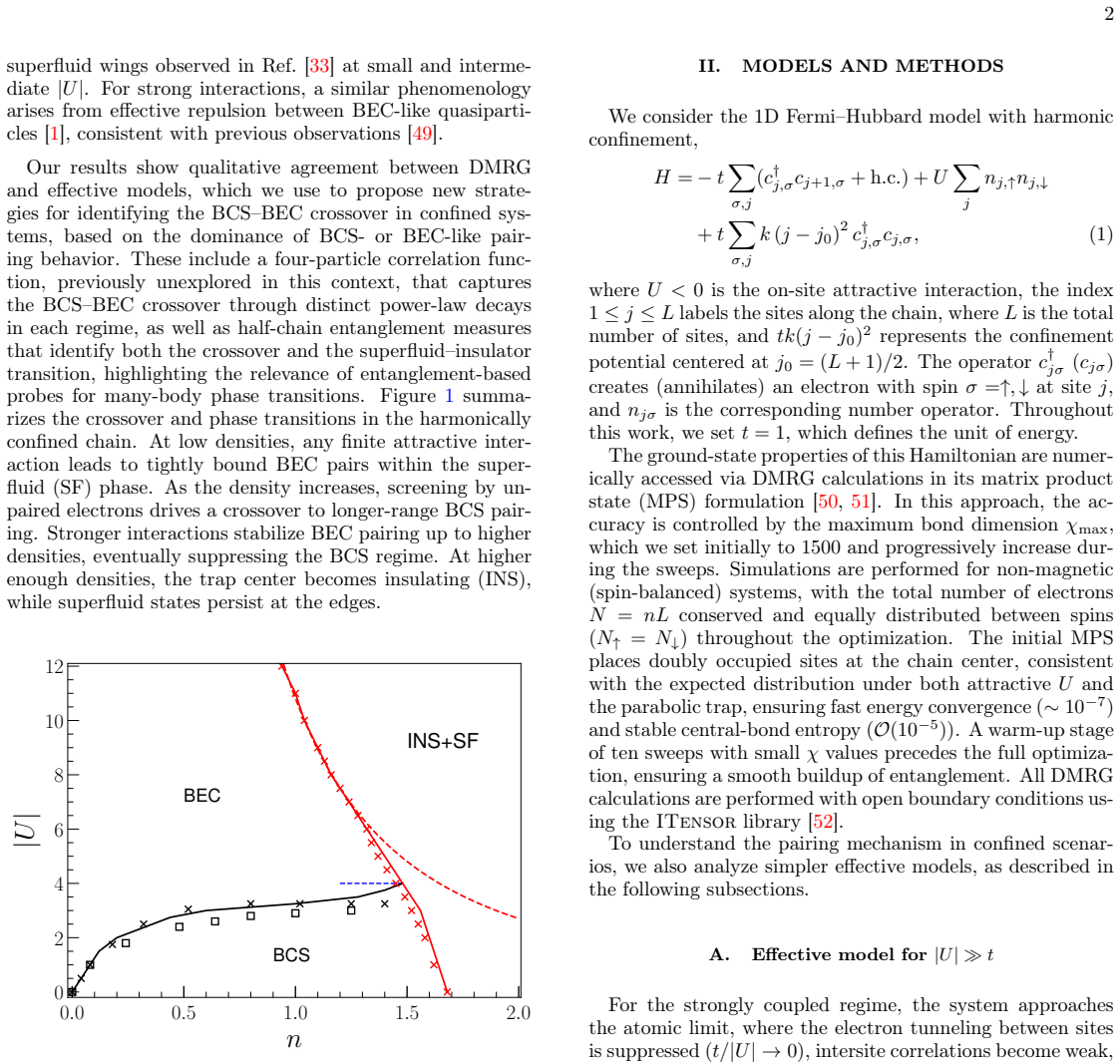
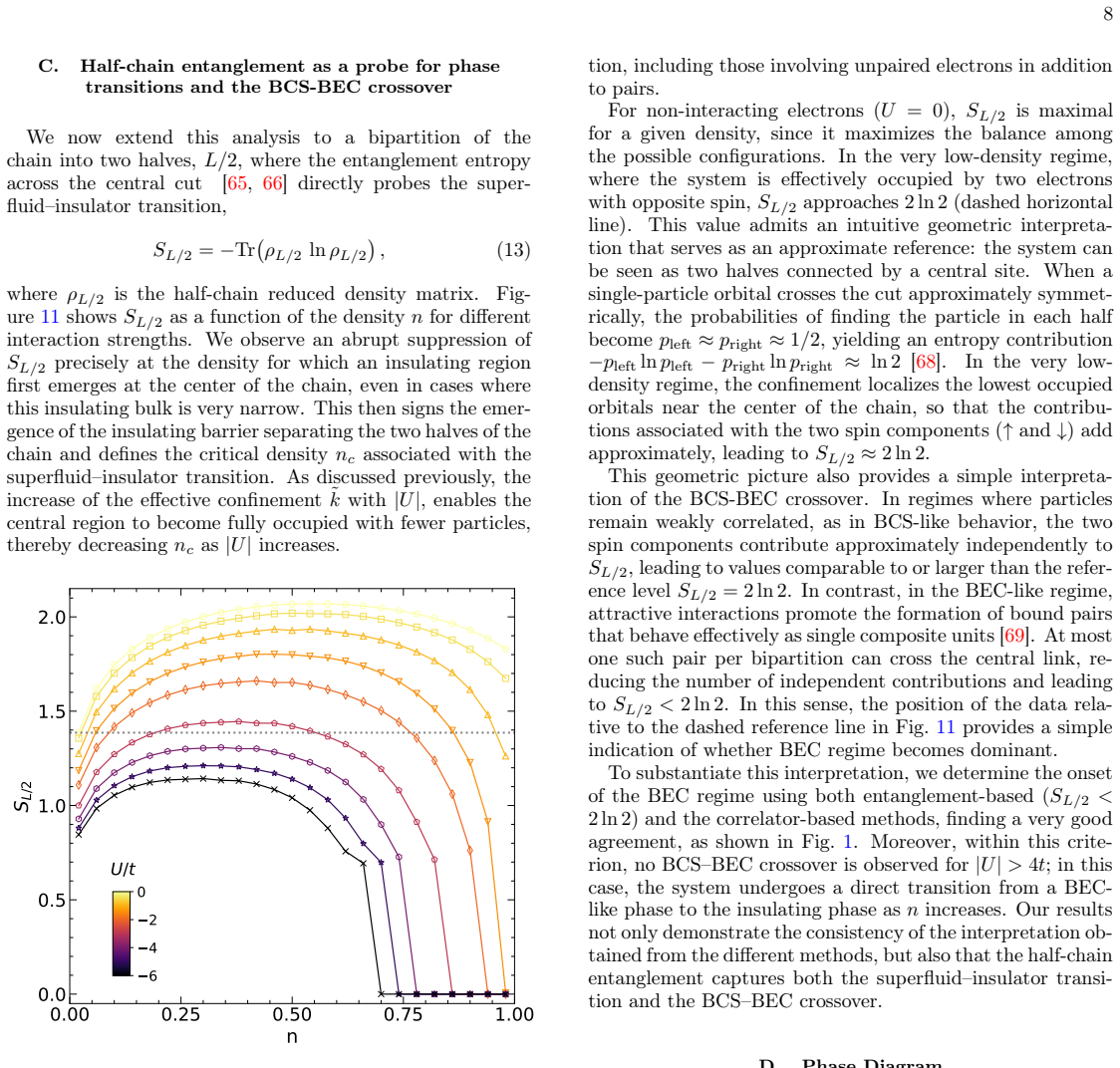
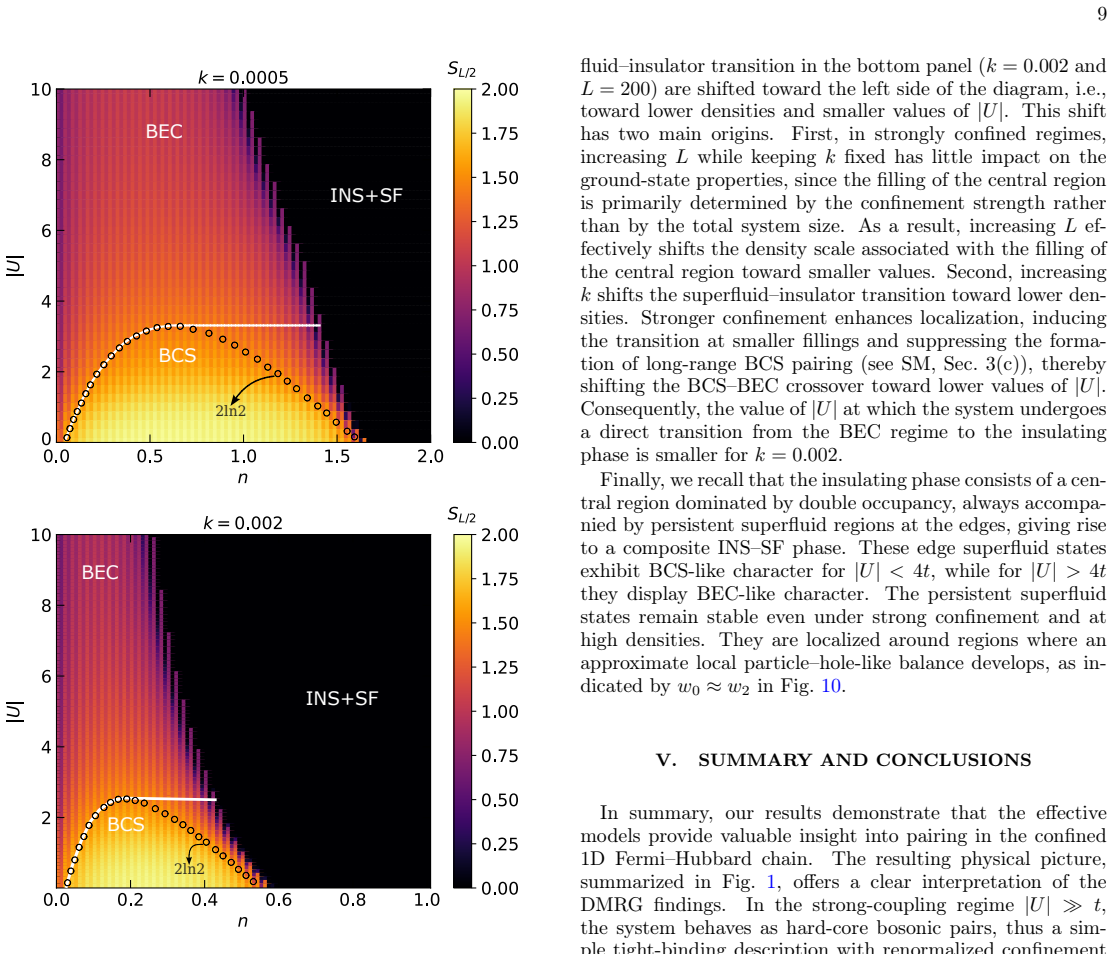
Confined ultracold atoms in optical lattices provide a versatile platform for simulating lattice models of strongly correlated quantum systems, where pairing phenomena and superfluid phases can be explored under controlled conditions. While the crossover between the Bardeen-Cooper-Schrieffer (BCS) phase and the Bose-Einstein condensation (BEC) is well understood in homogeneous systems, spatial confinement breaks translational symmetry and reshapes correlation patterns, making the BCS-BEC identification in trapped geometries challenging and allowing unconventional phases to emerge with no direct analog in homogeneous systems. Here we present a characterization of the BCS-BEC crossover in harmonically confined one-dimensional Fermi-Hubbard chains. Our analysis combines Density Matrix Renormalization Group (DMRG) simulations and entanglement-based diagnostics with effective models describing the formation of tightly bound fermion pairs. This combined approach enables a detailed understanding of how the interplay between interactions and confinement reshapes the crossover, leading to insulating regions coexisting with persistent superfluid correlations. Within this framework, we further introduce conditioned correlation functions whose power-law decay allows a clear distinction between BCS-like and BEC-like regimes. The consistency between the effective descriptions and the numerical DMRG results yields a unified picture of the crossover in harmonically confined geometries.
Editorial analysis
A structured set of objections, weighed in public.
Referee Report
Summary. The manuscript characterizes the BCS-BEC crossover in harmonically confined one-dimensional Fermi-Hubbard chains. It combines DMRG simulations with entanglement diagnostics and effective models for tightly bound fermion pairs, introduces conditioned correlation functions to distinguish BCS-like from BEC-like regimes, and concludes that the agreement between numerics and effective descriptions produces a unified picture of the crossover, including coexistence of insulating regions and persistent superfluid correlations.
Significance. If the reported consistency is quantitatively robust, the work supplies useful diagnostics for pairing in inhomogeneous 1D systems and could inform ultracold-atom experiments. The combination of DMRG with an effective-pairing approach and the conditioned correlators is a constructive methodological contribution.
major comments (2)
- [Abstract and effective-model discussion] The central claim of a unified picture rests on consistency between DMRG and the effective-pairing theory in the trap. The effective model is described as treating formation of tightly bound pairs, yet the manuscript does not appear to incorporate or test position-dependent corrections arising from the spatially varying local chemical potential (e.g., position-dependent pair-binding energy or hopping). This assumption is load-bearing for the claim that the effective description remains accurate without additional trap-induced terms.
- [Abstract and results] The abstract and summary state consistency between DMRG and effective models but provide no quantitative measures of agreement, error bars on DMRG data, or finite-size scaling. Without these, it is difficult to assess whether the reported agreement confirms the effective theory or could be affected by uncontrolled approximations.
minor comments (2)
- [Abstract] The abstract would be strengthened by specifying the interaction and trap-strength regimes explored.
- [Figures] Figures presenting correlation functions or entanglement measures should include DMRG error estimates or convergence checks.
Simulated Author's Rebuttal
We thank the referee for the constructive report and positive assessment of the methodological contributions. We address the two major comments point by point below, indicating where revisions will be made to strengthen the manuscript.
read point-by-point responses
-
Referee: [Abstract and effective-model discussion] The central claim of a unified picture rests on consistency between DMRG and the effective-pairing theory in the trap. The effective model is described as treating formation of tightly bound pairs, yet the manuscript does not appear to incorporate or test position-dependent corrections arising from the spatially varying local chemical potential (e.g., position-dependent pair-binding energy or hopping). This assumption is load-bearing for the claim that the effective description remains accurate without additional trap-induced terms.
Authors: We appreciate the referee highlighting this point. The effective-pairing theory employed is derived under a local-density approximation in which pair-binding energies and hopping amplitudes are evaluated at the local chemical potential; trap-induced spatial variations are therefore incorporated at the mean-field level through the position-dependent density profile. In the parameter regime of tightly bound pairs (large attraction), the pair size is much smaller than the trap length scale, rendering higher-order gradient corrections subdominant. Nevertheless, we acknowledge that an explicit test of these corrections (e.g., via position-dependent renormalization of the effective model parameters) is not presented. In the revised manuscript we will add a dedicated paragraph in the effective-model section discussing the validity of the local approximation, including a brief estimate of the neglected terms and a comparison of results obtained with and without a simple position-dependent correction for a representative trap strength. revision: partial
-
Referee: [Abstract and results] The abstract and summary state consistency between DMRG and effective models but provide no quantitative measures of agreement, error bars on DMRG data, or finite-size scaling. Without these, it is difficult to assess whether the reported agreement confirms the effective theory or could be affected by uncontrolled approximations.
Authors: We agree that quantitative indicators of agreement would strengthen the presentation. DMRG calculations in one dimension are controlled by bond-dimension convergence; we will therefore include explicit error estimates (obtained from the difference between successive bond dimensions) on all plotted observables in the revised figures. In addition, we will add a supplementary figure or appendix panel showing finite-size scaling of the key correlation functions and entanglement measures for the largest system sizes accessible, demonstrating that the reported power-law exponents and crossover features remain stable. These additions will allow a more rigorous assessment of the consistency between DMRG and the effective theory. revision: yes
Circularity Check
No significant circularity; DMRG numerics provide independent benchmarks for effective-pairing theory
full rationale
The paper's central claim is the consistency between DMRG simulations (entanglement diagnostics, conditioned correlation functions) and effective-pairing models in harmonically confined 1D Fermi-Hubbard chains. DMRG supplies first-principles numerical data on the trapped system without reference to the effective theory, while the effective model is applied and compared rather than used to define or fit the target quantities. No quoted equations or sections reduce a prediction to a fitted input by construction, import uniqueness via self-citation chains, or smuggle ansatzes through prior work in a load-bearing manner. The derivation remains self-contained because the numerical results function as external validation of the model's applicability under confinement, with no definitional equivalence between inputs and outputs.
Axiom & Free-Parameter Ledger
axioms (1)
- domain assumption Effective-pairing theory describes tightly bound fermion pairs in the presence of harmonic confinement.
Reference graph
Works this paper leans on
- [1]
- [2]
- [3]
- [4]
-
[5]
C. F. Chan, M. Gall, N. Wurz, and M. Köhl, Phys. Rev. Res. 2, 023210 (2020)
work page 2020
-
[6]
R. A. Fontenele, N. C. Costa, R. R. dos Santos, and T. Paiva, Phys. Rev. B105, 184502 (2022)
work page 2022
-
[7]
Y. Mizukami, M. Haze, O. Tanaka, K. Matsuura, D. Sano, J. Böker, I. Eremin, S. Kasahara, Y. Matsuda, and T. Shibauchi, Communications Physics6, 10.1038/s42005- 023-01289-8 (2023)
- [8]
-
[9]
T. Stöferle, H. Moritz, C. Schori, M. Köhl, and T. Esslinger, Phys. Rev. Lett.92, 130403 (2004)
work page 2004
- [10]
-
[11]
P. Nozières and S. Schmitt-Rink, Journal of Low Temperature Physics59, 195 (1985)
work page 1985
-
[12]
A. N. Kocharian, C. Yang, and Y. L. Chiang, Phys. Rev. B 59, 7458 (1999)
work page 1999
- [13]
-
[14]
P. Vignolo and A. Minguzzi, Journal of Physics B: Atomic, Molecular and Optical Physics34, 4653 (2001)
work page 2001
-
[15]
A. J. Leggett, inModern Trends in the Theory of Cond Mat- ter, Lecture Notes in Physics, Vol. 115, edited by A. Pękalski and J. A. Przystawa (Springer Berlin Heidelberg, 1980) pp. 13–27
work page 1980
-
[16]
Shiba, Progress of Theoretical Physics48, 2171 (1972)
H. Shiba, Progress of Theoretical Physics48, 2171 (1972)
work page 1972
-
[17]
Q. Chen, J. Stajic, S. Tan, and K. Levin, Physics Reports 412, 1 (2005)
work page 2005
-
[18]
M. Randeria and E. Taylor, Annual Review of Condensed Matter Physics5, 209 (2014)
work page 2014
- [19]
-
[20]
W. S. Bakr, J. I. Gillen, A. Peng, S. Fölling, and M. Greiner, Nature462, 74 (2009)
work page 2009
-
[21]
M. Gall, C. F. Chan, N. Wurz, and M. Köhl, Phys. Rev. Lett. 124, 010403 (2020)
work page 2020
- [22]
-
[23]
V. Guarrera, N. Fabbri, L. Fallani, C. Fort, K. M. R. van der Stam, and M. Inguscio, Phys. Rev. Lett.100, 250403 (2008)
work page 2008
-
[24]
C. T. Schmiegelow, H. Kaufmann, T. Ruster, J. Schulz, V. Kaushal, M. Hettrich, F. Schmidt-Kaler, and U. G. Poschinger, Phys. Rev. Lett.116, 033002 (2016)
work page 2016
-
[25]
U. Bissbort, D. Cocks, A. Negretti, Z. Idziaszek, T. Calarco, F. Schmidt-Kaler, W. Hofstetter, and R. Gerritsma, Phys. Rev. Lett.111, 080501 (2013)
work page 2013
-
[26]
Zwerger, Journal of Optics B: Quantum and Semiclassical Optics5, S9 (2003)
W. Zwerger, Journal of Optics B: Quantum and Semiclassical Optics5, S9 (2003)
work page 2003
-
[27]
P.T.Brown, E.Guardado-Sanchez, B.M.Spar, E.W.Huang, 11 T. P. Devereaux, and W. S. Bakr, Nature Physics16, 26 (2020)
work page 2020
- [28]
-
[29]
M. Greiner, O. Mandel, T. Esslinger, T. W. Hänsch, and I. Bloch, Nature415, 39 (2002)
work page 2002
- [30]
-
[31]
N.A.Boidi, K.Hallberg, A.Aharony,andO.Entin-Wohlman, Phys. Rev. B109, L041404 (2024)
work page 2024
-
[32]
N. Aucar Boidi, A. Aharony, O. Entin-Wohlman, K. Hallberg, and C. R. Proetto, Journal of Physics: Condensed Matter37, 385602 (2025)
work page 2025
- [33]
-
[34]
A. Guidini, L. Flammia, M. V. Milošević, and A. Perali, Journal of Superconductivity and Novel Magnetism29, 711 (2016)
work page 2016
- [35]
- [36]
-
[37]
O. Juillet, F. Gulminelli, and P. Chomaz, Phys. Rev. Lett. 92, 160401 (2004)
work page 2004
-
[38]
Blume, Reports on Progress in Physics75, 046401 (2012)
D. Blume, Reports on Progress in Physics75, 046401 (2012)
work page 2012
-
[39]
J. von Stecher, C. H. Greene, and D. Blume, Phys. Rev. A 76, 053613 (2007)
work page 2007
-
[40]
K. Jiménez-García, R. L. Compton, Y.-J. Lin, W. D. Phillips, J. V. Porto, and I. B. Spielman, Phys. Rev. Lett.105, 110401 (2010)
work page 2010
-
[41]
G. A. Canella and V. V. França, Physica A536, 122646 (2019)
work page 2019
-
[42]
T. Pauletti, M. A. G. Silva, G. A. Canella, and V. V. França, Physica D: Nonlinear Phenomena642, 133009 (2024)
work page 2024
-
[43]
V. L. Campo, Phys. Rev. A92, 013614 (2015)
work page 2015
- [44]
-
[45]
A. E. Feiguin and F. Heidrich-Meisner, Phys. Rev. B76, 220508 (2007)
work page 2007
- [46]
- [47]
- [48]
- [49]
-
[50]
S. R. White, Phys. Rev. Lett.69, 2863 (1992)
work page 1992
-
[51]
U.Schollwöck,AnnalsofPhysics326,96(2011),january2011 Special Issue
work page 2011
-
[52]
M. Fishman, S. R. White, and E. M. Stoudenmire, SciPost Phys. Codebases , 4 (2022)
work page 2022
-
[53]
M. D. Girardeau, Journal of Mathematical Physics1, 516 (1960)
work page 1960
-
[54]
Thisquasiparticlebehavesasaspin-zerohard-coreboson.Op- erators on different sites commute, while double occupancy of the same site is forbidden due to the underlying fermionic structure of the pair
-
[55]
J. Bardeen, L. N. Cooper, and J. R. Schrieffer, Phys. Rev. 108, 1175 (1957)
work page 1957
- [56]
- [57]
-
[58]
J. A. Sheikh, J. Dobaczewski, P. Ring, L. M. Robledo, and C. Yannouleas, Journal of Physics G: Nuclear and Particle Physics48, 123001 (2021)
work page 2021
-
[59]
T. Ying, R. T. Scalettar, and R. Mondaini, Phys. Rev. B105, 115116 (2022)
work page 2022
-
[60]
R. T. Scalettar, E. Y. Loh, J. E. Gubernatis, A. Moreo, S. R. White, D. J. Scalapino, R. L. Sugar, and E. Dagotto, Phys. Rev. Lett.62, 1407 (1989)
work page 1989
-
[61]
Note thatαandβshow similar oscillations, leading to related momentum distributions. Since a hole with momentum⃗ qis equivalent to a particle with momentum−⃗ q, the Bogoliubov quasiparticle acting on the effective vacuum encodes a BCS- like pair structure
-
[62]
G. C. Strinati, P. Pieri, G. Röpke, P. Schuck, and M. Urban, Physics Reports738, 1 (2018)
work page 2018
- [63]
-
[64]
The resulting state can therefore be interpreted as a superpo- sition of different Cooper-pair configurations
-
[65]
K. Zawadzki, G. A. Canella, V. V. França, and I. D’Amico, Advanced Quantum Technologies7, 2300237 (2024)
work page 2024
-
[66]
M. F. V. Oliveira, F. A. B. F. de Moura, M. L. Lyra, and G. M. A. Almeida, Entanglement dynamics of delocalized in- teracting particles (2026), arXiv:2604.18960 [quant-ph]
work page internal anchor Pith review Pith/arXiv arXiv 2026
- [67]
- [68]
-
[69]
In 1D, BEC particles behave as spinless fermions, as shown in Ref. [53]. Therefore, in the BEC regime the number of degrees of freedom is approximately half that of theU= 0case at the same density
-
[70]
K. G. Wilson, Phys. Rev. B4, 3174 (1971)
work page 1971
-
[71]
K. G. Wilson and J. Kogut, Physics Reports12, 75 (1974)
work page 1974
-
[72]
W. C. de Freitas da Silva, A. R. Medeiros-Silva, R. Mondaini, V. V. França, and T. Paiva, Phys. Rev. A112, 062436 (2025)
work page 2025
-
[73]
G. Zürn, A. N. Wenz, S. Murmann, A. Bergschneider, T. Lompe, and S. Jochim, Phys. Rev. Lett.111, 175302 (2013)
work page 2013
-
[74]
J. Koepsell, S. Hirthe, D. Bourgund, P. Sompet, J. Vijayan, G. Salomon, C. Gross, and I. Bloch, Phys. Rev. Lett.125, 010403 (2020)
work page 2020
- [75]
-
[76]
ATOMIC LIMIT SOLUTION Let us here discuss the case whent= 0, known as atomic limit. In this limit, the total Hamiltonian can be written as: H0 = X j t.kj2 (nj,↑ +n j,↓)− |U|n j,↑nj,↓ .(S1) This Hamiltonian is diagonal in the occupation basis and the energy of each site depends only on the number of electronsnj in each site, which can be written as ϵj(nj =...
-
[77]
EFFECTIVE MODEL IN STRONGLY COUPLED LIMIT VIA LÖWDIN PERTURBATION THEORY For simplicity, let us consider the initial Hamiltonian (1), but after an translationj0 = 0in the|U| ≫tregime. Once that is required a high energy to break one electronic pair in this system, we can also extract the effective model via well known Löwdin Perturbation Theory method, th...
-
[78]
−|U| X l nl,↑nl,↓ # ϕ† q |0⟩ ≈ −|U|(1−2δ 2),(S19) 14 and ⟨0|ϕ q
EFFECTIVE TIGHT-BINDING MODEL FOR BEC QUASIPARTICLES An interesting case with an easily obtainable analytical solution is the two-site (dimmer) negative-UFermi-Hubbard model, whose Hamiltonian can be written as: HD =t.kj 2(n1 +n 2) + 2Vjn2 − |U|[n 1↑n1↓ +n 2↑n2↓]−t h c† 1,↑c2,↑ +c † 1,↓c2,↓ + h.c. i .(S9) Here,V j =t.k j+ 1 2 . Focusing on the two particl...
-
[79]
MEAN-FIELD APPROACH Using Wick’s theorem on the interaction term of the Hubbard model, one can express the quartic operator as: ni↑ni↓ ≈ ⟨n i↑⟩n i↓ +n i↑ ⟨ni↓⟩ − ⟨c† i↑ci↓⟩c † i↓ci↑ − ⟨c† i↓ci↑⟩c † i↑ci↓ +⟨c i↓ci↑⟩c † i↑c† i↓ +⟨c † i↑c† i↓⟩c i↓ci↑ − ⟨ni↑⟩⟨ni↓⟩+⟨c † i↑ci↓⟩⟨c† i↓ci↑⟩ − ⟨ci↓ci↑⟩⟨c† i↑c† i↓⟩.(S27) Once we consider nonmagnetic solutions,⟨c† i↑...
-
[80]
Influence of the interaction strength and Confinement effect As shown in Fig. S1 (LEFT), as|U|increases the particle density along the chain becomes increasingly concentrated near the center, eventually forming a smaller, effectively fully filled region. This behavior is consistent with the enhancement of the effective confinement strength for|U|>0. To un...
discussion (0)
Sign in with ORCID, Apple, or X to comment. Anyone can read and Pith papers without signing in.