Recognition: 2 theorem links
· Lean TheoremLeveraging Non-Equilibrium ECRAM Dynamics for Short-Term Plasticity in Neuromorphic Circuits
Pith reviewed 2026-05-13 00:58 UTC · model grok-4.3
The pith
Non-equilibrium ECRAM dynamics can serve as a native hardware substrate for short-term plasticity in neuromorphic circuits.
A machine-rendered reading of the paper's core claim, the machinery that carries it, and where it could break.
Core claim
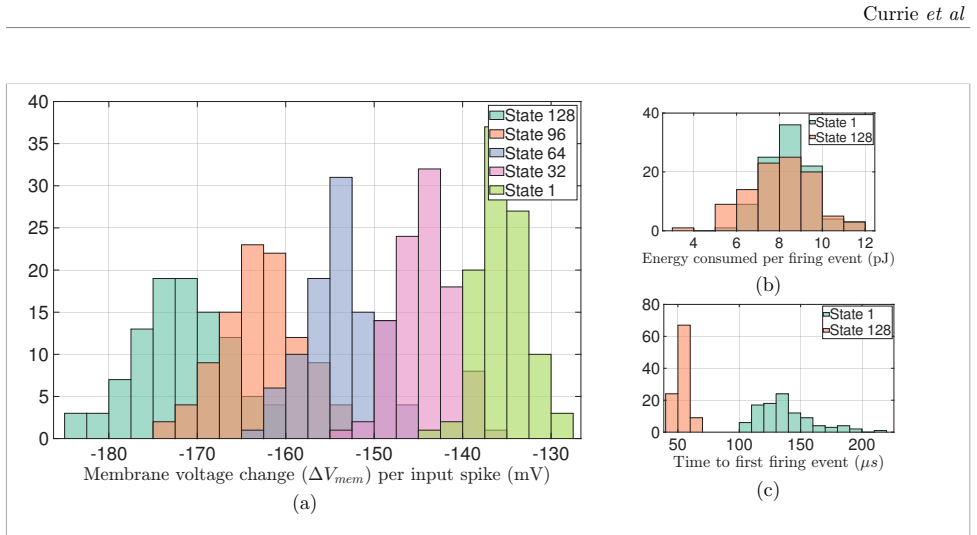
The central claim is that non-equilibrium ECRAM ionic dynamics generate transient conductance modulation (1.5 kΩ per spike) that, when paired with a tunable delay-feedback LIF architecture, directly produces synaptic facilitation and intrinsic excitability modulation; the same mechanisms extend to multiple neuron topologies and allow individual synapses to function as tunable temporal filters in spiking networks while consuming 2 pJ per spike.
What carries the argument
The delay-feedback leaky integrate-and-fire neuron architecture co-designed with ECRAM synapses, which routes activity-dependent conductance modulation into the spike-generation path to alter excitability and synaptic strength.
If this is right
- Synaptic facilitation arises directly from the device's transient conductance changes without auxiliary circuits.
- Neuron excitability can be modulated by recent spiking history through the same ECRAM dynamics.
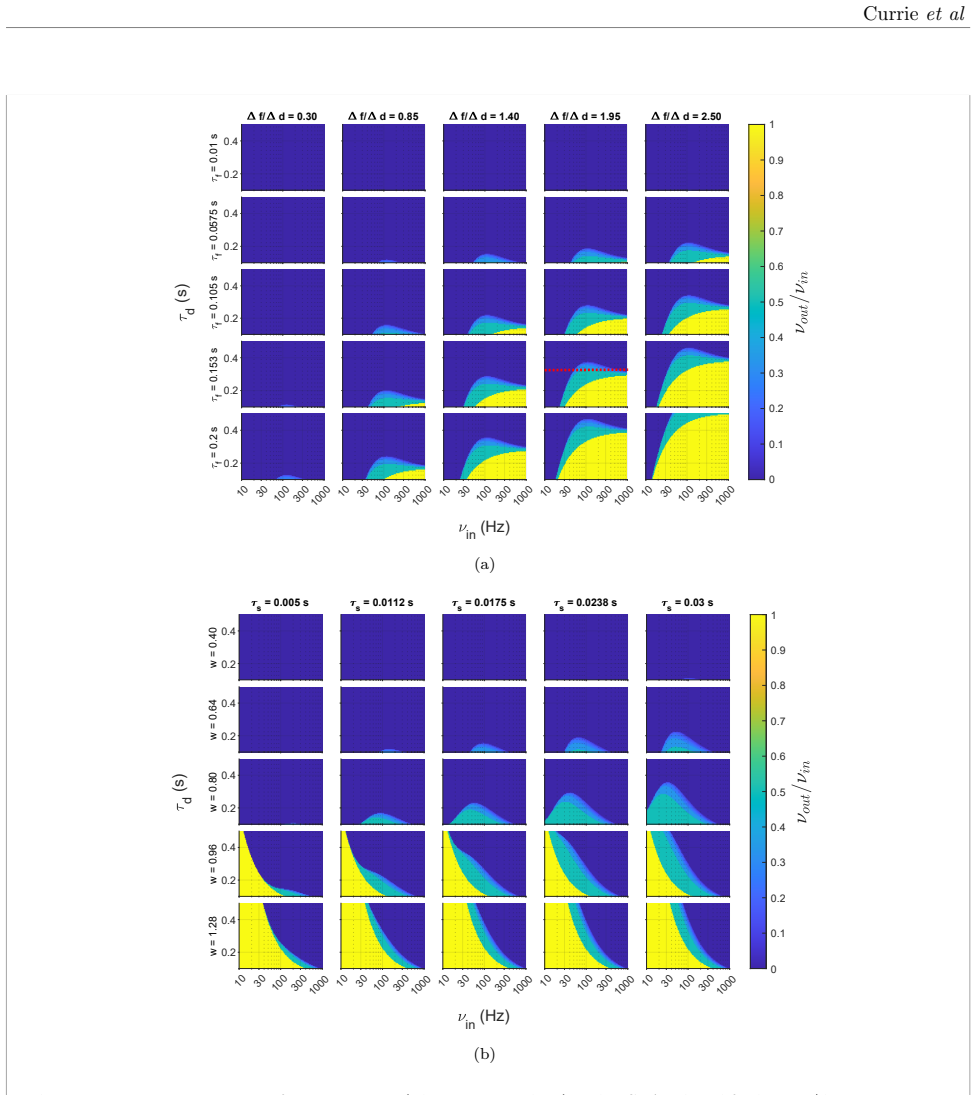
- Individual synapses can operate as tunable temporal filters for frequency-selective spike processing in networks.
- The same device-circuit co-design works across multiple neuron topologies with low overhead.
- Overall energy remains at 2 pJ per spike in the simulated configurations.
Where Pith is reading between the lines
- This device-level approach could reduce the area and power cost of adding explicit short-term memory elements in neuromorphic chips.
- Variability in real ECRAM endurance might limit the reliability of the temporal filtering over long operation.
- The same co-design principle could be tested on other volatile memristive technologies to broaden the set of native plasticity mechanisms.
- Large-scale networks built this way might show emergent filtering behaviors not captured in the small-scale simulations.
Load-bearing premise
The compact behavioral model extracted from experimental ECRAM data accurately represents all relevant non-equilibrium dynamics under the voltage and timing conditions of the proposed circuit, with negligible variability or endurance loss.
What would settle it
A fabricated delay-feedback LIF circuit using the characterized ECRAM devices that fails to exhibit synaptic facilitation or excitability modulation, or that consumes substantially more than 2 pJ per spike, would disprove the central claim.
Figures





read the original abstract
Short-term plasticity (STP) is fundamental to temporal information processing in biological neural systems but remains difficult to realize efficiently in neuromorphic hardware. Memristive electrochemical random-access memory (ECRAM) devices naturally exhibit non-equilibrium ionic dynamics that produce transient conductance modulation; however, these behaviors are typically treated as undesirable variability or tolerated as side effects in memory-centric computing paradigms. In this work, we instead transform these volatile dynamics from a tolerated device artifact into a computational resource through a cross-layer device-circuit-system co-design framework. We introduce a delay-feedback leaky integrate-and-fire (LIF) neuron architecture co-designed with ECRAM synapses that exploits activity-dependent conductance modulation with negligible additional circuit overhead. The architecture integrates ECRAM-based synapses with a tunable delay-feedback spike-generation path, enabling transient device dynamics to directly modulate neuron excitability and synaptic efficacy. We used experimentally characterized ECRAM devices exhibiting transient conductance modulation (1.5 KOhms per spike) to develop a compact behavioral model suitable for circuit-level simulation. Circuit simulations demonstrate two key STP behaviors -- synaptic facilitation and intrinsic excitability modulation -- while consuming 2 pJ per spike, and the same device-driven mechanisms extend across multiple neuron topologies. Network-level analysis further demonstrates frequency-selective spike processing, allowing individual synapses to act as tunable temporal filters within spiking neural networks. This work demonstrates that non-equilibrium ECRAM dynamics can serve as a native hardware substrate for STP and temporal computation in neuromorphic circuits.
Editorial analysis
A structured set of objections, weighed in public.
Referee Report
Summary. The paper claims that non-equilibrium ionic dynamics in ECRAM devices, which produce transient conductance modulation (experimentally measured at 1.5 kΩ per spike), can be repurposed as a native hardware substrate for short-term plasticity (STP) and temporal computation in neuromorphic circuits. Through a device-circuit co-design, the authors introduce a delay-feedback leaky integrate-and-fire (LIF) neuron architecture that couples ECRAM synapses to a tunable spike-generation path; a compact behavioral model fitted to experimental transients is then used in circuit simulations to demonstrate synaptic facilitation, intrinsic excitability modulation, 2 pJ/spike energy consumption, and frequency-selective spike processing that extends across multiple neuron topologies and enables individual synapses to act as tunable temporal filters in spiking networks.
Significance. If the behavioral model accurately reproduces the relevant non-equilibrium dynamics under the voltage, timing, and feedback conditions of the proposed circuits, the work would demonstrate a low-overhead route to native STP in hardware without auxiliary circuits, turning a common device non-ideality into a computational primitive. This could meaningfully advance energy-efficient temporal processing in neuromorphic systems, with the reported 2 pJ/spike figure and cross-topology generality providing concrete, falsifiable simulation benchmarks.
major comments (2)
- [Behavioral Model and Circuit Simulations] The central claim that non-equilibrium ECRAM dynamics serve as a native STP substrate rests entirely on circuit simulations driven by the compact behavioral model derived from experimental transients. No additional device measurements or hardware-in-the-loop validation are reported under the specific pulse amplitudes, intervals, and delay-feedback conditions of the LIF architecture, leaving open whether variability, endurance degradation, or regime-specific deviations would preserve the observed facilitation, excitability modulation, and 2 pJ/spike figures (see abstract description of model development and simulation results).
- [Network-level Analysis] The network-level frequency-selective filtering result depends on the model faithfully capturing activity-dependent conductance modulation when coupled to the tunable delay-feedback path. Without independent verification of the model under those exact operating conditions, the extension to tunable temporal filters in SNNs remains simulation-dependent and could be sensitive to unmodeled non-idealities.
minor comments (1)
- [Abstract] The abstract states the transient modulation as '1.5 KOhms per spike' while the full text uses '1.5 kΩ'; consistent notation would improve readability.
Simulated Author's Rebuttal
We thank the referee for the detailed and constructive review. The comments correctly identify that our claims rest on a behavioral model fitted to prior device measurements and on circuit simulations rather than new hardware validation under the exact delay-feedback conditions. We have revised the manuscript to strengthen the discussion of model applicability, add sensitivity analyses, and explicitly state the assumptions and limitations. Below we respond point by point.
read point-by-point responses
-
Referee: [Behavioral Model and Circuit Simulations] The central claim that non-equilibrium ECRAM dynamics serve as a native STP substrate rests entirely on circuit simulations driven by the compact behavioral model derived from experimental transients. No additional device measurements or hardware-in-the-loop validation are reported under the specific pulse amplitudes, intervals, and delay-feedback conditions of the LIF architecture, leaving open whether variability, endurance degradation, or regime-specific deviations would preserve the observed facilitation, excitability modulation, and 2 pJ/spike figures (see abstract description of model development and simulation results).
Authors: We agree that direct hardware-in-the-loop measurements under the precise delay-feedback LIF operating points would provide stronger confirmation. The compact model was obtained by fitting to experimental transient data collected under pulsed voltages and timings that overlap with the amplitudes and intervals used in the circuit simulations; the 1.5 kΩ per spike modulation and the functional form of the non-equilibrium decay were directly taken from those measurements. In the revised manuscript we have (i) expanded the model-development section with the exact experimental parameter ranges and fitting residuals, (ii) added a dedicated subsection on model limitations that discusses variability, endurance, and possible deviations outside the characterized regime, and (iii) included new Monte-Carlo simulations that propagate measured device-to-device variation through the LIF circuit to quantify impact on facilitation and energy figures. We note, however, that performing new device experiments with the full feedback circuitry is a substantial follow-on effort that lies beyond the scope of the present co-design study. revision: partial
-
Referee: [Network-level Analysis] The network-level frequency-selective filtering result depends on the model faithfully capturing activity-dependent conductance modulation when coupled to the tunable delay-feedback path. Without independent verification of the model under those exact operating conditions, the extension to tunable temporal filters in SNNs remains simulation-dependent and could be sensitive to unmodeled non-idealities.
Authors: We acknowledge the simulation dependence. The frequency-selective behavior emerges directly from the same activity-dependent conductance transients that were experimentally observed and captured by the model. In the revision we have added (i) an explicit robustness analysis that sweeps model parameters within the experimentally observed spread and shows that the frequency selectivity persists, and (ii) a new paragraph in the discussion section that enumerates the main unmodeled non-idealities (e.g., history-dependent drift, temperature sensitivity) and their expected influence on the temporal-filtering function. These additions make the assumptions and the simulation-only nature of the network results transparent while preserving the core demonstration that the device dynamics can be co-designed into tunable filters. revision: partial
Circularity Check
No circularity: experimental data grounds behavioral model used in forward circuit simulations
full rationale
The paper's chain proceeds from direct experimental characterization of ECRAM transient conductance (1.5 kΩ per spike) to a compact behavioral model fitted to those measurements, followed by circuit simulations of a co-designed delay-feedback LIF architecture that exhibits STP behaviors. This is a standard, non-circular modeling workflow: the model parameters are externally anchored in measured device data rather than defined in terms of the target STP outcomes or circuit results. No self-citation load-bearing steps, uniqueness theorems, or ansatz smuggling appear in the provided text; the frequency-selective filtering and 2 pJ/spike claims are simulation outputs that depend on the architecture-device interaction, not tautological restatements of the input transients. The derivation remains self-contained against the external experimental benchmarks.
Axiom & Free-Parameter Ledger
free parameters (2)
- transient conductance modulation amplitude
- delay-feedback time constant
axioms (2)
- domain assumption LIF neuron dynamics with additive delayed feedback accurately represent biological short-term plasticity when driven by ECRAM conductance transients.
- domain assumption The compact behavioral model extracted from device measurements remains valid under the voltage and timing regimes of the proposed circuit.
Lean theorems connected to this paper
-
Cost/FunctionalEquationwashburn_uniqueness_aczel unclear?
unclearRelation between the paper passage and the cited Recognition theorem.
We used experimentally characterized ECRAM devices exhibiting transient conductance modulation (1.5 kΩ per spike) to develop a compact behavioral model suitable for circuit-level simulation.
What do these tags mean?
- matches
- The paper's claim is directly supported by a theorem in the formal canon.
- supports
- The theorem supports part of the paper's argument, but the paper may add assumptions or extra steps.
- extends
- The paper goes beyond the formal theorem; the theorem is a base layer rather than the whole result.
- uses
- The paper appears to rely on the theorem as machinery.
- contradicts
- The paper's claim conflicts with a theorem or certificate in the canon.
- unclear
- Pith found a possible connection, but the passage is too broad, indirect, or ambiguous to say the theorem truly supports the claim.
Reference graph
Works this paper leans on
-
[1]
J. Lou, F. Freye, C. Lanius, and T. Gemmeke, “An energy efficient all-digital time-domain compute-in-memory macro optimized for binary neural networks,”IEEE Transactions on Circuits and Systems I: Regular Papers, vol. 71, no. 1, pp. 287–298, 2024
work page 2024
-
[2]
Enabling long chain lengths and high-throughput for time-domain neuromorphic computing,
K. Bergthold, H. Hendy, E. Greenfield, C. Merkel, and T. Das, “Enabling long chain lengths and high-throughput for time-domain neuromorphic computing,”IEEE Transactions on Circuits and Systems II: Express Briefs, vol. 72, no. 8, pp. 983–987, 2025
work page 2025
-
[3]
Neuromemristive Circuits for Edge Computing: A Review,
O. Krestinskaya, A. P. James, and L. O. Chua, “Neuromemristive Circuits for Edge Computing: A Review,”IEEE Transactions on Neural Networks and Learning Systems, vol. 31, no. 1, pp. 4–23, Jan. 2020
work page 2020
-
[4]
A Compact Memristor-Based Dynamic Synapse for Spiking Neural Networks,
M. Hu, Y. Chen, J. J. Yang, Y. Wang, and H. H. Li, “A Compact Memristor-Based Dynamic Synapse for Spiking Neural Networks,”IEEE Transactions on Computer-Aided Design of Integrated Circuits and Systems, vol. 36, no. 8, pp. 1353–1366, Aug. 2017
work page 2017
-
[5]
ECRAM as Scalable Synaptic Cell for High-Speed, Low-Power Neuromorphic Computing,
J. Tang, D. Bishop, S. Kim, M. Copel, T. Gokmen, T. Todorov, S. Shin, K.-T. Lee, P. Solomon, K. Chan, W. Haensch, and J. Rozen, “ECRAM as Scalable Synaptic Cell for High-Speed, Low-Power Neuromorphic Computing,” in2018 IEEE International Electron Devices Meeting (IEDM), Dec. 2018, pp. 13.1.1–13.1.4, iSSN: 2156-017X
work page 2018
-
[6]
An ECRAM-Based Analog Compute-in-Memory Neuromorphic System with High-Precision Current Readout,
M. Um, M. Kang, H. Kwak, K. Noh, S. Kim, and H.-M. Lee, “An ECRAM-Based Analog Compute-in-Memory Neuromorphic System with High-Precision Current Readout,” in2023 IEEE Biomedical Circuits and Systems Conference (BioCAS), Oct. 2023, pp. 1–5, iSSN: 2766-4465
work page 2023
-
[7]
Emulating short-term synaptic dynamics with memristive devices,
R. Berdan, E. Vasilaki, A. Khiat, G. Indiveri, A. Serb, and T. Prodromakis, “Emulating short-term synaptic dynamics with memristive devices,”Scientific Reports, vol. 6, no. 1, p. 18639, Jan. 2016
work page 2016
-
[8]
Tunable synaptic working memory with volatile memristive devices,
S. Ricci, D. Kappel, C. Tetzlaff, D. Ielmini, and E. Covi, “Tunable synaptic working memory with volatile memristive devices,”Neuromorphic Computing and Engineering, vol. 3, no. 4, p. 044004, Oct. 2023
work page 2023
-
[9]
Building Time-Surfaces by Exploiting the Complex Volatility of an ECRAM Memristor,
M. Rasetto, Q. Wan, H. Akolkar, F. Xiong, B. Shi, and R. Benosman, “Building Time-Surfaces by Exploiting the Complex Volatility of an ECRAM Memristor,”IEEE Journal on Emerging and Selected Topics in Circuits and Systems, vol. 13, no. 4, pp. 877–888, Dec. 2023. 20 Currieet al
work page 2023
-
[10]
Neuromorphic Silicon Neuron Circuits,
G. Indiveri, B. Linares-Barranco, T. J. Hamilton, A. van Schaik, R. Etienne-Cummings, T. Delbruck, S.-C. Liu, P. Dudek, P. H¨ afliger, S. Renaud, J. Schemmel, G. Cauwenberghs, J. Arthur, K. Hynna, F. Folowosele, S. Sa¨ ıghi, T. Serrano-Gotarredona, J. Wijekoon, Y. Wang, and K. Boahen, “Neuromorphic Silicon Neuron Circuits,”Frontiers in Neuroscience, vol. ...
work page 2011
-
[11]
In-Memory Computing for Machine Learning and Deep Learning,
N. Lepri, A. Glukhov, L. Cattaneo, M. Farronato, P. Mannocci, and D. Ielmini, “In-Memory Computing for Machine Learning and Deep Learning,”IEEE Journal of the Electron Devices Society, vol. 11, pp. 587–601, 2023
work page 2023
-
[12]
H. Kang, J. Park, D. Lee, H. W. Kim, S. Jin, M. Ahn, and J. Woo, “Two- and three-terminal HfO2-based multilevel resistive memories for neuromorphic analog synaptic elements,”Neuromorphic Computing and Engineering, vol. 1, no. 2, p. 021001, Oct. 2021
work page 2021
-
[13]
A comparative review of deep and spiking neural networks for edge AI neuromorphic circuits,
P. M Ferreira, S. Wang, Y. Gao, and A. Benlarbi-Delai, “A comparative review of deep and spiking neural networks for edge AI neuromorphic circuits,”Front. Neurosci., vol. 19, no. 1676570, p. 1676570, Oct. 2025
work page 2025
-
[14]
D. Zendrikov, S. Solinas, and G. Indiveri, “Brain-inspired methods for achieving robust computation in heterogeneous mixed-signal neuromorphic processing systems,”Neuromorphic Comput. Eng., vol. 3, no. 3, p. 034002, Sep. 2023
work page 2023
-
[15]
Towards spike-based machine intelligence with neuromorphic computing,
K. Roy, A. Jaiswal, and P. Panda, “Towards spike-based machine intelligence with neuromorphic computing,”Nature, vol. 575, no. 7784, pp. 607–617, Nov. 2019
work page 2019
-
[16]
Efficiency metrics for auditory neuromorphic spike encoding techniques using information theory,
A. El Ferdaoussi, J. Rouat, and E. Plourde, “Efficiency metrics for auditory neuromorphic spike encoding techniques using information theory,”Neuromorphic Computing and Engineering, vol. 3, no. 2, p. 024007, Jun. 2023
work page 2023
-
[17]
B. Drukarch and M. M. M. Wilhelmus, “Thinking about the action potential: the nerve signal as a window to the physical principles guiding neuronal excitability,”Frontiers in Cellular Neuroscience, vol. 17, Aug. 2023
work page 2023
-
[18]
Leaky integrate-and-fire neuron with a refractory period mechanism for invariant spikes,
H. M. Lehmann, J. Hille, C. Grassmann, and V. Issakov, “Leaky integrate-and-fire neuron with a refractory period mechanism for invariant spikes,” in2022 17th Conference on Ph.D Research in Microelectronics and Electronics (PRIME), June 2022, pp. 365–368
work page 2022
-
[19]
A Low-Energy Refractory Spike Frequency Adaptive LIF Neuron Model,
A. Deb and D. Selvakumar, “A Low-Energy Refractory Spike Frequency Adaptive LIF Neuron Model,” in2024 IEEE International Conference on Electronics, Computing and Communication Technologies (CONECCT), Jul. 2024, pp. 1–6, iSSN: 2766-2101
work page 2024
-
[20]
M. K. Q. Jooq, M. R. Azghadi, F. Behbahani, A. Al-Shidaifat, and H. Song, “High-Performance and Energy-Efficient Leaky Integrate-and-Fire Neuron and Spike Timing-Dependent Plasticity Circuits in 7nm FinFET Technology,”IEEE Access, vol. 11, pp. 133 451–133 459, 2023
work page 2023
-
[21]
Energy- and area-efficient cmos synapse and neuron for spiking neural networks with stdp learning,
B. Joo, J.-W. Han, and B.-S. Kong, “Energy- and area-efficient cmos synapse and neuron for spiking neural networks with stdp learning,”IEEE Transactions on Circuits and Systems I: Regular Papers, vol. 69, no. 9, pp. 3632–3642, Sep. 2022
work page 2022
-
[22]
Ultra-Low Power Reconfigurable Synaptic and Neuronal Transistor for Spiking Neural Network,
N. Kamal, J. Singh, A. Lahgere, and P. K. Tiwari, “Ultra-Low Power Reconfigurable Synaptic and Neuronal Transistor for Spiking Neural Network,”IEEE Transactions on Nanotechnology, vol. 22, pp. 245–251, 2023
work page 2023
-
[23]
Spike-based local synaptic plasticity: a survey of computational models and neuromorphic circuits,
L. Khacef, P. Klein, M. Cartiglia, A. Rubino, G. Indiveri, and E. Chicca, “Spike-based local synaptic plasticity: a survey of computational models and neuromorphic circuits,”Neuromorphic Computing and Engineering, vol. 3, no. 4, p. 042001, Nov. 2023
work page 2023
-
[24]
The mechanisms and functions of synaptic facilitation,
S. L. Jackman and W. G. Regehr, “The mechanisms and functions of synaptic facilitation,”Neuron, vol. 94, no. 3, pp. 447–464, May 2017
work page 2017
-
[25]
Neural ensembles: role of intrinsic excitability and its plasticity,
C. Hansel and R. Yuste, “Neural ensembles: role of intrinsic excitability and its plasticity,”Front. Cell. Neurosci., vol. 18, p. 1440588, Jul. 2024
work page 2024
-
[26]
Spiking neurons with short-term synaptic plasticity form superior generative networks,
L. Leng, R. Martel, O. Breitwieser, I. Bytschok, W. Senn, J. Schemmel, K. Meier, and M. A. Petrovici, “Spiking neurons with short-term synaptic plasticity form superior generative networks,”Sci. Rep., vol. 8, no. 1, Jul. 2018
work page 2018
-
[27]
Short-term synaptic facilitation improves information retrieval in noisy neural networks,
J. F. Mejias, B. Hernandez-Gomez, and J. J. Torres, “Short-term synaptic facilitation improves information retrieval in noisy neural networks,”Europhys. Lett., vol. 97, no. 4, p. 48008, Feb. 2012
work page 2012
-
[28]
A switched-capacitor implementation of short-term synaptic dynamics,
M. Noack, C. Mayr, J. Partzsch, M. Schultz, and R. Sch¨ uffny, “A switched-capacitor implementation of short-term synaptic dynamics,” inProceedings of the 19th International Conference Mixed Design of Integrated Circuits and Systems - MIXDES 2012, May 2012, pp. 214–218
work page 2012
-
[29]
Neuro-memristive circuit for bio-synaptic plasticity,
Z. I. Mannan and H. Kim, “Neuro-memristive circuit for bio-synaptic plasticity,” in2021 IEEE International Symposium on Circuits and Systems (ISCAS), May 2021, pp. 1–5
work page 2021
-
[30]
T. Mei, W. Liu, G. Xu, Y. Chen, M. Wu, L. Wang, and K. Xiao, “Ionic Transistors,”ACS Nano, vol. 18, no. 6, pp. 4624–4650, Feb. 2024
work page 2024
-
[31]
Ionically gated transistors based on two-dimensional materials for neuromorphic computing,
K. Xu and S. K. Fullerton-Shirey, “Ionically gated transistors based on two-dimensional materials for neuromorphic computing,”2D Materials, vol. 12, no. 2, p. 023003, Mar. 2025
work page 2025
-
[32]
——, “Electric-double-layer-gated transistors based on two-dimensional crystals: recent approaches and advances,”Journal of Physics: Materials, vol. 3, no. 3, p. 032001, May 2020
work page 2020
-
[33]
Electrochemical Random-Access Memory: Progress, Perspectives, and Opportunities,
A. A. Talin, J. Meyer, J. Li, M. Huang, M. Schwacke, H. W. Chung, L. Xu, E. J. Fuller, Y. Li, and B. Yildiz, “Electrochemical Random-Access Memory: Progress, Perspectives, and Opportunities,”Chemical Reviews, vol. 125, no. 4, pp. 1962–2008, Feb. 2025
work page 1962
-
[34]
ECRAM Materials, Devices, Circuits and Architectures: A Perspective,
A. A. Talin, Y. Li, D. A. Robinson, E. J. Fuller, and S. Kumar, “ECRAM Materials, Devices, Circuits and Architectures: A Perspective,”Advanced Materials, vol. 35, no. 37, p. 2204771, 2023, eprint: https://advanced.onlinelibrary.wiley.com/doi/pdf/10.1002/adma.202204771
-
[35]
K. Xu, M. M. Islam, D. Guzman, A. C. Seabaugh, A. Strachan, and S. K. Fullerton-Shirey, “Pulse Dynamics of Electric Double Layer Formation on All-Solid-State Graphene Field-Effect Transistors,”ACS Applied Materials & Interfaces, vol. 10, no. 49, pp. 43 166–43 176, Dec. 2018
work page 2018
-
[36]
An Energy Efficient Crossbar MAC Array with 128 Conductance State ECRAM devices,
H. Han, J. Inman, S. Maczynski, M. Indovina, A. Ganguly, T. Das, and K. Xu, “An Energy Efficient Crossbar MAC Array with 128 Conductance State ECRAM devices,” in2025 IEEE 34st Microelectronics Design & Test Symposium (MDTS), May 2025, pp. 1–6, iSSN: 2573-7600. 21 Currieet al
work page 2025
-
[37]
D. Nishioka, H. Kitano, W. Namiki, S. Souma, K. Terabe, and T. Tsuchiya, “Two Orders of Magnitude Reduction in Computational Load Achieved by Ultrawideband Responses of an Ion-Gating Reservoir,”ACS Nano, vol. 19, no. 42, pp. 36 896–36 914, Oct. 2025
work page 2025
-
[38]
M. Takayanagi, D. Nishioka, T. Tsuchiya, M. Imura, Y. Koide, T. Higuchi, and K. Terabe, “Ultrafast-switching of an all-solid-state electric double layer transistor with a porous yttria-stabilized zirconia proton conductor and the application to neuromorphic computing,”Materials Today Advances, vol. 18, p. 100393, Jun. 2023
work page 2023
-
[39]
K. G. Cho, K. H. Lee, and C. D. Frisbie, “Tuning Gate Potential Profiles and Current–Voltage Characteristics of Polymer Electrolyte-Gated Transistors by Capacitance Engineering,”ACS Applied Materials & Interfaces, vol. 16, no. 15, pp. 19 309–19 317, Apr. 2024
work page 2024
-
[40]
D. Sun, A. Li, X. Deng, S. Zhao, Z. Xu, Q. Tan, Y. Wan, X. Li, S. Chen, I. Valov, and Y. Shi, “Dynamic Monolayer WSe2 Electrolyte-Gated Transistor with Coexistent Double Relaxation Timescale for Enhanced Physical Reservoir Computing,” Small, vol. n/a, no. n/a, p. 2504066, Jun. 2025, eprint: https://onlinelibrary.wiley.com/doi/pdf/10.1002/smll.202504066
-
[41]
W. Zhang, J. Li, M. Li, Y. Li, H. Lian, W. Gao, B. Sun, F. Wang, L. Cheng, H. Yu, L. Chen, and J. Zhang, “Electrolyte-Gated Transistor Array (20×20) with Low-Programming Interference Based on Coplanar Gate Structure for Unsupervised Learning,”Small Science, vol. 4, no. 4, p. 2300306, Apr. 2024
work page 2024
-
[42]
S.-Y. Min and W.-J. Cho, “CMOS-compatible synaptic transistor gated by chitosan electrolyte-Ta2O5 hybrid electric double layer,”Scientific Reports, vol. 10, no. 1, p. 15561, Sep. 2020
work page 2020
-
[43]
J. Lee, R. D. Nikam, D. Kim, and H. Hwang, “Understanding Controlled Ion Doping Mechanism of Vertical Sensing Electrochemical Random Access Memory Using Ion-Permeable Graphene Electrodes,”IEEE Transactions on Electron Devices, vol. 70, no. 7, pp. 3951–3957, Jul. 2023
work page 2023
-
[44]
G. Liu, W. Wen, Z. Zhao, X. Huang, Y. Li, M. Qin, Z. Pan, Y. Guo, and Y. Liu, “Bionic Tactile-Gustatory Receptor for Object Identification Based on All-Polymer Electrochemical Transistor,”Advanced Materials, vol. 35, no. 24, p. e2300242, Jun. 2023
work page 2023
-
[45]
Redox-Based Resistive Switching Memories - Nanoionic Mechanisms, Prospects, and Challenges,
R. Waser, R. Dittmann, G. Staikov, and K. Szot, “Redox-Based Resistive Switching Memories - Nanoionic Mechanisms, Prospects, and Challenges,”Advanced Materials, vol. 21, no. 25-26, pp. 2632–2663, Jul. 2009
work page 2009
-
[46]
Two-dimensional electric-double-layer Esaki diode,
P. Paletti, R. Yue, C. Hinkle, S. K. Fullerton-Shirey, and A. Seabaugh, “Two-dimensional electric-double-layer Esaki diode,” npj 2D Materials and Applications, vol. 3, no. 1, p. 19, Apr. 2019
work page 2019
-
[47]
S. S. Awate, B. Mostek, S. Kumari, C. Dong, J. A. Robinson, K. Xu, and S. K. Fullerton-Shirey, “Impact of Large Gate Voltages and Ultrathin Polymer Electrolytes on Carrier Density in Electric-Double-Layer-Gated Two-Dimensional Crystal Transistors,”ACS Applied Materials & Interfaces, vol. 15, no. 12, pp. 15 785–15 796, Mar. 2023
work page 2023
-
[48]
Molecularly Thin Electrolyte for All Solid-State Nonvolatile Two-Dimensional Crystal Memory,
J. Liang, K. Xu, M. Wu, B. M. Hunt, W.-H. Wang, K. Cho, and S. K. Fullerton-Shirey, “Molecularly Thin Electrolyte for All Solid-State Nonvolatile Two-Dimensional Crystal Memory,”Nano Letters, vol. 19, no. 12, pp. 8911–8919, Dec. 2019
work page 2019
-
[49]
K. Xu, H. Lu, E. W. Kinder, A. Seabaugh, and S. K. Fullerton-Shirey, “Monolayer Solid-State Electrolyte for Electric Double Layer Gating of Graphene Field-Effect Transistors,”ACS Nano, vol. 11, no. 6, pp. 5453–5464, Jun. 2017
work page 2017
-
[50]
I. Filanovsky and H. Baltes, “CMOS Schmitt trigger design,”IEEE Transactions on Circuits and Systems I: Fundamental Theory and Applications, vol. 41, no. 1, pp. 46–49, Jan. 1994
work page 1994
-
[51]
A biomorphic digital image sensor,
E. Culurciello, R. Etienne-Cummings, and K. Boahen, “A biomorphic digital image sensor,”IEEE Journal of Solid-State Circuits, vol. 38, no. 2, pp. 281–294, Feb 2003
work page 2003
-
[52]
A highly tunable 65-nm CMOS LIF neuron for a large scale neuromorphic system,
S. A. Aamir, P. M¨ uller, A. Hartel, J. Schemmel, and K. Meier, “A highly tunable 65-nm CMOS LIF neuron for a large scale neuromorphic system,” inESSCIRC Conference 2016: 42nd European Solid-State Circuits Conference, Sep. 2016, pp. 71–74
work page 2016
-
[53]
M. Cho, M. Kang, M. Um, H. Park, and H.-M. Lee, “CMOS LIF Neurons With Local Membrane Dynamic Biasing Based on Reciprocal Inhibition for Self-Oscillatory Neural Networks,”IEEE Transactions on Biomedical Circuits and Systems, vol. 19, no. 6, pp. 1213–1225, Dec. 2025. 22
work page 2025
discussion (0)
Sign in with ORCID, Apple, or X to comment. Anyone can read and Pith papers without signing in.