Recognition: no theorem link
3DGS³: Joint Super Sampling and Frame Interpolation for Real-Time Large-Scale 3DGS Rendering
Pith reviewed 2026-05-13 02:26 UTC · model grok-4.3
The pith
A post-rendering framework jointly super-samples and interpolates low-resolution 3D Gaussian splats to enable real-time high-resolution rendering of large scenes.
A machine-rendered reading of the paper's core claim, the machinery that carries it, and where it could break.
Core claim
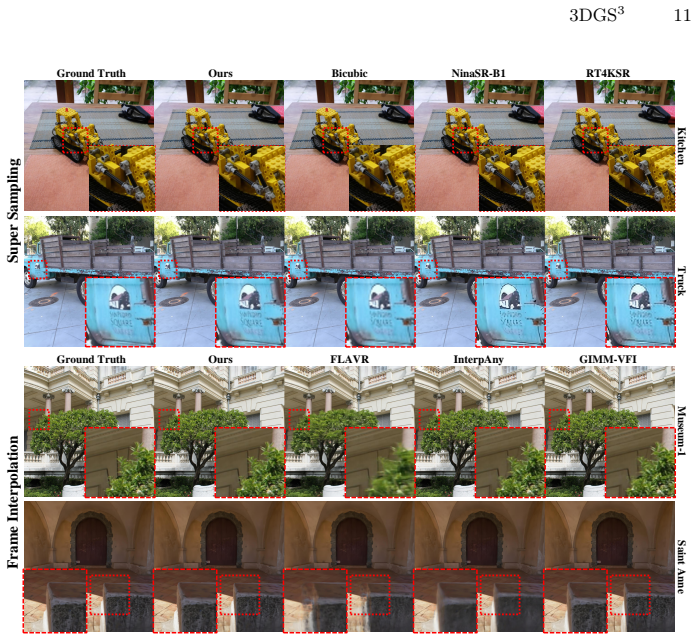
3DGS³ is a unified post-rendering framework that performs super sampling via a Gradient-Aware Super Sampling module and frame interpolation via a Lightweight Temporal Frame Interpolation module on low-resolution 3DGS outputs. The GASS module extracts gradients from the continuous differentiability of 3DGS to guide a GRU-based refinement network for high-fidelity upsampling. The LTFI module uses a compact U-Net-like backbone to fuse temporal and spatial cues from consecutive frames for coherent intermediates. This achieves high-resolution and high-frame-rate rendering without modifying the splatting pipeline itself.
What carries the argument
Gradient-Aware Super Sampling (GASS) module that leverages 3DGS differentiability for gradient-guided refinement, paired with Lightweight Temporal Frame Interpolation (LTFI) module for temporal coherence.
If this is right
- Achieves superior rendering efficiency compared to state-of-the-art methods.
- Delivers better visual quality on public datasets.
- Remains compatible with existing 3DGS acceleration techniques.
- Enables real-time rendering for ultra-dense and high-resolution scenes.
Where Pith is reading between the lines
- The method could extend to other neural rendering techniques that support differentiation.
- It might allow deployment on lower-power hardware by reducing the base render resolution.
- Further optimization of the modules could lead to even higher frame rates without quality loss.
Load-bearing premise
The low-resolution 3DGS outputs contain sufficient differentiable information that the proposed modules can use to reconstruct high-fidelity frames without introducing noticeable artifacts in large-scale scenes.
What would settle it
Rendering a complex large-scale scene directly at high resolution and comparing it side-by-side with the output of the method at the same resolution to check for introduced artifacts or quality degradation.
Figures


read the original abstract
3D Gaussian Splatting (3DGS) enables high-quality real-time 3D rendering but faces challenges in efficiently scaling to ultra-dense scenes and high-resolution due to computational bottlenecks that limit its use in latency-sensitive applications. Instead of optimizing the splatting pipeline itself, we propose \textbf{3DGS$^3$}, a unified post-rendering framework that jointly performs super sampling and frame interpolation through differentiable processing of low-resolution outputs to achieve both high-resolution and high-frame-rate rendering. Our \textbf{Gradient\- \-Aware Super Sampling (GASS)} module leverages the continuous differentiability of 3DGS to extract image gradients that guide a GRU-based refinement network to enable high-fidelity super sampling. Furthermore, a \textbf{Lightweight Temporal Frame Interpolation (LTFI)} module based on a compact U-Net-like backbone fuses temporal and differentiable spatial cues from consecutive frames to synthesize temporally coherent intermediate frames. Experiments on public datasets demonstrate that 3DGS$^3$ achieves superior rendering efficiency and visual quality when compared with state-of-the-art methods and remains compatible with existing 3DGS acceleration techniques. The code will be publicly released upon acceptance.
Editorial analysis
A structured set of objections, weighed in public.
Referee Report
Summary. The paper proposes 3DGS³, a post-rendering framework for 3D Gaussian Splatting that jointly performs super-sampling and frame interpolation via differentiable processing of low-resolution outputs. It introduces a Gradient-Aware Super Sampling (GASS) module that extracts image gradients from 3DGS to guide a GRU-based refinement network, and a Lightweight Temporal Frame Interpolation (LTFI) module using a compact U-Net-like backbone to fuse temporal and spatial cues for coherent intermediate frames. The central claim is that this achieves superior rendering efficiency and visual quality over state-of-the-art methods on public datasets while remaining compatible with existing 3DGS acceleration techniques.
Significance. If the quantitative results and ablations support the claims, the work provides a practical post-processing solution to scale 3DGS to high-resolution and high-frame-rate rendering in large scenes without modifying the core splatting pipeline. This has clear significance for latency-sensitive applications in graphics, VR, and simulation. The explicit use of 3DGS differentiability for gradient guidance and the compatibility with accelerations are notable strengths that could enable broader adoption.
major comments (3)
- [Abstract] Abstract: The claim that '3DGS³ achieves superior rendering efficiency and visual quality' is presented without any quantitative metrics, error bars, ablation details, baseline descriptions, or dataset specifics, making it impossible to verify whether the data support the central claim of superiority.
- [Method (GASS)] GASS module (method description): The reliance on gradients extracted from low-resolution 3DGS rasterization to recover high-fidelity details assumes that sufficient continuous high-frequency information survives the averaging over overlapping Gaussians; this is load-bearing for the super-sampling claim but is not validated in ultra-dense or large-scale regimes where such averaging could erase recoverable cues.
- [Method (LTFI) and Experiments] LTFI module and experiments: The assertion that the compact U-Net fuses temporal and differentiable spatial cues to produce coherent frames without artifacts requires explicit testing and metrics in complex/large-scale scenes; public-dataset results as described do not necessarily address the risk of hallucination or temporal inconsistency under high Gaussian density.
minor comments (2)
- [Abstract] The abstract contains a clear LaTeX formatting artifact ('Gradient- -Aware') that should be corrected to 'Gradient-Aware'.
- [Experiments] The manuscript would benefit from explicit statements of the specific public datasets used, the exact baselines compared, and the hardware/setup for efficiency measurements to improve reproducibility.
Simulated Author's Rebuttal
We thank the referee for the constructive feedback. We address each major comment point-by-point below. Where the comments identify opportunities to strengthen validation or presentation, we have made corresponding revisions to the manuscript.
read point-by-point responses
-
Referee: [Abstract] Abstract: The claim that '3DGS³ achieves superior rendering efficiency and visual quality' is presented without any quantitative metrics, error bars, ablation details, baseline descriptions, or dataset specifics, making it impossible to verify whether the data support the central claim of superiority.
Authors: We agree that the abstract would benefit from explicit quantitative support. We have revised the abstract to include key results from our experiments on public datasets (referencing the specific benchmarks, baselines, and ablations), along with average improvements in rendering quality and efficiency. Full metrics, error bars, and dataset details remain in the experiments section. revision: yes
-
Referee: [Method (GASS)] GASS module (method description): The reliance on gradients extracted from low-resolution 3DGS rasterization to recover high-fidelity details assumes that sufficient continuous high-frequency information survives the averaging over overlapping Gaussians; this is load-bearing for the super-sampling claim but is not validated in ultra-dense or large-scale regimes where such averaging could erase recoverable cues.
Authors: This is a substantive concern about the limits of gradient-based guidance. Our original experiments already cover large-scale scenes with high Gaussian densities from public benchmarks and show consistent GASS gains. To directly validate cue survival, we have added a targeted analysis and ablation in the revised method and supplementary material examining performance across density regimes, including ultra-dense configurations. revision: yes
-
Referee: [Method (LTFI) and Experiments] LTFI module and experiments: The assertion that the compact U-Net fuses temporal and differentiable spatial cues to produce coherent frames without artifacts requires explicit testing and metrics in complex/large-scale scenes; public-dataset results as described do not necessarily address the risk of hallucination or temporal inconsistency under high Gaussian density.
Authors: We acknowledge the value of more explicit checks for temporal artifacts in high-density settings. The evaluated public datasets include complex large-scale scenes with dense Gaussians. In the revision we have added quantitative temporal-consistency metrics, artifact analysis, and a limitations discussion focused on hallucination risk under high density, with results confirming coherence in the tested regimes. revision: yes
Circularity Check
No circularity; post-processing pipeline is independent of its outputs
full rationale
The paper describes 3DGS³ as an external post-rendering framework that applies GASS (GRU-based gradient-guided super-sampling) and LTFI (U-Net temporal fusion) to low-resolution 3DGS rasterizations. These modules exploit the pre-existing differentiability of 3DGS rather than defining it; performance claims rest on direct comparisons against external baselines on public datasets. No equations redefine fitted parameters as predictions, no self-citation chains carry the central argument, and no ansatz or uniqueness result is smuggled in. The derivation chain therefore remains self-contained against external benchmarks.
Axiom & Free-Parameter Ledger
Reference graph
Works this paper leans on
-
[1]
In: Annual Conference on Computer Graphics and Interactive Techniques
Akeley, K.: Reality engine graphics. In: Annual Conference on Computer Graphics and Interactive Techniques. pp. 109–116 (1993)
work page 1993
-
[2]
AMD: Amd fidelityfx super resolution.https://www.amd.com/en/technologies/ fidelityfx-super-resolution(2021)
work page 2021
-
[3]
com / GPUOpen - Effects/FidelityFX-FSR2(2022)
AMD: Amd fidelityfx super resolution 2.1.https : / / github . com / GPUOpen - Effects/FidelityFX-FSR2(2022)
work page 2022
-
[4]
In: IEEE/CVF Conference on Computer Vision and Pattern Recognition
Bao, W., Lai, W.S., Ma, C., Zhang, X., Gao, Z., Yang, M.H.: Depth-aware video frame interpolation. In: IEEE/CVF Conference on Computer Vision and Pattern Recognition. pp. 3703–3712 (2019)
work page 2019
-
[5]
In: IEEE/CVF Conference on Computer Vision and Pattern Recognition
Barron, J.T., Mildenhall, B., Verbin, D., Srinivasan, P.P., Hedman, P.: Mip-nerf 360: Unbounded anti-aliased neural radiance fields. In: IEEE/CVF Conference on Computer Vision and Pattern Recognition. pp. 5470–5479 (2022)
work page 2022
-
[6]
ACM Transactions on Graphics 40(6), 1–13 (2021)
Briedis, K.M., Djelouah, A., Meyer, M., McGonigal, I., Gross, M., Schroers, C.: Neural frame interpolation for rendered content. ACM Transactions on Graphics 40(6), 1–13 (2021)
work page 2021
-
[7]
In: SIGGRAPH Conference Papers
Briedis, K.M., Djelouah, A., Ortiz, R., Meyer, M., Gross, M., Schroers, C.: Kernel-based frame interpolation for spatio-temporally adaptive rendering. In: SIGGRAPH Conference Papers. pp. 1–11 (2023)
work page 2023
-
[8]
International Journal of Computer Vision 61(3), 211–231 (2005)
Bruhn, A., Weickert, J., Schnörr, C.: Lucas/kanade meets horn/schunck: Combin- ing local and global optic flow methods. International Journal of Computer Vision 61(3), 211–231 (2005)
work page 2005
-
[9]
Learning Phrase Representations using RNN Encoder-Decoder for Statistical Machine Translation
Cho, K., Van Merriënboer, B., Gulcehre, C., Bahdanau, D., Bougares, F., Schwenk, H., Bengio, Y.: Learning phrase representations using rnn encoder-decoder for sta- tistical machine translation. arXiv preprint arXiv:1406.1078 (2014)
work page internal anchor Pith review Pith/arXiv arXiv 2014
-
[10]
In: IEEE/CVF Conference on Computer Vision and Pattern Recognition
Ding, T., Liang, L., Zhu, Z., Zharkov, I.: Cdfi: Compression-driven network de- sign for frame interpolation. In: IEEE/CVF Conference on Computer Vision and Pattern Recognition. pp. 8001–8011 (2021)
work page 2021
-
[11]
Advances in Neural Information Processing Systems37, 140138–140158 (2024)
Fan, Z., Wang, K., Wen, K., Zhu, Z., Xu, D., Wang, Z., et al.: Lightgaussian: Unbounded 3d gaussian compression with 15x reduction and 200+ fps. Advances in Neural Information Processing Systems37, 140138–140158 (2024)
work page 2024
-
[12]
In: European Conference on Computer Vision
Fang,G.,Wang,B.:Mini-splatting:Representingsceneswithaconstrainednumber of gaussians. In: European Conference on Computer Vision. pp. 165–181 (2024)
work page 2024
-
[13]
In: IEEE/CVF Conference on Computer Vision and Pattern Recognition
Feng, G., Chen, S., Fu, R., Liao, Z., Wang, Y., Liu, T., Hu, B., Xu, L., Pei, Z., Li, H., et al.: Flashgs: Efficient 3d gaussian splatting for large-scale and high- resolution rendering. In: IEEE/CVF Conference on Computer Vision and Pattern Recognition. pp. 26652–26662 (2025)
work page 2025
-
[14]
ACM on Computer Graphics and Interactive Techniques8(1), 1–21 (2025)
Franke, L., Fink, L., Stamminger, M.: Vr-splatting: Foveated radiance field render- ing via 3d gaussian splatting and neural points. ACM on Computer Graphics and Interactive Techniques8(1), 1–21 (2025)
work page 2025
-
[15]
In: European Conference on Computer Vision
Girish, S., Gupta, K., Shrivastava, A.: Eagles: Efficient accelerated 3d gaussians with lightweight encodings. In: European Conference on Computer Vision. pp. 54–71 (2024)
work page 2024
-
[16]
https://github.com/Coloquinte/torchSR/blob/main/doc/NinaSR.md(2021)
Gouvine, G.: NinaSR: Efficient small and large convnets for super-resolution. https://github.com/Coloquinte/torchSR/blob/main/doc/NinaSR.md(2021). https://doi.org/10.5281/zenodo.4868308
-
[17]
Guo, J., Fu, X., Lin, L., Ma, H., Guo, Y., Liu, S., Yan, L.Q.: Extranet: Real-time extrapolatedrenderingforlow-latencytemporalsupersampling.ACMTransactions on Graphics40(6), 1–16 (2021) 16 Y. Zhao et al
work page 2021
-
[18]
Advances in Neural Information Processing Systems37, 63747– 63770 (2024)
Guo, Z., Li, W., Loy, C.C.: Generalizable implicit motion modeling for video frame interpolation. Advances in Neural Information Processing Systems37, 63747– 63770 (2024)
work page 2024
-
[19]
In: IEEE/CVF Conference on Computer Vision and Pattern Recognition
Hamdi, A., Melas-Kyriazi, L., Mai, J., Qian, G., Liu, R., Vondrick, C., Ghanem, B., Vedaldi, A.: Ges: Generalized exponential splatting for efficient radiance field ren- dering. In: IEEE/CVF Conference on Computer Vision and Pattern Recognition. pp. 19812–19822 (2024)
work page 2024
-
[20]
In: IEEE/CVF Conference on Computer Vision and Pattern Recognition
Hanson, A., Tu, A., Lin, G., Singla, V., Zwicker, M., Goldstein, T.: Speedy-splat: Fast 3d gaussian splatting with sparse pixels and sparse primitives. In: IEEE/CVF Conference on Computer Vision and Pattern Recognition. pp. 21537–21546 (2025)
work page 2025
-
[21]
In: IEEE/CVF Conference on Computer Vision and Pattern Recognition
Hanson, A., Tu, A., Singla, V., Jayawardhana, M., Zwicker, M., Goldstein, T.: Pup 3d-gs: Principled uncertainty pruning for 3d gaussian splatting. In: IEEE/CVF Conference on Computer Vision and Pattern Recognition. pp. 5949–5958 (2025)
work page 2025
-
[22]
ACM Transactions on Graphics 37(6), 1–15 (2018)
Hedman, P., Philip, J., Price, T., Frahm, J.M., Drettakis, G., Brostow, G.: Deep blending for free-viewpoint image-based rendering. ACM Transactions on Graphics 37(6), 1–15 (2018)
work page 2018
-
[23]
In: IEEE/CVF Conference on Computer Vision and Pattern Recognition
Huang, Y.H., Lin, M.X., Sun, Y.T., Yang, Z., Lyu, X., Cao, Y.P., Qi, X.: De- formable radial kernel splatting. In: IEEE/CVF Conference on Computer Vision and Pattern Recognition. pp. 21513–21523 (2025)
work page 2025
-
[24]
Intel: Intel Arc Xe Super Sampling.https://www.intel.cn/content/www/cn/zh/ developer/topic-technology/gamedev/xess2.html(2023)
work page 2023
-
[25]
In: SIGGRAPH Conference Papers
Jiang, Y., Yu, C., Xie, T., Li, X., Feng, Y., Wang, H., Li, M., Lau, H., Gao, F., Yang, Y., et al.: Vr-gs: A physical dynamics-aware interactive gaussian splatting system in virtual reality. In: SIGGRAPH Conference Papers. pp. 1–1 (2024)
work page 2024
-
[26]
Jimenez, J., Echevarria, J.I., Sousa, T., Gutierrez, D.: Smaa: Enhanced subpixel morphological antialiasing. In: Computer Graphics Forum. vol. 31, pp. 355–364 (2012)
work page 2012
-
[27]
In: European Conference on Computer Vision
Johnson, J., Alahi, A., Fei-Fei, L.: Perceptual losses for real-time style transfer and super-resolution. In: European Conference on Computer Vision. pp. 694–711 (2016)
work page 2016
-
[28]
In: Winter Conference on Applications of Computer Vision
Kalluri, T., Pathak, D., Chandraker, M., Tran, D.: Flavr: Flow-agnostic video representations for fast frame interpolation. In: Winter Conference on Applications of Computer Vision. pp. 2071–2082 (2023)
work page 2071
-
[29]
ACM Transactions on Graphics42(4), 139–1 (2023)
Kerbl, B., Kopanas, G., Leimkühler, T., Drettakis, G.: 3d gaussian splatting for real-time radiance field rendering. ACM Transactions on Graphics42(4), 139–1 (2023)
work page 2023
-
[30]
Kincaid, D.R., Cheney, E.W.: Numerical Analysis: Mathematics of Scientific Com- puting, vol. 2. American Mathematical Society (2009)
work page 2009
-
[31]
ACM Transactions on Graphics36(4) (2017)
Knapitsch, A., Park, J., Zhou, Q.Y., Koltun, V.: Tanks and temples: Benchmarking large-scale scene reconstruction. ACM Transactions on Graphics36(4) (2017)
work page 2017
-
[32]
In: IEEE/CVF Conference on Computer Vision and Pattern Recognition
Kong, L., Jiang, B., Luo, D., Chu, W., Huang, X., Tai, Y., Wang, C., Yang, J.: Ifrnet: Intermediate feature refine network for efficient frame interpolation. In: IEEE/CVF Conference on Computer Vision and Pattern Recognition. pp. 1969– 1978 (2022)
work page 1969
-
[33]
In: IEEE/CVF Conference on Computer Vision and Pattern Recognition
Lee, H., Kim, T., Chung, T.y., Pak, D., Ban, Y., Lee, S.: Adacof: Adaptive col- laboration of flows for video frame interpolation. In: IEEE/CVF Conference on Computer Vision and Pattern Recognition. pp. 5316–5325 (2020)
work page 2020
-
[34]
Lee, J., Lee, S., Lee, J., Park, J., Sim, J.: Gscore: Efficient radiance field ren- dering via architectural support for 3d gaussian splatting. In: ACM International Conference on Architectural Support for Programming Languages and Operating Systems. vol. 3, pp. 497–511 (2024) 3DGS3 17
work page 2024
-
[35]
In: IEEE/CVF Conference on Computer Vision and Pattern Recognition
Li, J., Chen, Z., Wu, X., Wang, L., Wang, B., Zhang, L.: Neural super-resolution for real-time rendering with radiance demodulation. In: IEEE/CVF Conference on Computer Vision and Pattern Recognition. pp. 4357–4367 (2024)
work page 2024
-
[36]
In: Annual International Symposium on Computer Architecture
Li, S., Li, C., Zhu, W., Yu, B., Zhao, Y., Wan, C., You, H., Shi, H., Lin, Y.: Instant- 3d:Instantneuralradiancefieldtrainingtowardson-devicear/vr3dreconstruction. In: Annual International Symposium on Computer Architecture. pp. 1–13 (2023)
work page 2023
-
[37]
Li, Z., Marshall, C.S., Vembar, D.S., Liu, F.: Future frame synthesis for fast monte carlo rendering. In: Graphics Interface. pp. 74–83 (2022)
work page 2022
-
[38]
Liu, E.: Dlss 2.0: Image reconstruction for real-time rendering with deep learning. In: GPU Technology Conference. vol. 1 (2020)
work page 2020
-
[39]
In: IEEE/CVF International Conference on Computer Vision
Liu, Z., Yeh, R.A., Tang, X., Liu, Y., Agarwala, A.: Video frame synthesis using deep voxel flow. In: IEEE/CVF International Conference on Computer Vision. pp. 4463–4471 (2017)
work page 2017
-
[40]
In: IEEE/CVF Conference on Computer Vision and Pattern Recognition
Lu, T., Yu, M., Xu, L., Xiangli, Y., Wang, L., Lin, D., Dai, B.: Scaffold-gs: Struc- tured 3d gaussians for view-adaptive rendering. In: IEEE/CVF Conference on Computer Vision and Pattern Recognition. pp. 20654–20664 (2024)
work page 2024
-
[41]
In: Symposium on Interactive 3D Graphics
Mark, W.R., McMillan, L., Bishop, G.: Post-rendering 3d warping. In: Symposium on Interactive 3D Graphics. pp. 7–ff (1997)
work page 1997
-
[42]
In: IEEE/CVF Conference on Computer Vision and Pattern Recognition
Meyer, S., Wang, O., Zimmer, H., Grosse, M., Sorkine-Hornung, A.: Phase-based frame interpolation for video. In: IEEE/CVF Conference on Computer Vision and Pattern Recognition. pp. 1410–1418 (2015)
work page 2015
-
[43]
In: IEEE/CVF International Conference on Computer Vision
Niedermayr, S., Neuhauser, C., Westermann, R.: Lightweight gradient-aware up- scaling of 3d gaussian splatting images. In: IEEE/CVF International Conference on Computer Vision. pp. 25862–25871 (2025)
work page 2025
-
[44]
In: International Conference on 3D Vision
Niemeyer, M., Manhardt, F., Rakotosaona, M.J., Oechsle, M., Duckworth, D., Gosula, R., Tateno, K., Bates, J., Kaeser, D., Tombari, F.: Radsplat: Radiance field-informed gaussian splatting for robust real-time rendering with 900+ fps. In: International Conference on 3D Vision. pp. 134–144 (2025)
work page 2025
-
[45]
In: IEEE/CVF International Conference on Computer Vision
Niklaus, S., Mai, L., Liu, F.: Video frame interpolation via adaptive separable convolution. In: IEEE/CVF International Conference on Computer Vision. pp. 261–270 (2017)
work page 2017
-
[46]
Advances in Neural Information Processing Systems37, 112284–112309 (2024)
Qu, H., Li, Z., Rahmani, H., Cai, Y., Liu, J.: Disc-gs: Discontinuity-aware gaussian splatting. Advances in Neural Information Processing Systems37, 112284–112309 (2024)
work page 2024
-
[47]
In: Conference on High Performance Graphics
Reshetov, A.: Morphological antialiasing. In: Conference on High Performance Graphics. pp. 109–116 (2009)
work page 2009
-
[48]
Scherzer, D., Yang, L., Mattausch, O., Nehab, D., Sander, P.V., Wimmer, M., Eisemann, E.: Temporal coherence methods in real-time rendering. In: Computer Graphics Forum. vol. 31, pp. 2378–2408 (2012)
work page 2012
-
[49]
arXiv preprint arXiv:2501.05757 (2025)
Shin, S., Park, J., Cho, S.: Locality-aware gaussian compression for fast and high- quality rendering. arXiv preprint arXiv:2501.05757 (2025)
-
[50]
In: SIGGRAPH Asia Conference Papers
Wang, X., Yi, R., Ma, L.: Adr-gaussian: Accelerating gaussian splatting with adap- tive radius. In: SIGGRAPH Asia Conference Papers. pp. 1–10 (2024)
work page 2024
-
[51]
In: IEEE/CVF Conference on Computer Vision and Pattern Recognition
Wu, M., Dai, H., Yao, K., Tuytelaars, T., Yu, J.: Bg-triangle: Bézier gaussian tri- angle for 3d vectorization and rendering. In: IEEE/CVF Conference on Computer Vision and Pattern Recognition. pp. 16197–16207 (2025)
work page 2025
-
[52]
Wu, R., Liu, Y., Ning, G., Liang, P., Chang, Q.: Ultralight vm-unet: Parallel vi- sion mamba significantly reduces parameters for skin lesion segmentation. Patterns (2024) 18 Y. Zhao et al
work page 2024
-
[53]
In: SIGGRAPH Asia Conference Papers
Wu, S., Kim, S., Zeng, Z., Vembar, D., Jha, S., Kaplanyan, A., Yan, L.Q.: Ex- trass: A framework for joint spatial super sampling and frame extrapolation. In: SIGGRAPH Asia Conference Papers. pp. 1–11 (2023)
work page 2023
-
[54]
In: SIGGRAPH Asia Conference Papers
Wu, Z., Zuo, C., Huo, Y., Yuan, Y., Peng, Y., Pu, G., Wang, R., Bao, H.: Adaptive recurrent frame prediction with learnable motion vectors. In: SIGGRAPH Asia Conference Papers. pp. 1–11 (2023)
work page 2023
-
[55]
ACM Transactions on Graphics39(4), 142– 1 (2020)
Xiao, L., Nouri, S., Chapman, M., Fix, A., Lanman, D., Kaplanyan, A.: Neural supersampling for real-time rendering. ACM Transactions on Graphics39(4), 142– 1 (2020)
work page 2020
-
[56]
ACM Transactions on Graphics28(5), 1–12 (2009)
Yang, L., Nehab, D., Sander, P.V., Sitthi-Amorn, P., Lawrence, J., Hoppe, H.: Amortized supersampling. ACM Transactions on Graphics28(5), 1–12 (2009)
work page 2009
-
[57]
In: IEEE/CVF Conference on Computer Vision and Pattern Recognition Work- shops
Zamfir,E.,Conde,M.V.,Timofte,R.:Towardsreal-time4kimagesuper-resolution. In: IEEE/CVF Conference on Computer Vision and Pattern Recognition Work- shops. pp. 1522–1532 (2023)
work page 2023
-
[58]
arXiv preprint arXiv:2406.01467 (2024)
Zhang, B., Fang, C., Shrestha, R., Liang, Y., Long, X., Tan, P.: Rade-gs: Raster- izing depth in gaussian splatting. arXiv preprint arXiv:2406.01467 (2024)
-
[59]
In: ACM International Conference on Multimedia
Zhang, X., Zeng, H., Zhang, L.: Edge-oriented convolution block for real-time super resolution on mobile devices. In: ACM International Conference on Multimedia. pp. 4034–4043 (2021)
work page 2021
-
[60]
In: IEEE/CVF Conference on Computer Vision and Pattern Recognition
Zheng, M., Sun, L., Dong, J., Pan, J.: Efficient video super-resolution for real- time rendering with decoupled g-buffer guidance. In: IEEE/CVF Conference on Computer Vision and Pattern Recognition. pp. 11328–11337 (2025)
work page 2025
-
[61]
In: European Conference on Computer Vision
Zhong, Z., Krishnan, G., Sun, X., Qiao, Y., Ma, S., Wang, J.: Clearer frames, anytime: Resolving velocity ambiguity in video frame interpolation. In: European Conference on Computer Vision. pp. 346–363 (2024)
work page 2024
-
[62]
In: SIGGRAPH Asia Conference Papers
Zhong, Z., Zhu, J., Dai, Y., Zheng, C., Chen, G., Huo, Y., Bao, H., Wang, R.: Fusesr: Super resolution for real-time rendering through efficient multi-resolution fusion. In: SIGGRAPH Asia Conference Papers. pp. 1–10 (2023)
work page 2023
-
[63]
Zwicker,M.,Pfister,H.,VanBaar,J.,Gross,M.:Ewasplatting.IEEETransactions on Visualization and Computer Graphics8(3), 223–238 (2002)
work page 2002
discussion (0)
Sign in with ORCID, Apple, or X to comment. Anyone can read and Pith papers without signing in.