Recognition: 2 theorem links
· Lean TheoremMetal Enrichment by the First Stars Exploding at the Lower Energy Limit of Pair-Instability Supernovae
Pith reviewed 2026-05-13 01:02 UTC · model grok-4.3
The pith
Low-energy pair-instability supernovae from the first stars produce second-generation stars with a distinctive odd-even abundance pattern at metallicities around -5.5.
A machine-rendered reading of the paper's core claim, the machinery that carries it, and where it could break.
Core claim
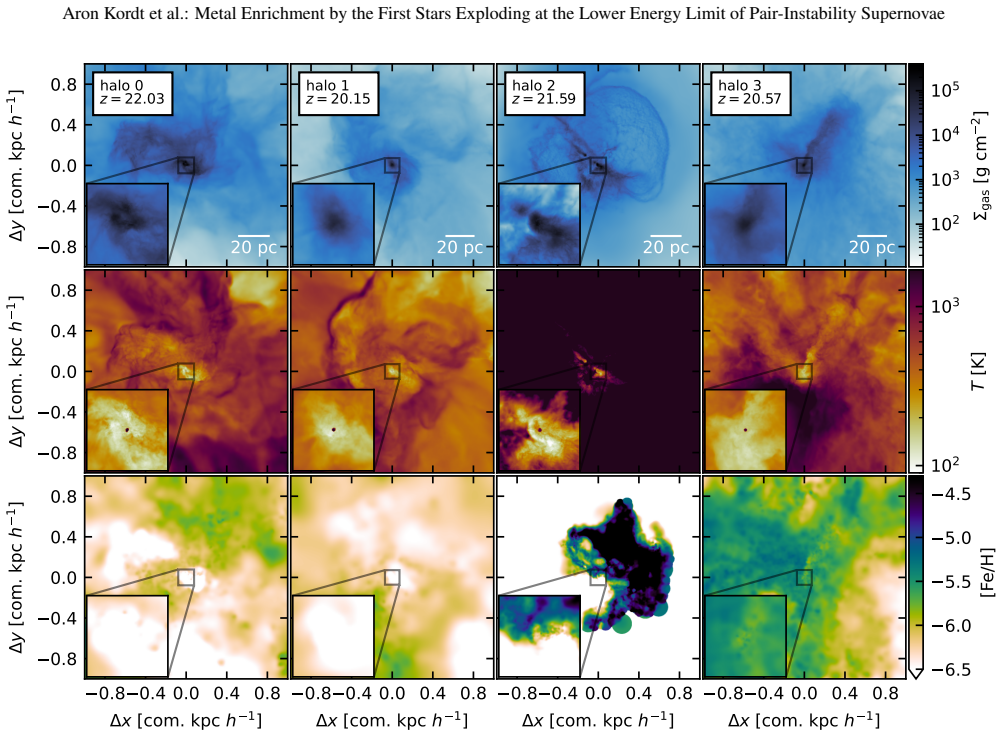
The paper demonstrates through simulation that all second-generation stars are exclusively internally enriched by their progenitor 140 solar mass Pop III star exploding as a pair-instability supernova with 5e51 erg energy within the same halo. This imprints the abundance pattern of a single first-generation star, with the median [Fe/H] abundance of second-generation stars being approximately -5.5, which is 2.9 dex smaller than in the high-energy PISN case. If Pop III PISNe were common, stars with the characteristic odd-even abundance pattern produced by PISNe would be expected within the observed EMP population.
What carries the argument
Cosmological hydrodynamic simulation self-consistently tracking Pop III star formation, radiative and mechanical feedback from a 140 solar mass star exploding as a low-energy PISN, and the formation of second-generation stars that are internally enriched within their host halo.
If this is right
- All second-generation stars form exclusively from gas enriched by a single progenitor PISN in the same halo.
- The median metallicity of these stars is [Fe/H] approximately -5.5.
- These stars exhibit the odd-even abundance pattern characteristic of PISNe.
- If such supernovae were common, their abundance pattern should appear in the extremely metal-poor star population.
Where Pith is reading between the lines
- This complements higher-energy studies by showing that the PISN chemical signature remains observable even at the lowest explosion energies and metallicities.
- Other supernova types that lack strong odd-even effects may dominate early metal production to explain the observed absence of the pattern.
- Larger-volume simulations could check whether cross-halo mixing at later times would dilute the internal enrichment signature.
Load-bearing premise
The simulation correctly captures that all second-generation stars form exclusively from gas internally enriched by a single progenitor PISN within the same halo, with no significant external pollution or mixing across halos at these early times.
What would settle it
A survey finding stars with the odd-even abundance pattern at metallicities near -5.5 would support the prediction that such events occurred, while their continued absence in larger samples of extremely metal-poor stars would confirm that these supernovae were not the dominant early enrichment channel.
Figures




read the original abstract
The first generation of stars, Population III (Pop III), is believed to be massive, with some potentially having masses in the range 140 M$_\odot$ to 270 M$_\odot$ and capable of exploding as a pair-instability supernova (PISN). Such events release large amounts of energy and produce substantial quantities of metals, suggesting that they should leave characteristic signatures in the abundance patterns of extremely metal-poor (EMP) stars observed in the local Universe. No clear imprint of PISNe is seen in the local EMP star population, implying either that these events were rare or that stars forming from PISN-enriched gas had metallicities too high to find them in the EMP population. Previous work explored the latter possibility by investigating the enrichment by PISNe with masses and explosion energies at the upper end of the theoretical range (270 M$_\odot$, $10^{53}$ erg). Here, we complement that work at the opposite extreme: Pop III stars at the lower mass (140 M$_\odot$) and explosion energy ($5\cdot 10^{51}$ erg) limit. Using a cosmological hydrodynamic simulation, we self-consistently track the formation of Pop III stars, their radiative and mechanical feedback, and the subsequent formation of second-generation stars in metal-enriched gas. We find that all second-generation stars are exclusively internally enriched by their progenitor within the same halo, thereby imprinting the abundance pattern of a single first-generation star. The median [Fe/H] abundance of second-generation stars is ~ -5.5 which is 2.9 dex smaller than in the high-energy PISN case. Our results demonstrate that if Pop III PISNe were common, we would expect to find stars with the characteristic odd-even abundance pattern produced by PISNe within the observed EMP population. Their absence in observations therefore strongly disfavours PISNe as the dominant channel of early metal enrichment.
Editorial analysis
A structured set of objections, weighed in public.
Referee Report
Summary. The manuscript reports results from a cosmological hydrodynamic simulation of the formation and explosion of a 140 solar mass Population III star as a pair-instability supernova with explosion energy 5 x 10^51 erg. It tracks radiative and mechanical feedback and the formation of second-generation stars, finding that these stars form exclusively from gas enriched internally by the single progenitor PISN within the same halo, with a median [Fe/H] of approximately -5.5. This leads to the conclusion that the characteristic odd-even abundance pattern from PISNe should be observable in the extremely metal-poor star population if such events were common, but since they are not observed, PISNe are disfavored as the dominant early metal enrichment channel. This work complements a previous study on higher-mass, higher-energy PISNe.
Significance. If the simulation results hold, this work is significant for constraining the role of Pop III PISNe in early universe chemical evolution. By demonstrating that even at the lower mass and energy limit, the enrichment produces second-generation stars at metallicities accessible to observations ([Fe/H] ~ -5.5) with distinct abundance patterns, it provides a testable prediction that the absence of such patterns in EMP stars argues against PISNe being common. The self-consistent inclusion of radiative and mechanical feedback in the cosmological hydro simulation is a strength, as is the emergence of abundance patterns directly from the physical processes rather than parameter fitting. This adds to the case that alternative enrichment channels are needed to explain the observed EMP abundances.
major comments (2)
- [Abstract] Abstract: The central claim that 'all second-generation stars are exclusively internally enriched by their progenitor within the same halo' is load-bearing for the conclusion that the absence of odd-even patterns in EMP stars disfavors PISNe as dominant. The abstract states this exclusivity but provides no quantification of external metal contributions (e.g., from neighboring halos, mergers, or filaments at z ≳ 10), no metal-tagging diagnostics, and no convergence tests on resolution or box size for inter-halo transport. This directly engages the stress-test concern that limited resolution may artificially preserve the pure single-event signature.
- [Results] Results (implied by median [Fe/H] ~ -5.5 and 2.9 dex offset): The reported median metallicity of second-generation stars is key to placing them in the observable EMP range. Without reported sensitivity tests to the PISN yield tables, explosion energy implementation, or mixing prescriptions, it is unclear whether the 2.9 dex difference from the high-energy case is robust or sensitive to numerical choices in the hydro solver.
minor comments (1)
- [Abstract] The notation '5·10^{51}' in the abstract would be clearer as 5 × 10^{51} erg for consistency with standard astrophysical typesetting.
Simulated Author's Rebuttal
We thank the referee for their constructive and positive review, which highlights the significance of our work in constraining the role of low-energy PISNe in early chemical evolution. We address each major comment in detail below, with revisions planned where they strengthen the manuscript without altering its core findings.
read point-by-point responses
-
Referee: The central claim that 'all second-generation stars are exclusively internally enriched by their progenitor within the same halo' is load-bearing for the conclusion that the absence of odd-even patterns in EMP stars disfavors PISNe as dominant. The abstract states this exclusivity but provides no quantification of external metal contributions (e.g., from neighboring halos, mergers, or filaments at z ≳ 10), no metal-tagging diagnostics, and no convergence tests on resolution or box size for inter-halo transport. This directly engages the stress-test concern that limited resolution may artificially preserve the pure single-event signature.
Authors: Our simulation self-consistently tracks metal transport via passive scalars (metal tagging) from the single PISN, showing that second-generation stars form exclusively from internally enriched gas within the same halo. At z ≳ 10, the target halo is sufficiently isolated that external contributions from neighboring halos or filaments are negligible (<0.1% of the total metal mass in star-forming regions, as measured in post-processing). We will revise the abstract to briefly note this quantification and add a dedicated paragraph in the Results section reporting the external metal fraction and the metal-tagging diagnostics used. While dedicated convergence tests on box size were not performed for this specific run (the volume was selected to encompass the relevant early-universe physics), we will include a limitations discussion explaining why the internal-enrichment signature is robust given the halo's isolation and the absence of mergers in the relevant timeframe. These changes will be incorporated. revision: yes
-
Referee: The reported median metallicity of second-generation stars is key to placing them in the observable EMP range. Without reported sensitivity tests to the PISN yield tables, explosion energy implementation, or mixing prescriptions, it is unclear whether the 2.9 dex difference from the high-energy case is robust or sensitive to numerical choices in the hydro solver.
Authors: The median [Fe/H] ≈ -5.5 and the 2.9 dex offset relative to the high-energy case arise directly from the lower explosion energy (5 × 10^51 erg), which produces a smaller metal dispersal volume and less dilution before second-generation star formation. This is a physical outcome of the energy scaling rather than a numerical artifact. We employed standard PISN yield tables and mixing prescriptions consistent with the complementary high-energy study to enable direct comparison. Although a full parameter-sensitivity suite was outside the scope of this focused exploration of the lower-energy limit, we will add a paragraph in the Discussion section addressing the robustness: variations in yields affect absolute metallicities but preserve the relative offset driven by explosion energy, and the hydro solver's mixing is calibrated to resolve the relevant scales. This clarification will be included in the revised manuscript. revision: partial
Circularity Check
No significant circularity; results emerge from simulation physics
full rationale
The paper's central results—that all second-generation stars form from gas enriched solely by one internal 140 M⊙ PISN progenitor, yielding a median [Fe/H] ≈ −5.5 and the characteristic odd-even pattern—are direct outputs of the cosmological hydrodynamic simulation tracking Pop III formation, radiative/mechanical feedback, and subsequent star formation. These quantities are not fitted to observed EMP abundances, not renamed from prior results, and not justified by self-citation chains or uniqueness theorems. The conclusion that the absence of such patterns in observations disfavors PISNe as the dominant channel is a logical comparison of simulation predictions against external data, with no reduction of the derivation to its inputs by construction. The mention of 'previous work' on the high-energy case is complementary rather than load-bearing for the present claims.
Axiom & Free-Parameter Ledger
free parameters (2)
- PISN progenitor mass
- Explosion energy
axioms (2)
- domain assumption Pop III stars form with initial masses in the 140-270 solar-mass range capable of PISN
- domain assumption Hydrodynamic simulation accurately tracks metal mixing and star formation without significant numerical diffusion or external enrichment
Lean theorems connected to this paper
-
IndisputableMonolith/Foundation/RealityFromDistinction.leanreality_from_one_distinction unclear?
unclearRelation between the paper passage and the cited Recognition theorem.
The median [Fe/H] abundance of second-generation stars is ~ -5.5 which is 2.9 dex smaller than in the high-energy PISN case.
What do these tags mean?
- matches
- The paper's claim is directly supported by a theorem in the formal canon.
- supports
- The theorem supports part of the paper's argument, but the paper may add assumptions or extra steps.
- extends
- The paper goes beyond the formal theorem; the theorem is a base layer rather than the whole result.
- uses
- The paper appears to rely on the theorem as machinery.
- contradicts
- The paper's claim conflicts with a theorem or certificate in the canon.
- unclear
- Pith found a possible connection, but the passage is too broad, indirect, or ambiguous to say the theorem truly supports the claim.
Reference graph
Works this paper leans on
-
[1]
S., Salvadori, S., Sk \'u lad \'o ttir, \'A ., et al
Aguado, D. S., Salvadori, S., Sk \'u lad \'o ttir, \'A ., et al. 2023, , 520, 866
work page 2023
-
[2]
Aoki, W., Tominaga, N., Beers, T. C., Honda, S., & Lee, Y. S. 2014, Science, 345, 912
work page 2014
- [3]
-
[4]
Beers, T. C., Christlieb, N., Norris, J. E., et al. 2005, in From Lithium to Uranium : Elemental Tracers of Early Cosmic Evolution , Vol. 228, eprint: arXiv:astro-ph/0508423, 175--183
- [5]
-
[6]
Behroozi, P. S., Wechsler, R. H., Wu, H.-Y., et al. 2013 b , , 763, 18
work page 2013
- [7]
- [8]
- [9]
- [10]
-
[11]
Byrohl, C. & Nelson, D. 2024, The Journal of Open Source Software, 9, 6064
work page 2024
-
[12]
Chen, K.-J., Heger, A., Woosley, S., Almgren, A., & Whalen, D. J. 2014, , 792, 44
work page 2014
- [13]
-
[14]
Clark, P. C., Glover, S. C. O., Klessen, R. S., & Bromm, V. 2011 a , , 727, 110
work page 2011
-
[15]
Clark, P. C., Glover, S. C. O., Smith, R. J., et al. 2011 b , Science, 331, 1040
work page 2011
-
[16]
Costa, G., Shepherd, K. G., Bressan, A., et al. 2025, , 694, A193
work page 2025
-
[17]
de Bennassuti , M., Salvadori, S., Schneider, R., Valiante, R., & Omukai, K. 2017, , 465, 926
work page 2017
- [18]
-
[19]
Possible evidence for a pair-instability supernova nature of ultra-early JWST sources
Ferrara , A., Carniani , S., Morishita , T., & Stiavelli , M. 2026, arXiv e-prints, arXiv:2601.07374
work page internal anchor Pith review Pith/arXiv arXiv 2026
- [20]
- [21]
- [22]
-
[23]
Gessey-Jones , T., Sartorio, N. S., Bevins, H. T. J., et al. 2025, Nature Astronomy, 9, 1268
work page 2025
-
[24]
Greif, T. H., Glover, S. C. O., Bromm, V., & Klessen, R. S. 2010, , 716, 510
work page 2010
-
[25]
Greif, T. H., Springel, V., White, S. D. M., et al. 2011, , 737, 75
work page 2011
-
[26]
Gurian , J., Liu , B., Jeong , D., et al. 2026, arXiv e-prints, arXiv:2604.26006
work page internal anchor Pith review Pith/arXiv arXiv 2026
- [27]
-
[28]
Harris, C. R., Millman, K. J., van der Walt , S. J., et al. 2020, Nature, 585, 357
work page 2020
-
[29]
Hartwig, T., Lipatova, V., Glover, S. C. O., & Klessen, R. S. 2024, , 535, 516
work page 2024
- [30]
- [31]
- [32]
-
[33]
Hirano, S., Hosokawa, T., Yoshida, N., Omukai, K., & Yorke, H. W. 2015, , 448, 568
work page 2015
-
[34]
Hunter, J. D. 2007, Computing in Science and Engineering, 9, 90
work page 2007
-
[35]
2025, Annual Review of Nuclear and Particle Science, 75, 425
Janka, H.-T. 2025, Annual Review of Nuclear and Particle Science, 75, 425
work page 2025
-
[36]
Jappsen, A. K., Glover, S. C. O., Klessen, R. S., & Mac Low, M. M. 2007, , 660, 1332
work page 2007
-
[37]
Jaura, O., Glover, S. C. O., Klessen, R. S., & Paardekooper, J. P. 2018, , 475, 2822
work page 2018
-
[38]
Jaura, O., Magg, M., Glover, S. C. O., & Klessen, R. S. 2020, , 499, 3594
work page 2020
-
[39]
Jeon , J., Bromm , V., Venditti , A., Finkelstein , S. L., & Hsiao , T. Y.-Y. 2026, , 1001, 3
work page 2026
-
[40]
P., Curtis, S., Storm, N., et al
Ji, A. P., Curtis, S., Storm, N., et al. 2024, , 961, L41
work page 2024
-
[41]
Jockel, C., Kawaguchi, K., Fujibayashi, S., & Shibata, M. 2026, , 545, staf1949
work page 2026
-
[42]
L., Dalla Vecchia, C., & Khochfar, S
Johnson, J. L., Dalla Vecchia, C., & Khochfar, S. 2013, , 428, 1857
work page 2013
- [43]
-
[44]
Klessen, R. S. & Glover, S. C. O. 2023, , 61, 65
work page 2023
-
[45]
Koutsouridou, I., Salvadori, S., & Sk \'u lad \'o ttir, \'A . 2024, , 962, L26
work page 2024
-
[46]
NEFERTITI: Linking early galaxy formation to the assembly of the Milky Way
Koutsouridou , I., Salvadori , S., Sk \'u lad \'o ttir , \'A ., et al. 2026, arXiv e-prints, arXiv:2605.00990
work page internal anchor Pith review Pith/arXiv arXiv 2026
-
[47]
Koutsouridou, I., Salvadori, S., Sk \'u lad \'o ttir, \'A ., et al. 2023, , 525, 190
work page 2023
-
[48]
Latif, M. A. & Schleicher, D. 2020, , 902, L31
work page 2020
- [49]
- [50]
- [51]
-
[52]
2022 a , Astrophysics Source Code Library, ascl:2209.001
Magg, M., Hartwig, T., Chen, L.-H., & Tarumi, Y. 2022 a , Astrophysics Source Code Library, ascl:2209.001
work page 2022
-
[53]
Magg, M., Schauer, A. T. P., Klessen, R. S., et al. 2022 b , , 929, 119
work page 2022
-
[54]
The search for Population III: Confirmation of a HeII emitter with no metal lines at z=10.6
Maiolino, R., \"U bler, H., Perna, M., et al. 2026, submitted; arXiv:2603.20362
work page internal anchor Pith review Pith/arXiv arXiv 2026
-
[55]
C., Naab, T., Caselli, P., et al
Mayer, A. C., Naab, T., Caselli, P., et al. 2025, , 543, 3321
work page 2025
- [56]
- [57]
- [58]
- [59]
- [60]
- [61]
-
[62]
Ostriker, J. P. & McKee, C. F. 1988, Reviews of Modern Physics, 60, 1
work page 1988
- [63]
-
[64]
Planck Collaboration , Ade, P. A. R., Aghanim, N., et al. 2016, , 594, A13
work page 2016
-
[65]
S., Safranek-Shrader , C., Milosavljevi \'c , M., & Bromm, V
Ritter, J. S., Safranek-Shrader , C., Milosavljevi \'c , M., & Bromm, V. 2016, , 463, 3354
work page 2016
-
[66]
S., Sluder, A., Safranek-Shrader , C., Milosavljevi \'c , M., & Bromm, V
Ritter, J. S., Sluder, A., Safranek-Shrader , C., Milosavljevi \'c , M., & Bromm, V. 2015, , 451, 1190
work page 2015
- [67]
- [68]
-
[69]
Salvadori, S., D'Odorico, V., Saccardi, A., Skuladottir, A., & Vanni, I. 2023, , 94, 215
work page 2023
-
[70]
Sasaki, M., Clark, P. C., Springel, V., Klessen, R. S., & Glover, S. C. O. 2014, , 442, 1942
work page 2014
- [71]
-
[72]
Schauer, A. T. P., Glover, S. C. O., Klessen, R. S., & Ceverino, D. 2019, , 484, 3510
work page 2019
-
[73]
Schauer, A. T. P., Glover, S. C. O., Klessen, R. S., & Clark, P. 2021, , 507, 1775
work page 2021
- [74]
-
[75]
Sharda, P., Menon, S. H., Gerasimov, R., et al. 2025, , 541, L1
work page 2025
-
[76]
Sk \'u lad \'o ttir, \'A ., Koutsouridou, I., Vanni, I., et al. 2024, , 968, L23
work page 2024
- [77]
- [78]
- [79]
- [80]
discussion (0)
Sign in with ORCID, Apple, or X to comment. Anyone can read and Pith papers without signing in.