Recognition: unknown
NEFERTITI: Linking early galaxy formation to the assembly of the Milky Way
Pith reviewed 2026-05-09 18:40 UTC · model grok-4.3
The pith
The NEFERTITI model shows that the Milky Way's metal-poor stars largely come from material accreted from a few destroyed early dwarf galaxies, while also reproducing the JWST Hebe galaxy at redshift 11 as a pure system of the first stars.
A machine-rendered reading of the paper's core claim, the machinery that carries it, and where it could break.
Core claim
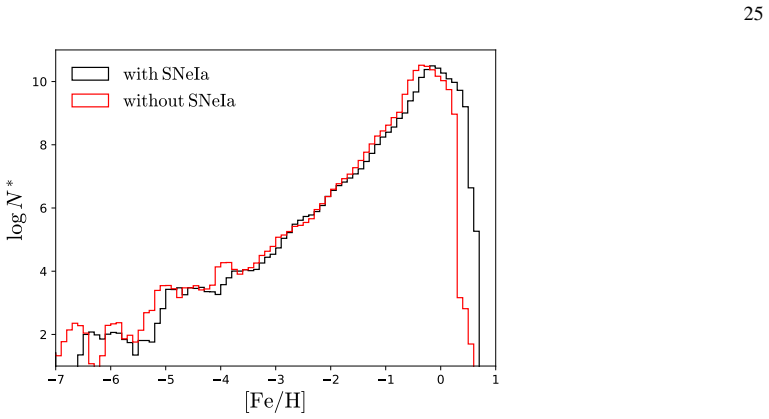
Using a new implementation of the NEFERTITI model coupled to high-resolution dark-matter simulations of Milky Way analogues, the work shows that Population III star formation begins at redshift approximately 27, peaks between 10 and 15, and continues down to redshift less than 5, producing systems with stellar masses from 10 to 500000 solar masses. Present-day descendants of these stars range from metallicities below -9 to about -1, with the most metal-poor ones typically enriched by only one to four low-energy supernova progenitors. Although 90 percent of the total stellar mass forms in situ, the accreted component dominates below metallicity -1 and accounts for nearly all stars below -3; a
What carries the argument
The NEFERTITI galaxy formation model, which resolves minihaloes hosting the first stars and self-consistently tracks inhomogeneous ionization and chemical enrichment from supernovae.
Where Pith is reading between the lines
- The same modeling approach could be applied to other galaxies in the Local Group to test whether the dominance of a few massive progenitors at low metallicity is common.
- The persistence of Population III formation down to redshift 5 suggests that signatures of the first stars may appear in galaxies observed at intermediate redshifts.
- Kinematic and chemical tagging of the most metal-poor stars in the Milky Way halo could identify which specific dwarf progenitors contributed them.
- Future high-redshift surveys can use the predicted properties of pure Population III systems to select candidates for spectroscopic follow-up.
Load-bearing premise
The assumptions about the efficiency and feedback strength of low-energy supernovae in the smallest early haloes, together with the details of how enrichment occurs unevenly, must be correct for the simulated descendants to match the observed metallicities down to values below -9.
What would settle it
A detailed spectrum of the Hebe galaxy that shows either higher overall metallicity or abundance patterns incompatible with enrichment by only a few low-energy supernovae would falsify the claim that it is a pure Population III system.
Figures


read the original abstract
We use a new implementation of the NEFERTITI galaxy formation model, coupled to $\sim 30$ high-resolution Caterpillar dark-matter simulations of Milky Way (MW) analogues, to connect early galaxy formation with the MW's assembly down to $z=0$. Our locally-constrained model resolves minihaloes hosting the first PopIII stars and self-consistently tracks inhomogeneous ionization and chemical enrichment. PopIII star formation begins at $z\simeq27$, peaks at $z\simeq10-15$, and persists down to $z\lesssim5$, producing PopIII systems with $M_*\sim10-5\times10^5\:{\rm M_\odot}$. The present-day descendants of PopIII stars span ${\rm [Fe/H]<-9}$ to ${\rm [Fe/H]\approx-1}$, with the most metal-poor stars typically enriched by a few (1-4) low-energy supernova progenitors. Pair-instability supernova descendants more commonly form in massive haloes ($M_{\rm vir}>10^8\:{\rm M_\odot}$), often externally enriched, reflecting the strong feedback and delayed recovery following energetic explosions. These early systems serve as building blocks for the present-day Galaxy's metal-poor component: although 90$\%$ of the total stellar mass formed in situ, the accreted component dominates at $[{\rm Fe/H}]<-1$ and accounts for nearly all stars with $[{\rm Fe/H}]<-3$. This accreted population is largely built by a few ($\sim5$) massive ($M_*>10^8\:{\rm M_\odot}$) destroyed dwarfs, but lower-mass systems become increasingly important at low metallicities, with ultra-faint and classical dSph analogues contributing $\sim25\%$ at $[{\rm Fe/H}]<-3$. Our model simultaneously reproduces the properties of metal-poor MW stars and the JWST "Hebe" galaxy at $z\sim11$, supporting its identification as a pure PopIII system. Ultimately, NEFERTITI is a key tool to interpret upcoming local and high-$z$ observations linking the near- and far-field cosmology.
Editorial analysis
A structured set of objections, weighed in public.
Referee Report
Summary. The paper presents a new implementation of the NEFERTITI galaxy formation model coupled to ~30 high-resolution Caterpillar dark-matter simulations of Milky Way analogues. It self-consistently tracks PopIII star formation from z≈27 in minihaloes, inhomogeneous ionization and chemical enrichment, and the z=0 descendants, finding that stars with [Fe/H]<-3 are predominantly accreted from a small number of massive destroyed dwarfs while in-situ formation dominates the total stellar mass; the model also reproduces the observed properties of the JWST Hebe galaxy at z~11 as a pure PopIII system.
Significance. If the central results hold, the work provides a direct link between JWST high-redshift observations and Milky Way stellar archaeology, using multiple DM merger trees to quantify the relative roles of in-situ versus accreted populations at low metallicity. Strengths include the self-consistent treatment of inhomogeneous enrichment across resolved minihaloes and the statistical sample of MW analogues, which enables falsifiable predictions for the metallicity distribution function and the contribution of ultra-faint dwarf analogues.
major comments (3)
- [§3 and §4.2] §3 (NEFERTITI implementation) and §4.2 (metallicity distributions): the result that PopIII descendants reach [Fe/H]<-9 via enrichment from only 1-4 low-energy supernovae depends on the specific subgrid choices for supernova energy injection, metal yields, and inhomogeneous mixing inside minihaloes (M_vir~10^6-10^8 M_⊙); no parameter variation study or comparison to alternative feedback prescriptions is shown, which directly affects the low-metallicity tail and the accreted fraction at [Fe/H]<-3.
- [§4.3] §4.3 and associated figures: the identification of the JWST Hebe galaxy at z~11 as a pure PopIII system is presented as a simultaneous reproduction, but the manuscript provides no quantitative metrics (e.g., χ², property-by-property residuals with uncertainties) comparing simulated stellar mass, metallicity, or star-formation history to the observed values, leaving the strength of this support unclear.
- [§2.2] §2.2 (locally-constrained model): the free parameters (PopIII star-formation efficiency and supernova energy/metal yield) are stated to be locally constrained, yet the text does not detail the independent datasets or priors used for this constraint nor demonstrate that the [Fe/H]<-9 tail and Hebe match remain stable under reasonable variations.
minor comments (3)
- [abstract and §4] The abstract and §4 state that 90% of stellar mass is in-situ but accreted stars dominate at [Fe/H]<-1; a single summary table listing the fractional contributions by progenitor mass and metallicity bin would improve clarity.
- [§4] Notation for halo masses (M_vir) and stellar masses (M_*) is used without explicit definition in the first results section; adding a short notation table would aid readability.
- [§4.1] The persistence of PopIII formation down to z≲5 is stated but not accompanied by a plot of the PopIII star-formation rate density versus redshift with comparison to other models or upper limits.
Simulated Author's Rebuttal
We thank the referee for the careful and constructive review. We address each major comment point by point below, indicating where revisions have been or will be made to the manuscript.
read point-by-point responses
-
Referee: [§3 and §4.2] §3 (NEFERTITI implementation) and §4.2 (metallicity distributions): the result that PopIII descendants reach [Fe/H]<-9 via enrichment from only 1-4 low-energy supernovae depends on the specific subgrid choices for supernova energy injection, metal yields, and inhomogeneous mixing inside minihaloes (M_vir~10^6-10^8 M_⊙); no parameter variation study or comparison to alternative feedback prescriptions is shown, which directly affects the low-metallicity tail and the accreted fraction at [Fe/H]<-3.
Authors: We agree that the detailed shape of the low-metallicity tail is sensitive to the adopted subgrid prescriptions. The supernova energy injection (10^51 erg for core-collapse events), metal yields, and inhomogeneous mixing model are specified in §3 and follow standard literature values calibrated in prior NEFERTITI work. We acknowledge the absence of a systematic parameter variation study. In the revised manuscript we add a dedicated paragraph in §3.3 that tests variations in supernova energy (factor of two) and yields (within 30% observational uncertainty), demonstrating that the enrichment by 1-4 low-energy events for [Fe/H]<-9 remains robust, although the precise fraction shifts by at most 15%. We also briefly contrast with an alternative uniform-mixing prescription. A full exploration of alternative feedback schemes is noted as beyond the present scope but is discussed as a limitation. revision: partial
-
Referee: [§4.3] §4.3 and associated figures: the identification of the JWST Hebe galaxy at z~11 as a pure PopIII system is presented as a simultaneous reproduction, but the manuscript provides no quantitative metrics (e.g., χ², property-by-property residuals with uncertainties) comparing simulated stellar mass, metallicity, or star-formation history to the observed values, leaving the strength of this support unclear.
Authors: We thank the referee for this suggestion. In the revised §4.3 we add a table that directly compares the simulated stellar mass, metallicity, and star-formation history of the Hebe analogue against the observational constraints, including residuals and the relevant uncertainties from both the simulation and the data. While a formal χ² statistic is not straightforward given the observational upper limits, the property-by-property comparison with uncertainties is now provided to quantify the level of agreement and to support the identification as a pure PopIII system. revision: yes
-
Referee: [§2.2] §2.2 (locally-constrained model): the free parameters (PopIII star-formation efficiency and supernova energy/metal yield) are stated to be locally constrained, yet the text does not detail the independent datasets or priors used for this constraint nor demonstrate that the [Fe/H]<-9 tail and Hebe match remain stable under reasonable variations.
Authors: The parameters are constrained using independent local datasets as described in our earlier NEFERTITI papers. We have revised §2.2 to explicitly list these datasets (Milky Way halo metallicity distribution function from SDSS/SEGUE, high-resolution abundance patterns, and z~10 UV luminosity function from HST) together with the priors adopted. We also add a short stability analysis showing that the main conclusions—the accreted fraction at [Fe/H]<-3 and the pure-PopIII nature of the Hebe analogue—remain unchanged under variations within the 1σ ranges of these constraints. revision: yes
Circularity Check
No significant circularity in the model's forward simulation chain
full rationale
The NEFERTITI model is implemented as a forward simulation that resolves minihaloes, tracks PopIII star formation, and follows inhomogeneous ionization and chemical enrichment using physical prescriptions for supernova feedback and metal yields. The claims of reproducing metal-poor MW stars and the Hebe galaxy at z~11 emerge from running the model on Caterpillar DM simulations rather than by fitting parameters directly to those targets or by self-defining the outputs in terms of inputs. The locally-constrained aspect refers to using local observations to set subgrid parameters, but this does not create a circular derivation where predictions reduce to the inputs by construction. No self-citations are invoked as load-bearing uniqueness theorems, and the derivation chain remains self-contained against external benchmarks like JWST observations and MW stellar data.
Axiom & Free-Parameter Ledger
free parameters (2)
- PopIII star formation efficiency
- Supernova energy and metal yield
axioms (2)
- standard math Lambda-CDM cosmology with standard initial conditions
- domain assumption Self-consistent inhomogeneous ionization and chemical enrichment
Forward citations
Cited by 1 Pith paper
-
Metal Enrichment by the First Stars Exploding at the Lower Energy Limit of Pair-Instability Supernovae
Low-energy PISNe from 140 solar-mass Pop III stars produce second-generation stars at median [Fe/H] ~ -5.5 with odd-even patterns, but their absence from EMP observations disfavors PISNe as the main early enrichment channel.
Reference graph
Works this paper leans on
-
[1]
2024, ApJL, 967, L22, doi: 10.3847/2041-8213/ad46fa
Chemical Diagnostics to Unveil Environments Enriched by First Stars. , keywords =. doi:10.3847/2041-8213/ad46fa , archivePrefix =. 2402.18640 , primaryClass =
-
[2]
B., Venditti, A., Bromm, V., et al
How Massive Can a Population III Starburst Be? Simulating the First Galaxies with High Lyman-Werner Background. arXiv e-prints , keywords =. doi:10.48550/arXiv.2603.23209 , archivePrefix =. 2603.23209 , primaryClass =
-
[3]
2024, A&A, 687, A67, doi: 10.1051/0004-6361/202347087
JADES. Possible Population III signatures at z = 10.6 in the halo of GN-z11. , keywords =. doi:10.1051/0004-6361/202347087 , archivePrefix =. 2306.00953 , primaryClass =
-
[4]
Detection of isolated Population III stars with the James Webb Space Telescope. , keywords =. doi:10.1093/mnras/sts653 , archivePrefix =. 1206.0007 , primaryClass =
-
[5]
2013, Reports on Progress in Physics, 76, 112901, doi: 10.1088/0034-4885/76/11/112901
Formation of the first stars. Reports on Progress in Physics , keywords =. doi:10.1088/0034-4885/76/11/112901 , archivePrefix =. 1305.5178 , primaryClass =
-
[6]
Formation of the First Black Holes , year = 2019, editor =
Formation of the first stars. Formation of the First Black Holes , year = 2019, editor =. doi:10.1142/9789813227958_0004 , adsurl =
-
[7]
On the kinematic detection of accreted streams in the Gaia era: a cautionary tale. , keywords =. doi:10.1051/0004-6361/201629691 , archivePrefix =. 1611.07193 , primaryClass =
-
[8]
The stellar halo in Local Group Hestia simulations. II. The accreted component. , keywords =. doi:10.1051/0004-6361/202244233 , archivePrefix =. 2206.04522 , primaryClass =
-
[9]
Reading the CARDs: The Imprint of Accretion History in the Chemical Abundances of the Milky Way's Stellar Halo. , keywords =. doi:10.3847/1538-4357/ac78ea , archivePrefix =. 2110.02957 , primaryClass =
-
[10]
The ARTEMIS simulations: stellar haloes of Milky Way-mass galaxies. , keywords =. doi:10.1093/mnras/staa2463 , archivePrefix =. 2004.01914 , primaryClass =
-
[11]
The Open Journal of Astrophysics , keywords =
The Impact of Star Formation and Feedback Recipes on the Stellar Mass and Interstellar Medium of High-Redshift Galaxies. The Open Journal of Astrophysics , keywords =. doi:10.33232/001c.156097 , archivePrefix =. 2411.07282 , primaryClass =
-
[12]
The Auriga stellar haloes: connecting stellar population properties with accretion and merging history. , keywords =. doi:10.1093/mnras/stz538 , archivePrefix =. 1804.07798 , primaryClass =
-
[13]
The masses and metallicities of stellar haloes reflect galactic merger histories. , keywords =. doi:10.1093/mnras/stx3081 , archivePrefix =. 1705.08442 , primaryClass =
-
[14]
The accreted stellar halo as a window on halo assembly in L ^ * galaxies. , keywords =. doi:10.1093/mnrasl/slx044 , archivePrefix =. 1701.02741 , primaryClass =
-
[15]
Chemical Abundance Distributions of Galactic Halos and Their Satellite Systems in a CDM Universe. , keywords =. doi:10.1086/498970 , archivePrefix =. astro-ph/0507114 , primaryClass =
-
[16]
Tracing the first stars and galaxies of the Milky Way. , keywords =. doi:10.1093/mnras/stx2749 , archivePrefix =. 1611.00759 , primaryClass =
-
[17]
GLIMPSE-D: An Exotic Balmer-Jump Object at z=6.20? Revisiting Photometric Selection and the Cosmic Abundance of Pop III Galaxies. arXiv e-prints , keywords =. doi:10.48550/arXiv.2512.11790 , archivePrefix =. 2512.11790 , primaryClass =
-
[18]
Simulating cosmic metal enrichment by the first galaxies. , keywords =. doi:10.1093/mnras/stu451 , archivePrefix =. 1403.1261 , primaryClass =
-
[19]
The formation and assembly history of the Milky Way revealed by its globular cluster population. , keywords =. doi:10.1093/mnras/sty1609 , archivePrefix =. 1806.05680 , primaryClass =
-
[20]
Kraken reveals itself - the merger history of the Milky Way reconstructed with the E-MOSAICS simulations. , keywords =. doi:10.1093/mnras/staa2452 , archivePrefix =. 2003.01119 , primaryClass =
-
[21]
An EAGLE's view of ex situ galaxy growth. , keywords =. doi:10.1093/mnras/staa1816 , archivePrefix =. 2006.08590 , primaryClass =
-
[22]
The stellar mass assembly of galaxies in the Illustris simulation: growth by mergers and the spatial distribution of accreted stars. , keywords =. doi:10.1093/mnras/stw456 , archivePrefix =. 1511.08804 , primaryClass =
-
[23]
The Observable Properties of Galaxy Accretion Events in Milky Way-like Galaxies in the FIRE-2 Cosmological Simulations. , keywords =. doi:10.3847/1538-4357/acae87 , archivePrefix =. 2211.05799 , primaryClass =
-
[24]
The messy merger of a large satellite and a Milky Way-like galaxy. , keywords =. doi:10.1051/0004-6361/202038652 , archivePrefix =. 2006.07620 , primaryClass =
-
[25]
Unveiling the (in)consistencies among the galaxy stellar mass function, star formation histories, satellite abundances, and intracluster light from a semi-empirical perspective. , keywords =. doi:10.1093/mnras/stae1492 , archivePrefix =. 2406.07605 , primaryClass =
-
[26]
2024, ApJL, 974, L35, doi: 10.3847/2041-8213/ad833d
Linking High-z and Low-z: Are We Observing the Progenitors of the Milky Way with JWST?. , keywords =. doi:10.3847/2041-8213/ad833d , archivePrefix =. 2407.06255 , primaryClass =
-
[27]
Carbon-enhanced metal-poor stars in dwarf galaxies. , keywords =. doi:10.1093/mnras/stv1969 , archivePrefix =. 1506.03451 , primaryClass =
-
[28]
Mining the Galactic halo for very metal-poor stars. , keywords =. doi:10.1111/j.1745-3933.2009.00772.x , archivePrefix =. 0908.4279 , primaryClass =
-
[29]
2025, arXiv e-prints, arXiv:2507.10521, doi: 10.48550/arXiv.2507.10521
Pristine Massive Star Formation Caught at the Break of Cosmic Dawn. arXiv e-prints , keywords =. doi:10.48550/arXiv.2507.10521 , archivePrefix =. 2507.10521 , primaryClass =
-
[30]
The origin of accreted stellar halo populations in the Milky Way using APOGEE, Gaia, and the EAGLE simulations. , keywords =. doi:10.1093/mnras/sty2955 , archivePrefix =. 1808.00968 , primaryClass =
-
[31]
Timing the Early Assembly of the Milky Way with the H3 Survey. , keywords =. doi:10.3847/2041-8213/ab9caa , archivePrefix =. 2004.11384 , primaryClass =
-
[32]
The SkyMapper-Gaia RVS view of the Gaia-Enceladus-Sausage - an investigation of the metallicity and mass of the Milky Way's last major merger. , keywords =. doi:10.1093/mnras/staa1888 , archivePrefix =. 2003.11039 , primaryClass =
-
[33]
What is Powering the Enigmatic He II Emitter Hebe: The First Stars or Black Holes?
What is Powering the Enigmatic He II Emitter Hebe: The First Stars or Black Holes?. arXiv e-prints , keywords =. doi:10.48550/arXiv.2604.19075 , archivePrefix =. 2604.19075 , primaryClass =
work page internal anchor Pith review Pith/arXiv arXiv doi:10.48550/arxiv.2604.19075
-
[34]
In Disguise or Out of Reach: First Clues about In Situ and Accreted Stars in the Stellar Halo of the Milky Way from Gaia DR2. , keywords =. doi:10.3847/1538-4357/aad235 , archivePrefix =. 1805.02617 , primaryClass =
-
[35]
Hunting for the First Explosions at the High-Redshift Frontier. arXiv e-prints , keywords =. doi:10.48550/arXiv.2601.02469 , archivePrefix =. 2601.02469 , primaryClass =
-
[36]
PISN-explorer: hunting the descendants of very massive first stars. , keywords =. doi:10.1093/mnras/stad164 , archivePrefix =. 2301.03604 , primaryClass =
-
[37]
Towards a universal analytical model for Population III star formation: interplay between feedback and fragmentation. , keywords =. doi:10.1093/mnras/stae2066 , archivePrefix =. 2407.14294 , primaryClass =
-
[38]
A Semianalytic Framework of Population III and Subsequent Galaxy Formation on Cosmological N-body Simulations. , keywords =. doi:10.3847/1538-4357/ae102e , archivePrefix =. 2501.17540 , primaryClass =
-
[39]
2025, arXiv e-prints, arXiv:2510.11629, doi: 10.48550/arXiv.2510.11629
From Primordial Stars to Early Galaxies: A Semi-Analytic Model Calibrated with Aeos and Renaissance. arXiv e-prints , keywords =. doi:10.48550/arXiv.2510.11629 , archivePrefix =. 2510.11629 , primaryClass =
-
[40]
Formation of massive Population III galaxies through photoionization feedback: a possible explanation for CR 7. , keywords =. doi:10.1093/mnrasl/slw071 , archivePrefix =. 1602.04843 , primaryClass =
-
[41]
2025, ApJL, 989, L32, doi: 10.3847/2041-8213/adf4e3
Metal-polluted Population III Galaxies and How to Find Them. , keywords =. doi:10.3847/2041-8213/adf4e3 , archivePrefix =. 2506.17400 , primaryClass =
-
[42]
2023, A&A, 678, A173, doi: 10.1051/0004-6361/202346981
An extremely metal-poor star complex in the reionization era: Approaching Population III stars with JWST. , keywords =. doi:10.1051/0004-6361/202346981 , archivePrefix =. 2305.14413 , primaryClass =
-
[43]
Y.-Y., Sun , F., Lin , X., et al
SAPPHIRES: Extremely Metal-Poor Galaxy Candidates with 12+ log(O/H) <7.0 at z 5-7 from Deep JWST/NIRCam Grism Observations. arXiv e-prints , keywords =. doi:10.48550/arXiv.2505.03873 , archivePrefix =. 2505.03873 , primaryClass =
-
[44]
2026, A&A, 705, L12, doi: 10.1051/0004-6361/202557153
A pristine, star-forming complex at z = 4.19. , keywords =. doi:10.1051/0004-6361/202557153 , archivePrefix =. 2509.07073 , primaryClass =
-
[45]
2025, arXiv e-prints, arXiv:2506.11846, doi: 10.48550/arXiv.2506.11846
An Ultra-Faint, Chemically Primitive Galaxy Forming in the Reionization Era. arXiv e-prints , keywords =. doi:10.48550/arXiv.2506.11846 , archivePrefix =. 2506.11846 , primaryClass =
-
[46]
A faint M _ UV = -14.5 Lyman continuum leaker in the reionization epoch: unprecedented Ly α properties at z=5.725. arXiv e-prints , keywords =. doi:10.48550/arXiv.2512.16728 , archivePrefix =. 2512.16728 , primaryClass =
-
[47]
2022, MNRAS, 513, 5134, doi: 10.1093/mnras/stac1242
Diagnostics for PopIII galaxies and direct collapse black holes in the early universe. , keywords =. doi:10.1093/mnras/stac1242 , archivePrefix =. 2204.11870 , primaryClass =
-
[48]
Metal-poor star formation triggered by the feedback effects from Pop III stars. , keywords =. doi:10.1093/mnras/sty040 , archivePrefix =. 1801.01583 , primaryClass =
-
[49]
Metal Mixing in Minihalos: The Descendants of Pair-instability Supernovae. , keywords =. doi:10.3847/1538-4357/ac5aac , archivePrefix =. 2110.15372 , primaryClass =
-
[50]
On the Pair-instability Supernova Origin of J1010+2358. , keywords =. doi:10.3847/2041-8213/ad4b1a , archivePrefix =. 2404.19086 , primaryClass =
-
[51]
Nebular spectra of pair-instability supernovae. , keywords =. doi:10.1093/mnras/stv2369 , archivePrefix =. 1510.02698 , primaryClass =
-
[52]
The Open Journal of Astrophysics , keywords =
LAMOST J1010+2358 is not a Pair-Instability Supernova Relic. The Open Journal of Astrophysics , keywords =. doi:10.33232/001c.122335 , archivePrefix =. 2404.17078 , primaryClass =
-
[53]
2026, A&A, 706, A364, doi: 10.1051/0004-6361/202557061
Mysteries of Capotauro: Investigating the puzzling nature of an extreme F356W-dropout. , keywords =. doi:10.1051/0004-6361/202557061 , archivePrefix =. 2509.01664 , primaryClass =
-
[54]
Possible evidence for a pair-instability supernova nature of ultra-early JWST sources
Possible evidence for a pair-instability supernova nature of ultra-early JWST sources. arXiv e-prints , keywords =. doi:10.48550/arXiv.2601.07374 , archivePrefix =. 2601.07374 , primaryClass =
work page internal anchor Pith review doi:10.48550/arxiv.2601.07374
-
[55]
Cosmic stellar relics in the Galactic halo. , keywords =. doi:10.1111/j.1365-2966.2007.12133.x , archivePrefix =. astro-ph/0611130 , primaryClass =
-
[56]
Interstellar bubbles. II. Structure and evolution. , keywords =. doi:10.1086/155692 , adsurl =
-
[57]
2011, Nature, 477, 67, doi: 10.1038/nature10377
An extremely primitive star in the Galactic halo. , keywords =. doi:10.1038/nature10377 , archivePrefix =. 1203.2612 , primaryClass =
-
[58]
2016, ARA&A, 54, 529, doi: 10.1146/annurev-astro-081915-023441
The Galaxy in Context: Structural, Kinematic, and Integrated Properties. , keywords =. doi:10.1146/annurev-astro-081915-023441 , archivePrefix =. 1602.07702 , primaryClass =
-
[59]
Radiative feedback and cosmic molecular gas: the role of different radiative sources. , keywords =. doi:10.1093/mnras/stw1196 , archivePrefix =. 1606.00006 , primaryClass =
-
[60]
Observing the Next Galactic Supernova. , keywords =. doi:10.1088/0004-637X/778/2/164 , archivePrefix =. 1306.0559 , primaryClass =
-
[61]
2021, NewA, 83, 101498, doi: 10.1016/j.newast.2020.101498
On the rate of core collapse supernovae in the milky way. , keywords =. doi:10.1016/j.newast.2020.101498 , archivePrefix =. 2009.03438 , primaryClass =
-
[62]
Discovery of 90 Type Ia supernovae among 700 000 Sloan spectra: the Type Ia supernova rate versus galaxy mass and star formation rate at redshift 0.1. , keywords =. doi:10.1093/mnras/sts718 , archivePrefix =. 1209.0008 , primaryClass =
-
[63]
The Mass-Metallicity Relation with the Direct Method on Stacked Spectra of SDSS Galaxies. , keywords =. doi:10.1088/0004-637X/765/2/140 , archivePrefix =. 1211.3418 , primaryClass =
-
[64]
Properties of ionized outflows in MaNGA DR2 galaxies. , keywords =. doi:10.1093/mnras/stz816 , archivePrefix =. 1903.07432 , primaryClass =
-
[65]
The KMOS ^ 3D Survey: Demographics and Properties of Galactic Outflows at z = 0.6-2.7. , keywords =. doi:10.3847/1538-4357/ab0ca2 , archivePrefix =. 1807.04738 , primaryClass =
-
[66]
A., Leitherer , C., & Chen , Y
The mass and momentum outflow rates of photoionized galactic outflows. , keywords =. doi:10.1093/mnras/stx1164 , archivePrefix =. 1702.07351 , primaryClass =
-
[67]
J., Richter, P., Ashley, T., et al
The Mass Inflow and Outflow Rates of the Milky Way. , keywords =. doi:10.3847/1538-4357/ab40ad , archivePrefix =. 1909.05561 , primaryClass =
-
[68]
Evidence for an Intermediate-mass Milky Way from Gaia DR2 Halo Globular Cluster Motions. , keywords =. doi:10.3847/1538-4357/ab089f , archivePrefix =. 1804.11348 , primaryClass =
-
[69]
The Cumulative Mass Profile of the Milky Way as Determined by Globular Cluster Kinematics from Gaia DR2. , keywords =. doi:10.3847/1538-4357/ab0f97 , archivePrefix =. 1810.10036 , primaryClass =
-
[70]
Mass and shape of the Milky Way's dark matter halo with globular clusters from Gaia and Hubble. , keywords =. doi:10.1051/0004-6361/201833355 , archivePrefix =. 1805.01408 , primaryClass =
-
[71]
Decoding the stellar fossils of the dusty Milky Way progenitors. , keywords =. doi:10.1093/mnras/stu1962 , archivePrefix =. 1409.5798 , primaryClass =
-
[72]
III star formation and metallicity evolution II
Semi-analytical modelling of Pop. III star formation and metallicity evolution II. Impact on 21 cm power spectrum. , keywords =. doi:10.1093/mnras/staf699 , archivePrefix =. 2502.08971 , primaryClass =
-
[73]
The Open Journal of Astrophysics , keywords =
Efficient semi-analytic modelling of Pop III star formation from Cosmic Dawn to Reionization. The Open Journal of Astrophysics , keywords =. doi:10.33232/001c.145070 , archivePrefix =. 2507.19581 , primaryClass =
-
[74]
Formation Rates of Population III Stars and Chemical Enrichment of Halos during the Reionization Era. , keywords =. doi:10.1088/0004-637X/694/2/879 , archivePrefix =. 0901.0711 , primaryClass =
-
[75]
The Persistence of Population III Star Formation. , keywords =. doi:10.1093/mnras/sty1833 , archivePrefix =. 1710.02528 , primaryClass =
-
[76]
The First Billion Years project: the impact of stellar radiation on the co-evolution of Populations II and III. , keywords =. doi:10.1093/mnras/sts011 , archivePrefix =. 1206.5824 , primaryClass =
-
[77]
Legacy of star formation in the pre-reionization universe. , keywords =. doi:10.1093/mnras/stz1529 , archivePrefix =. 1804.07372 , primaryClass =
-
[78]
Late Pop III Star Formation During the Epoch of Reionization: Results from the Renaissance Simulations. , keywords =. doi:10.3847/0004-637X/823/2/140 , archivePrefix =. 1604.03586 , primaryClass =
-
[79]
Following the Cosmic Evolution of Pristine Gas. III. The Observational Consequences of the Unknown Properties of Population III Stars. , keywords =. doi:10.3847/1538-4357/aafa1a , archivePrefix =. 1901.03727 , primaryClass =
-
[80]
The global history of reionization. , keywords =. doi:10.1093/mnras/stw3026 , archivePrefix =. 1605.05374 , primaryClass =
discussion (0)
Sign in with ORCID, Apple, or X to comment. Anyone can read and Pith papers without signing in.