Recognition: 2 theorem links
· Lean TheoremEnhancing Target-Guided Proactive Dialogue Systems via Conversational Scenario Modeling and Intent-Keyword Bridging
Pith reviewed 2026-05-13 05:18 UTC · model grok-4.3
The pith
Jointly modeling user profiles and domain knowledge as conversational scenarios, combined with intent-keyword bridging, dynamically guides target-guided proactive dialogue systems toward pre-defined goals.
A machine-rendered reading of the paper's core claim, the machinery that carries it, and where it could break.
Core claim
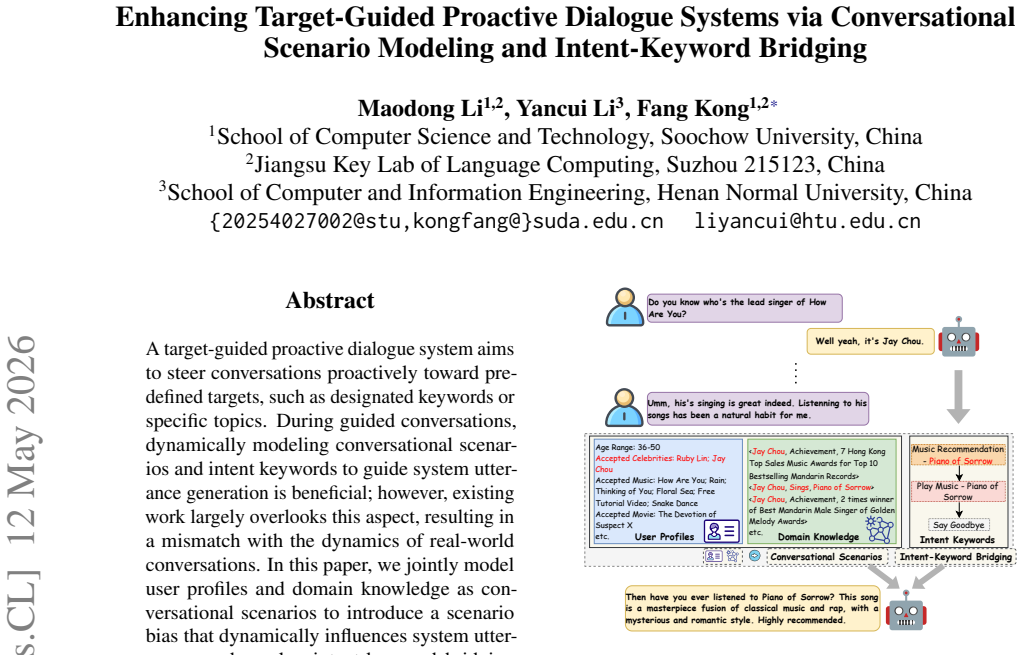
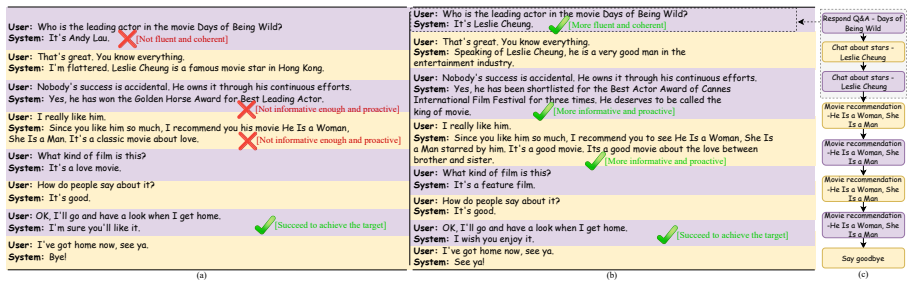
Conversational scenario modeling treats user profiles and domain knowledge as a single source of bias that modulates every system utterance; intent-keyword bridging predicts the intent keywords that will be needed in upcoming turns and thereby supplies flexible, multi-turn guidance. When both components are active, the resulting dialogues are reported to be more proactive, fluent, and informative than those produced by prior target-guided systems.
What carries the argument
Conversational scenario modeling that fuses user profiles and domain knowledge into a dynamic bias, paired with intent-keyword bridging that forecasts future intent keywords.
If this is right
- System utterances become continuously steered by an evolving scenario bias instead of reacting only to the immediate turn.
- Predicted intent keywords give the system advance notice of what the user is likely to discuss next, enabling smoother topic transitions.
- The combination raises proactivity, fluency, and informativeness scores while reducing the mismatch with real-world conversation patterns.
- The approach narrows the performance gap between automated target-guided systems and human-led guided conversations.
Where Pith is reading between the lines
- The same scenario-plus-bridging structure could be reused in non-target-guided chatbots to improve long-term coherence without explicit goals.
- If scenario modeling proves robust, it may reduce the need for hand-crafted dialogue policies in many goal-oriented systems.
- Live deployment with actual users would test whether the predicted keywords remain accurate once the conversation leaves the training distribution.
Load-bearing premise
The new scenario bias and keyword bridging will accurately reflect how real conversations unfold and will reliably produce measurable gains over existing methods.
What would settle it
A controlled experiment in which the proposed model shows no statistically significant improvement over strong baselines on proactivity, fluency, or informativeness metrics when both are evaluated on the same target-guided dialogue tasks.
Figures



read the original abstract
A target-guided proactive dialogue system aims to steer conversations proactively toward pre-defined targets, such as designated keywords or specific topics. During guided conversations, dynamically modeling conversational scenarios and intent keywords to guide system utterance generation is beneficial; however, existing work largely overlooks this aspect, resulting in a mismatch with the dynamics of real-world conversations. In this paper, we jointly model user profiles and domain knowledge as conversational scenarios to introduce a scenario bias that dynamically influences system utterances, and employ intent-keyword bridging to predict intent keywords for upcoming dialogue turns, providing higher level and more flexible guidance. Extensive automatic and human evaluations demonstrate the effectiveness of conversational scenario modeling and intent keyword bridging, yielding substantial improvements in proactivity, fluency, and informativeness for target-guided proactive dialogue systems, thereby narrowing the gap with real world interactions.
Editorial analysis
A structured set of objections, weighed in public.
Referee Report
Summary. The paper claims that jointly modeling user profiles and domain knowledge as conversational scenarios introduces a dynamic scenario bias to influence system utterances, while intent-keyword bridging predicts keywords for future turns to provide higher-level guidance. It reports that these components yield substantial gains in proactivity, fluency, and informativeness for target-guided proactive dialogue systems, as shown by extensive automatic and human evaluations that narrow the gap with real-world interactions.
Significance. If the empirical results hold under rigorous controls, the work could advance target-guided dialogue by supplying a more flexible, dynamic bias mechanism that better matches real conversation dynamics than prior static approaches. The dual use of automatic metrics and human judgments is a strength that would support broader adoption if baselines and datasets are clearly documented.
major comments (2)
- [Abstract] Abstract: The abstract asserts 'substantial improvements' from 'extensive automatic and human evaluations' but supplies no methods, metrics, baselines, datasets, or implementation details. This absence makes it impossible to verify whether the evidence supports the central claims about effectiveness and real-world alignment.
- [Introduction / Proposed Method] The weakest assumption—that scenario modeling and intent-keyword bridging will reliably capture real-world dynamics—remains untested in the provided description, as no controls for confounding factors or ablation studies are referenced.
Simulated Author's Rebuttal
We thank the referee for the constructive feedback on our manuscript. We address each major comment point by point below, offering clarifications from the full paper and proposing targeted revisions where the concerns are valid.
read point-by-point responses
-
Referee: [Abstract] Abstract: The abstract asserts 'substantial improvements' from 'extensive automatic and human evaluations' but supplies no methods, metrics, baselines, datasets, or implementation details. This absence makes it impossible to verify whether the evidence supports the central claims about effectiveness and real-world alignment.
Authors: Abstracts are conventionally concise and omit granular details such as specific metrics, baselines, and implementation to focus on high-level contributions and results. The full manuscript details the evaluation protocol in Sections 4 and 5, including automatic metrics for proactivity, fluency, and informativeness, the chosen baselines, the datasets employed, and implementation specifics. To address the concern, we will revise the abstract to include a brief clause referencing the evaluation framework and primary datasets used. revision: partial
-
Referee: [Introduction / Proposed Method] The weakest assumption—that scenario modeling and intent-keyword bridging will reliably capture real-world dynamics—remains untested in the provided description, as no controls for confounding factors or ablation studies are referenced.
Authors: The manuscript includes ablation studies (Section 4.3) that isolate the contributions of conversational scenario modeling and intent-keyword bridging, along with comparisons against multiple baselines that omit the dynamic bias mechanism to control for confounding factors. Human evaluations further assess alignment with real-world dynamics. We will add explicit forward references to these ablations and controls in the Introduction and Method sections to make their presence clearer. revision: yes
Circularity Check
No significant circularity detected in modeling or evaluation chain
full rationale
The paper describes an architectural proposal: jointly encoding user profiles and domain knowledge as conversational scenarios that supply dynamic bias to utterance generation, plus an intent-keyword bridging mechanism to forecast keywords for future turns. These choices are presented as design decisions, followed by standard automatic and human evaluations that measure gains in proactivity, fluency, and informativeness. No equations, parameter-fitting steps, or derivation chains appear that reduce a claimed prediction or result to the inputs by construction. No load-bearing self-citations or uniqueness theorems imported from prior author work are invoked in the provided text. The central claims rest on empirical outcomes rather than definitional equivalence or renamed fits, rendering the approach self-contained.
Axiom & Free-Parameter Ledger
Reference graph
Works this paper leans on
-
[1]
ACM Transactions on Information Systems , volume=
Target-constrained bidirectional planning for generation of target-oriented proactive dialogue , author=. ACM Transactions on Information Systems , volume=. 2024 , publisher=
work page 2024
-
[2]
IEEE Transactions on Neural Networks and Learning Systems , volume=
A target-driven planning approach for goal-directed dialog systems , author=. IEEE Transactions on Neural Networks and Learning Systems , volume=. 2023 , publisher=
work page 2023
-
[3]
Scaling Instruction-Finetuned Language Models , author=. 2022 , eprint=
work page 2022
- [4]
- [5]
-
[6]
DeepSeek LLM: Scaling Open-Source Language Models with Longtermism , author=. 2024 , eprint=
work page 2024
- [7]
-
[8]
Enhancing Goal-oriented Proactive Dialogue Systems via Consistency Reflection and Correction
Zhang, Didi and Fan, Yaxin and Li, Peifeng and Zhu, Qiaoming. Enhancing Goal-oriented Proactive Dialogue Systems via Consistency Reflection and Correction. Proceedings of the 63rd Annual Meeting of the Association for Computational Linguistics (Volume 1: Long Papers). 2025. doi:10.18653/v1/2025.acl-long.1050
-
[9]
Interpersonal Memory Matters: A New Task for Proactive Dialogue Utilizing Conversational History
Wu, Bowen and Wang, Wenqing and Lihaoran, Lihaoran and Deng, Yunhan and Li, Ying and Yu, Jingsong and Wang, Baoxun. Interpersonal Memory Matters: A New Task for Proactive Dialogue Utilizing Conversational History. Proceedings of the 29th Conference on Computational Natural Language Learning. 2025. doi:10.18653/v1/2025.conll-1.4
-
[10]
Dao, Huy Quang and Deng, Yang and Bui, Khanh-Huyen and Le, Dung D. and Liao, Lizi. Experience as Source for Anticipation and Planning: Experiential Policy Learning for Target-driven Recommendation Dialogues. Findings of the Association for Computational Linguistics: EMNLP 2024. 2024. doi:10.18653/v1/2024.findings-emnlp.829
-
[11]
Hao, Jiawang and Kong, Fang. Enhancing Emotional Support Conversations: A Framework for Dynamic Knowledge Filtering and Persona Extraction. Proceedings of the 31st International Conference on Computational Linguistics. 2025
work page 2025
-
[12]
Xu, Kaishuai and Cheng, Yi and Hou, Wenjun and Tan, Qiaoyu and Li, Wenjie. Reasoning Like a Doctor: Improving Medical Dialogue Systems via Diagnostic Reasoning Process Alignment. Findings of the Association for Computational Linguistics: ACL 2024. 2024. doi:10.18653/v1/2024.findings-acl.406
-
[13]
T op KG : Target-oriented Dialog via Global Planning on Knowledge Graph
Yang, Zhitong and Wang, Bo and Zhou, Jinfeng and Tan, Yue and Zhao, Dongming and Huang, Kun and He, Ruifang and Hou, Yuexian. T op KG : Target-oriented Dialog via Global Planning on Knowledge Graph. Proceedings of the 29th International Conference on Computational Linguistics. 2022
work page 2022
-
[14]
Target-Guided Open-Domain Conversation
Tang, Jianheng and Zhao, Tiancheng and Xiong, Chenyan and Liang, Xiaodan and Xing, Eric and Hu, Zhiting. Target-Guided Open-Domain Conversation. Proceedings of the 57th Annual Meeting of the Association for Computational Linguistics. 2019. doi:10.18653/v1/P19-1565
-
[15]
Reinforced Target-driven Conversational Promotion
Dao, Huy and Liao, Lizi and Le, Dung and Nie, Yuxiang. Reinforced Target-driven Conversational Promotion. Proceedings of the 2023 Conference on Empirical Methods in Natural Language Processing. 2023. doi:10.18653/v1/2023.emnlp-main.775
-
[16]
Dialogue Planning via Brownian Bridge Stochastic Process for Goal-directed Proactive Dialogue
Wang, Jian and Lin, Dongding and Li, Wenjie. Dialogue Planning via Brownian Bridge Stochastic Process for Goal-directed Proactive Dialogue. Findings of the Association for Computational Linguistics: ACL 2023. 2023. doi:10.18653/v1/2023.findings-acl.25
-
[17]
Proceedings of the AAAI Conference on Artificial Intelligence , volume=
Keyword-guided neural conversational model , author=. Proceedings of the AAAI Conference on Artificial Intelligence , volume=
-
[18]
Proceedings of the AAAI conference on artificial intelligence , volume=
Conceptnet 5.5: An open multilingual graph of general knowledge , author=. Proceedings of the AAAI conference on artificial intelligence , volume=
-
[19]
Advances in Neural Information Processing Systems , volume=
A simple language model for task-oriented dialogue , author=. Advances in Neural Information Processing Systems , volume=
-
[20]
Proceedings of the AAAI Conference on Artificial Intelligence , volume=
A goal interaction graph planning framework for conversational recommendation , author=. Proceedings of the AAAI Conference on Artificial Intelligence , volume=
-
[21]
A Survey on Proactive Dialogue Systems: Problems, Methods, and Prospects , author=. IJCAI , year=
-
[22]
ACM Transactions on Information Systems , volume=
Proactive conversational ai: A comprehensive survey of advancements and opportunities , author=. ACM Transactions on Information Systems , volume=. 2025 , publisher=
work page 2025
-
[23]
Towards Conversational Recommendation over Multi-Type Dialogs
Liu, Zeming and Wang, Haifeng and Niu, Zheng-Yu and Wu, Hua and Che, Wanxiang and Liu, Ting. Towards Conversational Recommendation over Multi-Type Dialogs. Proceedings of the 58th Annual Meeting of the Association for Computational Linguistics. 2020. doi:10.18653/v1/2020.acl-main.98
-
[24]
D u R ec D ial 2.0: A Bilingual Parallel Corpus for Conversational Recommendation
Liu, Zeming and Wang, Haifeng and Niu, Zheng-Yu and Wu, Hua and Che, Wanxiang. D u R ec D ial 2.0: A Bilingual Parallel Corpus for Conversational Recommendation. Proceedings of the 2021 Conference on Empirical Methods in Natural Language Processing. 2021. doi:10.18653/v1/2021.emnlp-main.356
-
[25]
Tang, Jiakai and Shen, Shiqi and ZhipengWang, ZhipengWang and Zhi, Gong and Feng, Xueyang and Sun, Zexu and Tan, Haoran and Chen, Xu. KAPA : A Deliberative Agent Framework with Tree-Structured Knowledge Base for Multi-Domain User Intent Understanding. Findings of the Association for Computational Linguistics: ACL 2025. 2025. doi:10.18653/v1/2025.findings-acl.319
-
[26]
The Moral Integrity Corpus: A Benchmark for Ethical Dialogue Systems
Ziems, Caleb and Yu, Jane and Wang, Yi-Chia and Halevy, Alon and Yang, Diyi. The Moral Integrity Corpus: A Benchmark for Ethical Dialogue Systems. Proceedings of the 60th Annual Meeting of the Association for Computational Linguistics (Volume 1: Long Papers). 2022. doi:10.18653/v1/2022.acl-long.261
-
[27]
Persuading across Diverse Domains: a Dataset and Persuasion Large Language Model
Jin, Chuhao and Ren, Kening and Kong, Lingzhen and Wang, Xiting and Song, Ruihua and Chen, Huan. Persuading across Diverse Domains: a Dataset and Persuasion Large Language Model. Proceedings of the 62nd Annual Meeting of the Association for Computational Linguistics (Volume 1: Long Papers). 2024. doi:10.18653/v1/2024.acl-long.92
-
[28]
Proceedings of the 18th ACM Conference on Recommender Systems , pages=
Towards empathetic conversational recommender systems , author=. Proceedings of the 18th ACM Conference on Recommender Systems , pages=
-
[29]
and Konstas, Ioannis and Rieser, Verena
Sevegnani, Karin and Howcroft, David M. and Konstas, Ioannis and Rieser, Verena. OTT ers: One-turn Topic Transitions for Open-Domain Dialogue. Proceedings of the 59th Annual Meeting of the Association for Computational Linguistics and the 11th International Joint Conference on Natural Language Processing (Volume 1: Long Papers). 2021. doi:10.18653/v1/2021...
-
[30]
Advances in neural information processing systems , volume=
Attention is all you need , author=. Advances in neural information processing systems , volume=
-
[31]
Multi-Hop Question Generation via Dual-Perspective Keyword Guidance
Li, Maodong and Zhang, Longyin and Kong, Fang. Multi-Hop Question Generation via Dual-Perspective Keyword Guidance. Findings of the Association for Computational Linguistics: ACL 2025. 2025. doi:10.18653/v1/2025.findings-acl.526
- [32]
-
[33]
A Diversity-Promoting Objective Function for Neural Conversation Models
Li, Jiwei and Galley, Michel and Brockett, Chris and Gao, Jianfeng and Dolan, Bill. A Diversity-Promoting Objective Function for Neural Conversation Models. Proceedings of the 2016 Conference of the North A merican Chapter of the Association for Computational Linguistics: Human Language Technologies. 2016. doi:10.18653/v1/N16-1014
-
[34]
B leu: a method for automatic evaluation of machine translation
Papineni, Kishore and Roukos, Salim and Ward, Todd and Zhu, Wei-Jing. B leu: a Method for Automatic Evaluation of Machine Translation. Proceedings of the 40th Annual Meeting of the Association for Computational Linguistics. 2002. doi:10.3115/1073083.1073135
-
[35]
Journal of machine learning research , volume=
Exploring the limits of transfer learning with a unified text-to-text transformer , author=. Journal of machine learning research , volume=
-
[36]
Journal of Machine Learning Research , volume=
Scaling instruction-finetuned language models , author=. Journal of Machine Learning Research , volume=
-
[37]
T encent P retrain: A Scalable and Flexible Toolkit for Pre-training Models of Different Modalities
Zhao, Zhe and Li, Yudong and Hou, Cheng and Zhao, Jing and Tian, Rong and Liu, Weijie and Chen, Yiren and Sun, Ningyuan and Liu, Haoyan and Mao, Weiquan and Guo, Han. T encent P retrain: A Scalable and Flexible Toolkit for Pre-training Models of Different Modalities. Proceedings of the 61st Annual Meeting of the Association for Computational Linguistics (...
-
[38]
doi:10.57967/hf/2316 , publisher =
Wang, Shenzhi and Zheng, Yaowei and Wang, Guoyin and Song, Shiji and Huang, Gao , title =. doi:10.57967/hf/2316 , publisher =
-
[39]
doi:10.57967/hf/2317 , publisher =
Wang, Shenzhi and Zheng, Yaowei and Wang, Guoyin and Song, Shiji and Huang, Gao , title =. doi:10.57967/hf/2317 , publisher =
-
[40]
Wu, Shenghan and Zhu, Yimo and Hsu, Wynne and Lee, Mong-Li and Deng, Yang. From Personas to Talks: Revisiting the Impact of Personas on LLM -Synthesized Emotional Support Conversations. Proceedings of the 2025 Conference on Empirical Methods in Natural Language Processing. 2025. doi:10.18653/v1/2025.emnlp-main.277
-
[41]
Pseudo-Siamese Network for Planning in Target-Oriented Proactive Dialogues , author=. ICASSP 2026-2026 IEEE International Conference on Acoustics, Speech and Signal Processing (ICASSP) , pages=. 2026 , organization=
work page 2026
discussion (0)
Sign in with ORCID, Apple, or X to comment. Anyone can read and Pith papers without signing in.