Recognition: 2 theorem links
· Lean TheoremH2G: Hierarchy-Aware Hyperbolic Grouping for 3D Scenes
Pith reviewed 2026-05-13 07:34 UTC · model grok-4.3
The pith
A single Lorentz hyperbolic field encodes hierarchical groupings across 3D scenes from 2D foundation-model cues.
A machine-rendered reading of the paper's core claim, the machinery that carries it, and where it could break.
Core claim
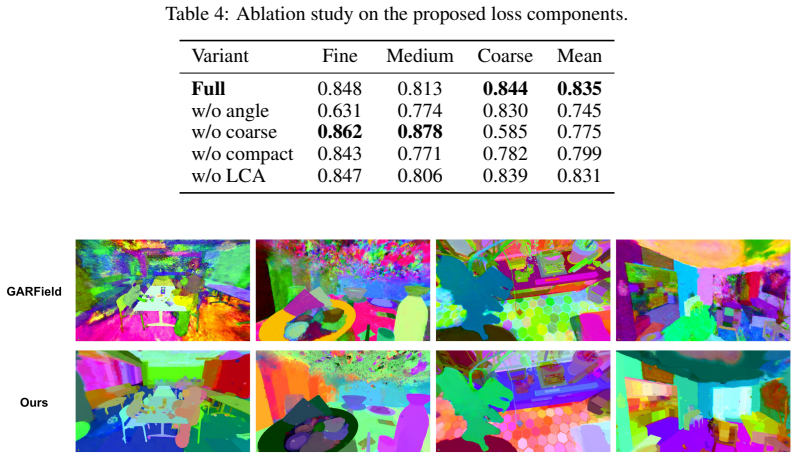
The authors claim that interpreting 2D foundation-model affinities through Dasgupta's objective produces tree supervision that can be faithfully embedded in a Lorentz hyperbolic field; a hierarchy-aware objective then aligns this field to fine-level assignments, coarse structures, compact clusters, and LCA ordering, allowing multiple grouping levels to be represented in one feature space.
What carries the argument
The Lorentz hyperbolic feature field, whose geometry supports tree-like branching, aligned via a hierarchy-aware objective to fine assignments, coarse structure, compact clusters, and lowest-common-ancestor orderings.
If this is right
- Multiple grouping levels are represented simultaneously in one shared feature space.
- Semantic hierarchical grouping becomes possible without 3D labels or a fixed category vocabulary.
- Hyperbolic geometry is shown to be well suited for embedding the branching structure of scene hierarchies.
- Alignment to lowest-common-ancestor ordering preserves ancestor-descendant relations across scales.
Where Pith is reading between the lines
- The same hyperbolic distillation pipeline could be applied to video sequences by adding a temporal consistency term.
- Robotic grasping or navigation systems might directly use the multi-scale groupings for planning at different levels of detail.
- The approach indicates that hyperbolic embeddings can serve as a general medium for transferring hierarchical knowledge from large 2D models to 3D domains.
Load-bearing premise
Interpreting foundation-model affinities through Dasgupta's objective produces reliable hierarchy supervision that can be faithfully distilled into a Lorentz hyperbolic field without loss of structure.
What would settle it
An experiment showing that the learned field fails to preserve the clustering quality or lowest-common-ancestor distances of the 2D-derived hierarchy when evaluated on held-out 3D scenes would disprove the central claim.
Figures



read the original abstract
Hierarchical 3D grouping aims to recover scene groups across multiple granularities, from fine object parts to complete objects, without relying on semantic labels or a fixed vocabulary. The main challenge is to transform 2D foundation-model cues into coherent hierarchy supervision and embed that hierarchy in a 3D representation. We propose H2G, a hyperbolic affinity field for hierarchical 3D grouping. Our method derives semantically organized tree supervision by interpreting foundation-model affinities through Dasgupta's objective for similarity-based hierarchical clustering. This supervision is distilled into a single Lorentz hyperbolic feature field, whose geometry is well suited for tree-like branching structures. A hierarchy-aware objective aligns the field with fine-level assignments, coarse object structure, compact feature clusters, and LCA (Lowest Common Ancestor) ordering. This formulation represents multiple grouping levels in one feature space, enabling semantic hierarchical grouping grounded in 2D foundation-model knowledge.
Editorial analysis
A structured set of objections, weighed in public.
Referee Report
Summary. The paper proposes H2G, a method for hierarchical 3D grouping that derives tree-structured supervision from 2D foundation-model affinities via Dasgupta's objective and distills it into a single Lorentz hyperbolic feature field. A hierarchy-aware loss aligns the field to fine/coarse assignments, compact clusters, and LCA ordering, allowing multiple semantic grouping levels to be represented in one embedding space without labels or fixed vocabularies.
Significance. If the central claim holds, the work offers a principled way to embed multi-granularity hierarchies in 3D scenes by exploiting hyperbolic geometry's natural fit for tree structures and transferring knowledge from 2D foundation models. This could advance label-free scene understanding and open avenues for hierarchical reasoning in robotics and AR applications.
minor comments (2)
- The abstract and introduction would benefit from a brief statement of the key equations (e.g., the precise form of the hierarchy-aware objective and the Lorentz inner-product definition used) to allow readers to assess the formulation without immediately consulting the methods section.
- Figure captions and the experimental section should explicitly report the number of hierarchy levels recovered and the quantitative metrics (e.g., dendrogram purity or LCA distance) used to evaluate multi-granularity performance.
Simulated Author's Rebuttal
We thank the referee for the positive summary of H2G and the recommendation for minor revision. We appreciate the recognition that the approach of distilling 2D foundation-model affinities into a Lorentz hyperbolic field via Dasgupta's objective provides a principled way to represent hierarchical groupings in 3D without labels.
Circularity Check
No significant circularity detected
full rationale
The derivation applies Dasgupta's established objective to external foundation-model affinities to obtain tree supervision, then distills the result into a Lorentz hyperbolic field using standard geometric properties for hierarchy embedding. The hierarchy-aware objective (fine/coarse alignment plus LCA ordering) directly targets structure preservation without any parameter defined in terms of the target output or any prediction that reduces to a fitted input by construction. No load-bearing self-citations, uniqueness theorems, or ansatzes imported from prior author work appear in the chain; the method remains self-contained against external benchmarks.
Axiom & Free-Parameter Ledger
axioms (2)
- domain assumption Lorentz hyperbolic geometry is well suited for tree-like branching structures
- domain assumption Dasgupta's objective produces coherent hierarchy supervision from foundation-model affinities
Lean theorems connected to this paper
-
IndisputableMonolith/Cost/FunctionalEquation.leandAlembert_to_ODE_general_theorem echoes?
echoesECHOES: this paper passage has the same mathematical shape or conceptual pattern as the Recognition theorem, but is not a direct formal dependency.
We use the D-dimensional Lorentz model H^D_c ... projection ... angular classification ... LCA ordering loss ... do(i,j) hyperbolic distance surrogate
-
IndisputableMonolith/Foundation/AlexanderDuality.leanalexander_duality_circle_linking echoes?
echoesECHOES: this paper passage has the same mathematical shape or conceptual pattern as the Recognition theorem, but is not a direct formal dependency.
negative curvature of hyperbolic space provides a natural bias for representing branching structures
What do these tags mean?
- matches
- The paper's claim is directly supported by a theorem in the formal canon.
- supports
- The theorem supports part of the paper's argument, but the paper may add assumptions or extra steps.
- extends
- The paper goes beyond the formal theorem; the theorem is a base layer rather than the whole result.
- uses
- The paper appears to rely on the theorem as machinery.
- contradicts
- The paper's claim conflicts with a theorem or certificate in the canon.
- unclear
- Pith found a possible connection, but the passage is too broad, indirect, or ambiguous to say the theorem truly supports the claim.
Reference graph
Works this paper leans on
-
[1]
Alexander Kirillov, Eric Mintun, Nikhila Ravi, Hanzi Mao, Chloe Rolland, Laura Gustafson, Tete Xiao, Spencer Whitehead, Alexander C Berg, Wan-Yen Lo, et al. Segment anything. InProceedings of the IEEE/CVF international conference on computer vision, pages 4015–4026, 2023
work page 2023
-
[2]
Ben Mildenhall, Pratul P Srinivasan, Matthew Tancik, Jonathan T Barron, Ravi Ramamoorthi, and Ren Ng. Nerf: Representing scenes as neural radiance fields for view synthesis.Communications of the ACM, 65(1):99–106, 2021
work page 2021
-
[3]
Garfield: Group anything with radiance fields
Chung Min Kim, Mingxuan Wu, Justin Kerr, Ken Goldberg, Matthew Tancik, and Angjoo Kanazawa. Garfield: Group anything with radiance fields. InProceedings of the IEEE/CVF Conference on Computer Vision and Pattern Recognition, pages 21530–21539, 2024
work page 2024
-
[4]
Omniseg3d: Omniversal 3d segmentation via hierarchical contrastive learning
Haiyang Ying, Yixuan Yin, Jinzhi Zhang, Fan Wang, Tao Yu, Ruqi Huang, and Lu Fang. Omniseg3d: Omniversal 3d segmentation via hierarchical contrastive learning. InProceedings of the IEEE/CVF Conference on Computer Vision and Pattern Recognition, pages 20612–20622, 2024
work page 2024
-
[5]
View-consistent hierarchical 3d segmentation using ultrametric feature fields
Haodi He, Colton Stearns, Adam W Harley, and Leonidas J Guibas. View-consistent hierarchical 3d segmentation using ultrametric feature fields. InEuropean Conference on Computer Vision, pages 268–286. Springer, 2024
work page 2024
-
[6]
Oriane Siméoni, Huy V V o, Maximilian Seitzer, Federico Baldassarre, Maxime Oquab, Cijo Jose, Vasil Khalidov, Marc Szafraniec, Seungeun Yi, Michaël Ramamonjisoa, et al. Dinov3.arXiv preprint arXiv:2508.10104, 2025
work page internal anchor Pith review Pith/arXiv arXiv 2025
-
[7]
A cost function for similarity-based hierarchical clustering
Sanjoy Dasgupta. A cost function for similarity-based hierarchical clustering. InProceedings of the forty-eighth annual ACM symposium on Theory of Computing, pages 118–127, 2016
work page 2016
-
[8]
Suhani V ora*, Noha Radwan *, Klaus Greff, Henning Meyer, Kyle Genova, Mehdi S. M. Sajjadi, Etienne Pot, Andrea Tagliasacchi, and Daniel Duckworth. Nesf: Neural semantic fields for gener- alizable semantic segmentation of 3d scenes.Transactions on Machine Learning Research, 2022. https://openreview.net/forum?id=ggPhsYCsm9
work page 2022
-
[9]
Sosuke Kobayashi, Eiichi Matsumoto, and Vincent Sitzmann. Decomposing nerf for editing via feature field distillation.Advances in neural information processing systems, 35:23311–23330, 2022
work page 2022
-
[10]
Kunhao Liu, Fangneng Zhan, Jiahui Zhang, Muyu Xu, Yingchen Yu, Abdulmotaleb El Saddik, Christian Theobalt, Eric Xing, and Shijian Lu. Weakly supervised 3d open-vocabulary segmentation.Advances in Neural Information Processing Systems, 36:53433–53456, 2023
work page 2023
-
[11]
Shuaifeng Zhi, Tristan Laidlow, Stefan Leutenegger, and Andrew J. Davison. In-place scene labelling and understanding with implicit scene representation. InProceedings of the IEEE/CVF International Conference on Computer Vision (ICCV), pages 15838–15847, October 2021
work page 2021
-
[12]
Panoptic lifting for 3d scene understanding with neural fields
Yawar Siddiqui, Lorenzo Porzi, Samuel Rota Bulò, Norman Müller, Matthias Nießner, Angela Dai, and Peter Kontschieder. Panoptic lifting for 3d scene understanding with neural fields. InProceedings of the IEEE/CVF Conference on Computer Vision and Pattern Recognition (CVPR), pages 9043–9052, June 2023
work page 2023
-
[13]
Guibas, Andrea Tagliasacchi, Frank Dellaert, and Thomas Funkhouser
Abhijit Kundu, Kyle Genova, Xiaoqi Yin, Alireza Fathi, Caroline Pantofaru, Leonidas J. Guibas, Andrea Tagliasacchi, Frank Dellaert, and Thomas Funkhouser. Panoptic neural fields: A semantic object-aware neural scene representation. InProceedings of the IEEE/CVF Conference on Computer Vision and Pattern Recognition (CVPR), pages 12871–12881, June 2022
work page 2022
-
[14]
Distilled feature fields enable few-shot language-guided manipulation
William Shen, Ge Yang, Alan Yu, Jansen Wong, Leslie Pack Kaelbling, and Phillip Isola. Distilled feature fields enable few-shot language-guided manipulation. In7th Annual Conference on Robot Learning, 2023
work page 2023
-
[15]
Lerf: Language embedded radiance fields
Justin Kerr, Chung Min Kim, Ken Goldberg, Angjoo Kanazawa, and Matthew Tancik. Lerf: Language embedded radiance fields. InProceedings of the IEEE/CVF international conference on computer vision, pages 19729–19739, 2023
work page 2023
-
[16]
Openscene: 3d scene understanding with open vocabularies
Songyou Peng, Kyle Genova, Chiyu Jiang, Andrea Tagliasacchi, Marc Pollefeys, Thomas Funkhouser, et al. Openscene: 3d scene understanding with open vocabularies. InProceedings of the IEEE/CVF conference on computer vision and pattern recognition, pages 815–824, 2023
work page 2023
-
[17]
OpenNeRF: Open Set 3D Neural Scene Segmentation with Pixel-Wise Features and Rendered Novel Views
Francis Engelmann, Fabian Manhardt, Michael Niemeyer, Keisuke Tateno, Marc Pollefeys, and Federico Tombari. OpenNeRF: Open Set 3D Neural Scene Segmentation with Pixel-Wise Features and Rendered Novel Views. InInternational Conference on Learning Representations, 2024. 10
work page 2024
-
[18]
Contrastive lift: 3d object instance segmentation by slow-fast contrastive fusion
Yash Bhalgat, Iro Laina, João F Henriques, Andrew Zisserman, and Andrea Vedaldi. Contrastive lift: 3d object instance segmentation by slow-fast contrastive fusion. InThirty-seventh Conference on Neural Information Processing Systems, 2023
work page 2023
-
[19]
Segment anything in 3d with nerfs
Jiazhong Cen, Zanwei Zhou, Jiemin Fang, Chen Yang, Wei Shen, Lingxi Xie, Xiaopeng Zhang, and Qi Tian. Segment anything in 3d with nerfs. InNeurIPS, 2023
work page 2023
-
[20]
Poincaré embeddings for learning hierarchical representations
Maximillian Nickel and Douwe Kiela. Poincaré embeddings for learning hierarchical representations. Advances in neural information processing systems, 30, 2017
work page 2017
-
[21]
Learning continuous hierarchies in the lorentz model of hyperbolic geometry
Maximillian Nickel and Douwe Kiela. Learning continuous hierarchies in the lorentz model of hyperbolic geometry. InInternational conference on machine learning, pages 3779–3788. PMLR, 2018
work page 2018
-
[22]
Valentin Khrulkov, Leyla Mirvakhabova, Evgeniya Ustinova, Ivan Oseledets, and Victor Lempitsky. Hyperbolic image embeddings. InProceedings of the IEEE/CVF conference on computer vision and pattern recognition, pages 6418–6428, 2020
work page 2020
-
[23]
Wei Peng, Tuomas Varanka, Abdelrahman Mostafa, Henglin Shi, and Guoying Zhao. Hyperbolic deep neural networks: A survey.IEEE Transactions on Pattern Analysis and Machine Intelligence, 44(12):10023– 10044, 2022
work page 2022
-
[24]
Ines Chami, Albert Gu, Vaggos Chatziafratis, and Christopher Ré. From trees to continuous embeddings and back: Hyperbolic hierarchical clustering.Advances in neural information processing systems, 33:15065– 15076, 2020
work page 2020
-
[25]
Cross-modal scalable hyperbolic hierarchical clustering
Teng Long and Nanne van Noord. Cross-modal scalable hyperbolic hierarchical clustering. InProceedings of the IEEE/CVF international conference on computer vision, pages 16655–16664, 2023
work page 2023
-
[26]
Hyperbolic image-text representations
Karan Desai, Maximilian Nickel, Tanmay Rajpurohit, Justin Johnson, and Shanmukha Ramakrishna Vedantam. Hyperbolic image-text representations. InInternational Conference on Machine Learning, pages 7694–7731. PMLR, 2023
work page 2023
-
[27]
Accept the modality gap: An exploration in the hyperbolic space
Sameera Ramasinghe, Violetta Shevchenko, Gil Avraham, and Ajanthan Thalaiyasingam. Accept the modality gap: An exploration in the hyperbolic space. InProceedings of the IEEE/CVF Conference on Computer Vision and Pattern Recognition, pages 27263–27272, 2024
work page 2024
-
[28]
Openhype: Hyperbolic embeddings for hierarchical open-vocabulary radiance fields.NeurIPS, 2025
Lisa Weijler, Sebastian Koch, Fabio Poiesi, Timo Ropinski, and Pedro Hermosilla. Openhype: Hyperbolic embeddings for hierarchical open-vocabulary radiance fields.NeurIPS, 2025
work page 2025
-
[29]
Miroslav Fiedler. A property of eigenvectors of nonnegative symmetric matrices and its application to graph theory.Czechoslovak mathematical journal, 25(4):619–633, 1975
work page 1975
-
[30]
Instant neural graphics primitives with a multiresolution hash encoding.ACM Trans
Thomas Müller, Alex Evans, Christoph Schied, and Alexander Keller. Instant neural graphics primitives with a multiresolution hash encoding.ACM Trans. Graph., 41(4):102:1–102:15, July 2022
work page 2022
-
[31]
Junnan Li, Pan Zhou, Caiming Xiong, and Steven C.H. Hoi. Prototypical contrastive learning of unsuper- vised representations. InICLR, 2021
work page 2021
-
[32]
Abraham Albert Ungar.Analytic hyperbolic geometry: Mathematical foundations and applications. World Scientific, 2005
work page 2005
-
[33]
Tsung-Yi Lin, Michael Maire, Serge Belongie, James Hays, Pietro Perona, Deva Ramanan, Piotr Dollár, and C. Lawrence Zitnick. Microsoft coco: Common objects in context. In David Fleet, Tomas Pajdla, Bernt Schiele, and Tinne Tuytelaars, editors,Computer Vision – ECCV 2014, pages 740–755, Cham, 2014. Springer International Publishing
work page 2014
-
[34]
Ricardo J. G. B. Campello, Davoud Moulavi, and Joerg Sander. Density-based clustering based on hierarchical density estimates. In Jian Pei, Vincent S. Tseng, Longbing Cao, Hiroshi Motoda, and Guandong Xu, editors,Advances in Knowledge Discovery and Data Mining, pages 160–172, Berlin, Heidelberg, 2013. Springer Berlin Heidelberg. 11 A Implementation detail...
discussion (0)
Sign in with ORCID, Apple, or X to comment. Anyone can read and Pith papers without signing in.