Cavity shape reconstruction with a homogeneous Robin condition via a constrained coupled complex boundary method with ADMM
Pith reviewed 2026-05-14 20:52 UTC · model grok-4.3
The pith
An unknown Robin boundary segment is recovered by minimizing the imaginary part of the solution to a complex boundary-value problem that couples one pair of Cauchy measurements.
A machine-rendered reading of the paper's core claim, the machinery that carries it, and where it could break.
Core claim
The overdetermined inverse problem is recast as a complex boundary-value problem whose solution's imaginary part serves as the objective for shape optimization; the formulation is augmented with inequality constraints on admissible state values to improve stability, and the resulting problem is solved using an ADMM framework with shape derivatives of the complex state.
What carries the argument
The coupled complex boundary method, which merges the given Dirichlet and Neumann data into a single complex Robin condition on the accessible boundary so that the imaginary part of the solution drives the shape cost.
If this is right
- Shape derivatives of the complex state yield an explicit gradient for the cost functional that can be used inside the ADMM iteration.
- The inequality constraints on the state improve robustness to noise without requiring multiple independent measurements.
- Finite-element discretization of the complex problem produces practical reconstructions on standard test geometries.
- The ADMM splitting separates the state constraints from the shape update, allowing modular numerical implementation.
Where Pith is reading between the lines
- The same complex-coupling idea could be tried on other inverse problems where only one pair of boundary data is available.
- Testing the method on three-dimensional cavities would show whether the stability gained from the constraints carries over to higher dimensions.
- If the prior bounds prove too restrictive in practice, one could replace them with a penalty term that is gradually relaxed during iteration.
Load-bearing premise
That prior admissible bounds on the state variables are known in advance and tight enough to restore uniqueness when a single measurement would otherwise admit infinitely many domains.
What would settle it
Reconstructing the boundary after deliberately widening or removing the state bounds and checking whether the recovered shape becomes unstable or jumps to a different admissible domain under the same noisy data.
Figures


read the original abstract
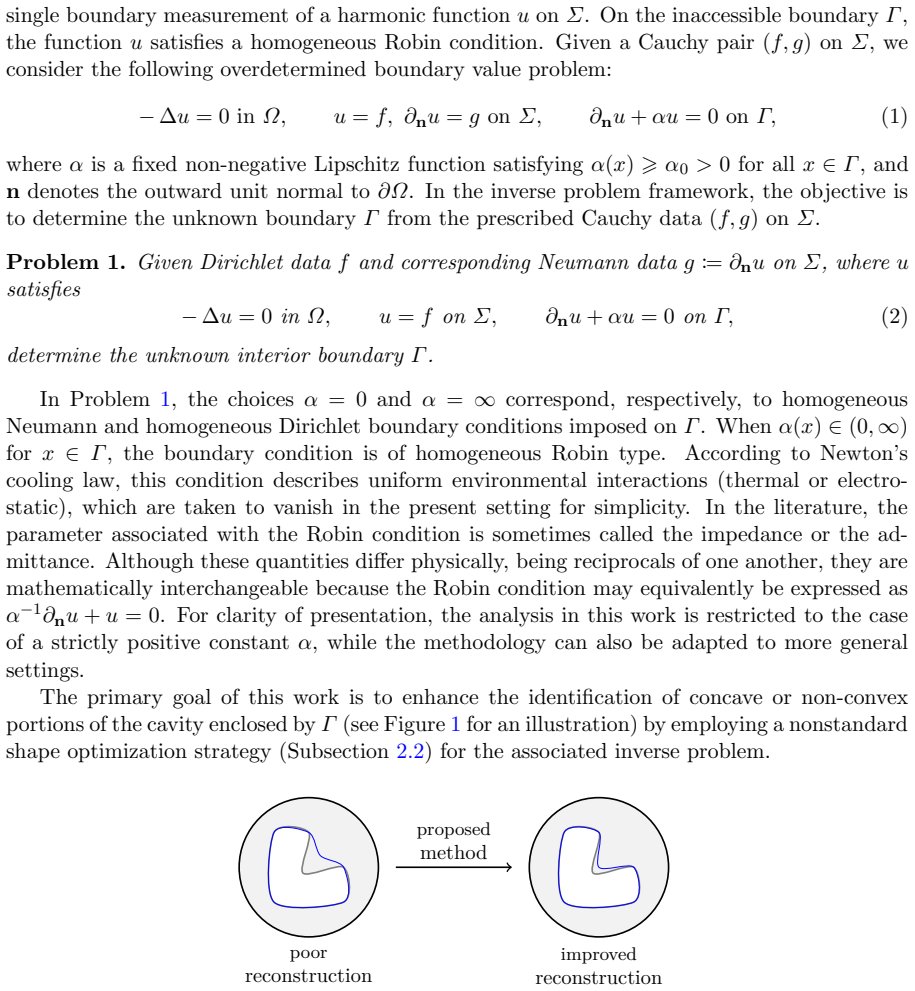
We revisit the problem of identifying an unknown portion of a boundary subject to a Robin condition based on a pair of Cauchy data on the accessible part of the boundary. It is known that a single measurement may correspond to infinitely many admissible domains. Nonetheless, numerical strategies based on shape optimization have been shown to yield reasonable reconstructions of the unknown boundary. In this study, we propose a new application of the coupled complex boundary method to address this class of inverse boundary identification problems. The overdetermined problem is reformulated as a complex boundary value problem with a complex Robin condition that couples the Cauchy data on the accessible boundary. The reconstruction is achieved by minimizing a cost functional constructed from the imaginary part of the complex-valued solution. To improve stability with respect to noisy data and initialization, we augment the formulation with inequality constraints through prior admissible bounds on the state, leading to a constrained shape optimization problem. The shape derivative of the complex state and the corresponding shape gradient of the cost functional are derived, and the resulting problem is solved using an alternating direction method of multipliers (ADMM) framework. The proposed approach is implemented using the finite element method and validated through various numerical experiments.
Editorial analysis
A structured set of objections, weighed in public.
Referee Report
Summary. The paper revisits identifying an unknown boundary portion subject to a homogeneous Robin condition from Cauchy data on the accessible boundary. It reformulates the overdetermined problem as a complex boundary-value problem with a complex Robin condition coupling the data, minimizes a cost functional based on the imaginary part of the complex solution, augments the formulation with inequality constraints from prior admissible bounds on the state to improve stability, derives the shape derivative and gradient, and solves the resulting constrained shape optimization problem via an ADMM framework implemented with finite elements, validated on numerical experiments.
Significance. If the constrained formulation indeed restores stability and uniqueness, the work would offer a practical numerical strategy for a classically ill-posed inverse shape problem where single Cauchy measurements admit infinitely many solutions. The combination of the coupled complex boundary method with ADMM and explicit state constraints is a novel technical contribution that could extend shape-optimization techniques in numerical analysis, provided the stability claims are substantiated.
major comments (2)
- [Abstract] Abstract: the claim that inequality constraints from prior admissible bounds on the state improve stability with respect to noisy data and initialization is load-bearing for the central contribution, yet no uniqueness result, stability estimate, or analysis is supplied showing that the admissible set excludes all but one domain consistent with the data.
- [Numerical experiments] The manuscript supplies no error analysis, convergence proof for the ADMM iteration, or quantitative reconstruction metrics (e.g., boundary error norms under controlled noise), leaving the practical performance of the method unverified despite the emphasis on improved stability.
Simulated Author's Rebuttal
We thank the referee for the careful reading and constructive comments on our manuscript. We address the major concerns point by point below, indicating where revisions will be made.
read point-by-point responses
-
Referee: [Abstract] Abstract: the claim that inequality constraints from prior admissible bounds on the state improve stability with respect to noisy data and initialization is load-bearing for the central contribution, yet no uniqueness result, stability estimate, or analysis is supplied showing that the admissible set excludes all but one domain consistent with the data.
Authors: We agree that the manuscript provides no theoretical uniqueness result or stability estimate showing that the admissible set excludes all but one domain. The claim in the abstract is based on numerical observations that the constraints help avoid non-physical solutions and improve robustness. In the revision we will rephrase the abstract to state that the constraints are designed to improve stability in practice, as demonstrated by the numerical experiments, rather than asserting a general theoretical improvement. A remark will be added noting that a full analysis of uniqueness under the constraints remains open. revision: yes
-
Referee: [Numerical experiments] The manuscript supplies no error analysis, convergence proof for the ADMM iteration, or quantitative reconstruction metrics (e.g., boundary error norms under controlled noise), leaving the practical performance of the method unverified despite the emphasis on improved stability.
Authors: We acknowledge the lack of formal error analysis, ADMM convergence proof, and quantitative metrics. The experiments illustrate feasibility via qualitative results. In the revision we will add quantitative metrics such as boundary L2 error norms and Hausdorff distances under controlled noise levels, along with ADMM residual histories and iteration counts. A rigorous convergence proof lies beyond the present scope. revision: partial
- Providing a rigorous uniqueness or stability analysis for the constrained formulation.
Circularity Check
No circularity: derivation chain is self-contained
full rationale
The paper reformulates the inverse problem as a complex Robin BVP, constructs a cost from the imaginary part of the solution, derives the shape gradient via standard complex PDE theory, and solves the constrained problem with ADMM. None of these steps reduce by construction to fitted inputs, self-definitions, or load-bearing self-citations. The prior admissible bounds are introduced as an external modeling choice to address known non-uniqueness; they are not derived from the method itself. The FEM implementation and numerical experiments provide independent validation outside any internal loop. This matches the default expectation of a non-circular paper.
Axiom & Free-Parameter Ledger
free parameters (1)
- state bounds
axioms (1)
- domain assumption The overdetermined Cauchy data can be encoded exactly by a single complex Robin condition on the accessible boundary.
Reference graph
Works this paper leans on
-
[1]
M. Hrizi and R. Prakash and A. A. Novotny , date-added =. Approximation of unknown sources in a time fractional. Comput. Math. Appl. , pages =
- [2]
-
[3]
L. Afraites and A. Hadri and M. Hrizi and J. F. T. Rabago , date-added =. Statistical topological gradient and shape optimization for robust metal--semiconductor contact reconstruction , year =
-
[4]
J. F. T. Rabago and M. Kimura , date-added =. On the well-posedness of a. ESAIM Control Optim. Calc. Var. , pages =
-
[5]
M. Chicco , date-added =. A maximum principle for mixed boundary value problems for elliptic equations in non-divergence form , volume =. Boll. Un. Mat. Ital. B (7) , pages =
-
[6]
E. Cherrat and L. Afraites and J. F. T. Rabago , date-added =. Enhanced shape recovery in advection--diffusion problems via a novel. J. Optim. Theory Appl. , pages =
-
[7]
A. Hamdi and I. Mahfoudhi , date-added =. Inverse source problem in a one-dimensional evolution linear transport equation with spatially varying coefficients: application to surface water pollution , volume =. Inverse Probl. Sci. Eng. , pages =
-
[8]
A. Hamdi , date-added =. Inverse source problem in a 2D linear evolution transport equation: detection of pollution source , volume =. Inverse Probl. Sci. Eng. , pages =
-
[9]
A. E. Badia and T. H. Duong and A. Hamdi , date-added =. Identification of a point source in a linear advection-dispersion-reaction equation: application to a pollution source problem , volume =. Inverse Problems , pages =
-
[10]
M. Andrle and A. E. Badia , date-added =. Identification of multiple moving pollution sources in surface waters or atmospheric media with boundary observations , volume =. Inverse Problems , pages =
-
[11]
A. E. Badia and T. H. Duong , date-added =. On an inverse source problem for the heat equation. Application to a pollution detection problem , volume =. J. Inverse Ill-Posed Probl. , pages =
-
[12]
A. Okubo , date-added =. Diffusion and Ecological Problems: Mathematical Models , year =
-
[13]
S. Neelz , date-added =. Limitations of an analytical solution for advection-diffusion with variable coefficients , volume =. Commun. Numer. Methods Eng. , pages =
-
[14]
C. Zoppou and J. H. Knight , date-added =. Analytical solution of a spatially variable coefficient advection--diffusion equation in up to three dimensions , volume =. Appl. Math. Model. , number =
-
[15]
S. Dempe , date-added =. Bilevel Optimization: Theory, Algorithms, Applications and a Bibliography , volume =
-
[16]
J. F. T. Rabago and A. Hadri and L. Afraites and A. S. Hendy and M. A. Zaky , date-added =. A robust alternating direction numerical scheme in a shape optimization setting for solving geometric inverse problems , volume =. Comput. Math. Appl. , month =
-
[17]
J. F. T. Rabago and L. Afraites and H. Notsu , date-added =. Detecting immersed obstacle in. SIAM J. Control & Optim. , number =
-
[18]
X. Zheng and X. Cheng and R. Gong , date-added =. A coupled complex boundary method for parameter identification in elliptic problems , volume =. Int. J. Comput. Math. , number =
-
[19]
J. F. T. Rabago , date-added =. On the new coupled complex boundary method in shape optimization framework for solving stationary free boundary problems , volume =. Math. Control Relat. Fields , number =
-
[20]
E. Cherrat and L. Afraites and J. F. T. Rabago , date-added =. Shape reconstruction for advection-diffusion problems by shape optimization techniques: The case of constant velocity , volume =. Discrete Contin. Dyn. Syst. Ser. S , number =
-
[21]
E. Cherrat and L. Afraites and J. F. T. Rabago , date-added =. Numerical solution by shape optimization method to an inverse shape problem in multi-dimensional advection-diffusion problem with space dependent coefficients , volume =. Appl. Math. Optim. , pages =
- [22]
-
[23]
J. F. T. Rabago , date-added =. Numerical solution to the exterior. Numer. Algorithms , month =
-
[24]
J. F. T. Rabago , date-added =. Localization of tumor through a non-conventional numerical shape optimization technique , volume =. Appl. Numer. Math. , pages =
-
[25]
J. F. T. Rabago and H. Notsu , date-added =. Numerical solution to a free boundary problem for the. Appl. Math. Optim. , pages =
-
[26]
L. Afraites and J. F. T. Rabago , date-added =. Boundary shape reconstruction with. Comput. Appl. Math. , number =
-
[27]
A. Chakib and A. Ellabib and A. Nachaoui and M. Nachaoui , date-added =. A shape optimization formulation of weld pool determination , volume =. Appl. Math. Lett. , number =
-
[28]
T. Kurahashi and K. Maruoka and T. Iyama , date-added =. Numerical shape identification of cavity in three dimensions based on thermal non-destructive testing data , volume =. Eng. Optim. , number =
- [29]
-
[30]
L. Afraites and W. Fang and J. F. T. Rabago , date-added =. Detecting an unknown boundary with the
-
[31]
C. S. Alves and N. F. M. Martins and N. C. Roberty , date-added =. Full identification of acoustic sources with multiple frequencies and boundary measurements , volume =. Inverse Prob. Imaging , number =
-
[32]
M. Giacomini and O. Pantz and K. Trabelsi , date-added =. Certified Descent Algorithm for shape optimization driven by fully-computable a posteriori error estimators , volume =. ESAIM - Control Optim. Calc. Var. , pages =
-
[33]
W. H. Loh , date-added =. Modeling and Measurement of Contact Resistances , type =
-
[34]
W. Fang and M. Lu , date-added =. A fast collocation method for an inverse boundary value problem, , volume =. Internat. J. Numer. Methods Engrg. , pages =
-
[35]
F. Cakoni and R. Kress and C. Schuft , date-added =. Simultaneous reconstruction of shape and impedance in corrosion detection , volume =. Methods Appl. Anal. , pages =
-
[36]
F. Cakoni and R. Kress and C. Schuft , date-added =. Integral equations for inverse problems in corrosion detection from partial. Inverse Problems , pages =
-
[37]
E. Sincich , date-added =. Stability for the determination of unknown boundary and impedance with a. SIAM J. Math. Anal. , pages =
-
[38]
C. D. Pagani and D. Peerotti , date-added =. Identifiability problems of defects with. Inverse Problems , pages =
-
[39]
W. Fang , date-added =. Simultaneous recovery of. J. Comput. Appl. Math. , pages =
-
[40]
W. Fang and S. Zeng , date-added =. Numerical recovery of. J. Comput. Appl. Math. , pages =
-
[41]
W. Fang and F. Lin and Y. Ma , date-added =. Fast algorithms for boundary integral equations on elliptic domains and related inverse problems , volume =. East Asian J. Appl. Math. , pages =
-
[42]
R. Kohn and M. Vogelius , date-added =. Relaxation of a variational method for impedance computed tomography , volume =. Commun. Pure Appl. Math. , number =
-
[43]
H. Meftahi , date-added =. Stability analysis in the inverse. Math. Meth. Appl. Sci. , number =
-
[44]
L. Afraites and M. Dambrine and D. Kateb , date-added =. Shape methods for the transmission problem with a single measurement , volume =. Numer. Funct. Anal. Optim. , number =
-
[45]
L. Afraites and C. Masnaoui and M. Nachaoui , date-added =. Shape optimization method for an inverse geometric source problem and stability at critical shape , volume =. Discrete Contin. Dyn. Syst. Ser. S , number =
-
[46]
F. Caubet and M. Dambrine and D. Kateb and C. Z. Timimoun. , date-added =. A. Inverse Prob. Imaging , number =
-
[47]
L. Afraites and M. Dambrine and D. Kateb , date-added =. On second order shape optimization methods for electrical impedance tomography , volume =. SIAM J. Control Optim. , number =
-
[48]
L. Afraites and M. Dambrine and K. Eppler and D. Kateb , date-added =. DETECTING PERFECTLY INSULATED OBSTACLES BY SHAPE OPTIMIZATION TECHNIQUES OF ORDER TWO , volume =. Discrete Contin. Dyn. Syst. Ser. B , number =
-
[49]
R. Kress and D. Colton , date-added =. Inverse Acoustic and Electromagnetic Scattering Theory , volume =
-
[50]
F. Caubet and M. Dambrine and D. Kateb , date-added =. Shape optimization methods for the inverse obstacle problem with generalized impedance boundary conditions , volume =. Inverse Problems , pages =
-
[51]
R. Kress and W. Rundell , date-added =. Nonlinear integral equations and the iterative solution for an inverse boundary value problem , volume =. Inverse Problems , pages =
-
[52]
V. Bacchelli , date-added =. Uniqueness for the determination of unknown boundary and impedance with the homogeneous. Inverse Problems , pages =
-
[53]
P. G. Kaup and F. Santosa and M. Vogelius , date-added =. Method for imaging corrosion damage in thin plates from electrostatic data , volume =. Inverse Problems , pages =
-
[54]
P. G. Kaup and F. Santosa , date-added =. Nondestructive evaluation of corrosion damage using electrostatic measurements , volume =. J. Nondestr. Eval. , pages =
-
[55]
G. Inglese , date-added =. An inverse problem in corrosion detection , volume =. Inverse Problems , pages =
-
[56]
D. Fasino and G. Inglese , date-added =. Recovering nonlinear terms in an inverse boundary value problem for. J. Comput. Appl. Math. , pages =
-
[57]
W. Rundell , date-added =. Recovering an obstacle and its impedance from. Inverse Problems , pages =
-
[58]
G. Inglese and F. Mariani , date-added =. Corrosion detection in conducting boundaries , volume =. Inverse Problems , pages =
-
[59]
S. Chaabane and M. Jaoua , date-added =. Identification of. Inverse Problems , pages =
-
[60]
G. Alessandrini and E. Sincich , date-added =. Solving elliptic. J. Comput. Appl. Math. , pages =
-
[61]
G. Alessandrini and L. Del Piero and L. Rondi , date-added =. Stable determination of corrosion by a single electrostatic boundary measurement , volume =. Inverse Problems , pages =
-
[62]
F. Cakoni and R. Kress , date-added =. Integral equations for inverse problems in corrosion detection from partial Cauchy data , volume =. Inverse Prob. Imaging , pages =
-
[63]
H. Ouaissa and A. Chakib and A. Nachaoui and M. Nachaoui , date-added =. On Numerical Approaches for Solving an Inverse. Appl. Math. Optim. , number =
-
[64]
E. H. Van Brummelen and A. Segal , date-added =. Numerical solution of steady free-surface flows by the adjoint optimal shape design method , volume =. Int. J. Numer. Methods Fluids , number =
-
[65]
E. H. VanBrummelen and H. C. Raven and B. Koren , date-added =. Efficient numerical solution of steady free-surface. J. Comput. Phys. , number =
-
[66]
H. Kasumba , date-added =. Shape optimization approaches to free-surface problems , volume =. Int. J. Numer. Meth. Fluids , pages =
- [67]
-
[68]
O. Volkov and B. Protas and W. Liao and D. W. Glander , date-added =. Adjoint-based optimization of thermo-fluid phenomena in welding processes , volume =. J. Eng. Math. , number =
-
[69]
B. Alessandrini and G. Delhommeau , date-added =. Simulation of three-dimensional unsteady viscous free surface flow around a ship model , volume =. Int. J. Numer. Methods Fluids , number =
-
[70]
K. T. K\". Free surfaces: shape sensitivity analysis and numerical methods , volume =. Int. J. Numer .Methods Eng. , number =
-
[71]
H. Saito and L. E. Scriven , date-added =. Study of coating flow by the finite element method , volume =. J. Comput. Phys. , pages =
-
[72]
I. Babu. The theory of small changes in the domain of existence in the theory of partial differential equations and its applications , year =
-
[73]
G. P. Galdi , date-added =. An introduction to the mathematical theory of the
-
[74]
V. Girault and P.A. Raviart , date-added =. Finite element methods for Navier--Stokes equations , year =
-
[75]
G. J. Beavers and D. D. Joseph , date-added =. Boundary conditions of a naturally permeable wall , volume =. J. Fluid Mech. , pages =
-
[76]
A. Liakos , date-added =. Discretization of the. Num. Meth. for Partial Diff. Eq. , number =
- [77]
-
[78]
Y. Sunayama and M. Kimura and J. F. T. Rabago , date-added =. Comoving mesh method for certain classes of moving boundary problems , volume =. Japan J. Indust. Appl. Math. , pages =
-
[79]
K. Eppler and H. Harbrecht , date-added =. Compact gradient tracking in shape optimization , volume =. Comput. Optim. Appl. , pages =
- [80]
discussion (0)
Sign in with ORCID, Apple, or X to comment. Anyone can read and Pith papers without signing in.